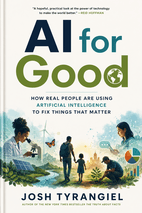
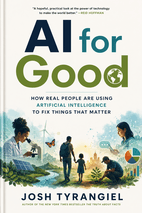
Josh Tyrangiel's AI for Good moves beyond hype and doomsday scenarios to explore how dedicated people are using artificial intelligence to fix broken systems in education, healthcare, and government. Based on detailed reporting from Khan Academy, Cleveland Clinic, and federal agencies, this book is for readers weary of utopian promises and dystopian warnings who want a grounded understanding of what AI can actually do in the hands of thoughtful practitioners.
Feature
Insta.Page
Blinkist
Shortform
Summary Depth
Full Chapter-by-Chapter
15-min overview
Section-by-section guides
Audio Narration
✓
✓
✓
Visual Mindmaps
✓
✕
✕
AI Q&A
✓
✕
✕
Quizzes
✓
✕
✕
PDF Downloads
✓
✕
✓
Price
$89.99/yr
$146/yr (PRO)
$199/yr
*Competitor data last verified July 2026.
1 Page Summary
This book explores how artificial intelligence is being applied to solve tangible, real-world problems across education, healthcare, and government, moving beyond the hype and doomsday scenarios that dominate public conversation. The central thesis is that AI’s most meaningful impact comes not from speculative breakthroughs, but from dedicated people using the technology to fix broken, messy systems—from tutoring under-resourced students to streamlining life-saving hospital care and making government agencies more responsive. Author Josh Tyrangiel grounds this exploration in detailed, on-the-ground reporting, following the specific struggles and small victories of those building and implementing these tools.
The book is distinctive for its focus on the human stories behind the technology, emphasizing the grind, failure, and iterative problem-solving required to make AI useful. Tyrangiel profiles a diverse cast of characters, including Sal Khan’s fraught partnership with OpenAI to build an ethical AI tutor, the Cleveland Clinic’s internal team using AI to combat the cognitive load on doctors and predict sepsis, and a logistics veteran applying lessons from Operation Warp Speed to modernize government. Each case study reveals that the hardest challenges are not technical but cultural and organizational—overcoming institutional inertia, bureaucratic resistance, and the simple fact that people, not algorithms, ultimately drive change.
The intended audience is general readers interested in a realistic, non-technical account of what AI can and cannot do right now. Those who will gain the most are readers weary of both utopian promises and dystopian warnings, seeking a grounded understanding of how AI is being wielded by real people to improve lives. The book offers a pragmatic framework for thinking about AI not as a magic bullet, but as a powerful tool that, in the hands of thoughtful practitioners, can fix things that genuinely matter—and a call for readers to become intentional participants in shaping its role.
Introduction
Overview
The introduction opens with a scene familiar to anyone who’s fallen down a late-night rabbit hole: a YouTube video with a few thousand views, capturing a conference presentation that feels like a college professor’s TED Talk audition. The speaker, a young man named Leopold, starts talking about artificial intelligence—specifically, the idea that AI could become dangerous enough to warrant a global regulatory body, akin to the International Atomic Energy Agency. The audience is polite but unconvinced. The video ends; the author closes his laptop. And that’s the moment his AI awakening truly begins—not with a eureka insight, but with a gnawing sense that something profound was slipping past everyone’s grasp.
Leopold’s forgettable presentation turns out to be anything but. Two years later, the world is debating an open letter calling for a six-month pause on AI development, signed by everyone from Elon Musk to Steve Wozniak. Doomers and accelerationists are locked in a public feud, each camp genuinely convinced they’re saving humanity. The author, assigned to make sense of it all, finds himself drowning in confusion. The AI industry, he observes, has become a hall of mirrors: hype so thick it obscures reality, jargon so dense it defies translation, and a cast of geniuses, grifters, and ideologues who all speak different languages. Even the skeptics are cashing in—speaking fees, consulting gigs, protection rackets dressed up as concern.
The Problem with Defining AI
Artificial intelligence, we’re reminded, is a seventy-year-old branch of computer science with no objective threshold. Deciding what qualifies as AI is as arbitrary as distinguishing a novel from a novella, except the people debating it are rarely gifted communicators. Many are neurodivergent, speak English as a second language, or both—and almost all are men. The companies racing ahead are the same ones that drained society’s reservoir of trust through social media. So when they say “AI will change everything,” the public is left squinting through the static, asking: What does that actually mean?
The climax of this confusion arrives in the form of Matthew McConaughey. Yes, that Matthew McConaughey. Hired by the terminally dull software company Salesforce, he stars in a series of ads wandering through trippy AI-generated landscapes, drawling buzzwords like a beat poet. At one point he talks to a squirrel. The ads are captivating, incomprehensible, and utterly reflective of the moment: AI’s promise is everywhere, yet its concrete impact remains invisible to ordinary people, reserved for the already-rich. The whole thing makes sense only if you’re baked out of your mind.
Danny Hillis and the Counterculture
Enter Danny Hillis—a computer science legend who was on the Arpanet when the community was so small he knew every other Danny online. If the field had a Mount Rushmore, he’d hold down the Teddy Roosevelt spot: burly, bearded, Buddha-like calm. When the author vents his exasperation—“Danny, what is AI actually good for?”—Hillis offers a single piece of advice that reframes everything: Try to imagine the tech without the tech companies.
It’s embarrassingly obvious in hindsight, but the author hadn’t considered it. Most of Hillis’s career predated the tech megalopolises. He’d roamed through MIT, startups, government consulting, Disney Imagineering. He’d once sold Google a graph of human knowledge, only to see it used for ad placement. But he knew that people like his younger self were experimenting with AI in ways no one was talking about—ways that could bring AI’s capabilities into focus with more meaningful outcomes than chatbot-calendar integration. The author takes the hint and starts searching. He finds General Perna and Operation Warp Speed. Then threads in other government agencies, education, health care, human connection. Quiet, practical people tinkering with AI to fix the things that matter—not in some distant future, but today.
The AI Counterculture
These are the stories that make up the book: an AI counterculture. Unlike the doomers and accelerationists, these people share certain traits. They’re quiet, practical, with little vanity. Many had no previous software expertise. They ran into a problem that defied conventional solutions and were stubborn or desperate enough to keep going, even if it meant learning more about technology than they ever wanted. That stubbornness is crucial, because AI is going to be weird for a while. It’s a puppy that will read the Quran in Portuguese and eat the TV remote. But the trajectory is clear: it will only get easier, faster, and a little less strange every day forward. The same cannot be said for people.
The Choice Ahead
The author acknowledges that humans are resistant to change—sentimental, loyal, addicted to comfort and magical thinking. AI means change, and one response is the techno-optimist philosophy of “move fast and break things.” Smashing is fast. You don’t need to understand something to destroy it. But the people in this book don’t grab the hammer. They’re frustrated with broken systems, but they don’t believe people—or the things we build—are garbage. Just broken. They’ve chosen the ridiculous, divine task of trying to fix what they love with a technology they’re only beginning to understand.
The downsides of AI are real: misuse, malfunction, the temptation to replace people instead of teaching them new skills. They’re arriving whether we like it or not. But defensive crouches don’t stop anything; they just ensure you get hit while looking the other way. The only effective response is to make AI a collaborator in preserving and improving the things you love. That’s not naive optimism—it’s enlightened self-interest. If we don’t shape AI for good, it will be shaped by people who don’t know or care about our problems. The choice isn’t between a world with AI and a world without it. The choice is between AI designed by people who think fixing things is worth the trouble, and AI designed by people who think breaking things is more efficient.
Key Takeaways
The AI debate is saturated with hype and confusion, making it nearly impossible for ordinary people to grasp AI’s real near-term impact.
Danny Hillis’s advice—imagine the tech without the tech companies—opened a new frame: look for practical, mission-driven applications beyond profit motives.
An AI counterculture exists: quiet, stubborn, non-expert problem-solvers using AI to fix broken systems in education, health care, government, and human connection.
AI is inevitable and weird, but the genuine response isn’t avoidance or destruction—it’s thoughtful collaboration. The choice is ours: fix what matters, or let profit-driven disruption run the show.
Global debate on AI pause signed by Musk and Wozniak
AI industry is a hall of mirrors with hype and jargon
Skeptics profit from speaking fees and consulting gigs
Defining AI is Arbitrary
AI is a 70-year-old field with no objective threshold
Debaters are often poor communicators, neurodivergent, or non-native speakers
Trust drained by same companies behind social media
Matthew McConaughey's Salesforce ads epitomize confusion
Danny Hillis's Reframing
Hillis is a computer science legend from early Arpanet days
Advice: imagine the tech without the tech companies
His career predates tech megalopolises
AI experimentation exists beyond chatbot-calendar integration
The AI Counterculture
Quiet, practical people tinkering with AI to fix real problems
Many had no prior software expertise
Stubbornness drives them through AI's weirdness
AI will get easier and less strange over time
The Choice: Fix vs. Destroy
Humans resist change due to sentimentality and comfort
Techno-optimism says 'move fast and break things'
Counterculture chooses to fix broken systems, not smash them
They use AI to repair what they love despite limited understanding
The Inevitability of AI and the Choice We Face
AI misuse and malfunction are real risks
Defensive avoidance is ineffective; collaboration is key
Enlightened self-interest means shaping AI for good
Choice is between fixing or breaking systems
The AI Counterculture and Practical Application
Non-expert problem-solvers use AI for mission-driven goals
Focus on fixing education, health care, government, and connection
Avoidance or destruction is not the genuine response
Thoughtful collaboration preserves what matters
💡 Try clicking the AI chat button to ask questions about this book!
Chapter 1: Ed’s Dead
Overview
Ed’s dead. The Los Angeles Unified School District’s AI chatbot, launched in March 2024 as a “game changer,” died a spectacular death before the year was out. The company behind it, AllHere Education, imploded under allegations of fraud, data mishandling, and bankruptcy—its founder arrested on charges of securities fraud and identity theft. Ed joined a graveyard of failed EdTech experiments: Summit Learning, Knewton, AltSchool. The obituary for this sector is long. But amid these failures stands Sal Khan, the founder of Khan Academy, an organization that has become the gold standard for integrity in educational technology. Khan Academy’s mission is to provide free, world-class education for anyone, anywhere, and for over a decade it has done so without ads, without selling data, and with a gentle, nerdy empathy that makes learning safe. Khan himself is no Luddite—he lives in Silicon Valley, knows the Sergeys and Sundars, and believes technology can be great. But when OpenAI cofounder Greg Brockman first showed him GPT-3 in early 2021, Khan politely passed. The model was too raw, too prone to rolling into corners. It was only in the summer of 2022, when Brockman hinted at something far more capable, that Khan paid attention.
The GPT-4 Revelation
Two weeks later, Khan and his chief learning officer, Kristen DiCerbo, signed NDAs and joined a Zoom call that would upend their assumptions. They saw GPT-4 answer an AP biology multiple choice question correctly, explain its reasoning, and generate new questions on the fly. Khan got goose bumps. DiCerbo was more impressed when she asked it about learning styles—a trap question for any educator—and GPT-4 responded with the nuance of a seasoned teacher, debunking the myth and suggesting evidence-based alternatives. It felt like stepping off an amusement park ride. For Khan Academy’s content team, GPT-4 was a turbocharger. For use with students, it was more complicated. Khan and DiCerbo wanted a tutor, not an answer dispenser. Brockman showed them how to prompt the model: “You are a tutor. Do not give the answer.” It mostly worked. The conversation ended with a looming question: what now?
The Hackathon and the Great Debate
Khan didn’t command a shift; he convened a Socratic debate. At the next hackathon, he gave fifty people GPT-4 logins. The room polarized. One half saw the key to scaling personalized learning; the other half saw a buggy, hallucinating machine that could be bullied into giving wrong answers, that made up sources, and that might be dangerous in the hands of a twelve-year-old. The debates were spirited, sometimes existential. Khan understood what OpenAI was really asking: not just a partnership, but a wager on Khan Academy’s reputation. If the model failed, his life’s work would be collateral damage. But over hours of argument, a majority began to align with his instinct: AI was coming, whether schools wanted it or not. The only choice was who would help them navigate it. Khan told the team they could do it best—because they actually cared. They wrote down every risk and turned it into a feature: transparency, guardrails, moderation, fixing the math, anchoring the model on Khan Academy content. It was a bet, but an informed one.
Key Takeaways
The collapse of Ed reflects a pattern of overpromise and underdelivery in EdTech, from Summit to Knewton.
Sal Khan’s reputation for integrity is the core asset he risks—and the reason OpenAI sought his partnership.
GPT-4’s abilities were genuinely transformative, but its flaws (hallucination, bias, susceptibility to user manipulation) required deliberate mitigation.
Khan’s decision to proceed was not impulsive; it emerged from an inclusive, agonizing debate within his organization, with each concern turned into a product requirement.
Key concepts: Chapter 1: Ed’s Dead
2. Chapter 1: Ed’s Dead
EdTech's Failure Pattern
Ed, LAUSD's AI chatbot, died spectacularly in 2024
AllHere Education imploded under fraud and bankruptcy
Ed joins a graveyard of failed EdTech experiments
Khan Academy stands as the gold standard of integrity
GPT-4's Transformative Revelation
Khan initially passed on GPT-3 in early 2021
GPT-4 demo in summer 2022 gave Khan goose bumps
Model answered AP biology and debunked learning styles myth
GPT-4 was a turbocharger for content but complex for students
The Internal Debate and Risk Assessment
Khan convened a Socratic debate at the next hackathon
Team polarized between scaling potential and dangerous flaws
Khan understood the wager on Khan Academy's reputation
Majority aligned: AI was coming, they could navigate it best
Turning Risks into Product Requirements
Every risk was written down and turned into a feature
Transparency, guardrails, and moderation were prioritized
Fixing math and anchoring model on Khan Academy content
The decision was an informed bet, not an impulsive leap
Chapter 2: How to Train Your Tutor (While Slowly Losing Your Mind)
Overview
The chapter opens with a perfect metaphor from Teller, the silent half of Penn & Teller: magic is just someone spending more time on something than anyone else would reasonably expect. Swap time with computing power and you get ChatGPT. These large language models are prediction engines, trained on hundreds of billions of words from every corner of the written world. They process language through transformer architecture, assigning numerical weights to every word in relation to all others—which is how it knows "hot dog" isn't a warm canine. The scale is almost comical: training GPT-4 required roughly 10²⁵ floating point operations, a number so large it dwarfs every word uttered by every human in a year. But the vital catch? ChatGPT doesn't think or know anything. It optimizes for fluency, not truth. That makes it the world's most dangerous tutor when left unchecked, and Khan Academy's attempt to tame it was anything but smooth.
From there, the story turns to the actual collaboration between Khan Academy and OpenAI. It was less a partnership and more a Vegas elopement—no road map, no formal rituals, just a "let's start?" on the product side. Khan Academy had maybe two engineers with AI experience. They sent OpenAI years of proprietary content, thinking it would help train the model, only to get a polite thanks. The model was already past training, in the fine-tuning phase. There was almost no traditional engineering work to do. As Sal Khan put it, that was the first real sign they were living in science fiction.
The real work became prompting: a new coding language called English. Sal's first prompt asked the bot to act as a tutor and guide a student without giving away the answer. That part worked quickly. But teaching the model to mimic Sal's own blend of probing questions, encouragement, and knowing when to hold back? That got messy fast. Language models are probabilistic—same prompt, different responses every time. A good result might only work six out of ten runs. Then you tweak, test, tweak again. Meanwhile, OpenAI kept updating GPT-4 for its own launch, making earlier progress obsolete. Hallucinations surfaced unpredictably. Stability was a promise, not a guarantee.
Key Takeaways
ChatGPT is a massive prediction engine trained on staggering amounts of data, but it doesn't understand facts—it optimizes for fluent-sounding text, not truth.
Khan Academy's partnership with OpenAI was shockingly informal, with no conventional engineering roadmap; the real work was manual prompting.
Prompting a language model is an iterative, frustrating process because each run is probabilistic and the model changes as OpenAI updates it.
Teaching a tutor bot to be patient, probing, and encouraging rather than answer-dispensing required endless cycles of trial, error, and rewording.
The instability of GPT-4 during that period meant Khan Academy couldn't rely on any single prompt or improvement—they were building on shifting ground.
Key concepts: Chapter 2: How to Train Your Tutor (While Slowly Losing Your Mind)
3. Chapter 2: How to Train Your Tutor (While Slowly Losing Your Mind)
ChatGPT as a Prediction Engine
Trained on hundreds of billions of words
Uses transformer architecture for word relationships
Optimizes for fluency, not truth
Scale: 10²⁵ floating point operations for GPT-4
Khan Academy's Informal Partnership with OpenAI
No roadmap or formal rituals, like a Vegas elopement
Only two engineers with AI experience
Sent proprietary content, but model was past training
Real work was prompting, not engineering
The Art and Frustration of Prompting
Prompting is a new coding language called English
First prompt: guide student without giving answer
Probabilistic responses: good result only 6/10 runs
Endless cycles of tweak, test, and reword
Instability of GPT-4 During Development
OpenAI updates made earlier progress obsolete
Hallucinations surfaced unpredictably
Stability was a promise, not a guarantee
Building on shifting ground with no reliable prompts
Teaching a Tutor Bot Patience and Encouragement
Mimic Sal's blend of probing questions and encouragement
Knowing when to hold back was messy
Required endless trial, error, and rewording
Avoid answer-dispensing behavior
Chapter 3: You’ll Be Disappointed for a Long Time Until You’re Not
Overview
Building Khanmigo—Khan Academy's AI tutor—with OpenAI was messy, uncertain, and often frustrating. It wasn't smooth innovation but grinding through failures, misaligned expectations, and eleventh-hour panic. The title nails the emotional arc: you work for months on something that feels broken, until suddenly it's not.
The core tension was between scaling Sal Khan's patient teaching style and the stubborn reality of what large language models could actually do in early 2023. Vicki Zubovic framed the original problem clearly: in a typical classroom, kids get stuck, there's only one teacher, and disengagement follows. Khan Academy knew they needed a bot that could keep students productively struggling—not just spit out answers. But getting there meant navigating a model that was powerful, unpredictable, and often embarrassingly wrong.
Jessica Shieh Enters the Picture
OpenAI introduced a solution strategist named Jessica Shieh, who became the human bridge between the lab's raw capabilities and Khan Academy's educational needs. Shieh was a self-described "very nice asshole trying to get things done," and she brought an almost evangelical energy. She'd grown up watching Sal Khan's videos, so the project was personal. But she also had the brutal pragmatism to tell Khan Academy that their initial ambitions were too small. The model they were building didn't sound like Sal Khan. It wasn't asking interesting questions. It was doing things GPT-3.5 could already handle. Her message: Trust us that GPT-4 will be smarter, and aim higher.
Context Stuffing: The Art of Reminding the Model
One of the chapter's most practical insights is the concept of context stuffing. ChatGPT at the time had no persistent memory—every interaction started fresh. So Khan Academy had to pack every prompt with background information: the student's name, grade, the specific math concept they were learning, their common misconceptions, and instructions to act like a Socratic tutor. It's like leaving a stack of notes on a substitute teacher's desk.
But context stuffing had two big downsides. First, it was a hassle—every use case required manual effort, and there were hundreds of thousands of students across different states and subjects. Second, it was expensive. Tokens cost money, and a single stuffed prompt could easily run nine cents per interaction. Multiply that by millions of sessions, and a nonprofit suddenly faces a small country's computing budget. No one knew how much context was just right—enough to work, not so much that it bankrupted the mission.
The GPT-3.5 Shock and the Cheating Panic
On November 30, 2022, OpenAI released ChatGPT to the public without telling Khan Academy. Within days, millions of people were using it—including students, who immediately started cheating on homework. School districts banned it. Sal Khan was stuck under an NDA, unable to defend a technology he was betting his organization on.
But this turned into a backhanded blessing. The public backlash surfaced every possible failure mode—plagiarism, inappropriate responses, emotional tone-deafness. Khan Academy started a list of guardrails they'd need to build before launching their own tool. They'd rather be late and safe than first and disastrous.
Red Teaming: Saying the Worst Things on Purpose
OpenAI brought Khan Academy's leaders together for a safety meeting. The exercise was "red teaming"—simulating attacks on the model to find vulnerabilities. For two people who don't casually use slurs or talk about suicide, the experience was deeply uncomfortable. But it built trust. They discovered that ChatGPT handled topics like the Trail of Tears with appalling casualness (calling it a "government-sponsored hike"). They learned it would deflect a suicidal student back to math instead of offering a helpline.
The takeaway: building an AI tutor meant erecting stricter standards than OpenAI's own, and softer ones for emotional safety. It required imagining every way a kid could break the bot and coding around it.
The Prototype: Craftsmanship, Not Magic
Shieh convinced Khan Academy to raise their ambitions again. She set up a five-day sprint, placing herself at the center of a team of engineers. When a prompt didn't work, she'd take it, adjust it, and hand back a "very ugly shape" for them to refine. She taught them how to context-stuff without overwhelming the model, how to spot adversarial inputs, how to nudge instead of answer.
For three days, nothing clicked. Then on day four, the team started believing it was possible. By the end of the week, they had a working prototype. Shieh explains the process as gradual craftsmanship, not a single breakthrough. "You show and then tell and then build. You guide them through it." Eventually, you're not explaining to the model anymore—you're riding it like a bicycle.
The Math Problem
For all its conversational prowess, GPT-4 was terrible at arithmetic. It would change answers under pressure, get lost in word problems, or be confidently wrong. Language models don't compute—they predict the next word that looks correct. So Khan Academy made a pragmatic decision: use AI for explanation and conversation, but use Python—a thirty-year-old programming language—for actual calculations. One of the most sophisticated creations in human history had to lean on old-school code to do basic math.
72 Hours Before Launch
With the March 14 launch date approaching, the model still wasn't good enough. Shieh was getting frantic texts on Friday and Saturday: Do you have an updated model yet? She was relaying feedback frantically between OpenAI's researchers and Khan Academy's team. Right up until delivery, no one was sure it would work.
Yet it did. The release happened. Khanmigo went live alongside GPT-4 on March 14, 2023. The chapter closes with Shieh reflecting that the most expensive commodity is trust—and at a time when the education system was hating on OpenAI, Sal Khan's trust in them made all the difference.
Key Takeaways
Context stuffing is essential but expensive—both in human effort and token costs. Finding the right balance is a constant negotiation.
Public backlash can be a gift—the GPT-3.5 cheating panic forced Khan Academy to build robust guardrails before launch.
AI tutors need emotional intelligence, not just math skills—handling sensitive topics like suicide or historical trauma requires carefully designed responses.
Math is the model's weak spot—language models don't compute; they pattern-match. For reliable arithmetic, pair them with deterministic tools like Python.
Building with AI requires faith—you will be disappointed for a long time until you're not. The leap from "this doesn't work" to "this works" often happens without a clean explanation.
Key concepts: Chapter 3: You’ll Be Disappointed for a Long Time Until You’re Not
4. Chapter 3: You’ll Be Disappointed for a Long Time Until You’re Not
The Emotional Arc of Building Khanmigo
Messy, uncertain, and often frustrating process
Grinding through failures and misaligned expectations
Months of feeling broken until suddenly it works
Core tension: scaling Sal's teaching vs. model limits
Jessica Shieh: The Human Bridge
Solution strategist connecting OpenAI to Khan Academy
Self-described 'very nice asshole' with evangelical energy
Personal mission: grew up watching Sal Khan's videos
Pushed Khan Academy to aim higher than GPT-3.5
Context Stuffing: The Art of Reminding the Model
Packing prompts with student info and Socratic instructions
No persistent memory—every interaction starts fresh
Expensive: nine cents per interaction, millions of sessions
Balancing enough context to work without bankrupting mission
The GPT-3.5 Shock and Cheating Panic
OpenAI released ChatGPT without warning Khan Academy
Students immediately cheated; schools banned the tool
Sal Khan stuck under NDA, unable to defend technology
Public backlash surfaced failure modes for guardrails
Red Teaming: Finding Vulnerabilities on Purpose
Simulating attacks to discover model weaknesses
Uncomfortable but trust-building exercise for leaders
Found appalling casualness on sensitive topics
Built stricter standards than OpenAI's own
The Prototype: Craftsmanship Over Magic
Five-day sprint with Shieh at center of engineers
Three days of nothing clicking, then day four breakthrough
Gradual refinement: show, tell, build, then ride like bicycle
No single breakthrough—just persistent iteration
The Math Problem and Last-Minute Launch
GPT-4 terrible at arithmetic despite conversational prowess
Used Python for calculations, not AI prediction
Frantic weekend texts before March 14 launch
No one sure it would work until delivery
You've reached the end of the free chapters
Next chapter: “Get Buffington” is locked
Keep reading AI for Good — and unlock all 700+ book summaries with audio, mindmaps and AI Q&A.
$0.00 due today · 7 days free, then $89.99/year ($7.49/mo) · Cancel anytime before day 7
Josh Tyrangiel is an American journalist and editor best known for his tenure as editor-in-chief of Bloomberg Businessweek, where he oversaw a notable redesign and expansion of the magazine. He previously served as an executive editor at Time and as a contributing editor for The New Yorker, covering business, media, and technology. Tyrangiel is also the author of "The Bad Boys of Silicon Valley," a profile of tech culture.
Frequently Asked Questions about AI for Good
What is AI for Good about?
The book explores the real-world applications of artificial intelligence across education, healthcare, and government. It follows the development of Khan Academy's AI tutor Khanmigo, Cleveland Clinic's use of AI in diagnostics and operations, and government efforts like Operation Warp Speed. Through these stories, the book examines both the promise and challenges of AI, focusing on people who are using it to solve practical problems. It emphasizes that AI's value lies not in speed but in its potential to improve human systems.
Who is the author of AI for Good?
Josh Tyrangiel is the author. He is an experienced journalist who has written extensively about technology and its impact on society. This book is the result of his deep reporting on how AI is being implemented in real-world settings.
Is AI for Good worth reading?
Absolutely. The book offers a grounded, balanced look at AI beyond the hype, focusing on actual projects and the people behind them. It reveals both the breakthroughs and the messy failures, making it a refreshingly honest account. Anyone interested in AI's practical potential—and its limitations—will find it insightful.
What are the key lessons from AI for Good?
1) AI works best when designed with human-centered goals, as seen with Khanmigo's focus on student engagement rather than just correct answers. 2) Success requires bridging the gap between technical capabilities and organizational culture, as demonstrated by Cleveland Clinic's challenges. 3) Government adoption of AI is hindered by bureaucratic inertia, but small wins can lead to larger change, like the IRS's incremental approach. 4) The most impactful AI applications are those that enhance human connection, such as tools for nonverbal communication in autism research.
📚 Explore Our Book Summary Library
Discover more insightful book summaries from our collection