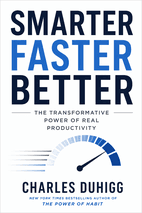
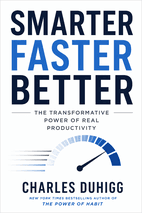
Charles Duhigg's Smarter Faster Better investigates productivity as a set of learnable skills rooted in psychology and neuroscience, exploring motivation, team dynamics, focus, and decision-making. It's for anyone seeking to improve personal or organizational effectiveness through better choices, not just harder work.
Feature
Insta.Page
Blinkist
Shortform
Summary Depth
Full Chapter-by-Chapter
15-min overview
Section-by-section guides
Audio Narration
✓
✓
✓
Visual Mindmaps
✓
✕
✕
AI Q&A
✓
✕
✕
Quizzes
✓
✕
✕
PDF Downloads
✓
✕
✓
Price
$89.99/yr
$146/yr (PRO)
$199/yr
*Competitor data last verified July 2026.
1 Page Summary
Based on the provided chapter summaries, 'Smarter Faster Better' by Charles Duhigg investigates productivity not as a trait of relentless work, but as a set of learnable skills rooted in psychology and neuroscience. The book's central thesis is that true productivity is about making better choices in how we think, work, and collaborate, rather than simply working harder. Duhigg explores this through eight key concepts, including motivation as a skill built on perceived control, the critical role of psychological safety in teams, the use of mental models to maintain focus, and the dangers of cognitive rigidity in goal setting.
Duhigg's approach is distinctive for its narrative-driven exploration of scientific and organizational research. He grounds each principle in compelling, real-world stories—from the tragic cockpit errors of Air France Flight 447 to the creative breakthrough behind Disney's Frozen and the FBI's use of lean management to solve a kidnapping. This method illustrates how abstract concepts like probabilistic decision-making, innovation brokering, and absorbing data through "disfluent" processes operate in high-stakes environments. The book connects disparate fields, showing how lessons from Marine Corps boot camp, Google's team studies, and championship poker all contribute to a unified understanding of productive behavior.
The intended audience is anyone seeking to improve their effectiveness, whether individually, in teams, or as leaders within organizations. Readers will gain a practical framework for enhancing performance by learning to cultivate internal motivation, foster environments where teams can speak openly, build robust mental models to guide focus, and make smarter decisions by embracing uncertainty. Ultimately, the book argues that productivity is a manageable science of attention, culture, and choice, offering strategies to work more intelligently and sustainably.
Introduction
Overview
The author introduces his personal investigation into productivity not from a place of expertise, but from one of personal crisis. While frantically finishing a book on habits, juggling a demanding job at The New York Times, and caring for a newborn, his life felt like an unsustainable treadmill. This feeling of being perpetually behind led him to reach out to Atul Gawande, a surgeon, writer, and professor whose staggering array of meaningful accomplishments made him seem like a "paragon of success."
The Gawande Revelation
The author emailed Gawande to ask for the secret to such profound productivity. Gawande’s polite refusal, citing being "running flat out," initially seemed to confirm the author's assumption that such output required relentless, singular focus. However, a conversation with a mutual friend revealed the truth: Gawande was busy because he was taking his kids to a rock concert and going on a mini-vacation with his wife. This was a pivotal moment. It shattered the author's assumption that productivity was synonymous with constant work and sacrifice. He realized he was doing something wrong, having not taken a day off in nine months, and that truly productive people might operate by a different, more sustainable set of rules.
Defining True Productivity
This experience prompted the author to define productivity not as merely checking off tasks, but as "the name we give our attempts to figure out the best uses of our energy, intellect, and time as we try to seize the most meaningful rewards with the least wasted effort." It's a process of learning to succeed with less stress and struggle, without sacrificing everything we care about. Gawande, by this definition, was a master.
The Investigation Begins
Inspired, the author began a four-year investigation, speaking to experts from diverse fields—neurologists, FBI agents, filmmakers, military generals, and cognitive scientists. He visited organizations like Google, the team behind Frozen, and Cincinnati public schools. From these conversations, eight key ideas consistently emerged as the core drivers of genuine productivity.
The Book's Premise and Promise
This book explores those eight ideas, which include concepts like fostering a sense of control, constructing mental models, setting goals correctly, and building commitment cultures. Underpinning them all is a central principle: Productivity isn't about working more or harder; it's about making specific choices in specific ways. The author argues we live in a revolutionary age of technology that often increases stress because we focus on the tools of productivity rather than the underlying psychological and organizational principles they hint at. This book aims to share the science and stories of those who have learned to navigate this world successfully—to become smarter, faster, and better by making the choices that fuel true productivity.
Key Takeaways
Productivity is about smart choices, not heroic effort. It’s the art of obtaining meaningful rewards with the least wasted effort, not a grind of endless sacrifice.
Busyness is not the same as productivity. The story of Atul Gawande illustrates that truly productive people protect time for what matters most, including family and leisure, rather than being constantly "on."
The modern productivity challenge is psychological, not technological. While tools and apps promise efficiency, real mastery comes from understanding the mental models, team dynamics, and decision-making frameworks that high performers use.
Universal principles exist. The author’s research suggests that a small set of core ideas—eight, in this case—explain why some people and companies achieve so much more than others, regardless of their field.
Key concepts: Introduction
1. Introduction
Personal Crisis and Motivation
Author's unsustainable work-life balance during book deadline
Feeling perpetually behind led to seeking answers
Reached out to Atul Gawande as productivity paragon
The Gawande Revelation
Gawande refused meeting due to family commitments
Shattered assumption that productivity requires constant work
Realized productive people operate by different rules
Redefining Productivity
Not just checking off tasks or busyness
Best use of energy, intellect, and time
Seizing meaningful rewards with least wasted effort
Four-Year Investigation
Interviewed experts across diverse fields
Studied high-performing organizations
Eight key ideas consistently emerged
Core Premise of the Book
Productivity is about specific choices, not working harder
Modern focus on tools increases stress
Eight principles explain high performance across fields
💡 Try clicking the AI chat button to ask questions about this book!
1. Motivation: Reimagining Boot Camp, Nursing Home Rebellions, and the Locus of Control
Overview
Robert Philippe was a driven businessman who suddenly lost all motivation after a minor brain incident. He was left apathetic but otherwise intact. His story isn't isolated; neurologists find a pattern where tiny injuries to the brain's striatum extinguish people’s internal drive. This suggests the area is crucial for turning decisions into action. Lab discoveries show our brains light up when we make choices. The mere perception of control is inherently motivating, even when outcomes don't change.
From this science, the chapter shows that motivation is not just a personality trait but a skill we can build. It's rooted in our biological need for autonomy. A reformed Marine Corps boot camp illustrates this. It was designed to build an internal locus of control—the belief that one's actions shape destiny. Recruits practiced decision-making and linked hardships to personal meaning. In nursing homes, residents who acted as "subversives," making small rebellious choices, showed remarkable improvements in health and happiness compared to passive peers. These stories share a core principle: the most motivating choices do two things. They convince us we're in control, and they give our actions larger personal significance.
The summary returns to Robert Philippe. His wife Viola offered him small choices, which gradually reawakened his drive. This shows that apathy often stems from an emotional dysfunction—a disconnect from the reward of self-determination. Motivation can be rebuilt by practicing and rewarding initiative. This strengthens the internal locus of control. Robert's ultimate resilience, caring for his wife through illness and honoring her memory, shows the enduring power of a rebuilt sense of agency.
The Case of Robert Philippe
Robert Philippe was a hardworking Louisiana businessman. He became disoriented and apathetic during a trip to Bolivia. Back home, his lethargy persisted. Neurologist Dr. Richard Strub found him physically and intellectually intact, with no signs of depression. The only anomaly was a tiny shadow on an MRI. It showed minor bleeding in a deep brain region called the striatum. Robert’s case was a medical curiosity: a man whose fundamental motivation had vanished, leaving his capabilities intact but devoid of drive.
A Pattern of Lost Drive
Robert’s case was not unique. Neurologist Michel Habib collected similar stories of people who suddenly lost their "get-up-and-go" after minor brain incidents. Each patient shared two traits: profound apathy without depression, and tiny injuries in the same brain area—the striatum. Habib’s research highlighted the striatum’s role as the brain's "central dispatch." It translates decisions into action and emotion. These patients could move but had no desire to do so. Their internal motivation was extinguished by minuscule damage.
The Neuroscience of Choice and Control
Researcher Mauricio Delgado found that participants' striata lit up with activity during a guessing game, linked to anticipation. In a follow-up experiment, when participants made their own guesses, their striata showed robust activity and they enjoyed the game. When the computer made guesses for them, their brain activity diminished and they grew bored—even though the odds of winning were identical. The critical difference was the perception of control. The act of making a choice itself was inherently motivating.
Motivation as a Skill of Control
In today’s economy, self-motivation is a vital skill. It isn't just a personality trait but something we can cultivate. It's rooted in a biological need: the need for control. The first step in generating motivation is creating a sense of autonomy through decision-making. Each choice, however small, reinforces our perception of control. This is why tasks framed as decisions are more motivating than those framed as commands. The initial trick to self-motivation is to find any choice that asserts personal control and triggers the will to act.
The Marine Corps Experiment: Building Internal Locus of Control
A reformed Marine Corps boot camp was designed under Commandant Charles C. Krulak. He wanted to create "extreme self-starters" by building an internal locus of control—the belief that one's own actions shape their destiny. The redesigned training forced recruits to practice making decisions. An early example was ordering a platoon to clean a mess hall with zero instructions. Instructors then offered targeted praise. They congratulated the shyest recruit for a minor decision to reinforce that stepping up was rewarded.
The culmination was the Crucible, a grueling 54-hour final test. One obstacle required a team to cross a pit on moving planks while wearing gas masks, following a rule that every action required a verbal order. The solution was a subversive workaround: the leader used shrugged shoulders and sung commands. The lesson was that success required interpreting and adapting rules, not blind obedience.
Recruits were also taught to link hardship to personal meaning. On the final hike, exhausted recruits asked each other "why" questions. One recruit connected his pain to building a better life for his daughter. This practice transforms chores into meaningful choices. The results showed increased retention, performance, and measurable growth in recruits' internal locus of control.
The Nursing Home "Subversives"
Studies of nursing homes revealed a stark divide. Some residents thrived, while others declined rapidly. The critical difference was that thriving residents were "subversives"—they consistently made small, rebellious choices to assert control. Examples included trading food at meals to construct their own menus and using a crowbar to rearrange furniture to personalize their rooms.
The effects were profound. Compared to their passive peers, these subversives walked twice as much, ate more, complied better with medical care, and reported higher happiness and longevity. The specific choice mattered less than the act of choosing itself, which reinforced their sense of being "still in charge."
Synthesis: The Two-Part Power of Choice
The Marine Corps training and the nursing home rebellions share a core insight: the most motivation-generating choices do two things simultaneously.
They convince us we are in control.
They endow our actions with larger personal meaning.
Whether it's a recruit linking a march to providing for his family or a senior refusing institutional cake to affirm her autonomy, the habit of transforming imposed tasks into self-directed, meaningful decisions is the engine of self-motivation.
Key Takeaways
Internal locus of control—the belief you influence your own destiny—is a learnable skill linked to greater success, health, and happiness.
Motivation can be taught by putting people in situations where they must practice making choices and feel the resulting sense of control.
Effective targeted praise focuses on effort and choices (e.g., "you worked hard"), not innate traits (e.g., "you're smart"), to reinforce an internal locus.
The most powerful motivational choices combine personal control with personal meaning. Linking a difficult action to a core value or goal (asking "why") makes self-motivation more sustainable.
Small, even subversive, acts of self-assertion can have outsized psychological benefits, proving to ourselves that we are still agents in our own lives.
Viola's Campaign and Robert's Reawakening
Viola's persistent efforts to offer Robert small choices—where to sit, what music to listen to—began to yield results. During one moment, Robert spontaneously launched into a funny story from their early marriage. Viola seized on these flashes, consciously congratulating him whenever he displayed initiative. This consistent reinforcement paid off. Seven years after his illness, during a checkup, Dr. Strub observed a dramatic change: Robert was engaging with nurses and offering opinions. It was "like someone was turning on the lights again."
The Neurology of Emotional Reward
This recovery points to a crucial insight. Researchers found that apathetic patients often suffer from an emotional dysfunction. Their injuries impair the feeling of reward that comes from taking control. They become emotionally detached, unable to feel the satisfaction of making a choice. This same principle applies beyond brain injuries: people can lose motivation if they are in environments with few perceived choices. They forget how good it feels to be self-determined.
Strengthening the Internal Locus of Control
The path to building self-motivation is to practice and reward self-determination. This means applauding initiative wherever we see it—in a child's defiant stubbornness or a student's creative workaround. It is difficult, as it often means tolerating inconvenient assertiveness, but it is how the internal locus of control is strengthened. Our minds learn the emotional reward of being in control through repeated acts of assertiveness.
Furthermore, we must consciously link small actions to larger meanings. When facing a chore, asking "why" connects that duty to a bigger goal or personal value. This transforms trivial tasks into pieces of a meaningful constellation, providing emotional rewards because they prove we are making genuine choices.
A Final Testament to a Rebuilt Life
The power of this rebuilt internal locus of control was ultimately tested. When Viola was diagnosed with terminal cancer, Robert became her dedicated caregiver. After her death, his children feared a return of his apathy. But Robert clarified he needed time to reflect. He had not lost his drive. Viola had helped him rebuild a life of agency, and he was actively choosing to honor that. He resumed his life shortly after, remaining active until his own death.
Key Takeaways
Apathy is often rooted in an emotional dysfunction; the feeling of reward for making choices becomes disconnected.
The internal locus of control is strengthened by consistently practicing self-determination
Key concepts: 1. Motivation: Reimagining Boot Camp, Nursing Home Rebellions, and the Locus of Control
2. 1. Motivation: Reimagining Boot Camp, Nursing Home Rebellions, and the Locus of Control
The Neuroscience of Motivation
The striatum is the brain's 'central dispatch' for drive
Perception of control triggers brain's reward system
Choice itself is inherently motivating
Motivation as a Cultivable Skill
Not just a personality trait but a buildable skill
Rooted in biological need for autonomy
Generated by creating a sense of control
Internal Locus of Control
Belief that one's actions shape destiny
Can be strengthened through practice
Key to self-motivation and resilience
Marine Corps Boot Camp Experiment
Designed to build 'extreme self-starters'
Forced recruits to practice decision-making
Linked hardship to personal meaning
Nursing Home 'Subversives'
Thriving residents made small rebellious choices
Asserting control improved health and happiness
Examples: trading food, rearranging furniture
The Power of Small Choices
Small choices can reawaken lost motivation
Each choice reinforces perception of control
Tasks framed as decisions are more motivating
Core Principle of Motivating Choices
Convince us we're in control
Give actions larger personal significance
Transform chores into meaningful choices
2. Teams: Psychological Safety at Google and Saturday Night Live
Overview
Julia Rozovsky had two very different team experiences in business school. One group left her stressed and competitive, while another felt exciting and supportive. Her personal puzzle mirrored a larger one tackled by Google’s Project Aristotle, which sought to build the perfect team. After extensive study, Google’s researchers made a critical discovery: who is on a team matters less than how the team interacts. The specific group norms—the unwritten rules of behavior—were what truly determined success, particularly when they fostered an environment of psychological safety, where members feel safe to take risks without fear of embarrassment or punishment.
Researcher Amy Edmondson pioneered this concept. She found that the best teams weren’t necessarily the most cohesive, but were the ones where people felt secure enough to speak up and admit mistakes. Google recognized this as the cornerstone of effective teamwork but faced a practical dilemma: how to cultivate such safety in its own high-performance, debate-driven culture without stifling the creative conflict essential for innovation.
The chapter then turns to a seemingly chaotic but brilliantly successful team: the original cast and writers of Saturday Night Live. Far from a harmonious family, this group was rife with competitiveness and clashing egos. Its success wasn’t despite this conflict, but because of the specific norms established by producer Lorne Michaels. He ensured everyone had a voice and demonstrated high social sensitivity, making each individual feel heard and valued. This created the psychological safety necessary for the team to channel their fierce disagreements into extraordinary creativity.
Research on collective intelligence confirms this approach. It shows that the smartest teams aren’t those with the highest individual IQs, but those with two key norms: relatively equal participation in conversation and high average social sensitivity among members. Michaels intuitively engineered these conditions, proving that psychological safety doesn’t require friendship, but it does require disciplined, empathetic interaction.
Google’s data ultimately pointed to the same universal principles. After debunking myths about superstar employees or consensus-driven decisions, Project Aristotle identified that how a team interacts matters most, defined by a sense of voice and demonstrated social sensitivity. Leaders can build this by modeling concrete behaviors: not interrupting, admitting fallibility, and ensuring everyone contributes. This framework allows teams to “debug” their human interactions as rigorously as they would software.
The chapter concludes that in the modern, team-based workplace, psychological safety is the non-negotiable foundation for performance. It allows individuals to cede some control to the group, trusting that their voices will be heard and their colleagues are attuned to their needs. Whether in a hospital, a tech company, or a comedy writers’ room, the most effective teams are those that master this delicate balance of safety, honest conflict, and mutual respect.
Julia Rozovsky's Team Experiences at Yale
Julia Rozovsky’s two team experiences at Yale were a study in contrasts. Her assigned study group, full of similar professionals, became a source of stress due to competitive, passive-aggressive norms. In contrast, a voluntary case competition team with diverse members thrived on a culture of enthusiasm and safety, where even "crazy ideas" were explored without judgment. This stark difference—between a draining and an energizing team—puzzled her and set the stage for her later work.
Google's Project Aristotle and the Search for the Perfect Team
At Google, Julia joined Project Aristotle, which aimed to build the perfect team. Researchers studied 180 teams, measuring everything from personality types to social habits. They found no evidence that the specific composition of a team—the "who"—correlated with its effectiveness. Two teams with nearly identical members could perform at completely different levels.
The Pivot to Studying Group Norms
Shifting focus to group norms—the unwritten rules of behavior—revealed the answer. The most effective teams were not those with a specific set of rules, but those where the norms created a particular emotional experience. Employees on high-performing teams described feelings of safety and energy, using phrases like "a safe space for you to take risks." The key was to manage the how of teams, not the who.
Amy Edmondson and the Discovery of Psychological Safety
This led researchers to the work of organizational psychologist Amy Edmondson. Studying hospital teams, she expected cohesive teams to make fewer mistakes. Instead, she found that stronger teams reported more errors. The reason? Nurses on psychologically safe teams felt more comfortable reporting their mistakes. She defined psychological safety as "a shared belief held by members of a team that the group is a safe place for taking risks."
Google's Dilemma: Teaching Safety Without Stifling Debate
Google’s data confirmed psychological safety as the critical factor for team success. The challenge was how to instill this within Google’s fast-paced, debate-driven culture without extinguishing the constructive conflict essential to innovation. The central question became: why can some teams clash vigorously yet maintain safety, while others disintegrate?
The Unconventional Assembly of Saturday Night Live
The original Saturday Night Live team was assembled by producer Lorne Michaels from his network of acquaintances and recommendations. It was a collection of disparate, unknown talents, young and broke, forced to rely on each other in a corporate environment.
The Myth and Reality of the SNL "Family"
Contrary to the myth of a perfectly bonded "family," the original SNL was a hotbed of competitiveness, infighting, and brutal criticism. Writers fought over sketches, cliques shifted, and some members felt like outcasts. Their cohesion was not born from natural affection.
The Discovery of Collective Intelligence
Independent research found that a team’s "collective intelligence" across tasks was separate from the average IQ of its members. Smart individuals did not necessarily form smart teams. The key differentiator was the team’s norms.
The Two Critical Norms for Smart Teams
Analysis revealed two consistent norms in the smartest teams:
Equality in Conversational Turn-Taking: Everyone contributed relatively equally.
High Average Social Sensitivity: Members were skilled at reading each other’s emotions and nonverbal cues, demonstrating empathy.
SNL’s success is attributed to Lorne Michaels deliberately cultivating these norms. Despite the team's tensions, he ensured everyone had a voice, asking who hadn't been featured recently. He demonstrated high social sensitivity, offering personal support. By making people feel heard and valued as individuals, he fostered the psychological safety that allowed the group to channel their conflicts into extraordinary creativity.
Modeling the Norms: Leadership and Social Sensitivity
Michaels’s leadership created a paradoxical dynamic: a team that was fiercely competitive yet protective. Disagreements were contained, and everyone was guaranteed a voice. As Harvard’s Amy Edmondson notes, psychological safety doesn't require friendship, but it does require social sensitivity and a leader who actively models it—inviting participation, admitting fallibility, and listening attentively.
The Google Data: Debugging Human Interactions
Project Aristotle’s final conclusion was that how a team interacts matters more than who is on it. The foundation was two elements: a sense of voice and demonstrated social sensitivity.
The research identified five key norms, with psychological safety as the most critical. To build it, Google advised leaders to model concrete behaviors: don't interrupt, summarize points, admit ignorance, and ensure everyone speaks. This gave teams a framework to "debug human interactions" with rigor.
The Universal Principle for Modern Teams
In today’s team-centric workplace, psychological safety is the non-negotiable foundation for success. While norms may vary, high-performing groups always share a climate of trust where honest discussion occurs without fear, voices are roughly equal, and teammates are attuned to each other.
Establishing this starts with the leader’s choices to model listening, demonstrate sensitivity, and reward equitable participation. Effective teamwork requires a voluntary ceding of some individual control to the group, which only works when people feel psychologically safe. When a team reaches this state, it becomes a self-reinforcing system of mutual support and amplified performance.
Key Takeaways
Psychological safety is universal: The dynamics that make a comedy writers' room or a Google engineering team successful are the same: team members need to feel safe to speak up and feel that others are socially sensitive.
Leaders set the tone: Safety is established from the top down. Leaders must model vulnerability, invite participation, practice active listening, and address conflicts openly.
It's about behaviors, not friendships: Teams don't need to be friends, but they do need disciplined norms that contain conflict and protect each member's voice. Social sensitivity is a learnable, critical skill.
Ceding control builds strength: Effective teamwork requires individuals to willingly give some control to the group. This is only possible in an environment of trust, where everyone feels their contributions are valued.
Key concepts: 2. Teams: Psychological Safety at Google and Saturday Night Live
3. 2. Teams: Psychological Safety at Google and Saturday Night Live
Psychological Safety Defined
Safe environment for taking risks
Members feel safe from embarrassment
Allows admission of mistakes
Google's Project Aristotle Discovery
Team interaction matters more than composition
Group norms determine team success
Debunked myths about superstar employees
Amy Edmondson's Research
Stronger teams report more errors
Safety enables honest reporting
Not about cohesion but security
Saturday Night Live Case Study
Success despite competitiveness and conflict
Lorne Michaels ensured everyone had voice
Channeled disagreements into creativity
Key Team Norms for Success
Relatively equal participation in conversation
High average social sensitivity
Demonstrated empathy and listening
Google's Implementation Challenge
Teaching safety without stifling debate
Balancing conflict with mutual respect
Modeling behaviors like not interrupting
Universal Principles of Effective Teams
Psychological safety as non-negotiable foundation
Allows ceding control to group
Enables debugging human interactions
3. Focus: Cognitive Tunneling, Air France Flight 447, and the Power of Mental Models
Overview
The chapter opens with the haunting mystery of Air France Flight 447, a tragedy ultimately caused not by mechanical failure but by a catastrophic failure of attention. The story reveals how the very automation designed to make flying safer had quietly eroded the pilots' vigilance, turning them into passive monitors. When a routine alarm sounded, the flying pilot’s brain, unprepared for sudden engagement, snapped into a narrowed state of cognitive tunneling. His attention fixated on a single instrument, blinding him to the larger reality that the plane was stalling. This was compounded by reactive thinking, where he defaulted to a panic-driven habit utterly wrong for the situation.
This concept is explored further through a study of neonatal nurses, where the best practitioners stood out because they constantly compared reality against a detailed mental picture of what should be happening. This ability to build and hold mental models—internal forecasts and stories—allowed them to spot subtle warning signs others missed. It’s this habitual model-building that the Air France pilots lacked.
The chapter then provides a powerful counterpoint in the story of Qantas Flight 32. Here, Captain Richard Champion de Crespigny had rigorously trained his crew to build shared mental models. When a catastrophic engine explosion created a cascade of failures, this preparation allowed them to collaborate effectively and resist cognitive tunneling. In a pivotal moment, de Crespigny consciously simplified his mental model, choosing to see the crippled Airbus as a basic Cessna. This new framework allowed him to filter out the noise of contradictory alarms and focus only on the core mechanics of flight.
The overarching lesson is that the key to maintaining effective focus is the proactive, daily habit of building mental models. By narrating our experiences and anticipating scenarios, we prepare our minds to direct attention wisely when pressure mounts.
The Crash Investigation and a Routine Flight
When investigators recovered the wreckage of Air France Flight 447, the true cause emerged from the cockpit voice recorder: a catastrophic failure of attention. The flight began normally aboard an advanced Airbus A330, a plane designed to be nearly error-proof through automation. For decades, piloting required constant vigilance. Automation changed this, turning pilots into reactive monitors. This made flying safer, but it also fundamentally altered the pilots' relationship with the aircraft, eroding their vigilance.
The Descent into Cognitive Tunneling
Mid-flight over the Atlantic, the plane entered a storm. Ice crystals clogged the external sensors, causing a loss of airspeed data. This triggered an alarm and the autopilot disengaged—a routine event. The flying pilot, Pierre-Cedric Bonin, took control. If he had done nothing, the plane would have flown on safely. Instead, he gently pulled back on the stick, raising the nose.
This began a deadly chain of events. As the plane climbed into thinner air, it entered an aerodynamic stall. A loud "STALL" warning blared. Bonin agreed they should descend, but his actions contradicted his words; he kept pulling back.
Cognitive tunneling explains this fatal error. After hours of relaxed monitoring, the sudden alarm forced Bonin's brain to snap into focused attention. His mental "spotlight" fixated on the most obvious stimulus: the primary flight display screen directly before him. He became obsessed with leveling a slightly tilted aircraft icon on that screen, failing to notice he was still pulling the nose up. His attention had tunneled onto one detail, blinding him to the critical picture.
Reactive Thinking and the Final Mistake
As the stall worsened, Bonin, in a panicked state, committed a second critical error: reactive thinking. He fell back on a well-practiced habit for emergencies at low altitude, which maximizes thrust and raises the nose. At 38,000 feet, this was precisely the wrong response. His brain outsourced the decision to a familiar habit.
For the final minutes, the cockpit was a cacophony of alarms and confusion. Despite the instruments now functioning correctly, the pilots were too overwhelmed to interpret them. The plane, nose high, fell into the ocean.
The NICU Study: Seeing the Whole Picture
Researchers studying neonatal intensive care units found that the most skilled nurses possessed a unique ability to spot a baby in distress based on subtle clues. The key difference was that the best nurses constantly carried a detailed mental picture of what a healthy baby should look like. When reality didn't match this internal model, their attention was automatically drawn to the discrepancies. They were engaged in constant, subconscious forecasting.
Building Mental Models as a Habit
This propensity to create mental models—internal stories about how the world works—emerged as the critical skill. People who habitually build these models narrate their experiences and visualize their days with specificity. This keeps their attentional "spotlight" active, so when reality diverges from their expectations, they notice immediately.
This explains the fatal confusion in the Air France 447 cockpit. The pilots had not been building mental models of their flight. When the crisis hit, they had no internal narrative to help process new information.
Productivity and the "Superstar" Pattern
Research at a recruiting firm revealed that the most productive employees actively cultivated mental models through specific behaviors:
They limited active projects to allow time to engage deeply and learn.
They gravitated toward projects in their risky, early stages to build models about emerging trends.
They were obsessive theory-generators, constantly telling stories and proposing explanations for why things succeeded or failed.
Qantas Flight 32: Mental Models in Action
The chapter contrasts the Air France disaster with the successful handling of a catastrophic engine explosion on Qantas Flight 32. Captain Richard Champion de Crespigny exemplified proactive mental model building.
Even before the flight, he drilled his crew in visualization exercises. He established psychological safety, demanding his crew challenge him if they saw a mistake.
When the explosion occurred, de Crespigny’s immediate, calm response and his crew’s efficiency were the products of pre-built models. Their shared mental framework allowed for rapid, collaborative problem-solving.
Resisting the Cognitive Tunnel
As alarms multiplied, the pilots risked cognitive tunneling. This danger became clear when a checklist commanded them to transfer fuel. De Crespigny shouted to stop, recalling a prior accident. By consciously rejecting the computer’s order, the crew began to prioritize human judgment.
The Shift to a Simpler Mental Model
Overwhelmed, de Crespigny deliberately removed his hands from the controls and reframed their mission. He asked himself, What if I imagine this plane as a Cessna? This was the pivotal moment. By replacing his fractured mental model of the complex Airbus with the simple model of a basic Cessna, he created a new framework. It allowed him to filter out the noise and concentrate on the core components needed to fly.
The Landing: Trusting the Model Over the Alarms
Guided by this simplified mental picture, de Crespigny approached the landing. When critical alarms like “SPEED!” and “STALL!” screamed, he ignored them. The Cessna in his mind was not stalling; it was flying. He trusted the model he had built over the terrifying sensory data. The damaged Airbus touched down safely.
The core lesson was the power of a deliberately constructed mental model. While the Air France 447 pilots, lacking strong models, became lost in data, de Crespigny’s team used stories and models to control their focus.
Key Takeaways
Mental models are cognitive scaffolds: They provide a framework to manage information overload, helping us choose where to direct attention.
Control focus by controlling your model: When overwhelmed, consciously replace a failing mental model with a simpler, more robust one.
Proactive storytelling is preparation: Narrating your life and anticipating scenarios builds mental models in advance, so you’re prepared to focus correctly in a crisis.
Thinking cannot be delegated: Checklists and computers can fail. The ultimate responsibility for deciding what deserves attention rests with the individual.
Key concepts: 3. Focus: Cognitive Tunneling, Air France Flight 447, and the Power of Mental Models
4. 3. Focus: Cognitive Tunneling, Air France Flight 447, and the Power of Mental Models
The Air France 447 Tragedy
Caused by catastrophic failure of attention, not mechanics
Charles Duhigg is a Pulitzer Prize-winning reporter and author, best known for his books on habits and productivity, including *The Power of Habit* and *Smarter Faster Better*. His expertise lies in examining the science of productivity and the patterns that shape human and organizational behavior. He previously worked as a reporter for *The New York Times*.
Frequently Asked Questions about Smarter Faster Better
What is Smarter Faster Better about?
This book explores the science of productivity through key areas like motivation, teamwork, focus, and decision-making, using real-world stories from aviation, business, and creative industries. It reveals how productive people achieve more by working smarter, not harder, by applying principles such as psychological safety and mental models. The author argues that sustainable productivity comes from understanding these concepts and integrating them into daily life.
Who is the author of Smarter Faster Better?
Charles Duhigg is an author and former reporter for The New York Times who investigated productivity after his own personal crisis of juggling work and family. His experience of feeling perpetually behind led him to research what truly drives effective and sustainable achievement.
Is Smarter Faster Better worth reading?
Yes, it offers compelling insights backed by research and engaging narratives that can transform how you approach work and life. Readers gain practical strategies for enhancing motivation, building better teams, and making smarter decisions in uncertain situations.
What are the key lessons from Smarter Faster Better?
Key lessons include that motivation is a skill built on autonomy and personal meaning, while effective teams require psychological safety to foster collaboration. Maintaining focus involves building mental models to avoid cognitive tunneling, and innovation often stems from recombining existing ideas under pressure. Additionally, good decision-making relies on probabilistic thinking and embracing uncertainty over time.
📚 Explore Our Book Summary Library
Discover more insightful book summaries from our collection