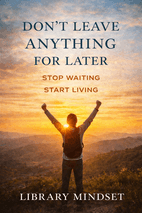
Don't Leave Anything for Later

About the Author

Library Mindset

Library Mindset is an author and researcher focused on the philosophy of knowledge organization and the evolving role of libraries in the digital age. Their notable works include "The Curated Mind" and essays on information architecture, exploring how systematic access to information shapes learning and innovation. Their background combines formal training in library science with a practical focus on cognitive patterns and digital literacy.

📖 1 Page Summary

This book challenges the pervasive tendency to delay life's most meaningful pursuits under the assumption that there will be a more convenient "later." It argues that the habit of postponement—whether of personal goals, difficult conversations, or moments of joy—is a psychological trap rooted in fear and perfectionism. The central philosophy is that "later" is not a guaranteed destination, and by constantly deferring action, individuals inadvertently sacrifice the richness of the present, leading to a life of regret and unfulfilled potential.

Drawing on principles from mindfulness and behavioral psychology, the work provides a practical framework for breaking the cycle of procrastination. It emphasizes the power of small, immediate actions and the importance of redefining success not as a distant future achievement, but as the cumulative result of daily, intentional living. Key strategies include identifying and confronting the underlying anxieties that fuel delay, setting non-negotiable priorities, and cultivating a mindset that values progress and experience over an elusive state of perfect readiness.

Its lasting impact lies in its call for a profound shift from a passive, waiting existence to an active, engaged one. By dismantling the illusion of "someday," the book empowers readers to reclaim agency over their time and choices. It serves as a potent reminder that a fulfilling life is built not in some distant future chapter, but through the decisions made and the presence embraced in the current moment.

Don't Leave Anything for Later

Introduction

Overview

Overview

This chapter opens with a poignant reflection on human mortality, highlighting how we often shield ourselves from the harsh reality of death. It argues that while we cannot change the inevitability of our end, we can choose how to live our remaining days with intention and gratitude.

Confronting Mortality

Our natural instinct is to avoid thinking about death, as the thought of our own demise or the loss of loved ones feels too depressing to face. The chapter uses a simple metaphor—life is like water in a cup, present one day and gone the next—to underscore its fragility and our ultimate powerlessness over it. Yet, within this truth lies a profound opportunity: the chance to consciously decide how we spend the time we have left.

Cultivating Gratitude in Daily Life

Given life’s transient nature, the text urges a shift from taking our days for granted to actively practicing gratitude. It reminds us that many people who went to sleep or to work as usual never woke up or returned home, making our own continued existence a gift. This perspective encourages us to cherish our time and resist the temptation to let it slip away unnoticed or unappreciated.

The Essence of True Urgency

Living with urgency is presented not as impatience, but as a mindful commitment to avoid future regrets. The chapter warns against the common trap of postponing dreams, noting that “one day” may never come, leaving aspirations forever unfulfilled. Instead, it advocates for seizing the present moment to live authentically, ensuring that when we look back, we are not haunted by wishes for a different path.

Key Takeaways

  • Acknowledge mortality to live deliberately: Confronting the reality of death can transform how we prioritize our time and choices.
  • Practice gratitude as a daily habit: Appreciating the gift of each day helps combat complacency and enriches our experience.
  • Embrace purposeful urgency: Acting now on dreams and values, rather than waiting, is key to building a life without regrets.
Mindmap for Don't Leave Anything for Later - Introduction

If you like this summary, you probably also like these summaries...

💡 Try clicking the AI chat button to ask questions about this book!

Don't Leave Anything for Later

The Regret of an Unlived Life

Overview

The chapter presents a stark, probing question meant to shake the reader from complacency. It confronts the profound and haunting sorrow that comes not from the mistakes we make, but from the chances we never take—the parallel existence that whispers from the shadows of our chosen path.

The Anatomy of a Phantom Life

This regret is defined by absence and negation. It is not about the path taken, but the one left forever untrodden. The text paints a vivid picture of its components: the unseen landscapes, the precious moments with family and friends that were sacrificed to lesser priorities, and the personal growth that was forever stunted. This phantom life is built from a series of silent "no's" that accumulate over decades.

The Internal Saboteurs

The narrative identifies the specific culprits that conspire to create this unlived life. It moves beyond bad luck or circumstance to point directly at internal failings. Cowardice is called out for letting fear veto dreams, while laziness is indicted for choosing comfort over the effort required for a fulfilling existence. Most poignantly, it highlights how toxic emotions like envy and resentment can actively poison one's own capacity for joy, leading a person to sabotage their happiness rather than celebrate the good in their life and the success of others.

The Weight of Conscious Choice

A crucial distinction is made. This is not the regret of unforeseen misfortune, but the regret of deliberate, if passive, choice. The phrase "decided not to" is loaded with implication. It suggests that the unlived life is often the result of a thousand small surrenders, a consistent preference for the safe and known over the bold and uncertain. The weight of this regret is heavier because it stems from our own agency, or lack thereof.

Key Takeaways

  • The most profound regret at life's end is often for the "unlived life"—the experiences, loves, and growth that were foregone.
  • This regret is primarily self-inflicted, born from internal barriers like fear, complacency, and negative emotions rather than external fate.
  • Envy and resentment are particularly insidious thieves, capable of destroying one's own potential for happiness.
  • Recognizing that an unlived life is the result of passive decisions, not just misfortune, is the first step toward choosing a different, more engaged path.
Mindmap for Don't Leave Anything for Later - The Regret of an Unlived Life

⚡ You're 2 chapters in and clearly committed to learning

Why stop now? Finish this book today and explore our entire library. Try it free for 7 days.

Don't Leave Anything for Later

How This Book Will Help You

Overview

The chapter opens with a sobering yet liberating truth: the past is unchangeable, and the future will simply be an extension of the present unless a conscious, decisive break is made. It frames personal transformation not as an option, but as the fundamental requirement for a different future. The book is presented as a practical guide for this transformation, structured to first confront a reader's perspective, then reshape their thinking, and finally provide a blueprint for action.

The Core Realization for Change

It establishes that intellectual knowledge is powerless without the will to apply it. The pivotal moment for change is the internal realization that one must take full responsibility for their own life. The text stresses that passivity guarantees stagnation; a better life is a direct result of deliberate choice and effort, not chance or hope.

The Book’s Structure and Approach

To facilitate this change, the book is organized into a three-part journey:

  1. Death: Confronting mortality to create urgency and clarify what truly matters.
  2. Mindset: Examining and rebuilding the internal beliefs and attitudes that shape every decision.
  3. How to Live a Good Life: Moving from theory to practice with actionable steps for daily living.

The chapter notes that its 28 chapters are designed to be digestible and self-contained, each blending illustrative stories, quotes from thinkers like Bukowski and Confucius, and concrete, applicable advice. This design allows a reader to engage with topics as needed, making the guidance flexible and personal.

Key Takeaways

  • Change is a conscious decision: Your life will only improve if you actively decide to change its course. Awareness is the mandatory first step.
  • Knowledge requires action: Understanding concepts is meaningless without the will to implement them in your own life.
  • The structure is intentional: The book’s three-part sequence—from awakening (Death) to thinking (Mindset) to doing (How to Live)—is a deliberate roadmap for transformation.
  • It’s built for practical use: With independent chapters filled with stories and actionable steps, the book is a tool you can use according to your immediate needs and challenges.
Mindmap for Don't Leave Anything for Later - How This Book Will Help You

If you like this summary, you probably also like these summaries...

Don't Leave Anything for Later

You Don’t Have Time

Overview

The chapter confronts the finite nature of human life, arguing that our greatest existential error is assuming we have abundant time. Through the visceral example of Dostoevsky's near-execution and the poignant reflections of historical figures, it makes a case for urgent, purposeful living. The narrative presents a dual truth: time is slipping away faster than we acknowledge, yet the power to change our course remains available to us until our final breath.

The Precipice of a Wasted Minute

The story of Fyodor Dostoevsky, facing a firing squad before a last-second reprieve, serves as the chapter's emotional anchor. His subsequent letter reveals a profound shift: the realization that life is a gift of happiness contained in every minute, and his anguish over time previously lost to "futilities, errors, laziness." This frames the central question: why do we live as if we have infinite tomorrows? The text pushes the reader to feel the swift passage of the last five years and to confront the uncomfortable truth that our active, vibrant years are fewer than we pretend. The reminders are stark—aging parents, declining health, and the inevitable deathbed regret for paths not taken.

The Liberating Truth of "Now"

Counterbalancing the urgency is a powerful message of hope and agency, illustrated by Julius Caesar. At thirty-two, he despaired comparing his lack of achievement to Alexander the Great’s conquered world. Yet, Caesar’s legendary accomplishments all began at the age Alexander died. This story dismantles the excuses of being "too late" or "too old." The chapter insists that the moment of decision is always now. Whether chasing a dream, improving health, or starting anew, the power to begin is perpetually present. It challenges the reader to escape the "rat race" and superficial concerns, and to immediately re-engage with what is truly important.

Key Takeaways

  • Life’s brevity is a gift, not a curse. Acknowledging that our time is limited is the first step toward valuing it properly.
  • Procrastination is a betrayal of potential. Postponing meaningful actions—like connecting with loved ones or pursuing passions—under the illusion of plentiful time is the seed of future regret.
  • The capacity for transformation is ageless. Your current age, whether young or old, is never a valid barrier to starting a new chapter, pursuing a dream, or changing your life's direction.
  • Purposeful living requires conscious choice. It means actively spending your time on what money cannot buy—relationships, experiences, and personal growth—rather than drifting in routine.
Mindmap for Don't Leave Anything for Later - You Don’t Have Time

If you like this summary, you probably also like these summaries...

📚 Explore Our Book Summary Library

Discover more insightful book summaries from our collection