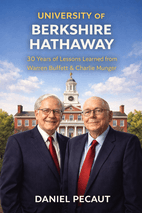
What is the book University of Berkshire Hathaway about?
Daniel Pecaut's University of Berkshire Hathaway distills three decades of wisdom from Berkshire's annual meetings into annual snapshots, chronicling the evolution of Buffett and Munger's philosophy on moats, value, and capital allocation for long-term investors and students of business.
Feature
Insta.Page
Blinkist
Shortform
Summary Depth
Full Chapter-by-Chapter
15-min overview
Detailed analysis
Audio Narration
✓ (AI narration)
✓
✓
Visual Mindmaps
✓
✕
✕
AI Q&A
✓ Voice AI
✕
✕
Quizzes
✓
✕
✕
PDF Downloads
✓
✕
✓
Price
$59.99/yr
$146/yr (PRO)
$199/yr
*Competitor data last verified February 2026.
About the Author
Daniel Pecaut
Daniel Pecaut is a renowned investor and author specializing in the analysis of Berkshire Hathaway and Warren Buffett's investment philosophy. He is best known for co-authoring the annual "Berkshire Hathaway Shareholder Letters" commentary and the book "University of Berkshire Hathaway." With decades of experience, Pecaut is the CEO of Pecaut & Company, a firm managing global investment strategies.
1 Page Summary
University of Berkshire Hathaway distills three decades of wisdom from Warren Buffett and Charlie Munger as captured at Berkshire's iconic annual meetings. The book's core structure presents a concise annual snapshot—combining key business events, notable quotes, and insightful commentary—to chronicle the evolution of Berkshire from a textile manufacturer into a sprawling conglomerate. This format allows readers to trace foundational concepts like the "economic moat," intrinsic value, rational capital allocation, and the profound importance of management character over a long and dynamic timeline, observing how these principles were consistently applied through market cycles, crises, and major acquisitions.
The historical journey provides crucial context, showcasing how Buffett and Munger's partnership and philosophy matured. Early meetings were small and focused on cigar-butt investing, but the narrative progresses through pivotal shifts: the move to buying wonderful businesses at fair prices, the game-changing purchases of See's Candies and GEICO, navigating the dot-com bubble by sticking to their circle of competence, and steering through the 2008 financial crisis from a position of unparalleled strength. This chronicle highlights their long-term focus, ethical transparency, and the powerful compound growth of both Berkshire's book value and their educational dialogue with shareholders.
The lasting impact of the work is its unique presentation of a living case study in business and investing excellence. By organizing the lessons chronologically, the book demonstrates not just what Buffett and Munger think, but how they think—showing the consistency, adaptability, and wit of their reasoning over 30 years. It transcends mere quote collection to offer a masterclass in building a resilient business and cultivating a rational temperament, cementing the Berkshire annual meeting as a priceless educational institution for investors and managers worldwide.
More ways to explore University of Berkshire Hathaway
The annual meeting itself was notably efficient, with the formal business wrapped up quickly to allow for an extensive two-and-a-half-hour question-and-answer session with Buffett and his partner, Charlie Munger. This format underscored the event's true purpose: a direct, unfiltered transmission of wisdom from the leaders to the shareholders.
The Philosophical Foundation: Graham's Value Investing
Before delving into the meeting's insights, the chapter establishes the bedrock of Buffett's approach. His philosophy is traced directly to his intellectual father, Benjamin Graham, whose work frames investing through the simple, powerful lens of price versus value. The goal is to buy a dollar's worth of business value for fifty cents, insisting on a wide margin of safety to account for error or misfortune. This method explicitly ignores economic forecasts, market timing, and technical analysis, focusing solely on this discrepancy between market price and intrinsic worth.
Buffett's Track Record
The theory is spectacularly validated by Buffett's own history. An investment in his original partnership in 1956 would have grown at an annual compounded rate of 25.9% over 13 years without a single down year. After shifting his base to Berkshire Hathaway in 1969, the performance was even more stunning, with the stock price compounding at 28.5% annually. This three-decade record of achieving superior returns with below-average risk is presented not just as data, but as a marvel of consistent execution of a sound principle.
Key Insights from the Q&A
The heart of the chapter captures the pivotal concepts Buffett and Munger discussed with shareholders.
On Intrinsic Business Value
Buffett refined Graham's number-centric model by defining intrinsic value as "what a company would bring if sold to a knowledgeable buyer." This critical evolution places formal value on intangible assets like management quality and brand strength, which is central to Buffett's unique genius.
On Inflation
In a rare and forceful forecast, Buffett labeled inflation as a political, not economic, phenomenon. He warned of "substantial inflation" and "rates we've never seen before" arriving within a few years, a stark caution from someone known for understatement. His implication was clear: long-term bonds were vulnerable.
On Economic Forecasting
Despite his specific inflation warning, Buffett reiterated that he pays no attention to general economic outlooks when making investment decisions. His process remains anchored in comparing price to intrinsic value, not macroeconomic predictions.
On Capital Cities/ABC
He justified Berkshire's major investment in financing the merger of these media giants with supreme praise, calling Cap Cities management "the best of any public-owned company in the country." The investment, made at $172.50 per share, was already trading at a significant profit.
On the Stock Market
Buffett observed that the raging bull market had eliminated opportunities. The prices of the quality businesses he favored—media, consumer goods, insurance—now fully reflected their intrinsic value. Consequently, he and Munger were finding little to buy in the public markets and were instead selling. The chapter offers a crucial nuance: Buffett was not necessarily predicting an immediate market crash, but simply acting on his discipline. His actions were a function of his scale and opportunity set, not a direct signal for the average investor, who still had thousands of smaller companies to analyze.
Key Takeaways
The Core Principle: Successful investing boils down to consistently buying a business for less than its intrinsic value, with a significant margin of safety.
Evolution of Value: Intrinsic value encompasses tangible assets and critical intangibles like management and brand power.
Discipline Over Prediction: Investment decisions should be based on price-value discrepancies, not economic forecasts or market predictions, even when specific macroeconomic risks (like inflation) are acknowledged.
Scale Changes the Game: An investor's size and capital base dramatically alter the available universe of opportunities. What is overpriced for a multi-billion dollar fund may still be a bargain for an individual investor.
Learn, Don't Mimic: The goal is to understand and internalize the fundamental principles behind a master's strategy, not to copy their specific trades.
Key concepts: 1986
1986
The Annual Meeting Format & Purpose
Efficient formal business followed by extensive 2.5-hour Q&A session
Purpose: Direct transmission of wisdom from Buffett and Munger to shareholders
Emphasis on unfiltered, substantive dialogue over procedural formalities
Philosophical Foundation: Graham's Value Investing
Rooted in Benjamin Graham's price versus value framework
Goal: Buy a dollar's worth of business value for fifty cents
Requires wide margin of safety to account for error or misfortune
Explicitly ignores economic forecasts, market timing, and technical analysis
Buffett's Track Record of Success
Original partnership (1956-1969): 25.9% annual compounded return with no down years
💡 Try clicking the AI chat button to ask questions about this book!
Chapter 2: 1987
Overview
The chapter opens at the 1987 Berkshire Hathaway annual meeting, held at the Joslyn Art Museum in Omaha with over 500 attendees. It was a year of remarkable milestones: Berkshire's stock price stood at $2,827, and an initial 1964 investment had grown 229-fold. The narrative, however, centers on a thematic tour of wisdom, as the author and an associate embarked on a cross-country quest to learn from master investors including George Michaelis, Charles Munger, Warren Buffett, and John Templeton.
A Classroom of Masters
The author describes adopting a "world-as-our-classroom" approach, seeking out exceptional investors as professors. This quest led to meetings with George Michaelis in Santa Monica, Charlie Munger in Pasadena, and Warren Buffett in Omaha, building on a prior meeting with John Templeton. The goal was straightforward: to become better investors by absorbing their collective wisdom and, in turn, have fewer excuses for future mistakes.
A Consensus on Market Euphoria
A unified theme emerged from these conversations: a pronounced caution toward the stock market. Most of these value investors saw few bargains. Michaelis held significant cash. Buffett and Munger had taken an even more defensive stance, selling all their non-permanent equity holdings and investing over $1 billion in medium-term tax-free bonds. Buffett’s commentary from the annual report is highlighted, emphasizing the cyclical epidemics of "fear and greed" and his observation that the prevailing "euphoria" on Wall Street, where stock prices had become detached from business fundamentals, could not last indefinitely. His quip quoting Herb Stein—"Anything that can't go on forever will end"—summed up the sober perspective.
The Central Virtue of Humility
Across all meetings, humility was repeatedly underscored as the cornerstone of successful investing. John Templeton framed it as the gateway to understanding. Charlie Munger noted that Tom Murphy, a CEO Buffett deeply admired, prayed daily for humility. While Munger jokingly denied personal humility, he stressed that a key to his and Buffett's success was their "very low opinion of our abilities." He offered a vivid analogy: he’d prefer a partner with a 130 IQ who thinks it’s 128 over a genius with a 190 IQ who believes it’s 240, as the latter is a recipe for costly overconfidence.
Rejecting False Precision
This humility directly connected to a skepticism of complex models and false precision. Buffett argued it was a "terrible mistake" to think computer-generated figures were inherently precise, stating that if an investment thesis required three decimal places, it was too complicated. He lamented that in 35 years, the breed of investment managers had not improved in wisdom or stability, only in their ability to make things unnecessarily difficult. Munger echoed this, warning that the worst mistakes often come from "the nicest graphs," championing instead the use of "enlightened common sense." The section closes with John Maynard Keynes's aphorism: "I would rather be vaguely right than precisely wrong."
Insights on Industries and Ideals
The masters offered pointed views on specific areas. On insider trading, Munger dryly noted that when "incredible rewards go to the casino operators," society has not reached perfection. Regarding the insurance industry, Buffett declared "the party is over," predicting a long hangover as the business became intrinsically less profitable, though accounting earnings might lag. In contrast, George Michaelis found value in the depressed stocks of insurance brokers like Marsh & McLennan. The chapter concludes with Buffett’s tongue-in-cheek definition of the ideal business: "Something that costs a penny, sells for a dollar and is habit forming."
Key Takeaways
Defensive Positioning is Prudent: When master investors uniformly see few bargains and raise cash or move to bonds, it signals a market driven by euphoria, not value.
Humility is a Strategic Advantage: A realistic, even low, opinion of one's own abilities and knowledge limits is a critical defense against overconfidence and error.
Simplicity Over Spurious Precision: Complex models can obscure rather than clarify. "Enlightened common sense" and a tolerance for being "vaguely right" are more valuable than false precision from excessive data.
Cyclical Wisdom Applies: Markets are forever susceptible to waves of fear and greed. The disciplined approach is to be "fearful when others are greedy," as the uncoupling of stock prices from business performance cannot last forever.
Key concepts: 1987
2. 1987
The Classroom of Masters
Adopting a 'world-as-our-classroom' approach to learn from exceptional investors
Meetings with George Michaelis, Charlie Munger, Warren Buffett, and John Templeton
Goal: Absorb collective wisdom to become better investors and reduce future mistakes
Consensus on Market Euphoria
Unified caution toward the stock market with few bargains identified
Buffett and Munger's defensive stance: sold equities, invested $1B+ in tax-free bonds
Observation that stock prices had detached from business fundamentals
Key insight: 'Anything that can't go on forever will end' (Herb Stein)
Humility as Cornerstone of Investing
Humility repeatedly underscored as gateway to understanding
Munger's preference for realistic self-assessment over genius with overconfidence
Key to success: 'very low opinion of our abilities' (Munger/Buffett approach)
Rejecting False Precision
Skepticism toward complex models and computer-generated precision
Buffett: Investment theses requiring three decimal places are too complicated
Munger: Worst mistakes come from 'the nicest graphs'
Championing 'enlightened common sense' over false precision
Keynes' principle: 'I would rather be vaguely right than precisely wrong'
Industry Insights and Business Ideals
Munger on insider trading: society imperfect when 'incredible rewards go to casino operators'
Buffett on insurance: 'the party is over' with long-term profitability decline
Michaelis finding value in depressed insurance broker stocks
Buffett's ideal business: 'costs a penny, sells for a dollar and is habit forming'
Key Investment Principles
Defensive positioning prudent when masters see few bargains
Humility as strategic advantage against overconfidence
Simplicity and common sense over spurious precision
Cyclical wisdom: be 'fearful when others are greedy'
⚡ You're 2 chapters in and clearly committed to learning
Why stop now? Finish this book today and explore our entire library. Try it free for 7 days.
Chapter 3: 1988
Overview
The 1988 Berkshire Hathaway annual meeting, held at Omaha's Joslyn Art Museum, was a masterclass in efficient corporate governance and shareholder dialogue. With formal business concluded in mere minutes, the heart of the event was a sprawling three-hour Q&A where Warren Buffett and Charlie Munger fielded wide-ranging questions. The backdrop was a staggering track record: one dollar invested in Berkshire in 1964 was now worth $239, with per-share book value compounding at 23% annually.
Confronting the Inevitability of Inflation
Buffett reaffirmed his long-held view that significant inflation is a near certainty, driven by the simple, global temptation to print money. When shareholders sought advice on traditional hedges, both he and Munger offered blunt dismissals. Real estate and leverage were portrayed as treacherous, foreign currencies as inscrutable, and hard assets like fine art as underperformers compared to Berkshire itself.
The Only Hedge That Matters
Their solution to inflation was the same as their core investment philosophy: buying wonderful businesses managed by able and honest people at sensible prices. They argued that companies requiring little capital, generating abundant cash, and possessing strong pricing power are naturally equipped to navigate inflationary periods. The hedge, therefore, is not a separate asset class but the quality of the underlying business.
Program Trading and Economic "Friction"
The duo expressed deep skepticism toward complex financial instruments like index options and program trading. Buffett illustrated the absurdity with a parable of shipwrecked shareholders, suggesting that diverting the island's "best and brightest" to trade futures on the food supply, rather than produce, would be a societal waste. Munger was characteristically blunt, labeling the entire concept "a totally asinine idea."
Salomon Brothers: A Calculated Bet
Discussing Berkshire's new, large investment in Salomon Brothers, Buffett admitted uncertainty about the investment banking industry's future shape. However, he expressed strong confidence in Chairman John Gutfreund. Munger, while noting it was "one tough business," offered rare enthusiasm, praising Salomon as a "deep" meritocracy of talent that might do very well over time.
Navigating Obsolescence and Economic Cycles
Two pieces of wisdom stood out. First, Buffett cautioned that recognizing a dying business does not mean jumping into its successor. Using the example of trains and planes, he noted the visionary railroad owner in 1930 should have exited passenger transport entirely, not entered the airline industry. Second, he dismissed the utility of predicting business cycles, stating that trying to "dance in and out" based on forecasts would have destroyed Berkshire's value.
The Trade Deficit: Trading Manhattan for Trinkets
While generally avoiding macroeconomics, Buffett identified the trade deficit as a severe, underappreciated threat—far more serious than the budget deficit. He framed it as a tragic reversal of history: where Peter Minuit once bought Manhattan for trinkets, America was now selling its assets (like an ABC office building) to fund consumption of foreign-made goods (like VCRs), gradually trading away the national "farm."
Biographies: Making Friends with the Eminent Dead
In a personal aside, Munger revealed himself as a "biography nut," recommending the genre as a way to "make friends among the eminent dead" and gain vicarious experience. Buffett quipped that these friends "don't talk back." Munger believed this practice could extend one's intellectual range and even improve the quality of one's living friends, citing business biographies like those on McDonald's and Sears as instructive.
Key Takeaways
Inflation Hedge = Business Quality: The best protection against inflation is owning exceptional businesses with low capital needs and pricing power.
Ignore Noise, Focus on Durability: Predicting economic cycles or chasing financial fads (like program trading) is a distraction from the core work of evaluating business durability and management quality.
Obsolescence Requires Clarity: Disruption demands clear-eyed exit decisions, not a reflexive jump into the successor industry, which may be fundamentally unattractive.
The Real Macro Threat: The chronic trade deficit, which exchanges durable national assets for transient consumer goods, poses a greater long-term risk than the federal budget deficit.
Learn from the Masters: Studying history and biography provides invaluable, condensed wisdom for both investing and life.
Key concepts: 1988
3. 1988
The Inflation Challenge
Significant inflation viewed as near certainty due to global temptation to print money
Traditional hedges like real estate, leverage, foreign currencies, and fine art dismissed as treacherous or underperforming
Best inflation hedge is owning wonderful businesses with low capital needs, strong cash flow, and pricing power
Critique of Financial Engineering
Deep skepticism toward complex instruments like index options and program trading
Buffett's shipwreck parable illustrates societal waste of diverting talent to financial speculation
Munger labels program trading concept as 'a totally asinine idea'
Investment in Salomon Brothers
Berkshire makes large investment despite uncertainty about investment banking industry's future
Strong confidence expressed in Chairman John Gutfreund's leadership
Munger praises Salomon as a 'deep' meritocracy of talent with potential for strong performance
Business Strategy Wisdom
Recognizing dying business doesn't mean jumping into its successor industry (train vs. plane example)
Dismisses utility of predicting business cycles - 'dancing in and out' would destroy value
Focus on business durability and management quality over economic forecasting
Trade Deficit as National Threat
Identifies trade deficit as severe, underappreciated threat more serious than budget deficit
Frames as tragic reversal: America selling assets (like ABC building) to fund consumption of foreign goods
Gradually trading away national 'farm' for transient consumer goods like VCRs
Intellectual Development Through Biography
Munger recommends biographies to 'make friends among the eminent dead' for vicarious experience
Extends intellectual range and improves quality of living friendships
Business biographies (McDonald's, Sears) cited as particularly instructive
Chapter 4: 1989
Overview
The 1989 annual meeting of Berkshire Hathaway was a testament to its growing legend, with a bustling crowd of over 1,000 people spilling into the Joslyn Art Museum's auditorium—so many that the proceedings began fifteen minutes late. Warren Buffett dryly observed the preference for financial talk over fine art, framing a day of profound insights against a backdrop of remarkable corporate performance. Berkshire's stock had soared to $4,711 per share, and the compounded annual growth in book value since 1964 stood at an astonishing 23.8%, dramatically outpacing the S&P 500. The discussions that year ranged from grave economic warnings to timeless investment principles, all delivered with the characteristic wit and clarity that have come to define these gatherings.
A Record Turnout and Stellar Performance
The sheer number of attendees at the Joslyn Art Museum underscored Berkshire's expanding influence. Buffett's quip about money trumping art captured the eager anticipation in the room. Financially, the numbers spoke volumes: one dollar invested in Berkshire in 1964 had blossomed to $381, while per-share book value climbed from $19.46 to $4,296.01. This growth rate of 23.8% per year, compared to the S&P 500's 9.4%, highlighted the extraordinary compounding machine Buffett and Charlie Munger had built. It set the stage for deeper conversations about value, risk, and economic stewardship.
Buffett's Economic Warnings
Buffett turned his attention to two pressing issues: the U.S. trade deficit and the frenzy around junk bonds. He described the trade deficit as "our most important economic problem," comparing it to consuming 103% of what we produce by issuing $130 billion in claim checks annually. Like eating an extra piece of toast daily, the immediate pleasure belied a slow, inevitable crisis—a gradual "giving away of the farm" where America traded assets for trinkets.
On junk bonds, Buffett and Munger were unsparing. They argued that the leverage buyout mania, fueled by "creative financing" like zero-coupon and payment-in-kind bonds, was built on a sound premise gone wild. Just as Florida land deals had bankrupted many, the LBO game was pushing risk onto the next "patsy" until it couldn't continue. Munger's wry comment about Argentina highlighted the absurdity, and Buffett predicted a bloody end when the music stopped, emphasizing that past performance in high-yield bonds was a misleading crow, not the rising sun.
The Heart of Value Investing
At the core of the discussion was the concept of intrinsic business value (IBV). Buffett defined it simply as the present value of all future net cash flows, discounted at current bond rates. The real challenge, he admitted, lay in forecasting those cash flows—a task easier for some businesses than others. True to their disciplined approach, Buffett and Munger sought a margin of safety: if they estimated a value between X and 3X, they aimed to buy at half of X. This conservative stance underscored their commitment to avoiding folly in pursuit of opportunity.
Business Realities: Insurance and Brands
The insurance industry, a significant part of Berkshire's portfolio, faced headwinds. Buffett and Munger anticipated more onerous regulation, citing public antagonism like California's Proposition 103, and predicted underwriting losses would worsen for at least two more years. This sober outlook contrasted with the enduring value of strong brand names. Using See's Candy's struggle to launch a chocolate syrup against Hershey's dominance, Buffett illustrated how difficult it is to crack established markets. His personal switch from Pepsi to Cherry Coke—joking about 50 years of research—led him to invest in Coca-Cola, noting the duopoly that controlled over 70% of the soft drink market and grew stronger each year.
Lessons from History and Humor
Amid the serious analysis, lighter moments revealed Berkshire's culture. When asked about the corporate jet Berkshire owned, Munger deadpanned his ignorance of "this ridiculous extravagance," noting he flew coach. This homespun humor complemented Buffett's caution against extrapolating the recent past. He warned that Wall Street's cycles of boom and bust often stem from unthinking reliance on immediate history, like the junk bond advocates pointing to 30 years of returns. Buffett quipped that if studying the past alone made one rich, librarians would be billionaires, reminding everyone that foresight, not hindsight, drives wise investing.
Key Takeaways
Economic Prudence Matters: The trade deficit represents a slow, dangerous transfer of national assets, akin to living beyond one's means.
Junk Bonds Signal Excess: The leverage buyout frenzy, with its deceptive financing, is unsustainable and likely to end in significant losses.
Margin of Safety is Crucial: Intrinsic business value requires conservative estimates and buying at a discount to ensure protection against uncertainty.
Brands Are Mighty Moats: Established brand names, like Coca-Cola or See's, offer formidable competitive advantages that are hard to replicate.
History Can Mislead: Past performance, especially in volatile markets, is not a reliable predictor of future outcomes; independent thinking is essential.
Culture Reflects Values: Even in success, Berkshire's leadership emphasizes frugality and humor, grounding financial wisdom in everyday sense.
Key concepts: 1989
4. 1989
Berkshire's Growing Legend and Performance
Record turnout of over 1,000 people at the annual meeting, reflecting Berkshire's expanding influence
Stock price reached $4,711 per share with book value growing at 23.8% annually since 1964
Dramatically outperformed S&P 500's 9.4% growth rate over the same period
One dollar invested in 1964 had grown to $381 by 1989
Economic Warnings: Trade Deficit and Junk Bonds
Trade deficit described as 'our most important economic problem' - consuming 103% of production
America trading assets for trinkets represents a gradual 'giving away of the farm'
Junk bond and LBO frenzy built on creative financing like zero-coupon bonds
Predicted a 'bloody end' when the music stops, comparing it to Florida land deals
Core Investment Principles: Intrinsic Value and Margin of Safety
Intrinsic business value defined as present value of all future net cash flows
Challenge lies in accurately forecasting those cash flows
Sought margin of safety by buying at half of conservative value estimates
If estimated value between X and 3X, aimed to buy at half of X
Business Analysis: Insurance and Brand Strength
Insurance industry facing headwinds with anticipated more onerous regulation
Predicted underwriting losses would worsen for at least two more years
Strong brands like Coca-Cola create formidable competitive advantages
Established markets difficult to crack (See's Candy vs. Hershey's example)
Coca-Cola and Pepsi duopoly controlled over 70% of soft drink market
Wisdom and Culture: Learning from History
Warning against extrapolating recent past performance (junk bond advocates' mistake)
If studying past alone made one rich, librarians would be billionaires
Foresight, not hindsight, drives wise investing
Culture of frugality exemplified by Munger flying coach despite corporate jet ownership
Homespun humor as part of Berkshire's grounded leadership approach
📚 Explore Our Book Summary Library
Discover more insightful book summaries from our collection