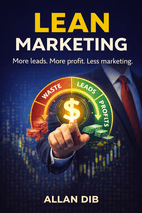
Lean Marketing: More leads. More profit. Less marketing.
Introduction
Chapter 1/4
Lang
1x
Voice
PDF
0:00
0:00
Lean Marketing: More leads. More profit. Less marketing.
by Allan Dib · Summary updated
What is the book Lean Marketing: More leads. More profit. Less marketing. about?
Allan Dib's Lean Marketing provides a systematic, data-driven framework for small businesses and startups to eliminate wasteful spending and focus on high-ROI activities through rapid testing and iteration.
Feature
Insta.Page
Blinkist
Shortform
Summary Depth
Full Chapter-by-Chapter
15-min overview
Detailed analysis
Audio Narration
✓ (AI narration)
✓
✓
Visual Mindmaps
✓
✕
✕
AI Q&A
✓ Voice AI
✕
✕
Quizzes
✓
✕
✕
PDF Downloads
✓
✕
✓
Price
$59.99/yr
$146/yr (PRO)
$199/yr
*Competitor data last verified February 2026.
About the Author
Allan Dib
Allan Dib is a renowned entrepreneur, marketing strategist, and bestselling author celebrated for his practical and high-impact business advice. He is best known for his groundbreaking book, *The 1-Page Marketing Plan*, which has become an essential resource for small business owners seeking to simplify and supercharge their marketing efforts. His work distills complex business concepts into actionable strategies, empowering readers to achieve rapid growth. As a successful founder and consultant, Dib brings real-world expertise and a proven track record to his writing. His influential books are available for purchase on Amazon, where they continue to receive widespread acclaim from the business community.
1 Page Summary
Allan Dib's Lean Marketing challenges the traditional, high-cost marketing approaches that often burden small businesses and startups. Drawing inspiration from the lean manufacturing principles popularized by Toyota, Dib advocates for a more agile, data-driven, and resource-efficient methodology. The core premise is to systematically eliminate wasteful marketing activities that don't generate leads or sales, focusing instead on a continuous cycle of building targeted campaigns, measuring their performance with key metrics, and learning from the results to rapidly iterate and improve. This "build-measure-learn" loop is central to creating a marketing engine that is both effective and capital-efficient.
The book is situated within the modern context of digital marketing tools and analytics, which provide unprecedented access to customer data and campaign tracking. Dib argues that this technological shift renders old, spray-and-pray advertising models obsolete. He provides practical frameworks for identifying a business's unique value proposition, targeting high-potential customer segments, and crafting compelling messages. Key concepts include the use of minimum viable campaigns to test assumptions cheaply, the emphasis on lifetime customer value over short-term acquisition costs, and strategies for leveraging automation and scalability once a winning formula is found.
The lasting impact of Lean Marketing lies in its empowerment of entrepreneurs and small business owners. It demystifies marketing as a complex, budget-intensive function and recasts it as a systematic process of experimentation that any business can implement. By prioritizing measurable ROI and iterative growth over grandiose, untested campaigns, the book provides a sustainable blueprint for generating more leads and profit with less time, stress, and financial outlay. Its principles continue to resonate in an era where agility and smart resource allocation are critical competitive advantages.
More ways to explore Lean Marketing: More leads. More profit. Less marketing.
This chapter opens with a timeless metaphor: the idea of letting your light shine so others can see your good works. It quickly pivots to the core dilemma facing every business—how to move from deserving success based on merit to actually achieving it in a crowded marketplace. The author introduces the book's mission: to provide a practical framework for attracting, converting, and retaining customers, bridging the gap between value and visibility. He acknowledges the frustration many feel after investing in marketing that fails to deliver, and sets the stage for a mindset shift, urging readers to embrace conflicting ideas and move beyond superficial tactics to build a sustainable, profitable business.
The Frustration of Invisible Value
Many entrepreneurs and marketers have experienced the soul-crushing reality of being a "best-kept secret." They pour resources into agencies, websites, or ads, only to see minimal impact on revenue. The author empathizes, noting that these tools and experts aren't inherently flawed—the problem lies in the lack of a proper marketing infrastructure. Without a solid foundation, random acts of marketing are doomed to fail. This section underscores that hoping for visibility isn't a strategy; value must be deliberately elevated and made visible to create momentum.
Defining the Journey
Here, the author broadens the definition of key terms to include everyone in the pursuit of growth. An "entrepreneur" is anyone who solves problems for a profit, from founders and CEOs to heads of marketing. Similarly, "customers" encompass clients, patients, donors, or any audience you aim to attract and serve. This inclusive approach ensures the principles apply across industries, focusing on the universal goal of reliably generating leads and revenue.
Escaping the Midwit Trap
To succeed, readers are encouraged to avoid being a "midwit"—someone who overcomplicates ideas and prioritizes being right over being effective. The intelligence bell curve meme illustrates how both simpletons and geniuses often reach practical conclusions, while midwits get stuck in analysis paralysis. The author challenges us to hold conflicting concepts without rejection, asking, "Would you rather be right or rich?" This mindset is crucial for navigating the nuanced world of marketing, where flexibility and openness lead to profit.
The Dual Nature of Marketing
Marketing is presented as both easy and hard, a deliberate contradiction to test the reader's adaptability. On one hand, it's easy because it's a learnable skill based on simple frameworks that yield consistent results when followed. Mastery can cover a multitude of business sins and transform startups or scale-ups. On the other hand, it's hard because it demands commitment and resilience; most who dabble quit without results. The path involves frustration and effort, akin to "crawling on your hands and knees over broken glass," but persevering develops the most valuable business skill: the ability to reliably attract, convert, and retain ideal customers.
Integrating Diverse Wisdom
The chapter explores contrasting marketing philosophies, from Seth Godin's emphasis on creating remarkable work for a tribe to Dan Kennedy's direct-response focus on measurable actions and urgency. Instead of choosing sides, the author advocates learning from both. Godin's approach inspires pride and creativity, while Kennedy's teaches psychological leverage and accountability. The goal is to blend these strengths—building a brand you're proud of, backed by ruthless results—rather than clinging to labels that limit thinking. This synthesis requires holding conflicting ideas simultaneously, a task that midwits resist but that leads to innovative, effective strategies.
Key Takeaways
Visibility is non-negotiable: Merit alone doesn't guarantee success; value must be paired with strategic visibility to attract customers.
Infrastructure over tactics: Isolated marketing efforts often fail without a cohesive framework to support them.
Embrace contradictions: Success requires holding opposing ideas, like marketing being both easy and hard, and integrating diverse perspectives.
Avoid midwit thinking: Prioritize practical results over being right, and stay open to ideas that challenge your worldview.
Blend creativity with accountability: Combine the pride of brand-building with the measurable results of direct-response marketing for sustainable growth.
Key concepts: Introduction
1. Introduction
The Core Marketing Dilemma
Merit alone doesn't guarantee success in a crowded marketplace
The gap exists between creating value and achieving visibility
The book's mission is to provide a framework for attracting, converting, and retaining customers
A mindset shift is required to move beyond superficial tactics
The Frustration of Invisible Value
Many businesses remain 'best-kept secrets' despite marketing investments
Marketing tools and experts aren't inherently flawed—the problem is lack of infrastructure
Random acts of marketing without foundation are doomed to fail
Hoping for visibility isn't a strategy—value must be deliberately elevated
Inclusive Definitions for Universal Application
'Entrepreneur' includes anyone who solves problems for profit (founders, CEOs, marketing heads)
'Customers' encompass clients, patients, donors, or any target audience
Principles apply across industries and roles
Universal goal: reliably generating leads and revenue
Avoiding Midwit Thinking
Midwits overcomplicate ideas and prioritize being right over being effective
Both simpletons and geniuses often reach practical conclusions while midwits experience analysis paralysis
Success requires holding conflicting concepts without rejection
Key question: 'Would you rather be right or rich?'
The Paradoxical Nature of Marketing
Marketing is easy: it's a learnable skill based on simple frameworks that yield consistent results
Marketing is hard: it demands commitment and resilience—most who dabble quit without results
The path involves frustration and effort ('crawling on your hands and knees over broken glass')
Perseverance develops the most valuable business skill: reliably attracting, converting, and retaining customers
Integrating Contrasting Marketing Philosophies
Seth Godin's approach: creating remarkable work for a tribe, inspiring pride and creativity
Dan Kennedy's approach: direct-response focus on measurable actions and urgency, teaching psychological leverage
Instead of choosing sides, learn from both perspectives
Blend brand-building pride with ruthless results for innovative, effective strategies
If you like this summary, you probably also like these summaries...
💡 Try clicking the AI chat button to ask questions about this book!
Chapter 2: 1: Leaning Into Marketing
Overview
The chapter begins with a revealing personal story, where the author, overwhelmed by the positive reception at an event in Mexico, hears his work described as lean marketing for the first time. This sparks the core idea of the book: applying the powerful, waste-eliminating philosophy of lean manufacturing to the world of marketing. It all started with Japanese manufacturers like Toyota, who mastered doing more with less by ruthlessly cutting anything that didn't create value for the customer.
Applying this thinking means marketing must first create value for your target market, aiming to be a genuine benefit they might even pay for, rather than an annoying interruption. It also requires embedding marketing throughout the entire customer journey, from product development to customer service, to eliminate the wasteful silos that cause internal friction and inefficiency.
The philosophy smartly blends the two dominant schools of thought. It takes the measurable, accountable discipline of direct response marketing and combines it with the long-term storytelling and goodwill of brand marketing. The goal is to build a powerful brand using efficient, scientific methods. This is powered by marketing processes—consistent routines that act as force multipliers, creating compounding growth over time from minimal inputs.
Critically, the chapter argues that success isn't about finding a secret new tactic. The principles are common sense, but common sense is not common practice. The real advantage comes from mastering and expertly executing these fundamental strategies that most businesses neglect. To that end, the book focuses on teaching these timeless fundamentals, while pointing to the constantly updated online Lean Marketing Hub for the technical, how-to details that change rapidly. The ultimate promise is a system that delivers significant results from streamlined, efficient effort.
The author opens with a vivid, personal story from a speaking tour in Mexico. Exhausted and anxious in a foreign city, his low expectations were completely overturned by an overwhelming reception at the event. Attendees lined up for his autograph and photos, creating a surreal "celebrity" experience he still jokes about with his team.
A pivotal conversation occurred here with Luis Socconini, a founder of the Lean Six Sigma Institute. After expressing admiration for the author’s work, Socconini remarked, “You know, I consider your book to be lean marketing.” This was the first time the author had heard the term. That offhand comment became a catalyst, helping him see the clear intersection between the proven lean movement and his own work to simplify and effective marketing. This insight led directly to the nine principles of lean marketing explored in the book.
From Lean Manufacturing to Lean Marketing
The lean methodology originated in post-WWII Japanese manufacturing, most famously with the Toyota Production System. With its cities devastated and resources scarce, Japan couldn't adopt the Western model of mass production, which required huge inventories and massive capital investment. Instead, manufacturers pioneered a system focused on eliminating all waste—defined as anything that consumes resources without creating value for the customer.
This philosophy, encapsulated as “a way to do more and more with less and less,” transformed “Made in Japan” from a joke into a symbol of quality and reliability. The principles of lean—defining value from the customer’s perspective, continuous improvement, and smooth workflow—have since been successfully applied beyond factories to healthcare, software, and services.
Core Principles of Lean Marketing
Applying lean thinking to marketing means ruthlessly cutting waste and focusing on value creation. The chapter introduces two foundational principles:
Create value for your target market with your marketing. Most traditional, interruption-based marketing creates negative externalities—like pollution—annoying the vast majority who see it. Lean marketing aims to create positive externalities, providing so much value that your target market would theoretically pay to receive it. Your marketing should be a genuine benefit, not a nuisance.
Embed marketing throughout the entire product life cycle and customer journey. A major source of waste is treating marketing as a separate silo, brought in only at the end to "sell" a finished product. This leads to inefficiency and internal conflict (e.g., sales blaming marketing for bad leads). Instead, marketing must be integrated into every customer touchpoint: product development, sales conversations, onboarding, and customer service. Viewing marketing as part of the core value stream ensures the entire organization works smoothly to create and retain customers efficiently.
Blending Brand and Direct Response
The chapter contrasts the two dominant schools of marketing:
Brand Marketing is about aspiration, image, and long-term recognition. It’s traditionally not easily measurable (following the John Wanamaker adage: “Half the money I spend on advertising is wasted; the trouble is I don’t know which half”). It requires massive scale and investment over many years.
Direct Response Marketing is action-based, scientific, and relentlessly focused on measurable ROI and short-term accountability. It can, however, burn goodwill by ignoring the 99% who don’t click and often lacks a cohesive brand story.
Lean marketing seeks to blend the best of both. It takes the profit-focused discipline of direct response and makes it more brand-friendly. Simultaneously, it applies the waste-elimination focus of lean to make branding efforts more efficient and accessible, even for smaller businesses. The goal is to build powerful stories and goodwill (like brand marketing) using the measurable, efficient methods of direct response.
The Third Force Multiplier: Marketing Processes
Marketing processes represent the final component of a lean marketing system, acting as the executable algorithms for your business. Establishing daily, weekly, and monthly marketing routines creates a compounding effect, similar to financial interest, leading to outsized growth over time. When integrated with tools and assets, these processes form a complete system that generates significant results from minimal, efficient inputs, offering a refreshing alternative to the common pressure for more complex and expensive marketing efforts.
"Nothing New" and Common Sense
The principles of lean marketing are often acknowledged as simple common sense. The critical insight, however, is that common sense is not common practice. While tactics like email capture or content marketing are well-known, few businesses implement them consistently or effectively. This book bridges the gap between knowledge and execution, focusing on the practical details of implementation. The philosophy is compared to fitness: lasting results come from mastering fundamental movements (like squats or deadlifts), not from novel but ineffective tricks. The goal is to be an effective "trainer" for your marketing muscle, not an original theorist.
The Fundamental and the Technical
Books are ideal for conveying timeless fundamentals—principles that remain stable over years, much like answering Jeff Bezos's question, "What's going to stay the same?" However, the technical how-to aspects of marketing (like software screenshots or platform-specific templates) change rapidly. To provide the best of both worlds, this book focuses on the enduring fundamentals, while a companion online resource—the Lean Marketing Hub (LeanMarketing.com/hub)—hosts constantly updated technical guides, templates, and community support. This approach ensures you learn the unchanging strategic foundations while having access to current tactical instructions.
Key Takeaways
Processes Compound: Consistent marketing routines are force multipliers that generate compounding results over time, forming the final piece of a high-impact, lean marketing system.
Execution Over Novelty: Success lies not in discovering new ideas, but in expertly implementing fundamental, common-sense strategies that most businesses neglect.
Fundamentals Are Timeless: Sustainable competitive advantage comes from mastering marketing fundamentals, not chasing fleeting technical tactics.
A Dual-Path Resource: This book provides the enduring strategic principles, while the online Lean Marketing Hub offers the evolving technical details and tools for implementation.
Chapter 1 Action Items:
Review all marketing activities and eliminate those that don't create direct value for your target market.
Audit your customer journey to identify new opportunities to integrate marketing touchpoints.
Revisit your marketing plan using a simple framework like the 1-Page Marketing Plan (available in the Lean Marketing Hub).
Key concepts: 1: Leaning Into Marketing
2. 1: Leaning Into Marketing
Origins and Personal Catalyst
Author first hears term 'lean marketing' from Lean Six Sigma founder Luis Socconini in Mexico
Personal story reveals moment of insight connecting lean philosophy to marketing
Catalyst for developing the nine principles of lean marketing explored in the book
Lean Manufacturing Foundation
Originated with Toyota Production System in post-WWII Japan
Philosophy: 'do more and more with less and less' by eliminating waste
Defines waste as anything consuming resources without creating customer value
Transformed 'Made in Japan' from joke to symbol of quality
Core Principles of Lean Marketing
Create value for target market with marketing (positive externalities)
Embed marketing throughout entire product life cycle and customer journey
Eliminate silos between marketing and other departments
View marketing as part of core value stream for customer creation and retention
Blending Marketing Philosophies
Combine measurable discipline of direct response marketing
Integrate long-term storytelling and goodwill of brand marketing
Apply waste-elimination focus to make branding efficient for smaller businesses
Build powerful brands using scientific, accountable methods
Execution and Practical Application
Success comes from mastering fundamentals, not finding secret tactics
Common sense principles are not common practice
Focus on timeless fundamentals while using online resources for technical details
Marketing processes as force multipliers creating compounding growth
The Third Force Multiplier: Marketing Processes
Marketing processes act as executable algorithms that create compounding growth over time through consistent routines
Daily, weekly, and monthly marketing routines generate outsized results from minimal, efficient inputs
When integrated with tools and assets, processes form a complete lean marketing system
This approach offers an alternative to complex, expensive marketing efforts by focusing on systematic execution
The Gap Between Knowledge and Execution
Lean marketing principles are common sense but not common practice in business implementation
Most businesses know fundamental tactics but fail to implement them consistently or effectively
The book bridges the gap between theoretical knowledge and practical execution
Success comes from mastering fundamental movements rather than chasing novel but ineffective tricks
Timeless Fundamentals vs. Changing Tactics
Books excel at conveying timeless fundamentals that remain stable for years
Technical how-to aspects of marketing change rapidly with platforms and tools
The book focuses on enduring strategic foundations while the Lean Marketing Hub provides updated technical guides
This dual approach ensures learning of unchanging principles with access to current tactical instructions
Implementation Philosophy
Be an effective 'trainer' for your marketing muscle rather than an original theorist
Sustainable competitive advantage comes from mastering fundamentals, not chasing fleeting tactics
The companion online resource (LeanMarketing.com/hub) hosts templates, guides, and community support
Focus on practical details of implementation rather than theoretical novelty
⚡ You're 2 chapters in and clearly committed to learning
Why stop now? Finish this book today and explore our entire library. Try it free for 7 days.
Chapter 3: 2: Who Are Your People?
Overview
It all begins by flipping the script on a classic entrepreneurial mistake. Instead of building something brilliant and then hunting for customers, the chapter argues you must start by becoming intimately familiar with a specific group of people. This is Lean Marketing Principle 3: Market comes before product. Trying to appeal to everyone is a recipe for failure, while radical focus—being an inch wide and a mile deep—creates a powerful stronghold. This focus requires discipline to avoid the siren call of shiny new opportunities, metaphorically called the woman in the red dress, which scatter your energy.
This specificity works because it mirrors how people actually search for solutions, using precise, problem-focused language. To connect effectively, you must segment your audience, recognizing that different groups, like end-consumers versus distributors, need completely different messaging and strategies. Your goal isn't to invent new needs but to skillfully tap into existing demand by understanding where people are in their journey, using frameworks like the five stages of customer awareness. You don't need to be the world's best at one thing; you can stand out through talent stacking, combining several good-but-not-great skills to create a unique and valuable intersection.
To define this focused arena, the chapter provides seven dimensions for defining your niche, like location, industry, or specific problem. Combining these dimensions creates a powerful target. A profound way to connect with this niche is by serving your former self, leveraging your own past struggles for genuine empathy and resonant messaging. If that personal experience isn't there, you must become a spy, conducting undercover market research in online communities, trade publications, and at live events to uncover your audience's true hopes and pains. Ultimately, success hinges on strategically choosing who you serve, ensuring your valuable skills aren't wasted on a market that can't properly appreciate them, but are instead positioned where they command maximum impact and reward.
The Fatal Flaw of Product-First Thinking
The chapter opens by identifying a critical and common error: entrepreneurs beginning with a product or service and then desperately searching for a market to buy it. This "solution in search of a problem" is described as "ass-backward" and a primary reason businesses struggle and fail. When you don't know who you're talking to, your messaging becomes generic and ineffective, advertising budgets are wasted on the wrong audiences, and sales become an exhausting uphill battle. The core principle introduced is Lean Marketing Principle 3: Market comes before product. You must first become the "mayor" of a specific "town," understanding the unique needs of your citizens before you decide what to build for them.
The Power of a Narrow Focus: An Inch Wide, a Mile Deep
Attempting to appeal to everyone is likened to a rookie clay shooter trying to follow the target—it guarantees a miss. While casting a wide net feels instinctively safer, true market domination begins with radical specificity. Examples like Facebook (starting only in colleges), Apple's comeback (focusing solely on the iPod), and Amazon (beginning as just a bookstore) illustrate this path. A successful niche is "an inch wide and a mile deep": a tightly defined segment with a specific, urgent problem, yet large enough to support a sustainable business. You can achieve phenomenal success even if 99.9% of the world has never heard of you.
Resisting Distraction: The Woman in the Red Dress
Entrepreneurs are naturally drawn to novelty—new ideas, products, and markets. These shiny new opportunities are metaphorically called "the woman in the red dress," a reference to a distracting, seductive figure in The Matrix. Chasing them scatters your finite energy and focus, making you vulnerable to competitors who are concentrating all their efforts in one direction. To combat this, the author suggests two tactics: 1) Maintain a "parking lot" for future ideas to acknowledge them without acting on them, and 2) Develop a realistic understanding that many attractive-looking businesses have difficult, low-leverage models upon closer inspection.
Why Specificity Sells and Generality Repels
The evidence for specificity is in our own search behavior. When we intend to buy, we use precise, problem-focused search terms (e.g., "dermatologist downtown Brooklyn," not just "doctor"). This principle is exploited masterfully by consumer goods companies. Identical pain relievers or razors are packaged and marketed differently (e.g., "for back pain" or "for women") to trigger the "that's for me" response, allowing for targeted messaging and often higher margins. Your marketing must achieve the same effect by speaking directly to a specific pain point.
Segmenting Your Audience for Maximum Impact
Treating all potential customers the same is inefficient and wasteful. Irrelevant marketing devalues your brand. You must determine if you have separate target markets requiring distinct marketing plans or segments within one market needing tailored messaging. Using a baby product company as an example, the chapter contrasts the messaging and sales process for end-consumers (focused on safety and results) versus retail distributors (focused on margins and sell-through rates). The channels, nurturing, and sales cycles for each are completely different, necessitating separate strategies.
Tapping into Demand vs. Generating It
Trying to generate demand—to convince people they have a problem they don't recognize—is compared to the decades-long, multimillion-dollar effort Colgate undertook to make toothbrushing a universal habit. It's "business on hard mode." The superior strategy is to tap into existing, unsatisfied demand. This involves understanding the five stages of customer awareness (Unaware, Problem Aware, Solution Aware, Product Aware, Most Aware) and marketing to them appropriately. The "unaware" are rarely worth the effort, while the "problem aware" are perfect for educational content. Your goal is to meet people where they are in their journey, not drag them to the starting line.
Finding Your Unique Intersection Through Talent Stacking
You don't need to be the absolute best in the world at one thing to succeed. The gap between legendary success and obscurity can be infinitesimally small (like 0.35 seconds in a race). Instead, you can stand out through talent stacking—combining several complementary skills to create a unique value proposition. The author uses himself as an example, stacking skills in writing, business knowledge, technology systems, and the perseverance to publish a book. While not world-class in any single area, the intersection of these skills makes him uniquely positioned. The key is to stack skills that reinforce each other and enhance your core offerings, making you "dangerous enough at each" to be a king in your chosen, specific land.
Seven Dimensions for Defining Your Niche
The chapter presents seven specific lenses through which to view and narrow your target market: location, demography, shared values, industry, desire, problem, and trend. While using a single dimension can be effective, combining them—like serving British expats in Australia or a California lawyer focusing on AI for software companies—creates a powerful, specific niche. This specificity makes it easier for ideal clients to recognize your service as "for them," often searching for those precise solutions rather than generic terms. A critical additional factor is assessing whether your chosen niche is growing, shrinking, or stable; aligning with a growing, affluent segment, like DINKS (Double Income, No Kids) or DINKWADs (with a dog), provides a significant tailwind for success.
The Power of Serving Your Former Self
Choosing a target market you have personally experienced can be a profound advantage. The author shares how his own midlife crisis and past struggles with marketing became the foundation for his business. Having been in your prospect's shoes builds genuine empathy, allows you to tap into their specific emotions, and enables you to craft messaging that resonates deeply with their internal dialogue. This principle is encapsulated in the idea that you are "most powerfully positioned to serve the person you once were." This approach not only makes marketing more effective but is also personally satisfying and motivational.
Conducting Undercover Market Research
When you don't have personal experience in your target market, you must become a "spy" to gather deep intelligence. This involves infiltrating the online and offline spaces where your ideal clients congregate.
Online Communities: Investigate platforms like Reddit (for anonymous, honest discussions), Facebook Groups (for real-name, community-focused chats), LinkedIn, Discord, and niche forums. These are where people openly share frustrations, desires, and questions.
Consumed Content: Study the books, podcasts, and YouTube channels popular in the niche to understand dominant thought leaders and surface-level narratives.
Trade Publications: Subscribe to industry-specific journals, newsletters, and magazines. These reveal topical pain points and highlight which advertisers are successfully monetizing those problems.
In-Person Events: The most powerful "hack" is attending conferences, trade shows, and association meetings. Immersing yourself for a day can yield more actionable insight than months of online research, providing direct access to industry conversations, trends, and networking.
The goal of all this research is to move beyond superficial demographics and understand your market's core hopes, dreams, fears, and pressing pain points.
Positioning for Maximum Value: Avoiding Pearls Before Swine
A critical strategic leap is understanding that your skills have vastly different values in different markets. Many skilled entrepreneurs "cast their pearls before swine," offering incredible solutions to markets that cannot afford or do not value them appropriately. The real breakthrough often comes from pivoting your target audience. The example given is a storyteller who, instead of serving local small businesses, works with companies pre-IPO, taking an equity stake because his work can swing valuations by billions. The same skill, applied to a high-value market, yields exponentially greater rewards. Success, therefore, depends not just on solving a problem but on strategically selecting who you solve it for.
Key Takeaways
Define your niche with precision using multiple dimensions (e.g., location + problem + industry) to attract clients who see your offer as uniquely for them.
Leverage your own past struggles and experiences to serve a market with deep empathy and powerful messaging.
If you lack personal experience, conduct immersive "undercover" research in online communities, through content, trade publications, and, most effectively, at in-person industry events.
Strategically select a target market that highly values your solution; the same skill can command vastly different compensation based on the market's ability and willingness to pay.
Key concepts: 2: Who Are Your People?
3. 2: Who Are Your People?
The Fatal Flaw of Product-First Thinking
Starting with a product and then searching for a market is a primary reason businesses fail
Generic messaging and wasted advertising budgets result from not knowing your audience
Lean Marketing Principle 3: Market comes before product
You must become the 'mayor' of a specific community before building solutions
The Power of a Narrow Focus
Attempting to appeal to everyone guarantees failure
Radical specificity creates market domination (an inch wide and a mile deep)
Examples: Facebook (colleges), Apple (iPod), Amazon (bookstore)
Success possible even if 99.9% of the world doesn't know you
Resisting Distraction
Entrepreneurs are naturally drawn to shiny new opportunities
The 'woman in the red dress' metaphor for seductive distractions
Chasing distractions scatters energy and makes you vulnerable
Use a 'parking lot' for future ideas and scrutinize attractive business models
Why Specificity Sells
People use precise, problem-focused language when searching for solutions
Consumer goods exploit this (identical products marketed for specific pains)
Targeted messaging triggers the 'that's for me' response
Specificity allows for higher margins and more effective marketing
Segmenting Your Audience
Treating all customers the same is inefficient and wasteful
Different target markets require completely different marketing plans
Example: Baby product company needs separate strategies for consumers vs. distributors
Channels, nurturing, and sales cycles vary dramatically between segments
Tapping into Existing Demand
Don't invent new needs—tap into existing demand
Understand where people are in their journey using frameworks like the five stages of customer awareness
Talent stacking: combine several good skills to create unique value
Position your skills where they command maximum impact and reward
Defining Your Niche
Use seven dimensions for defining your niche (location, industry, problem, etc.)
Combining dimensions creates a powerful target
Serve your former self for genuine empathy and resonant messaging
Conduct undercover market research in communities and events if personal experience is lacking
Tapping into Existing Demand vs. Generating It
Generating demand for unrecognized problems is 'business on hard mode,' akin to Colgate's long-term effort to universalize toothbrushing.
The superior strategy is to tap into existing, unsatisfied demand rather than trying to create it from scratch.
Understand and market to customers based on the five stages of awareness: Unaware, Problem Aware, Solution Aware, Product Aware, and Most Aware.
The 'unaware' are rarely worth targeting, while the 'problem aware' are ideal for educational content.
The goal is to meet people where they are in their journey, not to drag them to the starting line.
Talent Stacking for a Unique Value Proposition
You don't need to be the absolute best in the world at one thing to succeed; the gap between success and obscurity can be very small.
Talent stacking involves combining several complementary skills to create a unique and valuable intersection.
The author exemplifies this by stacking writing, business knowledge, technology systems, and perseverance.
The combined effect of these skills makes him uniquely positioned, even if he's not world-class in any single area.
Stack skills that reinforce each other and enhance your core offerings, making you 'dangerous enough at each' to dominate a specific niche.
Defining Your Niche with Seven Dimensions
Narrow your target market using seven lenses: location, demography, shared values, industry, desire, problem, and trend.
Using a single dimension can be effective, but combining them (e.g., British expats in Australia) creates a powerful, specific niche.
Specificity makes it easier for ideal clients to recognize your service as 'for them,' as they often search for precise solutions.
A critical additional factor is assessing whether your chosen niche is growing, shrinking, or stable.
Aligning with a growing, affluent segment (like DINKS or DINKWADs) provides a significant tailwind for success.
Serving Your Former Self for Profound Advantage
Choosing a target market you have personally experienced is a profound strategic and empathetic advantage.
The author's own midlife crisis and marketing struggles became the foundation for his business.
Having been in your prospect's shoes allows you to tap into their specific emotions and internal dialogue.
You are 'most powerfully positioned to serve the person you once were.'
This approach makes marketing more effective and is personally satisfying and motivational.
Conducting Undercover Market Research
When lacking personal experience, become a 'spy' to gather deep intelligence on your target market.
Investigate online communities like Reddit, Facebook Groups, LinkedIn, Discord, and niche forums for honest discussions and frustrations.
Study consumed content (books, podcasts, YouTube) to understand dominant narratives and thought leaders in the niche.
Subscribe to trade publications and industry journals to reveal pain points and see which advertisers are successfully monetizing them.
Attend in-person events (conferences, trade shows); immersion can yield more insight than months of online research.
Positioning for Maximum Value: Strategic Market Selection
Your skills have vastly different values in different markets; avoid 'casting pearls before swine.'
Many entrepreneurs offer incredible solutions to markets that cannot afford or do not value them appropriately.
The real breakthrough often comes from pivoting your target audience to one that highly values your solution.
Example: A storyteller serving pre-IPO companies for equity, as his work can swing valuations by billions, versus serving local small businesses.
Success depends not just on solving a problem but on strategically selecting who you solve it for.
Chapter 4: 3: What Are You (Really) Selling?
Overview
The ultimate goal for any business is to find that "starving crowd"—a market with such intense demand that your product sells itself. This is product-market fit, where marketing becomes an accelerator rather than a constant push. To reach this point, you must first understand what drives buying decisions. Humans are like "moist robots", running on predictable algorithms shaped by fundamental desires. By using the Five Whys technique, you can peel back the layers to uncover the core human needs behind any purchase. These needs are distilled into seven core commodities: money and wealth, time and convenience, sex and mating, status and fame, safety and peace of mind, leisure and entertainment, and freedom. Every product or service is merely a delivery mechanism for one or more of these commodities.
Positioning is critical here; our brains are wired to avoid immediate pain, so you must frame your offering as a painkiller—solving an acute need—rather than a vitamin that provides optional future benefits. Achieving fit often requires iteration, focusing on reducing friction in the customer's journey. This means minimizing time, effort, risk, and side effects to widen the gap between perceived value and price. Successful entrepreneurs often build "profit machines" by doing ordinary things exceptionally well, enhancing value through seamless service and convenience.
From there, deliberate premium positioning helps you avoid the crowded middle ground, attracting higher-quality customers who value what you offer. Price serves as a powerful signal of quality and status, not just a reflection of costs, so adopting value-based pricing reinforces your brand's prestige. Every product falls somewhere on the utility-signaling spectrum, from pure function to pure status, and understanding this allows you to leverage signaling to build identity. Creating a velvet rope experience—through exclusivity, insider rituals, or community—turns customers into raving fans who associate your brand with their self-image.
Finally, to scale these efforts, leverage tools and technology as marketing superpowers. Automation acts like an "Iron Man suit," reducing friction in processes and allowing you to focus on strategy, ultimately driving growth through a seamless, customer-centric approach.
The Search for Product-Market Fit
The chapter opens with a powerful metaphor: the ultimate wish for a new restaurant owner isn't a perfect location or chef, but a "starving crowd." This encapsulates product-market fit—the condition where a market actively demands your solution. This demand creates a "pull" from customers, making marketing an accelerator rather than a pushing force. Businesses like Starbucks or McDonald's exemplify this; they may not have the "best" product, but they possess intense market pull. Achieving this fit means your product becomes a retention tool, but your marketing—which customers experience first—is the essential acquisition tool. Without this fit, every sale feels like pushing a boulder uphill.
Understanding the "Moist Robots"
To influence buying behavior, we must understand what drives it. Humans are compared to "moist robots"—beings with physical hardware and mental software that run on predictable algorithms. Our behavior can be understood, predicted, and influenced. The most effective way to "program" these robots is through language. This sets the stage for identifying the fundamental drivers, or "core commodities," that all human actions—including purchases—are designed to acquire.
The Five Whys Technique
To move beyond surface-level features and uncover what you are really selling, the Five Whys technique is essential. Originally a lean manufacturing tool, it involves iteratively asking "why" to drill down to the root cause of a behavior. For instance, asking why someone wants a luxury car eventually reveals a desire for status and admiration. This technique strips away the superficial (the product) to reveal the core human desire (the commodity) it serves.
The Seven Core Commodities
All human behavior, including every purchase, is driven by the pursuit of one or more of seven fundamental commodities:
Money and Wealth: The pursuit of resources to acquire desired things (wealth) and the medium to exchange for them (money).
Time and Convenience: The saving of our most finite resource. Convenience often overrides other preferences, making it a dominant decision-making force.
Sex and Mating: The deep biological drive to reproduce and attract partners, influencing behavior far beyond the obvious.
Status, Fame, and Approval: The need for social hierarchy, respect, and tribal belonging. Signaling this status is a key component.
Safety, Peace of Mind, and Basic Needs: The foundational pursuit of survival, security, and the absence of risk or pain.
Leisure, Entertainment, and Play: The need for relaxation, escape, and social connection, which are crucial for well-being.
Freedom: The desire for autonomy, independence, and optionality in one's choices.
Your product or service is merely a delivery mechanism for one or more of these commodities. The key is to identify which commodity your target market lacks and perceives your offering as providing.
Positioning as a Painkiller, Not a Vitamin
Our brains are wired for survival and immediate pain avoidance, not long-term success. This is crucial for marketing: you must position your offering as a painkiller (solving an immediate, painful need) rather than a vitamin (providing a future, optional benefit). Whether something is a painkiller or vitamin is determined by the market's perception, not the product itself. The goal is to find the "starving crowd" that feels an acute lack of a core commodity, which your product relieves.
Finding Fit by Reducing Friction
True product-market fit often requires iteration. A personal example illustrates how the author's business pivoted from coaching to offering a recruitment service after identifying the client's real pain point: procrastination on hiring. This shift tapped into existing demand for time, convenience, and peace of mind.
Furthermore, what sways a buying decision is often not the "main thing" you do. For a supercar buyer, it might be the emotional roar of the engine (status, leisure) over pure speed. For a hotel guest, it could be the quality of the gym (health as safety/status) over room decor. Discovering these hidden drivers through customer interviews is vital.
The most reliable path to success isn't a revolutionary idea but doing a common thing uncommonly well. Successful entrepreneurs often build "profit machines" in ordinary businesses by relentlessly reducing friction for customers—making it easier, faster, or more convenient to obtain a core commodity they already want. Differentiation frequently lies in service, responsiveness, and process, not in the core product itself.
The essence of product-market fit lies in the gap between perceived value and price. Instead of racing to the bottom with lower prices, the sustainable path is to amplify value by reducing the friction customers face in achieving their desired outcome. This friction is influenced by four key levers: time, effort, risk, and side effects. Enhancing your offer means minimizing these elements—whether in reality or in perception—because to your prospects, perceived value is real value. For instance, quick wins can offset time delays, while pre-assembled products reduce effort. Risk, whether from the supplier's reliability or the customer's self-doubt, can be mitigated with social proof like testimonials or risk-reversal guarantees. Side effects, such as maintenance costs, diminish when included in the service. Continuously improving these areas not only boosts your value proposition but moves you closer to that elusive "shut up and take my money" moment.
The Power of Premium Positioning
Positioning isn't just about where you stand in the market; it's about consciously choosing to avoid the crowded, mediocre middle. The anecdote of a specialist doctor illustrates how strong positioning—as an expert—allows for premium pricing and even tolerates poor service, though that's not advised. By deliberately positioning yourself at the premium end, you attract higher-quality customers who pay on time, complain less, and have realistic expectations. Conversely, competing on price alone often leads to attracting high-maintenance, low-margin clients. The takeaway: be intentional about your positioning to command respect and better compensation.
Price as a Signal, Not Just a Number
Economics often portrays price as a function of supply and demand, but human behavior is far from rational. Price serves as a powerful signal of quality and status. Set it too low, and quality-seeking customers will doubt your offering; set it appropriately high, and it reinforces prestige. Consider luxury goods like a Rolls-Royce—part of its appeal is the exclusivity signaled by its price. Everyone engages in status signaling, whether through wealth, intelligence, or even humility. Recognizing this helps you price not based on costs but on the value and identity you provide to customers.
Navigating the Utility-Signaling Spectrum
Every product or service falls somewhere between pure utility and pure signaling. A basic T-shirt offers utility, while a designer version is largely about status signaling. This spectrum applies broadly: a college degree signals competitiveness beyond mere knowledge, and luxury items like Tiffany's paper clips sell for exorbitant prices because of the story and status they convey. Avoid the trap of cost-plus pricing; instead, adopt value-based pricing that reflects the perceived value and positioning you've cultivated. Your goal is to make customers feel they're buying into an experience or identity, not just a functional item.
Creating a Velvet Rope Experience
Exclusivity breeds loyalty. By implementing a "velvet rope" strategy, you can turn customers into insiders who feel part of an exclusive club. This can be achieved through visual cues, insider jargon, or rituals—think of iPhone users with blue message bubbles or Jeep Wrangler drivers exchanging waves. These elements raise the status of your customers, fostering raving fans who associate your brand with their identity. Celebrity fandoms like "Swifties" exemplify this perfectly. Use these tactics to differentiate your offer and build a community of dedicated supporters.
Leveraging Tools for Marketing Superpowers
Just as a handyman uses the right tool for efficiency, lean marketers employ technology to reduce friction and amplify efforts. Tools and automation act like tireless employees, handling repetitive tasks and allowing you to focus on creative and strategic work. However, they're not magic bullets; a solid grasp of marketing fundamentals is essential. The concept of jidoka or "autonomation" blends human judgment with machine consistency, much like Iron Man's suit augments Tony Stark's abilities. Use technology strategically to eliminate customer friction—whether in navigation, service delivery, or communication—to create a seamless experience that drives growth. By donning this "Iron Man suit," you can transform your marketing infrastructure into a powerful, scalable engine.
Key Takeaways
Widen the price-value gap by enhancing value through reducing time, effort, risk, and side effects—perception is reality for customers.
Consciously position yourself at the premium end to attract better customers and avoid the crowded middle ground.
Price signals quality and status; adopt value-based pricing over cost-plus models to reflect the experience you offer.
Understand where your product falls on the utility-signaling spectrum and leverage signaling to build brand identity.
Create exclusive "velvet rope" experiences to foster insider communities and turn customers into raving fans.
Use tools and technology to automate and augment marketing processes, reducing friction and scaling your efforts effectively.
Key concepts: 3: What Are You (Really) Selling?
4. 3: What Are You (Really) Selling?
The Search for Product-Market Fit
Ultimate goal is finding a 'starving crowd' with intense demand
Product-market fit creates customer 'pull' making marketing an accelerator
Marketing is the acquisition tool; product is the retention tool
Without fit, every sale feels like pushing a boulder uphill
Understanding Human Buying Behavior
Humans are 'moist robots' with predictable behavioral algorithms
Behavior can be understood, predicted, and influenced through language
All purchases are driven by fundamental human desires
The Five Whys Technique
Iteratively asking 'why' to uncover root motivations
Moves beyond surface features to core human desires
Reveals the commodity being sold rather than the product itself
The Seven Core Commodities
Money and Wealth: Resources and exchange medium
Time and Convenience: Saving our most finite resource
Sex and Mating: Biological drive for reproduction and attraction
Status, Fame, and Approval: Social hierarchy and tribal belonging
Safety, Peace of Mind, and Basic Needs: Survival and security
Leisure, Entertainment, and Play: Relaxation, escape, and connection
Freedom: Autonomy, independence, and optionality
Positioning Strategy
Position as a painkiller (solves immediate pain) not a vitamin (optional future benefit)
Determined by market perception, not product features
Aligns with brain's wiring for immediate pain avoidance over long-term success
Achieving Fit Through Friction Reduction
Minimize time, effort, risk, and side effects in customer journey
Widen gap between perceived value and price
Build 'profit machines' by doing ordinary things exceptionally well
Enhance value through seamless service and convenience
Premium Positioning and Signaling
Avoid crowded middle ground by deliberate premium positioning
Price signals quality and status, not just reflects costs
Products exist on utility-signaling spectrum from pure function to pure status
Leverage signaling to build customer identity and brand association
Creating Exclusive Experiences
Develop 'velvet rope experience' through exclusivity and insider rituals
Build community to turn customers into raving fans
Associate brand with customer self-image and identity
Scaling with Technology
Use automation as 'Iron Man suit' to reduce process friction
Leverage tools and technology as marketing superpowers
Focus on strategy while technology handles execution
Drive growth through seamless, customer-centric approach
Iterating to True Product-Market Fit
True fit often requires pivoting based on discovered customer pain points.
A personal example shows shifting from coaching to recruitment to address client procrastination on hiring.
The pivot tapped into existing demand for time, convenience, and peace of mind.
What sways buying decisions is often not the core function but hidden emotional or status drivers.
The Path to Success: Common Things Done Uncommonly Well
Success often comes from building 'profit machines' in ordinary businesses.
Differentiation lies in service, responsiveness, and process, not the core product.
Relentlessly reduce customer friction to make obtaining a desired commodity easier, faster, or more convenient.
Amplifying Value by Reducing Friction
Product-market fit lies in the gap between perceived value and price.
Sustainable growth comes from amplifying value, not racing to lower prices.
Value is enhanced by minimizing four key friction levers: time, effort, risk, and side effects.
Perceived value is real value to prospects; use quick wins, pre-assembly, social proof, and guarantees to reduce friction.
Continuous improvement in these areas moves toward a 'shut up and take my money' moment.
The Power of Premium Positioning
Positioning is about consciously avoiding the crowded, mediocre middle.
Strong positioning as an expert allows for premium pricing and attracts higher-quality customers.
Premium customers tend to pay on time, complain less, and have realistic expectations.
Competing on price often attracts high-maintenance, low-margin clients.
Be intentional about positioning to command respect and better compensation.
Price as a Signal of Quality and Status
Price is more than a function of supply and demand; it's a powerful signal.
Setting price too low can make quality-seeking customers doubt your offering.
An appropriately high price reinforces prestige and exclusivity.
Everyone engages in status signaling through wealth, intelligence, or humility.
Price based on the value and identity you provide, not just costs.
Navigating the Utility-Signaling Spectrum
Every product or service falls between pure utility and pure signaling.
Examples range from basic T-shirts (utility) to designer versions (status).
A college degree signals competitiveness; luxury items sell stories and status.