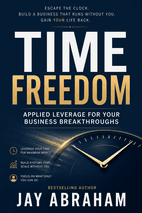
Jay Abraham's Time Freedom presents a framework for overworked entrepreneurs to break free from trading time for money, shifting from revenue-maintaining work to revenue-multiplying systems using concepts like the Toll Booth Position and power partnerships.
Feature
Insta.Page
Blinkist
Shortform
Summary Depth
Full Chapter-by-Chapter
15-min overview
Section-by-section guides
Audio Narration
✓ (AI narration)
✓
✓
Visual Mindmaps
✓
✕
✕
AI Q&A
✓ Voice AI
✕
✕
Quizzes
✓
✕
✕
PDF Downloads
✓
✕
✓
Price
$59.99/yr
$146/yr (PRO)
$199/yr
*Competitor data last verified February 2026.
About the Author
Jay Abraham
Jay Abraham is a renowned marketing strategist and author, best known for his influential book "Getting Everything You Can Out of All You've Got." He has consulted with over 10,000 businesses across 400+ industries, pioneering the concept of "guerrilla marketing" and focusing on exponential growth through strategic alliances and value creation. Abraham’s expertise in direct response marketing and his "Abraham Method" have made him a sought-after speaker and advisor to Fortune 500 companies and entrepreneurs alike.
1 Page Summary
Drawing entirely from the provided chapter summaries, this book presents a framework for business owners to break free from the trap of trading time for money. Its central thesis is that entrepreneurs must shift from revenue-maintaining work (which stops when they do) to revenue-multiplying systems that generate compounding returns and ongoing income. The author’s distinctive approach is to reframe the entrepreneur's role from being the engine of the business to its architect, using concepts like the Toll Booth Position—capturing value from transactions that occur regardless of one's direct involvement—and identifying underutilized assets such as past clients, proprietary systems, and professional relationships.
The book is structured through illustrative case studies, such as the consultant who became his own bottleneck by doing work his team could handle, and the executive who built a subscription model to replace feast-or-famine project revenue. Key methodologies include a brutal time audit, a three-question filter to find compounding work, a Reactivation System for past clients, and the creation of power partnerships to scale expertise. The book emphasizes that business leverage alone is insufficient, introducing Strategic Action and Abundance Tracking as personal frameworks to ensure that time freedom also leads to genuine satisfaction and happiness.
The intended audience is clearly the overworked entrepreneur or business leader who feels trapped by their own success, working long hours with no real freedom or scalability. Readers will gain a concrete Time Freedom Action Plan organized into three phases, providing a systematic path to move from working in their business to working on it. The ultimate takeaway is the ability to build a business that not only generates multiple revenue streams with less effort but also supports a fulfilling personal life, transforming the owner from a prisoner of their daily grind into an architect of lasting value and freedom.
The relentless grind of building a business often blinds owners to a dangerous truth: the very systems they created for success can become the cage that traps them. The journey to simplify begins with a brutal time audit, exposing how many hours are spent on revenue-maintaining rather than revenue-multiplying work. One consultant discovered that eighty percent of his effort went into tasks his team could handle, making him the biggest bottleneck in his own company. The solution wasn't to work harder but to ask a different question—not "How do I get more done?" but "What could I do that compounds returns?" That shift unlocked partnerships, licensing deals, and a franchise model, proving that generating returns that compound is the path to both growth and freedom.
But compounding isn't just about time; it's about the work itself. Another leader found that every project started from scratch, each one as exhausting as the first—a pattern that feels like pushing a boulder uphill forever. The breakthrough came from asking what activities build on each other rather than disappear. A simple three-question filter—Will this make next week easier? Will it stack on what's already built? Will it keep giving after one effort?—transformed disconnected sprints into a flywheel. A client success magazine, a delivery playbook, and a modular proposal library turned each engagement into an asset that made the next one faster and better. The result was not just higher revenue and shorter workweeks, but a dramatic jump in profit margins: compounding work is more profitable because the upfront investment keeps paying returns without consuming more energy.
Yet even the best systems are undermined by the wrong clients. A devastating personal loss forced a hard look at the client portfolio, revealing that a small fraction consumed the vast majority of stress, weekend work, and team turnover. The mathematics was clear: the revenue from these clients was eaten up by hidden costs, and the opportunity cost was immeasurable—lost time with family, lost health, lost life. Pruning the wrong clients became an act of honoring a loved one's memory. By slashing sixty percent of clients, revenue actually rose, profit margins nearly doubled, and workweeks dropped dramatically. A simple "Chris Test" now governs every prospect decision: Would this client respect your boundaries? Would you be excited to work with them on Christmas morning? Saying no to the wrong client is saying yes to the right life.
Ultimately, simplification leads to the deepest freedom: income that flows without constant effort. One entrepreneur owned millions in real estate and businesses yet had almost no cash and no time. His father's health scare revealed the trap of being asset-rich but cash-poor. The solution was a systematic implementation of multiple income streams—subscriptions, licensing, royalties, dividends, and options—each built sequentially. The first deals were agonizingly slow, but the principle held: the first ten sales are the hardest; by sale fifty, you're just taking orders. By month eighteen, four streams generated nearly $150,000 per month with just twenty-two hours of weekly work. The true measure of success wasn't the money but the ability to say yes to a trip to the park without calculating the cost. When income streams flow automatically, the business stops owning you, and you become free to build what matters.
Amedeo's Time ROI Trap
Amedeo ran a $15 million fintech consultancy, yet at 11:47 p.m. he was still hunched over spreadsheets, exhausted. He worked seventy-plus hours a week, feeling like he was drowning in a business that should have been a triumph. The root problem? He had never calculated the return on investment of his own time. When asked what his time was worth, he quoted his billing rate—but that missed the point entirely. He was stuck in what Jay Abraham and I call the Time ROI Trap: obsessing over money ROI while treating his hours as infinite.
The brutal math: Amedeo invested 3,640 hours a year maintaining a business that no longer needed his daily involvement. His team was capable, his systems solid, yet he had become the bottleneck. At a coaching call, Jay asked a devastating question: "If you disappeared for three months, would your business grow or shrink?" The honest answer was uncomfortable—it would probably grow, because his team would stop waiting for approval. He was the biggest constraint in his own company.
Amedeo decided to break out. He created a time audit with four columns: Revenue-Generating, Revenue-Multiplying, Revenue-Neutral, and Revenue-Destroying activities. Tracking his week revealed a painful imbalance: only 20% of his time went to high-impact work; 80% was maintenance. He began systematically eliminating and delegating. He canceled recurring meetings, stopped attending status updates, and implemented a project management system that gave his team autonomy.
The real breakthrough came when he shifted his question from "How do I get more done?" to "What could I do with my time that multiplies revenue instead of just maintaining it?" That led to three discoveries:
Big Partnerships – He blocked four hours every Wednesday to explore joint ventures. Within months, he signed a deal adding $2.3 million in annual revenue without hiring anyone.
Licensing Deals – A client asked to license his proprietary financial analysis framework. He formalized it, producing $288,000 per year in passive income.
Franchising – He began developing a professional services franchise model, aiming to scale from $15 million to $50 million without proportionally increasing his involvement.
Within six months, his firm's revenue grew 21% to $18.2 million while his work hours dropped 36%. He started working out, having dinner with friends, and treating every hour as an investment decision. The key insight: Generate returns that compound instead of consuming more of your life.
Phyllis's Starting-From-Scratch Trap
Phyllis ran a $14.2 million tech services company that was relentlessly busy but never got easier. Every project started from scratch. After 147 successful projects, project 148 felt as hard as project one. She called it the Starting-From-Scratch Trap—nothing compounded. Her work felt like Sisyphus pushing a boulder up a hill, only to watch it roll back down.
The turning point came from an unlikely source: her daughter Emma, who was rehearsing for Hamilton. Emma explained how theater compounds—each week builds on the last until opening night results in something magnificent. Phyllis realized her business was stuck in homework mode, where every assignment is separate and disappears. She asked the question that would transform her company: What if we only did activities that compound?
She called an emergency team meeting. They listed everything they did in two columns: Starting From Scratch versus Compounding. The ratio was crushing—90% started from scratch, only 10% compounded. Phyllis declared a new rule: Only do work that compounds. If an activity starts from scratch and ends at zero, transform it or stop doing it.
She created the Focus Card—a simple filter for compounding work. Before starting any task, they asked three questions:
Will this make next week easier, better, or more valuable?
Will it stack on what we've already built?
Will it keep giving after we build it once?
They launched a 90-day sprint centered on three compounding projects:
The Client Success Compendium – Transform scattered LinkedIn posts into a beautifully designed annual magazine, organized by industry. It became a flagship sales asset that cuts meeting time because prospects arrive informed.
The Delivery Playbook – Document the entire delivery framework so a new hire can operate at 80% quality with 20% training time.
The Proposal Library – Create a modular proposal system where 80% is pre-written excellence, only 20% customized. Proposal time dropped from eight hours to ninety minutes.
Each team leader took ownership of a compounding lane. Mike built a diagnostic tool that improved with every use. David made a video training library with a feedback loop—new hires add questions, strengthening the system over time. Olimpia wrote LinkedIn posts that fed into the quarterly magazine, which would eventually become an annual printed compendium.
The compounding ripple effect spread: every activity was filtered through the three questions. The business transformed from a series of disconnected sprints into a flywheel where each piece of work made the next piece easier, better, and more valuable. Phyllis proved you don't have to choose between quality and sanity—you just have to build once and benefit forever.
The Flywheel Starts Spinning
By Month 3, the compounding assets began reinforcing each other. Olimpia completed the Q1 Client Success Magazine—a 43-page compendium of twelve client projects with before-and-after metrics and client quotes. Phyllis printed fifty copies on premium paper and brought five to a meeting with a Fortune 500 prospect. Instead of emailing a PDF, she handed them a physical magazine. The prospect spent twenty minutes flipping through it, then said, “Most agencies send PowerPoints with three vague case studies. This feels substantial.”
When the prospect asked diagnostic questions, Phyllis pulled out The Clarity Diagnostic: “We’ve refined this through forty-seven client engagements. It takes forty-five minutes and will pinpoint exactly where your opportunities are.” The prospect agreed immediately. The diagnostic revealed three significant gaps. Phyllis didn’t write a custom proposal; she pulled from the modular proposal library—the 80% already proven and
Key concepts: Part I: Simplify
1. Part I: Simplify
The Time ROI Trap
Obsessing over money ROI while treating time as infinite
80% of time spent on maintenance, not multiplication
Shift from 'get more done' to 'compound returns'
Partnerships, licensing, and franchising multiply revenue
Compounding Work
Activities that build on each other create a flywheel
💡 Try clicking the AI chat button to ask questions about this book!
Chapter 2: Part II: Multiplying
Overview
Most entrepreneurs don’t realize they’ve built a cage made of gold. Arora managed $240 million for 87 clients, worked seventy hours a week, and couldn’t make it through a date without a panicked phone call. Her business generated six million dollars annually, but if she stopped working, the money stopped. Her friend Marcus drew a toll booth on a napkin and explained the difference between building a product and capturing a position. The Toll Booth Position means placing yourself inside transactions that already happen and getting paid each time they occur, whether you’re there or not. Arora had been digging for gold while standing on a mountain of diamonds: past clients, a proprietary system, professional relationships, underutilized staff, and deep niche expertise. Instead of creating another generic course, she reframed every business relationship with five questions—what keeps happening without me, who else wants access to what I control, what can I arrange once that pays me forever, where am I doing all the work while someone else captures the value, and how do I move from engine to architect.
The four streams that transformed her business began with a Reactivation System—a junior advisor ran a three-touch campaign for former clients, keeping 40% of the revenue. Costing just $4,200, it generated $430,500 for Arora in nine months while she spent only three hours on welcome calls. The Licensing Play turned her proprietary Three Aurora Method into a $2,000-per-month subscription for financial advisors in a specific niche, plus $75,000 annual partnerships with regional associations—$777,000 annually for forty hours of setup. The Referral Partnership Network captured value from referrals she had been giving away for free: proposing a 15% fee to top partners created $287,000 outbound income plus $423,000 in new assets from inbound referrals, with zero ongoing time. The Capacity Play restructured her team so junior advisors managed ongoing client relationships while she focused on complex planning and onboarding; her client-facing time dropped from fifty to twelve hours a week, client satisfaction rose, and her income held steady. Eighteen months later, Arora’s income climbed from $2.1 million to $3.8 million while her hours fell from seventy-plus to twenty-five to thirty per week. She walked into her daughter’s science fair without checking her phone, played tennis twice a week, and slept seven hours a night. She stopped being the engine and became the architect.
The universal principle is to stop trying to make passive income and instead position yourself where value already flows. Three paths to start today: reactivate dormant clients with a three-touch campaign expecting 5–12% reactivation; license your expertise by documenting your system and offering it to a specific niche; capture referral value by auditing past referrals, proposing formal fee arrangements, and making it systematic. Common mistakes include creating products instead of capturing positions, going too broad, doing it all yourself, starting too big, and forgetting to install the toll booth. Two critical errors are underpricing out of guilt—price based on the value of the transformation, not your discomfort—and waiting for perfect before launching. Sold beats perfect every time.
Seven common objections are dismantled: past clients include anyone who engaged, even without buying; uniqueness is revealed by asking clients what you do differently; referral fees can work within compliant structures like co-marketing; being too busy is exactly why this matters; previous failures with passive income were product creation, not residual positioning; clients want excellent results, not your specific presence; and "my business is different" is fear dressed as exceptionalism. Red flags to watch for: three months with zero revenue, income eating as much time as your main business, consistently unhappy partners, tiny revenue with massive complexity, and dreading the work.
The 90-day blueprint moves from audit and decision in weeks one through two, to design in weeks three through four, test in weeks five through eight, and scale in weeks nine through twelve. A 30-day First $5,000 Challenge offers a compressed sprint: identify your path in the first week, reach out to ten prospects in the second, close at least one deal in the third, and collect your first check in the fourth. The hardest shift is mental: from engine thinking—more hours equal more money, my value is in my doing—to architect thinking—my value is in design and positioning, systems create consistency, clients pay for outcomes, not my presence. There is no truly passive income, but income exists on a spectrum from high-touch to ultra-low-touch; the goal is decoupling income from hours.
Three pillars of exponential growth are increase sales volume through partnerships and outreach, increase the value of each sale through upsells and bundling, and increase purchase frequency by engineering reordering. A 10% improvement in each yields a 33% revenue increase. Diversification means building five to seven independent acquisition pillars—think of the Parthenon’s many columns supporting the roof—so no single failure cripples the business. Beyond diversification lies integration: deploying every pillar across every revenue stream creates a self-reinforcing ecosystem where cross-promotion compounds growth. Fifteen power pivots offer small changes that create massive shifts: marketing, strategy, product portfolio, supply chain, preeminence, target market, positioning, business model, branding, pricing, social media, competitive intelligence, lead generation, trying something new, and strategic partnerships.
Sticking point solutions address common traps. Losing to competition usually means sharper positioning is needed, not better products. Not selling enough demands consultative selling and joint ventures. Erratic volume calls for focusing on the top 20% of clients and cutting the bottom tier. Failing to strategize requires answering six fundamental questions about whom you serve, what they need, why they’re stuck, and what’s coming next. Doing what’s not working means thinking in first principles and borrowing from other industries. Being marginalized requires preeminence—be the one they think of. Insisting on doing it all yourself means delegating mediocre tasks and operating in the exponential zone.
The referral dependence trap is illustrated by Johann, whose $11.8 million practice built entirely on referrals gave him zero control over flow, creating a panic loop of feast or famine. He engineered a Repeat Referral System based on three principles from a country club membership director: make referring easy, rewarding, and habitual. His five-part framework included referral-worthy wow moments, timing invitations at four ideal moments, removing friction with pre-written emails and guides, expanding to strategic partners like estate planners, and following up systematically. Within six months, referrals jumped from zero to five per month up to twelve to fifteen, annual growth hit 45%, and he replaced anxiety with calm confidence. Fabiana escaped the premium prisoner trap by shifting from $450-per-hour billing to outcome-based pricing after realizing she captured only 4% of the value she created. She defined her primary offer as “smooth cash flows” instead of tax advisory, tested pricing, built a proprietary four-step delivery system trained junior consultants, and six months later saw revenue hit $3.7 million with her true hourly value rising to $2,200. Laia productized her expertise through knowledge archaeology—recording and transcribing her methodology, then packaging it into reusable assets. Her first digital diagnostic tool sold 47 copies in 90 days for $117,500 with zero additional time. She built five core products over twelve months, pushing revenue from $1.9 million to $2.3 million while $400,000 came from products requiring almost no ongoing time. Her expertise became a compounding asset serving thousands of employees without her personal presence, and she shifted from thinking like a service provider to thinking like a product company.
A bonus chapter presents 97 strategic levers organized into categories covering strategic clarity, mindset, exponential thinking, positioning, revenue architecture, innovation, marketing, client relationships, performance gaps, decision excellence, partnerships, financial intelligence, risk management, systems, leverage, communication, and continuous learning. Each lever offers a way to diagnose and amplify any part of a business.
Key Takeaways
Productizing transforms knowledge into a scalable asset that generates value independently.
Real freedom comes when the business grows beyond personal capacity.
The mental shift to a product company compounds expertise.
Maximize what works before scaling; optimize first, then multiply.
Key concepts: Part II: Multiplying
2. Part II: Multiplying
The Toll Booth Position
Place yourself inside existing transactions
Get paid each time, whether you're there or not
Stop digging for gold; you're on diamonds
Five questions to reframe business relationships
Four Revenue Streams That Transformed Arora's Business
Licensing Play: $2,000/month subscription for niche advisors
Referral Partnership Network: 15% fee on past referrals
Capacity Play: junior advisors manage clients, you focus
Three Paths to Start Today
Reactivate dormant clients with 3-touch campaign
License your expertise to a specific niche
Capture referral value with formal fee arrangements
Common Mistakes & Critical Errors
Creating products instead of capturing positions
Going too broad or doing it all yourself
Underpricing out of guilt
Waiting for perfect before launching
Mental Shift: From Engine to Architect
Engine: more hours = more money
Architect: value is in design and positioning
Systems create consistency, not your presence
Goal: decouple income from hours
Three Pillars of Exponential Growth
Increase sales volume through partnerships
Increase value per sale with upsells and bundling
Increase purchase frequency by engineering reordering
10% improvement in each yields 33% revenue increase
90-Day Blueprint & First $5,000 Challenge
Weeks 1-2: Audit and decide your path
Weeks 3-4: Design your toll booth
Weeks 5-8: Test with 10 prospects
Weeks 9-12: Scale and collect first check
⚡ You're 2 chapters in and clearly committed to learning
Why stop now? Finish this book today and explore our entire library. Try it free for 7 days.
Chapter 3: Part III: Compounding
Overview
The shift from trading time for money to building systems that multiply value is the core of this section. Kim discovered his project-based consulting punished him: every victory erased future revenue. The solution came from reframing transformation as an ongoing process, creating an Ongoing Strategic Partnership subscription model that smoothed his rollercoaster revenue and gave him clarity instead of fear. Across the Bay, Naomi faced a different trap—maxed out at seventy hours a week, she realized she couldn't scale her own expertise. Instead of trying to do everything, she engineered power partnerships with complementary experts like David Kim, transforming her business from a solo offering into a comprehensive cybersecurity network that generated multiple revenue streams from a single client relationship.
But technical systems aren't enough. Emma built the time freedom she craved, yet still wasn't happy until she developed Strategic Action—a personal framework to identify and protect the daily practices that create genuine energy and satisfaction. Her Abundance Tracking ritual rewired her attention toward progress, and within months her company grew while her happiness soared. This integration of business leverage and personal design is codified in a detailed Time Freedom Action Plan organized into three phases. Phase 1: Foundation Building requires brutal honesty about where time goes, a Focus Card system to protect your top priorities, aggressive elimination of low-ROI activities, and measurement to create momentum. Phase 2 moves into creating a scalable product from what you already deliver, documenting processes so you can delegate authority along with responsibility, and systematically building partnership networks. Phase 3 completes the picture with strategic action discovery, abundance tracking, life design integration through non-negotiable boundaries, and sustainable review practices that ensure transformation isn't a one-time event but continuous renewal.
The bonus material introduces Marcus, who learned the hard way that building alone is the costliest mistake. Instead of hiring six new executives, he partnered with an AI company, a European distributor, a complementary SaaS firm, and a training provider—zero new hires, transformative new capabilities. The hidden math is compelling: hiring gives you one person's time at high cost, while partnerships give you access to an entire organization's technology, market reach, and expertise. A comprehensive Partnership Menu lists 154 documented forms, from customer reach and operational cost reduction to innovation and market entry. The critical lesson came from Marcus's failed first partnership: paper beats promises, start small and scale smart, and culture compatibility trumps capability.
The three levers that change everything—increase number of customers, average transaction value, and purchase frequency—are illustrated through David, an architecture firm owner who nearly doubled revenue by rebuilding acquisition around referrals, selling outcomes instead of services, and converting projects into ongoing partnerships. But the deepest insight arrives through Scott's story: becoming an orchestrator, not a supplicant. His $2.5 million partnership took ten months of radio silence, budget freezes, and near-death experiences. He persisted by delivering value before the deal—sharing insights, making introductions, offering strategy. When the deal finally signed, it was bigger than envisioned. The real separator isn't technical deal-making skill but emotional resilience: the ability to stay engaged when months pass without visible progress, to see delay as an opportunity to demonstrate reliability, and to understand that the best partnerships, like trust, cannot be rushed.
The daily practice that compounds is quiet and unglamorous: sharing useful insights, making introductions, answering quick questions, being genuinely helpful without expecting immediate returns. Over time this builds a self-sustaining ecosystem. Every entrepreneur has potential partnerships hiding in plain sight—complementary service providers, platform companies, distribution partners. The question isn't whether opportunities exist, but whether you have the patience to navigate the zigzag path that turns them into enduring relationships. Start by identifying three potential partners, begin with value delivery, build relationships before you need them, and prepare for the long game. Escape the time-for-money trap not by working harder or charging more, but by orchestrating relationships that create leverage, recurring revenue, and exponential growth.
Key Takeaways
Create a scalable product from what you already do well, starting with a simple prototype and refining based on real use.
Delegate by documenting tasks, training with resources, and ensuring authority matches responsibility.
Partnerships compound faster than hiring: access capabilities through collaboration instead of building everything internally.
Never outsource your core differentiator or lose control of customer relationships and data.
Start partnerships small with clear agreements; cultural fit matters more than size or resources.
Your personal energy and satisfaction need the same systematic attention as your business—track, protect, and schedule what fuels you.
Stop being a supplicant; become an orchestrator. Shift from “Please give me this opportunity” to “Here’s how we can succeed together.”
Deliver value before the deal closes. Provide insights, introductions, and strategic help during the process.
Embrace the zigzag and systematize it. Meaningful partnerships take 12–18 months and will face delays and doubts.
Build emotional resilience. The best deals will test you. Stay engaged through silence and setbacks.
Key concepts: Part III: Compounding
3. Part III: Compounding
Ongoing Strategic Partnership Model
Shift from project-based to subscription revenue
Smooths rollercoaster income and reduces fear
Reframes transformation as continuous process
Power Partnerships
Scale by partnering with complementary experts
Generate multiple revenue streams per client
Avoid the trap of maxing out personal hours
Strategic Action & Abundance Tracking
Identify daily practices that create genuine energy
Rewire attention toward progress and satisfaction
Integrate business leverage with personal design
Time Freedom Action Plan Phases
Phase 1: Audit time, protect priorities, eliminate waste
Phase 2: Create scalable products and delegate authority
Phase 3: Discover strategic action and set boundaries
Partnerships Over Hiring
Building alone is the costliest mistake
Partnerships give access to entire organizations
Paper beats promises; start small and scale smart
Three Levers for Growth
Increase number of customers and referrals
Sell outcomes instead of services
Convert projects into ongoing partnerships
Emotional Resilience & Daily Compounding
Become an orchestrator, not a supplicant
Deliver value before the deal closes
Build relationships through consistent helpfulness
Frequently Asked Questions about Time Freedom
What is Time Freedom about?
This book guides entrepreneurs on breaking free from the trap of trading time for money by building systems that multiply value. It introduces a brutal time audit to distinguish revenue-maintaining from revenue-multiplying work, then shows how to create toll booth positions that generate income even when you're not working. The final part reveals how to compound freedom through subscription models, power partnerships, and personal rituals like Abundance Tracking. Overall, it's a practical playbook for shifting from being the engine of your business to its architect.
Who is the author of Time Freedom?
Jay Abraham, the author, is a business strategist whose insights in this book are drawn from real-world examples of entrepreneurs who transformed their businesses. His expertise lies in helping professionals stop trading time for money and instead build systems that generate returns that compound. The content reflects his deep understanding of leveraging existing assets and creating ongoing revenue streams.
Is Time Freedom worth reading?
This book is worth reading because it offers actionable frameworks like the Toll Booth Position and a three-question filter that immediately change how you think about work and time. It provides real case studies of entrepreneurs who reclaimed their lives by focusing on revenue-multiplying activities and power partnerships. The integration of business leverage with personal well-being makes it a unique guide for anyone seeking both growth and genuine freedom.
What are the key lessons from Time Freedom?
The first lesson is to conduct a time audit and use a three-question filter to ensure your activities build on each other rather than disappear. Second, identify your Toll Booth Position by finding where you can capture value from transactions that already happen, leveraging underutilized assets like past clients or expertise. Third, transform project-based work into ongoing subscription models or strategic partnerships that create multiple revenue streams from a single client relationship. Finally, protect your personal energy with rituals like Abundance Tracking to ensure your business growth also fuels your happiness.
📚 Explore Our Book Summary Library
Discover more insightful book summaries from our collection