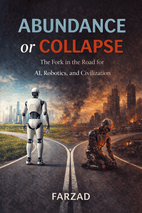
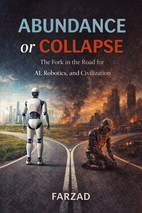
Abundance or Collapse: The Fork in the Road for AI, Robotics, and Civilization
Chapter 1
Chapter 1/4
Lang
1x
Voice
PDF
0:00
0:00
Abundance or Collapse: The Fork in the Road for AI, Robotics, and Civilization
by Farzad Mesbahi · Summary updated
What is the book Abundance or Collapse: The Fork in the Road for AI, Robotics, and Civilization about?
Farzad Mesbahi's Abundance or Collapse analyzes the pivotal fork facing civilization due to AI and robotics, mapping the systemic paths toward post-scarcity abundance or societal collapse. It is for policymakers, technologists, and citizens seeking to understand and influence this critical transition.
Feature
Insta.Page
Blinkist
Shortform
Summary Depth
Full Chapter-by-Chapter
15-min overview
Detailed analysis
Audio Narration
✓ (AI narration)
✓
✓
Visual Mindmaps
✓
✕
✕
AI Q&A
✓ Voice AI
✕
✕
Quizzes
✓
✕
✕
PDF Downloads
✓
✕
✓
Price
$59.99/yr
$146/yr (PRO)
$199/yr
*Competitor data last verified February 2026.
About the Author
Farzad Mesbahi
Farzad Mesbahi is an Iranian-American author and scholar whose work focuses on the intersection of spirituality, psychology, and self-development. He is best known for his book "The Art of Conscious Evolution," which explores practical pathways for personal and collective transformation. His expertise draws from a deep study of both Eastern wisdom traditions and Western psychology.
1 Page Summary
In Abundance or Collapse: The Fork in the Road for AI, Robotics, and Civilization, Farzad Mesbahi presents a stark analysis of the pivotal juncture at which humanity stands due to accelerating technological change. The central thesis is that the convergence of artificial intelligence, robotics, and other transformative technologies is not leading to a single, inevitable future, but rather creating a fundamental fork in the road. One path leads toward a post-scarcity "Age of Abundance," where automation liberates humanity from menial labor and solves grand challenges. The other path spirals toward societal "Collapse," characterized by mass unemployment, extreme inequality, and potential loss of human agency and purpose. Mesbahi argues that which future we realize depends less on the technology itself and more on the economic, political, and ethical choices we make today.
The book's distinctive approach lies in its systemic, interdisciplinary framework, examining the technological trajectory not in isolation but through the interconnected lenses of economics, sociology, geopolitics, and philosophy. Rather than a purely technical forecast, it is a work of strategic foresight that maps out the cascading second- and third-order consequences of widespread automation. Mesbahi emphasizes the critical feedback loops between technology deployment, labor market dynamics, wealth distribution, and social stability, contending that our current institutions and economic models are dangerously ill-equipped to manage the coming transition, thereby making collapse a plausible outcome if proactive measures are not taken.
This book is intended for a broad audience of concerned citizens, policymakers, business leaders, and technologists who seek to move beyond simplistic utopian or dystopian narratives. Readers will gain a structured understanding of the high-stakes forces shaping our collective future and the key leverage points for intervention. The core takeaway is an urgent call to action: to consciously design new social contracts, economic systems (potentially exploring models like universal basic income), and governance frameworks for intelligent machines to steer civilization toward the path of shared abundance rather than catastrophic disruption.
Chapter 1: Chapter 1
Overview
We stand at a critical juncture, facing a stark choice between a future of abundance and one of collapse. This pivotal moment is being forged by the powerful merger of three forces—Artificial Intelligence, robotics, and energy—which are not separate trends but parts of one accelerating event: The Convergence. These technologies are deeply intertwined, each solving the other's core constraints. AI needs vast amounts of energy to power its compute; robotics are physical AI requiring both intelligence and power; and new energy systems are being designed and built by AI and robots. This interdependence creates a unique, self-improving system where each element accelerates the others in a feedback loop more powerful than any past technological revolution.
This dynamic operates like a relentless flywheel. As AI advances, it designs better energy systems and more capable robots. Those robots then build the infrastructure for more abundant energy and manufacture more advanced hardware. Cheaper, cleaner energy, in turn, powers more AI development. This cycle is already spinning, driven by an economic principle known as Wright's Law, where costs plunge exponentially with each doubling of production. Most people, thinking in linear terms, drastically underestimate how fast this will change our world, with seismic shifts projected within years, not decades.
While many companies, from NVIDIA to Amazon, are building crucial pieces, a uniquely integrated view emerges through the lens of Tesla and the broader Musk ecosystem. Here, Tesla’s real-world AI and robotics, xAI’s intelligence, and SpaceX’s infrastructure combine into a coordinated testbed for The Convergence. However, the transformation does not depend on any single entity; the flywheel’s momentum is building across the global economy.
The ultimate promise is a world where fundamental constraints on labor, energy, and intelligence relax, making basic needs trivial to meet and unlocking unprecedented potential. Yet this promise comes with a period of intense peril and disruption. The same technologies creating abundance will rapidly displace millions of jobs, challenging the very link between work and survival. The critical questions are no longer about stopping this change—which is presented as an economic certainty—but about managing the turbulent transition. How will we distribute the benefits? How do we structure society? This chapter sets the stage for understanding these forces, arguing that preparation is essential to navigate the coming upheaval and reach a future defined not by scarcity, but by possibility.
The Civilizational Fork in the Road
We are presented with a stark, binary choice for our future: a path toward abundance or one leading to collapse. This fork is being shaped by the intertwined forces of Artificial Intelligence, robotics, and energy. Together, they possess the power to eradicate scarcity, amplify human potential, and make basic needs trivial to meet. Conversely, they could also concentrate power destructively, render billions economically obsolete, and tear society apart. The central argument is that we are not witnessing three separate technological revolutions, but one singular, accelerating event: The Convergence.
The Three Threads That Are Actually One
The common mistake is to analyze AI, robotics, and energy in isolation. In reality, they form a deeply interconnected system:
AI requires massive compute power, which is fundamentally constrained by energy availability.
Robotics are AI with a physical form; they require intelligence (AI), cheap manufacturing, and reliable power (energy) to scale.
Energy infrastructure (solar, batteries, grids) is increasingly optimized by AI and will be installed/maintained by robots.
This interdependence creates a powerful feedback loop. A pivotal example is the merger of SpaceX and xAI, aimed at deploying a million AI-powered satellites in space. This move capitalizes on infinite solar energy to power AI compute clusters 24/7, beaming intelligence back to Earth and bypassing terrestrial limitations.
A System That Improves Itself
This situation is historically unique. Past revolutions like electricity or the internal combustion engine were transformative but passive; they could not redesign themselves. The Convergence is categorically different because it creates a self-improving system.
AI can participate in designing better AI.
Robots can help manufacture better robots.
AI-optimized energy systems become cheaper, enabling more AI and robotics.
This removes human innovation speed as the primary constraint on technological progress, launching us into uncharted territory of exponential advancement.
The Flywheel in Action
The Convergence operates as a self-reinforcing "flywheel," where each component accelerates the others:
AI Advancement: Current AI systems need more compute and energy to improve. They are also becoming producers of energy solutions, optimizing grids, discovering new battery materials, and improving solar efficiency.
Robotic Deployment: AI intelligence is scaling into physical robots (e.g., Tesla Optimus). These robots will manufacture, install, and maintain the very infrastructure of the Convergence—solar panels, batteries, data centers, and even more robots.
Energy Abundance: Cheaper, more plentiful energy (accelerated by AI and robotics) powers more AI development, which further optimizes energy systems.
The cycle is already beginning, with each revolution of the wheel promising to spin faster than the last.
A First Principles Framework
To understand the Convergence's potential, one must move beyond reasoning by analogy (e.g., "this boom will bust like the internet boom"). Instead, first principles thinking is required—breaking the system down to its fundamental truths:
The core constraint on AI is compute, which requires energy.
The core constraint on robotics is manufacturing scale and intelligence, both addressed by AI.
The core constraint on energy is cost and installation, both addressed by robotics.
Tracing these interconnected constraints reveals why progress in one area creates cascading breakthroughs in the others. The power lies in the systemic feedback loop, not in any single technology.
The Timeline Most People Underestimate
Human psychology and linear extrapolation cause most to dramatically underestimate the speed of the Convergence. The pattern observed with technologies like Tesla's electric vehicles and Full Self-Driving is repeating: the "impossible" happens faster than critics expect.
We are not looking at change over decades, but over years. The early stages are happening now. A projected timeline suggests:
By the end of 2027: AI capable of performing 80% of digital tasks at a top-20% human level; robots moving beyond factory floors.
By 2030: A world dramatically reshaped—industries transformed, entire categories of work eliminated, and new opportunities created.
The pace is accelerating, not slowing.
The Convergence Beyond Any Single Company
This transformation does not hinge on one company's success. The flywheel will spin regardless of which specific entities lead it. Multiple players are building crucial pieces:
NVIDIA supplies the foundational compute hardware (the "picks and shovels") to the entire AI industry.
Amazon integrates AI (AWS), robotics (warehouse automation), and physical logistics infrastructure.
BYD demonstrates formidable vertical integration in batteries and manufacturing.
Figure AI, Boston Dynamics, Sanctuary AI are advancing the humanoid robotics field alongside Tesla.
The thesis is robust; one can position for the Convergence without betting on a single winner.
The Central Role of Tesla & The Musk Ecosystem
While multiple companies participate, Tesla (and the broader Musk ecosystem) holds a uniquely integrated position across all three Convergence threads:
AI: Tesla's Full Self-Driving network is a massively scaled, real-world AI system learning from millions of vehicles.
Robotics: The Optimus program applies Tesla's AI and scaled manufacturing expertise to humanoid robots.
Energy: Tesla Energy is a major global player in battery storage and solar.
This vertical integration allows optimizations to flow directly across the stack. Furthermore, the ecosystem architecture extends beyond Tesla:
xAI is the Brain: The intelligence layer, trained on unique data from Tesla vehicles and the X platform.
SpaceX is the Vessel: The infrastructure layer, providing cheap space access for orbiting AI data centers and global connectivity.
Tesla is the Body: The physical layer, where AI meets the tangible world through cars, robots, and energy products.
Controlled by a single visionary, this ecosystem can coordinate feedback loops (data from Tesla vehicles training xAI, SpaceX launching AI satellites powered by solar energy) in a way no disconnected set of companies can replicate. It is a testable, visible proxy for understanding the forces of the Convergence as they unfold.
The Flywheel of Falling Costs
The text introduces Wright's Law as a core mechanism powering The Convergence. This principle—where costs fall by a consistent percentage with every cumulative doubling of production—creates a powerful economic flywheel. As each element (batteries, solar, compute) scales, it becomes cheaper; as it becomes cheaper, it is deployed more widely, driving further production and even steeper cost reductions. Most analysts, looking at linear progress, underestimate how rapidly this flywheel accelerates when these technological curves interact. Companies like Tesla, which position themselves to ride multiple Wright's Law curves simultaneously, operate on a fundamentally different and steeper trajectory than their competitors.
The Promise and Peril of Transition
The ultimate stakes of The Convergence are framed as a forcing function for a future of abundance. The relaxation of fundamental constraints on labor, energy, and intelligence could unlock unprecedented access to housing, water, education, and healthcare, potentially lifting the global population out of poverty through economics, not charity. However, this promise is paired with a stark warning about imminent and chaotic disruption. The same technologies creating abundance will displace millions of workers in both physical and cognitive fields at a pace that will shock societies built around traditional career identities.
The author expresses deep concern that current discourse is asking the wrong questions. The debate is no longer if AI and robotics will replace jobs—that outcome is presented as an economic certainty. The critical questions are societal: How do we distribute the benefits of abundance? How do we structure society when the link between work and survival is broken? The transition period, estimated at 1-5 years of extreme upheaval, will see entire industries and job categories vanish rapidly. The author suggests Western individualistic societies, particularly the US, will struggle more with this disruption than more communal ones.
A Roadmap for Understanding
The chapter concludes by outlining the book's structure, which will dissect The Convergence in three parts: an examination of the core technologies (AI, robotics, energy), an analysis of the resulting disruption and geopolitical race, and finally a guide to finding opportunity and positioning oneself for the changes ahead. The author's stated goal is to equip readers to understand, prepare for, and benefit from this inevitable transformation, rather than be crushed by it.
Key Takeaways
Wright's Law is the engine: Exponential cost reductions in batteries, solar, and compute are not linear but accelerate with scale, creating a powerful economic flywheel that most analysts underestimate.
Abundance is the goal, disruption is the path: The Convergence aims at a future of radically cheaper labor, energy, and intelligence, but the transition will be devastatingly disruptive for millions whose jobs become economically obsolete.
Asking the wrong questions: The critical debate is no longer about preventing technological displacement but about managing its aftermath—redesigning society, economics, and meaning in an age of potential abundance.
Prepare for a chaotic transition: The shift will happen in years, not generations, disproportionately impacting Western societies and demanding urgent, conscious preparation from individuals to avoid being blindsided.
Key concepts: Chapter 1
1. Chapter 1
The Civilizational Fork in the Road
Humanity faces a binary choice between a future of abundance or collapse
The outcome depends on how we manage the intertwined forces of AI, robotics, and energy
We are witnessing one singular accelerating event called The Convergence, not three separate revolutions
These technologies can either eradicate scarcity or concentrate power destructively
The Three Interdependent Forces
AI requires massive compute power fundamentally constrained by energy availability
Robotics are physical AI requiring intelligence, manufacturing, and reliable power
Energy infrastructure is increasingly optimized by AI and built/maintained by robots
SpaceX-xAI merger exemplifies this: using space-based solar to power AI compute clusters
The Self-Improving System
The Convergence creates a historically unique self-improving feedback loop
AI can participate in designing better AI architectures
Robots can help manufacture more advanced robots
AI-optimized energy systems become cheaper, enabling more AI and robotics
Removes human innovation speed as primary constraint on progress
The Flywheel Mechanism
AI advancement drives better energy solutions and robotic intelligence
Robotic deployment builds and maintains the infrastructure of abundance
Energy abundance powers more AI development and robotic operations
Each revolution of the wheel accelerates faster than the last
Driven by Wright's Law: costs plunge exponentially with production scaling
The Transition Challenge
Technologies will rapidly displace millions of jobs, challenging work-survival link
Change is presented as an economic certainty that cannot be stopped
Critical questions shift to distribution of benefits and societal restructuring
Preparation is essential to navigate upheaval and reach abundance future
Most people underestimate the speed of change due to linear thinking
The Interlocking Core Constraints
AI's primary constraint is compute, which depends on energy availability.
Robotics' primary constraints are manufacturing scale and intelligence, both solvable by AI advancements.
Energy's primary constraints are cost and installation, both solvable by robotics automation.
Progress in one area creates cascading breakthroughs in the others through a systemic feedback loop.
The Underestimated Timeline of Change
Human psychology and linear thinking cause dramatic underestimation of the Convergence speed.
Change is projected in years, not decades, with acceleration being the norm.
By 2027: AI performing 80% of digital tasks at top-20% human level; robots expanding beyond factories.
By 2030: A world dramatically reshaped with transformed industries and eliminated work categories.
The Multi-Company Convergence Landscape
The transformation does not depend on any single company's success.
NVIDIA provides foundational compute hardware for the AI industry.
Amazon integrates AI, robotics, and physical logistics in its operations.
Companies like BYD, Figure AI, and Boston Dynamics advance key pieces of the puzzle.
Tesla & The Musk Ecosystem's Unique Integration
Tesla holds a uniquely integrated position across AI, robotics, and energy.
The ecosystem architecture: xAI as the brain, SpaceX as the vessel, Tesla as the body.
Vertical integration allows optimizations to flow directly across the technological stack.
Controlled coordination enables testable feedback loops unmatched by disconnected companies.
The Economic Flywheel of Wright's Law
Wright's Law drives cost reductions with each cumulative doubling of production.
This creates a powerful economic flywheel: scaling reduces costs, enabling wider deployment.
Most analysts underestimate acceleration when multiple technological curves interact.
Companies riding multiple Wright's Law curves operate on fundamentally steeper trajectories.
The Dual Promise and Peril of Transition
The Convergence promises abundance by relaxing constraints on labor, energy, and intelligence.
Simultaneously, it threatens chaotic disruption through rapid displacement of workers.
The critical questions are societal: distributing benefits and restructuring society post-work.
Western individualistic societies may struggle more with disruption than communal ones.
Roadmap for Navigating The Convergence
The book's structure examines core technologies, resulting disruption, and finding opportunity.
Goal is to equip readers to understand, prepare for, and benefit from the transformation.
Focus shifts from debating if jobs will be replaced to addressing how society adapts.
Emphasis on positioning oneself to avoid being crushed by inevitable change.
The Economic Engine of Convergence
Wright's Law drives exponential cost reductions in foundational technologies like batteries, solar, and compute.
Cost reductions accelerate with cumulative production scale, creating a self-reinforcing economic flywheel.
This non-linear progress is systematically underestimated by traditional linear forecasting models.
The Goal and the Path of Disruption
The ultimate objective is a future of radical abundance in labor, energy, and intelligence.
The transition to this abundance will be achieved through devastating economic disruption.
Jobs and industries will become obsolete not due to lack of skill, but because their economic value is undercut by cheaper technological alternatives.
Reframing the Critical Societal Debate
The central question is no longer how to prevent technological displacement, as this is now inevitable.
The essential debate must shift to managing the societal aftermath of widespread economic obsolescence.
Society must redesign its economic structures, social contracts, and concepts of meaning and purpose in an age of potential abundance.
The Nature and Urgency of the Transition
The disruptive shift will occur on a timescale of years or decades, not generations.
Western societies, with their high labor costs, will feel the impact disproportionately and first.
Conscious, urgent preparation at both individual and societal levels is critical to avoid being blindsided by the speed of change.
Scroll to load interactive mindmap
If you like this summary, you probably also like these summaries...
💡 Try clicking the AI chat button to ask questions about this book!
Chapter 2: Chapter 2
Overview
The author begins by openly acknowledging a significant personal investment in Tesla, both financially and as a consumer, setting the stage for a deeply conviction-driven analysis. His central thesis is clear: he believes Tesla is positioned to dominate the future of autonomous driving. This belief isn't rooted in mere preference, but in what he argues is a fundamental and unassailable strategic advantage playing out in real time.
That advantage is framed as a live, global experiment. While competitors operate limited, geofenced fleets, millions of Tesla vehicles are already on roads everywhere, constantly feeding billions of miles of diverse, real-world driving data into the company's neural networks. This creates a powerful data flywheel that allows the system to learn and adapt at a scale no one else can match. The author contrasts this with approaches like Waymo's, which rely on meticulous pre-mapping of specific areas. Tesla's strategy, he argues, is to build a system that understands driving universally, making it inherently scalable to any road without prior preparation.
This leads directly to the pivotal question of scalability. The debate isn't about who has a functional robotaxi in one city today, but who can deploy a global network. Here, Tesla's core business gives it a staggering edge: its ability to manufacture millions of vehicles annually versus a competitor's capacity for thousands. This isn't just about future robotaxis; it's underscored by a powerful "car sales hedge." Even if full autonomy faces delays, Tesla is already selling increasingly capable cars, generating revenue and gathering more data regardless of the regulatory timeline.
The economic potential of scaling this technology is presented as transformative. The cost to operate a Robotaxi could fall to a fraction of today's ride-hailing services, creating massive margins. This efficiency will be turbocharged by a purpose-built, steering-wheel-less Cybercab, designed solely for autonomous rides to minimize costs.
A common skepticism—that regulators will halt progress—is addressed directly. The author contends that while regulatory approval will be a state-by-state process, the overwhelming moral and economic imperative of saving lives and reducing costs will ultimately prevail once the safety data becomes undeniable. The technology itself is explained as a paradigm shift from old-school, rules-based programming to an end-to-end neural network. This AI doesn't follow pre-written code for every scenario; it learns from immense datasets, developing a driving intuition that improves and generalizes with more experience.
The narrative suggests we are at an inflection point, with software like FSD Version 14 representing a dramatic leap in capability. With next-generation AI hardware coming, the author predicts the visible, large-scale deployment of unsupervised Tesla Robotaxis is imminent, making the scalability advantage obvious to all.
Ultimately, the chapter zooms out to frame this not just as a corporate competition, but as the first major wave of AI displacing human labor in the physical world. The arrival of full self-driving promises immense societal benefits—far safer roads and drastically cheaper transportation. Yet, it will also inevitably displace millions of driving-related jobs in a short timeframe. This dual outcome of tremendous net benefit coupled with significant disruption is presented as the defining pattern of the coming age, with Tesla's autonomous driving race serving as the powerful, real-world proof of concept.
The Author's Bias and Conviction
The chapter opens with a frank disclosure: the author is heavily invested in Tesla, owning both the stock and the cars. While he acknowledges this bias and encourages healthy skepticism, he states his core conviction: Tesla is going to win the autonomous driving race. His argument hinges not on brand loyalty, but on what he sees as an insurmountable strategic and technological advantage that is already playing out on roads globally.
The Live, Global Experiment
Tesla’s critical advantage is framed as a massive, real-time experiment. While competitors operate controlled fleets, millions of Tesla vehicles are already on roads worldwide, collecting data from billions of miles of real-world driving. This continuous data stream—from routine maneuvers to rare "edge cases"—feeds directly into Tesla's neural network, allowing it to learn and improve constantly. The author contrasts this with Waymo’s impressive but geographically limited approach, which relies on pre-mapped, centimeter-accurate HD maps of specific zones. Tesla’s system, he argues, is designed to understand driving like a human, making it scalable to any road, anywhere, without prior mapping.
A Question of Scale and Strategy
The debate isn't about who has a functional Robotaxi service today, but who can scale. The author presents a stark comparison: Tesla’s manufacturing capacity of ~2 million vehicles per year versus Waymo’s capacity of ~10,000. This 200x advantage means Tesla could theoretically deploy Robotaxi fleets faster and more broadly than any competitor. Furthermore, Tesla holds a powerful "car sales hedge": even if the Robotaxi network faces delays, they are already selling cars with increasingly capable self-driving software, creating a unique value proposition and a steady stream of revenue and data regardless of regulatory timelines.
The Staggering Economics of Robotaxis
When Robotaxis do scale, the economic disruption will be profound. The author estimates the cost to operate a self-driving vehicle will plummet to around 30 cents per mile, compared to the current average fully-loaded cost of $2.80 per mile for a human-driven Uber. This cost advantage isn't marginal—it's transformative. A Tesla-operated network charging passengers $1.50 per mile would generate massive margins. This efficiency will be further amplified by the purpose-built Cybercab, a steering-wheel-less vehicle designed solely for autonomous rides, which will lower manufacturing costs and operating expenses even further.
The Inevitable Regulatory Path
A common counter-argument—that regulators will block progress—is addressed head-on. The author argues that while regulatory friction is real, it is ultimately outweighed by the technological reality and moral imperative. With ~40,000 annual U.S. traffic fatalities largely due to human error, once self-driving systems demonstrably prove to be safer (a trend supported by Tesla’s and Waymo’s published safety data), the regulatory question shifts from "Should we allow this?" to "Can we afford not to?" He anticipates a patchwork, state-by-state approval process that builds momentum as the safety and economic benefits become undeniable.
How the Technology Actually Works
The author explains the fundamental technological difference between the old and new approaches. Legacy autonomous systems are rules-based, requiring programmers to manually code for countless driving scenarios—a task that becomes infinitely complex. Tesla’s system is an end-to-end neural network. Instead of following rules, it is trained on vast amounts of video and driver data, learning to associate visual inputs with appropriate driving actions, much like a human develops intuition. This approach inherently scales and improves with more data, as new scenarios simply become additional training examples.
The Approaching Inflection Point
The narrative points to a current inflection point with FSD Version 14, described as a dramatic leap in smoothness and capability over previous versions. With the next-generation AI hardware (AI5) on the horizon, the author believes the progress toward reliable, unsupervised operation is accelerating. He predicts that within months of the book’s 2026 publication, metropolitan areas will begin seeing significant deployments of unsupervised Tesla Robotaxis, making the scale advantage viscerally apparent.
The Bigger Picture: The First Major Wave of Displacement
Finally, the chapter zooms out to the core thesis: FSD is the proof-of-concept for AI replacing human labor at scale in the physical world. It will bring immense benefits—saving tens of thousands of lives annually and drastically reducing transportation costs. However, it will also directly displace millions of driving-related jobs in a matter of years, not decades. This dual outcome—tremendous net benefit coupled with significant worker displacement—is presented as the defining pattern of The Convergence, a forcing function that will repeat across industries. FSD is the canary in the coal mine for the broader societal and economic shifts to come.
The Scalability Question
The competitive landscape hinges on a critical question: does early technical perfection outweigh the ability to scale globally? While Waymo's operational geofenced robotaxis are impressive, their path to nationwide deployment faces significant hurdles. They must either undertake the monumental task of mapping the entire world or develop a generalizable AI capable of navigating unmapped areas—the very problem Tesla is solving. Google's resources are vast, but they cannot purchase Tesla's fundamental advantage: billions of real-world training miles generated daily by its existing fleet.
Waymo essentially has two scaling paths, both fraught with difficulty. The first is to become a vehicle manufacturer at a scale of millions of units per year, a task requiring years, untold billions, and expertise that money alone cannot quickly buy. The second is to license their technology to established automakers, which creates a dependency problem. Major manufacturers may be reluctant to cede control of their vehicle's core functionality to a tech partner like Google. This same strategic dilemma applies to all other players in the field, from GM's Cruise to potential Chinese competitors. The data flywheel created by a massive, real-world fleet presents a moat that is increasingly difficult to cross.
The Timeline Debate
Addressing the skepticism around timelines is crucial. Predictions in the autonomous vehicle space have a notorious history of being overly optimistic and missed. However, conflating "taking longer than expected" with "never happening" is a critical error. The technology is undeniably arriving—v14 software demonstrates near-unsupervised capability, regulatory approvals are progressing, and initial robotaxi networks are launching.
The unique aspect of Tesla's deployment model is what makes rapid scaling plausible. The company already has millions of vehicles on the road capable of becoming robotaxis with a simple software update. Unlike any traditional hardware rollout, scaling does not require building new factories or shipping new products. Once regulatory approval for unsupervised operation is granted in a major market, deployment could be almost instantaneous. This potential for near-instantaneous global scaling is unprecedented and a factor often underestimated by skeptics.
Key Takeaways
The central competitive battleground is scalability, not just localized technical competence. A solution that works perfectly in one city but cannot be deployed everywhere is at a strategic disadvantage.
Tesla's data advantage, fueled by billions of real-world miles from its existing fleet, creates a compounding moat that is exceptionally difficult for competitors to replicate, regardless of their financial resources.
Vertical integration—controlling the vehicle, AI, software, and hardware—provides a cohesive advantage that "horizontal" players partnering across companies struggle to match.
While timelines have historically been optimistic, the nature of software deployment means scaling can happen with unprecedented speed once key thresholds are crossed, as the required hardware is already in place globally.
FSD serves as a microcosm of the broader AI transition: it promises massive societal benefit (safer, cheaper transportation) but simultaneously guarantees significant workforce disruption, forcing a societal choice between abundance and collapse.
Key concepts: Chapter 2
2. Chapter 2
Author's Conviction and Thesis
Author discloses significant personal investment in Tesla (financial and as consumer)
Core thesis: Tesla is positioned to dominate the future of autonomous driving
Belief rooted in fundamental strategic advantage, not mere preference
Encourages skepticism while presenting conviction-driven analysis
Tesla's Data Flywheel Advantage
Live, global experiment with millions of vehicles on roads worldwide
Billions of miles of diverse, real-world driving data feeding neural networks
Contrast with competitors' geofenced, pre-mapped approaches (e.g., Waymo)
System designed to understand driving universally for inherent scalability
Scalability and Manufacturing Edge
Key question: who can deploy a global robotaxi network, not just local service
Tesla's manufacturing capacity (~2M vehicles/year) vs. competitors (~10K)
200x advantage in potential fleet deployment speed and breadth
Car sales hedge: revenue and data collection continue even with autonomy delays
Economic Transformation Potential
Robotaxi operating costs could fall to fraction of current ride-hailing services
Massive profit margins from autonomous ride networks
Purpose-built Cybercab (steering-wheel-less) designed to minimize costs
Transformative impact on transportation economics
Technological Paradigm Shift
Shift from rules-based programming to end-to-end neural networks
AI learns from immense datasets, developing driving intuition
FSD Version 14 represents dramatic leap in capability
Next-generation AI hardware enabling imminent large-scale deployment
Regulatory and Societal Implications
Regulatory approval will be state-by-state process, not blanket halt
Moral and economic imperative (saving lives, reducing costs) will prevail
First major wave of AI displacing human labor in physical world
Dual outcome: tremendous net benefits coupled with significant job displacement
The Economic Disruption of Robotaxis
Operating costs for self-driving vehicles could plummet to ~30 cents per mile versus $2.80 for human-driven rideshare
A Tesla-operated network charging $1.50 per mile would generate massive profit margins
Purpose-built Cybercabs without steering wheels will further reduce manufacturing and operating costs
The cost advantage isn't marginal but transformative for transportation economics
Regulatory Inevitability and Moral Imperative
Regulatory friction exists but is outweighed by technological reality and safety benefits
With ~40,000 annual U.S. traffic fatalities from human error, regulators face moral pressure to approve safer systems
Approval will follow a state-by-state patchwork process as safety data becomes undeniable
The regulatory question shifts from 'Should we allow this?' to 'Can we afford not to?'
Technological Approach: Rules-Based vs. Neural Networks
Legacy systems use rules-based programming requiring manual coding for countless scenarios
Tesla's system uses end-to-end neural networks trained on vast video and driver data
The neural network learns to associate visual inputs with driving actions like human intuition
This approach inherently scales and improves with more data as new scenarios become training examples
The Competitive Scaling Advantage
Tesla's fundamental advantage is billions of real-world training miles from its existing fleet
Waymo faces two difficult scaling paths: becoming a vehicle manufacturer or licensing technology
Major automakers may resist ceding core functionality to tech partners like Google
The data flywheel from Tesla's massive fleet creates an increasingly difficult moat to cross
The Deployment Timeline and Scaling Model
FSD Version 14 represents a dramatic leap in capability toward unsupervised operation
Tesla's deployment model enables rapid scaling via software updates to existing vehicles
Scaling doesn't require new factories or products once regulatory approval is granted
Potential for near-instantaneous global scaling is unprecedented and often underestimated
FSD as Proof-of-Concept for AI Labor Displacement
FSD represents the first major wave of AI replacing human labor in the physical world
Will bring immense benefits: saving tens of thousands of lives and reducing transportation costs
Will directly displace millions of driving-related jobs in years, not decades
This dual outcome—net benefit with worker displacement—is the defining pattern of The Convergence
The Scalability Imperative
The central competitive battleground is scalability, not just localized technical competence.
A solution that works perfectly in one city but cannot be deployed everywhere is at a strategic disadvantage.
Software deployment enables scaling with unprecedented speed once key thresholds are crossed, as hardware is already in place globally.
Structural Competitive Advantages
Tesla's data advantage, fueled by billions of real-world miles, creates a compounding moat difficult to replicate.
Vertical integration—controlling vehicle, AI, software, and hardware—provides a cohesive advantage.
Horizontal players partnering across companies struggle to match the integration of vertical players.
FSD as a Microcosm of AI Transition
Full Self-Driving represents the broader AI transition in a specific application.
It promises massive societal benefits including safer and cheaper transportation.
It simultaneously guarantees significant workforce disruption and forces a societal choice between abundance and collapse.
Scroll to load interactive mindmap
⚡ You're 2 chapters in and clearly committed to learning
Why stop now? Finish this book today and explore our entire library. Try it free for 7 days.
Chapter 3: Chapter 3
Overview
Imagine a market worth over $40 trillion annually—the total global value of human physical labor. This isn't a distant sci-fi concept but the staggering economic reality framing the race to build a useful humanoid robot. Replacing even a fraction of this work with machines represents the largest commercial opportunity in history, dwarfing entire industries like automotive or smartphones.
Skepticism is natural, often rooted in past failures or the perception of humanoids as mere publicity stunts. History is full of impressive mechanical prototypes that went nowhere because they tackled the body before the brain. The critical shift in thinking is that Optimus is fundamentally an AI project with a physical form. Its intelligence isn't starting from scratch; it's built directly upon the neural networks developed for Tesla’s Full Self-Driving (FSD) system. The same core problem—using cameras to perceive the world and output physical actions—applies, whether commanding a car or coordinating limbs. This gives Tesla a monumental head start on the software intelligence that has always been the true bottleneck.
This AI advantage is supercharged by a proven flywheel of scale. Just as FSD improved exponentially by learning from millions of miles of real-world driving, each deployed Optimus unit will generate priceless data. More data creates smarter robots, enabling more complex tasks and wider deployment, which in turn generates even more data. Tesla’s unmatched manufacturing prowess—the ability to design and produce millions of complex systems—transforms this from a lab experiment into a scalable product.
The deployment pathway starts simple. Initial versions will perform basic, repetitive tasks in controlled environments like Tesla’s own factories. This isn't just about immediate utility; it's about bootstrapping that data flywheel in a safe setting. The economics quickly become compelling. At a projected manufacturing cost of $20,000-$30,000, a single robot could cost less than one year's fully-loaded expense for a human worker, yet operate for years, improve via software, and work tirelessly. This creates an irresistible forcing function for adoption across logistics, agriculture, construction, and healthcare.
However, the vision is grounded in significant risks and real-world hurdles. Timelines are famously optimistic, and the regulatory maze for certifying intelligent machines working alongside people is uncharted territory. The mechanical challenge of dexterous manipulation remains immense, and capable competitors are emerging. While the internal factory rollout is expected within a few years, expanding to partner industries and eventually mainstream use is a decade-long journey.
Ultimately, this technology is a catalyst with two possible futures. Optimus makes the $40 trillion labor market contestable, potentially unlocking an age of abundance where physical work constraints vanish. Yet, the same force could cause severe economic displacement and strife. The outcome hinges not on the technology itself, but on how society manages the transition. This looming revolution in labor naturally leads to the next critical question: where will the colossal energy needed to power this new world of AI and robots come from?
The Immense Scale of the Opportunity
The chapter immediately grounds the discussion of humanoid robots in a staggering economic reality: the global market for human labor exceeds $40 trillion annually. This encompasses virtually all physical work—from manufacturing and warehousing to healthcare, construction, and service jobs. To illustrate its magnitude, this figure is at least ten times larger than the entire global automotive industry and dwarfs markets like smartphones or cloud computing. The fundamental premise is that creating a robot capable of replacing even a fraction of this labor, at lower cost and higher reliability, represents the largest addressable market in history.
Common Misconceptions and Why They're Flawed
The narrative addresses three widespread skeptical views head-on. First, the notion that humanoid robots are a mere publicity gimmick, akin to other ambitious but delayed Tesla products. Second, the belief that useful robotics are decades away, based on the slow progress of historical projects like Honda's ASIMO. Third, the assumption that a car company like Tesla lacks the expertise to surpass dedicated robotics firms like Boston Dynamics.
The counter-argument is that all three views misunderstand the core driver of progress. The historical slowness stemmed from a focus on mechanical bodies first, with intelligence as an afterthought. Tesla’s approach flips this model.
The Foundational AI Brain
Optimus is presented not primarily as a robotics project, but as an AI project with a physical form. Its "brain" is the critical component, and it directly leverages Tesla’s years of development on Full Self-Driving (FSD). The same fundamental architecture—neural networks processing visual input from cameras to output actions in the physical world—applies. Where FSD outputs steering and braking commands for a car, Optimus would output coordinated limb movements for a body. This gives Tesla a monumental head start in the intelligence layer, which has traditionally been the bottleneck for real-world robotics.
The Proven Flywheel of Scale
A direct parallel is drawn to the development of FSD. Its neural networks improved exponentially as more Tesla vehicles drove more miles, generating more training data. Optimus is set to follow the same pattern: deployment leads to data, which improves the AI, which enables broader deployment and more complex tasks. This creates a self-reinforcing flywheel effect. Furthermore, Tesla’s unparalleled manufacturing scale and vertical integration—its ability to design, produce, and assemble millions of complex electromechanical systems (cars)—is a decisive advantage over competitors who have only built expensive prototypes in small batches.
The Deployment Pathway: Starting Simple
The path to a generalized humanoid robot is framed as a climb up a complexity ladder. The initial, near-term applications will be in controlled environments like Tesla’s own factories, performing simple, repetitive tasks such as pick-and-place. Even this basic functionality generates economic value and, more importantly, a massive stream of training data. Deploying first internally allows for rapid iteration in a controlled setting, accelerating the AI learning cycle precisely as it did with FSD.
The Unbeatable Economic Equation
The financial case is made with stark arithmetic. A manufactured Optimus unit is projected to cost $20,000-$30,000—a one-time capital expense comparable to a single year’s fully-loaded cost for a low-wage human worker (wages, benefits, taxes, insurance). The robot, however, can work for years, more hours per day, with no sick days, and its skills improve via software updates. As production scales and costs fall, the equivalent hourly cost of robot labor could plummet to a small fraction of human labor, creating an irresistible economic forcing function for adoption across industries.
Concrete Applications Across Industries
The potential applications move beyond abstraction: flexible humanoid robots that can move between workstations in factories (unlike fixed robot arms), pick and pack items in warehouses, harvest produce on farms, perform basic physical tasks in construction, and assist with patient care logistics in healthcare. Each represents a multi-billion-dollar segment of the $40 trillion labor market waiting to be addressed.
Business Model and Secondary Advantages
The commercial model may not be simple sales; a "Robots-as-a-Service" leasing model is likely, where companies pay for labor by the hour or task, providing flexibility and recurring revenue. A significant secondary advantage is liability and insurance: robots do not require health insurance or generate workers’ compensation claims, making their fully-loaded cost even more advantageous.
Acknowledged Risks and Uncertainties
The argument concludes by grounding its optimism in key risks. The primary uncertainty is timeline—predictions could be off by years. Other hurdles include the immense complexity of achieving human-level dexterity and intelligence, potential supply chain constraints for scaling production, and the inevitable emergence of regulatory and social pushback as the technology’s impact on employment becomes clear.
The Risks and Real-World Hurdles
The path to a humanoid robot revolution is not without significant obstacles. The narrative outlines four primary categories of risk that could derail or delay Tesla's Optimus vision.
Elon Time and Execution Risk: Historically, Tesla's aggressive timelines—often called "Elon Time"—are notoriously optimistic. Major products like Full Self-Driving, the Cybertruck, and the Semi have shipped years later than initially projected. Any bullish forecast for Optimus inherently assumes execution on or near schedule, which history suggests is unlikely. While the technology will likely arrive, the timelines could be significantly extended.
The Regulatory Maze: A critical and underappreciated risk is the complete absence of a regulatory framework for certifying humanoid robots to work alongside people. Agencies like OSHA and the FDA have no precedent for walking, intelligent machines. Legitimate questions about liability, safety certification, and insurance must be answered. The standard regulatory playbook for slowing disruptive new technologies could impose requirements—like constant human supervision—that strip away the economic advantage or delay deployment for years.
Technical and Mechanical Walls: While AI may transfer from driving to manipulation, the physical act of manipulation is profoundly harder. Dexterous tasks like handling fragile objects or tying knots present immense challenges for current actuators and mechanical design. The software AI might be ready long before the hardware "hands" are. Furthermore, the chaos of the real world—unlevel floors, misplaced objects, unpredictable humans—adds layers of complexity that are harder to solve in aggregate than individually.
The Competition: While Tesla has formidable advantages, competitors should not be dismissed. Companies like Figure AI and Boston Dynamics have serious funding and deep expertise. Chinese firms have substantial government backing. If a competitor cracks the code on manufacturing scale or finds a technical shortcut, Tesla's perceived head start could evaporate rapidly, as has happened to early leaders in other tech domains.
Beyond these known risks lie "unknown unknowns"—unforeseen economic, social, or technical barriers that could emerge.
The Expected Timeline
Despite the risks, a probable trajectory emerges. Within the next few years, thousands of Optimus units are expected to be performing real work inside Tesla's own factories, creating a powerful data flywheel. Following this, deployment will expand to partner companies in logistics, manufacturing, and agriculture. By the end of this decade, these robots should handle a significant fraction of current human tasks. By the 2030s, humanoid robotics could become mainstream, moving into homes and municipal services, envisioning a future where cities deploy fleets of robots for public assistance.
The Chapter's Conclusion: Abundance or Collapse?
This chapter connects directly to the book's core theme. It argues that if AI can master driving (as shown in Chapter 2), it can learn other physical tasks. If Tesla can manufacture cars at scale, it can manufacture robots. Optimus is the forcing function that makes the $40 trillion global labor market contestable. It represents the catalyst for a fundamental economic shift from labor scarcity to potential abundance.
However, this technology is neutral. It enables two possible futures: a world of unprecedented abundance where labor constraints vanish, or a world of severe economic displacement and societal strife. The outcome depends entirely on how the transition is managed. This sets the stage for the next critical piece of the puzzle: energy. All this AI and robotics requires vast amounts of power, leading into a discussion of the coming revolution in how we fuel this new machine.
Key Takeaways
The Optimus vision faces four major hurdles: Tesla's historical timeline optimism ("Elon Time"), a nonexistent regulatory landscape, profound mechanical/software integration challenges, and credible competition.
The expected rollout begins with internal Tesla factory deployment within a few years, expanding to industrial partners later this decade, and reaching mainstream home and municipal use by the 2030s.
Optimus is the key technology for contesting the global labor market, making the Age of Abundance technically possible.
The technology itself is neutral; it can lead to a future of widespread prosperity or severe societal disruption, depending on how the economic and social transition is managed.
This discussion naturally leads to the third leg of "The Convergence": the energy revolution needed to power this new AI-and-robotics-driven world.
Key concepts: Chapter 3
3. Chapter 3
The Economic Opportunity
Global human labor market valued at over $40 trillion annually
Replacing even a fraction represents largest commercial opportunity in history
Dwarfs entire industries like automotive and smartphones
Creates irresistible forcing function for adoption across multiple sectors
Addressing Skepticism
Historical failures focused on body before brain
Optimus is fundamentally an AI project with a physical form
Leverages Tesla's Full Self-Driving neural networks as foundation
Same core problem: using cameras to perceive world and output physical actions
The AI Advantage
Intelligence built directly upon Tesla's FSD system
Monumental head start on software intelligence
Core architecture transfers from vehicle control to limb coordination
Perception-to-action pipeline already proven in real-world applications
The Scale Flywheel
Proven model from FSD improvement through real-world data
Each deployed Optimus unit generates priceless training data
More data creates smarter robots enabling more complex tasks
Tesla's manufacturing prowess enables scalable production
Deployment Pathway
Starts with basic repetitive tasks in controlled environments
Initial focus on Tesla's own factories for safe bootstrapping
Projected manufacturing cost of $20,000-$30,000 per unit
Costs less than one year's fully-loaded human worker expense
Risks and Challenges
Timelines are famously optimistic
Uncharted regulatory maze for intelligent machines
Immense mechanical challenge of dexterous manipulation
Expansion to mainstream use is a decade-long journey
Societal Implications
Technology as catalyst with two possible futures
Potential to unlock age of abundance by removing physical work constraints
Risk of severe economic displacement and strife
Outcome depends on society's management of transition
The Deployment Pathway: Starting Simple
Initial applications will be in controlled environments like Tesla factories performing simple, repetitive tasks
Basic functionality generates economic value and crucial training data for AI improvement
Internal deployment allows rapid iteration in controlled settings, accelerating the learning cycle
Follows the same pattern as FSD development: deployment leads to data which improves AI
The Unbeatable Economic Equation
Projected Optimus cost of $20,000-$30,000 compares to single year's cost for human worker
Robots work for years with no sick days and improve via software updates
As production scales, hourly robot labor cost could plummet to fraction of human labor
Creates irresistible economic forcing function for adoption across industries
Concrete Applications Across Industries
Flexible humanoid robots can move between workstations unlike fixed robot arms
Applications include warehouses, farms, construction, and healthcare logistics
Each represents multi-billion-dollar segments of the $40 trillion labor market
Humanoid form allows robots to work in environments designed for humans
Business Model and Secondary Advantages
Likely 'Robots-as-a-Service' leasing model with pay-per-hour or task pricing
Provides flexibility for companies and recurring revenue for Tesla
Robots eliminate health insurance and workers' compensation costs
Reduced liability and insurance requirements compared to human workers
Elon Time and Execution Risk
Tesla's aggressive timelines historically optimistic and often delayed
FSD, Cybertruck, and Semi shipped years later than initially projected
Technology likely to arrive but timelines could be significantly extended
Bullish forecasts assume execution on schedule contrary to historical patterns
The Regulatory Maze
Complete absence of regulatory framework for certifying humanoid robots
OSHA and FDA have no precedent for walking, intelligent machines
Critical questions about liability, safety certification, and insurance unanswered
Regulatory requirements could strip economic advantage or delay deployment for years
Technical and Mechanical Walls
Physical manipulation and dexterity present immense challenges for current hardware
Tasks like handling fragile objects or tying knots harder than driving AI
Software AI might be ready long before hardware 'hands' are capable
Real-world chaos adds layers of complexity harder to solve in aggregate
Competition and Market Dynamics
Companies like Figure AI and Boston Dynamics have serious funding and expertise
Chinese firms benefit from substantial government backing
Competitors could crack manufacturing scale or find technical shortcuts
Tesla's perceived head start could evaporate rapidly as in other tech domains
The Probable Trajectory for Optimus Deployment
Initial deployment within Tesla factories creates a data flywheel for rapid improvement
Expansion to partner companies in logistics, manufacturing, and agriculture follows
By end of decade, robots handle significant fraction of current human tasks
By 2030s, mainstream adoption in homes and municipal services becomes feasible
Future vision includes city fleets of robots for public assistance
Optimus as Economic Catalyst
Connects AI mastery of driving to learning other physical tasks
Leverages Tesla's manufacturing scale for robot production
Makes the $40 trillion global labor market contestable
Represents forcing function for shift from labor scarcity to potential abundance
Forms critical component of the book's convergence thesis
Dual Potential Futures
Technology is neutral, enabling two divergent paths
Positive outcome: unprecedented abundance with vanished labor constraints
Negative outcome: severe economic displacement and societal strife
Outcome depends entirely on management of the transition
Sets stage for discussion of energy requirements for this new machine age
Scroll to load interactive mindmap
Chapter 4: Chapter 4
Overview
While much attention is focused on AI's silicon brains and digital code, a far more fundamental limitation looms: the massive, physical need for electricity. This chapter argues that energy is the critical, non-negotiable foundation for the AI revolution, a pillar that has been dangerously overlooked. The demand is staggering; training a single large model can consume as much power as a small city, and the ongoing operational use, or inference, will demand exponentially more as AI integrates into daily life.
Solving this crisis requires reimagining the entire energy system. A key lies in grid-scale batteries, like Tesla's Megapack, which can store cheap, abundant solar power and release it on demand, effectively multiplying grid capacity without building new plants. This is propelled by Wright's Law, which has driven battery costs down relentlessly, creating a virtuous cycle where cheaper storage enables more renewables, powering more AI, which in turn drives demand for better storage. However, the path in the United States is blocked less by technology and more by political paralysis, involving lobbying, outdated utility models, and regulatory delays. In stark contrast, China is executing at a breathtaking scale, modernizing its grid and deploying solar capacity far faster.
Other solutions face their own realities. While nuclear power offers incredible density, it is hamstrung in the U.S. by decades-long timelines and cost overruns, making the predictable, falling cost of solar a more compelling long-term bet. Alongside massive infrastructure, a distributed home energy revolution is unfolding, with products like the Powerwall turning homes into mini power plants that can stabilize the wider grid. Looking further ahead, the ultimate convergence may be in orbit, where space-based solar—with far greater efficiency—could directly power AI compute satellites, a vision hinted at by the merging capabilities of companies like SpaceX and xAI.
This landscape reveals a profound investment opportunity in Tesla Energy, a segment often overshadowed by cars but now a high-margin, hyper-growth business at the nexus of storage, generation, and management. More broadly, it underscores a deep convergence: AI, robotics, and energy are in a self-reinforcing cycle. You can't have advanced AI without vast, cheap power, and you can't manage a modern renewable grid without AI. The result is a looming energy shortage that is already causing grid strain and forcing tech giants to build their own power plants, potentially constraining the entire AI race.
The implications are vast. For investors, it's about betting on the companies that solve the energy bottleneck. For policymakers, it's a wake-up call that speed in building infrastructure is a competitive necessity in the AI era. The foundational truth is that energy abundance is the prerequisite for an AI-powered future, and the race to achieve it will define which nations and corporations lead the coming decades.
The Overlooked Energy Crisis
The chapter opens by challenging the prevailing focus on AI hardware (chips) and software (models), asserting that energy is the critical, forgotten third pillar of the AI revolution. This oversight stems from energy being perceived as boring infrastructure. However, the coming 10-20 years will witness unprecedented demand for power generation from all sources—solar, natural gas, geothermal, nuclear—to feed AI's insatiable appetite.
The Staggering AI Energy Appetite
Training a single large language model in a data center can consume as much electricity as a small city. This immense draw comes not only from the hundreds of thousands of power-hungry GPU chips but also from cooling systems, which alone can account for 40% of total energy use. The operational phase, known as inference, will demand even more power as billions of users integrate AI into daily tasks, from simple queries to running autonomous vehicles and robots. Energy and AI are now an inseparable conversation; solving one requires solving the other.
Batteries as Grid Multipliers
A transformative solution lies in combining batteries with solar energy. The current electrical grid is wildly inefficient, built to handle peak demand but underutilized most of the time, with no ability to store excess power. Massive grid-scale battery installations, like Tesla's Megapack, can charge during off-peak hours and discharge during peaks, effectively doubling grid capacity without building new power plants. This isn't theoretical; Tesla Energy's deployments are growing rapidly (~50% year-over-year), and the segment boasts significantly higher gross margins (~31.4%) than the automotive business, signaling strong, profitable demand.
Wright's Law and the Battery Flywheel
Wright's Law—which observes predictable cost declines as cumulative production increases—has consistently applied to lithium-ion batteries. Pack costs have plummeted from over $1,000/kWh in 2010 to around $115 today, with projections pointing toward $80. This relentless cost reduction creates a powerful flywheel: cheaper batteries enable more grid storage, which makes renewable energy more viable, leading to cheaper power for AI, which accelerates AI adoption and further drives demand for better, cheaper storage technology.
The Political Paralysis vs. China's Execution
The primary barrier to energy transformation in the United States is not technology or economics, but politics. Opposition comes from entrenched oil and gas lobbies, utility business models that favor expensive centralized plants, regulatory sluggishness, and local NIMBYism that fights every new solar farm or transmission line. In stark contrast, China is executing at an overwhelming scale, installing more solar capacity in 2023 than the rest of the world combined and modernizing its grid while the U.S. system remains antiquated.
The Nuclear Question
While nuclear power offers incredible energy density and zero operational carbon emissions, its role is constrained by monumental challenges in the U.S.: projects routinely take 15-20 years and suffer massive cost overruns. There is renewed political and corporate interest, especially in co-locating nuclear plants with AI data centers for reliable baseload power. However, from a first-principles, long-term perspective, the Sun is the obvious winner. Solar energy is abundant and its cost continues to fall predictably, whereas nuclear's does not.
The Distributed Home Energy Revolution
Beyond grid-scale solutions, home energy systems represent a parallel, distributed model. Products like Tesla's Powerwall, when paired with rooftop solar, allow homeowners to generate and store their own power. When aggregated into virtual power plants, thousands of these home batteries can discharge simultaneously to stabilize the grid during peak demand, creating a resilient, decentralized network. This model turns consumers into prosumers and is poised for dramatic scaling as economics improve.
The Ultimate Frontier: Space-Based Solar & AI
The long-term solution for AI's energy needs may lie in space. The recent merger of SpaceX and xAI points toward a convergence of capabilities: SpaceX's drastically reduced launch costs, Tesla's expertise in solar and batteries, and xAI's AI systems. Solar panels in space operate with 6-8 times greater efficiency, unhindered by atmosphere, night, or weather. They could power AI compute satellites directly in orbit, where cooling is also vastly simpler, with only the results transmitted to Earth. This vision of solar-powered AI satellites represents the full manifestation of the Musk ecosystem thesis.
The Tesla Energy Investment Opportunity
The market overwhelmingly views Tesla through its automotive business, but Tesla Energy is emerging as a high-margin, hyper-growth segment in its own right. As AI-driven electricity demand explodes, the company is uniquely positioned with an integrated ecosystem of grid storage (Megapack), home storage (Powerwall), solar generation, and electric vehicles. The energy business is not a side project but a fundamental pillar that may eventually rival or surpass automotive in scale and importance.
The Convergence Continues
The narrative circles back to the book's core idea: artificial intelligence, robotics, and energy are deeply intertwined, each propelling the others forward in a self-reinforcing cycle. Energy isn't just a supporting player; it's the critical, underpinning force. Think of it this way: you can't train vast AI models without huge amounts of cheap power, and you can't efficiently manage modern renewable grids without AI's optimization. Meanwhile, the batteries needed to store that energy are increasingly built by automated systems. Tesla emerges as the quintessential case study in this convergence. They aren't just a car company; their vehicles are mobile energy storage units. They produce stationary batteries for homes and the grid, manufacture solar panels, develop the AI to orchestrate this entire system, and are advancing the robotics that build it all. This isn't a scattered portfolio—it's a deliberate, integrated strategy to master every link in the chain from energy generation to consumption.
The Coming Energy Shortage
A sobering reality check follows. The explosive growth of AI is rapidly outpacing our ability to supply it with electricity. As tech giants race to construct data centers and demand for chips soars, the power grid is showing signs of severe strain. In some areas, utilities are telling companies they must wait years for grid connections, and electricity prices are rising due to demand from AI hyperscalers. The response has been inefficient, with companies building their own fossil-fuel power plants just to guarantee supply. This bottleneck isn't about silicon or algorithms; it's about raw watts. The author warns that energy availability could become the primary constraint on the AI revolution, granting a decisive advantage to those who secure reliable, cheap power. This dynamic is why Tesla's energy division is so strategically vital—controlling both the AI workload and its power source creates a formidable, vertically integrated moat. On a global scale, China is highlighted as moving decisively faster in building energy infrastructure, potentially capturing leadership in AI while other nations lag due to regulatory and permitting delays.
What This Means For You
The implications are broken down for different audiences. For investors, the opportunity transcends traditional "green energy" themes; it's about recognizing that AI will drive unprecedented energy demand, making the companies that solve this supply-demand crisis immensely valuable. For policymakers, the message is urgent: this is a competitive race. Lengthy permitting processes and policy inertia risk ceding AI leadership to faster-moving countries like China. For everyone else, the takeaway is that energy abundance is inevitable—AI's hunger for power will force the issue. The pivotal question is whether we build this new energy foundation quickly and deliberately, or slowly and chaotically. The author paints a stark picture: every day of delay is a day lost in the global AI race, with profound consequences for economic leadership and even geopolitical influence.
Key Takeaways
Energy is the fundamental, non-negotiable foundation for the AI and automation revolution, creating a critical bottleneck that could constrain growth.
Tesla exemplifies the strategic advantage of integrating AI, robotics, and energy into a single, self-reinforcing system.
A global race for energy infrastructure is underway, with China currently building capacity at a pace that may secure its lead in AI development.
The path to energy abundance is clear technologically and economically, but its realization hinges on political will and regulatory acceleration. The choices made in the next few years will determine which nations and companies shape the future.
Key concepts: Chapter 4
4. Chapter 4
The Overlooked Energy Crisis
Energy is the critical, non-negotiable third pillar of the AI revolution, often overshadowed by hardware and software
AI's energy demand will drive unprecedented need for power generation from all sources over the next 10-20 years
Energy infrastructure is perceived as boring, leading to dangerous oversight despite its foundational importance
The Staggering AI Energy Appetite
Training a single large model consumes as much electricity as a small city
Cooling systems alone can account for 40% of total energy use in data centers
Inference (operational use) will demand exponentially more power as AI integrates into daily life
Energy and AI are now inseparable—solving one requires solving the other
Batteries as Grid Multipliers
Grid-scale batteries like Tesla's Megapack can store cheap solar power and release it on demand
Batteries effectively double grid capacity without building new power plants
Tesla Energy is experiencing rapid growth (~50% year-over-year) with high gross margins (~31.4%)
Current electrical grids are inefficient with no storage capacity, built only for peak demand
Wright's Law and the Battery Flywheel
Wright's Law drives predictable cost declines as cumulative battery production increases
Lithium-ion battery costs have plummeted from $1,000/kWh (2010) to ~$115 today, heading toward $80
Creates a virtuous cycle: cheaper storage enables more renewables, powering more AI, driving demand for better storage
Relentless cost reduction makes renewable energy increasingly viable
Political Paralysis vs. China's Execution
U.S. transformation blocked by oil/gas lobbying, outdated utility models, regulatory delays, and NIMBYism
China installed more solar capacity in 2023 than the rest of the world combined
China is modernizing its grid at breathtaking scale while U.S. infrastructure remains antiquated
Technology and economics aren't the primary barriers—politics is
Alternative Energy Solutions
Nuclear power offers incredible density but faces decades-long timelines and cost overruns in U.S.
Solar's predictable falling costs make it a more compelling long-term bet
Distributed home energy revolution (e.g., Powerwall) turns homes into mini power plants
Space-based solar could directly power AI compute satellites with far greater efficiency
Investment Opportunity and Convergence
Tesla Energy represents a high-margin, hyper-growth business at nexus of storage, generation, and management
AI, robotics, and energy are in a self-reinforcing cycle—each depends on the others
Looming energy shortage is already causing grid strain and forcing tech giants to build their own power plants
Energy abundance is the prerequisite for an AI-powered future
Broader Implications
For investors: Bet on companies solving the energy bottleneck
For policymakers: Speed in building infrastructure is a competitive necessity in AI era
Energy race will define which nations and corporations lead the coming decades
Grid strain may constrain the entire AI race if not addressed
The Nuclear Question
Nuclear power offers high energy density and zero operational emissions but faces major challenges in the U.S., including long project timelines (15-20 years) and cost overruns.
Renewed interest exists in co-locating nuclear plants with AI data centers to provide reliable baseload power.
From a long-term perspective, solar energy is favored due to its abundance and predictably falling costs, unlike nuclear.
The Distributed Home Energy Revolution
Home energy systems (e.g., Tesla Powerwall with rooftop solar) enable homeowners to generate and store their own power, turning them into 'prosumers'.
Aggregated into virtual power plants, home batteries can discharge simultaneously to stabilize the grid during peak demand.
This decentralized model enhances grid resilience and is poised for dramatic scaling as economics improve.
The Ultimate Frontier: Space-Based Solar & AI
Space-based solar power, enabled by reduced launch costs (e.g., SpaceX), offers 6-8 times greater efficiency by avoiding atmospheric and weather limitations.
AI compute could occur directly on satellites powered by space-based solar, with only results transmitted to Earth, simplifying cooling.
The merger of SpaceX and xAI exemplifies a convergence of capabilities for realizing this vision within the Musk ecosystem.
The Tesla Energy Investment Opportunity
Tesla Energy is emerging as a high-margin, hyper-growth segment, distinct from the automotive business.
It offers an integrated ecosystem: grid storage (Megapack), home storage (Powerwall), solar generation, and electric vehicles.
This energy pillar may eventually rival or surpass Tesla's automotive scale in importance, especially as AI-driven electricity demand grows.
The Convergence of AI, Robotics, and Energy
AI, robotics, and energy are deeply intertwined in a self-reinforcing cycle: AI needs cheap power, renewable grids need AI for optimization, and batteries are built by automated systems.
Tesla exemplifies this convergence as an integrated strategy, mastering every link from energy generation to consumption.
Their products (vehicles, batteries, solar panels, AI, robotics) form a deliberate ecosystem, not a scattered portfolio.
The Coming Energy Shortage
AI's explosive growth is outpacing electricity supply, causing grid strain, years-long wait times for connections, and rising prices.
Companies are building inefficient fossil-fuel plants to guarantee supply, making energy availability a primary constraint on the AI revolution.
China's faster infrastructure build-out may grant it AI leadership, while regulatory delays in other nations pose competitive risks.
Implications and Urgency
For investors: The opportunity is in companies solving the AI-driven energy supply-demand crisis, beyond traditional green energy themes.
For policymakers: Urgent action is needed to streamline permitting and avoid ceding AI leadership to faster-moving countries like China.
For everyone: Energy abundance is inevitable, but the pace of building new infrastructure will determine whether it happens quickly and deliberately or slowly and chaotically, with profound economic and geopolitical consequences.
The Energy Bottleneck for AI and Automation
AI and automation systems are extremely energy-intensive, creating a fundamental constraint on their growth and deployment.
The scale of future energy demand is unprecedented, requiring a massive, rapid expansion of global power generation capacity.
Energy scarcity directly translates to computational scarcity, limiting the training and operation of advanced AI models.
This bottleneck makes energy infrastructure a primary strategic asset in the 21st century, akin to oil in the 20th.
Tesla's Integrated System Advantage
Tesla's strategy uniquely combines AI (self-driving), robotics (manufacturing), and energy (generation and storage) into a single ecosystem.
This integration creates a self-reinforcing loop where advancements in one domain accelerate progress in the others.
The company's energy products (solar, batteries) provide a dedicated, scalable power supply for its AI and manufacturing ambitions.
This model demonstrates a competitive moat built on controlling the entire stack from energy to end-product.
The Global Race for Energy Infrastructure
China is currently leading this race, building new power generation capacity, particularly nuclear and renewable, at a staggering pace.
This aggressive build-out is a direct enabler of its national AI strategy, providing the necessary computational foundation.
The race highlights that geopolitical and economic leadership in the AI era will be determined by who secures energy abundance first.
Other nations risk falling behind if they cannot match the scale and speed of energy infrastructure development.
Pathways and Barriers to Energy Abundance
The technological and economic blueprint for abundant, clean energy (e.g., advanced nuclear, solar, wind, geothermal) already exists.
The primary obstacles are not technical but political and regulatory, involving permitting, investment frameworks, and public policy.
Accelerating deployment requires a deliberate shift in policy priorities to treat energy infrastructure as a critical national imperative.
The decisions and investments made in the immediate future will lock in competitive advantages for decades to come.
Scroll to load interactive mindmap
📚 Explore Our Book Summary Library
Discover more insightful book summaries from our collection