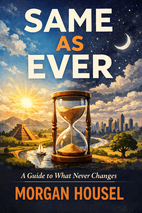
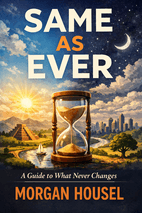
Morgan Housel's Same as Ever explores the timeless aspects of human behavior that drive financial markets and personal decisions, arguing that understanding these enduring truths is key to navigating uncertainty. It offers a stable framework for investors and anyone seeking better long-term decisions.
Feature
Insta.Page
Blinkist
Shortform
Summary Depth
Full Chapter-by-Chapter
15-min overview
Detailed analysis
Audio Narration
✓ (AI narration)
✓
✓
Visual Mindmaps
✓
✕
✕
AI Q&A
✓ Voice AI
✕
✕
Quizzes
✓
✕
✕
PDF Downloads
✓
✕
✓
Price
$59.99/yr
$146/yr (PRO)
$199/yr
*Competitor data last verified February 2026.
About the Author
Morgan Housel
Morgan Housel is a partner at The Collaborative Fund and a former columnist at The Wall Street Journal and The Motley Fool. He is a two-time winner of the Best in Business Award from the Society of American Business Editors and Writers and was selected by the Columbia Journalism Review for the Best Business Writing anthology. Housel is the acclaimed author of *The Psychology of Money*, a timeless exploration of how people think about money and make financial decisions. His insightful work has cemented his reputation as a leading voice in behavioral finance and investing. His published books are available for purchase on Amazon.
1 Page Summary
In Same as Ever, Morgan Housel explores the timeless and unchanging aspects of human behavior that drive financial markets, economic cycles, and personal decision-making. He argues that while the world undergoes constant technological and social transformation, the fundamental drivers of our actions—such as greed, fear, risk perception, and the desire for status—remain remarkably consistent. The book is built on the premise that understanding these enduring truths is far more valuable for navigating uncertainty than trying to predict specific future events.
Housel supports his thesis by drawing on vivid historical anecdotes and psychological insights, illustrating how patterns from centuries ago repeat themselves in modern contexts. He examines events like market manias, financial crises, and periods of innovation to show how the same human tendencies lead to similar outcomes across different eras. The historical context serves not as a catalogue of past events, but as a series of case studies proving that human nature is the most reliable variable in any equation about the future.
The lasting impact of the book lies in its practical wisdom for investors, business leaders, and individuals. Housel concludes that preparing for the unexpected by building robust systems, embracing humility, and focusing on what never changes is the key to resilience. By shifting focus from fleeting trends to perennial truths, the book offers a stable framework for making better long-term decisions in an inherently unpredictable world.
This introduction establishes the book's core purpose: to explore the timeless, unchanging patterns of human behavior that persist beneath the surface of a world that seems in constant flux. It argues that while change is dramatic and captivating, the real key to understanding our lives and our future lies in recognizing what never changes—the fundamental psychological drivers like greed, fear, tribalism, and the pursuit of happiness.
The Buffett Snickers Anecdote
The chapter opens with a revealing story about Warren Buffett. During the depths of the 2009 financial crisis, while being driven through a desolate Omaha, Buffett is asked how the economy could possibly recover. His response is to point out that Snickers was the bestselling candy bar in 1962 and remains so today. The lesson is delivered in silence: amidst colossal economic change, some simple, foundational human preferences remain utterly constant. This sets the stage for the book's entire philosophy.
The Power of Timeless Behavior
The narrative expands on the idea that if you were transported to any era—past or future—the technology, politics, and language would be bewildering. However, you would quickly recognize the same human emotions and behavioral patterns: people succumbing to greed and fear, forming tribal loyalties, displaying overconfidence, and seeking happiness and certainty. These are history's most powerful lessons because they are reliable predictors of future behavior, for individuals and societies alike.
The Bezos Principle
Amazon founder Jeff Bezos's strategic insight is highlighted as a practical application of this philosophy. He notes that people obsess over what will change but rarely ask what will stay the same. He argues the latter question is more important because you can build long-term strategies and invest with confidence around stable truths. For Amazon, those truths are that customers will always want low prices and fast delivery.
Applying Timelessness to Life and Investing
The author applies this lens to his own areas of interest. He admits he cannot predict stock markets, elections, or which businesses will succeed. Instead, he focuses on the constants: the unchanging cycle of greed and fear in markets, the perennial influence of tribal identity in politics, and the predictable pattern of successful leaders becoming complacent. This shifts focus from unpredictable outcomes to understandable, repeating human dynamics.
A Guide for Parallel Universes
The introduction concludes by framing the book's goal through a philosophical and practical lens. Citing entrepreneur Naval Ravikant, it asks: what principles would lead to success in 999 out of 1,000 parallel versions of your life? The book aims to identify those universal truths—the behaviors and lessons that are not dependent on luck or chance, but are evergreen. Each chapter stands alone, examining a different facet of these "little laws of life" that the author is confident will be relevant for centuries to come.
Key Takeaways
Focus on the unchanging. In a world obsessed with change, the most reliable insights come from understanding what remains constant, particularly in human nature.
Build on permanence. Like Bezos with Amazon's core customer desires, you can make confident decisions and investments by anchoring them to timeless truths.
Predict behavior, not events. You cannot foresee specific events, but you can anticipate how people will likely react based on historical patterns of fear, greed, tribalism, and hubris.
Seek universal principles. The most valuable lessons are those that would apply across countless possible versions of your life, independent of luck or circumstance.
Key concepts: Introduction
1. Introduction
The Buffett Snickers Anecdote
Warren Buffett uses Snickers' consistent popularity to illustrate unchanging human preferences
Highlights that foundational human behaviors persist despite dramatic economic change
Sets the philosophical foundation for the book's focus on constants over change
The Power of Timeless Behavior
Human emotions and behavioral patterns remain recognizable across all eras
Greed, fear, tribalism, overconfidence, and pursuit of happiness are universal constants
These patterns are reliable predictors of future behavior for individuals and societies
The Bezos Principle
Jeff Bezos emphasizes focusing on what will stay the same rather than what will change
Building strategies around stable truths enables confident long-term investment
For Amazon, these truths are customers always wanting low prices and fast delivery
Applying Timelessness to Life and Investing
Shift focus from unpredictable outcomes to repeating human dynamics
Focus on constants like greed/fear cycles in markets and tribal identity in politics
Recognize patterns like successful leaders becoming complacent over time
A Guide for Parallel Universes
Seeks principles that would lead to success in most versions of one's life
Identifies universal truths independent of luck or chance
Each chapter examines different facets of 'little laws of life' with lasting relevance
Key Takeaways
Focus on the unchanging aspects of human nature rather than surface-level change
Build strategies and make decisions anchored to timeless truths
Predict behavioral patterns rather than specific events
Seek universal principles applicable across countless life scenarios
If you like this summary, you probably also like these summaries...
💡 Try clicking the AI chat button to ask questions about this book!
Chapter 2: Hanging by a Thread
Overview
The chapter introduces a haunting reality: much of our world—and history itself—hinges on random, unforeseeable moments. A personal, tragic story from the author's youth illustrates how a split-second decision can be the most consequential of a lifetime. This theme is then expanded to show how tiny, accidental events have repeatedly altered the course of history, suggesting that while we can understand the past, predicting the future is a fool's errand given the boundless potential for chance and compounding consequences.
A Personal Story of Chance and Loss
The author recounts a devastating event from his time as a teenage ski racer in Lake Tahoe in February 2001. After a blizzard created perfect avalanche conditions, he and his two close friends, Brendan Allan and Bryan Richmond, ducked out of bounds to ski a treacherous area. They triggered a small avalanche but shrugged it off. Later, when his friends wanted to ski the same run again, the author inexplicably declined, offering instead to pick them up by car. They never arrived.
A massive avalanche had engulfed them. After a frantic search, Brendan and Bryan were found buried under six feet of snow, ten feet apart. The author is left with the agonizing, unanswerable question of why he chose not to join them on that second run. He frames it as a "complete fluke, a random and thoughtless bit of dumb luck" that became the most important decision of his life, highlighting how life-altering outcomes can rest on thoughtless, momentary whims.
Historical Events That Hung by a Thread
To demonstrate that his personal story is a microcosm of a broader truth, the author presents three pivotal historical moments that turned on absurdly small details:
The Battle of Long Island (1776): George Washington’s cornered army faced annihilation, which would have likely ended the Revolutionary War. Their escape was made possible solely because the wind direction prevented the British fleet from sailing up the East River. Historian David McCullough asserts this simple meteorological fact changed the course of history.
The Sinking of the Lusitania (1915): To save money, Captain William Turner shut down one of the ship's boiler rooms, delaying its voyage by a day. This delay placed it directly in the path of a German submarine. The torpedoing of the Lusitania killed 1,200 and was a key trigger for U.S. entry into World War I. A functioning boiler would have avoided the encounter entirely.
The Attempted Assassination of FDR (1933): Giuseppe Zangara, a tiny man, stood on a chair to fire at Franklin D. Roosevelt. He missed, killing Chicago Mayor Anton Cermak instead. Had Roosevelt been killed, his Vice President-elect, John Nance Garner—a staunch opponent of deficit spending—would have become president and almost certainly would not have implemented the transformative New Deal policies that still shape the economy today.
The Unfathomable Compounding of Events
The chapter argues that this perspective reveals an irony: we know how history ends but rarely see where it truly began, as every event is the product of an endless chain of prior causes. The 2008 financial crisis, for example, can be traced back through a labyrinth of preceding events like falling interest rates, 1970s inflation, and the Cold War, ad infinitum.
This understanding leads to two crucial insights for navigating a world vulnerable to chance:
Predict behavior, not events: It's impossible to forecast specific future events. However, predicting that people will continue to respond to greed, fear, opportunity, and social persuasion is a reliable bet. Every event creates unpredictable ripple effects, making linear forecasting futile.
Have a wider imagination: No matter how stable the present seems, everything can change tomorrow due to a tiny accident no one considered. Like money, events compound, and the end result of compounding is never intuitive from the small beginning.
Key Takeaways
Major historical and personal outcomes often depend on random, unforeseeable moments—the world truly "hangs by a thread."
We study history knowing how stories end, but we can rarely pinpoint where they began due to infinite, compounding causes.
Effective prediction should be based on understanding enduring human behaviors (greed, fear, social persuasion) rather than attempting to forecast specific events.
Maintaining a wide imagination about the future is essential, as small, accidental beginnings can compound into unimaginably large consequences.
Key concepts: Hanging by a Thread
2. Hanging by a Thread
The Central Premise: Life and History on a Thread
The world and history hinge on random, unforeseeable moments.
A split-second decision can be the most consequential of a lifetime.
We can understand the past, but predicting the future is a fool's errand due to chance.
Tiny, accidental events have repeatedly altered the course of history.
A Personal Story of Chance and Loss
The author's teenage ski trip led to an avalanche that killed his two friends.
He made a random, thoughtless decision not to join them on the fatal second run.
This 'complete fluke' became the most important decision of his life.
Illustrates how life-altering outcomes can rest on momentary whims.
Historical Events That Hung by a Thread
Battle of Long Island (1776): A wind direction saved Washington's army and the Revolution.
Sinking of the Lusitania (1915): A boiler shutdown delayed the ship into a submarine's path, triggering US WWI entry.
Attempted Assassination of FDR (1933): A missed shot spared FDR, preserving the New Deal's future.
The Nature of Cause and Compounding
We know how history ends but rarely see where it truly began.
Every event is the product of an endless, compounding chain of prior causes.
Events compound like money; the end result is never intuitive from the small beginning.
Insights for Navigating a World of Chance
Predict behavior, not events: Forecast human responses to greed, fear, and social persuasion.
Have a wider imagination: Everything can change tomorrow due to a tiny, unconsidered accident.
Linear forecasting is futile due to unpredictable ripple effects from every event.
⚡ You're 2 chapters in and clearly committed to learning
Why stop now? Finish this book today and explore our entire library. Try it free for 7 days.
Chapter 3: Risk Is What You Don’t See
Overview
Overview
The chapter explores a counterintuitive truth about risk: it's not the dangers we anticipate that cause the most harm, but the ones we never see coming. Our ability to predict the future is decent for the ordinary, yet it's the complete surprises—the events that blindside us—that truly shape history and our lives. This idea is framed by the notion that risk is what's left over after you've planned for everything you can imagine.
The Illusion of Foresight and Historical Surprise
We often look back at historical calamities and deem them obvious, but this is a trick of hindsight. The Great Depression serves as a prime example. While the 1920s boom seemed unsustainable to some, no one—not even top economists like Irving Fisher—predicted the decade-long catastrophe that followed. Polls from the early 1930s show that even as unemployment soared, experts ranked it below issues like prohibition and law enforcement, highlighting how utterly unprepared society was. This pattern repeats: Pearl Harbor, 9/11, and the COVID-19 pandemic were all surprises that dominated the news precisely because they were unforeseen.
Stories of Unseen Catastrophe
Vivid anecdotes underscore the central point. NASA astronaut Victor Prather survived a high-altitude balloon test only to drown after landing in the ocean because he opened his helmet's faceplate—a small, unplanned action that circumvented thousands of hours of meticulous safety planning. Similarly, escape artist Harry Houdini died not from one of his staged, perilous escapes, but from an unexpected punch to the stomach from a student when he wasn't physically prepared. In both cases, the biggest risk wasn't the monumental challenge they had rehearsed for; it was the trivial, overlooked detail.
The Limits of What We Know
Our understanding of both the present and the past is remarkably limited. History is built on a tiny fraction of recorded events—photographs, writings, and interviews—all susceptible to bias and error. As Franklin Roosevelt mused about his library, historians will never have the full picture. This limitation makes us like a content child, blissfully unaware of the vast, complex world beyond immediate perception. Psychologist Daniel Kahneman notes that we rarely consider how what we don't know could颠覆 our beliefs.
Preparing for the Unknowable
Since we can't predict specific surprises, the solution isn't better forecasting but better preparation. Nassim Taleb's advice to "invest in preparedness, not in prediction" is key. Think of California's approach to earthquakes: they build resilient infrastructure and train emergency crews without knowing when or where the next big quake will hit. In personal finance, this translates to saving more than seems necessary and taking on less debt than you think you can handle. True preparedness should feel a bit excessive because it's designed for events that would sound absurd before they happen.
Key Takeaways
The defining risks are always surprises. The most consequential events in history and in our lives are typically those no one anticipated.
Hindsight breeds overconfidence. We mistakenly believe past disasters were predictable, blinding us to the unseen risks of the future.
Human knowledge is inherently limited. Our view of history and the present is incomplete, making it easy to underestimate what we don't know.
Preparation beats prediction. Instead of trying to forecast specific risks, focus on building general resilience—financially, physically, and mentally—to withstand a variety of shocks.
Embrace prudent excess. In areas like savings and safety margins, if your preparations feel completely sensible, they're probably inadequate for the unimaginable.
Key concepts: Risk Is What You Don’t See
3. Risk Is What You Don’t See
The Core Paradox of Risk
The greatest harm comes not from anticipated dangers, but from complete surprises that blindside us.
Risk is defined as what remains after planning for everything you can imagine.
Our predictive ability works decently for the ordinary but fails for history-shaping events.
The Hindsight Illusion in Historical Surprises
We mistakenly view past calamities as obvious in hindsight, creating overconfidence.
Major events like the Great Depression, Pearl Harbor, and COVID-19 were unforeseen when they occurred.
Even experts fail to rank emerging catastrophic risks accurately, as shown by 1930s polls on unemployment.
Anecdotes of Unseen Catastrophe
Victor Prather (NASA): Survived a high-altitude test but drowned from a trivial, unplanned action—opening his helmet after landing.
Harry Houdini: Died not from a staged escape, but from an unexpected punch when unprepared.
The biggest risk is often the overlooked detail, not the monumental, rehearsed challenge.
The Inherent Limits of Human Knowledge
Our understanding of history and the present is built on a tiny, biased fraction of recorded events.
We are like a content child, unaware of the vast complexity beyond immediate perception.
We rarely consider how unknown information could颠覆 (overturn) our current beliefs.
The Strategy: Preparation Over Prediction
The solution is not better forecasting, but building general resilience for the unknowable.
Invest in preparedness, not in prediction (as advised by Nassim Taleb).
Examples: California's earthquake-ready infrastructure and personal finance principles of excess saving and low debt.
True preparedness should feel excessive, as it is designed for events that seem absurd beforehand.
Chapter 4: Expectations and Reality
Overview
The chapter explores a simple yet profound idea: our happiness is less about our actual circumstances and more about the gap between what we expect and what we experience. Through historical examples, personal stories, and psychological insights, it reveals how easily our expectations can inflate, often keeping us from appreciating genuine improvements in our lives. The narrative challenges the common belief that more wealth or success directly leads to contentment, instead arguing that managing expectations is a critical skill for finding fulfillment.
The Relativity of Well-Being
Happiness is inherently relative, shaped by comparisons with those around us. As Montesquieu observed centuries ago, we often wish to be happier than others, a difficult pursuit because we perceive others as happier than they are. This relativity means that luxuries quickly become necessities when our peers gain them, and objective measures of wealth—like having modern medicine or higher incomes—fail to boost happiness if others have more. Investor Charlie Munger's point that envy drives the world underscores how social comparisons constantly reset our benchmarks for success.
Nostalgia for the 1950s: A Puzzle Solved
Many Americans look back on the 1950s as a golden age of prosperity, but data shows that by nearly every metric—income, home size, workplace safety, food costs—life is better today. Median family income has more than doubled since 1955, and homes are larger and safer. Yet, the era feels superior because of a unique economic context: post-World War II wage controls and flatter income distribution meant that most people lived similarly comfortable lives. With less disparity between neighbors, expectations remained stable, allowing economic gains to translate directly into happiness. This created a fleeting period where people felt better off because everyone around them was in the same boat.
The Envy Engine in Modern Life
The cohesion of the 1950s gave way to greater income inequality in later decades, amplifying social comparisons. Today, technology and social media have turbocharged envy by exposing us to curated highlight reels of others' lives. As psychologist Jonathan Haidt notes, social media is often about performance rather than genuine communication, making it easy to feel inadequate when comparing ourselves to inflated portrayals of success. This environment generates wealth, showcases it, and fuels desire for it, but it also smothers satisfaction by constantly raising our expectations.
When Expectations Dictate Perception
Personal stories highlight how expectations shape reality. Ben Ferencz, who survived persecution to become a war crimes prosecutor, found happiness in tough circumstances because his past was worse. Conversely, Gary Kremen, a millionaire in Silicon Valley, felt like "nobody" because his wealth paled next to his peers. Similarly, celebrities like Will Smith and Naomi Osaka experience fame as a relief or misery depending on whether it meets or falls short of expectations. Even historical figures like Harry Truman benefited from low initial expectations, which made his subsequent successes seem miraculous.
Mastering the Expectations Game
Managing expectations is portrayed as a vital, often neglected life skill. Peter Kaufman's analogy reminds us that we safeguard material possessions but ignore priceless assets like relationships or contentment, which rely heavily on our mental frameworks. Charlie Munger's advice—"the first rule of a happy life is low expectations"—emphasizes stoicism and realistic outlooks. Happiness is a two-part equation: what you have and what you expect. While we focus intensely on improving circumstances, we rarely invest in controlling expectations, even though they are more within our grasp. The key is recognizing that progress alone doesn't bring joy; it's the gap between expectations and reality that truly matters.
Key Takeaways
Happiness hinges more on the gap between expectations and reality than on objective circumstances.
Social comparisons drive envy and inflate expectations, often negating gains in wealth or quality of life.
The 1950s are nostalgically remembered not because life was better, but because economic equality kept expectations in check.
Modern tools like social media exacerbate comparison, making it harder to appreciate our own progress.
Managing expectations through realism and stoicism is as crucial as improving circumstances for long-term fulfillment.
Key concepts: Expectations and Reality
4. Expectations and Reality
The Core Premise: Expectations vs. Reality
Happiness is determined by the gap between expectations and experience, not by objective circumstances.
Managing expectations is a critical skill for finding fulfillment, often more important than acquiring more wealth or success.
The narrative challenges the direct link between material progress and contentment.
The Relativity of Well-Being
Happiness is inherently relative and shaped by social comparisons with those around us.
Luxuries quickly become necessities when peers gain them, resetting our benchmarks for success.
Envy is a powerful driver that undermines satisfaction, as we often perceive others as happier than they are.
The 1950s Nostalgia Puzzle
Life is objectively better today by metrics like income and safety, yet the 1950s are remembered as a golden age.
The key was post-war economic equality and flatter income distribution, which kept expectations stable.
With less disparity between neighbors, economic gains translated directly into perceived happiness.
The Modern Envy Engine
Increased income inequality has amplified social comparisons in recent decades.
Technology and social media turbocharge envy by exposing curated highlight reels of others' lives.
Social media fosters performance over genuine connection, making it easy to feel inadequate and constantly raising expectations.
How Expectations Shape Perception
Personal stories show happiness in tough circumstances if past was worse (e.g., Ben Ferencz).
Wealth feels inadequate when compared to richer peers (e.g., Gary Kremen in Silicon Valley).
Fame and success are experienced as relief or misery based on whether they meet expectations (e.g., Will Smith, Naomi Osaka).
Mastering the Expectations Game
Managing expectations is a vital, often neglected life skill, akin to safeguarding priceless assets.
Stoic advice like 'the first rule of a happy life is low expectations' emphasizes realistic outlooks.
Happiness is a two-part equation: what you have and what you expect, with the latter being more within our control.
📚 Explore Our Book Summary Library
Discover more insightful book summaries from our collection