What is the book Zero to One Summary about?
Peter Thiel's Zero to One advocates for creating monopolies through breakthrough innovation, arguing that true progress comes from building something entirely new. It provides a contrarian philosophy for founders and entrepreneurs seeking to build valuable, transformative companies.
| Feature | Blinkist | Insta.Page |
|---|---|---|
| Summary Depth | 15-min overview | Full Chapter-by-Chapter |
| Audio Narration | ✓ | ✓ (AI narration) |
| Visual Mindmaps | ✕ | ✓ |
| AI Q&A | ✕ | ✓ Voice AI |
| Quizzes | ✕ | ✓ |
| PDF Downloads | ✕ | ✓ |
| Price | $146/yr (PRO) | $33/yr |
1 Page Summary
In Zero to One, Peter Thiel argues that true innovation comes from creating something entirely new—going from "zero to one"—rather than iterating on existing ideas ("one to n"). He critiques the competitive mindset that dominates business and education, advocating instead for monopolies that avoid competition and generate unique value. Thiel emphasizes the importance of bold, contrarian thinking and building proprietary technology that offers a significant improvement over alternatives, often by a factor of ten.
The book emerged from a popular Stanford course Thiel taught in 2012, reflecting Silicon Valley’s post-2008 focus on transformative startups amid economic stagnation. Thiel challenges conventional wisdom about globalization, technology, and progress, urging entrepreneurs to pursue secrets—valuable truths overlooked by society—and to build durable businesses with strong foundations, clear plans, and a compelling vision for the future.
Zero to One has had a lasting impact on startup culture and entrepreneurial philosophy, popularizing concepts like "definite optimism," "last mover advantage," and the value of monopoly-like market dominance. Its emphasis on breakthrough innovation over incremental improvement continues to influence founders and investors, reinforcing the idea that the most valuable companies create new markets rather than competing in old ones.
Zero to One Summary
Title Page
Overview
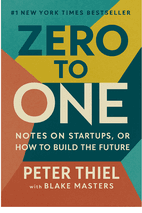
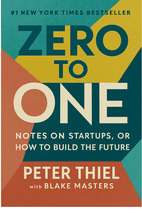
The title page immediately establishes the book's practical, forward-looking nature. It presents the work as "NOTES ON STARTUPS, OR HOW TO BUILD THE FUTURE," positioning itself not as abstract theory but as actionable insights from the front lines of innovation. The dual authorship—Peter Thiel with Blake Masters—signals a collaboration between an iconic Silicon Valley founder and a protégé, suggesting the content will blend proven experience with fresh perspective.
Key Takeaways
- The book positions itself as a practical guide, not an academic text, focused on the tangible process of creating new ventures.
- The collaboration between Thiel and Masters implies the content is filtered through both established expertise and contemporary application.
- The ultimate subject is framed as building the future itself, setting a ambitious and transformative tone for the entire work.
If you like this summary, you probably also like these summaries...
Zero to One Summary
Copyright
Overview
This section presents the formal copyright information and publication details for Peter Thiel's book Zero to One. It establishes the legal framework protecting the work while providing essential bibliographic data that situates the book within the publishing ecosystem.
Publication Details
The copyright is held by Peter Thiel since 2014, with the book published by Currency, an imprint of the Crown Publishing Group (a division of Penguin Random House LLC). The notice includes both the print and ebook ISBN numbers, acknowledging the dual publication format. The section credits the various contributors involved in the book's production, including book designer Ralph Fowler, graphics by Rodrigo Corral Design, illustrations by Matt Buck, and cover design by Michael Nagin.
Legal Framework
The copyright notice serves as a formal declaration of intellectual property protection under United States law. It includes the Library of Congress Cataloging-in-Publication Data, which provides standardized classification information (HD62.5.7525 2014) and subject headings including "New business enterprises," "New products," "Entrepreneurship," and "Diffusion of innovations." This legal framework protects the original content while making the work discoverable through library systems.
Key Takeaways
• Copyright protection formally establishes the book as Peter Thiel's intellectual property • The publication details reveal the ecosystem of professionals involved in book production • Legal cataloging information makes the work discoverable through library systems • The notice covers both print and digital editions, reflecting modern publishing practices
⚡ You're 2 chapters in and clearly committed to learning
Why stop now? Finish this book today and explore our entire library. Try it free for 7 days.
Zero to One Summary
Contents
Overview
This table of contents maps the intellectual journey of Peter Thiel's "Zero to One," outlining a provocative argument for building a better future through bold, contrarian innovation. It moves from diagnosing the failures of past technological optimism to prescribing a philosophy for creating valuable monopolies through unique solutions.
Thematic Groupings
The chapters are organized into a logical progression that builds Thiel's core thesis:
- The Setup (Chapters 1-4): Establishes the fundamental question—"What important truth do very few people agree with you on?"—and critiques the prevailing mindsets of globalization and competition.
- The Blueprint for Value (Chapters 5-9): Shifts to the positive case, detailing the principles of building a durable monopoly business, including the importance of last mover advantage, definite optimism, network effects, and a strong founding culture.
- Execution and Pitfalls (Chapters 10-14): Covers the practicalities of building a team, distributing a product, and navigating specific industries like cleantech, while also exploring the complex psychology of founders.
- The Stakes (Conclusion): Ends by framing the entire argument within the monumental choice between a future of technological stagnation or a transformative singularity.
Narrative Arc
The structure reveals a clear story: first, unlearn the destructive lessons of the past. Second, embrace a new philosophy focused on creating something new and dominating a small market. Finally, execute on this vision with a dedicated team to avoid the pitfalls that doom most startups, ultimately aiming to push humanity forward.
Key Takeaways
- The book is a structured argument, moving from critique to prescription.
- Its core concern is the difference between horizontal (globalizing) and vertical (innovating) progress.
- Success is framed as building a "monopoly" by solving a unique problem, not by competing in an existing market.
- Practical advice on company culture, sales, and distribution is grounded in this larger philosophical framework.
- The ultimate goal is not just business success, but driving humanity toward a transformative future.
If you like this summary, you probably also like these summaries...

Zero to One Summary
Preface: Zero to One
Overview
This opening section sets the stage for a radical rethinking of business and innovation. It challenges the conventional wisdom of imitation and optimization, arguing that true progress comes not from competing in existing markets but from creating entirely new ones. The text establishes a foundational dichotomy between going from "1 to n" (copying what works) and going from "0 to 1" (creating something novel).
The Core Choice: Imitation vs. Creation
The chapter posits that every meaningful moment in business is unique and non-repeatable. Copying the successes of giants like Gates, Page, or Zuckerberg is not learning from them; it is merely participating in a crowded race of imitation. This path, moving from "1 to n," involves adding more of something familiar and is ultimately a dead end. The only path to a valuable future is through the singular act of creation—the "0 to 1" moment that brings something fresh and strange into the world. The author issues a stark warning: a reliance on today's "best practices" and fine-tuning old models will lead to a crisis far worse than 2008.
Technology as a Human Miracle
In the face of this daunting challenge, the text offers a source of hope: humanity's unique capacity for miracles, which we call technology. Technology is defined not just as software, but as any new and better way of doing things that allows us to do more with less. This ability to rewrite the plan of the world is what fundamentally distinguishes humans from other species. The book's purpose is to explore how to build companies that perform this miracle of creation.
The Book's Origin and Philosophy
Zero to One is born from the author's direct experience as a founder of PayPal and Palantir and an investor in groundbreaking companies. It is explicitly not a formula or a step-by-step guide. The central paradox it embraces is that a formula for innovation cannot exist because true innovation is, by definition, new and unique. Instead, the book aims to provide patterns and a mindset. It champions thinking from "first principles"—questioning fundamental assumptions—as the way to find value in unexpected places. The content originated from a Stanford University course designed to help students look beyond academic specialization to see the future they could create themselves.
Key Takeaways
- The Path to the Future: Progress can be horizontal (1 to n) or vertical (0 to 1). Copying what already exists only creates more of the same; the real rewards and the only sustainable future lie in creating something new.
- Embrace the Singular: Every great business is built on a secret or a unique insight about the world. Don't compete in established markets; create a new market where you can be the sole dominant player.
- There is No Formula: Innovation cannot be prescribed. Success comes from thinking for yourself, reasoning from first principles, and being bold enough to believe you can create a miracle.
- Technology is Hope: The ability to create new technology is humanity's defining trait. It is the tool that allows us to build a radically better future, and business is the vehicle for doing so.
If you like this summary, you probably also like these summaries...
📚 Explore Our Book Summary Library
Discover more insightful book summaries from our collection
BusinessRelated(57 books)

The Curious Mind of Elon Musk
Charles Steel

Pineapple and Profits: Why You're Not Your Business
Kelly Townsend

Big Trust
Shadé Zahrai

Obviously Awesome
April Dunford

Crisis and Renewal
S. Steven Pan

Get Found
Matt Diamante

Video Authority
Aleric Heck

One Venture, Ten MBAs
Ksenia Yudina

BEATING GOLIATH WITH AI
Gal S. Borenstein

Digital Marketing Made Simple
Barry Knowles

The She Approach To Starting A Money-Making Blog
Ana Skyes

The Blog Startup
Meera Kothand

How to Grow Your Small Business
Donald Miller

Email Storyselling Playbook
Jim Hamilton

Simple Marketing For Smart People
Billy Broas

The Hard Thing About Hard Things
Ben Horowitz

Good to Great
Jim Collins

The Lean Startup
Eric Ries

The Black Swan
Nassim Nicholas Taleb

Building a StoryBrand 2.0
Donald Miller

How To Get To The Top of Google: The Plain English Guide to SEO
Tim Cameron-Kitchen

Great by Choice: 5
Jim Collins

How the Mighty Fall: 4
Jim Collins

Built to Last: 2
Jim Collins

Social Media Marketing Decoded
Morgan Hayes

Start with Why 15th Anniversary Edition
Simon Sinek

3 Months to No.1
Will Coombe

Think Big
Donald J. Trump

Zero to One
Peter Thiel

Who Moved My Cheese?
Spencer Johnson

SEO 2026: Learn search engine optimization with smart internet marketing strategies
Adam Clarke

University of Berkshire Hathaway
Daniel Pecaut

Rapid Google Ads Success: And how to achieve it in 7 simple steps
Claire Jarrett

3 Months to No.1
Will Coombe

How To Get To The Top of Google: The Plain English Guide to SEO
Tim Cameron-Kitchen

Unscripted
MJ DeMarco

The Millionaire Fastlane
MJ DeMarco

Great by Choice
Jim Collins

Abundance
Ezra Klein

How the Mighty Fall
Jim Collins

Built to Last
Jim Collins

Give and Take
Adam Grant

Fooled by Randomness
Nassim Nicholas Taleb

Skin in the Game
Nassim Nicholas Taleb

Antifragile
Nassim Nicholas Taleb

The Infinite Game
Simon Sinek

The Innovator's Dilemma
Clayton M. Christensen

The Diary of a CEO
Steven Bartlett

The Tipping Point
Malcolm Gladwell

Million Dollar Weekend
Noah Kagan

The Laws of Human Nature
Robert Greene

Hustle Harder, Hustle Smarter
50 Cent

Start with Why
Simon Sinek

MONEY Master the Game: 7 Simple Steps to Financial Freedom
Tony Robbins

Lean Marketing: More leads. More profit. Less marketing.
Allan Dib

Poor Charlie's Almanack
Charles T. Munger

Beyond Entrepreneurship 2.0
Jim Collins