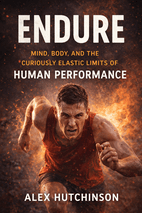
Alex Hutchinson is a journalist and author specializing in the science of endurance and human performance. He is best known for his book "Endure: Mind, Body, and the Curiously Elastic Limits of Human Performance," which synthesizes research on the limits of physical endurance. His background includes a PhD in physics and a career as a long-distance runner for the Canadian national team.
Chapter 1: Chapter 1: The Unforgiving Minute
Overview
A university runner crosses the line in Sherbrooke, stunned. He has just smashed his personal best in the 1,500 meters by a huge nine seconds. The secret? A miscommunication made him think he was running much faster splits than he was. Freed from his own expectations about what was possible, he just ran as hard as he could. This personal breakthrough leads to a bigger question: what really determines our limits?
The chapter looks at the popular story of the four-minute mile as a purely mental barrier. It argues that real-world factors, like faster tracks and competition, were just as important for the runners who came after Roger Bannister. It moves past the simple idea of mind over matter to ask a more detailed question about the mind's role in endurance. First, endurance is defined as the struggle to continue against a mounting desire to stop—a fight against fatigue that applies to anyone, from a sprinter to LeBron James in the fourth quarter. At the center of this is pacing, the constant management of perceived effort.
Alex Hutchinson’s path from frustrated athlete to science journalist shows a field changing its mind. For years, physiology pointed to clear physical failure points, like empty fuel tanks. But new neuroscience shows the brain actively interprets the body’s signals, acting as a central governor that can hit the brakes long before total collapse. This makes limits seem more flexible. We see it in British military brain-training programs and in strange experiments where subliminal pictures of smiling faces make cyclists more powerful.
In the end, the new understanding isn't that the brain simply overrules the body. Instead, the two are in a constant, back-and-forth conversation. Our endurance comes from this intricate dialogue, meaning the edges of human performance are more flexible and interesting than we thought.
A Personal Breakthrough
Alex Hutchinson remembers a key indoor 1,500-meter race in Sherbrooke, Quebec, in 1996. As a university runner, he was stuck, running times just above the four-minute mark for the distance. He was like the Australian miler John Landy, who struggled to break the four-minute mile before Roger Bannister. Hutchinson thought the slow, banked track was a bad place for a fast time, so he planned to take it easy.
His attitude changed after he saw a teammate run a fearless, solo race to a personal best. He decided to stop overthinking and just race as hard as possible. To his shock, he ran 3:52.4—a nine-second personal best. He later learned why: the lap counter called out splits that were three seconds too fast. Thinking he was running much faster than planned, yet feeling good, Hutchinson broke free from his own pre-race limits and ran far better than he expected.
The Landy Enigma and the Myth of the Mental Barrier
This experience makes Hutchinson look at the popular four-minute mile story. The common tale says that once Roger Bannister broke the barrier, dozens followed right away, proving it was all in the mind. In truth, only John Landy did it within the next year. Landy’s breakthrough, Hutchinson says, had real causes: he finally raced in Europe on faster tracks with real competition and pacers, not just a sudden change in belief.
This creates the central question of the chapter and the book: what really sets our limits? Is endurance purely physical, or is the mind in charge? Hutchinson’s own quick improvement from 3:52 to an Olympic Trials-qualifying 3:44 suggests the mind matters a lot. But he found this hard to use consistently in the years that followed.
Redefining Endurance
Before getting into the science, Hutchinson gives a working definition. Endurance isn't just about marathons; it's “the struggle to continue against a mounting desire to stop.” This applies to LeBron James fighting fatigue over a long NBA season, a sprinter trying to maintain speed for 10 seconds, or a weightlifter pacing themselves across many lifts.
The link is pacing—the constant, conscious or unconscious choice about how hard to push. This is why athletes fixate on splits, trying to spend their energy perfectly. Hutchinson’s Sherbrooke race was a perfect, though accidental, example of how changing your sense of effort and pace can change your performance completely.
The Search for Answers
Hutchinson’s running career ended with more questions than answers. He moved into science journalism to understand why performance wasn't a simple math problem of physical inputs. He found a field divided.
For most of the 20th century, physiology saw limits in a mechanical way: you go until a physical factor, like fuel or heat, hits a critical point and you stop. But new neuroscience started showing the brain's key role as an interpreter of the body's distress signals. This new view suggests limits are more flexible. It leads to new, sometimes unusual, ways to influence them—like the electrical brain stimulation experiments mentioned at the end of the chapter.
The British military's work on computer-based brain training shows a modern approach to building endurance in soldiers, with results that challenge old training models. The science even touches on perception, where studies show that subliminal cues—like a smiling face flashed for just 16 milliseconds—can boost athletic performance, making cyclists 12 percent more powerful than if they saw a frowning face. This shows how deeply our subconscious can affect physical limits.
Over ten years, Hutchinson traveled the world, talking to hundreds of researchers and athletes. This led him to a key idea: while the brain is crucial for endurance, it's not a simple "mind over matter" story. Instead, endurance comes from a complex, active back-and-forth between brain and body, where each constantly talks to and adjusts the other. The scientists in this book work from this combined view. Their research suggests we are just starting to understand human potential, and that there may be new ways to push past the limits we feel.
Key Takeaways
Perception Shapes Performance: Small, even subliminal, cues in your environment—like seeing a smiling face—can change your physical endurance and power.
Integrated Mind-Body System: Endurance comes from constant communication between the brain and the body, not from one ruling the other.
Frontier of Potential: Current research using this combined view shows we are only beginning to understand and expand the limits of human endurance.
Key concepts: Chapter 1: The Unforgiving Minute
1. Chapter 1: The Unforgiving Minute
The Sherbrooke Breakthrough: A Personal Case Study
A university runner (the author) shattered his 1500m personal best by nine seconds due to a miscommunication about his splits.
Believing he was running faster than planned but feeling good, he was liberated from his pre-race calculations and self-imposed limits.
This accidental experiment demonstrated the powerful influence of perceived effort and belief on physical performance.
Debunking the Four-Minute Mile Myth
The popular narrative that the four-minute mile was a purely mental barrier broken by Roger Bannister is overly simplistic.
John Landy's subsequent breakthrough was aided by concrete factors like faster tracks, competition, and pacers, not just a shift in belief.
This analysis establishes the book's central question: what is the true, complex relationship between mind and body in determining limits?
A New Definition of Endurance
Endurance is broadly defined as 'the struggle to continue against a mounting desire to stop.'
This applies universally, from marathoners and sprinters to athletes like LeBron James facing cumulative fatigue.
At its core is pacing: the constant, conscious or unconscious negotiation of perceived effort to manage energy expenditure.
The Evolving Science of Limits
Traditional physiology viewed limits as physical failure points (empty fuel tanks, critical overheating).
Emerging neuroscience posits the brain as a 'central governor,' actively interpreting bodily signals and applying brakes before catastrophe.
This new model makes limits appear malleable, influenced by factors like competition, environment, and even subliminal cues (e.g., smiling faces).
The Emerging Consensus: A Dynamic Dialogue
The frontier of performance science is not about 'mind over matter' but a continuous conversation between brain and body.
Endurance emerges from this real-time dialogue, making human performance more flexible and fascinating than previously believed.
The author's journey from athlete to journalist mirrors this scientific transition from simple, physical models to complex, integrative ones.
Military Investment in Brain Training
British military uses computer-based brain training to enhance personnel endurance
Approach challenges traditional physical training models with scientific methods
Demonstrates forward-thinking application of cognitive science to physical performance
Subliminal Perception and Performance
Subliminal cues like smiling faces (16ms exposure) boost athletic performance
Cycling output increased by 12% with positive subliminal cues versus frowning faces
Subconscious perceptions significantly influence physical limits and endurance
Brain-Body Interplay in Endurance
Endurance emerges from complex, dynamic interplay between brain and body
Not simple 'mind over matter' but continuous bidirectional communication
Brain and body constantly inform and regulate each other during exertion
Research Methodology and Insights
Author conducted decade-long global investigation across labs worldwide
Conversations with hundreds of researchers and athletes informed conclusions
Integrated perspective embraced by profiled scientists challenges traditional views
Future of Human Potential
Current understanding of human endurance limits is still in its infancy
Holistic brain-body research suggests untapped possibilities for performance
Innovative approaches indicate potential to push beyond perceived boundaries
Scroll to load interactive mindmap
If you like this summary, you probably also like these summaries...
💡 Try clicking the AI chat button to ask questions about this book!
Chapter 2: Chapter 2: The Human Machine
Overview
A century apart, Ernest Shackleton and Henry Worsley faced the same desolate spot in Antarctica. Shackleton’s 1909 retreat was an act of survival, made in brutal ignorance of how his body worked. When Worsley retraced those steps in 2009, he saw profound leadership in that decision. Their stories launch an exploration of the human body as a machine, and a modern tragedy that tested its limits.
In Shackleton’s era, the science of endurance was just emerging. The discovery of lactic acid's link to muscle fatigue began to explain the body’s energy systems. A.V. Hill revolutionized this field. He sought to measure the body’s ultimate engine: its VO₂ max. Through self-experimentation, Hill proved that oxygen consumption plateaus at maximum effort, creating a model that could predict race times. Yet his model contained an unsolved puzzle—it suggested a pace could be sustained indefinitely with enough oxygen, but real-world race times always worsened over very long distances.
For Henry Worsley, understanding these limits became an obsession. After completing historic polar routes, he aimed for a solo, unsupported crossing of Antarctica to finish what Shackleton had failed to begin. Equipped with modern technology, Worsley meticulously pushed his body. After 70 days of relentless effort and physical decline, he called for rescue. Evacuated, he unexpectedly died from a bacterial infection. His death appeared to be the consequence of systematically driving his human machine beyond its capacity.
The science to define that capacity evolved from Hill’s early research into an applied field. Funded by industries wanting to maximize worker output, it led to places like the Harvard Fatigue Laboratory. Scientists applied the principles to extreme workplaces, famously helping eliminate heat-stroke deaths at the Hoover Dam by understanding the body’s fuel and cooling needs. By the mid-20th century, VO₂ max was the gold standard for measuring potential.
Yet this quantifiable view always had cracks. Hill himself acknowledged the role of “moral” factors like grit. Worsley’s tragic end highlighted a paradox. If the body is a simple machine with fixed limits that, when exceeded, cause fatal collapse, why are deaths in extreme endurance so rare? This suggested the truly fascinating mystery wasn’t why some people push too far, but why most don’t. It pointed to a protective regulatory system that intervenes long before the machine truly runs dry, hinting that the brain holds the final key to endurance.
Key Takeaways
Modern safety nets, like satellite communication, can enable explorers to push closer to their absolute physiological limits, paradoxically increasing risk.
The scientific study of human endurance evolved into an applied science aimed at maximizing output, enshrining VO₂ max as a key metric.
The "human machine" model, while powerful, is incomplete, lacking an explanation for the brain's role in regulation.
The rarity of death in extreme endurance suggests the body possesses a complex safety system that prevents total self-destruction.
Key concepts: Chapter 2: The Human Machine
2. Chapter 2: The Human Machine
Historical Contrast: Shackleton vs. Worsley
Shackleton's 1909 retreat was a survival decision made in ignorance of human physiology
Worsley's 2009 journey was informed by modern science but ended in tragedy
The contrast frames the dual exploration of quantifying the body as a machine and testing its absolute limits
The Emergence of Endurance Science
Hopkins and Fletcher's 1907 discovery linked lactic acid to muscle fatigue
This established the foundation for understanding aerobic and anaerobic energy systems
Marked the shift from vitalist views to mechanistic understanding of the body
A.V. Hill and the VO₂ Max Revolution
Hill's self-experimentation proved oxygen consumption plateaus at maximum effort
VO₂ max became the gold standard for measuring aerobic capacity
His mathematical model could predict race times but contained an unsolved puzzle about indefinite sustainable pace
Applied Physiology and Industrial Demand
Harvard Fatigue Laboratory applied physiological principles to maximize worker output
Research helped eliminate heat-stroke deaths at projects like the Hoover Dam
VO₂ max was used to screen soldiers and predict athletic potential
The Paradox of Human Limits
Worsley's death highlighted the gap between theoretical limits and real-world endurance
Deaths in extreme endurance are rare despite pushing beyond supposed limits
Tim Noakes' research suggested a protective regulatory system in the brain intervenes before complete collapse
The Unanswered Question of Endurance
Why most people don't push to fatal limits despite having the physical capacity
The brain, not just muscles, appears to hold the final key to endurance
The mystery shifts from why some push too far to why most stop before true collapse
The Final Push and a Tragic End
Henry Worsley's solo Antarctic crossing attempt was a modern calibration of human limits, aided by emergency technology like a satellite phone.
He systematically pushed his body to extreme exhaustion over 70 days, leading to severe physical deterioration and eventual evacuation.
His death from bacterial peritonitis and organ failure appeared to result from driving his body beyond its sustainable capacity.
His story raises the critical question of whether, in pursuing outer limits, he failed to recognize he had surpassed his own.
From Amusement to Applied Science: Quantifying the Human Machine
A.V. Hill's early VO₂ max research, initially pursued 'because it's amusing,' was quickly applied to maximize industrial worker productivity.
The Harvard Fatigue Laboratory studied athletes like Clarence DeMar to understand a 'physicochemical' equilibrium that could prevent fatigue.
Practical interventions, such as recommending increased salt intake at the Hoover Dam, helped eliminate heat-stroke deaths.
This era cemented the view of the body as a quantifiable machine with specific fuel and cooling requirements.
The VO₂ Max Era and Its Limits
World War II accelerated the use of VO₂ max as a gold standard for measuring and enhancing soldier endurance.
Researchers developed rigorous, motivation-independent protocols to obtain objective physiological data.
By the 1960s, physiology was used to predict athletic potential, shifting from understanding great athletes to identifying them.
Dissidents like Hill acknowledged the role of 'moral' factors (grit), and models remained incomplete despite refinements like lactate threshold.
The Central Riddle: Why Don't More Endurance Athletes Die?
Henry Worsley's death seemed to confirm the body-as-machine model: exceed capacity, and it fails.
Tim Noakes identified a paradox: if the body has fixed limits, why are endurance-related deaths so rare?
The key question became why most people don't push themselves to fatal collapse, not why some do.
This mystery pointed to a protective regulatory system that intervenes well before catastrophic failure.
The Paradox of Modern Safety Nets
Advanced technologies like satellite communication create a false sense of security, encouraging riskier behavior.
Explorers can push closer to absolute physiological limits, paradoxically increasing overall danger.
This reliance shifts the critical failure point from physical limits to equipment or communication failure.
Evolution of Endurance Science
Research shifted from pure scientific inquiry to applied science for maximizing output.
Primary drivers were industrial efficiency and military performance optimization.
This focus enshrined VO₂ max as the definitive, quantifiable metric of human endurance capacity.
Limitations of the Machine Model
The model fails to account for the critical role of psychology and mental state.
It lacks an explanation for the brain's central role in regulating effort and fatigue.
The model is recognized as powerful but fundamentally incomplete for explaining human performance.
The Body's Overriding Safety System
The rarity of death in extreme endurance challenges contradicts their perceived danger.
This suggests a complex, innate biological system that prevents total self-destruction.
The system acts as a final safeguard, overriding conscious effort to push beyond catastrophic limits.
Scroll to load interactive mindmap
⚡ You're 2 chapters in and clearly committed to learning
Why stop now? Finish this book today and explore our entire library. Try it free for 7 days.
Chapter 3: Chapter 3: The Central Governor
Overview
Diane Van Deren is an ultramarathoner. Brain surgery for epilepsy left her with a broken memory and sense of time, yet it unlocked a profound ability to endure. Her story raises a question: what if our ultimate physical limits are not set by our muscles, lungs, or heart, but by our brain? This idea is explored through the work of South African scientist Tim Noakes, a perennial challenger of sports dogma. He proposed the central governor theory, arguing that the brain doesn’t just react to bodily distress but proactively governs performance from the very start. It acts like a dimmer switch, consciously limiting muscle recruitment to keep us within safe bounds and prevent catastrophic failure.
The most relatable proof of this theory is something every runner knows: the end spurt. Even when the body feels completely spent, we find a reserve to sprint at the finish. This isn't just a tactical choice; it reveals the brain holding something back until safety is assured. This pacing instinct appears to be deeply learned and may be rooted in our evolutionary past, as studies show children develop the same "start fast, fade, finish strong" pattern as adults and elite athletes.
Perhaps the most fascinating evidence comes from the power of the mind over the body. An analysis of millions of marathon times shows huge spikes of finishers just under round-number goals, like breaking four hours. Since most runners are slowing down physically at that point, the ability to speed up for an abstract, mental target shows the brain overriding physiological signals. Interestingly, the fastest runners often sprint less at the finish, suggesting their extensive training has taught their central governor to leave very little in reserve, running perilously close to their true physical edge—a state that may mirror Diane Van Deren's unique neurological reality.
While Noakes's hypothesis successfully shifted the focus of endurance science to the brain, it remains scientifically contentious. Critics demanded hard proof, and directly locating a single "governor" in the brain has proven nearly impossible, as it's likely an emergent function of the entire organ. The field now broadly accepts the brain's central role; the debate has simply moved to understanding precisely how it exerts control. The theory's ultimate validation may depend on answering a more practical question: can we learn to change its settings and access deeper reserves, or is that final sprint purely a conscious act of will?
Diane Van Deren's Extreme Test
Diane Van Deren is attempting to set a speed record on North Carolina’s 1,000-mile Mountains-to-Sea Trail. Battling the aftermath of a tropical storm, severe fatigue, and horrendous blisters, she faces a critical deadline: catching a 1 P.M. ferry to stay on record pace. Her guide, Chuck Millsaps, helps her through the chaotic, wind-whipped night. Van Deren is no ordinary runner; she is a world-class ultramarathoner with a unique neurological history. At age thirty-seven, she underwent surgery to remove part of her right temporal lobe to stop debilitating epileptic seizures. The operation left her with poor memory, a faulty sense of direction, and an inability to track time—deficits that oddly seem to fuel, not hinder, her endurance career. She insists she feels pain like anyone else but is forced by her condition to live purely in the moment, focused only on the next step, unburdened by thoughts of the distance ahead or behind.
Tim Noakes and a Paradigm-Shifting Theory
Van Deren’s story introduces the chapter’s central question: does the brain ultimately set our physical limits? This leads to the work of Tim Noakes, a South African sports scientist and provocative iconoclast. The text follows Noakes’s journey from a runner converted by a “runner’s high” to a researcher who consistently challenged established dogma. He questioned the universal health benefits of running, identified the dangers of overdrinking during exercise decades before it was accepted, and grew deeply skeptical of VO₂max as a definitive measure of endurance potential. His pivotal moment came while preparing a confrontational 1996 lecture, where he reasoned that something must prevent catastrophic exhaustion during exercise—and that something, he argued, was the brain.
The "Central Governor" Hypothesis
Noakes formalized his brain-centric theory in a 1998 paper, coining the term “central governor.” This theory has two key pillars. First, it proposes anticipatory regulation: the brain doesn’t just react to physical distress (like a high core temperature) by shutting the body down; it proactively adjusts effort from the very start of exercise to keep you safely within limits, like a dimmer switch rather than an on/off button. Second, it asserts the brain enforces these limits by controlling muscle recruitment, consciously limiting how many muscle fibers are activated to preserve homeostasis. This stood in stark contrast to the traditional “body as machine” view, which held that physical failure (like oxygen deprivation to muscles) comes first, and the brain merely responds.
The Pacing Paradox and Compelling Evidence
The most relatable and convincing evidence for Noakes’s theory is the universal experience of the end spurt—the ability to sprint at the finish of a race when the body seemed completely spent moments before. The author connects this to a personal racing nemesis: consistently slowing in the middle laps of a 5,000-meter race only to unleash a dramatically faster final lap, a pattern he could not consciously control. Noakes and his colleagues found this pattern reflected in world-record pacing data. This phenomenon suggests the brain holds a reserve in check throughout most of the effort, only releasing it when the end—and safety—is in sight, proving that muscular failure was not the true limiting factor.
The Instinct to Conserve and the Will to Accelerate
The chapter explores the seemingly paradoxical finishing kicks of elite distance runners, arguing this pattern is more than a tactical choice—it's an evolutionary instinct. Researcher Dominic Micklewright's unique background in military diving and policing informs his view that pacing is deeply ingrained. His studies with children reveal a developmental shift: around age eleven or twelve, kids begin adopting the U-shaped pacing profile (fast start, gradual slowdown, strong finish) seen in world records. This suggests the brain learns to anticipate future energy needs and hold something in reserve, a trait Micklewright speculates may be a relic from our evolutionary past when balancing food-seeking and energy conservation was critical.
Evidence Beyond Physiology: The Power of Abstract Goals
Critics of the central governor theory suggest the finishing kick might simply be athletes tapping into anaerobic reserves. However, compelling counter-evidence comes from an analysis of over nine million marathon finish times. The data revealed significant spikes in the number of finishers just below round-number time barriers (like three or four hours), with fewer finishers just above them. Since most marathoners are slowing down metabolically at the end, the ability to speed up specifically to break an abstract time goal implicates the brain's role in overriding physical sensations. Intriguingly, faster runners were less likely to produce a final sprint, perhaps because their extensive training had taught their "central governors" to leave minimal reserve, running closer to their true physiological limit—a state akin to what allows ultra-runner Diane Van Deren to perform.
The Lingering Scientific Controversy
The central governor hypothesis remains contentious. Following Noakes's initial proposal, a heated academic debate ensued, with critics like Roy Shephard demanding concrete proof and dismissing the model. Noakes himself became a increasingly polarizing figure due to his controversial stances on hydration and nutrition, which somewhat overshadowed the governor debate. While his peers largely remain unconvinced, many younger exercise physiologists acknowledge the validity of his core challenge to purely peripheral, muscle-centric models of fatigue. The field now generally accepts the brain plays a defining role; the debate has shifted to how it exerts that control.
The Challenge of Finding the Governor
Directly proving the central governor's existence is profoundly difficult. Modern techniques like fMRI and EEG face immense practical hurdles when studying the brain during exhaustive exercise. Initial attempts, such as a complex MRI-compatible cycling setup, have yielded unclear results. As researcher Ross Tucker notes, a fundamental issue is that the "governor" is likely not a single brain structure but a complex, emergent behavior involving nearly every region of the brain. This makes pinpointing it a daunting, perhaps impossible, abstract challenge.
Ultimately, the most pragmatic proof of the governor's influence may lie in the answer to a simple question: Can we change its settings? The observable fact that some athletes access deeper reserves than others frames the enduring puzzle: Is this a subconscious throttling of muscle recruitment, or purely a conscious battle of willpower?
Key Takeaways
Pacing, particularly the near-universal finishing kick in long-distance races, appears to be a learned instinct rooted in the brain's evolutionary imperative to conserve energy.
Real-world data, like marathoners sprinting to break round-number time goals, demonstrates the brain's power to override physiological signals based on abstract incentives.
The central governor theory successfully shifted the focus of endurance science to the brain, but it remains controversial and is not a single, locatable brain structure.
The current scientific consensus accepts the brain's central role in fatigue; the active debate now centers on the mechanisms of that control.
The ultimate validation of the theory may depend on understanding whether and how we can consciously or subconsciously adjust the brain's protective limits.
Key concepts: Chapter 3: The Central Governor
3. Chapter 3: The Central Governor
The Central Governor Theory
Proposes the brain proactively governs physical performance from the start of exercise
Acts as a 'dimmer switch' limiting muscle recruitment to prevent catastrophic failure
Contrasts with traditional 'body as machine' view of passive brain response to distress
Suggests ultimate physical limits are set by the brain, not muscles or heart
Diane Van Deren's Neurological Case Study
Ultramarathoner with right temporal lobe removed to treat epilepsy
Surgery resulted in poor memory, faulty time sense, and inability to track distance
Neurological deficits may enable extreme endurance by forcing focus on the present moment
Represents a potential natural experiment in central governor function
Tim Noakes' Scientific Challenge
South African sports scientist who challenged established exercise dogma
Questioned VO₂max as definitive measure of endurance potential
Identified dangers of overdrinking during exercise decades before acceptance
Developed central governor theory while preparing a confrontational 1996 lecture
Evidence for Brain-Centered Limits
The 'end spurt' phenomenon: ability to sprint at finish despite feeling spent
Marathon data showing spikes under round-number goals (e.g., breaking 4 hours)
Children develop same pacing pattern as adults and elite athletes
Fastest runners sprint less at finish, suggesting less reserve held back
Mechanisms of Control
Anticipatory regulation: brain adjusts effort from exercise start
Conscious limitation of muscle fiber activation to preserve homeostasis
Pacing instinct appears deeply learned and evolutionarily rooted
Likely an emergent function of entire brain rather than single 'governor' location
Scientific Debate and Open Questions
Theory shifted focus of endurance science to the brain
Critics demand hard proof of specific neural mechanisms
Debate now centers on how brain exerts control rather than if
Key question: Can we learn to change governor settings to access deeper reserves?
The End Spurt as Evidence
The universal experience of a finishing sprint when the body seems spent is key evidence for the Central Governor theory.
Personal racing patterns, like slowing mid-race then accelerating dramatically at the end, suggest subconscious control.
World-record pacing data reflects this pattern, indicating the brain holds a reserve until safety is in sight.
This phenomenon proves muscular failure is not the true limiting factor in endurance performance.
Pacing as Evolutionary Instinct
The finishing kick in elite runners is argued to be more than tactics—it's an evolutionary instinct for energy conservation.
Research with children shows a developmental shift around age 11-12 toward adopting the U-shaped pacing profile of adults.
This suggests the brain learns to anticipate future energy needs and hold reserves, a trait possibly rooted in our evolutionary past.
The instinct balances the historical needs of food-seeking activity with the imperative to conserve energy.
Abstract Goals and Brain Override
Analysis of marathon finish times shows spikes in finishers just below round-number time barriers (e.g., sub-3 or sub-4 hours).
This ability to speed up to break an abstract goal, despite metabolic slowdown, implicates the brain in overriding physical sensations.
Faster runners are less likely to produce a final sprint, possibly because their training teaches their 'central governors' to leave minimal reserve.
This state allows them to run closer to their true physiological limit, similar to ultra-runner Diane Van Deren's capability.
Scientific Controversy and Evolution of the Debate
The Central Governor hypothesis remains contentious, sparking heated academic debate following Noakes's proposal.
Noakes's controversial stances on hydration and nutrition somewhat overshadowed the scientific debate about the governor.
While many peers remain unconvinced, younger exercise physiologists acknowledge the validity of his challenge to muscle-centric fatigue models.
The field now generally accepts the brain's defining role, shifting the debate to how it exerts control rather than if.
The Challenge of Proving the Governor
Direct proof is difficult due to practical hurdles in studying the brain during exhaustive exercise with tools like fMRI and EEG.
The 'governor' is likely not a single brain structure but a complex, emergent behavior involving nearly every brain region.
Pinpointing it is a daunting, perhaps impossible, abstract challenge, as noted by researcher Ross Tucker.
The most pragmatic proof may lie in answering whether we can consciously or subconsciously change the governor's settings.
Scroll to load interactive mindmap
Chapter 4: Chapter 4: The Conscious Quitter
Overview
Samuele Marcora’s grueling motorcycle trek from London to Beijing served as a field experiment on extreme stress. This journey set the stage for his revolutionary idea: endurance isn't just about muscles failing, but about the brain deciding to quit based on the perception of effort. Marcora’s psychobiological model argues that quitting is always a voluntary act dictated by this perception—if something feels too hard, you stop. His research shows that mental fatigue, like from a draining computer task, can make people quit physical tests earlier simply because the effort feels greater. From this, he proposed brain endurance training—training the brain to resist fatigue to boost physical endurance.
The chapter traces how this idea bridges a long-standing divide between exercise physiology and sports psychology. It details how psychological tricks, like subliminally showing happy faces to cyclists or using positive self-talk, can directly lower perceived effort and improve performance. Caffeine’s primary role, in this model, is in the brain where it dulls mental fatigue, keeping effort manageable.
A key cognitive skill for endurance is response inhibition—the ability to override impulses. Depleting this mental resource makes physical effort feel harder and slows performance. Elite athletes excel here, suggesting their training may inoculate the mind against fatigue, supporting the brain endurance training hypothesis.
However, Marcora’s focus on conscious choice clashes with Tim Noakes’ central governor model, which posits the brain unconsciously limits effort to prevent harm. This debate highlights that a full picture of endurance requires multiple perspectives. The story then shifts to the Nike Breaking2 project, an audacious attempt to break the two-hour marathon barrier. This project blended science, selecting athletes like Eliud Kipchoge for mental grit, and innovation, like a shoe that improved efficiency by 4%. Kipchoge embodies the chapter’s themes, viewing the attempt as a mental conquest where overcoming skepticism and embracing suffering are key to redefining limits.
The Silk Road Laboratory
Samuele Marcora's 13,000-mile motorcycle expedition from London to Beijing was a deliberate experiment. His bike carried a portable lab to measure the cumulative mental and physical toll of the journey on himself and fellow riders.
From Muscles to the Mind
Marcora, an exercise physiologist, shifted his focus from physical limits after his mother’s unexplained fatigue from an autoimmune disorder. This led him to study psychology and formulate his psychobiological model: the decision to quit is voluntary, governed by the brain's perception of effort, not mechanical muscle failure.
The Bathurst Conference and the Effort Dial
At a 2011 conference, Marcora presented a seminal study: subjects who first performed a mentally draining task quit a cycling test 15% earlier because pedaling felt harder. He argued this sense of effort is the ultimate arbiter of endurance. Motivation acts as a counterweight, influencing how much effort one will tolerate.
A Radical Training Proposal
Marcora predicted that if mental fatigue hurts performance, then training the brain to resist it should improve endurance. He called this "brain endurance training."
Historical Precedents and a Divided Field
The idea isn't new—19th-century scientist Angelo Mosso showed mental strain weakens physical power. But such insights were forgotten as exercise physiology embraced a "human machine" model, creating a rift with sports psychology.
Bridging the Gap with Faces and Words
Marcora’s model bridges this divide. Research showed cyclists subliminally shown happy faces lasted longer and reported lower effort. In another test, trained positive self-talk increased cycling endurance by 18% and slowed the rise of perceived effort.
Caffeine and the Brain's Role in Effort Perception
Marcora’s theory centers on the perception of effort. He argues caffeine’s primary benefit is in the brain, where it blocks adenosine receptors to reduce the sense of mental fatigue, allowing greater exertion. This has attracted military funding for fatigue research.
The Critical Skill of Response Inhibition
Response inhibition—the ability to override impulses—is crucial for enduring discomfort. Using a Stroop task to deplete this resource, Marcora showed subjects then ran a 5K 6 percent slower and reported higher effort. This skill is a finite mental resource for endurance.
Elite Athletes and Mental Fatigue Resistance
Elite professional cyclists not only performed better on cognitive tests like the Stroop task than amateurs, but were also immune to the performance drop amateurs suffered after the test. This suggests elite training may inoculate the mind against fatigue.
The Brain Endurance Training Hypothesis
This leads to Marcora’s brain endurance training (BET) hypothesis: repeated cognitive challenges can strengthen mental endurance, much like physical training.
Contested Theories: Conscious vs. Unconscious Limits
Marcora’s psychobiological model is contested. Tim Noakes’ central governor model argues that at extreme limits, the brain unconsciously curbs muscle activation to prevent harm. The debate is fiercest at the absolute edge of exhaustion.
A Multifaceted Inquiry and the Breaking2 Project
Understanding endurance requires multiple views: psychological (Marcora), integrative physiological (Noakes), and body-centric (e.g., heart, lungs, muscles). The story then turns to the Nike Breaking2 project, the attempt to engineer a sub-two-hour marathon.
The project focused on five pillars:
Athlete Selection: Choosing athletes like Eliud Kipchoge for physical and mental attributes.
Course & Environment: Seeking perfect conditions.
Training: Optimizing preparation.
Fuel & Hydration: A system to deliver high carbohydrate loads.
Equipment: A revolutionary shoe that improved running efficiency by ~4%.
The chapter closes on Kipchoge’s mindset. He frames the attempt as a mental conquest, seeing widespread skepticism as a "failure of imagination." He acknowledges that achieving this historic goal will require a willing embrace of profound suffering.
Key Takeaways
The final barrier to a sub-two-hour marathon is seen as more mental than physical.
Eliud Kipchoge approaches the attempt with a mindset prepared for transformation and sees it as a test of human imagination.
Ultimate success is acknowledged to involve inevitable and profound suffering.
Key concepts: Chapter 4: The Conscious Quitter
4. Chapter 4: The Conscious Quitter
The Psychobiological Model of Endurance
Quitting is a voluntary act governed by the brain's perception of effort, not by physical muscle failure.
The sense of effort is the primary governor of performance, with motivation acting as a counterweight.
The model bridges the historical divide between exercise physiology and sports psychology.
Brain Endurance Training (BET)
Proposes that the brain can be trained to resist fatigue, similar to physical training.
Involves repeated mental workouts (e.g., cognitive tasks) to build resilience and lower perceived effort.
Elite athletes may already possess a form of this training, showing superior cognitive resistance to fatigue.
Psychological Interventions to Lower Perceived Effort
Subliminal exposure to happy faces can reduce perceived strain and improve endurance.
Positive self-talk has been scientifically proven to significantly reduce effort perception and boost performance.
Simple physical cues, like relaxing the jaw, can have a measurable impact on effort perception.
The Role of Response Inhibition and Mental Fatigue
Response inhibition—the brain's ability to override impulses—is critical for enduring discomfort.
Depleting this mental resource (e.g., via cognitive tests) increases perceived effort and hampers physical performance.
Willpower and cognitive control act as finite reserves that can be exhausted.
The Central Debate: Conscious Choice vs. Unconscious Protection
Marcora's conscious 'psychobiological model' clashes with Tim Noakes' 'central governor model' of unconscious, protective brain intervention.
The debate centers on whether slowing down at extreme limits is a voluntary decision or an involuntary reflex to prevent harm.
A complete understanding of endurance requires integrating psychological, physiological, and body-centric perspectives.
Practical Application: The Nike Breaking2 Project
Embodied the chapter's themes by blending cutting-edge science with a focus on mental conquest.
Selected athletes like Eliud Kipchoge for their mental grit and ability to embrace suffering.
Viewed breaking the barrier as a holistic challenge, optimizing variables from shoe technology (improving efficiency) to psychology.
Key Supporting Evidence and Mechanisms
Mentally draining tasks (e.g., computer tests) can cause earlier quitting in physical tests by increasing perceived effort.
Caffeine's primary ergogenic effect is in the brain, where it blocks adenosine to dull the sense of mental fatigue.
Historical precedents exist (e.g., Angelo Mosso), but were long overshadowed by a mechanical view of the body.
The Psychobiological Model of Endurance
Perception of effort is the ultimate arbiter of endurance, determining when an athlete stops or continues