Chapter 1: What Is Quantum Physics, and Why Should I Learn It?
Chapter 1/4
Lang
1x
Voice
PDF
0:00
0:00
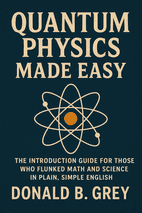
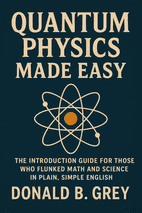
Quantum Physics Made Easy
by Donald B. Grey · Summary updated
What is the book Quantum Physics Made Easy about?
Donald B. Grey's Quantum Physics Made Easy demystifies core concepts like wave-particle duality and superposition using plain English and analogies, avoiding complex math for curious beginners with no scientific background.
Feature
Insta.Page
Blinkist
Shortform
Summary Depth
Full Chapter-by-Chapter
15-min overview
Detailed analysis
Audio Narration
✓ (AI narration)
✓
✓
Visual Mindmaps
✓
✕
✕
AI Q&A
✓ Voice AI
✕
✕
Quizzes
✓
✕
✕
PDF Downloads
✓
✕
✓
Price
$59.99/yr
$146/yr (PRO)
$199/yr
*Competitor data last verified February 2026.
About the Author
Donald B. Grey
Donald B. Grey is a published author known for his insightful and compelling contributions to his literary field. His works, which are celebrated for their depth and engaging narratives, have garnered a dedicated readership. With a distinctive voice and a talent for exploring complex themes, Grey has established himself as a notable figure among contemporary writers. His books are available for purchase on Amazon, where they continue to attract new audiences and critical acclaim. Donald B. Grey's writing reflects a profound expertise and a commitment to delivering powerful stories that resonate with readers.
1 Page Summary
Quantum Physics Made Easy by Donald B. Grey serves as a foundational primer for readers with no background in mathematics or science, aiming to demystify one of the most complex fields of modern physics. The book strategically avoids complex equations, instead using plain English and relatable analogies to introduce core concepts such as wave-particle duality, the uncertainty principle, and quantum superposition. It explains how particles can exist in multiple states at once and behave as both waves and particles, setting the stage for understanding the non-intuitive rules that govern the subatomic world.
The guide provides essential historical context, tracing the development of quantum theory from Max Planck's solution to the ultraviolet catastrophe through the contributions of pioneers like Niels Bohr, Werner Heisenberg, and Erwin Schrödinger. It covers pivotal experiments and thought experiments, such as the double-slit experiment and Schrödinger's Cat, which challenged and ultimately overturned the deterministic worldview of classical physics. This historical narrative helps beginners appreciate not just the "what" of quantum physics, but the "why"—the problems that forced scientists to invent a radical new description of reality.
The book concludes by exploring the profound and lasting impact of quantum theory, highlighting its role as the bedrock for modern technologies like semiconductors, lasers, and MRI machines. It also touches on more advanced, mind-bending implications, including quantum entanglement and its importance for emerging fields like quantum computing and cryptography. By making these abstract ideas accessible, Grey empowers the reader to grasp how quantum physics fundamentally reshaped our understanding of the universe and continues to drive technological innovation today.
Chapter 1: Chapter 1: What Is Quantum Physics, and Why Should I Learn It?
Overview
Practical Applications
Beyond theoretical interest, quantum physics enriches daily life by enhancing comprehension of science fiction media and deepening our grasp of cosmic phenomena. At its core, it describes how the world operates at a microscopic level, and while it involves technical terms and mathematics, the subject is far more approachable than its intimidating reputation suggests. The field remains an active area of discovery, with many cosmic mysteries still unresolved.
Defining the Quantum Realm
The term "quantum" originates from Latin, meaning "how much." Quantum physics specifically examines how matter behaves at the smallest observable scales—atoms and subatomic particles. While this book focuses primarily on atoms, electrons, and photons, it's helpful to recall that atoms consist of protons (positively charged), neutrons (neutrally charged), and electrons (negatively charged). The simplest element, hydrogen, with just one proton and one electron, has been fundamental to many quantum discoveries.
Classical Versus Quantum Physics
The primary distinction between classical and quantum physics lies in scale. Classical physics governs the macroscopic world—objects we can see and interact with directly. Quantum physics operates at the microscopic level, explaining behaviors that classical theories cannot. Interestingly, quantum principles can describe most classical phenomena, but the reverse isn't true. This relationship highlights quantum physics as a more fundamental framework.
Core Concepts and Theoretical Nature
Quantum physics emerged from mathematical concepts developed to explain phenomena that classical physics failed to address. Its theoretical nature means many aspects are proven through mathematical equations rather than direct observation. This leads to a reliance on probability—instead of stating definite positions, quantum physics describes likelihoods. Four key concepts form the foundation: wave-particle duality, the uncertainty principle, quantum entanglement, and quantization.
Einstein's Revolutionary Ideas
Albert Einstein's theory of relativity, introduced in 1905, comprises both general and special relativity. General relativity explains how gravity and acceleration can curve or distort space, time, and light. Special relativity establishes that light always travels at a constant speed of 186,000 miles per second, regardless of the observer's motion. This has been confirmed through observable phenomena like gravitational redshift, where light passing massive objects in space shifts toward the red end of the spectrum.
Key Takeaways
Quantum physics, while technical, is accessible and enriches our understanding of both everyday life and the universe.
It studies matter at atomic and subatomic scales, contrasting with classical physics that deals with larger, observable objects.
The field is inherently theoretical, relying heavily on mathematics and probability rather than direct observation.
Einstein's theory of relativity, proven through phenomena like gravitational redshift, revolutionized our understanding of space, time, and light.
Key concepts: Chapter 1: What Is Quantum Physics, and Why Should I Learn It?
1. Chapter 1: What Is Quantum Physics, and Why Should I Learn It?
Practical Applications and Accessibility
Enhances understanding of science fiction and cosmic phenomena
Describes microscopic world behavior despite technical reputation
More approachable than commonly perceived
Active field with many cosmic mysteries still unresolved
Defining the Quantum Realm
"Quantum" means "how much" in Latin
Studies matter at atomic and subatomic scales
Focuses on atoms, electrons, and photons
Hydrogen atom fundamental to quantum discoveries
Classical vs Quantum Physics
Classical physics governs macroscopic world
Quantum physics explains microscopic behaviors
Quantum principles can describe classical phenomena
Quantum physics is more fundamental framework
Core Theoretical Concepts
Emerged from mathematical concepts explaining classical failures
Relies on probability rather than definite positions
Proven through equations rather than direct observation
Four foundational concepts: wave-particle duality, uncertainty principle, entanglement, quantization
Einstein's Relativity Contributions
General relativity explains gravity's effect on space, time, and light
Special relativity establishes constant speed of light
Light always travels at 186,000 miles per second
Confirmed through phenomena like gravitational redshift
Key Takeaways Summary
Quantum physics is accessible and enriches universal understanding
Studies atomic/subatomic scales vs classical macroscopic focus
Inherently theoretical with mathematical/probability foundation
Einstein's relativity revolutionized space, time, and light concepts
If you like this summary, you probably also like these summaries...
💡 Try clicking the AI chat button to ask questions about this book!
Chapter 2: Chapter 2: Quantization and the Uncertainty Principle
Overview
This chapter explores the foundational shifts in physics that led to quantum theory, beginning with the puzzling behavior of black-body radiation and culminating in the revolutionary uncertainty principle. It traces how classical physics failed to explain certain phenomena, paving the way for Max Planck's introduction of energy quantization and Werner Heisenberg's insights into the inherent limits of measurement at the quantum scale.
Black-Body Radiation and Classical Physics's Shortcomings
Black-body radiation describes how objects emit electromagnetic energy when heated, with a "black body" absorbing and releasing all light frequencies. Classical physics relied on the Rayleigh-Jeans Law, which accurately modeled energy at low frequencies but predicted infinite energy at high frequencies—a flaw known as the Ultraviolet Catastrophe. Conversely, Wien's law worked well for high frequencies but failed at low frequencies, leading to the Infrared Catastrophe. These inconsistencies highlighted the need for a new framework beyond classical mechanics.
Planck's Revolutionary Quantization Idea
In 1900, Max Planck proposed a radical solution: electromagnetic radiation isn't emitted continuously but in discrete "chunks" or quanta. This concept of quantization resolved the black-body radiation problem by introducing steps in energy emission, rather than a smooth curve. Planck's approach was initially a mathematical convenience, but it laid the groundwork for quantum theory. He introduced Planck's constant (h = 6.62607004 × 10⁻³⁴ J·s), a fundamental value that defines the size of these energy chunks.
Understanding Planck's Constant and the Energy Equation
The energy of a photon, the basic unit of light, is calculated using the simple equation E = hf, where E is energy, h is Planck's constant, and f is the frequency of the light. This relationship shows that energy increases with frequency, and Planck's constant sets the minimum "step" for energy changes. An analogy helps visualize this: picture a wave forming a circle, like a guitar string looped around. To increase its energy, you must add whole "bumps" or multiples of h, as partial additions would break the circle's continuity—mirroring how electrons behave around an atomic nucleus.
Heisenberg's Uncertainty Principle
Werner Heisenberg's 1927 uncertainty principle marked another quantum leap, stating that it's impossible to simultaneously know both the exact position and velocity (or momentum) of a quantum particle. The more precisely one property is measured, the less certain the other becomes. This contrasts sharply with classical physics, where objects like cars can have both position and speed measured accurately. The principle is mathematically expressed as σₓσₚ ≥ ħ/2, where σₓ and σₚ are the standard deviations of position and momentum, and ħ is the reduced Planck's constant (related to h). This inequality underscores the trade-off between precision in measurements.
Wave-Particle Duality and Quantum Reality
To grasp the uncertainty principle, consider the wave-like nature of particles. Imagine ripples on a lake: their velocity is easy to gauge from wavelength, but their exact position is fuzzy. Conversely, a pebble has a clear location but an uncertain velocity if unobserved. In quantum physics, particles exist in multiple states and positions simultaneously, meaning terms like "position" and "momentum" lose their classical meanings. Moreover, the act of observation alters a quantum system, making it impossible to see particles in their natural state without disturbance—a topic that will be explored further in later chapters.
Key Takeaways
Quantization of Energy: Energy is emitted in discrete chunks, not continuously, as demonstrated by Planck's solution to black-body radiation.
Planck's Constant: A fundamental value (h) that defines the minimum energy change, used in E = hf to calculate photon energy.
Uncertainty Principle: At quantum scales, measuring position and momentum simultaneously is impossible, with precision in one increasing uncertainty in the other.
Wave-Particle Behavior: Quantum entities exhibit both wave and particle properties, challenging classical concepts of location and movement.
Observer Effect: Measuring quantum systems inherently changes them, emphasizing the unique nature of quantum reality.
Key concepts: Chapter 2: Quantization and the Uncertainty Principle
2. Chapter 2: Quantization and the Uncertainty Principle
Black-Body Radiation and Classical Physics's Shortcomings
Black-body radiation reveals classical physics limitations through emission/absorption paradoxes
Rayleigh-Jeans Law predicts infinite energy at high frequencies (Ultraviolet Catastrophe)
Wien's law fails at low frequencies (Infrared Catastrophe)
Classical physics cannot explain full spectrum of black-body radiation
Planck's Revolutionary Quantization Idea
Energy is emitted in discrete quanta rather than continuously
Quantization resolves black-body radiation problem mathematically
Initially a mathematical convenience that became foundational to quantum theory
Introduces Planck's constant (h) as fundamental quantum scale
Understanding Planck's Constant and the Energy Equation
Photon energy calculated by E = hf (energy equals Planck's constant times frequency)
Planck's constant defines minimum energy step for quantum systems
Energy increases with frequency in discrete increments
Wave analogy: energy changes occur in whole 'bumps' to maintain continuity
Heisenberg's Uncertainty Principle
Impossible to simultaneously know exact position and momentum of quantum particles
Measurement precision trade-off: more certainty in one property increases uncertainty in the other
Mathematically expressed as σₓσₚ ≥ ħ/2 using reduced Planck's constant
Contradicts classical physics where both properties can be precisely measured
Wave-Particle Duality and Quantum Reality
Quantum entities exhibit both wave-like and particle-like properties
Wave nature explains uncertainty: waves have clear velocity but fuzzy position
Particles exist in multiple states simultaneously (quantum superposition)
⚡ You're 2 chapters in and clearly committed to learning
Why stop now? Finish this book today and explore our entire library. Try it free for 7 days.
Chapter 3: Chapter 3: Waves and Particles and the Double Slit Experiment
Overview
Quantum mechanics introduces a mind-bending reality where the familiar categories of particles and waves blur into a single, dual nature for all matter and energy. This chapter traces the pivotal experiments that forced physicists to abandon classical views, revealing how light and even atoms can act as both discrete particles and spread-out waves depending on how we observe them. From Einstein's groundbreaking insights to simple yet profound lab setups, we see how this duality forms the bedrock of quantum theory.
Einstein's Leap with the Photoelectric Effect
Albert Einstein built on earlier work by Max Planck and Philipp Lenard to propose that light behaves as particles called photons. Lenard had found that shining light on metals ejected electrons, but only if the light's frequency was high enough—its color mattered more than its brightness. Einstein connected this to Planck's constant, using the equation E = hf to show that light energy comes in quantized packets. His idea was initially met with skepticism, but Robert Millikan's experiments later confirmed it, earning Einstein a Nobel Prize and solidifying the particle aspect of light.
Young's Double-Slit Revelation
Long before quantum mechanics, Thomas Young demonstrated light's wave nature with his double-slit experiment. By passing light through two slits onto a screen, he observed an interference pattern of bright and dark bars—clear evidence of waves overlapping. Imagine ripples on a pond: where crests meet, they amplify (constructive interference), and where crests and troughs collide, they cancel out (destructive interference). This visual pattern couldn't be explained if light were merely particles, challenging the scientific consensus of his time.
The Astonishing Single-Particle Tests
When scientists repeated the double-slit experiment with individual photons—firing them one at a time—the results were even more startling. Instead of each photon going straight through a slit and hitting a predictable spot, it landed in a way that contributed to the wave-like interference pattern over time. This held true for electrons, atoms, and molecules too, proving that even single entities exhibit wave behavior. It's as if each particle "knows" about both slits, highlighting the inherent duality that defies everyday intuition.
Key Takeaways
Wave-particle duality is a core principle where entities like light and matter display both particle-like and wave-like properties.
The photoelectric effect showed that light's energy is quantized, with frequency determining electron ejection, not intensity.
The double-slit experiment visually demonstrates wave interference, and even single particles create these patterns, confirming duality.
Historical experiments by figures like Einstein, Young, and Millikan were crucial in overturning classical physics and embracing quantum concepts.
Key concepts: Chapter 3: Waves and Particles and the Double Slit Experiment
3. Chapter 3: Waves and Particles and the Double Slit Experiment
Einstein's Photoelectric Effect
Light behaves as particles called photons with quantized energy
Electron ejection depends on light frequency, not intensity
Energy equation E = hf connects to Planck's constant
Initially met with skepticism but confirmed by Millikan's experiments
Earned Einstein Nobel Prize and established particle nature of light
Young's Double-Slit Experiment
Demonstrated wave nature of light through interference patterns
Bright and dark bars result from constructive and destructive interference
Patterns analogous to ripples overlapping in water
Could not be explained by particle-only model of light
Challenged scientific consensus of the time
Single-Particle Double-Slit Tests
Individual photons still create interference patterns over time
Each particle appears to 'know' about both slits simultaneously
Same wave behavior observed with electrons, atoms, and molecules
Demonstrates duality exists even for single entities
Defies classical intuition about particle behavior
Wave-Particle Duality Principles
Core quantum principle where matter and energy have dual nature
Behavior depends on how system is observed or measured
Forms bedrock of quantum theory and overturns classical physics
Applies to both light (photons) and matter (electrons, atoms)
Historical experiments forced abandonment of classical views
Chapter 4: Chapter 4: Quantum Non-Locality and the Bohr-Einstein Debates
Overview
Overview
This chapter transports us to the electrifying era of quantum physics' golden age, where scientific breakthroughs sparked intense intellectual clashes. At the heart of the turmoil were the legendary debates between Niels Bohr and Albert Einstein, two giants grappling with the bizarre realities of quantum mechanics. Their disagreements weren't just academic squabbles—they shaped our understanding of reality itself, challenging long-held beliefs about determinism, observation, and the very fabric of the universe.
The Clash of Scientific Titans
Bohr and Einstein's rivalry began with Bohr's initial resistance to Einstein's photoelectric effect, a stance he held for two decades. Their debates, later immortalized in Bohr's writings, centered on Einstein's deep unease with quantum mechanics' probabilistic nature. Einstein yearned for a deterministic universe where events had clear causes, while Bohr championed the Copenhagen interpretation, which suggested that particles like electrons exist as waves until observed, collapsing into particles upon measurement. This idea of an observer-dependent reality felt like a violation of objective truth to Einstein, who believed the universe operated independently of human observation.
Einstein's Ingenious Challenges
Determined to expose flaws in quantum theory, Einstein devised clever thought experiments. His first involved a modified double-slit setup with a movable wall, arguing that tracking a photon's path would violate the uncertainty principle. Bohr countered by highlighting the quantum-level precision needed to measure the wall's movement, which itself would breach the uncertainty principle. Undeterred, Einstein proposed a "photon-in-a-box" experiment, using a scale and clock to measure a photon's energy and time simultaneously. Bohr brilliantly turned Einstein's own theories against him, citing relativity's time distortion effects and Newton's laws to show the impossibility of such measurements, solidifying his defense of quantum principles.
The Legacy of "Spooky Action"
Despite Einstein's relentless efforts, Bohr consistently refuted each challenge, earning a symbolic victory in their lifelong friendly debate. However, one concept remained a thorn in Einstein's side: quantum entanglement, which he dismissively called "spooky action at a distance." This idea—that measuring one entangled particle instantly affects its partner, regardless of distance—defied Einstein's commitment to locality (the rule that influences can't travel faster than light). While Bohr's views largely endure in modern science, this unresolved tension over non-locality set the stage for future explorations into quantum weirdness.
Key Takeaways
Scientific progress thrives on debate: The Bohr-Einstein clashes exemplify how intellectual disagreements drive experimentation and refinement of theories.
Quantum mechanics challenges classical intuition: Concepts like the Copenhagen interpretation and wave-particle duality reveal a universe where observation shapes reality.
Thought experiments are powerful tools: Einstein's scenarios, though ultimately refuted, pushed the boundaries of quantum understanding and highlighted its paradoxes.
Non-locality remains a profound mystery: Quantum entanglement's "spooky" implications continue to inspire research and debate in physics today.
Key concepts: Chapter 4: Quantum Non-Locality and the Bohr-Einstein Debates
4. Chapter 4: Quantum Non-Locality and the Bohr-Einstein Debates
The Bohr-Einstein Scientific Rivalry
Began with Bohr's two-decade resistance to Einstein's photoelectric effect
Centered on Einstein's discomfort with quantum mechanics' probabilistic nature
Einstein advocated for deterministic universe with clear cause-and-effect
Bohr championed Copenhagen interpretation with observer-dependent reality
Einstein's Thought Experiment Challenges
Modified double-slit experiment with movable wall to challenge uncertainty principle
Photon-in-a-box experiment attempting simultaneous energy and time measurement
Bohr countered using quantum precision requirements and measurement limitations
Bohr turned Einstein's own relativity theories against his arguments
Quantum Entanglement and Non-Locality
Einstein dismissed entanglement as 'spooky action at a distance'
Violated Einstein's commitment to locality (no faster-than-light influences)
Measuring one entangled particle instantly affects its partner regardless of distance
Remained unresolved tension that inspired future quantum research
Legacy and Impact of the Debates
Bohr earned symbolic victory by consistently refuting Einstein's challenges
Demonstrated how scientific progress thrives on intellectual debate
Highlighted quantum mechanics' challenge to classical intuition and determinism
Established thought experiments as powerful tools for exploring quantum paradoxes
📚 Explore Our Book Summary Library
Discover more insightful book summaries from our collection