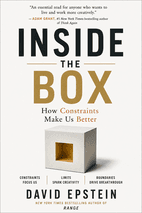
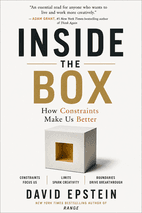
David Epstein's Inside the Box argues that breakthrough creativity and innovation emerge from embracing constraints, not boundless freedom, drawing on examples from Pixar to Keith Jarrett. It offers entrepreneurs, creatives, and leaders a practical toolkit for reframing limitations as opportunities.
Feature
Insta.Page
Blinkist
Shortform
Summary Depth
Full Chapter-by-Chapter
15-min overview
Section-by-section guides
Audio Narration
✓ (AI narration)
✓
✓
Visual Mindmaps
✓
✕
✕
AI Q&A
✓ Voice AI
✕
✕
Quizzes
✓
✕
✕
PDF Downloads
✓
✕
✓
Price
$59.99/yr
$146/yr (PRO)
$199/yr
*Competitor data last verified February 2026.
About the Author
David Epstein
David Epstein is an American journalist and author specializing in sports science and human performance. He is best known for his books *The Sports Gene* and *Range: Why Generalists Triumph in a Specialized World*, which explore the science of athletic excellence and the value of broad experience. A former senior writer at *Sports Illustrated*, Epstein holds degrees in environmental science and journalism.
1 Page Summary
In Inside the Box, David Epstein challenges the pervasive cultural myth that boundless freedom and unlimited resources are the keys to breakthrough innovation. Drawing on a wide array of examples—from the spectacular failure of General Magic, a company that had everything yet collapsed under the weight of its own ambition, to the incremental, constraint-driven success of Pixar—Epstein argues that the most profound creativity and problem-solving emerge when we embrace limits. The book systematically dismantles the "lone genius" and "moonshot" narratives, revealing that true progress is often the result of deliberately imposed boundaries, such as Pixar's "Three Pitches Rule," the scientific requirement to preregister hypotheses, or the market chiefs of Lusaka who enforce trust through objective rules.
Epstein’s approach is distinctive for its rigorous, cross-disciplinary synthesis. He weaves together stories from the arts, sciences, business, and sports, grounding each in robust research and vivid anecdotes. The book explores a wide range of "boxes," including the Green Eggs and Ham Effect (how Dr. Seuss and Bach created masterpieces under severe constraints), the power of paired constraints (blocking familiar solutions to force novelty), and the value of satisficing (choosing "good enough" over the paralyzing search for "the best"). He shows how figures like Keith Jarrett, whose broken piano forced a legendary concert, and James Rogers of Apeel Sciences, who focused on extending food shelf life rather than increasing production, all succeeded by identifying and working within their constraints.
This book is for anyone who feels stuck by limitations or, conversely, paralyzed by too many choices. Entrepreneurs, creatives, scientists, and leaders will find a practical toolkit for reframing obstacles as opportunities. Readers will learn that the most valuable skill is not dreaming without limits, but learning how to build better boxes, from designing for the most constrained user (universal design) to using framing and institutions to set the "rules of the game" for collaboration. Ultimately, Inside the Box offers a liberating counterintuitive insight: freedom isn’t the absence of limits, but the mastery of them.
The story of General Magic reads like a parable tailor-made for anyone who has ever wondered what happens when brilliance meets unlimited resources. The company had everything: founders who were Apple legends, a visionary who foresaw the information economy, and a product concept that presaged the iPhone by nearly two decades. Marc Porat’s “Pocket Crystal” sketch in 1989—a thin glass rectangle with a touch screen, capable of messaging, movies, apps, and more—was almost eerily accurate. Yet General Magic collapsed into obscurity, and the question of why is the heart of this chapter.
The story traces the company’s meteoric rise: an alliance of global giants (Sony, Motorola, AT&T, and others), a stock price that doubled on IPO day, and a culture where engineers slept under desks to build unheard-of innovations—early USB, touchscreen keyboards, emoji precursors, the cloud. But the very freedom that sparked that creativity became the company’s undoing. With no revenue and no clear customer, the team kept adding features, pushing deadlines, and refusing to set boundaries. The result was a bloated, battery-hungry device that sold only three thousand units. As one engineer put it, the calendar function alone grew from a few lines of code covering 1904–2096 to an astronomical-scale project—because nobody said “no.”
The chapter uses General Magic to illustrate a broader pattern: the instinct to add, not subtract, and the danger of skipping the slow, thoughtful phase of defining constraints. It introduces Bent Flyvbjerg’s research on project disasters, contrasting the “think fast, act slow” pattern (large projects that rush into scale without boundaries) with the successful “think slow, act fast” approach, which he calls Pixar planning. The lesson is that without limits, even the most talented teams can create a beautiful, useless explosion of brilliance.
Key Takeaways
The curse of abundance: Too much money, talent, and freedom can be as dangerous as too little. Without constraints, teams add features compulsively, losing focus and coherence.
The “Christmas tree effect”: Humans have a cognitive bias to solve problems by adding rather than subtracting, which often makes projects worse (Leidy Klotz’s Lego experiment).
Small experiments before scaling: Successful large projects take time to define boundaries and test assumptions early (“think slow”), then execute quickly (“act fast”). General Magic skipped the slow thinking and paid the price.
Define what not to do: The hardest part of innovation isn’t imagining possibilities—it’s deciding which to abandon. General Magic’s failure to say “no” to any cool idea doomed their product.
Key concepts: Chapter 1: A World without Limits
1. Chapter 1: A World without Limits
General Magic's Rise and Fall
Founded by Apple legends with unlimited resources
Pocket Crystal concept eerily predicted the iPhone
Alliance of global giants and soaring IPO
Only 3,000 units sold; company collapsed
The Curse of Abundance
Too much money, talent, and freedom breeds chaos
Engineers added features compulsively without focus
Calendar function grew from simple to astronomical
No one said 'no' to any cool idea
The Christmas Tree Effect
Cognitive bias to solve problems by adding
Adding often makes projects worse (Lego experiment)
Subtraction is harder but more valuable
General Magic kept decorating without pruning
Think Slow, Act Fast
Bent Flyvbjerg's research on project disasters
Successful projects define boundaries early
Pixar planning: slow thinking, fast execution
General Magic skipped the slow thinking phase
The Power of Constraints
Hardest innovation is deciding what not to do
Limits force focus and coherence
Without constraints, brilliance becomes useless
Define boundaries before scaling
If you like this summary, you probably also like these summaries...
💡 Try clicking the AI chat button to ask questions about this book!
Chapter 2: Chapter 2: A World with Limits
Overview
The myth of the moonshot—the lone genius with a grand vision who will inspire everyone to follow—is seductive but dangerous. Pixar cofounder Ed Catmull keeps a 1952 NASA planning book on his shelf as a corrective, one that breaks the Moon landing into small, solvable pieces. That same incremental philosophy guided his own twenty-year journey to Toy Story, where he and his team calculated that a full computer-animated film would require a hundred Cray-1 supercomputers costing a billion dollars—not as discouragement, but as a boundary that told them what not to chase. Instead, they focused on proximate problems: animating a hand, generating in-between frames, figuring out the exact number of pixels needed for a single realistic sequence. The process was slow, deliberate, and constrained.
Once Pixar succeeded, Catmull turned those constraints into organizational habits. The Three Pitches Rule forced directors to propose multiple ideas, preventing premature fixation. Development teams stayed tiny for years, simplifying until the story’s core emerged—Inside Out cut characters for ennui and schadenfreude when the cast grew too complicated. Production itself was walled in by daily “dailies,” Braintrust meetings where peers identified problems without prescribing solutions (Steve Jobs was banned), and mandatory postmortems whose real value came from the pre-postmortem deadline that forced ongoing reflection. When artists obsessed over a beautifully shaded penny—like the aquarium fish in The Incredibles that the director wanted to flicker for months—a wall of popsicle sticks made constraints visible: each stick represented a week of one animator’s work, so any new obsession meant stealing sticks from another character.
The same iterative principle appears in the production of This American Life. A pitch for an episode called “Something Only I Can See” began as a seven-minute-over, confusing mess. But the process titrated out confusion: each read-through included at least one fresh listener who pointed out what confused them without prescribing fixes. Only when a new listener had no notes did Ira Glass step in for hands-on editing, and the final edit happened the same afternoon the episode aired. The boundaries of time and fresh eyes turned a novice into someone who sounded like a pro, without anyone dictating the solution.
Tony Fadell learned the lesson at General Magic the hard way, then applied it at Apple. For the iPod, he set a self-imposed Christmas deadline that forced the team to use existing technology resourcefully—the scroll wheel came from a Danish cordless phone. For the iPhone, they used “heartbeats”: internal deadlines after which they paused, collected lessons, and regrouped, producing three versions in under a year. Fadell later said, “We forced as many constraints on ourselves as possible.” At Nest, the team prototyped the packaging before the product existed, forcing feature prioritization and clear communication. The result was a multi-billion-dollar acquisition. “With these ultra-constraint-based things, it makes you really think hard,” Fadell noted.
Even Bell Labs, legendary for unfettered innovation, operated on circumscribed freedom—what innovation historian Eric Gilliam calls “long leash, narrow fence.” Researchers had enormous autonomy but were expected to interact with engineers and manufacturing to identify specific, important problems. A dedicated staff, often as large as the research team, did nothing but find and define those problems. John R. Pierce put it bluntly: “Too much freedom is horrible.”
General Magic alumni internalized that lesson. Megan Smith, who later became U.S. CTO, pushed back against grand plans to “fix education,” urging colleagues to scout and scale—find solutions already working in communities and help them grow, rather than inventing from scratch. Darin Adler, the engineer who famously argued against the “no managers” ethos, later led the Safari team at Apple and became obsessed with the first step. He often asks teams to imagine the next step as if it weren’t part of a long-term vision—a trick to force specificity and sustainable chunk sizes. “A lot of times, the response will be, ‘You're ruining it,’” he said. “But when we didn’t do that, we ended up with nothing.”
Bent Flyvbjerg, who studies megaprojects, confirms that a giant vision actually demands a longer period of small experimentation. Frank Gehry tested ideas on his own house before designing the Guggenheim Bilbao on time and under budget. Solar farms, the least likely massive projects to suffer cost overruns, succeed because they’re modular: a single panel can be tested, snapped into an array, and scaled. The lesson is to shrink big challenges anyway, even when they aren’t naturally modular.
The Nobel laureate Herbert Simon formalized this in his concept of the problem space—the mental territory from an initial state to a solution. Unfamiliar problems are ill-structured and vast; the key is imposing structure by selecting a very small part of the maze to explore. In a 1990 experiment, students who succeeded at discovering Kepler’s orbital law didn’t guess randomly. They systematically guessed a relationship, tested it, used the exact way it was wrong to narrow their next guess, and repeated—learning from failure. The unsuccessful solvers tried random formulas, learned only whether each was right or wrong, and often repeated the same mistakes. When exploration is too free, you can’t build on failure. The creators at Pixar, This American Life, Apple, and Nest already knew that. Now it’s clear: put forward a specific idea, find out what’s wrong, use that information to adjust, and repeat. That’s how you turn a world with limits into a world of achievement.
Key Takeaways
Don’t start from scratch when you can find and scale solutions already working in small pockets.
Force yourself to identify the very first step—even if it feels like you’re ruining the grand vision.
Shrink the problem space by systematically testing guesses and learning from each specific failure, rather than flailing randomly.
Modularity helps: break big challenges into pieces that can be tested independently before scaling.
Design freeze (enforced stops) prevents featuritis and keeps projects from ballooning out of control—as the U.S. Navy recently learned the hard way.
Key concepts: Chapter 2: A World with Limits
2. Chapter 2: A World with Limits
The Danger of the Moonshot Myth
Lone genius vision is seductive but dangerous
NASA broke Moon landing into small solvable pieces
Pixar used boundaries to know what not to chase
Incremental philosophy guided Toy Story's 20-year journey
Pixar's Constraint-Based Habits
Three Pitches Rule prevents premature fixation
Tiny teams simplify until story core emerges
Braintrust meetings identify problems without prescribing solutions
Popsicle sticks make time constraints visible
Iterative Refinement at This American Life
Fresh listeners point out confusion without fixes
Time and fresh eyes turn novices into pros
Final edit happens same afternoon as airing
Process titrates out confusion gradually
Forced Constraints at Apple and Nest
Christmas deadline forced resourceful iPod design
iPhone heartbeats produced three versions in a year
Nest prototyped packaging before product existed
Ultra-constraints force hard thinking and prioritization
Bell Labs' Circumscribed Freedom
Long leash, narrow fence for researchers
Dedicated staff finds and defines important problems
Researchers must interact with engineers and manufacturing
Too much freedom is horrible, per John R. Pierce
Scout and Scale vs. Grand Plans
Find solutions already working in communities
Help existing solutions grow instead of inventing
Obsess over the first step, not long-term vision
Specificity and sustainable chunk sizes prevent failure
Herbert Simon's Problem Space Concept
Impose structure by exploring small maze parts
Successful solvers learn from exact failures
Unsuccessful solvers repeat same mistakes randomly
Put forward idea, find what's wrong, adjust, repeat
⚡ You're 2 chapters in and clearly committed to learning
Why stop now? Finish this book today and explore our entire library. Try it free for 7 days.
Chapter 3: Chapter 3: Limit-Powered Learning
Overview
A sudden shift in clinical trial results after 2000—from mostly positive to almost none outperforming placebos—revealed that the real change wasn't in the drugs but in a new requirement to preregister hypotheses and analysis plans. That simple constraint slashed "researcher degrees of freedom," meaning scientists could no longer tweak their story once they'd seen the data. The sudden drop in positive findings exposed that many earlier "breakthroughs" were likely false positives, driven by too much freedom to cherry-pick results. This same danger plays out in the story of Brian Wansink, whose once-celebrated nutrition studies crumbled when a blog post revealed he'd handed a graduate student a failed dataset and told her to "salvage" something—a textbook case of HARKing (Hypothesizing After the Results are Known). With unlimited flexibility and no limits, any large dataset can yield something that looks meaningful but is just random chance, just like slicing sports stats until a trivial pattern emerges. The broader replication crisis that followed across psychology, genetics, and cancer research showed fewer than half of high-impact studies could be replicated, but the bright side is that scientists themselves sounded the alarm, and fields now embrace preregistration and transparent reporting.
The same principle applies far beyond academia. Startups trained in the scientific method—defining problems, setting decision thresholds, and testing hypotheses—pivoted more effectively and earned significantly more than those who simply followed standard mentoring. In contrast, Apple’s Newton failed because CEO John Sculley ignored research that contradicted his desired outcome, relying on a "famous fake focus group" that told him what he wanted to hear. General Magic never wrote down its hypotheses, so the team could always rewrite history rather than face hard truths—causing them to miss out on a low-level engineer’s auction site that became eBay. The instinct to stick with the easy, intuitive path is baked into human cognition; we are cognitive misers who default to familiar solutions. That’s why constraints—like a publisher’s tough space limit—can force genuine breakthroughs. Dmitri Mendeleev only discovered the periodic table after being pushed away from a haphazard alphabetical listing into the hard work of grouping elements into families with shared properties. The pressure of limited options, not total freedom, sparked that leap. As cognitive science confirms, the brain is designed to save you from thinking; real creativity emerges when constraints block the lazy path and demand deeper experimentation.
The Vanishing Drug Benefits
Between 1970 and 1999, the National Heart, Lung, and Blood Institute (NHLBI) funded thirty large clinical trials testing drugs or supplements for cardiovascular disease. Most showed benefits. Then, starting in 2000, the results flipped: almost none of the new drugs or supplements outperformed placebos, and some caused harm. What changed wasn’t medicine—it was registration. Researchers were now required to preregister their hypotheses and analysis plans on clinicaltrials.gov before starting a trial. This forced them to commit to specific predictions and methods ahead of time, slashing what scientists call “researcher degrees of freedom.” Before 2000, researchers could tweak their story after seeing the data; after 2000, they couldn’t. The result? A sudden drop in positive findings, suggesting many earlier “breakthroughs” were likely false positives.
The Danger of Too Much Freedom
That counterintuitive problem—too much freedom leads to false conclusions—shows up vividly in the story of Brian Wansink, a once-celebrated nutrition researcher at Cornell. His lab produced headline-grabbing studies: bottomless soup bowls that made people eat more, snack bowls that doubled calorie intake, the effect of action movies on eating. In 2016, Wansink wrote a blog post titled “The Grad Student Who Never Said ‘No’,” proudly describing how he’d handed a graduate student a failed study’s dataset and told her to “salvage” something positive. She sifted through the data until she found correlations that held up—like diners who paid less for a buffet felt guiltier, or that the first slice of pizza mattered more for those who paid more. This is HARKing: Hypothesizing After the Results are Known. It’s like a sharpshooter firing randomly at a wall, then drawing a bull’s-eye around a cluster of bullet holes. With enough data and no limits, you’ll always find something that looks meaningful but is just random chance. After the blog post, fellow scientists pointed out the flaw; eighteen of Wansink’s studies were retracted, and he resigned.
This practice isn’t rare. In sports, announcers might create a stat like “the Chiefs are undefeated at home against division rivals when Taylor Swift is in attendance”—only because someone sliced the data until something popped. Combine HARKing with other “degrees of freedom” (how to analyze, when to stop collecting data, how to define groups), and any large dataset can yield a “significant” result. A trio of scientists once “proved” that listening to the Beatles’ “When I’m Sixty-Four” made college students younger. The replication crisis that followed has shaken psychology, genetics, nutrition, and cancer research: fewer than half of high-impact studies could be replicated. The bright side is that scientists themselves raised the alarm, and many fields now require preregistration and transparent deviations, turning negative findings into genuine learning rather than discarded failures.
Learning from Constraints in Business
The same principle applies beyond academia. In 2016, a team of scientists trained 116 early-stage startup founders in Italy. All received standard business mentoring, but half were randomly selected to also learn the scientific method: clearly define the problem, formulate testable hypotheses, set decision thresholds, and go test them. Founders who adopted this approach pivoted more often when their assumptions failed—like InkDome, which started as a tattoo-artist search engine. When their hypothesis that users could recognize the right artist online failed (only 60% support was the threshold), they pivoted to a network of tattoo experts. The non-scientific founders rarely changed course. On average, the scientifically trained startups earned significantly more money.
The danger of refusing to test assumptions played out painfully at General Magic and Apple’s Newton. Apple’s CEO John Sculley ignored anthropologist Eleanor Wynn’s research showing that businesspeople wouldn’t use the Newton unless it included a phone—and instead relied on a “famous fake focus group” that told him what he wanted to hear. The Newton flopped. General Magic’s Tony Fadell later reflected that none of the company’s hypotheses were ever written down, so they could always practice revisionist history. When a low-level engineer named Pierre Omidyar showed General Magic his personal auction site, they were too committed to their proprietary e-commerce network to pivot. He left, renamed it eBay, and changed the world.
The Power of Forced Creativity
That instinct to stick with the easy, intuitive path isn’t unique to failed companies. Humans are “cognitive misers”—we default to familiar solutions. Dmitri Mendeleev discovered this firsthand. When writing The Principles of Chemistry, he initially organized elements alphabetically and described lab techniques, a haphazard approach. But his publisher imposed a tough space constraint, forcing him to find a more efficient system. He experimented with valence, then with groups like fluorine, chlorine, bromine, and iodine that shared properties. That struggle led him to the periodic table, a breakthrough that only came because the easy path was blocked. Constraints, whether from preregistration, a publishing deadline, or a decision rule, force us to stop, think, and test—and that’s where genuine learning and creativity emerge.
Mendeleev’s breakthrough crystallized when he stopped treating elements as isolated characters and started seeing them as members of families. He noticed that chlorine, for instance, had a set of chemical cousins—bromine, fluorine, iodine—that behaved similarly. The same went for sodium: a whole group of analogous elements hovered around it. By grouping elements into families with shared properties, he could write entire chapters about a cluster rather than tediously covering each one individually. It was efficient, but more importantly, it unlocked the periodic pattern.
Yet here’s the twist: Mendeleev’s genius didn’t spring from pure creative freedom. He got there only after being forced away from the easy, arbitrary categories that first came to mind. The cognitive scientist Daniel Willingham puts it bluntly: “The brain is not designed for thinking. It’s designed to save you from having to think.” Left to its own devices, the brain clings to familiar patterns and spits out unoriginal ideas. Real breakthroughs demand constraints. In Mendeleev’s case, it was the hard work of mixing, matching, and experimenting under the pressure of limited options that pushed him toward the periodic table. Total freedom, it turns out, is the enemy of novelty; it’s the guardrails that actually spark creativity.
Key Takeaways
Mendeleev’s insight came from recognizing families of elements with shared chemical traits, not from treating them in isolation.
His progress accelerated when he moved away from easy, pre-existing schemas and began actively experimenting with groupings.
Cognitive science confirms that the brain prefers lazy shortcuts; true creative leaps require constraints that force deeper thinking.
Key concepts: Chapter 3: Limit-Powered Learning
3. Chapter 3: Limit-Powered Learning
Preregistration Transforms Research
Post-2000 requirement to preregister hypotheses
Slash researcher degrees of freedom
Exposed many earlier breakthroughs as false positives
Too Much Freedom Breeds False Conclusions
Brian Wansink's HARKing scandal
Any large dataset yields seemingly meaningful patterns
Mendeleev discovered periodic table under pressure
Business Lessons from Scientific Method
Startups using scientific method pivot more effectively
Apple Newton failed ignoring contradictory research
General Magic never wrote hypotheses, missed eBay
HARKing and Data Slicing Dangers
Hypothesizing after results are known
Like drawing bullseye around bullet holes
Sports stats can create false patterns
Transparency Turns Failures into Learning
Preregistration and transparent deviations required
Negative findings become genuine learning
Scientists themselves raised the alarm
Constraints Spark Creativity
Publisher's space limit forced periodic table discovery
Limited options, not freedom, drive leaps
Brain designed to avoid thinking
Chapter 4: Chapter 4: The Green Eggs and Ham Effect
Overview
It starts with a near-disaster in Cologne: a young promoter, Vera Brandes, convinces Keith Jarrett to play a solo piano concert despite an undersized, broken instrument. That night, forced to rely on the middle register and rhythmic invention, Jarrett produced The Köln Concert, the bestselling solo piano album of all time. This is the Green Eggs and Ham Effect in action—named after Dr. Seuss’s fifty-word bet—where constraints spark creativity. Theodor Geisel, after being challenged to use a minuscule vocabulary, transformed children’s literature because the limited sounds forced rhythmic discovery. Research confirms that when people face boundaries, they break free of familiar ruts; inventor Simone Giertz even uses a dice system to force novel combinations.
No one built tighter cages than Johann Sebastian Bach, who gravitated toward the fugue—an exceptionally rule-bound form. As book-cover designer and former pianist Peter Mendelsund explains, Bach’s Art of Fugue takes a spare twelve-note theme and smashes it through inversions, palindromes, and quadruple fugues. The rules leave “no choice” but to venture into groundbreaking harmonic territory. Bach, like the Oulipo writers who construct labyrinths to escape, engineered freedom through self-imposed chains. Stravinsky echoed this, describing the “anguish into which an unrestricted freedom plunges” him, and insisted that his most riotous masterpiece came from confinement.
But not all constraints work. Dr. Seuss’s art teacher gave the wrong kind—prescribing both end and process—which kills creativity. The right constraints limit the workspace while leaving the explorer free inside it. That principle shows up in improv comedy (Keegan-Michael Key setting rules for a sketch to rack up 225 million views), in sports coaching’s Constraints-Led Approach (swimmers threading hoops, sprinters hitting tiny wickets, soccer players outnumbered on small fields), and even in NBA star Kyrie Irving’s legendary finishing ability, forged by a broken backboard that forced strange angles. A study with business students found that a simple template for designing a sneaker ad instantly boosted creativity in supposedly “uncreative” participants.
Perhaps the most generative constraint of all is haiku. Its five-seven-five syllable structure originated as the throwaway introduction to long poems; Zen poet Matsuo Basho turned it into a serious form that captures a single moment. Richard Wright wrote thousands of haiku in his last year, and his daughter learned that the tiny box forces anyone into linguistic exploration. When twentieth-century poets tried a “Free Haiku School,” their influence dwindled because, as scholar Kenneth Yasuda noted, “Art exists and is communicable only through form.” Robert Frost captured it memorably: writing free verse is like “playing tennis without a net.”
The key lesson: the right constraints liberate creativity by shrinking the problem space and forcing active exploration; the wrong constraints—those that dictate both goal and method—stifle it. Whether through Bach’s cantus firmus, a five-seven-five count, or a broken backboard, sometimes the best way to think outside the box is to first build a very specific box.
The Cologne concert that nearly wasn't begins with an eighteen-year-old promoter named Vera Brandes. She had already built an unlikely career—arranging gigs for Ronnie Scott while still in school, promoting an eight-hundred-seat show at seventeen—and now she was bringing Keith Jarrett to the Cologne Opera House for a solo piano performance. All 1,432 tickets sold, cheap seats at four deutsche marks, a Friday night slot starting at 11 p.m. after the opera. Then the piano arrived.
Jarrett had requested a nine-and-a-half-foot Bösendorfer Imperial concert grand. What sat on the orchestra lift was two and a half feet shorter, with fewer bass keys, sticky pedals, and worn hammer felt that made the upper register sound tinny. The real Imperial was still trapped between two metal doors in an underground tunnel. The piano tuner arrived, assessed the damage, and told Brandes it would cost 45,000 deutsche marks to replace the instrument if she tried rolling it across cobblestones in the rain. Jarrett and his producer Manfred Eicher started walking away. Brandes stopped them, leaned into the yellow Rambler, and told Jarrett she'd be “truly fucked” if he didn't play—a phrase she’d borrowed from Miles Davis. After a long pause, Jarrett agreed, “just for you.”
The tuner and his son worked backstage while the opera played on. Jarrett ate a rushed dinner. He finally sat down around 11:30 p.m. The first tinkling notes mimicked the pre-concert bell, drawing a giggle from the crowd. Then came an hour of improvisation that stuck to the middle register, relying on ostinatos and rhythmic shifts instead of the full keyboard. Jarrett stamped the pedal without pressing it, pressed keys aggressively to reach the balconies, and wove driving rhythms with fragile whispers. The audience erupted, demanding one final short piece. The recording, released later that year as The Köln Concert, became the bestselling solo piano album of all time.
“That piano did him the biggest favor on the planet,” Brandes said half a century later. Jarrett himself acknowledged the constraints forced him to play in a new way, to bring out whatever qualities the imperfect instrument had.
The Green Eggs and Ham Model
That paradox—limitations spurring creativity—has a name borrowed from Dr. Seuss. Theodor Geisel wrote Green Eggs and Ham after Bennett Cerf bet him he couldn't use just fifty words. The Cat in the Hat came from a similar constraint: a list of 225 vocabulary words with no adjectives, no “queen,” no “zebra.” Geisel complained it was like making strudel without strudels, but the limited sounds forced him to explore rhythm and pacing. The result transformed children's literature.
Research backs this up. Given complete freedom, people follow the “path of least resistance,” defaulting to familiar solutions—the Einstellung effect. Without constraints, composition happens in a “cul-de-sac of the customary.” Studies show that when participants must use specific components or incorporate a particular word, they generate more original ideas. Inventor Simone Giertz created a set of three dice—with objects, materials, and properties—to force herself off her usual mental tracks. “If you can cook any meal, you're probably going to cook something you already know,” she said. “If you can only cook with these three ingredients, you're going to have to come up with something new.”
Bach’s Self-Imposed Cage
No one embraced constraints more zealously than Johann Sebastian Bach. The composer voted greatest of all time by 174 composers for BBC Music Magazine—ahead of Beethoven, Mozart, Coltrane, and Björk—made a career of heaping obstacles on himself.
Peter Mendelsund, the celebrated book-cover designer and former concert pianist, demonstrated this in his Manhattan home. He explained that by Bach's time, Western music had accumulated a massive rulebook—each melody should have a single climax note, overlapping lines must never jump the same distance simultaneously, and dozens more. Bach didn't just obey these rules; he gravitated to the fugue, an exceptionally rule-bound form where a short theme is imitated, manipulated, chased, and returned to across multiple concurrent melodies.
The pinnacle was The Art of Fugue. Mendelsund played its main theme—a spare twelve notes, up a little, down a little. Over fourteen fugues, Bach turned that theme upside down, at double speed, at half speed, simultaneously in different voices, then added a palindrome version and a third theme spelling B-A-C-H in German musical notation. At one point, Mendelsund paused to highlight a harmonic shift forced by the rule against simultaneous jumps. “He had no choice,” he said. “And it leads to some harmonic territory that's truly, truly groundbreaking.” The final fugue was planned as a quadruple fugue—four themes, sometimes inverted—but Bach died before finishing it.
Mendelsund compared Bach’s approach to the Oulipo writers, who one member described as “rats who construct the labyrinth from which they plan to escape.” Bach built his own musical escape rooms, and the result was an album that still landed on the iTunes home page beside Snoop Dogg and U2 in 2008.
When the legendary Bach imposed the cantus firmus rule on himself, he wasn't being masochistic—he was engineering freedom. That's the counterintuitive heart of this section: constraints aren't creativity's enemy; they're its secret engine. Peter Mendelsund, the book designer turned painter, deliberately painted with his left hand and limited his palette. His reasoning? "If you lay enough rules on yourself, you're going to find yourself in territory you didn't think you would end up in." The chains become the launchpad.
Stravinsky put it even more bluntly. In his Poetics of Music, he wrote about the "anguish into which an unrestricted freedom plunges" him. He wanted something finite, definite. His Rite of Spring—that famously riot-inducing masterpiece—came out of that very self-imposed confinement. A critic later said of Bach's work that it showed "freedom and assurance, even in chains." Or perhaps, as Stravinsky insisted, because of chains.
But not all constraints work
Key concepts: Chapter 4: The Green Eggs and Ham Effect
4. Chapter 4: The Green Eggs and Ham Effect
The Green Eggs and Ham Effect Defined
Named after Dr. Seuss's fifty-word bet
Constraints spark creativity and break familiar ruts
Forced rhythmic discovery from limited vocabulary
Simone Giertz uses dice for novel combinations
The Köln Concert: A Case Study
Broken piano forced middle register and rhythmic invention
Jarrett agreed to play after Vera Brandes pleaded
Became bestselling solo piano album of all time
Constraints forced new playing style and creativity
Bach and Self-Imposed Chains
Fugue form created tight rules for freedom
Art of Fugue uses inversions and palindromes
Rules leave 'no choice' but groundbreaking harmony
Stravinsky echoed need for confinement against anguish
Right vs. Wrong Constraints
Wrong constraints dictate both goal and method
Right constraints limit workspace but free explorer
Dr. Seuss's art teacher gave stifling constraints
Templates boosted creativity in business students
Constraints in Sports and Comedy
Constraints-Led Approach uses hoops and wickets
Soccer players outnumbered on small fields
Kyrie Irving's skill forged by broken backboard
Keegan-Michael Key's rules drove 225 million views
Haiku as Generative Constraint
Five-seven-five structure forces linguistic exploration
Basho turned throwaway form into serious art
Richard Wright wrote thousands in his last year
Free Haiku School failed; form enables communication
The Paradox of Creative Freedom
Unrestricted freedom plunges into anguish
Robert Frost: free verse is tennis without net
Best way to think outside box is build specific box
Constraints shrink problem space for active exploration
Frequently Asked Questions about Inside the Box
What is Inside the Box about?
This book challenges the common belief that unbounded freedom leads to the best creativity and innovation. Through compelling stories—from the spectacular failure of General Magic despite unlimited resources to Keith Jarrett's legendary concert on a broken piano—it shows that constraints actually unlock our highest potential. The author argues that setting boundaries forces us to think differently, focus on what truly matters, and produce breakthroughs that total freedom never could. By examining fields from animation to music to science, the book reveals how limits are not obstacles but essential tools for achievement.
Who is the author of Inside the Box?
David Epstein is the author of this book, known for his investigative journalism and previous bestselling work. He specializes in exploring the science of human performance and success, often challenging popular myths. Here, he applies his research to demonstrate how constraints, not unlimited options, drive innovation.
Is Inside the Box worth reading?
Absolutely. This book offers a refreshing and counterintuitive perspective on creativity that is both deeply researched and highly engaging. It changes how you think about problem-solving in your own work and life, providing practical lessons you can apply immediately. The vivid stories and scientific evidence make it a compelling read for anyone looking to break through creative blocks or improve their decision-making.
What are the key lessons from Inside the Box?
One key lesson is that excessive freedom can lead to paralysis or feature bloat, as seen with General Magic's failure—setting deliberate constraints forces focus and innovation. Another is the 'Green Eggs and Ham Effect,' where severe limitations, like Dr. Seuss's tiny vocabulary or Bach's fugue rules, spark unprecedented creativity. The book also emphasizes 'satisficing' over maximizing, showing that seeking 'good enough' frees up energy for real progress, a lesson supported by Herbert Simon's research on decision satisfaction. Finally, it teaches that designing for extreme users (e.g., female soldiers) often produces better products for everyone, a principle of universal design.
📚 Explore Our Book Summary Library
Discover more insightful book summaries from our collection