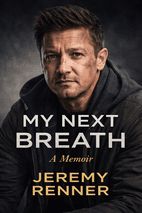
Jeremy Renner's My Next Breath chronicles his near-fatal snowplow accident and grueling recovery, offering a raw, introspective memoir on mortality and resilience for anyone moved by profound stories of human survival and transformation.
Feature
Insta.Page
Blinkist
Shortform
Summary Depth
Full Chapter-by-Chapter
15-min overview
Section-by-section guides
Audio Narration
✓ (AI narration)
✓
✓
Visual Mindmaps
✓
✕
✕
AI Q&A
✓ Voice AI
✕
✕
Quizzes
✓
✕
✕
PDF Downloads
✓
✕
✓
Price
$59.99/yr
$146/yr (PRO)
$199/yr
*Competitor data last verified February 2026.
About the Author
Jeremy Renner
Jeremy Renner is an American actor and musician best known for his roles in films such as *The Hurt Locker* and *The Town*, which earned him Academy Award nominations, and for portraying Hawkeye in the Marvel Cinematic Universe. Before his acting career took off, he also worked as a makeup artist.
1 Page Summary
My Next Breath by Jeremy Renner is a memoir that chronicles the actor’s near-fatal snowplow accident on New Year’s Day 2023 and his arduous, ongoing journey of recovery. The book’s central narrative is the raw and visceral account of the incident itself, where Renner was crushed while trying to save his nephew, and the subsequent fight for his life that involved over 30 broken bones and extensive surgeries. More than just a chronicle of trauma, the book positions this catastrophic event as a catalyst for profound personal transformation, exploring themes of mortality, resilience, and the reevaluation of what truly matters.
Renner’s approach is deeply introspective and unflinchingly honest, distinguishing the book from a typical celebrity autobiography. He delves into the physical agony and psychological toll of his rehabilitation, while also reflecting on his life and career leading up to the accident. The narrative is framed by his perspective from the ICU, grappling with the possibility that his next breath might be his last, which lends a poignant and immediate weight to his recollections and insights. This structure allows the book to weave together past and present, examining how his previous experiences shaped the man who faced this ultimate test.
The intended audience extends beyond fans of his film work to anyone interested in powerful stories of human survival and redemption. Readers will gain a stark, intimate look at the fragility of life and the strength required to rebuild it from the ground up. My Next Breath ultimately serves as a testament to the power of family, the resilience of the human spirit, and the hard-won wisdom that emerges from confronting one’s own mortality.
The prologue plunges the reader directly into a moment of crisis on January 1, 2023. Jeremy Renner is faced with an impossible, split-second decision as a 14,000-pound snowcat machine slides uncontrollably toward his nephew, Alex, who is pinned with no escape. This section establishes the central, life-defining event of the narrative while simultaneously revealing Renner's core personal philosophy: that decisive action, not mere thought or emotion, is what truly matters and defines a person.
The Setup: A Life in the Balance
The scene is chaotic and cold. Alex, Renner’s twenty-seven-year-old nephew with whom he shares a father-son bond, is trapped against a Ford Raptor truck, which is itself lodged in a snowbank. The massive industrial snowcat, which Renner uses to clear his mountain property near Lake Tahoe, is sliding across the ice directly toward him. The physics are terrifyingly simple: if the machine hits Alex, it will crush him to death. The extended family, having been snowed in by a major storm, is up at the house preparing for a ski trip, blissfully unaware of the disaster unfolding half a mile down the driveway.
A Philosophy of Action
Interwoven with the tense description of the accident is Renner’s foundational belief system. He reflects that while feeling and thinking have their place, they are ultimately passive. Real change, progress, and salvation come only from committing to action—from taking the first step and the next. He posits that emotions “never built a bridge or fed the hungry or saved a life,” framing his entire identity around the principle of doing. In this critical moment, his love for his family and his belief in action become “two immovable forces” about to collide.
The "One Shot"
With no time to plan or calculate, Renner’s only possible course of action crystallizes: a desperate leap. He must jump three feet across and nearly three feet up to the cab of the moving snowcat, grab the door handle, get inside, and hit the large red emergency stop button. This is his “one shot,” a single action that he knows will define everything that follows. He explicitly notes that in this moment, he is not the Hollywood actor who performs stunts; he is simply an uncle, a family man, acting on pure instinct and love. His conscious mind recedes, replaced by an animalistic drive to protect his kin.
The Miss and the Aftermath
The narrative builds with unbearable tension to the attempt itself, captured in his final shouted words: “Not today, motherfucker...” In the milliseconds it takes to execute the leap, everything hangs in the balance. The prologue ends with a devastating, simple declaration: “I missed.” This failure is the pivot point. The consequence of that missed shot is the “everything” that “changed forever,” leading directly into the next part of the story, titled “Incident.”
Key Takeaways
Action Over Contemplation: Renner’s guiding life principle is that tangible action is what creates change and defines a person, more than thoughts or feelings.
Love as Primal Motivation: In an extreme crisis, the conscious mind shuts down, and action is driven by a deep, instinctual love for family.
A Defining Moment: A single, split-second decision and physical attempt—a "one shot"—can irrevocably alter the entire course of a life.
The Inevitability of Consequence: The prologue establishes that a moment of failed action leads directly to a catastrophic and life-altering outcome.
Key concepts: Prologue: One Shot
1. Prologue: One Shot
The Crisis Moment
Snowcat slides toward trapped nephew Alex
14,000-pound machine will crush him
Family unaware of unfolding disaster
Philosophy of Action
Action defines a person, not thought or emotion
Real change comes only from doing
Love and action as immovable forces
The One Shot Decision
Desperate leap onto moving snowcat
Single action defining everything to follow
Instinct and love replace conscious thought
Identity in Crisis
Not Hollywood actor performing stunts
Simply an uncle and family man
Animalistic drive to protect kin
The Failed Attempt
Tension builds to final leap
Devastating declaration: 'I missed'
Failure changes everything forever
If you like this summary, you probably also like these summaries...
💡 Try clicking the AI chat button to ask questions about this book!
Chapter 2: 1. Snowmaggedon
Overview
A seemingly straightforward holiday trip spirals into chaos as a determined journey to reach Camp Renner for New Year's is thwarted by a missed flight and a forgotten key fob, forcing a harrowing drive through an approaching storm. The family barely arrives at their mountain home before a historic blizzard isolates them, severing digital connections but deepening real ones. Power failures turn a planned feast into a comedic disaster, prompting a risky pizza run that hinges on an old friendship and a fortunate police escort.
In their snowbound cocoon, a quiet celebration unfolds, sparking reflection on the precious balance between a demanding career and the commitment to family, especially his daughter. The brutal weather underscores their reliance on practical tools like an indispensable snowcat, a machine that promises freedom and control. Amidst the work and worry, a spontaneous snowball fight erupts, a pure moment of joy that reinforces the family's resilient bond and the hopeful promise of a fresh start, both for the new year and for healing old rifts.
The Chaotic Journey to Tahoe
What should have been a simple flight from Burbank to Reno for Jeremy, his daughter Ava, and nephew Alex turns into a comedy of errors. Despite arriving at the gate fifteen minutes before departure, they are denied boarding because the cabin doors have just closed. With all other flights fully booked and a massive storm approaching Lake Tahoe, their plans seem ruined.
Refusing to give up on hosting his extended family for the annual New Year's gathering at "Camp Renner," Jeremy decides to drive the eight hours from Los Angeles. The journey hits another snag just three miles from home when, after stopping for gas, the car won't start. He realizes he left the electronic key fob on the roof of the car. His nephew Alex takes an Uber back and miraculously finds it on the road near their house. The group finally sets off, driving through the night as the weather worsens, arriving at the mountain house just as the last light fades and the temperature plummets.
Bracing for the Historic Storm
The family home sits at 7,300 feet on Mount Rose. Forecasters are predicting a generational storm, with up to five feet of snow, hurricane-force winds, and high avalanche risk. Jeremy, Ava, and Alex barely make it ahead of the weather, and the rest of the family manages to arrive before the roads close. The storm hits with relentless force, quickly cutting off cell service and internet, isolating the large group. Jeremy reflects on the privilege and peril of mountain living, where breathtaking beauty coexists with treacherous conditions that demand self-reliance.
Family, Connection, and a "Cordon Beige" Roast
Cut off from the digital world, the family connects in profound ways. Jeremy feels an intense, unplanned gratitude and engagement, holding deep conversations and expressing his love openly—a shift noticed by his niece Kayla. The house buzzes with activity: kids playing, games of pool by generator-powered Christmas lights, and discussions about football. His sister Kym attempts to cook a roast for the crowd, but constant power failures turn it into a prolonged, unappetizing ordeal she dubs the "grossest" roast, simmering in "fatty waters."
The New Year's Eve Pizza Run
With the failed roast and hungry kids to feed for New Year's Eve, Jeremy decides to brave the deteriorating conditions for a pizza run to Reno. He brings his close friend and business partner, Rory Millikin. The chapter delves into the origin story of their unlikely friendship, recounting how Rory first met Jeremy without recognizing him as an actor, leading to a humorous confrontation where Rory doubted Jeremy was in the movie Arrival and accidentally poked him in the eye.
They successfully get the pizzas, but on the return trip, they find Mount Rose Highway closed by the NDOT (Nevada Department of Transportation) with a roadblock. Despite Jeremy's passionate pleas about his hungry, powerless family—including many children—the official refuses to let them pass. After calling a friend connected to the local police chief, Jeremy secures a police escort back up the mountain, but not before he and Rory start eating the pizzas themselves while stranded at the roadblock.
A Cozy Celebration
The escort driver insisted on delivering the narrator all the way to the house, a kindness that ultimately required the narrator to help free the vehicle from a snowbank. Safely home, the family celebrated New Year’s Eve with leftover pizza, fairy lights strung over the pool table, and a delayed, pixelated broadcast of the Times Square ball drop. The contrast was poignant: frantic crowds on a tiny screen versus their own quiet, snowbound mountain hideaway, a perfect, insulated world.
Reflections on Family and Work
In that perfect moment, the narrator reflects on his profound gratitude. He feels blessed by his family first, and then by a career that allows him to own such a property and tell meaningful stories. Yet, he grounds himself in his core identity: "just Jeremy," a part of the close-knit Renner family. Looking ahead to 2023, he anticipates more projects but acknowledges a recurring tension: his work often pulls him away from his daughter, Ava. He recounts missing her first birthday while filming abroad, a painful experience that led him to vow never to work outside the country again to ensure he’s present for her daily life. He dismisses any brewing career concerns as temporary, like the passing storm outside.
The Indispensable Snowcat
The narrator introduces his crucial piece of equipment: a 1988 PistenBully snowcat. This massive, tank-like machine with steel tracks and a front shovel is the only reason living at the top of a long, high-altitude driveway is feasible during heavy snowfall. He describes its operation as simple and notes his own proficiency with it. While he typically clears snow daily, the recent storm’s intensity made plowing impossible until it subsided. The snowcat represents both practical necessity and the promise of freedom, even in the most extreme conditions.
Playfulness in the Snow
With the immediate work deferred until morning, the family erupts into a joyous, spontaneous snowball fight in the driveway. The narrator watches with happiness, though his thoughts drift to a wish for his mother to be there, hinting at a familial rift he hopes the new year will heal. He expresses confidence in his family’s enduring love and their ability to resolve conflicts, comparing the process to clearing away snow.
Hopes for a Fresh Start
The chapter concludes with plans for the following day: an early morning snow cleanup with friends and family, followed by a hopeful trip to the ski slopes. The narrator basks in the feeling of a "perfect" night—safe, cocooned, and surrounded by loved ones. He looks forward to the promise of the new year, ending on a note of resilient optimism. No matter what the weather brings, they have each other and the tools, both literal and emotional, to handle it.
Key Takeaways
The snowstorm creates an idealized, isolated setting that heightens feelings of family closeness and gratitude.
A deep tension exists between the narrator’s passionate dedication to his career and his even stronger commitment to being present for his young daughter.
Practical tools like the snowcat are presented as extensions of the narrator’s capability and resilience, enabling his chosen lifestyle.
Moments of pure, childlike play (like the snowball fight) are celebrated as essential "celebrations of life."
Underlying the festive scene is a hope for reconciliation within the wider family, affirming a bedrock belief in the power of familial love to overcome discord.
Key concepts: 1. Snowmaggedon
2. 1. Snowmaggedon
The Chaotic Journey to Tahoe
Missed flight forces an 8-hour drive
Forgotten key fob causes critical delay
Arrive just as the historic storm begins
Isolation by the Historic Storm
Generational blizzard cuts off all digital connections
Family is physically isolated at 7,300 feet
Beauty of mountain living meets perilous self-reliance
Deepened Family Connections
Forced digital detox fosters profound engagement
Power failures turn a planned feast comically disastrous
Unplanned gratitude and open expressions of love emerge
The Risky Pizza Run
Braves storm to get food after failed meal
Uses old friendship network to secure police escort
Highlights origin story of friendship with Rory
A Quiet, Cozy Celebration
New Year's celebrated with pizza and generator lights
Stark contrast between frantic crowds and their peace
The house becomes a perfect, insulated world
Reflection on Career vs. Family
Gratitude for career that enables this life
Core identity remains 'just Jeremy' of the Renner family
Vow to prioritize presence for daughter Ava
Tools for Resilience & Joy
The snowcat symbolizes freedom and control
A spontaneous snowball fight creates pure joy
Practical tools and simple moments reinforce family bond
⚡ You're 2 chapters in and clearly committed to learning
Why stop now? Finish this book today and explore our entire library. Try it free for 7 days.
Chapter 3: 2. Snowcat
Overview
The chapter plunges into a New Year’s morning where a simple plan to dig out after a storm spirals into catastrophe. Jeremy and his friends, including his nephew Alex, battle deep snow, with tension rising as their efforts fail. In a desperate move, Jeremy attempts to use his truck, only to get stuck, prompting Alex to retrieve a massive snowcat to help. A momentary lapse—forgetting to set the brake on ice—unleashes disaster. The machine slides, and in a panicked correction, Jeremy accidentally sends it lurching forward. He is thrown under its tracks, experiencing a horrifying, visceral crushing that leaves him shattered on the ice, conscious but catastrophically injured.
From this moment, the narrative fractures into two simultaneous realities: Alex’s calm, focused transition into rescue mode, and Jeremy’s internal descent into a fight for survival. His first horrifying realization is the loss of automatic function, forcing him into a manual breath—each agonizing inhalation and exhalation must be consciously willed, a cycle of excruciating pain and diminishing air. Amidst this scramble, clear thoughts emerge like "cheat codes," with the foundational concept that THE ONLY OBSTACLE IN YOUR WAY IS YOU. This mental framework, alongside his actor’s training in body awareness, provides a critical anchor against panic.
Fueling this brutal physical effort is a profound emotional engine: the reason to live. Vivid images of his family and a determination not to ruin their holiday or leave them unaware crystallize into a survival superpower, the understanding that living for others provides an unshakeable will. Focusing inward, he uses his body awareness to confront the agony, cataloging injuries he cannot yet comprehend and committing to the one-way journey of survival. Through guttural groans and sheer determination, he begins the agonizing, second-by-second process of reclaiming breath, inching toward the next moment and the fragile hope of rescue.
A New Year's Morning Turned Catastrophic
The narrative opens not with an overview, but in the midst of action on the morning of New Year's Day, 2023. Jeremy and his friends—Rory, Dave, and a reluctantly awakened Alex—begin a grueling effort to dig out their snowbound property after a massive storm. The scene is one of stark beauty and camaraderie, with Jeremy and Dave sharing a profound moment of gratitude for their lives and friendship as they work in the quiet, snow-muffled dawn.
Their goal is to clear a path to the main road for a ski trip. Efforts with shovels and snowmobiles prove futile in the deep, icy snow. Alex is openly skeptical and frustrated, arguing the task is impossible amidst the abandoned vehicles visible on the highway below. Tension brews as Alex trudges through deep snow on a failed errand to a storage unit, returning as Jeremy switches tactics.
The Snowcat Takes Center Stage
Jeremy attempts to forge a path with his Ford Raptor truck but becomes stuck on an icy switchback. Seeing the predicament, Alex—who has never driven it before—decides to operate the massive PistenBully snowcat to help. He successfully retrieves it, hooks the Raptor to it with chains, and Jeremy takes over in the cab to pull the truck free.
In a critical, momentary lapse, Jeremy exits the cab to communicate with Alex without engaging the snowcat's parking brake on the slick ice. The machine begins to slide. In a panicked attempt to stop it and then to get a better view, Jeremy accidentally hits the forward control toggle. The 14,000-pound snowcat lurches toward Alex, who is now trapped between its blade and the Raptor.
The Leap and the Crush
Time distorts for Jeremy as he realizes Alex is about to be killed. Driven purely by instinct and love for his nephew, he attempts an impossible leap back into the moving cab to hit the emergency STOP button. He loses his footing on the spinning steel tracks and is violently thrown forward, headfirst onto the ice.
What follows is a harrowing, second-by-second account of the snowcat driving over his body. Jeremy describes the surreal horror with visceral detail: the sound of his skull cracking, the sensation of bones shattering under immense, repetitive pressure from the machine's six wheels and steel tracks, and the terrifying sight of his left eyeball being displaced from its socket. The entire crushing event lasts approximately five seconds.
Alex's Perspective and the Aftermath
From Alex's viewpoint, the event is a confusing nightmare. He hears Jeremy's shout, sees the machine coming, and barely escapes by scrambling into the Raptor, repeatedly whispering "Please be quick" as he expects to be crushed. The snowcat rams the truck into a snowbank, saving Alex but leaving Jeremy shattered on the ice.
Alex transitions into a state of calm, crisis-mode focus. Finding Jeremy in a pool of blood, he performs a quick assessment, feeling the alarming protrusions of broken ribs along Jeremy's spine and recognizing the catastrophic injuries. Jeremy, conscious but unable to breathe, begins a desperate internal quest for his next breath while taking a mental inventory of his destroyed body. Alex realizes immediate help is the only chance for survival.
The Manual Breath
The narrator’s first, horrifying realization is that the autonomic act of breathing is gone. Every inhalation and exhalation must now be consciously willed into being, each one accompanied by excruciating, disabling pain that feels like immersion in molten rock. The act becomes a grotesque, manual process: a groaned exhalation leaves him with barely enough air to then suck in a pitifully small inhalation, creating a terrifying cycle of diminishing returns. In this vacuum of automatic function, the primal fear of drowning and dying is immediate.
The Arrival of "Cheat Codes"
Amidst the pain and scrambling consciousness, clear, guiding thoughts emerge like life-saving mantras. The first is foundational: THE ONLY OBSTACLE IN YOUR WAY IS YOU. It arrives not as a coherent sentence but as a pure concept, a framework upon which to hang the coming struggle. It is followed by other insights: that stress is a useless, fear-fueled ego experience, and that it must be combated with "body awareness." The narrator’s years of training as an actor, where his body is his instrument, provide a critical jolt of confidence. This deep, intimate knowledge of his own mechanics gives him a focal point amidst the chaos and becomes a tool for survival, preventing panic from taking hold.
The Reason to Live
As the mental frameworks settle, a flood of emotional motivation follows. His mind fills with images of his family—he is determined not to ruin their holiday or disappoint the children waiting to ski. This leads to a profound realization: the question of who you are living for is a survival superpower. He feels eternally connected to others by love, shared history, and unchanging energy, understanding that without these bonds, the will to fight might evaporate. This love becomes the fuel for the brutal physical work ahead.
A Catalogue of Injury and Determination
Focusing on his body awareness, he attempts to relax his diaphragm and locate the source of cramping, only to be met with intense stabbing pains. Unaware of the true scope of his injuries—which included fourteen broken ribs, a punctured lung, a sliced liver, and multiple broken bones—he simply concentrates on calming the spasms to reclaim breath. The process is agonizing, marked by guttural groans as he relearns, second by second, a function he’s performed automatically for over fifty years. He commits to this one-way journey of survival, resolved not to die on the ice with his family unaware half a mile away. The section concludes with a moment of grueling progress: by positioning himself just right and pushing with all his might to groan out an exhalation, he reaches the halfway point to his next, desperately needed breath.
Key Takeaways
Extreme trauma can force the body’s autonomic systems, like breathing, into manual, conscious control, requiring immense willpower to maintain.
Pre-existing skills and deep self-knowledge (like an actor’s “body awareness”) can become unexpected, critical assets in a survival scenario, providing focus and combating panic.
Clear, mantra-like thoughts or “cheat codes” can emerge in crisis, offering a mental framework for resilience and action.
The motivation to live for others—driven by love and a sense of connection—can provide a powerful emotional engine for enduring physical agony.
Survival often begins with a conscious, irrevocable decision to live, followed by a relentless focus on executing the next necessary, however small, action.
Key concepts: 2. Snowcat
3. 2. Snowcat
The Accident Sequence
Snowcat slides after parking brake lapse
Panicked correction sends it lurching forward
Jeremy thrown under tracks and crushed
Physical Aftermath & Injuries
Conscious but catastrophically injured on ice
Skull cracked, bones shattered by tracks
Left eyeball displaced from socket
The Manual Breath
Loss of autonomic breathing function
Each breath must be consciously willed
Cycle of excruciating pain and diminishing air
Mental Survival Framework
"Cheat codes" emerge as clear thoughts
Core concept: THE ONLY OBSTACLE IS YOU
Actor's body awareness provides critical anchor
Emotional Engine for Survival
Vivid images of family as reason to live
Determination not to ruin their holiday
Living for others provides unshakeable will
Alex's Rescue Response
Transitions to calm, crisis-mode focus
Assesses catastrophic injuries quickly
Realizes immediate help is only chance
Internal Survival Process
Catalogs injuries he cannot comprehend
Commits to one-way journey of survival
Agonizing, second-by-second reclaiming of breath
Chapter 4: 3. Lamaze
Overview
A childhood lesson in controlled breathing, learned reluctantly at his mother's Lamaze class, becomes the foundation for survival decades later. This early training dovetails with a youth marked by self-sufficiency, where he learned to meet fear with information and crisis with calm—a mindset forged in the minor traumas of an active childhood. When a catastrophic accident on the ice leaves him with a crushed lung, these two threads of his life converge. His world collapses to the single, agonizing imperative to breathe, manually using Lamaze techniques to force air into his damaged body while panic threatens to overwhelm him.
As he fights for each breath, his nephew Alex sprints for help, triggering the formation of an ad hoc rescue team with strangers Rich and Barb. Their frantic efforts—stabilizing his arm, stemming a head wound, and desperately communicating with 911—buy him precious time against a backdrop of surreal frustration and urgency. Internally, his mind becomes a battlefield of cautious optimism, swinging between irrational hope and grim acceptance as he conducts a brutal inventory of his injuries. He clings to a philosophy of action, focusing solely on the next breath as the one task within his control, a skill sharpened by his life as an actor and athlete. All this unfolds in stark contrast to the cheerful, mundane morning continuing at the vacation house, where his oblivious family enjoys breakfast, completely unaware of the life-and-death struggle occurring just outside. The chapter illustrates how deeply ingrained lessons, from breath control to a realist's grit, can surface as the essential tools for enduring an unthinkable moment.
A Childhood Lesson in Breathing
The narrator recounts a formative childhood experience: as the oldest of seven and a twelve-year-old "good kid," he was pulled from soccer practice to attend Lamaze classes with his pregnant mother. At the time, it was an annoyance, but it became one of the most valuable lessons of his life. He learned the mechanics of controlled breathing to mitigate pain and gained an intimate, early understanding of childbirth and female resilience. This shared moment with his stoic mother created a rare bond. Unbeknownst to both, this early training in breath control would later become a literal lifesaving skill.
The Foundations of Tenacity and Calm
Reflecting on his upbringing in Modesto as a latchkey kid, the narrator describes how his childhood fostered self-sufficiency and a primal understanding of information as a tool against fear. From building go-karts to surviving reckless games, his active youth was a series of lessons in trial, error, and consequence. A key moment came when a car accident—where he hit his head on the windshield—taught him that once a traumatic event occurs, your reaction to the new "information" is all that matters. This ingrained calm in crisis and a hunger for knowledge became core parts of his identity, tools he would bring to his ultimate test.
The Immediate Aftermath: A Fight to Breathe
On the ice after being crushed, the narrator’s world narrows to one imperative: breathe or die. His injuries have compressed his lung, making each breath a agonizing, manual struggle. He consciously uses the Lamaze techniques, groaning to confirm each exhalation, and focuses on relaxing his diaphragm. Panic threatens but is held back by a dam of pain and a lifetime of conditioning. He conducts a frantic body inventory, trying to find a position that allows air into his lungs. His survival hinges entirely on his ability to manually operate his own respiratory system.
Alex Seeks Help
Seeing the severity of the situation, Alex declares he must get help and runs. The narrator is left alone, feeling loneliness but not panic, as he continues his grueling fight for air. Alex heads to the nearest house, desperately skidding under a closing garage door. The homeowner, Rich Kovach—who had been cleaning a shotgun—is startled by the sudden intruder but is disarmed by the terror on Alex’s face. Alex manages to convey that his uncle is dying outside, and Rich immediately follows him back to the scene.
An Ad Hoc Rescue Team Forms
Rich quickly assesses the situation and runs back to call 911. His partner, Barb Fletcher—a medical professional still reeling from seeing her deceased uncle the day before—springs into action. Grabbing towels, she rushes out, applies pressure to the narrator’s head wound, and cradles him. Alex finds and maintains a crucial arm position that relieves pressure on the collapsed lung. Rich, on the phone with dispatch, works to convey the bizarre and critical nature of the incident (initially misidentified as a “snowblower” or “snowcat” accident) and urgently requests a CareFlight helicopter. Barb continuously talks to the narrator, rubbing his arm and forehead, pleading with him to stay awake.
The 911 Call: Frustration and Urgency
The 911 call reveals the chaos and urgency. Rich frantically relays information about crushed ribs, a punctured lung, and massive bleeding, while the dispatcher methodically asks necessary questions. Barb’s medical insight is pivotal, insisting on a helicopter evacuation due to the remote, snowed-in location. Throughout the call, the narrator’s labored, groaning breaths are audible in the background. Despite moments of frustration over the responders' distance, the makeshift team—Alex stabilizing the arm, Barb stemming the bleed and providing comfort, Rich communicating—holds the line together, buying precious time.
The Agony of Survival
The narrator describes each labored breath as an excruciating effort, akin to doing a continuous push-up for forty-five minutes while breathing thin, frozen air at high altitude. His physical state is dire: multiple broken bones, a severe head wound, and a grievous eye injury. Amidst this agony, he maintains a desperate, rhythmic breathing technique, acutely aware of the voices around him—a panicked woman applying pressure to his head, his nephew Alex holding his arm, and a man urgently requesting an emergency airlift on the phone.
A Battlefield of Mind and Body
As he fights to stay conscious, his mind swings between stark realism and fleeting, irrational hope. Despite the catastrophic damage to his body, a part of him clings to the absurd notion that this is merely a bad cramp. He entertains thoughts of walking back to the house, taking an Epsom salt bath, and icing his eye, as if this were a minor setback to the vacation. These hopeful intrusions are constantly punctured by darker realizations—the fear of death, or worse, surviving as a consciousness trapped in a ruined body. He repeatedly pushes these thoughts aside, forcing his focus back to his breathing and conducting a grim inventory of his injuries, a skill honed by his profession as an actor and athlete.
The Philosophy of Cautious Optimism
This mental oscillation reveals his core philosophy: a tenacious, realistic form of optimism. He rejects blind positivity, identifying instead as a realist who “grits through” bad moments. His strategy is to find hope not in wishful thinking, but in an honest assessment of reality and taking actionable steps. Lying on the ice, this translates to a relentless focus on the next breath and the immediate, physical problem-solving of regulating his breathing and assessing damage. He sees complacency as a form of death, believing survival and progress are born from action, no matter how small.
Two Parallel Realities
The narrative starkly contrasts his brutal reality with the mundane, cheerful morning unfolding at the house. While he battles for each carved breath, his family is blissfully unaware, making breakfast, recalling the previous night’s snowball fight, and anticipating a day on the slopes. They assume he and Alex are still diligently clearing the road. This juxtaposition heightens the isolation and sheer gravity of his situation, where time stretches unbearably yet passes solely through the metric of each struggled inhalation.
Key Takeaways
Survival in extreme trauma can involve a tumultuous internal dialogue, swinging between irrational hope and grim acceptance.
A disciplined focus on the smallest actionable task—like the next breath—can provide a critical anchor for the mind and body.
A philosophy of "cautious optimism," rooted in realism and action rather than wishful thinking, can be a powerful tool for enduring crisis.
Profound personal catastrophe often occurs against a backdrop of normal, oblivious daily life, intensifying the feeling of isolation.
Professional training that involves deep bodily awareness can provide unexpected advantages in a physical emergency.
Key concepts: 3. Lamaze
4. 3. Lamaze
Lamaze Breathing as Lifesaving Skill
Childhood lesson becomes critical survival tool
Manual breath control against crushed lung
Focus on next breath as only controllable task
Foundations of Crisis Mindset
Childhood fostered self-sufficiency and calm
Information as primary tool against fear
Reaction to trauma matters more than event
Catastrophic Ice Accident
World narrows to agonizing fight for air
Conducts brutal inventory of injuries
Panic held back by pain and conditioning
Alex Triggers Rescue Response
Nephew sprints for help despite danger
Finds homeowner Rich Kovach by chance
Conveys urgency of life-or-death situation
Ad Hoc Rescue Team Formation
Strangers Rich and Barb join immediately
Barb applies medical pressure to wounds
Alex finds crucial arm stabilization position
Chaotic 911 Communication
Frustration relaying remote accident details
Barb insists on helicopter evacuation
Team buys time against systemic delays
Internal Battle for Survival
Mind swings between hope and acceptance
Clings to philosophy of focused action
Contrast with family's oblivious morning routine
📚 Explore Our Book Summary Library
Discover more insightful book summaries from our collection