Chapter One: From Civil War to the Battle of Ideas
Chapter 1 of 4
0:000:00
EN
1x
Voice
PDF
The Parasitic Mind
by Gad Saad
What is the book The Parasitic Mind about?
Gad Saad's The Parasitic Mind argues that ideologies like postmodernism and safetyism act as cognitive parasites, suppressing reason and free speech by exploiting social fears. It is a manifesto for defenders of Enlightenment values and scientific inquiry against ideological conformity.
Feature
Insta.Page
Blinkist
Shortform
Summary Depth
Full Chapter-by-Chapter
15-min overview
Section-by-section guides
Audio Narration
✓
✓
✓
Visual Mindmaps
✓
✕
✕
AI Q&A
✓
✕
✕
Quizzes
✓
✕
✕
PDF Downloads
✓
✕
✓
Price
$89.99/yr
$146/yr (PRO)
$199/yr
*Competitor data last verified July 2026.
1 Page Summary
In The Parasitic Mind, evolutionary psychologist Gad Saad argues that certain ideologies function like cognitive parasites, infecting and overriding human reason and biological reality. He posits that ideas such as radical political correctness, postmodernism, and social justice dogma spread not through logical persuasion but through emotional contagion and social coercion, exploiting innate human desires for belonging and fear of ostracism. Saad contends these "idea pathogens" suppress free speech, scientific inquiry, and common sense by enforcing a culture of grievance, victimhood, and the denial of objective truths, including well-established evolutionary and biological facts.
The book places this phenomenon within a historical context of intellectual battles between evidence-based reasoning and ideological dogma. Saad draws parallels to other historical episodes where rigid belief systems suppressed inquiry, but argues the modern version is uniquely enabled by "safetyism" on university campuses, the spread of "cancel culture," and the power of social media to create viral outrage. He identifies the roots of these parasitic ideas in the postmodern rejection of grand narratives and objective reality, which he sees as having metastasized into a militant orthodoxy that punishes dissent and prioritizes subjective lived experience over empirical evidence.
The lasting impact of Saad's work lies in its forceful, unapologetic defense of liberal Enlightenment values—free speech, rational debate, and the scientific method—as necessary antidotes to the spread of these malicious memes. While controversial, his analysis provides a framework for understanding contemporary cultural conflicts as a clash between parasitic ideologies that thrive on silencing opponents and a host culture of open inquiry. The book serves as a manifesto for resisting ideological conformity and reaffirming the tools of reason and common sense as vital for a healthy, functioning society.
Chapter One: From Civil War to the Battle of Ideas
Overview
The author's journey begins in 1960s Beirut, a city of vibrant culture where his identity as part of a tiny Jewish minority was marked by early, shocking encounters with antisemitism. This fragile normalcy was utterly destroyed by the outbreak of the Lebanese Civil War in 1975, plunging his family into a nightmare of sectarian violence where survival depended on concealing one’s faith. Their cinematic escape, aided by PLO militiamen, culminated in a symbolic moment aboard the escaping plane: his mother placed a Star of David around his neck, signaling a transition from hidden fear to open pride. Yet, the trauma of conflict followed them even to the safety of Canada, underscored by his parents' perilous kidnapping during a return trip to Lebanon.
These formative experiences of tribalism and dogma became the crucible for his lifelong intellectual mission. They forged in him two core, interconnected ideals: freedom and truth. His need for freedom, first felt as alienation from rigid religious ritual, later defined his approach to soccer, academia, and public engagement, rebelling against conformity and elitism. The pursuit of truth became a combative, visceral drive, sharpened by witnessing the intellectual dishonesty that allows ideology to override facts. He sees universities as the paradoxical heart of this struggle—the premier engines of scientific discovery yet also the primary incubators for what he terms anti-science idea pathogens.
These idea pathogens, like postmodernism and radical feminism, are presented as parasitic entities that infect the mind, crippling reason and logic much like a biological parasite manipulates its host. The book formalizes this epidemic as Ostrich Parasitic Syndrome (OPS), a memetic disease where ideology supersedes reality. The author argues that a confluence of these forces—political correctness, social constructivism, and a culture of victimhood—is systematically eroding the West’s Enlightenment foundations, creating a climate of fear and self-censorship. This intellectual environment, he contends, has real-world consequences, stifling honest debate on critical issues like immigration and contributing to the populist backlash that brought figures like Donald Trump to power. Ultimately, he frames the current cultural moment as an existential battle of ideas, warning that losing it to these "mind parasites" risks leading free societies toward a form of lunatic self-destruction.
Childhood in Pre-War Beirut
The author begins by situating his formative years in 1960s Beirut, Lebanon, a city then known as the "Paris of the Middle East." He was born into one of the last remaining Jewish families in the country. From an early age, he was acutely aware of his minority status within a predominantly Muslim and Christian society. This awareness was punctuated by stark incidents of antisemitism, such as public chants for the death of Jews following President Nasser’s death and a classmate’s declaration of a desire to become a "Jew killer," which was met with classroom applause. These experiences embedded in him a deep understanding of how individual identity can be subsumed by tribal and religious group affiliations.
The Descent into Civil War
The relative normalcy of his early childhood was shattered in 1975 with the outbreak of the Lebanese Civil War. The narrative describes a rapid descent into brutal sectarian violence where "neighbors who had lived next door to one another for decades became instant prospective enemies." Daily survival was a matter of avoiding shelling, snipers, and militia checkpoints where one's religious affiliation, listed on an internal ID, could mean execution. The author illustrates the pervasive fear and chaos with a chilling personal anecdote: a man who delivered hand-drying towels to his family used the cover of war to arrive at their home menacingly at night, an event that signaled it was no longer safe to stay.
Escape and a New Identity
The family's harrowing escape from Lebanon is depicted as a scene from an action film. They were forced to rely on armed PLO militiamen for safe passage to the airport, a journey that involved exchanging gunfire with other factions. A profound moment of transition occurred once their plane left Lebanese airspace: his mother placed a Star of David necklace around his neck, telling him he no longer had to hide his identity. This symbolic act marked a shift from a life defined by concealed fear to one where he could openly be proud of who he was. His introduction to a new life in Montreal was starkly contrasted by climate and culture, humorously underscored by his attempt to explain where he was from by miming machine gun fire to a baffled classroom.
The Lingering Shadow of Conflict
Even after reaching the safety of Canada, the trauma of the civil war continued to affect his family. His parents struggled to adapt and made several perilous return trips to Lebanon. On one such trip in 1980, they were kidnapped by Fatah and held for several days before being freed through high-level political intervention. This event underscored the enduring dangers of tribalism and the impossibility of returning to a homeland consumed by it. The advice from friends as his parents finally left for good—to never return—was a sobering endpoint to their connection to Lebanon.
The Foundation of a Lifelong Battle
This entire personal history is presented as the foundational crucible for the author's current intellectual stance. The Lebanese Civil War taught him the "ugliness of tribalism and religious dogma" firsthand, where group identity overrode individual merit and reason. These childhood and adolescent experiences with sectarian hatred and ideological zealotry directly informed his subsequent aversion to modern forms of identity politics and dogma. He frames his later "war against reason" on university campuses as a direct parallel to his first war—both are battles against ideologies that demand conformity, punish dissent, and prioritize group allegiance over truth and individual dignity.
The Freedom Ideal
The author traces his commitment to freedom back to childhood, where he felt alienated by the conformity of religious rituals in a Beirut synagogue. This early aversion to imposed structure manifested in his athletic career as a soccer playmaker who required complete tactical freedom on the field. Professionally, this ideal translates into two forms: the occupational freedom of academia, which allows control over one's time and reduces stress, and the intellectual freedom to pursue interdisciplinary research across fields like psychology, evolution, and economics, defying academic hyper-specialization.
This desire for intellectual freedom also fuels his engagement with the public via social media and platforms like the Joe Rogan podcast, a practice he defends against academic elitism. He argues that a complete scholar should both generate knowledge in peer-reviewed journals and disseminate it widely, rejecting the "garage band effect" where popular engagement is scorned.
The Truth Ideal
The pursuit of truth is presented as the author's second core ideal, one made possible by freedom. He describes a visceral, combative reaction to intellectual dishonesty and ideological dogma, a temperament at odds with a world he sees as morally grey. He contrasts this with a lack of "epistemic humility" witnessed in family members, recounting an anecdote where a relative, proven wrong about Ancient Greeks being Christians, simply lied to maintain a façade of superior knowledge. This background fuels his disdain for the Dunning-Kruger effect and his comfort in admitting when he does not know something, a practice he sees as building trust with students.
Universities: Purveyors of Truth and Ecosystems of Intellectual Garbage
The author's academic journey revealed a central paradox: universities are both engines of scientific discovery and incubators of anti-science thought. At Cornell, rigorous training in evolutionary psychology set his career path, but he was simultaneously exposed to what he considers "nonsensical gibberish," exemplified by a postmodernist paper in a consumer research journal that featured autoethnographic descriptions of sexual arousal. He observes that much of the social sciences are plagued by "biophobia"—a rejection of biological explanations for human behavior—and that feminist scholars often deride evolutionary psychology as "sexist nonsense." He concludes that academia often rewards conformity, hyper-specialization, and progressive ideology while punishing intellectual courage, broad thinking, and meritocracy.
Idea Pathogens as Parasites of the Human Mind
The author introduces a central metaphor for the book: bad ideas are like parasitic pathogens that infect the human mind. Just as biological parasites (like the mosquito-borne malaria parasite or the toxoplasma gondii that alters a mouse's fear of cats) manipulate their hosts' behavior, "mind viruses" such as postmodernism, radical feminism, and social constructivism parasitize cognitive processes. These ideas, he argues, cripple reason, logic, and a connection to reality. They flourish in the infected ecosystem of the university, from which they spread to the broader society, manipulating their human hosts into defending and propagating them.
Key Takeaways
The author's life and career are driven by two interconnected ideals: freedom (from conformity, intellectual shackles, and academic elitism) and truth (a combative pursuit defended with epistemic humility).
Universities embody a paradox, being the primary source of scientific truth while also functioning as the ground zero for anti-scientific movements like postmodernism and biophobia.
The core thesis of the book is introduced: dangerous ideologies are "idea pathogens" or "mind parasites" that infect reasoning, akin to biological parasites that manipulate host behavior, and they primarily originate and spread from academic institutions.
The Memetic Disease of OPS
The text formalizes a class of harmful ideologies as Ostrich Parasitic Syndrome (OPS), a "memetic disease of the human mind." Like a biological virus, OPS spreads through infectious ideas, or memes, which vary in their virulence and impact. The author argues that combating this epidemic requires an epidemiological approach: identifying the origin of these "mind pathogens," understanding how they spread, and developing effective inoculations. The proposed cognitive vaccine is a two-step process: providing accurate information and teaching the skills of scientific and logical reasoning to process it.
Forces Eroding the West
The chapter identifies a confluence of ideological forces that are gradually undermining the West’s foundational commitment to reason, science, and Enlightenment values. This erosion is described as a "death by a thousand cuts." The specific forces listed include:
Political correctness and its enforcement by "thought police" and "social justice warriors"
Postmodernism
Radical feminism
Social constructivism
Cultural and moral relativism
A culture of perpetual offense and victimhood (e.g., microaggressions, trigger warnings)
These forces are depicted as creating a climate of fear and stifling open discourse. Examples given include academics avoiding research on taboo topics like sex or racial differences, professors compelled to use mandated gender pronouns, students demanding protection from challenging ideas, and politicians fearing accusations of bigotry for criticizing policies. The result is a breakdown of rational, fearless public debate.
Consequences and the Current Battle
This section posits that these anti-reason movements have direct, real-world consequences. They are presented as the root cause of the West’s inability to critically and openly discuss the integration of Islam within secular liberal societies. Furthermore, the author frames the rise of Donald Trump as a popular backlash against this pervasive political correctness and its perceived threats to freedom and honesty. The chapter concludes with a stark warning: losing this "battle of ideas" to the "enemies of reason" and their mind viruses risks leading free societies toward "lunatic self-destruction."
Key Takeaways
Ostrich Parasitic Syndrome (OPS) is defined as a memetic disease where ideology supersedes truth, and it can be countered with a "cognitive vaccine" of accurate information and training in logic.
The West is seen as under sustained attack from a suite of interrelated ideologies that prioritize dogma, victimhood, and political correctness over free inquiry and reasoned debate.
This intellectual environment creates widespread self-censorship in academia, politics, and public life, crippling honest discourse.
The practical consequences include failed debates on major societal issues (like Islam and immigration) and have triggered a populist political backlash, exemplified by Trump's election.
The central conflict is framed as a existential "battle of ideas" between reason and dogma, with the future of liberal society at stake.
Key concepts: Chapter One: From Civil War to the Battle of Ideas
1. Chapter One: From Civil War to the Battle of Ideas
Formative Experiences in 1960s Beirut
Childhood as part of a tiny Jewish minority in a vibrant, multicultural city
Early encounters with public antisemitism and tribal hatred
Development of awareness that individual identity is subsumed by group affiliation
Trauma of the Lebanese Civil War
Outbreak in 1975 shatters normalcy with brutal sectarian violence
Daily survival depends on concealing religious identity at militia checkpoints
Neighbors become instant enemies in a climate of pervasive fear and chaos
Escape and Symbolic Reclaiming of Identity
Cinematic escape aided by armed PLO militiamen exchanging gunfire
Mother places Star of David necklace on him as plane leaves Lebanese airspace
Transition from hidden fear to open pride in identity upon reaching safety
Enduring Trauma and Family Peril
Parents' difficult adaptation to Canada and perilous return trips to Lebanon
Parents kidnapped by Fatah in 1980 and freed through political intervention
Sobering realization that return to a homeland consumed by tribalism is impossible
Forging Core Intellectual Ideals
Experiences become crucible for lifelong mission centered on freedom and truth
Freedom defined as rebellion against conformity, ritual, and elitism
Truth as a combative drive against ideology overriding facts
The Epidemic of Idea Pathogens
Universities as paradoxical engines of discovery and incubators of anti-science
Postmodernism, radical feminism as parasitic 'idea pathogens' crippling reason
Formalization as Ostrich Parasitic Syndrome (OPS): ideology superseding reality
The Battle for Enlightenment Values
Confluence of political correctness, social constructivism, and victimhood culture
Systematic erosion of West's foundations creating climate of fear and censorship
Real-world consequences: stifled debate on immigration, populist backlash, rise of figures like Trump
Existential Cultural Struggle
Framing current moment as existential battle of ideas against 'mind parasites'
Warning that losing this battle risks lunatic self-destruction of free societies
Intellectual mission as defense of reason against tribalism and dogma
The Foundation of a Lifelong Battle
The Lebanese Civil War served as a foundational crucible, teaching the author firsthand the ugliness of tribalism and religious dogma.
Childhood experiences with sectarian hatred directly informed his later aversion to modern identity politics and ideological zealotry.
He frames his current intellectual battle as a direct parallel to his first war—both oppose ideologies that demand conformity and punish dissent.
The core conflict is presented as prioritizing group allegiance over individual merit, reason, and dignity.
The Freedom Ideal
The author's commitment to freedom originated in childhood alienation from the conformity of religious rituals.
This ideal manifested in athletics as a soccer playmaker requiring complete tactical freedom and in academia as occupational and intellectual freedom.
Intellectual freedom involves pursuing interdisciplinary research across psychology, evolution, and economics, defying hyper-specialization.
He defends public engagement via social media and podcasts against academic elitism, arguing scholars should both generate and disseminate knowledge.
The Truth Ideal
Truth is presented as the second core ideal, made possible by freedom, and pursued with a visceral, combative reaction to dishonesty.
He contrasts this with a lack of 'epistemic humility,' illustrated by a relative who lied when proven wrong about Ancient Greeks being Christians.
This background fuels his disdain for the Dunning-Kruger effect and his comfort in admitting ignorance, which he sees as building trust with students.
The University Paradox
Universities are both engines of scientific discovery and incubators of anti-science thought, creating a central paradox.
Rigorous training in evolutionary psychology at Cornell set his career, but he was simultaneously exposed to 'nonsensical gibberish' like postmodernist autoethnography.
He observes 'biophobia' in social sciences—a rejection of biological explanations—and notes feminist scholars often deride evolutionary psychology as 'sexist nonsense.'
Academia often rewards conformity, hyper-specialization, and progressive ideology while punishing intellectual courage, broad thinking, and meritocracy.
Idea Pathogens as Mind Parasites
Bad ideas are metaphorically described as parasitic pathogens that infect the human mind, similar to biological parasites manipulating host behavior.
Examples of 'mind viruses' include postmodernism, radical feminism, and social constructivism, which cripple reason and connection to reality.
These ideas flourish in the infected ecosystem of the university and spread to broader society, manipulating hosts to defend and propagate them.
Ostrich Parasitic Syndrome (OPS)
OPS is formalized as a 'memetic disease of the human mind,' where harmful ideologies spread through infectious memes with varying virulence.
Combating this epidemic requires an epidemiological approach: identifying origins, understanding spread, and developing cognitive vaccines.
The proposed cognitive vaccine is a two-step process: providing accurate information and teaching scientific and logical reasoning skills.
Forces Eroding the West
A confluence of ideological forces is gradually undermining the West's foundational commitment to reason, science, and Enlightenment values.
This erosion is described as a 'death by a thousand cuts,' with specific forces including political correctness and its enforcement by 'thought police.'
Other forces include postmodernism, radical feminism, social constructivism, cultural/moral relativism, and a culture of perpetual offense and victimhood.
The Climate of Fear and Self-Censorship
Academics avoid research on taboo topics like sex or racial differences to avoid professional repercussions.
Professors are compelled to use mandated gender pronouns, reflecting institutional enforcement of ideological norms.
Students demand protection from challenging ideas, framing intellectual discomfort as psychological harm.
Politicians fear accusations of bigotry for criticizing policies, stifling honest policy debate.
The overall result is a breakdown of rational, fearless public discourse essential to a liberal society.
Real-World Consequences of Anti-Reason Movements
The West is portrayed as unable to critically discuss the integration of Islam within secular liberal societies.
Political correctness is seen as preventing honest assessment of immigration and multicultural policies.
These intellectual failures create policy paralysis and societal division on fundamental issues.
Populist Backlash and the Rise of Trump
Donald Trump's election is framed as a direct popular backlash against pervasive political correctness.
The backlash is driven by a perceived threat to freedom of speech and honesty in public discourse.
Trump represents a rejection of elite-enforced ideological conformity in favor of blunt, unfiltered communication.
The Existential Battle for Liberal Society
The chapter concludes with a stark warning: losing the 'battle of ideas' risks 'lunatic self-destruction.'
The conflict is framed as existential—between reason (defending free inquiry) and dogma (enforcing ideological conformity).
The future of free societies is presented as dependent on defeating the 'enemies of reason' and their 'mind viruses.'
💡 Try clicking the AI chat button to ask questions about this book!
Chapter Two: Thinking versus Feeling, Truth versus Hurt Feelings
Overview
It begins by challenging the false separation between logic and emotion, critiquing our tendency toward epistemological dichotomania—the urge to cram complex human experience into simplistic either-or boxes. Humans are neither purely thinking nor purely feeling machines; the real art lies in knowing which system to engage and when. This is explored through models like the Elaboration Likelihood Model, which details our dual routes to persuasion: the careful, cognitive central route and the heuristic-driven, emotional peripheral route. Far from being irrational, emotions are presented as evolutionarily shrewd tools, adaptive solutions honed over millennia to solve specific problems, from romantic jealousy to rapid threat assessment.
Yet, the chapter argues a profound cultural pathology has taken hold, where these affective systems improperly hijack domains dedicated to the intellect. This is starkly visible in a modern academic and institutional retreat from the pursuit of truth in favor of avoiding hurt feelings. Where university mottos once exalted Veritas, a new, unspoken motto prevails, leading to the suppression of forbidden knowledge and the punishment of heresy. The prosecution of Geert Wilders, the ousting of Harvard's Lawrence Summers for a hypothesis about gender, and the professional destruction of figures like James Damore and Alessandro Strumia for presenting inconvenient data exemplify this shift. The enforcement of this new orthodoxy extends beyond serious inquiry to eradicate humor and levity, as seen in the cases of Sir Tim Hunt and Matt Taylor, where jokes and a whimsical shirt were treated as capital offenses.
This ideological framework breeds glaring cultural contradictions, such as championing patriarchal religious garments as feminist symbols while condemning Western attire as oppressive, a stance the author lampoons with the hashtag #FreedomVeils. The result is a climate where political tribalism, as seen in the reactions to Donald Trump and Brett Kavanaugh, overrides principles like the presumption of innocence and rational analysis. The chapter concludes that this wholesale prioritization of emotion over evidence represents a catastrophic loss of reason, silencing debate, eroding intellectual freedom, and pushing society toward an infinite intellectual darkness.
The False Dichotomy of Thought and Emotion
The chapter opens with competing philosophical quotes—David Hume’s subordination of reason to passion versus Hans Eysenck’s uncompromising scientific dedication to facts—setting the stage for a critique of rigid binary thinking. Michael Shermer’s humorous rebuttal to a debate about God highlights a tendency the author calls epistemological dichotomania: the desire to force complex realities into simplistic either-or categories, such as the outdated nature-versus-nurture debate. This penchant for binaries falsely frames thinking and feeling as opposing forces, when in reality humans are both thinking and feeling beings. The central challenge is knowing when to engage our cognitive systems versus our affective ones.
Decision-Making Routes: Central vs. Peripheral Processing
The Elaboration Likelihood Model is introduced to explain how we process persuasive messages. The central route involves careful, cognitive evaluation of substantive information (e.g., analyzing a mutual fund's merits). The peripheral route relies on non-substantive, emotional cues (e.g., a perfume ad using imagery of romance and allure). The route activated depends on one's motivation and ability to process information. Problems arise when the wrong route is used for a given decision, such as choosing a presidential candidate based on visceral emotional reactions (peripheral processing) rather than a dispassionate analysis of policies (central processing). Hierarchy of effects models in marketing further illustrate that both cognition and emotion are fundamental to decision-making, with their sequence varying based on a product's level of consumer involvement.
The Rationality of Emotion in an Evolutionary Context
The archetype of the perfectly rational, emotionless decision-maker (like Mr. Spock) is challenged. Emotions are presented as evolutionarily adaptive solutions to recurring challenges. For example, research by David Buss shows that romantic jealousy manifests differently in men and women—men are more distressed by sexual infidelity (due to paternity uncertainty), while women are more upset by emotional infidelity (a predictor of lost commitment). These emotional responses are rational when viewed through an evolutionary lens. Daniel Kahneman’s dual-system model (fast, intuitive System 1 and slow, analytical System 2) is noted as a framework for our cognitive-affective strategies. The pathology occurs when domains properly belonging to the intellect, like academia, are “hijacked by feelings.”
The Academic Retreat from Truth to Feelings
Historically, university mottos exalted Veritas (truth), Lux et veritas (light and truth), and science. An informal analysis finds no mottos celebrating emotion or feeling. Yet, a cultural shift has occurred where truth is increasingly subordinated to hurt feelings across Western institutions. A stark example is the 2010 prosecution of Dutch politician Geert Wilders for criticizing Islam, where prosecutors declared the truth of his statements irrelevant, only their illegality mattered. This embodies the concept of forbidden knowledge, where certain research topics (e.g., race and intelligence) are deemed off-limits to avoid causing offense. The author, in a conversation with Joe Rogan, champions an absolutist, deontological pursuit of truth, famously stating “Fuck your feelings” when asked if truth should be suppressed to avoid emotional harm.
Case Study: Emotional Hysteria and Political Tribalism
The intense emotional reaction to Donald Trump’s presidency is analyzed as “mass psychogenic hysteria.” For his detractors, particularly in academia, Trump represented a profound “aesthetic injury”—a brash, inelegant contrast to the polished diplomacy of a figure like Barack Obama. This visceral disgust prevented a theory of mind that could understand the rational reasons nearly 63 million Americans voted for him, based on issues like immigration, tax policy, or judicial appointments. Similarly, the Brett Kavanaugh confirmation hearings showcased how political tribalism and emotional indignation led to the abandonment of core legal principles like the presumption of innocence and an understanding of the fallibility of memory. Critics then committed the fundamental attribution error, blaming Kavanaugh’s justified anger on a flawed “temperament” rather than the grotesque circumstances of uncorroborated allegations.
The Punishment of Academic Heresy
The case of Harvard President Lawrence Summers illustrates the consequences of prioritizing feelings over truth in academia. After suggesting intrinsic sex differences might explain women’s underrepresentation in STEM—a hypothesis supported by scientific literature—he was forced to resign. The backlash occurred despite a robust defense from colleagues like Steven Pinker, who argued that everything presented with rigor should be within the pale of legitimate academic discourse. This incident exemplifies how the new driving motto of the university is not the pursuit of truth, but the avoidance of hurt feelings.
Silencing Scientific Inquiry
The text details the severe professional consequences faced by individuals who present scientific data challenging prevailing narratives about gender disparities. James Damore was fired by Google for his memo citing evolutionary psychology, despite Google having solicited feedback on diversity policies. Similarly, physicist Alessandro Strumia faced professional ruin after presenting bibliometric data at a CERN workshop suggesting a lack of systemic discrimination against women in physics. He was widely condemned by thousands of colleagues under the "Particles for Justice" banner, which mischaracterized his work as an attack on human dignity. The climate is so toxic that a physicist's detailed, logical rebuttal to this condemnation had to be published anonymously for fear of career damage—a fact the author laments as a failure of courage, even while understanding the temptation.
The Criminalization of Humor and Levity
The enforcement of ideological purity extends to eradicating humor and informal remarks. Nobel laureate Sir Tim Hunt was forced to resign from prestigious positions after making a flippant joke about the "trouble with girls" in labs during a toast. Distinguished surgeon Lazar Greenfield was compelled to resign as a journal editor and as president-elect of a surgical college for making a light-hearted quip in an editorial about peer-reviewed research on sperm and depression. Astrophysicist Matt Taylor’s monumental achievement of landing a probe on a comet was entirely overshadowed by demands for a tearful apology over a shirt gifted by a female friend, featuring drawings of scantily clad women.
Cultural Contradictions and the Loss of Reason
This ideological framework leads to stark cultural contradictions that defy logic. The author satirizes the progressive stance where a bikini or a whimsical shirt is deemed oppressive and offensive, while religious garments like the burqa, niqab, and hijab—born from patriarchal societies—are celebrated as liberating tools that thwart the "male gaze." This is highlighted with the hashtag #FreedomVeils. A personal anecdote illustrates the real-world unease caused by this ideology: the author and his wife left a children's park disturbed by the presence of individuals in full black niqabs, a rational response to obscured human identity that was nonetheless mocked by commentators. The chapter argues that this represents a catastrophic loss of reason, where emotions and ideology completely override evidence, humor, and basic sensory perception.
Key Takeaways
Presenting scientific data that contradicts established social justice narratives can lead to swift professional destruction, creating a climate of fear where dissent is anonymized.
Informal humor and flippant remarks are now treated as capital offenses within academia and professional institutions, with no regard for context or intent.
Progressive ideology often embraces blatant contradictions, championing patriarchal religious garments as feminist while condemning Western clothing as oppressive.
The final result is the erosion of intellectual freedom, the suppression of open debate, and the dominance of emotional reasoning over evidence and rationality, pushing society toward what the author terms "infinite intellectual darkness."
Key concepts: Chapter Two: Thinking versus Feeling, Truth versus Hurt Feelings
2. Chapter Two: Thinking versus Feeling, Truth versus Hurt Feelings
The False Dichotomy of Thought and Emotion
Critique of epistemological dichotomania: the urge to force complex realities into simplistic either-or categories
Humans are both thinking and feeling beings, not purely one or the other
The central challenge is knowing when to engage cognitive versus affective systems
Illustrated through competing philosophical views (Hume vs. Eysenck) and modern examples
Dual Routes to Persuasion and Decision-Making
Elaboration Likelihood Model: central route (cognitive, analytical) vs. peripheral route (emotional, heuristic)
Route activation depends on motivation and ability to process information
Problems arise when using the wrong route for decisions (e.g., choosing leaders based on emotion rather than policy analysis)
Both cognition and emotion are fundamental to decision-making, with sequence varying by context
The Evolutionary Rationality of Emotion
Emotions are evolutionarily adaptive solutions to recurring challenges, not irrational impulses
Examples: romantic jealousy patterns differ by gender as adaptive responses to infidelity threats
Daniel Kahneman's dual-system model (System 1 intuitive, System 2 analytical) frames cognitive-affective strategies
Pathology occurs when feelings improperly hijack domains belonging to intellect
The Cultural Shift from Truth to Feelings
Historical academic mottos exalted truth (Veritas), while modern institutions increasingly subordinate truth to avoiding hurt feelings
Concept of forbidden knowledge: certain research topics deemed off-limits to avoid offense
Prosecution of Geert Wilders exemplifies truth being declared irrelevant compared to emotional impact
Author champions absolutist, deontological pursuit of truth over emotional protection
Case Studies: Enforcement of the New Orthodoxy
Professional destruction of figures like Lawrence Summers, James Damore, and Alessandro Strumia for presenting inconvenient data
Suppression extends to humor and levity (cases of Sir Tim Hunt and Matt Taylor)
Cultural contradictions: championing religious garments as feminist while condemning Western attire
Political tribalism overriding principles like presumption of innocence (Trump, Kavanaugh examples)
Consequences and Conclusion
Prioritizing emotion over evidence represents catastrophic loss of reason
Silencing debate and eroding intellectual freedom
Pushing society toward infinite intellectual darkness
Need to restore proper balance between thinking and feeling systems
Case Study: Emotional Hysteria and Political Tribalism
Trump's presidency triggered 'mass psychogenic hysteria' among detractors, driven by 'aesthetic injury' rather than policy analysis.
Critics failed to apply theory of mind to understand rational voter motivations on issues like immigration and judicial appointments.
The Kavanaugh hearings saw abandonment of legal principles like presumption of innocence due to political tribalism.
Critics committed the fundamental attribution error by mischaracterizing Kavanaugh's justified anger as flawed temperament.
The Punishment of Academic Heresy
Lawrence Summers was forced to resign for suggesting intrinsic sex differences might explain STEM gender gaps.
The backlash occurred despite scientific support and defense from colleagues like Steven Pinker.
The incident symbolizes academia's shift from pursuing truth to avoiding hurt feelings.
Silencing Scientific Inquiry
James Damore was fired by Google for citing evolutionary psychology in diversity feedback.
Alessandro Strumia faced professional ruin for presenting data challenging systemic discrimination narratives in physics.
The climate is so toxic that detailed rebuttals must be published anonymously to avoid career damage.
Scientific dissent is mischaracterized as attacks on human dignity rather than legitimate discourse.
The Criminalization of Humor and Levity
Nobel laureate Tim Hunt was forced to resign for a flippant joke about 'girls' in labs.
Surgeon Lazar Greenfield lost positions for a light-hearted quip in an editorial about sperm research.
Matt Taylor's comet landing achievement was overshadowed by demands for apology over a gifted shirt.
Context and intent are disregarded in enforcing ideological purity through punishment of informal remarks.
Cultural Contradictions and the Loss of Reason
Progressive ideology celebrates patriarchal religious garments (burqa, niqab) as liberating while condemning Western clothing as oppressive.
The hashtag #FreedomVeils exemplifies this logical contradiction regarding the 'male gaze'.
Rational discomfort with obscured identity (e.g., niqabs in parks) is mocked rather than engaged with reasonably.
Emotions and ideology override evidence, humor, and basic sensory perception, leading to catastrophic loss of reason.
Key Takeaways
Scientific dissent against social justice narratives leads to professional destruction and a climate of fear.
Humor and informal remarks are treated as capital offenses without regard for context.
Progressive ideology embraces contradictions regarding clothing and patriarchal symbols.
The result is erosion of intellectual freedom, suppression of debate, and dominance of emotional reasoning over evidence.
Chapter Three: Non-Negotiable Elements of a Free and Modern Society
Overview
The chapter begins by diagnosing a dangerous confusion about free speech, where many mistake a private right to curate one’s own attention for a violation of free speech principles. This misunderstanding becomes particularly perilous when applied to Big Tech platforms, whose unprecedented power over public discourse leads the author to argue they should be regulated as public utilities. The threat isn't just corporate; it's deeply cultural. Within universities, a climate of fear fosters academic self-censorship, where students and professors silence themselves to avoid professional ruin. This fear actively enables suppression, where critics are smeared with the "Free Speech = Nazism" smear tactic to shut down events, transforming campuses into ideological echo chambers.
This suppression is often justified by a hypocritical, conditional version of free speech that protects only certain groups from offense, a stance the author dismantles by defending the right to offend as fundamental. In this strained environment, satire emerges as both a vital tool for dissent and a litmus test for freedom; the inability to tolerate mockery signals a fragile ideology and a decaying society. The battle then shifts to the realm of knowledge itself, where the chapter confronts the injection of identity politics into science. It argues fiercely for scientific merit over identity-based quotas, warning that movements to "decolonize science" often seek to elevate tribal "ways of knowing" to the same status as evidence-based science, which rejects universal truth.
This anti-rational stance manifests in academic rituals and, more alarmingly, in attacks on core processes like blind peer-review, which some label as racist. The author identifies this as a form of polylogism—the false idea that different groups have distinct logics—now revived by modern activism. This ideology is enforced by a growing DIE Bureaucracy (Diversity, Inclusion, and Equity), which promotes compelled speech through loyalty oaths, spends lavishly on pseudo-scientific training, and enforces a rigid ideological monoculture while paradoxically stamping out viewpoint diversity. The common excuse that this liberal dominance simply reflects smarter people leaning left is debunked; evidence points to discriminatory practices against conservatives, and the chapter notes that science denial exists across the political spectrum.
The problem extends far beyond campus. A pervasive asymmetry of bias is documented across information industries—entertainment, media, tech—where political homogeneity shapes the ideas that reach the public. The chapter concludes that this widespread enforced conformity constitutes an active assault on the foundations of a free society. Preserving liberty, especially free speech, is framed not as a passive inheritance but as an active, generational struggle that demands vigilant defense against the forces of irrationality and coercion.
The Fundamental Misunderstanding of Free Speech
The chapter opens with John Stuart Mill's defense of free expression, framing it as essential for societal progress. The author argues that true liberalism rests on two pillars: the absolute right to debate any idea, and the use of reason and science to test those ideas. A major obstacle to this ideal is a widespread misunderstanding of what free speech entails. Many incorrectly equate a private individual choosing not to listen—by muting or blocking someone online—with a violation of free speech principles. This conflation ignores the distinction between a right to speak and a right to an audience.
The Power and Censorship of Big Tech
A more dangerous misconception is the blanket defense of social media companies' right to control content because they are private entities. The author contends this view is naive given the unprecedented informational power these platforms wield—power surpassing historical governments and religious institutions. This power is exercised through opaque algorithms and arbitrary enforcement of terms of service, often with a clear bias against right-leaning voices. Tactics include demonetization (as experienced by the author on YouTube) and the deplatforming of creators on financial support sites like Patreon, which financially cripples dissenters. The author, despite being a libertarian, concludes that such companies must be regulated as public utilities to prevent them from acting as unaccountable arbiters of permissible discourse.
The Chilling Effect of Academic Self-Censorship
The most pernicious threat to free speech is identified not as state action, but as self-censorship born of fear. The author shares anonymized emails from students and professors describing an academic climate dominated by progressive orthodoxy. Students fear failing "social justice" courses for questioning material, while junior academics and those seeking tenure hide their views to avoid professional ruin, including loss of research positions, removal from publications, and career blacklisting. This environment, described as "ideological Stalinism," thrives because senior academics prioritize career safety over defending intellectual freedom, privately supporting dissent but refusing to do so publicly.
The "Free Speech = Nazism" Smear Tactic
This culture of fear escalates into active suppression. The author recounts the 2017 cancellation of a Ryerson University free speech event featuring himself and others, which was shut down by activist pressure under the guise of "security concerns." The activists falsely smeared the diverse panel—including a Lebanese Jew and a psychologist with a Holocaust-surviving family—as "Nazis" and "white supremacists." This incident is presented as part of a broader trend documented by organizations like FIRE, where disinvitation campaigns disproportionately target right-leaning speakers and have a significant success rate, transforming universities from bastions of inquiry into leftist echo chambers.
The Hypocrisy of the "I Believe in Free Speech, But..." Crowd
The author attacks the modern progressive stance that conditions free speech on not offending protected groups, particularly Muslims. This is contrasted with historical defenses of speech by figures like Salman Rushdie, who argued that the right to offend is fundamental. A double standard is highlighted: while criticizing Christianity is commonplace and met with non-violent protest, similar criticism of Islam is often denounced as "Islamophobic," and has triggered violent global backlash, censorship (like Yale University Press refusing to publish the Danish cartoons), and deadly terror attacks like that on Charlie Hebdo. The author, a Jew, extends this absolutist position to defending the speech rights of even Holocaust deniers, arguing that protecting only comfortable speech is meaningless.
Satire as a Test of Truth and a Tool for Dissent
The final segment champions satire as a critical tool for challenging ideas. It posits that any robust, truthful idea should be "anti-fragile"—able to withstand mockery and ridicule. The suppression of satire is thus a hallmark of totalitarian and fragile ideologies. The author shares examples of his own satirical tweets—one mocking the phrase "Allahu Akbar" and another parodying leftist victimhood narratives—which were mistakenly taken seriously by both critics and allies, demonstrating the potent and misunderstood role of irony in public debate.
Satire as a Litmus Test for Freedom
The author recounts personal experiences where their satire was misinterpreted as genuine belief, leading to public backlash. They argue that a free society must protect and embrace satire aimed at all beliefs and ideologies without exception. The inability to recognize or tolerate satire is presented as a warning sign of societal decay, where the boundaries of acceptable discourse are narrowed to the point of suffocating freedom.
The Conflict Between Identity Politics and Scientific Merit
The narrative centers on a symposium the author organized, which was criticized for not having enough female speakers. The author's rejection of identity-based selection in science sparks a broader discussion. Examples are given of similar criticisms levied against public figures like Joe Rogan and institutional policies like Canada’s equity-based research chair allocations. The core argument is that scientific inquiry and recognition must be meritocratic; introducing identity-based quotas corrupts the process and undermines the universal, apolitical nature of scientific truth. The periodic table and the laws of physics do not change based on the identity of the discoverer.
The "Decolonize Science" Movement and Indigenization
The chapter examines the argument that science is a "white colonial" construct, citing the "Fallists" movement in South Africa and the push to "indigenize" curricula in Canadian universities. The author draws a sharp distinction: while indigenous local knowledge about specific environments is valuable, it is not equivalent to the scientific method as an epistemological framework. They contend that elevating tribal knowledge or "ways of knowing" to the same status as evidence-based science is an anti-rational stance that rejects a universal standard for understanding the natural world.
Rituals and the Corruption of Academic Processes
This section details how indigenization manifests in academic rituals, such as mandatory land acknowledgements at ceremonies. The author critiques this as imposing ahistorical guilt on students and faculty. More alarmingly, it describes an attempt to label the blind peer-review process as "racist" because it conflicts with oral traditions, a case that was brought before a human rights tribunal. The author defends peer review as an imperfect but essential meritocratic tool for vetting knowledge, arguing that attacking it in the name of cultural sensitivity undermines the entire foundation of academic rigor.
The Polylogism of the Modern Social Justice Warrior
The concept of "polylogism"—the discredited idea that different races or classes have fundamentally different ways of logic and reasoning—is introduced. The author argues that modern identity politics activists are engaging in a form of polylogism by claiming unique "ways of knowing" for different identity groups. This, they state, is a romantic revolt against logic and science itself. In contrast, fields like evolutionary psychology are presented as anti-racist because they seek universal mechanisms of the human mind.
The DIE Bureaucracy and Enforced Conformity
The acronym DIE (Diversity, Inclusion, and Equity) is used to describe a pervasive administrative ideology on campuses. The critique focuses on several elements:
Financial Bloat: The enormous cost of large DIE administrative staff.
Pseudo-Scientific Enforcement: The use of flawed tools like the Implicit Association Test (IAT) to "prove" unconscious bias.
Compelled Speech: The requirement for faculty to submit statements pledging allegiance to DIE principles for hiring and promotion, akin to a political loyalty oath.
Ideological Monoculture: Data is presented showing extreme political homogeneity (heavily skewed toward Democrats/liberals) among university faculty and administrators, revealing that "diversity" excludes intellectual and political difference. The author shares a personal anecdote where refusing to endorse a specific narrative about male "allies" led to a speaking invitation being rescinded.
Key Takeaways
A free society must protect satire without boundaries, as it is a crucial tool for challenging all ideologies.
Identity politics is fundamentally incompatible with science, which must be governed by merit and evidence, not the characteristics of the researcher.
Movements to "decolonize" or "indigenize" science by equating tribal knowledge with the scientific method represent a dangerous rejection of universal epistemological standards.
University administrations enforce a rigid ideological conformity under the banner of Diversity, Inclusion, and Equity (DIE), creating a bureaucratic system that demands loyalty, spends excessively, and suppresses viewpoint diversity.
The overwhelming political homogeneity in academia demonstrates that its proclaimed commitment to "diversity" is highly selective and does not extend to intellectual or political thought.
The Flawed Premise of Intellectual Homogeneity
The text dismantles the common defense that liberal dominance in academia is a simple result of "smart people being liberal." It identifies this as a three-fold error. First, evidence points not to self-selection but to active, systemic discrimination against conservative scholars, with studies showing many liberal professors would discriminate in hiring, publishing, and invitations. Second, the implication that conservatives are uniquely anti-science is false; science denial exists across the spectrum (e.g., some progressives reject evolutionary psychology). Third, and most crucially, countless vital policy debates—on foreign policy, healthcare, immigration—are not matters of settled science but of competing valid viewpoints. Depriving students of this intellectual diversity cripples their ability to evaluate complex issues.
The Pervasive Asymmetry of Bias
This ideological conformity is not confined to universities but is rampant across the information ecosystem. Data from political campaign donations reveals a stark asymmetry: key industries like entertainment, academia, online services, and print media lean overwhelmingly liberal, far more so than conservative industries lean conservative. Specific examples show extreme ratios, such as 99.6% of Netflix employee contributions going to Democrats. This bias extends to journalism, where journalists are far more likely to be Democrats, and even into fields like medicine, where a doctor's political leaning can influence treatment recommendations and specialties show distinct political patterns.
A Call to Arms for Free Speech
The section concludes with a powerful quote from Ronald Reagan, framing freedom as a fragile inheritance that must be consciously defended and taught to each new generation. The author uses this to issue a direct call to action: to renew the commitment to free speech and actively combat ideological forces that demand conformity and irrationality. The survival of a free society is presented as an active, ongoing struggle.
Key Takeaways
The liberal homogeneity in academia is sustained more by discriminatory practices than by a natural correlation between intelligence and political belief.
Science denial is not a partisan monopoly; it is a human tendency to protect cherished beliefs from challenge.
Intellectual diversity is essential for educating students on complex societal issues where multiple reasonable perspectives exist.
Extreme and asymmetric political bias pervades the information and cultural industries (media, tech, entertainment), shaping the ideas disseminated to the public.
Preserving freedom, particularly of speech, requires vigilant, active defense against enforced ideological conformity.
Key concepts: Chapter Three: Non-Negotiable Elements of a Free and Modern Society
3. Chapter Three: Non-Negotiable Elements of a Free and Modern Society
The Fundamental Misunderstanding of Free Speech
Free speech is essential for societal progress and true liberalism
Confusion between private right to curate attention vs. violation of free speech principles
Distinction between right to speak and right to an audience is crucial
Big Tech as Public Utilities
Social media platforms wield unprecedented power over public discourse
Private entity defense is naive given their informational power
Opaque algorithms and biased enforcement of terms of service
Regulation as public utilities needed to prevent unaccountable censorship
Academic Self-Censorship and Climate of Fear
Self-censorship born of fear is the most pernicious threat
Progressive orthodoxy dominates academic climate
Students and professors fear professional ruin for dissenting views
Senior academics prioritize career safety over defending intellectual freedom
Weaponized Rhetoric and Suppression Tactics
"Free Speech = Nazism" smear tactic used to shut down discourse
Hypocritical, conditional version of free speech that protects only certain groups
Right to offend as fundamental to free expression
Satire as litmus test for freedom and tool for dissent
Identity Politics vs. Scientific Merit
Injection of identity politics into science threatens evidence-based inquiry
Movements to "decolonize science" elevate tribal "ways of knowing"
Attacks on blind peer-review as allegedly racist
Polylogism revival: false idea that different groups have distinct logics
The DIE Bureaucracy and Enforced Conformity
Diversity, Inclusion, and Equity bureaucracy promotes compelled speech
Lavish spending on pseudo-scientific training programs
Enforces ideological monoculture while stamping out viewpoint diversity
Discriminatory practices against conservative voices in academia
Pervasive Asymmetry of Bias
Political homogeneity across information industries (entertainment, media, tech)
Science denial exists across political spectrum
Liberal dominance not simply reflection of smarter people leaning left
Widespread enforced conformity as assault on free society foundations
The Active Defense of Liberty
Preserving free speech as active, generational struggle
Vigilant defense needed against forces of irrationality and coercion
Free speech not passive inheritance but requires active protection
Battle for knowledge and reason as foundation of modern society
The Hypocrisy of Conditional Free Speech
Critiques the progressive stance that conditions free speech on not offending protected groups, highlighting a double standard
Contrasts the non-violent response to criticizing Christianity with the violent backlash and censorship faced when criticizing Islam
Defends an absolutist free speech position, including the right to offend and the protection of even Holocaust deniers' speech
Argues that protecting only comfortable or agreeable speech renders the principle of free speech meaningless
Satire as a Critical Tool and Litmus Test
Posits that robust, truthful ideas should be 'anti-fragile' and able to withstand mockery and ridicule
Argues that the suppression of satire is a hallmark of totalitarian and fragile ideologies
Uses personal examples of misinterpreted satire to demonstrate the erosion of ironic discourse in public debate
Contends that a free society must protect satire aimed at all beliefs without exception as a vital check on power
The Conflict Between Identity Politics and Scientific Merit
Rejects identity-based selection (e.g., speaker quotas) in scientific forums, advocating for strict meritocracy
Argues that introducing identity quotas corrupts scientific inquiry and undermines the apolitical nature of scientific truth
Asserts that scientific facts and discoveries are universal and do not change based on the identity of the discoverer
The 'Decolonize Science' Movement and Epistemological Conflict
Examines the claim that science is a 'white colonial' construct, as seen in movements like South Africa's 'Fallists'
Draws a sharp distinction between valuable indigenous local knowledge and the universal scientific method as an epistemological framework
Warns that elevating tribal 'ways of knowing' to the same status as evidence-based science is an anti-rational stance that rejects universal standards
Ritualization and the Corruption of Academic Rigor
Critiques mandatory academic rituals like land acknowledgements as imposing ahistorical guilt
Details attempts to label blind peer review as 'racist' for conflicting with oral traditions, citing a human rights tribunal case
Defends peer review as an essential, if imperfect, meritocratic tool for vetting knowledge and maintaining academic integrity
Modern Polylogism and the Revolt Against Universal Reason
Introduces 'polylogism'—the discredited idea that different groups have fundamentally different logics—as a framework for modern identity politics
Argues that claiming unique 'ways of knowing' for identity groups is a romantic revolt against logic and universal science
Posits fields like evolutionary psychology as anti-racist for seeking universal mechanisms of the human mind
The DIE Bureaucracy and Enforced Conformity
Examines the institutionalization of Diversity, Inclusion, and Equity (DIE) mandates as a bureaucratic enforcement mechanism
Argues that DIE frameworks often prioritize ideological conformity over genuine intellectual diversity or merit
Presents DIE as a system that narrows acceptable discourse and enforces a specific worldview within academic and professional institutions
Critique of DIE (Diversity, Inclusion, and Equity) Ideology
Highlights the enormous financial cost of bloated DIE administrative staff in universities
Criticizes the use of flawed pseudo-scientific tools like the Implicit Association Test to enforce ideology
Condemns compelled speech through mandatory DIE statements for hiring and promotion as political loyalty oaths
Reveals ideological monoculture where proclaimed 'diversity' excludes intellectual and political difference
Demonstrates extreme political homogeneity among faculty and administrators despite diversity rhetoric
The Flawed Premise of Intellectual Homogeneity in Academia
Rejects the defense that liberal dominance results from 'smart people being liberal' as a three-fold error
Identifies systemic discrimination against conservative scholars in hiring, publishing, and invitations
Challenges the false implication that conservatives are uniquely anti-science while noting science denial across spectrum
Emphasizes that many policy debates require intellectual diversity beyond settled scientific questions
Argues that depriving students of viewpoint diversity cripples their ability to evaluate complex societal issues
Asymmetric Political Bias Across Information Industries
Documents extreme political asymmetry in key industries including entertainment, academia, and media
Provides specific examples like 99.6% of Netflix employee contributions going to Democrats
Notes that journalism exhibits significant political homogeneity with journalists disproportionately Democratic
Reveals political bias extends to medicine where political leaning can influence treatment recommendations
Shows this bias shapes the ideas and information disseminated to the public through cultural channels
Essential Principles for a Free and Modern Society
Protection of unrestricted satire as crucial tool for challenging all ideologies
Incompatibility of identity politics with science, which must prioritize merit and evidence over researcher characteristics
Danger of movements to 'decolonize' science by equating tribal knowledge with scientific method
Rejection of universal epistemological standards threatens scientific integrity
Intellectual diversity as essential for addressing complex societal issues with multiple valid perspectives
The Imperative of Active Defense of Free Speech
Frames freedom as fragile inheritance requiring conscious defense across generations
Issues direct call to action to combat ideological forces demanding conformity and irrationality
Presents free speech preservation as requiring vigilant, active struggle against enforced conformity
Emphasizes that survival of free society depends on ongoing commitment to free expression
Uses Reagan's perspective to underscore the need to teach and defend freedom actively
Chapter Four: Anti-Science, Anti-Reason, and Illiberal Movements
Overview
This chapter argues that a powerful modern movement seeks to liberate individuals from the constraints of objective reality, a mindset that has evolved from intellectual obscurity into a force reshaping law, science, and daily life. It begins by tracing this desire back to debunked theories like the "blank slate," which denied biological human nature, and shows how it now fuels the outright denial of biological sex, asserting that identity alone can redefine material truth.
This rejection of objective facts is rooted in postmodernist philosophy, which the author critiques as using deliberately impenetrable language to create an "illusion of explanatory depth." This intellectual framework, which treats all truth as subjective, is shown to have escaped academia and entered the mainstream, leading to public assertions that defy basic biology. The corruption within the academy is further evidenced by successful academic hoaxes, where nonsense papers were published in peer-reviewed journals, proving that some fields value ideological conformity over rigorous scholarship.
The practical consequences are explored through the lens of transgender activism in sports and law, framed as a "tyranny of the minority" where the rights of a transgender individual are often placed above the rights of biological women. This leads to absurd legal conflicts and a stifling of debate, where any dissent is labeled as bigotry. The author details personal confrontations with activists who deny biological advantages in sports and highlights how political correctness suppresses academic research, such as studies on rapid-onset gender dysphoria, demonstrating that faux-outrage often trumps academic freedom.
A core hypocrisy is identified within progressive ideology regarding cognitive maturity, where definitions of capacity shift based on convenience—arguing a teenager is a child in court but capable of defining their gender at age three. Furthermore, strands of modern academic feminism are criticized for pathologizing normal behavior through concepts like "benevolent sexism" and "toxic masculinity," creating a narrative of perpetual victimhood that ignores the severe hardships faced by men. Finally, this anti-science impulse is shown to be colonizing hard sciences, with ideologically-driven fields denying neuroanatomical differences between the sexes. The chapter concludes that the primary enforcement tool for these ideas is not force, but a climate of fear and self-censorship, paralyzing critical thought and allowing nefarious ideas to consume public discourse.
Freedom from Reality
The chapter identifies a unifying theme among many modern idea pathogens: a desire to liberate individuals from the constraints of objective reality. This is exemplified by the long-debunked "blank slate" theory of human nature, which denies innate biological influences. The author highlights the extreme stance of behaviorist John Watson, who famously claimed he could shape any infant into any profession, irrespective of inherent talents—a notion presented as a hopeful but delusional rejection of biological science and common sense.
This rejection extends to sex differences. The text argues that radical feminism and social constructivism dismiss evolutionarily-based distinctions between men and women as mere patriarchal impositions, despite what it calls self-evident physical and behavioral realities. The ultimate tool for this "liberation," however, is identified as the prefix "trans," which is described as being used to magically redefine biological sex or even race according to self-identity, thereby placing subjective feeling above material truth.
Men Get Pregnant and Women Have Penises
The author uses a personal anecdote from 2002 to illustrate the early encroachment of this thinking. A dinner debate with a postmodernist graduate student centered on the existence of human universals. When the author proposed that only women bear children as an objective truth, the interlocutor cited a dubious anthropological claim of a tribe where men "spiritually" bear children. A second example—that the sun rises in the east—was deconstructed by questioning the arbitrary labels of "east," "west," and "sun."
This foundational rejection of objectivity is linked directly to contemporary gender debates. The chapter details the 2016 controversy around Canadian Bill C-16 and Jordan Peterson's refusal to use state-compelled gender pronouns. It recounts the author's own testimony before the Canadian Senate, where he argued that acknowledging biological sex could be construed as "transphobic misinformation" under the proposed law. The narrative then catalogs what it presents as escalating absurdities: first-graders being disciplined for misgendering, proposed laws criminalizing misgendering in care homes, and public figures asserting that men can menstruate or need abortion rights. These developments are framed not as progress but as a "war against reason."
Postmodernism: Intellectual Terrorism Masquerading as Faux-Profundity
Postmodernism is pinpointed as the philosophical engine of this movement. The text argues it thrives in academia due to an "illusion of explanatory depth," where impenetrable, obscure prose is mistaken for profundity. It quotes Michel Foucault admitting that a certain level of intentional incomprehensibility is required in French intellectual circles to be taken seriously, a tactic labeled obscurantisme terroriste—intellectual terrorism.
This principle is shown extending beyond theory into the art world, where subjective interpretation is used to justify "invisible art" or blank canvases as meaningful. The author satirically suggests writing an "invisible manuscript," arguing that if reality is subjective, then any meaning—or none—can be assigned to anything.
The Grievance Studies Project
The chapter presents academic hoaxes as definitive proof of the corruption within fields built on postmodernist and social justice frameworks. It begins with Alan Sokal's 1996 hoax, where a nonsense paper on "quantum gravity" was published in a leading postmodern journal. More recently, it details the "Grievance Studies Affair" by Peter Boghossian, James Lindsay, and Helen Pluckrose, who successfully published 20 utterly nonsensical papers in prestigious journals. These included studies on "rape culture in dog parks" and a feminist rewrite of Mein Kampf.
The author notes that instead of being lauded, Boghossian was investigated by his university for "ethical breaches." This is presented as evidence that these fields are insulated from criticism and more committed to ideology than truth. A clear warning is issued to students: avoid academic disciplines that promise liberation from reality, as they are fraudulent and a poor investment.
Trans Activism—The Tyranny of the Minority
The focus turns to the practical consequences in sports and law. The case of Rachel McKinnon (now Veronica Ivy), a transgender woman who won a women's world cycling championship, is highlighted. The author's attempt to debate the fairness of this was met with blocking and name-calling, which is framed as an unwillingness to engage with the material advantages biological males possess.
This is termed the "tyranny of the minority," where the rights of a transgender individual are seen as superseding the rights of biological women, such as to fair competition. The author uses satire—proposing to compete in children's judo as a "TransAge" individual—to underscore the perceived logical endpoint of this ideology. The satire is noted as having been prophetically mirrored by real cases, such as a man in the Netherlands seeking to legally change his age.
Finally, the chapter presents legal conflicts as a form of "Oppression Olympics," such as a transgender woman filing a human rights complaint against a Muslim waxing technician who refused to wax her male genitalia. This sets the stage for a direct clash of victimhood claims, previewing a conflict between transgender activists and women's shelters.
Activism vs. Biological Reality
The author details personal confrontations with activists who deny biological sex differences. He describes an exchange with LGBTQ activist Cyd Zeigler, who initially claimed on Fox News that trans athletes have no competitive advantage. When challenged with examples like biological males winning girls’ track events, Zeigler dismissed the author as a “transphobic culture warrior.” Similarly, the case of researcher Lisa Littman at Brown University is cited; her study on rapid-onset gender dysphoria was suppressed after activist outcry, illustrating how “faux-outrage trumps academic freedom.” The author uses satirical tweets directed at actress Charlize Theron—who declared her three-year-old son transgender—to critique the trend of treating young children’s gender declarations as infallible, suggesting some parents may be engaging in a form of virtue signaling.
Progressive Inconsistencies on Age and Capacity
A core hypocrisy within progressive ideology is highlighted: its fluid and inconsistent application of cognitive maturity based on ideological convenience. The author notes that progressives will argue a 17-year-old murderer is a “child” with an underdeveloped prefrontal cortex, deserving juvenile court. Yet, many support lowering the voting age to 16. The military accepts recruits at 17, and, as in Theron’s case, a three-year-old is deemed capable of defining their gender identity. This contrasts with established developmental psychology (e.g., Jean Piaget) and places figures like teen activist Greta Thunberg beyond critique, creating a landscape where “science is only valuable if it is consistent with ideological dogma.”
The Contradictions of Modern Academic Feminism
Modern academic feminism is portrayed as having devolved into a self-perpetuating ideology of manufactured victimhood. The Ambivalent Sexism Inventory (ASI) is analyzed as a tool that pathologizes normal human drives, classifying chivalrous or protective behaviors by men as “benevolent sexism.” The author argues this has perverse real-world consequences, like making men hesitant to perform CPR on women for fear of being labeled sexist. The concept of “toxic masculinity” is dismantled as a corrosive idea pathogen that blames masculinity itself for social ills, eventually leading some academics like Suzanna Danuta Walters to openly ask “Why Can’t We Hate Men?” This rhetoric, the author contends, ignores the severe hardships disproportionately faced by men (e.g., occupational deaths, suicide, homelessness) while focusing on illusory issues like the gender pay gap in sports, which is driven by market realities like viewership and revenue, not patriarchy.
The Anti-Science Reach of Ideology
The rejection of biological reality extends into hard sciences through fields like “feminist glaciology” and the denial of neuroanatomical sex differences (“neurosexism”). The author compares denying brain differences between sexes to claiming a Great Dane and a Chihuahua are indistinguishable because both have four legs. He laments that even prestigious journals like Nature give platform to such ideas. This reflects a broader campus environment where political correctness acts as a tool of intellectual suppression, paralyzing dissent and critical thinking much like the sting of a spider wasp paralyzes its prey, allowing “nefarious ideas to slowly consume us.”
Key Takeaways
Activist ideologies often demand the outright rejection of established biological science, framing dissent as bigotry and suppressing academic research that contradicts dogma.
Progressive movements frequently exhibit glaring logical inconsistencies, particularly in their flexible definitions of cognitive maturity and capacity, which shift to serve ideological goals.
Strands of modern academic feminism have embraced a victimhood narrative that pathologizes normal biological drives and interpersonal dynamics, potentially creating negative real-world outcomes.
The anti-science impulse is not confined to social sciences but actively seeks to colonize hard sciences, denying empirical reality in favor of ideologically compliant narratives.
The primary enforcement mechanism for these ideas in Western institutions is not violence but political correctness, which creates a climate of fear and self-censorship that stifles intellectual diversity and critical inquiry.
Key concepts: Chapter Four: Anti-Science, Anti-Reason, and Illiberal Movements
4. Chapter Four: Anti-Science, Anti-Reason, and Illiberal Movements
The Core Thesis: Freedom from Objective Reality
Modern movement seeks liberation from constraints of objective reality
Evolved from debunked theories like the 'blank slate' denial of biological human nature
Now manifests as denial of biological sex, asserting identity can redefine material truth
Represents a 'war against reason' with practical consequences in law, science, and daily life
Postmodernism as Philosophical Foundation
Postmodernist philosophy treats all truth as subjective and socially constructed
Uses deliberately impenetrable language creating an 'illusion of explanatory depth'
Employs 'obscurantisme terroriste' (intellectual terrorism) to intimidate critics
Escaped academia to mainstream, enabling denial of basic biological facts
Academic Corruption and Validation
Successful academic hoaxes prove some fields value ideological conformity over rigorous scholarship
Nonsense papers published in peer-reviewed journals in grievance studies fields
Political correctness suppresses research (e.g., rapid-onset gender dysphoria studies)
Faux-outrage often trumps academic freedom and scientific inquiry
Gender Ideology and Biological Denial
Transgender activism creates 'tyranny of the minority' prioritizing transgender rights over biological women's rights
Leads to absurd legal conflicts and suppression of debate through labeling dissent as bigotry
Public assertions that men can menstruate, get pregnant, or need abortion rights
Compelled speech laws (like Canadian Bill C-16) criminalize misgendering and biological acknowledgment
Progressive Hypocrisy and Contradictions
Inconsistent definitions of cognitive maturity based on convenience (child vs. gender-defining capacity)
Modern feminism pathologizes normal behavior through 'benevolent sexism' and 'toxic masculinity' concepts
Creates narrative of perpetual victimhood while ignoring severe hardships faced by men
Anti-science impulse colonizing hard sciences, denying neuroanatomical sex differences
Enforcement Mechanisms and Social Consequences
Primary enforcement tool is climate of fear and self-censorship rather than physical force
Paralyzes critical thought and allows nefarious ideas to consume public discourse
Examples include first-graders disciplined for misgendering, proposed laws for care homes
Any dissent labeled as bigotry, creating chilling effect on academic and public debate
Academic Hoaxes as Proof of Corruption
The Sokal Hoax (1996) exposed postmodern journals by publishing a nonsense paper on 'quantum gravity'.
The 'Grievance Studies Affair' involved publishing 20 absurd papers, including on 'rape culture in dog parks'.
Institutions protect ideology over truth, as shown by Boghossian's investigation for 'ethical breaches'.
A warning is issued to students to avoid disciplines that promise liberation from reality as fraudulent.
Trans Activism and the Tyranny of the Minority
The case of transgender cyclist Veronica Ivy illustrates the perceived unfair advantage in women's sports.
Debate is suppressed through blocking and name-calling rather than engagement with biological realities.
Satire (e.g., 'TransAge' competing in children's judo) highlights the logical extremes of identity ideology.
Legal conflicts, like a waxing technician case, create an 'Oppression Olympics' between competing victim claims.
Confronting Activist Denial of Biological Reality
Activists like Cyd Zeigler deny competitive advantages of trans athletes and dismiss critics as 'transphobic'.
Academic suppression occurs, as with Lisa Littman's study on rapid-onset gender dysphoria at Brown University.
Satirical critiques target the trend of treating young children's gender declarations as infallible.
Virtue signaling is suggested as a motive for some parents affirming very young children's transgender identities.
Progressive Inconsistencies on Age and Capacity
Cognitive maturity is applied fluidly based on ideological convenience (e.g., 17-year-old murderer vs. 16-year-old voter).
Contradictions exist in accepting a 3-year-old's gender identity while citing developmental psychology selectively.
Figures like Greta Thunberg are placed beyond critique, illustrating how ideology trumps consistent scientific application.
The military's acceptance of 17-year-olds contrasts with progressive stances on other age-related capacities.
The Contradictions of Modern Academic Feminism
The Ambivalent Sexism Inventory (ASI) pathologizes normal behaviors like chivalry as 'benevolent sexism'.
Concepts like 'toxic masculinity' are criticized as corrosive idea pathogens that blame masculinity for social ills.
Rhetoric like 'Why Can't We Hate Men?' ignores severe hardships disproportionately faced by men.
Focus on illusory issues (e.g., sports pay gap) overlooks market realities like viewership and revenue.
The Anti-Science Reach of Ideology
Fields like 'feminist glaciology' and denial of neuroanatomical sex differences ('neurosexism') invade hard sciences.
Denying brain sex differences is compared to claiming all dogs are identical because they have four legs.
Prestigious journals like Nature give platform to ideologically driven, anti-scientific concepts.
Political correctness on campus paralyzes dissent and critical thinking, allowing harmful ideas to spread unchallenged.
The Rejection of Biological Science
Activist ideologies frame established biological facts as social constructs to be rejected.
Academic research that contradicts ideological dogma is suppressed or labeled as bigotry.
This rejection targets core areas of human biology, including sex, reproduction, and cognitive development.
Logical Inconsistencies in Progressive Activism
Definitions of cognitive maturity and capacity are flexibly altered to serve specific ideological arguments.
These inconsistencies reveal a prioritization of political goals over coherent philosophical principles.
The shifting standards undermine the movement's claim to a rational, evidence-based foundation.
Pathologizing Normality in Modern Feminism
Certain academic feminist strands promote a narrative of pervasive victimhood and male predation.
Normal biological drives and heterosexual dynamics are reinterpreted as pathological or oppressive.
This worldview can foster alienation, anxiety, and negative interpersonal outcomes for its adherents.
The Colonization of Hard Sciences
The anti-science impulse actively seeks to redefine methodologies and conclusions in STEM fields.
Empirical reality is denied when it conflicts with pre-approved social or political narratives.
This represents an ideological incursion into disciplines traditionally governed by evidence and falsifiability.
Enforcement via Political Correctness
In Western institutions, compliance is enforced through social and professional coercion, not state violence.
A climate of fear and self-censorship stifles intellectual diversity and open critical inquiry.
This mechanism effectively suppresses dissent and protects ideological dogma from challenge.
You've reached the end of the free chapters
Next chapter: “Campus Lunacy: The Rise of the Social Justice Warrior” is locked
Keep reading The Parasitic Mind — and unlock all 600+ book summaries with audio, mindmaps and AI Q&A.
$0.00 due today · 7 days free, then $89.99/year ($7.49/mo) · Cancel anytime before day 7
Gad Saad is a Lebanese-Canadian evolutionary behavioral scientist and professor at Concordia University who applies evolutionary psychology to consumer behavior and cultural phenomena. He is best known for his books "The Consuming Instinct" and "The Parasitic Mind," which explore the biological roots of human behavior and critique ideological dogma. Saad is also a popular public intellectual, frequently contributing to discussions on free speech, reason, and scientific inquiry.
📚 Explore Our Book Summary Library
Discover more insightful book summaries from our collection
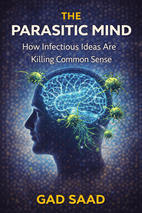

![The Explosive Child [Sixth Edition] by Ross W. Greene PhD - Book Summary](/_next/image?url=https%3A%2F%2Fapi.insta.page%2Fstorage%2Fv1%2Fobject%2Fpublic%2Fsmall_bookcovers2%2FB08NP52GTW.png&w=3840&q=75)