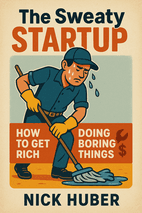
Nick Huber's The Sweaty Startup provides a practical guide for building service-based businesses with minimal capital, emphasizing sweat equity and bootstrapping over venture funding. It's for determined entrepreneurs seeking financial independence through hands-on, sustainable growth.
Feature
Insta.Page
Blinkist
Shortform
Summary Depth
Full Chapter-by-Chapter
15-min overview
Detailed analysis
Audio Narration
✓ (AI narration)
✓
✓
Visual Mindmaps
✓
✕
✕
AI Q&A
✓ Voice AI
✕
✕
Quizzes
✓
✕
✕
PDF Downloads
✓
✕
✓
Price
$59.99/yr
$146/yr (PRO)
$199/yr
*Competitor data last verified February 2026.
About the Author
Nick Huber
Nick Huber is a published author and recognized expert in the fields of entrepreneurship and business optimization. Through his insightful writing, he provides actionable strategies for scaling companies and building wealth. His notable works, available on Amazon, distill complex business concepts into practical guidance for aspiring and established entrepreneurs alike. Huber's contributions have established him as a trusted voice, offering a clear roadmap for achieving operational excellence and financial independence. His books are essential reading for anyone looking to navigate the challenges of modern business.
1 Page Summary
The Sweaty Startup by Nick Huber is a practical guide for entrepreneurs looking to build successful businesses with minimal upfront capital. Huber emphasizes the value of starting small, focusing on service-based businesses that require little investment but generate steady cash flow. Key concepts include leveraging sweat equity—putting in hard work instead of relying on outside funding—and scaling gradually by reinvesting profits. The book challenges the Silicon Valley myth of needing venture capital, advocating instead for bootstrapping and hands-on management.
Historically, Huber’s approach aligns with the timeless principles of frugality and self-reliance seen in classic entrepreneurship literature, but with a modern twist tailored to today’s gig economy. He draws from his own experience building a storage unit business from scratch, illustrating how niche markets and overlooked opportunities can yield substantial returns. The book also critiques the "get rich quick" mentality, promoting sustainable growth through customer satisfaction and operational efficiency.
The lasting impact of The Sweaty Startup lies in its actionable advice for aspiring entrepreneurs who may lack resources but possess determination. Huber’s philosophy democratizes entrepreneurship, making it accessible to anyone willing to put in the effort. By shifting focus from glamorous tech startups to gritty, real-world businesses, the book redefines success in terms of financial independence and personal fulfillment rather than viral fame or massive exits.
This chapter paints a vivid picture of modern success traps and the escape routes available through strategic choices. It opens with a gut-punch story of a millionaire lawyer forced to choose between career prestige and witnessing his child’s birth—a stark reminder that wealth without autonomy is hollow. His boss, a cautionary figure chained to golden handcuffs, embodies the systemic lie that status equals fulfillment.
The antidote? Building leverage through three pillars: networks that amplify your reach, skills that make you indispensable, and capital that buys freedom to take risks. These elements work in tandem, allowing you to ditch toxic clients (the “no-asshole rule”) and prioritize peace over paycheck panic. The math gets personal when evaluating time investments—why trade hours for $15 burgers when you could build systems earning $300k while you sleep?
Traditional jobs come under fire as time-for-money traps, with even high salaries failing to solve the autonomy puzzle. The chapter pushes readers to define their freedom number—the exact income needed to fund an ideal lifestyle—then reverse-engineer it through unsexy but reliable sweaty startups. Think logistics over Silicon Valley moonshots: scalable, practical ventures that generate cash flow without demanding your soul.
Woven throughout is a poker-chip metaphor: time as finite currency to bet wisely on high-leverage moves. It’s not about grinding harder but smarter—rejecting burnout culture to build asymmetrical returns. The final takeaway? True wealth isn’t Lamborghinis or LinkedIn clout. It’s designing a life where money flows whether you’re working, parenting, or simply breathing.
The High-Stakes Trade-Off
A high-achieving lawyer’s story serves as a cautionary tale about sacrificing personal priorities for professional success. Despite earning over $1 million annually at a prestigious law firm, he faced an ultimatum: miss the birth of his child or risk his partnership track. His boss—a divorced, overworked partner with strained family relationships—epitomized the hollow “prize” of winning a high-status game. The lawyer walked away, realizing that societal definitions of success often trap people in systems where status and wealth come at the cost of autonomy, health, and relationships.
The Three Pillars of Leverage
1. Network
Leverage begins with building reciprocal relationships. A strong network includes people who can work for you, invest in your ideas, or connect you to opportunities. Over time, this web allows you to delegate, scale, and access resources without direct effort.
2. Skills
Mastery of high-value skills—like sales, leadership, and decision-making—makes you irreplaceable. These aren’t innate talents but muscles developed through practice. As the author puts it: “You don’t get stronger by reading about Arnold Schwarzenegger; you lift weights.”
3. Capital
Financial runway transforms risk-taking. With steady cash flow or savings, you can invest in growth, hire talent, and weather setbacks. Entrepreneurs with capital operate on “easy mode,” while those living paycheck-to-paycheck face constant pressure to compromise.
The No-Asshole Rule
Early in your career, you’ll tolerate difficult clients, partners, or investors out of necessity. But as leverage grows, you gain the power to cut ties with toxic relationships. The author shares examples: buying out a micromanaging investor, firing an abusive client, and walking away from a disrespectful buyer. Leverage lets you prioritize peace of mind over short-term gains.
Calculating Return on Time
Every opportunity should be evaluated through two questions:
What’s the financial return per hour today, in one year, and in ten years?
A McDonald’s employee trades time for $15/hour with no future upside.
A franchise owner earns $300k/year passively after initial effort.
Does income stop when you stop working?
Passive income streams (rental properties, automated businesses) decouple time from earnings. The goal isn’t just wealth but freedom—earning money while golfing, traveling, or spending time with family.
Key Takeaways
Leverage ≠ Money: High-status careers often trap you in golden handcuffs. True wealth is autonomy.
Build Asymmetry: Focus on opportunities where your input (time, effort) shrinks while output (income, impact) grows.
Escape the Commodity Trap: If you’re easily replaceable, your earning potential is capped. Develop unique skills or assets.
Play the Long Game: Leverage compounds. Passive income, networks, and expertise take years to build but create exponential freedom.
The Limitations of Traditional Employment
Most jobs, especially W-2 roles, lack leverage because they tie income directly to time spent working. Professions like medicine or salaried positions force individuals into a cycle where stopping work means stopping paychecks. Even high earners aren’t truly wealthy if they’re trapped in 70-hour workweeks. The author emphasizes that wealth management, insurance, or sales careers offer better leverage through residual income streams, but these are exceptions. The core problem? Without passive income, you’re stuck trading hours for dollars indefinitely.
Defining Your Ideal Lifestyle
The chapter challenges readers to visualize their “perfect week” if money were no obstacle. This exercise involves detailing where you’d live, how you’d spend your time, and what your daily routine would look like. Next, quantify the monthly income needed to sustain this lifestyle. For the author, $30,000/month post-tax (adjusted for inflation) allowed a comfortable life with freedom to prioritize family, hobbies, and travel. The point isn’t extravagance—most people overestimate what they need. True wealth hinges on aligning income with personal freedom, not chasing status symbols.
The Poker Analogy: Strategic Investment of Time
Time is compared to poker chips in a tournament: finite and requiring careful allocation. Every hour spent on low-leverage activities (like traditional jobs) is a “fold” on high-potential opportunities. The author argues that maximizing odds of success means focusing on ventures that generate passive income, not chasing moonshot startups or corporate promotions. For example, he dismissed venture-backed tech startups (95% failure rate) in favor of “boring” businesses with predictable cash flow.
Choosing the Right Opportunity: The Sweaty Startup
The author’s solution? A “sweaty startup”—a hands-on, unglamorous business like logistics or service-based work. These ventures often have lower risk, faster revenue generation, and scalability compared to flashier options. By starting small (e.g., a side hustle earning $2,000/month) and reinvesting profits, he built a system that eventually delivered $30,000/month without requiring his constant presence. The key was prioritizing practicality over prestige.
Key Takeaways
True wealth = freedom + time: It’s not about raw income but controlling your schedule.
Start small, scale strategically: Begin with a side hustle or business generating $2,000/month and grow incrementally.
Quantify your freedom number: Calculate the exact monthly income needed to fund your ideal lifestyle, then reverse-engineer a plan to achieve it.
Invest time like poker chips: Prioritize opportunities with the highest leverage, even if they’re unsexy.
Sweaty startups > glamorous risks: Focus on practical, cash-flow-positive businesses rather than high-failure-rate ventures.
Key concepts: Chapter 1: Leverage
1. Chapter 1: Leverage
The Illusion of Traditional Success
High-status careers often sacrifice autonomy (e.g., millionaire lawyer forced to miss child’s birth)
Wealth without freedom is hollow—golden handcuffs trap people in unfulfilling systems
Societal definitions of success prioritize status over health/relationships
The Three Pillars of Leverage
Network: Reciprocal relationships that amplify reach and delegate effort
Skills: Mastery of high-value abilities (sales, leadership) to become indispensable
Capital: Financial runway to take risks and invest in growth
The No-Asshole Rule
Early career demands tolerating toxic relationships; leverage lets you walk away
Examples: firing abusive clients, buying out micromanaging investors
Prioritize peace of mind over short-term gains as leverage grows
Time vs. Wealth Calculus
Evaluate opportunities by financial return per hour (short-term vs. long-term upside)
Passive income (e.g., franchises, rentals) decouples time from earnings
Goal: Design systems where money flows without active work
Limitations of Traditional Employment
W-2 jobs lack leverage—income stops when work stops
Even high earners face time-for-money traps (70-hour workweeks)
Exceptions: Residual income careers (sales, wealth management) offer partial leverage
Core Principles of Leverage
True wealth = autonomy, not status or Lamborghinis
💡 Try clicking the AI chat button to ask questions about this book!
Chapter 2: Chapter 2: Business Is a Race
Overview
The chapter opens in 2011, as the author and his business partner, Dan, face a crossroads during their senior year at Cornell. While peers secure lucrative corporate jobs, they grapple with the uncertainty of their fledgling moving-and-storage business, Storage Squad. With only $5,000 in revenue and a single cargo van, the pressure mounts to prove their venture’s viability. A pivotal moment arrives when the author receives an $80,000 job offer from Coca-Cola, forcing a high-stakes decision: abandon the startup or commit fully. They set an audacious goal—250 customers by the end of the school year—as their “proof of concept.” The chapter traces their chaotic sprint to hit this target while juggling finals, Division I athletics, and personal relationships, ultimately revealing how urgency and momentum shaped their entrepreneurial journey.
The Make-or-Break Moment
Dan and the author launch a frantic expansion, opening branches at three universities beyond Cornell. They recruit friends to manage operations, buy more vans, and gamble on an untested profit-sharing model. The pressure is relentless: finals week, track championships, and a budding romance collide with their business grind. By May, they hit 253 customers—barely clearing their threshold—and decide to “keep racing ahead.” This early win becomes a blueprint for their philosophy: Entrepreneurship demands speed, even if it means tolerating discomfort and imperfection.
Speed Over Perfection
The author contrasts his “act now” approach with a Cornell friend stuck in “analysis paralysis.” While the friend researches, plans, and abandons ideas, the author emphasizes execution over perfection. He shares examples of rapid wins, like a UGA student who built a $30k/month recruiting firm by cold-calling clients immediately. The lesson: low-risk ventures require minimal deliberation. “Aim, fire, adjust” beats endless planning. Mistakes in early stages are survivable; hesitation is costlier.
Building Thick Skin
Entrepreneurship often invites ridicule. The author recalls overhearing teammates mock Storage Squad, doubting its legitimacy compared to their Wall Street futures. He argues that thick skin is earned through practice—facing rejection, jealousy, and failure head-on. Winners tolerate “cringe” moments and low-status work, knowing judgment is inevitable when pursuing unconventional paths.
Momentum in Action
Fast-forward to 2023: The author negotiates a $52 million deal to acquire a stake in Somewhere.com, a company he’d invested in years prior. This deal—raising $20 million, hiring a CEO, and navigating complex legal terms—exemplifies how momentum compounds over time. From moving boxes to multimillion-dollar acquisitions, each risk and lesson builds leverage for bigger opportunities. The author stresses that success isn’t linear but accelerates as skills, networks, and confidence grow.
Key Takeaways
Urgency Wins: Set non-negotiable goals and move fast—even with incomplete information.
Execution > Ideas: Start small, collect money quickly, and refine as you go.
Embrace Discomfort: Judgment and setbacks are inevitable; resilience is a muscle.
Momentum Compounds: Early wins create leverage for larger opportunities.
Start Now: If you’re not wealthy, your first business must generate cash immediately. Test demand by making $500 this weekend.
Key concepts: Chapter 2: Business Is a Race
2. Chapter 2: Business Is a Race
The Entrepreneurial Crossroads
Facing a pivotal decision: corporate job vs. startup commitment
Setting an audacious goal (250 customers) as proof of concept
Juggling academics, athletics, and business simultaneously
Early-stage uncertainty with minimal revenue and resources
The Make-or-Break Expansion
Rapidly scaling to three new university locations
Implementing an untested profit-sharing model
Hitting the 253-customer target under extreme pressure
Decision to continue despite barely meeting the goal
Speed as Competitive Advantage
Contrast between 'act now' vs. 'analysis paralysis' approaches
Examples of rapid execution leading to quick wins
'Aim, fire, adjust' philosophy over perfectionism
Early mistakes being more survivable than hesitation
Developing Entrepreneurial Resilience
Facing ridicule and skepticism from peers
Learning to tolerate judgment and low-status work
Thick skin developed through repeated challenges
Embracing discomfort as part of the process
The Compound Effect of Momentum
From moving boxes to $52M acquisitions
How early risks create leverage for bigger opportunities
Non-linear progression of entrepreneurial success
Skills, networks and confidence building over time
Core Entrepreneurial Principles
Urgency and speed trump perfect planning
Execution and cash flow validate ideas faster
Resilience is developed through practice
Momentum creates compounding opportunities
Immediate action tests real market demand
⚡ You're 2 chapters in and clearly committed to learning
Why stop now? Finish this book today and explore our entire library. Try it free for 7 days.
Chapter 3: Chapter 3: Not All Businesses Are Created Equal
Overview
Entrepreneurship isn’t about passion or personal interests—it’s about cold, hard logic. Markets don’t care what you love; they reward businesses that solve problems efficiently. This chapter dismantles the myth of the “passionate founder” and argues that success hinges on choosing the right business model. Using personal anecdotes—like comparing his grueling moving company (Storage Squad) to a lucrative self-storage venture—the author highlights how some businesses demand less effort, generate higher profits, and offer better quality of life. The key takeaway? Not all opportunities are equal, and picking the wrong one can mean burnout, failure, or leaving money on the table.
The Three Dealbreakers
The author identifies three red flags for non-feasible businesses:
Requiring venture capital (unless you’re already wealthy or experienced).
Relying on a “new idea” with no existing model to study.
Involving physical product manufacturing.
These ventures are capital-intensive, competitive, and statistically likely to fail. For example, app startups compete with Stanford grads backed by VC funding, while new product launches drain resources without guaranteed demand. The advice? Stick to proven models until you’ve built skills, capital, and a network.
Why “Fun” Businesses Flop
Passion projects attract dreamers, driving competition sky-high. Restaurants, fitness apps, and gaming startups often fail because too many people enter the field for love, not logic. Margins shrink, and operators cling to unprofitable ventures out of stubbornness. The author warns: “The more passionate people are, the longer they’ll run a business that isn’t feasible.” Instead, seek industries others find boring or unpleasant—like waste management or HVAC repair—where demand is steady and competition is sparse.
The Low-Status Advantage
Businesses with “low status” (think garbage collection or self-storage) repel ego-driven competitors. To test an idea’s viability, pitch it to an older relative. If they say, “Oh, good for you,” you’re on the right track. If they gush, “Wow, that’s genius!”—run. High-status ventures (AI startups, flashy tech) attract overfunded rivals and delusional optimists. Low-status industries, by contrast, are dominated by operators who prioritize profit over prestige.
Crunching the Numbers
Evaluate any business using three metrics:
Competition strength (avoid fields with savvy, well-funded players).
Profit margins (aim for industries averaging 20%+).
Industry-wide failure rates (self-storage has near-zero bankruptcies; restaurants fail at 90%+).
For example, landscaping companies thrive because many competitors lack websites or marketing savvy, while dog-walking apps struggle with marketplace dynamics (balancing supply and demand).
Red Oceans Beat Blue Oceans
Forget the “blue ocean” strategy of creating new markets. The author advocates for red oceans—existing industries where you can study competitors, spot inefficiencies, and out-execute them. Many established businesses (like contractors or home services) underperform: they don’t answer phones, lack online presence, or use outdated tech. By modernizing operations or improving customer service, you can steal market share with minimal innovation.
Play the Easy Game
Entrepreneurs often glorify “hard” challenges, but the smartest founders pick battles they can win. Imagine playing basketball for $30K/month: would you face LeBron James or a fifth-grader? The author urges readers to copy proven models, target weak competition, and prioritize high odds of success over moonshots. Example: A local HVAC company with 20–30% margins is a safer bet than a venture-backed app with a 0.5% chance of a $50M exit.
Train Your Business Curiosity
A practical exercise: Walk through your town and analyze every business. Estimate their revenue, costs, and operational headaches. Ask:
How could I run this more efficiently?
Where are the profit leaks?
What tech or process could improve it?
This “mindset of business curiosity” helps spot patterns: sustainable businesses have simple models, loyal customers, and manageable overhead. Avoid complex, low-margin ventures—even if they seem glamorous.
Key Takeaways
Market logic trumps passion: Build businesses that solve problems, not ones that feed your ego.
Avoid “fun” industries: High passion = high competition and low margins.
Seek low-status, boring niches: Less competition, more profitability.
Check failure rates (e.g., self-storage vs. restaurants).
Red Oceans vs. Blue Oceans
Ignore 'blue ocean' strategies; focus on improving existing markets.
Out-execute competitors by modernizing operations (e.g., better customer service).
Target industries with inefficiencies (e.g., outdated tech, poor online presence).
Playing the Easy Game
Prioritize high-odds, low-competition opportunities over moonshots.
Copy proven models instead of inventing untested ideas.
Example: Local HVAC companies > venture-backed apps for early-stage founders.
Developing Business Curiosity
Analyze local businesses for revenue, costs, and operational gaps.
Ask: How could this run more efficiently? Where are profit leaks?
Avoid complex, low-margin ventures even if they seem glamorous.
Key Takeaways Summary
Solve problems, not egos; avoid passion-driven traps.
Boring niches = less competition + higher profitability.
Copy and improve existing models; don’t reinvent the wheel.
Red oceans (existing markets) > blue oceans (untested innovation).
Geographic moats (local focus) protect from global competitors.
Chapter 4: Chapter 4: Idea Generation 101
Overview
This chapter shifts from theory to action, guiding readers through a structured process to identify viable business ideas. It emphasizes balancing market demand with personal circumstances, urging entrepreneurs to find gaps where they can leverage competitive advantages. The focus is on practical steps—assessing one’s financial runway, risk tolerance, and local opportunities—to build a list of potential businesses, then systematically narrow it down using real-world validation.
Competitive Advantage Fundamentals
Every successful business must dominate in at least two of three areas: price, speed, or quality. Trying to excel in all three is a recipe for failure. For example:
Price + Speed: Fast, affordable service but lower quality.
Speed + Quality: Premium pricing for rapid, high-end results.
Quality + Price: Affordable excellence but slower delivery.
The goal is to spot underserved niches. A tree-trimming service charging $400/hour with a two-week waitlist signals high demand and limited competition, while saturated markets like lawn care (e.g., $37/hour rates) may require differentiating through speed or service quality.
Personal Situation Assessment
Before brainstorming ideas, answer these questions:
Urgency: Do you need immediate income, or can you afford a longer runway?
Capital: How much can you invest without financial ruin? (e.g., $500 vs. $300,000 equipment loans).
Location: Does your area have unique needs? (Think Masters Tournament housing rentals in Augusta, GA.)
Skills/Network: Can existing relationships or expertise open doors? (Example: A corporate travel planner pivoting to luxury vacations.)
These factors determine whether you pursue low-risk, low-skill ventures or more complex opportunities.
Business Idea Tiers: Level 1 to Level 3
Level 1: Low skill, minimal investment. Examples: Lawn care, car detailing, mobile bartending. Success story: A teen’s $50k/year car-detailing side hustle.
Level 2: Moderate investment and skill. Examples: Wedding DJ services, Airbnb management. Case study: A property manager earning $100k/year managing rentals and cleaning crews.
Level 3: High capital, specialized skills. Examples: Arborist services, dumpster rentals. Example: A tree-trimming franchise owner scaling to $2M revenue.
The chapter advises starting at Level 1 to minimize risk, then “graduating” to higher tiers as skills and capital grow.
Validation Tactics: The Ten-Minute Drill
Before committing, test ideas by:
Calling Competitors: Pose as a customer. Are they hungry for work or booked for weeks?
Analyzing Quotes: Calculate competitors’ hourly rates (e.g., $8,000 for a well-drilling job = $400/hour).
Assessing Demand: Note response times, online reviews, and marketing efforts.
One entrepreneur scrapped a painting business idea after discovering cutthroat pricing and oversupply in his area—all revealed in three phone calls.
Key Takeaways
Dominate Two Pillars: Compete on price + speed, speed + quality, or quality + price—never all three.
Start Small: Level 1 businesses offer low-risk entry points with potential to scale.
Validate Relentlessly: Use competitor calls and quote comparisons to avoid saturated markets.
Leverage Location: Capitalize on local events, demographics, or underserved needs.
Adapt as You Grow: Transition to higher-tier businesses as resources and expertise expand.
Key concepts: Chapter 4: Idea Generation 101
4. Chapter 4: Idea Generation 101
Competitive Advantage Fundamentals
Dominate in two of three areas: price, speed, or quality—never all three
Start at Level 1 to minimize risk, then scale to higher tiers
Validation Tactics
Call competitors to gauge demand (e.g., wait times, pricing)
Analyze quotes to estimate hourly rates and profitability
Assess market saturation via reviews and competitor responsiveness
Key Takeaways
Focus on two competitive pillars—never all three
Begin with low-risk Level 1 businesses
Validate ideas through competitor research and local demand checks
Capitalize on location-specific opportunities
Gradually scale to higher-tier businesses as resources grow
Chapter 5: Chapter 5: Become an Expert Operator
Overview
This chapter dismantles the myth that business success hinges on groundbreaking ideas or industry-specific genius. Instead, it argues that exceptional execution—rooted in operational discipline, adaptability, and a willingness to embrace discomfort—is the true differentiator. Using vivid examples like Texas Roadhouse and the author’s own venture, Storage Squad, the chapter emphasizes that thriving businesses are built on mundane fundamentals, not novelty. It challenges entrepreneurs to prioritize practicality over passion, copy proven models, and endure short-term sacrifices for long-term gains.
The Universal Core of Business Success
Every business, from restaurants to tech startups, shares the same operational DNA at scale. Owners aren’t experts in the product or service—they’re experts in running a company. Success hinges on hiring, problem-solving, delegation, and resilience. For instance, a mediocre mechanic with strong operational skills will outperform a brilliant mechanic who can’t manage employees or market their services. The lesson? Master the “boring” work: sales, conflict resolution, and logistics.
Building a Franken Business
Innovation isn’t about reinventing the wheel—it’s about stitching together the best parts of existing models. The author’s student storage company, Storage Squad, thrived by borrowing strategies from competitors: free packing supplies from one, precise scheduling windows from another, and live Google Sheets for real-time updates. This “Franken business” approach prioritizes efficiency over originality. The takeaway: Study winners in your field, steal their playbook, and focus on incremental improvements rather than disruptive overhauls.
The Long Game of Delayed Gratification
Entrepreneurship demands trading immediate comfort for future freedom. The author dismisses the myth of “passive income” overnight success, stressing that early-stage ventures require grueling hours, missed family events, and relentless focus. Sacrifices compound over time: A snowball of momentum starts small but grows exponentially. For example, the author’s early days involved loading storage trucks during weekends and holidays—uncomfortable work that laid the foundation for eventual scale.
Key Takeaways
Execution trumps ideas: Texas Roadhouse’s $730M profit in 2023 wasn’t luck—it was operational mastery.
Copy, then optimize: Build a “Franken business” by combining proven tactics from competitors.
Embrace the grind: Success requires sacrificing short-term comfort for long-term gains.
Operators win: Great chefs don’t run great restaurants; great managers do.
Play the long game: Momentum builds slowly—patience and persistence separate winners from burnout cases.
Key concepts: Chapter 5: Become an Expert Operator
5. Chapter 5: Become an Expert Operator
The Universal Core of Business Success
Business success depends on operational skills, not product expertise
Master fundamentals like hiring, delegation, and problem-solving
Operational discipline (sales, logistics, conflict resolution) is key
Example: A mediocre mechanic with strong operations outperforms a brilliant but disorganized one
Building a Franken Business
Innovation means combining best practices from existing models
Example: Storage Squad borrowed free supplies, scheduling systems, and real-time tracking from competitors
Prioritize efficiency over originality
Study winners in your field and adapt their strategies
The Long Game of Delayed Gratification
Entrepreneurship requires sacrificing short-term comfort for long-term gains
Early stages demand grueling work and personal sacrifices
Momentum builds slowly but compounds over time
Example: Author loaded storage trucks on weekends/holidays to build foundation
Key Execution Principles
Execution matters more than ideas (Texas Roadhouse's $730M profit example)
Copy proven models first, then optimize
Great operators (not just experts) run successful businesses
Patience and persistence separate winners from burnout cases
Chapter 6: Chapter 6: Sales Is the Foundation of Every Business
Overview
A transformative mentorship reshapes the entrepreneur’s view of business, revealing that sales isn’t just transactions—it’s the art of aligning others’ self-interest with shared goals. Four universal truths anchor this philosophy: humans thrive on interdependence, resist coercion, act for personal benefit, and respond to those who prioritize their needs. These principles reframe sales as building win-win relationships, not pressuring targets.
The journey begins with rejecting desperation. Instead of chasing every lead, successful entrepreneurs qualify prospects by asking questions to find mutual fit—like a jeweler losing a sale by ignoring a customer’s budget. Embracing discomfort becomes non-negotiable: enduring 100+ investor rejections teaches that resilience trumps fear. Credibility emerges not from slick pitches but speaking the customer’s language, openly discussing risks like a contractor warning of delays. Trust deepens by managing expectations—underpromising and overdelivering—while loyalty grows when value comes first, like a wealth manager offering free tax advice.
Scarcity becomes a strategic ally. Positioning services as selective—even early on—shifts power dynamics, filtering out mismatched clients. Prospects convince themselves to buy when asked pointed questions like, “Why are we the right fit?” This flips the script, turning sales into collaborative problem-solving. When budgets are tight, guerrilla marketing thrives: chalk ads on campuses, door-to-door pitches, or relentless repetition of hand-drawn signs. These gritty tactics work precisely because they’re unglamorous—most competitors won’t bother.
Ultimately, the chapter underscores that sales isn’t a department—it’s the lifeblood of every interaction. From hiring employees who mirror company values to closing deals with confident clarity, success hinges on creating mutual benefit. By embracing rejection, prioritizing transparency, and doing the unsexy work others avoid, entrepreneurs build businesses where scarcity, trust, and hustle become unfair advantages.
The Mentor’s Lesson
A pivotal conversation with mentor Dan Cohen shatters the author’s idealized vision of entrepreneurship. Cohen bluntly states that entrepreneurship is sales—selling employees on trust, partners on collaboration, investors on capital, and vendors on reliability. This reframes the author’s understanding: Success hinges on aligning others’ self-interest with your goals.
These truths redefine sales as a tool to create win-win relationships, not manipulation.
Habit 1: Realize Not Everyone Wants to Buy
Forced sales tactics fail. Instead, qualify prospects by asking questions to identify mutual fit. Avoid desperation; rejections save future headaches (e.g., a pushy jeweler alienating a customer).
Habit 2: Get Comfortable Being Uncomfortable
Rejection is inevitable. The author recounts 100+ investor rejections before securing his first real estate deal. Sales is a numbers game: Consistency and resilience trump fear.
Habit 3: Prove You’re an Expert
Credibility comes from speaking the customer’s language. Discuss risks and challenges openly (e.g., a contractor detailing construction delays). Transparency builds trust faster than hype.
Habit 4: Manage Expectations
Underpromise and overdeliver. Contrasting stories of two contractors reveal the power of setting realistic timelines and budgets. One thrives by preparing clients for worst-case scenarios; the other drowns in stress from broken promises.
Habit 5: Add Value First
A wealth manager’s free consultation demonstrates giving before asking. Providing actionable advice (e.g., tax strategies or lawn care guides) builds trust and loyalty, making sales organic.
Habit 6: Make Scarcity Work for You
Instead of chasing clients, emphasize selectivity. Highlight why you might not be a fit (e.g., higher costs or limited availability). Scarcity elevates perceived value and attracts ideal customers.
The summary continues in Section 2 with Habit 7 and the Key Takeaways.
Creating Authentic Scarcity
The section emphasizes the importance of positioning your business as selective, even when starting out. By openly acknowledging that not every customer or investor is a good fit, you create genuine scarcity. This builds credibility and filters out low-quality prospects. For example, telling potential clients you’re busy or selective (even if you’re not yet) shifts the power dynamic, making your services feel more valuable. The goal isn’t to lie but to focus on quality over desperation.
Flipping the Sales Dynamic
A core tactic discussed is letting prospects “sell themselves” by asking pointed, open-ended questions like, “Why do you think I’m the right fit for this project?” or “Given the risks, why are you interested?” This forces the prospect to articulate their own reasons for wanting to work with you, often alleviating their doubts in the process. The author shares a real-world example of pitching real estate investors: by candidly outlining worst-case scenarios (e.g., market downturns, illiquid investments), he prompts investors to counter with reasons they’re still interested. This builds trust and shifts the conversation from a sales pitch to a partnership discussion.
Guerrilla Marketing: Doing What Others Won’t
When traditional marketing is out of reach, the chapter advocates for “unscalable” tactics that require hustle over budget. Examples include:
Physical Outreach: Hand-drawing chalk ads on college campuses, placing bandit signs for lawn care, or door-to-door sales for pest control.
Hyper-Targeting: Focusing on where your ideal customers physically are (e.g., dorms, neighborhoods) rather than relying on digital ads.
Repetition and Grit: Writing the same message thousands of times (like “Student Storage” on sidewalks) or replacing torn-down signs persistently.
The author stresses that these methods work precisely because they’re labor-intensive and unglamorous—most competitors won’t put in the effort.
Key Takeaways
Scarcity Builds Value: Position your business as selective, even early on, to attract higher-quality clients.
Let Prospects Convince Themselves: Ask open-ended questions that force them to justify working with you.
Embrace Unsexy Marketing: Prioritize hands-on, hyper-local strategies over flashy campaigns.
Record and Refine: Analyze sales interactions to improve your approach.
Close Confidently: After building trust, don’t shy away from directly asking for the sale.
Leverage Scarcity in Hiring: Use the same tactics to vet employees, ensuring they’re aligned with your company’s intensity and values.
Key concepts: Chapter 6: Sales Is the Foundation of Every Business
6. Chapter 6: Sales Is the Foundation of Every Business
The Mentor’s Lesson
Entrepreneurship is fundamentally about sales—selling trust, collaboration, capital, and reliability.
Success depends on aligning others' self-interest with your goals.
Sales is reframed as a tool for creating win-win relationships, not manipulation.
Position your business as selective to elevate perceived value.
Highlight why you might not be a fit (e.g., higher costs, limited availability).
Scarcity filters out low-quality prospects and attracts ideal customers.
Creating Authentic Scarcity
Emphasize selectivity, even when starting out, to build credibility.
Example: Telling clients you’re busy shifts the power dynamic.
Focus on quality over desperation.
Flipping the Sales Dynamic
Let prospects 'sell themselves' by asking open-ended questions.
Example: 'Why do you think I’m the right fit?' prompts self-convincing.
Shift from sales pitch to partnership discussion by outlining risks.
Key Takeaways
Sales is the lifeblood of every business interaction—not just transactions.
Win-win relationships are built on trust, transparency, and mutual benefit.
Embrace rejection, prioritize others’ needs, and do the unglamorous work for long-term success.
Guerrilla Marketing: Doing What Others Won’t
Use labor-intensive, unscalable tactics when traditional marketing isn't feasible.
Physical outreach (e.g., chalk ads, bandit signs, door-to-door) can be highly effective.
Hyper-target customers by focusing on their physical locations rather than digital ads.
Repetition and persistence (e.g., rewriting messages, replacing torn signs) set you apart.
These methods work because most competitors avoid the unglamorous effort.
Key Takeaways
Scarcity builds value—position your business as selective to attract better clients.
Let prospects convince themselves by asking open-ended questions about their needs.
Embrace unsexy, hands-on marketing strategies over flashy campaigns.
Record and refine sales interactions to continuously improve your approach.
Close confidently after building trust—don’t hesitate to ask for the sale.
Apply scarcity tactics in hiring to ensure employees align with your company’s intensity.
Chapter 7: Chapter 7: Life Is Short
Overview
This chapter challenges the notion of equality in life’s starting conditions while emphasizing the universal equalizer: time. It argues that while wealth, networks, and upbringing create disparities, everyone has the same 24 hours daily—how we invest that time determines success. The author contrasts disciplined, long-term thinking with short-term gratification, using personal anecdotes and frameworks to illustrate how prioritizing high-impact activities over urgent-but-unimportant tasks can transform both businesses and lives.
The Scarcity of Time
Time is the only resource that can’t be replenished, making it uniquely precious. Unlike money, which can be earned indefinitely, wasted time is lost forever. The author advocates adopting a “scarcity mindset” toward time, guarding it as fiercely as one might protect financial assets. Examples include avoiding unproductive social obligations and reallocating energy to meaningful pursuits. A stark warning underscores the chapter: Without intentionality, years can slip away in unfulfilling routines, leaving missed opportunities in their wake.
The Four Quadrants of Time Management
Activities fall into four categories based on urgency and importance:
Important & Not Urgent: High-leverage tasks like hiring, strategic planning, or innovation.
Not Important & Urgent: Delegatable tasks (e.g., answering routine calls, restocking supplies).
Not Important & Not Urgent: Time-wasters (e.g., idle chatter, excessive email checks).
The author critiques entrepreneurs who stagnate in Quadrant 3, mistaking busyness for productivity. Instead, success hinges on Quadrant 2—investing in activities that compound over time, even if they lack immediate urgency. A case study of a pizza restaurateur illustrates this: By refusing to delegate, he remains trapped in operational chaos, while others scale by focusing on systems and leadership.
The 80/20 Rule in Action
The Pareto Principle—20% of efforts drive 80% of results—applies universally. High-leverage tasks (e.g., refining customer onboarding, strategic hiring) often yield exponential returns. A poop-scooping business owner’s story exemplifies this: A 30-hour website overhaul doubled leads, catalyzing growth. The author urges readers to audit their schedules, identifying and amplifying the 20% of activities that matter most.
The Multigenerational Game
Wealth-building is rarely instantaneous; it’s a marathon spanning decades or generations. The author shares a friend’s family journey: Over 70 years, each generation climbed socioeconomic rungs, culminating in a real estate empire. This contrasts with society’s obsession with “overnight success,” emphasizing patience and incremental progress. Entrepreneurship is likened to a lion’s hunt: long periods of preparation punctuated by brief, decisive sprints toward opportunities.
Key Takeaways
Guard Your Time: Treat time as a non-renewable resource. Prioritize ruthlessly.
Focus on Quadrant 2: Invest in strategic, non-urgent tasks (hiring, innovation, planning) to unlock growth.
Leverage the 80/20 Rule: Identify and double down on high-impact activities.
Play the Long Game: Wealth and success often require decades of disciplined effort, not quick wins.
Delegate to Elevate: Free yourself from operational traps to focus on vision and scale.
By embracing these principles, readers can shift from surviving to thriving, transforming fleeting days into lasting legacies.
Key concepts: Chapter 7: Life Is Short
7. Chapter 7: Life Is Short
The Scarcity of Time
Time is non-renewable and uniquely precious compared to other resources.
Adopt a 'scarcity mindset' to guard time as fiercely as financial assets.
Avoid unproductive obligations to focus on meaningful pursuits.
Without intentionality, years can slip away in unfulfilling routines.
The Four Quadrants of Time Management
Activities are categorized by urgency and importance into four quadrants.
Quadrant 2 (Important & Not Urgent) is key for long-term success (e.g., strategic planning).
Entrepreneurs often stagnate in Quadrant 3 (Not Important & Urgent), mistaking busyness for productivity.
Delegation frees time for high-leverage tasks like systems-building and leadership.
The 80/20 Rule in Action
20% of efforts drive 80% of results (Pareto Principle).
Audit schedules to identify and amplify the most impactful activities.
The Multigenerational Game
Wealth-building is a marathon, often spanning decades or generations.
Patience and incremental progress trump society's obsession with 'overnight success.'
Entrepreneurship resembles a lion's hunt: long preparation followed by decisive sprints.
Key Principles for Thriving
Guard time ruthlessly as a non-renewable resource.
Focus on Quadrant 2 (strategic, non-urgent tasks) to unlock growth.
Leverage the 80/20 Rule to prioritize high-impact activities.
Play the long game—success requires decades of disciplined effort.
Delegate operational tasks to focus on vision and scale.
Chapter 8: Chapter 8: Get Your Shit Together
Overview
The chapter plunges readers into a raw, unfiltered account of entrepreneurial chaos during the 2013 Boston student move-in season. What begins as a scrappy startup triumph—hundreds of customers and a bustling warehouse—quickly spirals into a logistical nightmare. Understaffed, unprepared, and physically broken, the narrator battles sleepless nights, customer service meltdowns, and a series of costly disasters, culminating in a panic attack on the side of the road. Through this crucible, hard truths about resilience, accountability, and the gritty reality of building a business emerge.
The Breaking Point
The chaos peaks during Labor Day weekend, with seven hundred customers demanding storage deliveries. A skeleton crew of eight employees scrambles to manage five trucks, while the narrator juggles driving, customer calls, and hauling boxes up endless flights of stairs. Physical exhaustion—bleeding thighs, blistered hands, and a 102-degree fever—meets emotional collapse when an employee totals a BMW and another quits mid-shift, abandoning a loaded truck. Overwhelmed, the narrator collapses into a panic attack, questioning every life choice. A blunt pep talk from his partner—“Get your shit together”—forces him to push through the final 24 hours of mayhem.
Confronting the Victim Mentality
Reflecting on the ordeal, the chapter challenges the cultural narrative of pervasive victimhood. While media amplifies fear and injustice, the author argues that modern life—safer, richer, and full of opportunity—demands personal accountability. Success hinges on rejecting excuses: Your life today is a direct result of your decisions. Resilience and discomfort tolerance become competitive advantages, separating those who thrive from those who blame external forces.
Navigating Uncomfortable Conversations
A failed 2016 self-storage construction project underscores the cost of avoiding tough talks. Over budget by $500k, the narrator delays disclosing financial woes to investors until desperation forces a humbling confession. The lesson? Address problems early: One difficult conversation upfront saves ten later. Business owners must resist appeasing unrealistic demands and own missteps transparently, even when it risks conflict.
Fear Setting as a Tool
To combat anxiety, the author practices “fear setting”—writing worst-case scenarios and their logical conclusions. For example, envisioning business failure reveals survivable outcomes: moving home, securing a job, or rebuilding. This exercise defangs fear, highlighting that most risks are manageable. Applying it to rejection (e.g., a failed sales pitch or awkward conversation) reframes stress as a temporary hurdle, not a catastrophe.
Embracing Resourcefulness
Entrepreneurship offers no textbook answers—only endless decisions amid uncertainty. From hiring to pricing, every choice carries risk. The author emphasizes decision-making as a muscle: even 50% wrong choices can succeed if critical bets pay off. Resourcefulness—adapting to fluid, emotional, and illogical challenges—becomes the ultimate survival skill.
Key Takeaways
Stress is currency: Discomfort correlates with growth; embrace it as a sign of progress.
Own your outcomes: Blaming external factors surrenders power; accountability drives success.
Preempt crises: Have hard conversations early to avoid compounded fallout.
Fear-setting: Define worst-case scenarios to shrink anxiety into actionable steps.
Decide, adapt, repeat: Resourcefulness in uncertainty trumps textbook perfection.
Key concepts: Chapter 8: Get Your Shit Together
8. Chapter 8: Get Your Shit Together
The Breaking Point
Overwhelming chaos during peak demand with understaffed operations
Physical and emotional collapse leading to a panic attack
Critical moment of resilience: 'Get your shit together' as a turning point
Confronting the Victim Mentality
Rejecting cultural narratives of victimhood for personal accountability
Success depends on resilience and discomfort tolerance
Your life is a result of your decisions, not external forces
Decision-making is a muscle—even 50% wrong choices can succeed
Adaptability trumps textbook perfection in chaotic environments
Key Lessons
Stress signals growth—embrace discomfort as progress
Accountability > blame; own your outcomes
Preempt crises with early action and tough conversations
Fear-setting turns anxiety into actionable steps
Resourcefulness is the ultimate survival skill
Chapter 9: Chapter 9: The Attributes of Winners
Overview
This chapter explores the transformative power of building a team of exceptional people and the non-negotiable traits that define them. The author shares a personal journey from micromanaging every aspect of his real estate business to achieving a $9 million deal without his direct involvement—a testament to the strength of delegation, trust, and strategic hiring. The narrative underscores that entrepreneurship’s ultimate leverage isn’t capital or ideas, but people: those who align with your vision, challenge your assumptions, and execute with urgency.
The Ultimate Form of Leverage
The author reflects on 15 years of entrepreneurship, highlighting successes (300+ employees, $30M+ annual revenue) and painful lessons (firing friends, navigating emotional conflicts). Key insights:
People define scalability: Delegating high-stakes decisions allows leaders to focus on growth.
Trust is earned through transparency: Retaining top talent requires honesty, fairness, and valuing contributions.
Embrace discomfort: Managing egos, emotions, and unpredictable human dynamics is unavoidable—and a skill to master.
Building the Right Team
The chapter identifies five critical traits of “winners” who elevate businesses:
Abundance Mindset: Seek collaborators who celebrate others’ success, reject zero-sum thinking, and believe in collective growth.
Relentless Urgency: Prioritize action-oriented individuals who move quickly, even with imperfect plans.
Courage to Challenge Authority: Value team members who respectfully question decisions, like Kevin, the VP who prevented a $10M mistake by confronting the author’s flawed strategy.
Sound Decision-Making: Hire for judgment, not just competence. Observe how candidates analyze problems and learn from their outcomes.
Hands-On Grit: Avoid “messengers” who delegate without doing. Build a culture where leaders tackle problems directly—even if it’s messy.
Identifying Deal-Breakers
The author warns against toxic traits that erode teams:
Moral Failures: Dishonesty, theft, or cheating warrant immediate removal.
Pessimism: Negativity spreads faster than optimism and stifles innovation.
Manipulation: Self-serving agendas destroy trust.
Gossip: Erodes culture and fosters resentment.
Complacency: Avoid those content with the status quo; growth demands relentless improvement.
Key Takeaways
Delegate to scale: Your business can’t grow if you’re the bottleneck.
Hire for traits, not just skills: Abundance mindset, urgency, integrity, and grit matter more than resumes.
Cut toxicity swiftly: Protect your culture by removing pessimists, manipulators, and gossipers.
Lead by example: Roll up your sleeves—hands-on leaders inspire hands-on teams.
Embrace friction: Surround yourself with people brave enough to disagree; it’s how you avoid costly mistakes.
Key concepts: Chapter 9: The Attributes of Winners
9. Chapter 9: The Attributes of Winners
The Power of Exceptional Teams
People are the ultimate leverage in entrepreneurship
Delegation and trust enable scalability
Alignment with vision and execution urgency are critical
Lessons from Entrepreneurial Experience
People define scalability through delegation
Trust is built with transparency and fairness
Embrace discomfort in managing human dynamics
Five Critical Traits of Winners
Abundance mindset: Celebrate collective success
Relentless urgency: Prioritize action over perfection
Courage to challenge authority respectfully
Sound decision-making and judgment
Hands-on grit: Leaders tackle problems directly
Deal-Breaker Traits to Avoid
Moral failures like dishonesty or theft
Pessimism that stifles innovation
Manipulation with self-serving agendas
Gossip that erodes team culture
Complacency resisting growth
Key Leadership Principles
Delegate to scale and avoid being the bottleneck
Hire for traits (mindset, grit) over skills alone
Remove toxic influences swiftly to protect culture
Lead by example with hands-on involvement
Encourage constructive friction to avoid mistakes
Chapter 10: Chapter 10: How to Find High-Performing People
Overview
This chapter challenges traditional notions of networking and hiring, arguing that success in both areas hinges on adding value first rather than chasing opportunities through superficial connections. It dismantles the myth of "who you know" as the ultimate career catalyst, replacing it with a focus on becoming "someone worth knowing" through skill-building and strategic reciprocity. The narrative then shifts to actionable strategies for identifying and attracting high performers, emphasizing proactive recruitment, unconventional talent pools, and the overlooked potential of personal networks.
The Fallacy of "Who You Know"
Networking fails when approached with a self-centered mindset. People prioritize their own interests, so effective networking requires offering value before asking for favors. The author shares personal anecdotes about early networking failures—cold emails ignored, event conversations leading nowhere—contrasted with later success after building expertise in self-storage and international hiring. The lesson: become indispensable first. Master a niche, solve problems, and let your reputation attract opportunities organically.
Always Be Recruiting (ABR)
High-performing individuals rarely apply to job boards. The author breaks down the talent pool:
10% actively job-seeking (often desperate or mismatched).
10% unreachable (already in "career nirvana").
80% passive talent (content but open to better offers).
To access the 80%, entrepreneurs must hunt relentlessly. Examples include observing a hustling Walmart employee (later hired for his work ethic) and targeting undervalued professionals like teachers transitioning from stressful roles. The key is to identify transferable skills and offer clear upgrades: higher pay, flexibility, or growth potential.
Friends, Family, and Calculated Risks
Hiring from personal networks is controversial but potent if managed well. The author shares successes: a college friend launching a business branch, a teacher-turned-operations manager, even a CFO discovered through a roommate’s boyfriend. These hires worked because:
Pre-existing trust reduced onboarding risk.
Shared history provided insight into work ethic and problem-solving styles.
Clear communication set boundaries (e.g., "no special treatment").
However, this approach demands emotional maturity. The author admits to firing friends but maintaining relationships by prioritizing fairness and transparency.
Building Your Talent Profile
A practical exercise guides readers to:
List needed skills (e.g., sales, organization).
Identify where ideal candidates currently work (e.g., competitors, adjacent industries).
Craft offers addressing gaps in their current roles (e.g., higher pay, remote work).
This shifts recruitment from reactive job postings to strategic targeting—like the author’s deliberate outreach to burnt-out teachers or observant Walmart employees.
Key Takeaways
Become a magnet, not a beggar: Invest in skills that make others seek you out.
ABR mindset: Treat every interaction as a talent scouting opportunity.
Passive talent goldmine: The best hires aren’t looking—you must find and entice them.
Friends/family hires: High-risk, high-reward; succeed with clear expectations and emotional intelligence.
Solve their problems: Frame job offers as upgrades to their current situation, not charity.
Key concepts: Chapter 10: How to Find High-Performing People
10. Chapter 10: How to Find High-Performing People
The Fallacy of 'Who You Know'
Networking fails with a self-centered mindset; offer value first
Become indispensable by mastering a niche and solving problems
Reputation attracts opportunities organically, not forced connections
Always Be Recruiting (ABR)
High performers rarely apply to job boards (80% are passive talent)
Hunt relentlessly for undervalued professionals with transferable skills
Target candidates open to upgrades (pay, flexibility, growth)
Hiring from Personal Networks
Pre-existing trust reduces onboarding risk
Shared history reveals work ethic and problem-solving styles
Requires clear boundaries and emotional maturity to avoid favoritism
Strategic Talent Targeting
List needed skills and where ideal candidates currently work
Craft offers addressing gaps in their current roles
Shift from reactive job postings to proactive outreach
Key Takeaways
Become a magnet by investing in valuable skills
Treat every interaction as talent scouting (ABR mindset)
Best hires are passive; frame offers as upgrades, not charity
Chapter 11: Chapter 11: Hiring—The Key to Ultimate Leverage
Overview
Building a successful team starts with recognizing when stepping back creates more forward momentum. The chapter opens with a founder’s burnout from clinging to every task, revealing how delayed hiring traps businesses in stagnation. Letting go isn’t just about delegation—it’s about multiplying impact. Early hires fall into three categories: administrators who untangle daily chaos, technicians who deliver core services, and managers who steer strategy. A virtual assistant earning $800/month might free 30+ hours for revenue-generating work, proving that even modest investments in talent can unlock exponential growth.
Pricing becomes a linchpin here. Charging 2–3x labor costs isn’t greed—it’s survival. A lawn care business billing $80–$120/hour for a $20 worker covers hidden expenses while funding future hires. This math extends to global talent, where overseas hires in regions like the Philippines or Colombia offer elite skills at a fraction of domestic costs, accelerating scalability without sacrificing quality. Yet hiring isn’t just about filling seats; it’s about alignment. Asking candidates where they see themselves in five years weeds out mismatches early, like a technician who despises management suddenly leading a team.
Retention hinges on structure—clear expectations, accountability, and leaders who listen. High performers thrive in order, not chaos, and they’ll flee if forced to compensate for weak links. The chapter pulls no punches: tolerating low performers drags everyone down, echoing the mantra, “Fire them or lose your stars.” Letting go of underperformers—or even promising but erratic candidates—is messy but necessary. One founder’s gamble on a flaky hire paid off spectacularly, but only after swallowing pride and prioritizing team needs over ego.
Ultimately, hiring mirrors life: imperfect, emotional, and riddled with trade-offs. Whether navigating a candidate’s last-minute reversal or balancing empathy with business reality, the message is clear—leverage comes from people. Build thoughtfully, act decisively, and remember that every hire shapes not just the bottom line, but the soul of the company.
The Cost of Delayed Hiring
The author reflects on his early struggles at Storage Squad, where he and his partner handled every task—from customer service to manual labor—leaving no time for growth. Delaying critical hires led to burnout and stunted progress. He emphasizes a key lesson: If you’re the bottleneck in your business, it’s time to hire. Even when hiring felt financially risky, new hires quickly proved their value, freeing up time for high-impact work.
Managers: Drive strategy and operations.
For most startups, the first hire should be an admin or technician. The author shares a friend’s example: Hiring a $800/month virtual assistant from the Philippines allowed her to reclaim 30+ hours weekly, boosting billable work and revenue.
Pricing for Profitability
A lawn care example illustrates pricing strategy: Charging customers 2–3x an employee’s hourly wage ensures healthy margins. For a $20/hour worker, billing $80–$120/hour covers taxes, overhead, and profit. The author provides a downloadable spreadsheet (sweatystartup.com/wages) to model labor costs and margins, urging readers to test their pricing against real-world scenarios.
Global Talent as Strategic Leverage
Hiring overseas employees—particularly in Latin America, South Africa, and the Philippines—is highlighted as a low-risk, high-reward strategy. These roles (e.g., admins, managers, developers) cost 80% less than U.S. hires, enabling faster scaling. The author’s recruiting platform, Somewhere.com, vets candidates and guarantees hires for six months. Success stories include a Colombian hire poised to become a future CEO.
Aligning Visions in Hiring
During interviews, the author asks candidates to envision their ideal role in five years. This reveals motivations and fit. For example, a candidate seeking minimal people-management clashed with a management role’s demands. Alignment ensures employees thrive long-term, avoiding mismatches that lead to turnover.
Retaining Top Talent
Competent employees crave structure, not chaos. Clear expectations, benchmarks, and accountability reduce stress. A neighbor’s story underscores the frustration of high performers when leadership ignores improvement ideas. Decisive action and adaptability keep talent engaged.
Team Composition Matters
High performers resent carrying low-performing colleagues. The author shares a follower’s experience: C players forced her to clean up others’ mistakes until she quit. Chris Powers’ advice—“Fire low performers or lose high performers”—became a mantra. Tolerating incompetence drags the entire company down.
The Necessity of Tough Decisions
Firing is emotionally taxing but critical. The author’s experience firing nearly 100 people taught him: People don’t change. Generous severance and swift action preserve company health. He likens businesses to sports teams—only those who perform stay on the roster.
Key Takeaways
Hire when you’re the bottleneck, even if it feels risky.
Start with admins/technicians; use global talent to reduce costs.
Price services at 2–3x labor costs for sustainable margins.
Align employee goals with role expectations during hiring.
Foster structure, act on feedback, and eliminate low performers to retain top talent.
Treat firing as a necessary step to protect team morale and business health.
Navigating Uncertainty in Hiring Decisions
The hiring process took an unexpected turn when a top candidate abruptly declined the offer after securing a counteroffer from his current employer. The team, frustrated by the sudden silence and rejection, resumed their search—only for the candidate to reappear days later, admitting he’d made a mistake and asking to reconsider. His impulsive decision to quit his job after a heated argument with his employer raised concerns about his judgment and reliability.
The Candidate’s Reversal
Despite clear reservations—viewing the candidate’s indecision as a red flag—the team debated re-extending the offer. The founder argued against it, fearing future drama, while the co-founder advocated for humility and pragmatism. Reluctantly, the team agreed to give him another chance.
Team Dynamics and Compromise
The decision required swallowing pride and prioritizing the company’s needs over personal frustration. This willingness to adapt—despite initial skepticism—proved critical. The candidate not only joined but excelled, overhauling the tech stack, improving product delivery, and leading process innovations that had lasting positive impacts.
Key Takeaways
People are unpredictable: Hiring often involves messy, imperfect decisions.
Ego vs. pragmatism: Overcoming personal biases can lead to transformative hires.
Trust the process (and the team): Collaborative decision-making mitigates individual blind spots.
Risk and reward: Taking calculated chances on flawed candidates can yield outsized returns.
Key concepts: Chapter 11: Hiring—The Key to Ultimate Leverage
11. Chapter 11: Hiring—The Key to Ultimate Leverage
The Cost of Delayed Hiring
Delaying hires leads to burnout and stunts business growth
Founders often become bottlenecks by handling all tasks themselves
Early hires quickly prove their value by freeing time for high-impact work
Enables faster scaling without sacrificing quality
Platforms like Somewhere.com help vet international candidates
Aligning Visions in Hiring
Ask candidates about their 5-year vision to assess fit
Prevents mismatches between role requirements and candidate aspirations
Example: Technician who dislikes management shouldn't be promoted to manager
Retaining Top Talent
High performers need structure, clear expectations, and accountability
Ignoring employee feedback drives away top talent
Decisive action and adaptability keep employees engaged
Team Composition Matters
High performers resent carrying low-performing colleagues
Tolerating incompetence drags down the entire team
Mantra: 'Fire low performers or lose high performers'
The Necessity of Tough Decisions
Firing is emotionally difficult but critical for business health
People rarely change - swift action preserves company morale
Businesses should operate like sports teams: only keep performers
Key Takeaways
Hire when you're the bottleneck, even if it feels risky
Use global talent to reduce costs while maintaining quality
Price services at 2-3x labor costs for sustainable margins
Align employee goals with role expectations during hiring
Eliminate low performers to protect team morale and performance
Navigating Uncertainty in Hiring Decisions
Hiring processes can be disrupted by unexpected candidate behavior, such as sudden rejections or reversals.
Emotional reactions (e.g., quitting a job impulsively) may signal judgment concerns but don’t always predict future performance.
Teams must balance skepticism with openness when reevaluating a candidate.
The Candidate’s Reversal and Team Debate
Indecisiveness in candidates can be a red flag, but context matters—mistakes don’t always define potential.
Founders and teams may clash over rehiring decisions, with some prioritizing risk aversion and others pragmatism.
Humility in admitting a mistake (by the candidate) can justify giving them a second chance.
Compromise and Long-Term Outcomes
Prioritizing the company’s needs over personal frustrations can lead to successful compromises.
Exceptional hires may emerge from imperfect decisions, proving initial doubts wrong.
Adaptability in hiring decisions can unlock transformative contributions (e.g., tech stack improvements, leadership).
Lessons from High-Stakes Hiring
People are unpredictable—hiring requires tolerance for ambiguity and imperfection.
Ego can cloud judgment; pragmatic decisions often yield better results than rigid principles.
Collaborative decision-making helps counter individual biases and blind spots.
Calculated risks on flawed candidates can deliver outsized rewards for the company.
Chapter 12: Chapter 12: Management and Delegation
Overview
Effective management hinges on balancing immediate problem-solving with long-term employee development. This chapter explores the pitfalls of micromanagement, the power of teaching critical thinking, and the transformative impact of delegating not just tasks but decisions. It challenges entrepreneurs to shift from being the perpetual problem-solver to building a team capable of autonomous decision-making, ultimately freeing leaders to focus on strategic growth.
Teaching Critical Thinking Through Empowerment
When employees bring problems, responding with “What would you do and why?” flips the script. This approach forces them to analyze goals, risks, and solutions independently. The “monkey on the back” analogy illustrates the danger of taking ownership of employees’ problems: it creates dependency, bottlenecks, and burnout. Instead, guiding employees to “care for their own monkeys” fosters accountability and uncovers which team members excel at decision-making. Over time, this method identifies potential leaders and weeds out those unfit for responsibility.
The Two Levels of Delegation
Level 1: Tasks
Delegating repetitive, low-skill tasks (e.g., editing podcasts or running equipment) buys back time but keeps decision-making centralized. While profitable, this limits scalability. Entrepreneurs become bottlenecks, unable to disconnect without operations stalling.
Level 2: Decisions
True growth comes from empowering employees to make high-stakes choices—negotiating contracts, hiring, or solving crises. A pivotal example: A manager resolved a staffing emergency without consultation, proving that decentralized decision-making unlocks efficiency. This level requires trust but eliminates bottlenecks, allowing leaders to focus on innovation and strategy.
The Delegation Process: My Job, Our Job, Your Job
Delegation isn’t a one-time handoff. It’s a three-phase journey:
My Job: The leader defines the task, provides clear instructions, and models execution.
Our Job: Collaborative coaching, feedback, and gradual responsibility transfer.
Your Job: Full ownership after proven competence.
Skipping phases leads to failure (e.g., unmodified customer scripts despite instructions). Consistent follow-up and accountability ensure employees adhere to standards.
Communication: The Secret to Effective Delegation
Clear, concise communication prevents misunderstandings. Strategies include:
Trimming emails to under 200 words.
Using <5-minute Loom videos for training.
Avoiding lengthy explanations—focus on brevity.
Poor communication wastes time; precision accelerates delegation success.
Escaping the “Weeds” Trap
Micromanaging feels productive but stifles growth. Leaders must resist $20/hour tasks (e.g., manual labor) to focus on $100/hour strategic work (e.g., scaling operations). A storage business example shows how prioritizing staffing and logistics over day-to-day crises enabled expansion. Staying entrenched in minor details risks missing market shifts, innovation opportunities, and competitive threats.
Key Takeaways
Empower, don’t enable: Teach employees to solve problems, not rely on you.
Delegate decisions, not just tasks: Scalability requires trusting others with high-level choices.
Follow the process: Transition from “my job” to “your job” with coaching and accountability.
Communicate crisply: Brevity prevents confusion and accelerates execution.
Stay strategic: Avoid low-value tasks to focus on growth and innovation.
By mastering these principles, leaders transform their businesses from fragile, founder-dependent operations to resilient, self-sustaining systems.
Key concepts: Chapter 12: Management and Delegation
12. Chapter 12: Management and Delegation
Teaching Critical Thinking Through Empowerment
Encourage employees to propose solutions with 'What would you do and why?'
Avoid taking ownership of employees' problems ('monkey on the back' analogy)
Foster accountability by letting employees 'care for their own monkeys'
Identify potential leaders through independent decision-making
Weed out team members who struggle with responsibility
The Two Levels of Delegation
Level 1: Tasks - Delegating repetitive, low-skill work (time-saving but limits scalability)
Level 2: Decisions - Empowering employees to make high-stakes choices (enables true growth)
Centralized decision-making creates bottlenecks
Decentralized decision-making requires trust but unlocks efficiency
Example: Manager resolving staffing emergency without consultation
The Delegation Process Framework
Phase 1: My Job - Leader defines task, provides instructions, and models execution
Phase 2: Our Job - Collaborative coaching and gradual responsibility transfer
Phase 3: Your Job - Full employee ownership after proven competence
Skipping phases leads to failure (e.g., unmodified customer scripts)
Requires consistent follow-up and accountability
Communication for Effective Delegation
Brevity prevents confusion (e.g., emails under 200 words)
Use short video demonstrations (<5 minute Loom videos)
Avoid lengthy explanations - focus on concise instructions
Poor communication wastes time; precision accelerates success
Clear communication standards prevent misunderstandings
Avoiding Micromanagement Traps
Resist $20/hour tasks to focus on $100/hour strategic work
Example: Storage business prioritizing staffing/logistics over daily crises
Micromanaging stifles growth and innovation
Entrenchment in minor details risks missing market opportunities
Leaders must focus on scaling operations, not day-to-day execution
Core Leadership Principles
Empower employees to solve problems rather than enabling dependency
Delegate decision-making authority, not just task execution
Follow structured delegation process with coaching phases
Prioritize strategic work over tactical execution
Build resilient systems that don't rely on founder involvement
Chapter 13: Chapter 13: What Is This All About?
Overview
This chapter shifts focus from the mechanics of entrepreneurship to the broader question of why we pursue success—and what truly matters beyond financial gain. It challenges the reader to consider how business achievements fit into a fulfilling life, emphasizing balance, relationships, and personal growth. The author shares candid reflections on his own journey, blending practical advice with philosophical insights about happiness, family, and self-permission.
Geography: Choosing Where to Thrive
The author argues that many people settle for familiar locations out of inertia, not intentionality. He shares his family’s move from a cramped, overpriced apartment in Massachusetts to Athens, Georgia—a decision driven by prioritizing warmth, affordability, and community. Key criteria included climate, cost of living, proximity to amenities, and access to nature. By actively choosing a location aligned with their values, they transformed their quality of life. The message: Don’t let tradition or convenience trap you—relocate to a place that fuels your happiness.
Friendships: Building Your Tribe
A city’s appeal hinges on its people. The author stresses that friendships require effort, especially in a new environment. When he moved to Athens, he and his wife proactively built connections by initiating conversations, exchanging numbers, and accepting invitations—even when inconvenient. He cites The 7 Habits of Highly Effective People as a guide for fostering meaningful relationships. The result? A tight-knit community that enriches their daily lives. The takeaway: Invest energy in people, and prioritize shared experiences over passive routines.
Marriage and Family: Commit Early, Grow Together
The author advocates for marrying young and starting a family sooner rather than later. He critiques modern dating culture and the illusion of “infinite choice,” arguing that delayed commitment fosters bad habits and diminishes the rewards of parenthood. A stable spouse, he insists, should embody trustworthiness and emotional resilience. Marriage and children, he claims, instill discipline, maturity, and purpose—qualities that spill over into professional success. His blunt advice: Stop chasing perfection in partners; prioritize shared values and calm under pressure.
Parenthood: Raising Resilient Kids
Modern parenting, the author warns, often coddles children into helplessness. He advocates for letting kids fail early, make decisions, and face consequences—like earning money through jobs or navigating social conflicts. Key strategies include banning video games, teaching financial literacy, and fostering entrepreneurial curiosity. He also emphasizes consistency in discipline and building confidence through daily affirmations. The goal? Prepare kids for life’s inevitable hardships, not shield them from struggle.
Adventure: Reconnecting with Purpose
For the author, adventure—whether hiking, hunting, or exploring nature—is essential for mental reset and personal growth. These experiences combat complacency, reset dopamine levels, and foster resilience. He urges readers to embrace discomfort and share these challenges with loved ones. The underlying message: Adventure isn’t a luxury; it’s a tool for staying grounded and inspired.
Key Takeaways
Location matters: Move somewhere that aligns with your values—don’t default to familiarity.
Friendships take work: Be proactive; community transforms any city into a home.
Commit early: Marriage and parenthood accelerate personal growth—don’t overcommate.
Parent with grit: Let kids fail, work, and learn resilience; confidence comes from practice.
Embrace discomfort: Adventure and nature are antidotes to burnout and entitlement.
Self-permission is key: Success requires ignoring impostor syndrome and taking unqualified leaps.
The chapter closes with a rallying cry: Entrepreneurship isn’t about credentials—it’s about grit, repetition, and refusing to wait for approval.
Key concepts: Chapter 13: What Is This All About?
13. Chapter 13: What Is This All About?
Choosing Where to Thrive (Geography)
Prioritize intentional location choices over inertia or tradition
Key criteria: climate, affordability, community, and access to nature
Example: Moving to Athens, GA for warmth and quality of life
Message: Relocate to a place that fuels happiness, not convenience
Building Meaningful Friendships
Proactively invest effort to build connections in new environments
Initiate conversations, exchange contacts, and accept invitations
Reference: 'The 7 Habits of Highly Effective People' for relationship-building
Takeaway: Shared experiences > passive routines
Commitment in Marriage and Family
Advocate for marrying young and starting families early
Critique modern dating culture's 'infinite choice' illusion
Key spouse traits: trustworthiness and emotional resilience
Advice: Prioritize shared values over perfection
Raising Resilient Children (Parenthood)
Avoid coddling; let kids fail, work, and face consequences
Strategies: Ban video games, teach financial literacy, encourage entrepreneurship
Goal: Prepare kids for hardships, not shield them
Emphasize consistency in discipline and daily affirmations
The Role of Adventure in Growth
Adventure (e.g., hiking, hunting) resets mental clarity and dopamine
Embrace discomfort to combat complacency
Share challenges with loved ones for bonding
Message: Adventure is a tool for grounding and inspiration
Core Life Principles (Key Takeaways)
Location choices should reflect values, not default familiarity
Friendships require proactive effort to transform a place into home
Early commitment in relationships accelerates personal growth
Parent with grit: Resilience > overprotection
Adventure and discomfort prevent burnout and entitlement
Self-permission is critical—ignore impostor syndrome
📚 Explore Our Book Summary Library
Discover more insightful book summaries from our collection