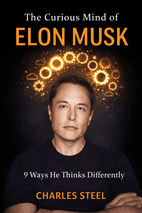
What is the book The Curious Mind of Elon Musk about?
Charles Steel's The Curious Mind of Elon Musk dissects nine specific cognitive frameworks behind his success, from first-principles reasoning to critical path analysis. It offers entrepreneurs and innovators a practical toolkit of learnable mental models for ambitious problem-solving.
Feature
Insta.Page
Blinkist
Shortform
Summary Depth
Full Chapter-by-Chapter
15-min overview
Detailed analysis
Audio Narration
✓ (AI narration)
✓
✓
Visual Mindmaps
✓
✕
✕
AI Q&A
✓ Voice AI
✕
✕
Quizzes
✓
✕
✕
PDF Downloads
✓
✕
✓
Price
$59.99/yr
$146/yr (PRO)
$199/yr
*Competitor data last verified February 2026.
About the Author
Charles Steel
Charles Steel is a contemporary British author and historian specializing in military history, particularly the Napoleonic Wars. He is best known for his meticulously researched biography, *Wellington: The Iron Duke*, and his analysis of battlefield tactics in *The Art of Command*. His work draws upon extensive archival research to offer fresh perspectives on 19th-century European conflict.
1 Page Summary
In "The Curious Mind of Elon Musk: 9 Ways He Thinks Differently," author Charles Steel dissects the unique cognitive frameworks and mental models that have propelled Elon Musk to revolutionize multiple industries. The central thesis is that Musk's extraordinary success is not merely a product of intelligence or work ethic, but of a distinct set of thinking patterns and principles that can be understood and, to some degree, emulated. Steel moves beyond biography to systematically analyze these patterns, which include first-principles reasoning, a relentless focus on critical path analysis, and a bias for ambitious, long-term goals over incremental progress.
The book's distinctive approach lies in its structured breakdown of nine specific "ways of thinking," presenting them as accessible concepts rather than abstract traits. Each chapter explores a different mental model, such as reasoning from first principles, applying physics-based thinking to business problems, and maintaining a "feedback loop" of rapid iteration. Steel supports these concepts with well-known examples from Musk's ventures with SpaceX, Tesla, and Neuralink, illustrating how each thinking style translates into concrete strategies for solving complex problems and overcoming seemingly impossible obstacles.
Intended for entrepreneurs, innovators, and anyone interested in productivity and strategic thinking, this book offers readers a practical toolkit. Rather than presenting Musk as an unreachable genius, Steel demystifies his approach, arguing that these cognitive strategies are learnable. Readers will gain a clearer understanding of the foundational philosophies behind Musk's companies and a set of mental frameworks to apply to their own ambitious projects, encouraging them to challenge assumptions and think more radically about problem-solving.
More ways to explore The Curious Mind of Elon Musk
The introduction opens with a vivid snapshot of Elon Musk unveiling his latest venture, xAI, in July 2023. Surrounded by a team of brilliant young engineers, Musk isn't just launching another company; he's inviting the world into his personal quest to decipher the universe's greatest mysteries. This chapter frames Musk not merely as a billionaire entrepreneur but as a philosopher-engineer driven by an insatiable curiosity that borders on religious fervor. It previews how the book will unravel the nine core beliefs that form the bedrock of his identity, explaining his unconventional path from founding SpaceX and Tesla to wading into political and cultural battles.
The xAI Launch and Musk's Cosmic Mission
The announcement of xAI was anything but a standard corporate event. Musk hosted eleven "quirky, intense, and formidably bright" recruits, each echoing his passions for math, physics, and logic. They spoke of building a general-purpose problem-solving AI dedicated to truth and discovery, explicitly avoiding the social and political distractions that preoccupy other firms. Musk nudged his reluctant team to "brag a little," using the moment as a recruiting tool for those who share his mindset. More revealingly, the launch served as a window into Musk's own existential drivers. He recounted his early love for physics and computer science, described civilization as fragile, and mused that AI might one day illuminate enigmas like dark matter or alien life. His tribute to author Douglas Adams—whose joke about "42" as the answer to life inspired the broadcast's date—highlighted Musk's conviction that formulating the right questions is harder and more important than finding answers.
A Portrait of Uncommon Curiosity
Musk's character is dissected through the lens of curiosity in its fullest sense. He is curious as in strange or unusual, evident in his children's names, his mercurial Twitter persona, and his rejection of business norms with titles like "Technoking." He is curious as in deeply inquisitive, treating his drive to understand the universe as a sacred calling that motivates his grand missions in energy, transport, and space. And he is curious in an old-fashioned, careful way, immersing himself in minute engineering details, believing that precision stems from "caring." This trifecta makes him an anomaly: critics label him a megalomaniac or sociopath, while admirers like Bill Gates and Nvidia's Jensen Huang praise his unparalleled impact on innovation. Physicist Casey Handmer notes Musk's mind operates on a different plane, preoccupied with problems "he is the first person in history to ever encounter."
The Blueprint of Belief
The chapter outlines the book's framework for decoding Musk: nine interconnected beliefs that explain his actions and ethos. These are grouped into three parts. Part I, "The Convert," explores the philosophical foundations—seeking meaning through better questions, embracing error to become "less wrong," and loving humanity by expanding consciousness. Part II, "The Missionary," examines how he translates belief into action through creation, using corporations as vehicles for missions, and viewing space colonization as a way to make the universe more human. Part III, "The Crusader," delves into his offensive stance in society, championing truth over tribe, protecting free speech, and advocating for "curious" AI as a safeguard. The narrative emphasizes that these beliefs are not random but build sequentially, rooted in Musk's words from thousands of tweets and interviews. His journey is portrayed as a coherent whole, from his childhood trauma and autistic traits to his current role as a cultural lightning rod.
Key Takeaways
Philosophical Engine: Musk's endeavors are fueled by a personal philosophy centered on cosmic curiosity—using questions to seek truth and meaning in an otherwise silent universe.
Mission Over Money: His companies, from SpaceX to xAI, are not primarily profit-driven but are extensions of a mission to preserve and expand human consciousness.
Consistent Worldview: Despite apparent contradictions, Musk's actions—from engineering feats to political interventions—are tied together by a relentless, internally logical belief system.
Human Enigma: Understanding Musk requires setting aside conventional business or psychological labels and appreciating how his unique blend of existential angst, hyper-rationality, and creativity shapes his legacy.
Key concepts: Introduction
1. Introduction
Musk's Philosophical Foundation
Driven by cosmic curiosity to find meaning
Believes asking right questions is crucial
Views understanding universe as sacred calling
The xAI Launch as Mission Statement
Recruits team focused on truth and discovery
AI as tool for solving cosmic mysteries
Avoids social/political distractions of other firms
Three Dimensions of Curiosity
Curious as strange/unusual in personality
Curious as deeply inquisitive about universe
Curious as careful attention to engineering details
💡 Try clicking the AI chat button to ask questions about this book!
Chapter 2: 1. Embrace Uncertainty
Overview
The chapter traces a profound psychological journey from despair to purpose, beginning with Elon Musk's deeply unhappy childhood in apartheid South Africa. Brutal bullying, social isolation, and a difficult home life culminated in a severe adolescent existential crisis. This anguish drove him into voracious reading, desperately seeking life’s meaning, only to find deeper desperation until he discovered Douglas Adams's The Hitchhiker’s Guide to the Galaxy. Its absurdist humor provided a cosmic perspective that shattered the quest for definitive answers. He internalized its lesson that the point is not to find a final answer but to continuously refine the questions, seeing the joke of the answer "42" as a critique of humanity's arrogant search for certainty.
This philosophical framework became a lifeline, helping him reframe his intense suffering. He came to view his existential pain as a kind of programming bug—an evolutionary glitch where the mind's rational and emotional parts conflict. By embracing the philosophical absurd, he accepted the disconnect between the human need for meaning and a universe indifferent to it. This allowed him to separate his rational mind from his emotional turmoil, using humor as a critical tool to manage anxiety. The ultimate liberation was flipping the script entirely: the universe isn't a problem to be solved but an answer to be understood. This shifted his core question from an unanswerable "Why?" to an explorative "How?"—a commitment to questioning and understanding the mechanics of reality.
This shift aligns with Adams’s framework for civilization's phases, which moves from basic survival ("What?") to philosophical inquiry ("Why?") and finally to trivial comfort ("Where?"). Musk rejected the profound but paralyzing "Why?" and the decadent "Where?" to focus relentlessly on the practical "How?". He views humanity's prehistoric wiring as creating an evolutionary asymmetry, where our limbic systems—optimized for survival against tangible threats—now generate disproportionate negativity, vengeance, and wishful thinking. His unique path was using absurdist philosophy to reframe his personal uncertainty positively, transforming the childhood trauma that fuels his propensity for existential depression into a constructive, outward-directed drive.
Thus, his obsessive curiosity became a form of secular reverence, a marveling at the universe that channels the energy of past pain into ambitious discovery. The journey illustrates how early trauma can shape a lifelong quest, not by being erased, but by finding a constructive outlet that turns questioning and uncertainty into the very engine of progress.
The Search Begins in Despair
Elon Musk describes his childhood as deeply unhappy, marked by years of sadness. This turmoil culminated in an early adolescent existential crisis that propelled his intellectual development. He became a voracious reader, consuming everything from encyclopedias to religious texts and philosophy, seeking answers to life's meaning. These searches, however, only deepened his desperation. The turning point came when he discovered Douglas Adams's The Hitchhiker's Guide to the Galaxy.
The book’s absurdist humor and cosmic perspective resonated powerfully with the isolated boy in Johannesburg. Musk interprets it not merely as comedy but as profound philosophy: the point is not to find a definitive answer to life's meaning, but to continuously learn and refine the questions we ask. Adams satirizes humanity's self-importance, showing Earth as an insignificant experiment and humans as far from the universe's most intelligent beings. The infamous answer "42" is a joke about the folly of seeking certainty; the real challenge is understanding the question.
A Childhood Forged in Conflict
Musk's desperate search for meaning was rooted in a brutal reality. He experienced severe, prolonged bullying at his school in apartheid-era South Africa, describing an environment akin to Lord of the Flies. The violence was extreme, including a near-fatal beating that required hospitalization. Compounding this, he felt profoundly isolated—a neurodivergent child who struggled with social cues, had few friends, and was more interested in coding and chess than sports.
His home life offered no refuge. After his parents' tumultuous divorce, he chose to live with his father, Errol, whom he later described as a "terrible human being" who could make life miserable. The abuse culminated when his father blamed Musk for provoking the near-fatal school attack. This combination of external violence and a lack of safe harbor led Musk to internalize his aggression, tipping him into a depression where he questioned the point of existence itself.
Reframing Reality: From Bug to Feature
Douglas Adams provided the framework Musk needed to reframe his suffering. Adams’s work illustrated that humans often accept answers without knowing the questions that prompted them. Musk latched onto this, realizing that progress requires escaping the "boxes" of pre-defined thinking.
More critically, Adams helped Musk model the human condition in a way that made sense of his pain. Musk came to see humans as a combination of a "monkey brain" (the emotional limbic system) and a "computer" (the rational cortex), often in conflict. The existential anguish he felt could be viewed as a kind of "programming bug"—an evolutionary glitch where the mind's protective mechanisms ironically ruin its own peace.
This perspective allowed Musk to perform a kind of self-analysis. By recognizing that his rational mind was grappling with questions his emotional brain magnified into suffering, he could begin to separate the two. He embraced the philosophical "absurd"—the disconnect between the mind's desire for meaning and the universe's indifference—as a lucid acceptance of reason's limits. Humor became a critical tool for managing this anxiety, a way to see the irrational in the rational and avoid being overwhelmed by life's vicissitudes.
The Liberation of the Right Question
Ultimately, Adams guided Musk to flip the script entirely. The universe is not a problem to be solved but an answer to be understood. The quest shifts from "What is the meaning of life?" to "How did we get here? Where are we going?" This embrace of uncertainty and commitment to questioning became foundational. It freed Musk from the need for a fixed, comforting answer and redirected his energy outward, toward exploration and understanding. The chapter sets the stage for how this mindset would define his approach to technology and civilization.
Adams's Phases of Civilization & The Human Condition
The text explores Douglas Adams's framework for galactic civilization, framing humanity's psychological evolution through three questions. The first, tied to survival, asks "What?"—what is edible, how to build shelter. Early humans lived in "simple chaos," intuitively aligned with natural patterns. The second phase, of inquiry, asks "Why?" This drive led to tool use and expanded experience but also to myth-making that placed humans at the center of the universe, complicating our chaos and blurring our grasp of reality.
Elon Musk sees our prehistoric wiring as a double-edged sword. Our limbic systems, optimized for survival against tangible threats like predators, now generate an "evolutionary asymmetry." We instinctively fixate on potential dangers and negative information—a trait that was once life-saving but is now often counterproductive, fostering unnecessary negativity and vengeance. Furthermore, our social brains make us prone to wishful thinking and conforming to comforting answers, subverting our rational capacities to serve emotional needs for certainty.
Adams's third, decadent phase asks "Where?"—concerned with trivial comforts in a life buffered from raw reality. Musk, too restless for this, finds no solace in the profound "Why?" or the trivial "Where?" His escape is to revert to a mode focused on the fundamental question: "How?"
Musk's Path: From Trauma to Curiosity
Choosing "How?" meant turning his attention outward, embracing uncertainty, and striving to see reality clearly, without the filter of human-centric myths. This aligns him with a long tradition of scientific inquiry, from Galileo to Einstein, who sought to read the "language" of the universe itself. Musk’s unique route to this perspective, however, was through absurdist humor, which helped him reframe his personal uncertainty positively.
This psychological shift was crucial. The chapter suggests Musk's relentless drive is deeply intertwined with childhood trauma. His existential questioning wasn't abstract; it was fueled by suffering during his formative years. Friends and biographers note this manifests as a need to soothe an "existential depression," a propensity for his childhood PTSD to "hijack" his limbic system under stress, and the imposition of exacting standards on himself and others. His journey is not about erasing this past, but about finding a constructive outlet for his frustration. Douglas Adams's influence was decisive, providing a framework that made Musk feel less alone and transforming his uncertainty into a source of obsessive curiosity.
This curiosity, for Musk, approaches a religious fervor—a marveling at the universe that replaces the search for a supernatural "Why?" with a relentless pursuit of "How?"
Key Takeaways
Reframe Fundamental Questions: Moving from unanswerable philosophical "Why?" questions to practical, explorative "How?" questions can shift one's focus from inward suffering to outward engagement with reality.
Acknowledge Cognitive Biases: Human brains are wired for survival in outdated contexts, leading to an asymmetry where negativity, threat-detection, and wishful thinking often override rationality. Recognizing these instincts is the first step in mitigating them.
Use Curiosity as an Antidote: An obsessive curiosity about how the world actually works can serve as a constructive pathway through personal uncertainty and existential dread, turning pain into a driver for discovery.
Accept the Influence of the Past: Early trauma can shape a lifelong quest for meaning and mastery. While the scars remain, they can be channeled into ambitious endeavors rather than being allowed to dictate a purely inward-focused struggle.
Key concepts: 1. Embrace Uncertainty
2. 1. Embrace Uncertainty
Childhood Trauma & Despair
Severe bullying and social isolation in South Africa
Difficult home life with an abusive father
Led to adolescent existential crisis and depression
The Search for Meaning
Voracious reading seeking life's answers
Found only deeper desperation initially
Discovery of Hitchhiker's Guide as turning point
Absurdist Philosophy as Framework
The answer '42' critiques search for certainty
Point is to refine questions, not find final answers
Provides cosmic perspective on human insignificance
Reframing Human Psychology
Views mind as 'monkey brain' vs 'computer' conflict
Existential pain as evolutionary programming bug
Separates rational mind from emotional turmoil
Shifting Core Question
From unanswerable 'Why?' to explorative 'How?'
Universe as answer to understand, not problem to solve
Rejects paralyzing philosophy for practical inquiry
Evolutionary Asymmetry
Prehistoric wiring mismatched with modern world
Limbic system generates disproportionate negativity
Leads to wishful thinking and vengeance cycles
Transforming Trauma into Drive
Uses absurdist philosophy to reframe uncertainty
Channels existential depression into outward curiosity
Obsessive questioning becomes engine of progress
⚡ You're 2 chapters in and clearly committed to learning
Why stop now? Finish this book today and explore our entire library. Try it free for 7 days.
Chapter 3: 2. Test & Learn
Overview
Elon Musk's journey begins with a childhood marked by isolation and an insatiable thirst for knowledge, a response to feeling out of place in the rigid society of South Africa. His voracious, self-directed reading across disciplines built the foundation for connecting disparate ideas, a skill that would become central to his later ventures. He realized early on that to truly navigate the world, passive curiosity had to evolve into a disciplined system of inquiry. He found this system in the scientific method, which he embraced not as a search for absolute truth, but as a practical process for becoming "less wrong" by constantly questioning and iterating.
This pragmatic need for a workable framework was solidified by his rejection of the pessimistic philosophies he encountered as a young man. He saw figures like Nietzsche and Schopenhauer as offering only despair, a retreat from reality into suffering. This pushed him to look outward, seeking meaning in action and solidarity with others to test ideas against the world itself. He found the concrete methodology he needed in his physics studies, which gave him the physics framework. This is a rigorous mental toolkit that involves reasoning from first principles, actively seeking negative feedback, and assigning probabilities to beliefs to combat overconfidence. It's a recursive cycle of questioning, concluding, and most importantly, trying to disprove one's own conclusions.
Musk didn't leave this framework as abstract theory; he operationalized it into a practical, ruthless algorithm for problem-solving, especially in engineering. His signature checklist demands questioning every requirement, aggressively deleting unnecessary parts before simplifying, and only then accelerating and automating. This process acts as a "cortical correction" against institutional complexity and inertia. He acknowledges that this intellectual rigor must be balanced with feeling and sensory experience—the heart and mind must work in tandem—but with the intellect acting as a check, not a servant, to desire.
Ultimately, for Musk, this entire approach transcends mere tool use and becomes a source of meaning. He believes that the scientific method itself is humanity's project to understand the universe, connecting us across generations. By assuming our current models are wrong, we remain curious and open, continually refining our understanding of reality from its origins to new frontiers like consciousness. The pursuit of a true, elegant explanation for the universe is, in his view, a profoundly satisfying and almost spiritual endeavor. The path forward is to prioritize this relentless pursuit of truth over the comfort of certainty, using the cyclical process of science as a guiding mantra for progress.
The Roots of Unconventional Thinking
Elon Musk’s formative years were defined by a profound sense of not belonging. Growing up in the rigid, macho culture of apartheid South Africa, he found its walls offered no comfort; instead, they felt like a prison. Betrayed by those he should have trusted and disconnected from religious tradition, he turned inward, feeding an insatiable curiosity through voracious reading. His self-education spanned physics, history, biology, and literature, building a broad, cross-disciplinary knowledge base that would later fuel his ability to connect ideas from disparate fields. He understood early that while he couldn’t change the time he was born into, he could change his place, leading him to view America as a land for explorers willing to trade the known for the unknown.
From Passive Curiosity to Active Inquiry
Musk realized that curiosity alone was a passive state. To actively navigate a world without comforting certainties, he needed a robust framework to guard against natural biases and wishful thinking. He found this in the scientific method. Inspired by Douglas Adams’s The Hitchhiker’s Guide to the Galaxy—which posits the universe itself as the answer to life’s ultimate question—Musk took a more literal and optimistic view. He reasoned that if understanding the universe is a “virtual impossibility,” then it is, by definition, a “finite improbability.” By continuously asking better questions as our knowledge improves, we can iterate toward that improbable understanding. For Musk, the scientific method became a secular rite of worship, a way to live with uncertainty by striving not to be right, but to be “less wrong.”
Rejecting the Philosophy of Despair
During a low point in his youth, Musk sought answers in the works of German philosophers Arthur Schopenhauer, Friedrich Nietzsche, and Martin Heidegger. He found them deeply demoralizing. Their focus on irrationalism, suffering, and the "will to power" represented a retreat from the world into negative thinking. For a literal-minded boy seeking practical inspiration, their dense, pessimistic rationalizations of misery were a dead end. Musk aligned more with Albert Camus’s idea of rebelling against absurdity through solidarity and action, and with Viktor Frankl’s insistence that we must bear our inability to rationally grasp life’s meaning. This reinforced his belief in looking outward toward reality and joining with others to test ideas, rather than wallowing in inward-focused suffering.
The Physics Framework as a Superpower
Musk’s academic background in physics provided the concrete methodology he sought. He internalized what he calls the “physics framework”—a set of mental tools for understanding counterintuitive truths. His detailed version of the scientific method is a rigorous, recursive process:
Ask a question.
Gather evidence.
Develop axioms and assign probabilities of truth.
Draw a conclusion.
Attempt to disprove the conclusion.
If it withstands invalidation, you’re probably—but not certainly—right.
This framework moves beyond "common sense," which only applies to the visible world, and into the "macro-cosmos" of abstract principles. It requires reasoning from first principles, seeking negative feedback, and embracing the idea that scientific wisdom is never settled. Musk operationalizes this by always assigning a probability to his beliefs, acknowledging his own potential wrongness.
Operationalizing the Method: The Checklist
Musk translated this theoretical framework into a practical, repeatable algorithm for engineering and manufacturing, akin to installing a new "operating system." His step-by-step checklist is designed to combat lazy thinking and institutional inertia:
Question every requirement.
Delete parts or steps aggressively and see what breaks.
Simplify and optimize only after deletion.
Accelerate the process.
Automate.
This "cortical correction" forces a counterintuitive purge of unnecessary complexity before any optimization begins, ensuring that every component is the answer to a fundamental question. This mindset would extend beyond engineering to influence his approach to staffing, regulation, and problem-solving across his ventures.
Balancing Heart and Mind
Musk acknowledges that critical thinking must be complemented by feeling and sensory experience—engaging the limbic system as well as the cortex. However, he firmly believes the intellect should not simply rationalize what the heart desires. His curiosity is a unified force, both emotional and intellectual, driving exploration, discovery, and problem-solving. This curiosity acts as a tether to the world, while the scientific method grounds it, creating a productive tension that aims to "make the universe more human."
Science as a Path to Meaning
Musk posits that the scientific method itself can provide meaning, as it offers a process for humanity to become "less wrong" over time. He builds this argument on several foundational beliefs:
The Domain of Big Questions: He agrees with Stephen Hawking that fundamental questions about reality, once the purview of philosophy, must now be addressed by science, as our mental models must be tested against the universe itself. History shows our models are perpetually refined, from Copernicus displacing Earth from the center of the cosmos to Einstein superseding Newton.
Understanding Through Origin: Like Richard Dawkins, Musk believes studying how complex things came to be—such as through evolution and genetics—reveals underlying simplicity and natural elegance, helping us understand our own place in the universe. The persistent "why" question of a "first cause" remains, but science continues to chase it, with even our concepts of time and boundaries being open to revision.
Comprehension of New Realities: Musk has faith in his (and humanity's) ability to grasp new models of reality, as scientific theories must be falsifiable. This includes the mystery of consciousness, which he suspects is an emergent property of physics that science—and perhaps the development of AI—can eventually examine.
Satisfaction in the Pursuit: He diverges from thinkers like Camus, believing that the pursuit of a true explanation for the universe would be deeply satisfying. For Musk, understanding the laws of physics approaches a spiritual endeavor; the measurable and finite universe, in all its elegance, is where meaning is sought.
The way forward, in his view, is to prioritize the pursuit of truth over the comfort of certainty, to assume we are wrong in order to remain open and curious. The cyclical process of the scientific method serves as a guiding mantra.
Key Takeaways
Critical thinking requires balancing intellectual rigor with emotional and sensory engagement, without letting either dominate.
The scientific method is framed not just as a tool for discovery but as a meaningful pursuit that connects us to past and future generations in the project of understanding reality.
Progress hinges on assuming our current models are wrong, which fosters curiosity and allows us to ask better questions.
By continually testing our beliefs against reality, we participate in the long-term human endeavor to become "less wrong" and find our place within the universe.
Key concepts: 2. Test & Learn
3. 2. Test & Learn
Scientific Method as Core Framework
Embraced as practical process for becoming 'less wrong'
Recursive cycle of questioning, concluding, disproving
Secular rite for living with uncertainty
Physics Framework Toolkit
Reasoning from first principles
Actively seeking negative feedback
Assigning probabilities to combat overconfidence
From Passive to Active Inquiry
Curiosity alone is insufficient for navigation
Needed robust framework against biases
Iterative questioning to approach improbable understanding
Rejection of Pessimistic Philosophy
Found German philosophers demoralizing and impractical
Preferred action and solidarity over suffering
Look outward to reality rather than inward
Engineering Problem-Solving Algorithm
Question every requirement aggressively
Delete parts before simplifying and automating
Acts as 'cortical correction' against complexity
Cross-Disciplinary Knowledge Foundation
Self-directed reading across multiple fields
Ability to connect disparate ideas
Built during childhood isolation and curiosity
Meaning Through Scientific Pursuit
Understanding universe as humanity's collective project
Pursuit of elegant explanation as spiritual endeavor
Prioritize truth over comfort of certainty
Chapter 4: 3. Increase Consciousness
Overview
This chapter presents a unified worldview where ancient myth, modern science fiction, and personal philosophy converge to define a single, urgent mission: expanding the scope and scale of human consciousness. It begins with the potent symbol of Prometheus, who gave humanity fire and knowledge, reframing technological progress not as mere invention but as a fundamental act of empowerment for civilization. This ambition is fueled by a mindset that views technology as applied magic, a perspective borrowed from science fiction that motivates turning the impossible into reality.
To answer the profound question of life’s meaning, this philosophy rejects passive distraction in favor of outward action and responsibility. It draws on thinkers like Viktor Frankl to argue that we respond to life by working for humanity's future, actively breaking cycles of decline. This theme is powerfully reinforced by the influence of Isaac Asimov’s Foundation, which provided a narrative template for using knowledge and reason to shorten dark ages and preserve civilization.
A central, driving concern is the cyclical rise and fall of societies and the ominous concept of the Great Filter—the potential catastrophic event that ends advanced civilizations. To survive and pass through this filter, the argument is that humanity must become expansionist, growing in population, knowledge, and reach to avoid becoming a failed, single-planet experiment. This grand civilizational imperative logically demands personal agency, a conviction that inaction in the face of existential risk is itself a cause of harm, compelling individuals to tackle problems others avoid.
The exploration then turns to the cognitive engines of such action. It examines how certain neurodivergent traits can foster intense focus, deep curiosity about reality, and a resilience to criticism, providing a unique advantage in innovation and challenging consensus. This connects directly to the problem-solving method of first principles and the physics approach, which involves stripping ideas down to fundamental truths to build new solutions from the ground up, a stark alternative to reasoning by analogy.
This kind of original thinking often requires a defiant spirit, driven by psychological reactance—a rebellious pushback against perceived constraints on freedom. Coupled with substantial self-belief and ego, it provides the fortitude to endure criticism and pursue audacious goals despite long odds. This is complemented by a unique approach to calculating risk with cheery fatalism, where the low probability of success is outweighed by the civilization-altering magnitude of the potential benefit.
Finally, this entire framework is applied through deliberate mission selection, targeting vanguard areas like sustainable energy and space exploration that maximize impact on human flourishing. The philosophy boils down to a clear purpose: using innovation, critical thinking, and relentless curiosity to increase consciousness, better understand the universe, and actively shape a future that reduces existential uncertainty.
The Promethean Ambition
Elon Musk’s use of the “Prometheus Unbound” caption for rocket launches is a deliberate philosophical statement. He connects to the myth not just as a story of stolen fire, but of a deity who shaped humans from clay and empowered them with the knowledge to build civilization—shelter, art, science, and agriculture. For Musk, this symbolizes the core of his third pillar: increasing the scope and scale of human consciousness. The goal is to “maximize the probability that the future will be good for civilization,” making the universe more human by expanding both the number of conscious beings and the depth of their collective knowledge.
Technology as Applied Magic
Musk’s worldview is heavily influenced by science fiction and the idea that advanced technology is indistinguishable from magic. He embraces Arthur C. Clarke’s laws and aligns with Douglas Adams’s rules of technology, particularly the notion that innovations encountered in young adulthood are seen as revolutionary. Musk deliberately chose to remain in this mindset, perpetually chasing the “magic” of turning science fiction into reality. This perspective frames the technologist as a modern-day wizard, pushing beyond perceived limits to expand what is possible.
A Questioning of Life, Answered by Action
The text contrasts common responses to life’s meaning—pursuing illusions, distractions, or intoxication—with the path Musk embodies. Drawing from Sigmund Freud and Viktor Frankl, it positions Musk among a minority who reframe anxiety into positive action. Frankl’s idea that life asks questions of us, and we answer through responsibility, mirrors Musk’s outlook. He turned the existential question outward, deciding that his responsibility was to act for humanity’s benefit, breaking what he calls the “generational transfer of trauma” by focusing on the species' future.
The Foundation of Future Consciousness
Isaac Asimov’s Foundation series had a profound impact on Musk’s thinking. The epic narrative of a galactic empire’s cyclical decline and the effort to shorten the ensuing dark age provided a template. Musk absorbed the lesson that proactive, knowledge-based action could prolong civilization and minimize future suffering. The series champions reason, scientific truth over dogma, and the perils of irrationalism—themes that directly inform Musk’s belief in using technology and critical thinking to safeguard humanity’s forward momentum.
Cycles, Filters, and the Stakes of Civilization
Musk views history through the lens of cyclical civilizational rise and fall, from Sumer to Rome. The “Great Filter” theory intensifies this concern: it suggests that the reason we see no aliens is because civilizations inevitably hit a catastrophic filter they cannot pass. Modern civilization, a mere blip in Earth’s history, is navigating its own treacherous filter. Musk argues we must become “expansionists”—growing population, knowledge, and technology—to safely pass through and avoid becoming a failed, single-planet society. He believes stagnation is a prelude to collapse, and that defending Western civilization’s ideals is critical for extending this upward cycle.
The Imperative of Personal Agency
Ultimately, the logic compels action. Musk is driven by Asimov’s “Zeroth Law” for robots: one must not, through inaction, allow humanity to come to harm. He operates on the belief that if he doesn’t tackle a critical problem, perhaps no one will, turning common pessimism on its head. This sense of agency is fueled by identifying overlooked or “improbable” areas where an individual can have outsized impact. Figures from Salvor Hardin in Foundation to Frodo in The Lord of the Rings exemplify the individual who steps up in a crisis, a role Musk seeks to embody by taking on the difficult challenges others avoid.
Neurodivergence and Technological Innovation
The chapter highlights how certain cognitive traits often associated with neurodivergence, such as reduced sensitivity to social cues, can foster exceptional focus and innovation. Figures like Bill Gates, Sergey Brin, and Elon Musk exemplify this, as their ability to pursue interests single-mindedly allows them to develop deep expertise and challenge conventional wisdom. Musk specifically notes that a neurodivergent perspective can drive greater curiosity about reality, a stronger adherence to truth, and a resilience against criticism, which are invaluable in technology fields. While not directly linked to risk-taking, this mindset promotes critical thinking and the capacity to view problems from unique angles—a skill Alan Kay famously valued as equivalent to an extra 80 IQ points.
First Principles and the Physics Approach
Moving beyond analogy-based thinking is crucial for breakthrough innovations. Musk advocates for the "physics approach," which involves stripping problems down to their fundamental truths and reasoning up from there, rather than copying others with slight variations. This method counters the human tendency to rely on consensus and probability, encouraging individuals to trust their own reasoning when they believe the majority is wrong. It’s framed as "thoughtful wishing" versus wishful thinking, empowering one to actively challenge established norms instead of passively accepting them.
Defiance and Psychological Reactance
A key theme is the role of defiance in innovation. When individuals perceive themselves as independent thinkers in the minority, they often become more rebellious, driven by a fear of losing intellectual freedom—a psychological state known as reactance. Musk’s personal history illustrates this: from standing up to bullies in his youth to consistently choosing confrontation over submission in his career. This mindset fuels a willingness to endure criticism and persist against odds, essential for those aiming to change the world.
The Role of Self-Belief and Ego
Substantial self-belief is necessary to undertake grand challenges and defy received wisdom. As Isaac Asimov observed, going against reason and authority requires considerable self-assurance. Musk embodies this, as seen in his hands-on leadership at SpaceX and Tesla, where he assumed critical roles without formal training. Charlie Munger’s remark about never underestimating someone who overestimates himself captures the nuance: ego drives initial ambition, but it’s tempered by the acknowledgment of likely failures. This balance allows for audacious goals despite low probabilities of success.
Calculating Risk with Cheery Fatalism
Musk’s approach to risk is characterized by a "cheery fatalism"—weighing the low probability of success against the monumental benefits if it occurs. He estimated only a 10% chance for Tesla and SpaceX to succeed, yet proceeded because the potential upside for humanity justified the attempt. This perspective embraces the uncertainty inherent in cutting-edge technology, where novelty means no one has experience, and thus, even a slight advantage in vision can lead to dominance.
Deliberate Mission Selection
Musk’s life work is deliberately focused on areas he identifies as vanguards of innovation: the internet, sustainable energy, and multi-planetary existence. These choices are driven by a desire to maximize impact on consciousness and human flourishing within his lifetime. His curiosity has led him to engineer solutions across all three domains, with later additions like artificial intelligence, all aimed at expanding the scope and scale of consciousness. This mission-oriented approach underscores a broader cultural goal: maintaining curiosity to sustain civilization’s health.
Boiling It Down: A Framework for Purpose
The chapter culminates in Musk’s personal philosophy, which centers on enhancing consciousness to better understand the universe. His purpose can be distilled into four points: first, increasing intelligent consciousness improves our ability to ask meaningful questions; second, focusing on reducing future uncertainty is preferable to seeking absolute certainty; third, innovation and critical thinking must be continually nurtured to prevent regression; and fourth, life’s brevity demands deliberate action, emphasizing that disproving the impossible starts with challenging widely held misconceptions.
Key Takeaways
Neurodivergent traits like reduced social sensitivity can foster deep focus and innovation, enabling individuals to challenge norms and excel in technology.
Adopting a first-principles or "physics approach" to problem-solving encourages independent thinking and breaks the cycle of analogical reasoning.
Psychological reactance—the defiance sparked by threatened freedom—can drive rebelliousness against consensus, essential for groundbreaking work.
Substantial self-belief and ego are necessary to undertake audacious missions, but they must be balanced with an acceptance of failure and risk.
Musk’s "cheery fatalism" involves pursuing high-impact, low-probability ventures because the potential benefits outweigh the risks.
Conscious mission selection in high-impact areas like sustainable energy and space exploration aims to expand human consciousness and ensure long-term flourishing.
Ultimately, increasing consciousness requires deliberate effort, curiosity, and a willingness to challenge popular beliefs to reduce uncertainty about the future.
Key concepts: 3. Increase Consciousness
4. 3. Increase Consciousness
The Promethean Ambition
Reframe progress as empowering civilization
Goal: Expand scope and scale of consciousness
Make the universe more human
Technology as Applied Magic
View advanced tech as indistinguishable from magic
Turn science fiction into reality
Technologist as a modern wizard
Meaning Through Action
Answer life's questions with responsibility
Reframe anxiety into positive outward action
Break cycles of generational trauma
The Foundation Narrative
Use knowledge to shorten dark ages
Champion reason and scientific truth
Proactive action safeguards civilization
Civilizational Imperative
Address cyclical rise and fall of societies
Confront the Great Filter existential risk
Become expansionist to survive
Cognitive Engines for Innovation
Leverage neurodivergent traits for focus
Employ first principles thinking
Use psychological reactance as defiance fuel
Calculated Audacity
Combine self-belief with cheery fatalism
Weigh low odds against civilization-scale benefit
Apply deliberate mission selection for impact
📚 Explore Our Book Summary Library
Discover more insightful book summaries from our collection