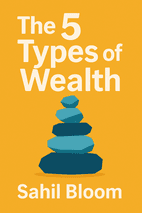
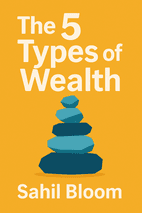
Sahil Bloom's The 5 Types of Wealth explores a holistic framework for prosperity across financial, physical, mental, emotional, and social dimensions, offering actionable strategies for readers seeking a more balanced and meaningful life beyond mere financial success.
Feature
Insta.Page
Blinkist
Shortform
Summary Depth
Full Chapter-by-Chapter
15-min overview
Section-by-section guides
Audio Narration
✓
✓
✓
Visual Mindmaps
✓
✕
✕
AI Q&A
✓
✕
✕
Quizzes
✓
✕
✕
PDF Downloads
✓
✕
✓
Price
$89.99/yr
$146/yr (PRO)
$199/yr
*Competitor data last verified July 2026.
1 Page Summary
The 5 Types of Wealth by Sahil Bloom explores a holistic approach to wealth beyond financial success, emphasizing five interconnected dimensions: financial, physical, mental, emotional, and social. Bloom argues that true prosperity requires balance across all areas, drawing on historical examples and modern research to illustrate how neglecting any one type can undermine overall well-being. The book challenges conventional notions of wealth by prioritizing long-term fulfillment over short-term gains.
Bloom situates his framework within a broader historical context, referencing thinkers like Aristotle and modern psychologists to show how these principles have evolved. He highlights how industrialization and digitalization have skewed societal focus toward financial wealth alone, often at the expense of other critical areas. The book offers actionable strategies—such as mindfulness practices, community building, and health optimization—to cultivate each type of wealth deliberately.
The lasting impact of The 5 Types of Wealth lies in its reframing of success as a multidimensional pursuit. By blending personal anecdotes with evidence-based insights, Bloom provides a roadmap for readers to achieve a more balanced, meaningful life. The book resonates in an era of burnout and isolation, offering a timely reminder that wealth is not just about money but about thriving in all aspects of human experience.
Chapter 1: One Thousand Years of Wisdom
Overview
The chapter opens with the author’s annual birthday ritual of self-reflection, which in 2022 centered on a profound question: What advice would you give to your younger self? This inquiry was sparked by the birth of his son and the shifting perspective it brought to time, aging, and legacy. To answer it, he sought wisdom from twelve individuals in their eighties and nineties, compiling insights from over 1,000 collective years of lived experience. Their reflections—ranging from love and loss to friendship and regret—revealed universal truths about what truly matters in life. Yet, amid their varied advice, one topic was conspicuously absent: money.
The Wisdom of Elders
The author’s conversations with older adults yielded poignant, practical, and often poetic advice. A ninety-four-year-old grandmother emphasized embracing sadness as a companion to love, while a ninety-eight-year-old Hollywood writer advised moderation: “Never raise your voice, except at a ball game.” Others stressed the importance of nurturing relationships (“Tell your partner you love them every night”) and prioritizing long-term well-being (“Treat your body like a house you have to live in for another seventy years”). The recurring themes—love, connection, and intentional living—stood in stark contrast to the absence of financial concerns.
The Money Paradox
Despite money’s cultural prominence, none of the elders mentioned it. The author explores this omission through research and anecdotes. Studies show that while money reduces stress at lower income levels, its impact on happiness plateaus once basic needs are met. Even millionaires, when asked, claimed they’d need two to five times more to achieve “perfect happiness”—a cycle of endless comparison. A friend’s story about renting a yacht, only to fixate on a larger one nearby, illustrated this trap: “There’s always going to be a bigger boat.” The chapter argues that wealth is a tool, not a destination, and that clinging to it as a scorecard distracts from life’s true riches.
Key Takeaways
Love and relationships form the bedrock of lasting fulfillment, as emphasized by elders with decades of lived experience.
Money’s role in happiness diminishes sharply after meeting basic needs; chasing wealth often leads to a treadmill of dissatisfaction.
Comparison corrodes contentment: Even extreme wealth can’t shield against the human tendency to measure oneself against others.
Intentionality matters: Prioritize health, repair small issues (emotional or physical), and express gratitude—before time forces your hand.
Key concepts: Chapter 1: One Thousand Years of Wisdom
1. Chapter 1: One Thousand Years of Wisdom
Birthday Reflection and the Search for Wisdom
Author's annual self-reflection ritual led to a pivotal question: advice for his younger self
Perspective shift from fatherhood inspired seeking wisdom from elders
Compiled insights from 12 individuals with over 1,000 collective years of experience
Notable absence of money-related advice despite diverse life themes
Core Lessons from the Elders
Embrace sadness as part of love's depth (94-year-old grandmother's insight)
Moderation in emotions: "Never raise your voice, except at a ball game" (98-year-old writer)
Prioritize relationships: daily affirmations of love to partners
Long-term health mindset: "Treat your body like a house you'll inhabit for decades"
The Silent Truth About Money
Cultural obsession with wealth contrasted by elders' unanimous silence on the topic
Research shows happiness plateaus after basic needs are met
Wealth comparison trap: millionaires perpetually wanting 2-5x more
"There's always a bigger boat" anecdote illustrates endless dissatisfaction
Fundamental Life Truths Revealed
Relationships and love are universal foundations of fulfillment
Money's diminishing returns on happiness beyond survival needs
Comparison as a thief of contentment, regardless of wealth level
Proactive intentionality with health and gratitude prevents future regrets
💡 Try clicking the AI chat button to ask questions about this book!
Chapter 2: The Five Types of Wealth
Overview
The chapter opens with a cautionary tale of King Pyrrhus, whose costly victories against the Romans left his empire weakened—a metaphor for modern lives obsessed with financial success at the expense of holistic well-being. It challenges the reader to redefine “wealth” beyond money, introducing a framework of five interconnected pillars designed to prevent life’s “Pyrrhic victories.” By shifting focus from narrow financial metrics to a broader scoreboard, the chapter argues that true prosperity emerges from balancing multiple dimensions of life.
The Perils of Single-Minded Focus
King Pyrrhus’s story illustrates the danger of fixating on short-term wins (like battles) while ignoring long-term costs (like losing the war). Similarly, prioritizing money above all else—missing family milestones, sacrificing health, or neglecting relationships—leads to hollow victories. The chapter warns that financial gains alone cannot compensate for eroded time, strained connections, or deteriorating health.
A New Framework for Thriving
The solution lies in the Five Types of Wealth:
Time Wealth: Control over how you spend your hours, prioritizing meaningful activities over perpetual busyness.
Social Wealth: Deep relationships and community ties that provide joy and support.
Mental Wealth: Clarity, purpose, and growth through lifelong learning and introspection.
Physical Wealth: Health habits that sustain vitality and combat natural decline.
Financial Wealth: Net worth tempered by managing expectations of “enough.”
This framework outperforms a money-only mindset by:
Measuring holistically to align daily actions with long-term fulfillment.
Guiding decisions to weigh impacts across all five areas.
Designing resilience by adapting priorities through life’s changing seasons.
Navigating Life’s Seasons
Life unfolds in phases—career-building, family-raising, purpose-seeking—each with unique demands. The five wealth types act as a compass, helping readers adapt without losing sight of their broader vision. For example, a career-focused season might prioritize financial and mental wealth, while a family season emphasizes social and time wealth. Balance is dynamic, not static, and requires intentional trade-offs.
The Light of Awareness
The chapter closes with a stark reminder: Ignoring non-financial wealth leads to regret, often realized too late. Stories of missed connections, unfulfilled dreams, and physical decline serve as “wake-up calls” to act now. By embracing the five wealth types, readers can avoid living “in the dark” and instead design a life where fulfillment is woven into daily choices.
Key Takeaways
Avoid Pyrrhic victories: Winning financially while losing relationships, health, or joy is a net loss.
Expand your scoreboard: Track all five wealth types—time, social, mental, physical, and financial—to gauge true prosperity.
Adapt with seasons: Priorities shift over time; balance means adjusting focus, not achieving perfection.
Define “enough”: Financial wealth requires curbing insatiable expectations as much as growing assets.
Act before regret strikes: Use life’s inevitable “lights” of clarity to course-correct early, not mourn lost opportunities later.
Key concepts: Chapter 2: The Five Types of Wealth
2. Chapter 2: The Five Types of Wealth
The Danger of Pyrrhic Victories
Short-term wins (e.g., financial success) can lead to long-term losses (e.g., health, relationships).
Money alone cannot compensate for eroded time, strained connections, or poor health.
King Pyrrhus's story serves as a metaphor for modern imbalances in wealth pursuit.
The Five Types of Wealth Framework
Time Wealth: Control over how hours are spent, prioritizing meaningful activities.
Social Wealth: Deep relationships and community support.
Mental Wealth: Clarity, purpose, and continuous growth.
Physical Wealth: Habits sustaining vitality and combating decline.
Financial Wealth: Net worth balanced with defining 'enough.'
Benefits of the Five-Wealth Approach
Measures holistic well-being, not just financial metrics.
Guides decisions by weighing impacts across all five areas.
Builds resilience by adapting priorities through life's seasons.
Adapting Wealth Priorities Through Life's Seasons
Balance is dynamic—career phases may prioritize financial/mental wealth, family phases social/time wealth.
Intentional trade-offs are necessary; perfection is unrealistic.
The framework acts as a compass for shifting priorities.
Stories of decline serve as wake-up calls to act now.
True fulfillment comes from daily choices aligned with all five wealth types.
Key Takeaways
Avoid winning financially while losing elsewhere (Pyrrhic victories).
Track all five wealth types for true prosperity.
Adapt priorities seasonally—balance is not static.
Define financial 'enough' to curb insatiable expectations.
Course-correct early to prevent future regret.
Chapter 3: The Wealth Score
Overview
This section introduces the Wealth Score, a personalized metric designed to measure holistic well-being across five core dimensions: Time, Social, Mental, Physical, and Financial Wealth. Unlike traditional financial assessments, this score acts as a dynamic "life dashboard," helping readers identify strengths, imbalances, and growth opportunities in their pursuit of a fulfilling, multi-dimensional life. The chapter emphasizes the importance of establishing a baseline score through a structured quiz, which serves as a starting point for intentional progress.
The Five Dimensions of Wealth
Each dimension of the Wealth Score is assessed through five statements, scored from 0 (strongly disagree) to 4 (strongly agree). Here’s what each category evaluates:
Time Wealth: Prioritization, focus, and control over how time is spent.
Social Wealth: Quality of relationships, community connection, and freedom from materialism.
Mental Wealth: Curiosity, purpose, growth mindset, and mental resilience.
Physical Wealth: Health habits, energy levels, and long-term vitality.
Financial Wealth: Financial clarity, discipline, and using money as a tool for broader wealth.
Taking the Quiz
The quiz requires honest self-reflection. For example:
Time Wealth asks whether you’re consistently focused on top priorities or feel scattered.
Social Wealth probes if you’re cultivating deep bonds and a diverse network.
Physical Wealth assesses sleep, diet, and structured movement.
Scores for each dimension max out at 20 (total 100), but perfection isn’t the goal—awareness is. Readers are encouraged to revisit the quiz periodically to track growth.
Visualizing Your Results
After calculating scores, the chapter guides readers to plot their results on a radar chart (shown as interconnected axes labeled for each wealth type). This visual snapshot highlights imbalances—like high Financial Wealth but low Social Wealth—and turns abstract goals into actionable targets. The online tool (thetypesofwealth.com/quiz) allows dynamic tracking and sharing.
Key Takeaways
Your Wealth Score is a compass, not a judgment. It reveals where to direct energy for a balanced life.
Imbalances are normal. Few people score evenly across all dimensions—this is a starting line, not a finish line.
Progress is dynamic. Reassessing your score annually (or during major life changes) ensures alignment with evolving priorities.
Money is just one piece. True wealth integrates time, relationships, health, and purpose alongside finances.
Key concepts: Chapter 3: The Wealth Score
3. Chapter 3: The Wealth Score
Introduction to the Wealth Score
The Wealth Score measures holistic well-being across five dimensions: Time, Social, Mental, Physical, and Financial Wealth.
Acts as a dynamic 'life dashboard' to identify strengths, imbalances, and growth opportunities.
Emphasizes establishing a baseline score through a structured quiz for intentional progress.
The Five Dimensions of Wealth
Time Wealth: Evaluates prioritization, focus, and control over time.
Social Wealth: Assesses quality of relationships and community connection.
Mental Wealth: Measures curiosity, purpose, growth mindset, and resilience.
Physical Wealth: Tracks health habits, energy levels, and long-term vitality.
Financial Wealth: Analyzes financial clarity, discipline, and money as a tool for broader wealth.
How to Take the Wealth Quiz
Requires honest self-reflection with statements scored from 0 (strongly disagree) to 4 (strongly agree).
Each dimension maxes out at 20 points (total 100), with awareness prioritized over perfection.
Encourages periodic revisiting of the quiz to track growth and changes.
Interpreting Your Results
Results can be visualized on a radar chart to highlight imbalances across dimensions.
Online tool (thetypesofwealth.com/quiz) allows dynamic tracking and sharing.
Visual snapshot turns abstract goals into actionable targets.
Key Insights from the Wealth Score
Acts as a compass, not a judgment, directing energy for a balanced life.
Imbalances are normal—few people score evenly across all dimensions.
Progress is dynamic; reassess annually or during major life changes.
True wealth integrates time, relationships, health, and purpose alongside finances.
Chapter 4: The Life Razor
Overview
The chapter opens with the harrowing tale of Apollo 13’s near-disastrous mission, where astronauts used the Earth as a fixed reference point to manually correct their trajectory during reentry. This life-or-death decision becomes a metaphor for the “Life Razor”—a guiding principle that cuts through complexity to prioritize what matters most. The chapter argues that in moments of chaos or overwhelming choice, a well-defined Life Razor helps individuals stay aligned with their core values and identity, simplifying decisions and fostering resilience.
The Apollo 13 Metaphor
When the Apollo 13 crew faced a critical manual correction without computer aid, Commander Jim Lovell’s decision to “keep the Earth in the window” became their literal lifesaver. This act mirrors the philosophical concept of a “razor”—a rule that strips away unnecessary variables to focus on what’s essential. The chapter likens this to navigating life’s challenges: without a clear focal point, we risk being overwhelmed by chaos, but with a razor, we gain clarity and direction.
Marc Randolph’s Tuesday Dinners
Netflix cofounder Marc Randolph’s “never miss a Tuesday dinner” rule exemplifies a Life Razor in action. Despite building a tech empire, Randolph prioritized weekly dinners with his wife as a nonnegotiable ritual. This commitment wasn’t just about the meal—it symbolized his dedication to family, creating ripple effects that reinforced his identity as a loyal partner and grounded leader. The ritual communicated priorities to his loved ones and colleagues, fostering trust and balance.
Crafting Your Life Razor
A Life Razor must be:
Controllable: Focus on actions within your power (e.g., “I will coach my son’s teams”).
Identity-Defining: Reflect who you aspire to be (e.g., “I am the type of person who…”).
The chapter encourages readers to draft their own Life Razor by envisioning their ideal legacy and identifying a single statement that embodies it. Examples include a consultant’s “I never let a friend cry alone” or a retiree’s “I do one good deed daily.”
Examples and Application
Real-world examples illustrate how Life Razors shape decisions:
A mid-forties professional turns down lucrative opportunities to honor his “wake up early and do hard things” mantra.
A stay-at-home mother prioritizes bedtime routines to embody the caregiver she wished she’d had.
The chapter emphasizes that Life Razors evolve with life’s seasons and should be revisited periodically.
Key Takeaways
Clarity in Chaos: A Life Razor acts as a fixed point to navigate uncertainty, much like Apollo 13’s Earth reference.
Identity Anchors: It reflects your core values, helping you make aligned decisions (e.g., Marc Randolph’s family-first identity).
Ripple Effects: Small, consistent actions reinforce priorities and inspire others.
Adaptability: Revisit and refine your Life Razor as life circumstances change.
Action Over Abstraction: The best razors are specific, actionable, and rooted in daily choices.
Key concepts: Chapter 4: The Life Razor
4. Chapter 4: The Life Razor
The Apollo 13 Metaphor
The Apollo 13 crew used the Earth as a fixed reference point to manually correct their trajectory during reentry.
This decision serves as a metaphor for the 'Life Razor'—a guiding principle that cuts through complexity.
A well-defined Life Razor helps individuals stay aligned with core values and identity in moments of chaos.
Marc Randolph’s Tuesday Dinners
Netflix cofounder Marc Randolph prioritized weekly dinners with his wife as a nonnegotiable ritual.
This Life Razor symbolized his dedication to family and reinforced his identity as a loyal partner.
The ritual communicated priorities to loved ones and colleagues, fostering trust and balance.
Crafting Your Life Razor
A Life Razor must be controllable, focusing on actions within your power.
It should create ripple effects, generating positive secondary impacts.
It must be identity-defining, reflecting who you aspire to be.
Examples include 'I never let a friend cry alone' or 'I do one good deed daily.'
Examples and Application
A professional turns down lucrative opportunities to honor his 'wake up early and do hard things' mantra.
A stay-at-home mother prioritizes bedtime routines to embody the caregiver she wished she’d had.
Life Razors evolve with life’s seasons and should be revisited periodically.
Key Takeaways
A Life Razor provides clarity in chaos, acting as a fixed point to navigate uncertainty.
It anchors identity, reflecting core values and helping make aligned decisions.
Small, consistent actions create ripple effects that reinforce priorities and inspire others.
Life Razors should be adaptable and revisited as life circumstances change.
The best Life Razors are specific, actionable, and rooted in daily choices.
You've reached the end of the free chapters
Next chapter: “Your True North” is locked
Keep reading The 5 Types of Wealth — and unlock all 600+ book summaries with audio, mindmaps and AI Q&A.
$0.00 due today · 7 days free, then $89.99/year ($7.49/mo) · Cancel anytime before day 7
Sahil Bloom is a prolific writer and thought leader known for his insightful exploration of curiosity, decision-making, and personal growth. He is the author of the widely acclaimed book "The Curiosity Chronicle," which distills complex ideas into actionable wisdom for a modern audience. His work has garnered a massive following, establishing him as a leading voice in the realms of business, psychology, and self-improvement. Bloom's writing is celebrated for its clarity, depth, and ability to connect with readers seeking to enhance their lives and careers. His published books are available for purchase on Amazon, where they continue to inspire and educate a global audience.
📚 Explore Our Book Summary Library
Discover more insightful book summaries from our collection