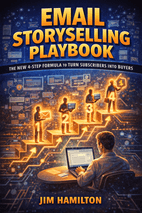
What is the book Email Storyselling Playbook about?
Jim Hamilton's Email Storyselling Playbook provides a four-step formula to transform subscribers into customers using narrative, with templates and psychological principles for entrepreneurs and marketers seeking authentic email engagement.
Feature
Insta.Page
Blinkist
Shortform
Summary Depth
Full Chapter-by-Chapter
15-min overview
Section-by-section guides
Audio Narration
✓
✓
✓
Visual Mindmaps
✓
✕
✕
AI Q&A
✓
✕
✕
Quizzes
✓
✕
✕
PDF Downloads
✓
✕
✓
Price
$89.99/yr
$146/yr (PRO)
$199/yr
*Competitor data last verified July 2026.
1 Page Summary
Jim Hamilton's Email Storyselling Playbook addresses a common challenge in digital marketing: how to create compelling email campaigns without being a born writer or storyteller. The book introduces a practical, four-step formula designed to systematically transform email subscribers into customers by leveraging the innate power of narrative. Hamilton argues that traditional feature-focused marketing is less effective than connecting through story, and he provides a structured framework to make this accessible to anyone.
The core methodology is the "Storyselling" sequence: Attract, Engage, Involve, and Convert. This process guides the subscriber from initial curiosity to a purchasing decision. First, an email must Attract attention with a relatable problem or desire. Next, it Engages by presenting a protagonist's struggle and a guiding solution. It then Involves the reader by making them the hero of their own story, demonstrating the transformation the product enables. Finally, it Converts with a clear, low-friction call to action. Hamilton supports this with templates, swipe files, and psychological principles, positioning it as a modern solution for the crowded inbox, where personal connection trumps generic sales pitches.
The lasting impact of the playbook is its democratization of sophisticated copywriting techniques. By breaking down storytelling into a repeatable business process, Hamilton empowers entrepreneurs, marketers, and small business owners to build deeper relationships and drive revenue through email. It shifts the focus from one-time transactions to guiding customers through a narrative journey, establishing a framework for consistent, authentic, and effective communication that builds trust and loyalty over time.
Introduction
Overview
The introduction opens by welcoming readers into a "brand new world" of email marketing, promising a fast-paced, tactical guide to transforming subscribers into buyers—even for those who don't consider themselves natural writers or storytellers. It positions the book as a direct alternative to traditional, information-heavy newsletters, introducing a method called "Email Storyselling" that is designed to be more profitable and sustainable. The author establishes a personal pact with the reader, asking them to visualize implementing each step to ensure psychological buy-in alongside the strategic lessons.
The Core Problem with Rented Audiences
The author makes a foundational argument: social media platforms are "rented land" where algorithms control reach and stability is an illusion. Building a business solely on these platforms makes distribution precarious. In contrast, an owned email list represents sovereignty—a direct, owned relationship with an audience. Examples from top creators like Chris Williamson, Tim Ferriss, and Ali Abdaal are cited to show that serious professionals view their newsletters as a "secret weapon" and a primary business asset, crucial for creating "know, like, and trust."
The Limitations of the Traditional Newsletter Model
The chapter then defines and critiques the "traditional newsletter": a weekly, long-form email focused on delivering free "how-to" value, typically monetized through sponsorships or "Super Signatures" (offer links in the P.S.). The model is broken down to reveal its inefficiency. Sponsors require huge audiences (10k+ subscribers), and offers placed as an afterthought generate low click-through rates. Crucially, giving away the "how-to" for free blurs the line between free content and paid solutions, training subscribers not to buy. The math is stark: needing 20,000 to 40,000 subscribers to earn $10k/month makes this an untenable path for most.
A Personal Journey to the Solution
To build credibility and rapport, the author shares a personal origin story. He recounts his own past struggles, working as an underpaid personal trainer and massage therapist while deep in debt. His turning point came when a shift to freelance copywriting led to a breakthrough: an email that used a simple story generated nearly $7,000 in sales. This experience proved that storytelling was a far more powerful sales tool than traditional "salesy" pitches. This pivotal moment led to a successful career contributing to over $40 million in client sales and achieving the personal freedom he once only dreamed of, a narrative underscored by personal photos from his travels.
Clarifying a Key Distinction
A critical clarification is made between having an "email list" and a "newsletter." An email list is often just a cold collection of leads who receive a promotional sequence and then silence. A newsletter, however, is defined as an agreement—a consistent broadcast of content that builds a relationship. The book’s promise is to transform any list into the latter: a responsive, cash-flowing asset.
The Seven Scientific Principles of Email Storyselling
The introduction concludes by laying out the core psychological and strategic principles that make the Email Storyselling system effective:
Show, Don’t Tell: Stories demonstrate leadership and values in action, creating True Fans rather than just an audience.
Entertainment + Education: In an age of AI, pure information is cheap. Blending engaging stories with valuable lessons creates emails people love to read.
The Voyeurism Effect: Allowing subscribers to "peer over the fence" into your life builds a powerful, personal connection.
Reveal the ‘What,’ Not the ‘How-To’: Healthy business boundaries are maintained by giving the "what" (the insight/lesson) for free, while reserving the precise "how-to" implementation for paid offers.
The Problem Is the Reason to Buy: Stories naturally illustrate problems, creating a direct, logical pathway to introducing your solution.
Casual Pitches Over Hard Sells: Story-driven pitches feel optional and low-pressure, reducing subscriber burnout and increasing long-term engagement.
Supports High Frequency: Because the emails are primarily entertaining and insightful, not purely promotional or instructional, you can mail daily without annoying your audience, which directly increases revenue potential.
Key Takeaways
An email newsletter is an owned asset critical for business sovereignty, unlike rented social media audiences.
The traditional "value-first" newsletter model is economically broken for most, requiring an impractically large audience to generate meaningful income.
The Email Storyselling system is built on a personal proof-of-concept and years of professional results.
The method works by using personal storytelling to entertain, build connection, demonstrate leadership, and naturally frame problems that your paid offers solve.
This approach allows for frequent (even daily) emails that subscribers enjoy, turning your list into a consistent and scalable revenue stream from day one.
Key concepts: Introduction
1. Introduction
The Core Problem with Rented Audiences
Social media platforms are 'rented land' with algorithm-controlled reach and instability.
An owned email list represents sovereignty and a direct relationship with an audience.
Top creators view their newsletters as a 'secret weapon' and primary business asset.
Email is crucial for building 'know, like, and trust' with an audience.
The Limitations of the Traditional Newsletter Model
Traditional newsletters are weekly, long-form emails focused on free 'how-to' value.
Monetization through sponsorships requires huge audiences (10k+ subscribers).
Offers placed as an afterthought (e.g., in a P.S.) generate low click-through rates.
Giving away the 'how-to' for free trains subscribers not to buy your solutions.
The math is untenable: needing 20,000-40,000 subscribers to earn $10k/month.
A Personal Journey to the Solution
Author's personal struggle: underpaid work and deep debt before discovering email marketing.
Breakthrough moment: an email using a simple story generated nearly $7,000 in sales.
Proved storytelling is more powerful than traditional 'salesy' pitches.
Result: contributed to over $40 million in client sales and achieved personal freedom.
Clarifying Email List vs. Newsletter
An email list is often a cold collection of leads receiving a promotional sequence.
A newsletter is an agreement—a consistent broadcast of content that builds a relationship.
The book's promise: transform any list into a responsive, cash-flowing asset.
The Seven Scientific Principles of Email Storyselling
Show, Don't Tell: Stories demonstrate leadership and create True Fans.
Entertainment + Education: Blend engaging stories with valuable lessons.
The Voyeurism Effect: Let subscribers 'peer over the fence' into your life.
Reveal the 'What,' Not the 'How-To': Maintain boundaries between free content and paid offers.
The Problem Is the Reason to Buy: Stories illustrate problems, creating a pathway to your solution.
Casual Pitches Over Hard Sells: Story-driven pitches feel optional and low-pressure.
Supports High Frequency: Enables daily emails without annoying the audience, increasing revenue.
💡 Try clicking the AI chat button to ask questions about this book!
CHAPTER 1: The 4-Step Formula
Overview
This chapter introduces a fundamental shift in marketing philosophy, championing storytelling over pure promotion. It presents a simple, four-step framework—the S.L.P.C. Method—designed to transform how you communicate with an audience, particularly through email. The method provides a structured yet flexible template for crafting engaging narratives that naturally lead to a desired action, moving away from the hard sell.
Step 1: Story (What Do You See?)
The foundation of every email is a personal story. To find one, you simply observe your world and ask, "What do I see?" This story can be drawn from content you've consumed, personal experiences, work projects, or client interactions. The key is relatability. Stories are categorized as either direct (closely tied to your newsletter's core topic) or indirect (a story from another area of life that can serve as an analogy). For instance, a fitness coach has a wealth of direct stories from the gym, but an indirect story about discipline learned from gardening could also be powerful.
Step 2: Lesson (What Does It Mean?)
After sharing the story, you extract its universal meaning. This step answers the question, "What does it mean?" Here, you move from observation to insight, synthesizing the anecdote into a concise lesson about human behavior, psychology, or how the world works. For example, watching someone at the gym skip leg day might teach a lesson about unbalanced effort, while a binge-watched TV series could illustrate principles of audience engagement. This lesson is the bridge between your personal story and your reader's broader life.
Step 3: Pivot (How Does It Also Apply to Your Audience/Offer?)
This is the crucial link that makes the email relevant to your business. You pivot from the general lesson to its specific application for your audience and your offer. The distinction between direct and indirect stories becomes clear here. A direct story (e.g., a marketing coach writing about growing an email list) leads to a lesson that applies straightforwardly to the reader's goals. An indirect story (e.g., that same coach writing about a TV show) uses the lesson as an analogy to explain a business principle, making the connection through clever comparison.
Step 4: Call to Action (What Should They Do Next?)
Finally, you guide the reader on what to do with this new insight. Because you've invested in the story, lesson, and pivot, the call to action (CTA) feels like a natural next step rather than a pushy sales pitch. It can be an invitation to book a call, consume more content, or make a purchase. The framework suggests that by this point, the "heavy lifting" of persuasion is done, allowing the CTA to be casual and confident.
Putting It All Together
The chapter provides a visual template for structuring an email using the formula:
Story: 100-250 words
Lesson: 25-50 words
Pivot: 50-100 words
CTA: 25-75 words
These word counts are guidelines, not rigid rules, with a typical total email length of 250-450 words. The emphasis is on clarity and brevity, ensuring the narrative drives the email forward efficiently.
Key Takeaways
Effective modern marketing is built on storytelling, not just presenting features and benefits.
The S.L.P.C. Method (Story, Lesson, Pivot, CTA) provides a repeatable formula for crafting compelling emails.
Stories can be direct (topic-related) or indirect (analogical), with the pivot step connecting them to your core offer.
The process of extracting a universal lesson from a personal story builds a bridge of shared understanding with your reader.
A narrative-driven structure makes the final call to action feel like a logical and helpful suggestion, not an interruption.
Key concepts: CHAPTER 1: The 4-Step Formula
2. CHAPTER 1: The 4-Step Formula
The S.L.P.C. Method Framework
A 4-step formula (Story, Lesson, Pivot, CTA) for crafting engaging emails
Shifts marketing philosophy from promotion to storytelling
Provides a structured yet flexible template for narrative-driven communication
Designed to naturally lead the audience to a desired action
Step 1: Story (What Do You See?)
Foundation is a personal, relatable story from observation
Sources include consumed content, personal experiences, work, or client interactions
Stories categorized as direct (topic-related) or indirect (analogical)
Begins by asking 'What do I see?' to find narrative material
Step 2: Lesson (What Does It Mean?)
Extracts universal meaning from the personal story
Moves from observation to insight about behavior, psychology, or world principles
Creates a bridge between the personal story and the reader's broader life
Answers the question 'What does it mean?' with a concise lesson
Step 3: Pivot (How Does It Apply to Audience/Offer?)
Crucial link making the email relevant to business and audience
Connects the general lesson to specific application for reader and offer
Direct stories lead to straightforward application of the lesson
Indirect stories use the lesson as an analogy to explain a business principle
Step 4: Call to Action (What Should They Do Next?)
Natural next step after story, lesson, and pivot establish context
Feels like helpful suggestion rather than pushy sales pitch due to narrative investment
Can invite to book calls, consume content, or make purchases
Persuasion 'heavy lifting' is done, allowing CTA to be casual and confident
Practical Implementation & Structure
Provides specific word count guidelines for each section (Story: 100-250, Lesson: 25-50, Pivot: 50-100, CTA: 25-75)
Total email length typically 250-450 words for clarity and brevity
Word counts are guidelines, not rigid rules
Emphasis on narrative driving the email forward efficiently
Core Principles & Benefits
Modern marketing built on storytelling over features/benefits presentation
Universal lesson extraction builds shared understanding with reader
Narrative structure makes CTA feel logical rather than interruptive
Repeatable formula for creating compelling, relationship-building communication
CHAPTER 2: Ideation
Overview
This chapter opens with a poignant reminder from James Clear that our ideas are shaped by what we consume, setting the stage for a practical guide on generating compelling content. At its heart, it’s about moving beyond blank-page anxiety by offering three repeatable techniques to uncover endless email ideas rooted in personal stories and core beliefs. You’ll learn how to transform everyday observations into persuasive narratives that not only engage your audience but also drive them to action.
The 2-Part Question
Imagine turning your daily routine into a treasure trove of email concepts. This method revolves around a simple yet powerful prompt: “What do you see and what does it mean?” By regularly observing moments—like someone skipping leg day at the gym or impulsively buying gum at checkout—you extract universal lessons. For instance, a calorie-counting success story might reveal that “what gets measured, gets managed.” The key is consistency; capture these ideas digitally or on paper, aiming for at least one per day. This habit ensures you’re never short of material, as life itself becomes your idea engine.
The Story Bank
Think of this as your personal library of anecdotes, ready to be borrowed whenever inspiration runs dry. By dedicating just 5-10 minutes each week—perhaps on a Friday—to review your inbox, calendar, or social media, you systematically collect stories and their associated lessons. The beauty lies in versatility: a single story, like a change in a newsletter platform’s payout model, can yield multiple lessons, such as the risks of relying on sponsorships. Using a provided template, you log dates, topics, and insights, building a reservoir that can fuel your writing for years. It’s a proactive way to ensure you always have a relevant tale to tell, no matter the offer you’re promoting.
The 10 Commandments
Here, we shift from gathering stories to defining your core messaging. The insight is profound: your audience doesn’t need a hundred new ideas; they need your fundamental beliefs repeated through fresh stories. Start by identifying your values—your “commandments”—and phrase them as strong, declarative statements. For example, “Social media is rented land” or “Writing is a keystone skill.” Once established, these commandments become your ideation compass. To generate an email, pick one commandment as the lesson, then scan your Story Bank for a story that illustrates it. If crafting commandments feels daunting, an AI prompt is available to help, making this a accessible way to align your content with your unique worldview.
Key Takeaways
Observe and Interpret: Regularly ask “What do you see and what does it mean?” to transform daily experiences into email ideas.
Build a Repository: Maintain a Story Bank by weekly logging stories and lessons, creating a reusable resource for multiple campaigns.
Define Core Messages: Establish your 10 Commandments—core beliefs repeated through stories—to ensure consistent and resonant messaging.
Combine Techniques: Use commandments as lessons and stories as proof, seamlessly linking ideation methods for efficient content creation.
Take Action: Implement these practices with provided templates and prompts to generate 3-5 email ideas immediately.
Key concepts: CHAPTER 2: Ideation
3. CHAPTER 2: Ideation
The 2-Part Question Method
Use the prompt 'What do you see and what does it mean?' to generate ideas
Practice consistency by capturing at least one idea per day
Turn life itself into an ongoing idea engine for content
The Story Bank System
Build a personal library of anecdotes by reviewing inbox, calendar, or social media weekly
Dedicate 5-10 minutes each week to systematically collect stories and associated lessons
Use a template to log dates, topics, and insights for future reference
Leverage single stories to yield multiple lessons for different contexts
The 10 Commandments Framework
Define core beliefs as strong, declarative statements (e.g., 'Social media is rented land')
Repeat fundamental beliefs through fresh stories rather than constantly generating new ideas
Use commandments as an ideation compass to guide content creation
Combine commandments with Story Bank stories to create aligned content
Practical Implementation
Combine techniques by using commandments as lessons and stories as proof
Utilize provided templates and AI prompts to overcome ideation challenges
Take immediate action to generate 3-5 email ideas using these methods
Transform blank-page anxiety into systematic content generation
CHAPTER 3: Outlining
Overview
This chapter dismantles the myth that more time spent on writing inherently produces better work, positioning the outline as the critical tool for achieving both speed and clarity. It introduces a simple, five-part framework designed to conquer the blank page by ensuring you know exactly what you want to say before you begin typing.
The Fallacy of Time Equals Quality
The chapter opens by challenging a common and seductive belief: that the quality of a piece of writing is directly proportional to the time invested in it. Using a quote from Rick Rubin, it argues that this idea is often a crutch for perfectionism and procrastination. Ironically, over-polishing can sand away the authentic, emotionally resonant edges that make writing compelling. The liberating counterpoint is established—sometimes the first draft is the best one, especially if it’s built on a solid foundation.
The Real Secret to Writing Fast
The ability to write quickly has little to do with typing speed and everything to do with mental preparation. Writer’s block stems not from an inability to type words, but from not knowing what those words should be. The secret is to achieve clarity of thought before you open a document. The chapter explains that once an idea is captured, your subconscious mind continues to work on it in the background, refining and connecting thoughts. This means you effectively start “writing” long before you ever sit down to type, making the actual drafting process remarkably fast.
The Email Storyselling Outline Framework
To operationalize this pre-writing clarity, a specific five-part outline template is provided. This structure is designed to organize the core components of a persuasive, story-driven email:
OFFER: Clearly state what you are selling, including key details like price or core promise.
STORY: Jot down a few rough bullet points depicting the narrative scene or experience. This is not the full story, just the raw material.
LESSON: Articulate the insight from the story as a short, punchy, declarative statement (similar to the "10 Commandments" from a prior chapter).
PIVOT: Connect the story’s lesson directly to the audience and your offer, often using analogy or metaphor.
CALL TO ACTION: Specify the single, clear action you want the reader to take next.
From Template to Filled Example
The framework is immediately brought to life with a completed example outline. This example shows rough, unpolished bullet points for each section, demonstrating that the goal is to capture ideas swiftly, not to craft perfect prose. The author provides practical next steps: saving the template, choosing an idea from the previous chapter’s brainstorming, and transforming it into a completed outline.
Key Takeaways
Quality is not a function of time. Endless tinkering can hinder authenticity and enable procrastination.
Speed comes from clarity, not typing. The key to writing fast is knowing exactly what you want to say before you start.
Your mind works subconsciously. Once an idea is captured in an outline, your brain continues to develop it, making the drafting process faster.
Use the S.L.P.C. framework. The Offer, Story, Lesson, Pivot, Call to Action structure provides a reliable blueprint for building effective emails.
Outline roughly, then step away. Create your outline with speed, then let it incubate for at least a night to allow for subconscious refinement before you write.
Key concepts: CHAPTER 3: Outlining
4. CHAPTER 3: Outlining
The Fallacy of Time Equals Quality
Quality is not directly proportional to time invested
Over-polishing can remove authentic, emotionally resonant edges
The first draft can be the best one if built on a solid foundation
The belief that more time equals better work enables perfectionism and procrastination
The Real Secret to Writing Fast
Speed comes from mental preparation, not typing speed
Writer's block stems from not knowing what to say, not inability to type
Achieve clarity of thought before opening a document
The subconscious mind refines ideas after capture, making drafting faster
The Email Storyselling Outline Framework
OFFER: Clearly state what you're selling with key details
STORY: Jot rough bullet points depicting narrative scene or experience
LESSON: Articulate insight as short, punchy declarative statement
PIVOT: Connect story's lesson to audience and offer using analogy
CALL TO ACTION: Specify single, clear action for reader
From Template to Filled Example
Framework demonstrated with completed example outline
Goal is to capture ideas swiftly, not craft perfect prose
Practical next steps: save template, choose idea, create outline
Shows rough, unpolished bullet points for each section
Key Takeaways
Quality is not a function of time - endless tinkering hinders authenticity
Speed comes from clarity, not typing - know what to say before starting
Mind works subconsciously - captured ideas continue developing
Use the S.L.P.C. framework for effective email structure
Outline roughly, then step away for subconscious refinement
You've reached the end of the free chapters
Next chapter: “Writing” is locked
Keep reading Email Storyselling Playbook — and unlock all 600+ book summaries with audio, mindmaps and AI Q&A.
$0.00 due today · 7 days free, then $89.99/year ($7.49/mo) · Cancel anytime before day 7
Jim Hamilton is a historian and author specializing in American history, particularly the Civil War era and the presidency. He is best known for his biographies, including *The Mantle of Command: FDR at War, 1941–1942* and *American Caesars: Lives of the Presidents from Franklin D. Roosevelt to George W. Bush*. His work is noted for its rigorous research and focus on leadership and decision-making.
📚 Explore Our Book Summary Library
Discover more insightful book summaries from our collection