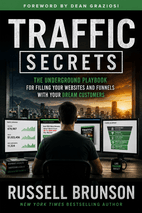
Russell Brunson's Traffic Secrets provides a timeless framework for entrepreneurs to attract their dream customers by identifying where they congregate, using a Hook-Story-Offer pattern, and building owned traffic through email lists. Written for business owners like chiropractors and software founders who have great products but lack a system for getting customers in the door.
Feature
Insta.Page
Blinkist
Shortform
Summary Depth
Full Chapter-by-Chapter
15-min overview
Section-by-section guides
Audio Narration
✓
✓
✓
Visual Mindmaps
✓
✕
✕
AI Q&A
✓
✕
✕
Quizzes
✓
✕
✕
PDF Downloads
✓
✕
✓
Price
$89.99/yr
$146/yr (PRO)
$199/yr
*Competitor data last verified July 2026.
1 Page Summary
This isn’t your typical traffic book. It’s a survival manual for a digital world where platforms like Facebook and Google operate like a villain from a superhero movie—luring entrepreneurs in with cheap, easy access, then dramatically “snapping” away their traffic with algorithm changes that wipe out their businesses overnight. The central lesson is that most entrepreneurs build their entire marketing strategy on "rented land" and mistakenly believe that if they build something great, customers will magically appear. The book’s solution is to identify and obsess over a specific "Dream Customer" (detailed to the point of having a name, family, and lifestyle), find where those customers already congregate (the "Dream 100" of influencers and platforms), and use a repeatable framework—Hook, Story, Offer—to pull them into your world.
The author’s approach is distinctive because it doesn’t just share platform-specific hacks; it teaches you a timeless framework for how to master any platform that comes next. He breaks traffic generation into two core concepts: "working your way in" (earning attention organically through relationships, content, and infiltrating existing audiences) and "buying your way in" (using paid ads that are scaled using a "break-even funnel" strategy). A critical insight is that the real fortune isn't in the first sale—it's in the follow-up. By building an email list that you actually own, you create a platform-proof asset that can multiply your profit 16x over, turning ad spend from a cost into a license to scale.
This book is written for entrepreneurs—from chiropractors and fitness coaches to software founders and small business owners—who have a great product but are failing because they were never taught how to get people in the door. Readers will gain a complete playbook for building an "attractive character" that hooks their dream customers, systematically infiltrating the tribes where those customers already hang out, and setting up Follow-Up Funnels that convert a small initial profit into massive, predictable, owned revenue. The ultimate takeaway is not a single tactic, but a living, repeatable strategy for staying in business long after the next "snap" comes.
Publisher’s Note
Overview
This isn't your typical publisher's note—it's a straight-talking promise of stability in an unstable digital world. The author cuts through the noise by introducing three core strategies: buying your way into an audience, building your own publishing platform, and constructing your own distribution lists. What unites them? They all weather platform storms. Whether Google changes its algorithm, Facebook tweaks its interface, or traffic patterns shift, these strategies keep working. The author draws from personal experience—remember Friendster? Myspace?—showing how the same foundational approach carried them through each wave. The book itself is structured as a three-part roadmap: first, identifying and reaching your dream customers; second, mastering a simple traffic-driving pattern across any ad network (Facebook, Instagram, Google, YouTube); and third, growth hacking techniques that work even without paid advertising. After 15 years of refining these concepts, the author's excitement to hand them over feels genuine and earned.
Key Takeaways
Platform-proof your business by owning your audience through your own platform and distribution lists, not just rented space on social networks.
The author’s personal journey proves that moving between platforms (Friendster → Myspace → Facebook) is possible when your strategy is built on stable, transferable principles.
Three-phase approach: Identify your dream customers, drive traffic using a repeatable ad pattern, then apply growth hacks that work without advertising networks.
Long-term stability comes from mastering fundamentals that survive algorithm changes and shifting user habits.
Key concepts: Publisher’s Note
1. Publisher’s Note
Platform-Proof Strategies
Buy your way into an audience
Build your own publishing platform
Construct your own distribution lists
These strategies survive algorithm changes
Author's Proven Experience
Survived Friendster, Myspace, and Facebook shifts
Same foundational approach worked across platforms
15 years of refining these concepts
Three-Phase Roadmap
Identify and reach dream customers
Master a repeatable ad pattern across networks
Apply growth hacks without paid advertising
💡 Try clicking the AI chat button to ask questions about this book!
Foreword by Dean Graziosi
Overview
Dean Graziosi opens with a raw, late-night phone call from his friend Chad—Dr. Woolner, a chiropractor who’d done everything right by the book. He spent eight years in higher education, wrote a business plan, took out a loan, and built a beautiful clinic. Yet his practice was failing because not a single professor ever taught him how to actually get patients in the door. That moment crystallizes the central tragedy this book aims to fix: entrepreneurs pour their hearts into building something great, but no one teaches them the art of being found.
Dean’s conviction is personal. He believes entrepreneurs are the true change-makers—more than governments or schools—and that watching them fail because they never learned to attract attention is a waste of potential. The biggest mistake? Assuming that if you build it, they will come. Instead, Dean insists, the real strategy is knowing exactly who your dream customer is, where they hang out, and how to throw irresistible hooks that pull them into your funnel. That night, Chad shifted his mindset, geeked out on funnels, learned to run ads, and eventually built a thriving practice that generates patients around the clock.
Who Is Your Dream Customer?
Dean then pivots to a second story—a cautionary one from his friend Perry Belcher. Perry was pitching products to an executive at Sally Beauty Supply, but every item was shot down with the same refrain: “I don’t know if Alexis will like this.” Confused, Perry finally asked who Alexis was. Turns out, Alexis was the customer avatar the company had defined. But the executive didn’t really know her—he just parroted the name without understanding her tastes, habits, or desires. That’s the problem. Knowing your dream customer isn’t about slapping a label on a persona; it’s about knowing them better than they know themselves.
Dean drives home that this section of the book will equip you to answer two critical questions:
Who is your dream customer?
Where are they congregating?
Without perfect clarity on the first, you’ll never find the second. And if you can’t find them, you can’t tell them your story. The foreword sets the stage for a deeper dive into customer avatars, traffic sources, and the mindset shift that separates struggling entrepreneurs from those who build lasting businesses.
Key Takeaways
Product quality alone isn’t enough. If no one knows you exist, your masterpiece stays invisible.
Marketing is a teachable skill—and it’s far more important than most formal education acknowledges.
Your dream customer must be defined with surgical precision. A vague persona like “Alexis” is useless if you can’t predict what she’ll actually love.
The real work begins after you build. Getting traffic, attention, and trust is the entrepreneur’s core competency.
Key concepts: Foreword by Dean Graziosi
2. Foreword by Dean Graziosi
The Core Problem: No One Teaches Marketing
Entrepreneurs build great products but can't get customers
Formal education ignores the art of being found
Chad's failing practice despite doing everything right
Entrepreneurs as Change-Makers
Entrepreneurs drive more change than governments or schools
Watching them fail due to marketing ignorance is tragic
The biggest mistake: 'If you build it, they will come'
The Real Strategy: Hooks and Funnels
Know your dream customer with surgical precision
Find where they hang out and throw irresistible hooks
Chad shifted mindset, learned funnels, and built a thriving practice
The Danger of Vague Customer Avatars
Perry's story: 'Alexis' was a meaningless label
Knowing a persona name isn't knowing the customer
You must understand their tastes, habits, and desires
Two Critical Questions to Answer
Who is your dream customer?
Where are they congregating?
Without clarity on the first, you can't find the second
Introduction
Overview
April 27, 2018—opening night of Avengers: Infinity War. Like a lot of superhero fans, I was glued to the screen, watching Thanos gather the Infinity Stones to snap away half the universe. But the next day, a throwaway line from my friend Peng Joon hit me like a lightning bolt: Mark Zuckerberg is playing Thanos, and he’s about to wipe out half the online entrepreneurs advertising on Facebook. That idea stuck, grew into an event, and eventually became the book you’re holding now.
It wasn’t just a clever comparison. It was déjà vu. I’d lived through this exact pattern before—back in 2003, when Google was the friendly giant letting me buy clicks for a quarter and turn them into DVDs about potato guns. Then came the “Google slap,” and my costs jumped from $0.25 to $3 a click overnight. Half the entrepreneurs I knew vanished. I survived by learning to build funnels that made more money per visitor.
That history repeats itself. Facebook follows the same three steps Google did: first, low prices to get everyone hooked; second, gradual price hikes; third, a sudden slap that wipes out the small advertisers. Those who rely entirely on Facebook traffic are heading straight into a storm. If it hasn’t hit you yet, it’s coming. If it already has, this book is your lifeline.
The Google Slap and the Zuckerberg Snap
My journey started with a book called Google Cash and a simple arbitrage model: spend $0.25 per click, make $2–3 back. When Google raised the floor to $3, my business should have collapsed. Instead, I reframed the problem. Instead of fighting the price hike, I built a funnel that extracted more value from each visitor—turning a $3 cost into $5–6 revenue. That funnel mindset saved me, and I wrote about it in DotCom Secrets and Expert Secrets.
But the pattern didn’t stop with Google’s paid ads. The same cycle hit free search traffic: Panda, Penguin, Hummingbird—each algorithm update was a new slap. Entrepreneurs who built their businesses on a single traffic source woke up to nothing. By 2007, a new hope arrived: Facebook Ads, with the same low-cost arbitrage that Google had offered a decade earlier. The crowd rushed in.
And now we see the same three steps playing out again—adoption, price hike, slap. If you spend less than $1 million a month on ads, you’re a small advertiser, and Facebook treats you accordingly. The “Zanos snap” (Zuckerberg + Thanos) is coming for half the businesses that depend on that platform.
Why Some Survive
Two things separated the survivors from the casualties in every past upheaval. First, they understood funnels—how to make five to ten times more money from each visitor, so that when ad costs spike, they still profit. Second, they mastered strategies for getting traffic, not just platform-specific tactics. Those strategies work on any advertising medium, past, present, or future.
Most people learn traffic the wrong way: they chase a hot new platform, exploit a loophole, then watch the loophole close. I learned it differently—from old-school direct response marketers like Dan Kennedy, Gary Halbert, and Jay Abraham. They taught me how to drive traffic with direct mail, radio, and newspapers, long before the internet existed. That lens lets me see the underlying patterns that repeat across every new channel.
An Evergreen Approach
A book about traffic that stays relevant? That’s the challenge. Most traffic books are obsolete before they hit the shelf because they’re full of screenshots and step-by-step guides for platforms that change daily. Instead, this book focuses on strategies that don’t change:
Identifying your dream customers
Finding where they already gather online
Working or buying your way into those communities
Building your own publishing platform and distribution lists
These strategies survived Friendster, Myspace, and will survive whatever comes after Facebook and Google. The book is divided into three sections: Section One shows you how to identify and reach your dream customers. Section Two reveals a universal pattern for driving traffic from any ad network. Section Three shares growth hacks that work even if you have no ad budget. Master these, and the next storm won’t just be survivable—it’ll be an opportunity.
Key Takeaways
Traffic platforms follow a predictable cycle: low-cost adoption, price hikes, then a “slap” that wipes out small advertisers.
Surviving and thriving requires a funnel that extracts more value per visitor, not just cheaper clicks.
Platform-specific tactics are temporary; underlying traffic strategies are evergreen.
The book intentionally avoids screenshots or UI instructions to stay relevant across platforms.
The right mindset (seeing traffic as people, not algorithms) is the foundation for long-term stability.
Key concepts: Introduction
3. Introduction
The Platform Slap Cycle
Google and Facebook follow same three-step pattern
Low prices hook users, then gradual hikes, then sudden slap
Zuckerberg's 'snap' will wipe out half of small advertisers
History repeats: Google slap in 2003, Facebook slap now
Survival Through Funnels
Funnels extract 5-10x more value per visitor
Turning $3 ad cost into $5-6 revenue saved my business
Funnel mindset beats fighting price hikes
Key to profit when ad costs spike
Evergreen Traffic Strategies
Focus on strategies, not platform-specific tactics
Identify dream customers and find where they gather
Build own publishing platform and distribution lists
Strategies survive Friendster, Myspace, and future platforms
Learning from Direct Response Masters
Old-school marketers like Dan Kennedy and Gary Halbert
Drove traffic via direct mail, radio, newspapers
Underlying patterns repeat across every new channel
Avoid chasing loopholes that close
Book Structure and Mindset
Three sections: reach customers, ad patterns, growth hacks
No screenshots or UI instructions for timelessness
See traffic as people, not algorithms
Next storm becomes opportunity, not crisis
SECTION ONE: Your Dream Customer
Overview
There’s a story I keep coming back to because it captures the core problem so many entrepreneurs face. A friend of mine—Dr. Chad Woolner, an incredible chiropractor—had poured everything into opening his own practice. He did all the right things: business plan, loan, remodel, logos. But after months, he was nearly broke and had no patients. When I went to his office that night, he said something that stuck with me: “I spent eight years in higher education learning how to be a chiropractor, and not once did anyone teach me how to actually get people to come see me.” That revelation is the quiet tragedy behind countless failed businesses. We’re taught to master our craft, but not how to let the world know it exists.
So many entrepreneurs operate under the assumption that if they build something remarkable, customers will magically appear. They invest every last penny into product creation, coaching, or design, but freeze when it’s time to run a Facebook ad or put in the sweat equity for organic reach. Some even feel entitled to customers because they believe their product is superior. They wait, wondering, “I built it—why aren’t they coming?” The hard truth is that waiting isn’t a strategy. The single biggest reason new businesses fail isn’t a bad product—it’s that nobody discovers the product exists.
This section starts by tackling the two questions that change everything: Who is your dream customer? and Where are they congregating? Without total clarity on the first, you’ll struggle to answer the second. But when you know exactly who you’re trying to reach and where they hang out, you can cast hooks that pull them into your story and your offer. That’s the real secret, and it’s what turned Dr. Woolner’s practice around—he stopped hoping and started building funnels that brought him new patients around the clock. The rest of this chapter is about helping you gain that same clarity so your vision doesn’t stay hidden.
Key Takeaways
Building a great product is only half the battle; the other half is getting people to see it.
The education system (and most founder instincts) neglect the skill of attracting customers.
Waiting for customers to find you is not a strategy—you must actively go where they are.
The two foundational questions are: Who is your dream customer? Where do they congregate?
Perfect vision of your audience makes it easy to locate them and grab their attention.
Key concepts: SECTION ONE: Your Dream Customer
4. SECTION ONE: Your Dream Customer
The Core Problem
Entrepreneurs master craft but not customer attraction
Building great product doesn't guarantee customers
Waiting for customers is not a strategy
Education neglects marketing skills
The Quiet Tragedy
Dr. Chad Woolner's empty practice story
Spent years learning craft, not marketing
Nearly broke despite doing everything right
Many businesses fail from invisibility, not bad product
The Two Foundational Questions
Who is your dream customer?
Where are they congregating?
Clarity on first enables answering second
Precision makes customer location easy
Active Customer Attraction
Stop hoping, start building funnels
Cast hooks to pull customers into your story
Organic reach and ads require sweat equity
No entitlement to customers based on product quality
The Transformation
Dr. Woolner turned practice around with clarity
Funnels brought patients around the clock
Same clarity can save your vision
Your product stays hidden without active outreach
You've reached the end of the free chapters
Next chapter: “Secret #1: Who Is Your Dream Customer?” is locked
Keep reading Traffic Secrets — and unlock all 600+ book summaries with audio, mindmaps and AI Q&A.
$0.00 due today · 7 days free, then $89.99/year ($7.49/mo) · Cancel anytime before day 7
Russell Brunson is a bestselling author and entrepreneur best known for his books *DotCom Secrets* and *Expert Secrets*, which focus on digital marketing and sales funnel strategies. As the co-founder of ClickFunnels, he has built a platform that revolutionized online sales, leveraging his expertise in direct response marketing. His background as a software entrepreneur and speaker has made him a pivotal figure in the internet marketing community.
Frequently Asked Questions about Traffic Secrets
What is Traffic Secrets about?
The book reveals three core strategies to drive traffic that withstand platform changes: owning your audience through your own platform and distribution lists, buying your way into existing audiences, and building relationships with dream customers. It provides a repeatable framework for mastering organic and paid traffic across Facebook, Instagram, Google, YouTube, and emerging platforms. The book also emphasizes the importance of follow-up funnels, growth hacking, and building an affiliate army to scale traffic sustainably.
Who is the author of Traffic Secrets?
Russell Brunson is a digital marketing entrepreneur and co-founder of ClickFunnels. He has built multiple successful online businesses over 15 years, surviving major platform algorithm changes like the Google slap and Facebook shifts by developing platform-proof traffic strategies. He is also the author of DotCom Secrets and Expert Secrets, forming a trilogy on digital marketing.
Is Traffic Secrets worth reading?
Yes, because it goes beyond short-term tactics to teach a durable framework for attracting customers regardless of algorithm changes. The book provides actionable steps from identifying your dream customer to growth hacking, backed by real-world examples and data. It's essential reading for any entrepreneur who wants to stop renting traffic from platforms and start owning their audience.
What are the key lessons from Traffic Secrets?
The most important lesson is to build traffic that you own, primarily through an email list, as it's immune to algorithm shifts. The Dream 100 strategy of targeting owners of existing audiences is a powerful way to tap into traffic without ads. Understanding the Hook, Story, Offer framework is critical for converting attention into sales, and mastering follow-up funnels multiplies profit beyond the first purchase. Finally, growth hacks like butterfly marketing and building an affiliate army can scale traffic exponentially without proportionally increasing costs.
📚 Explore Our Book Summary Library
Discover more insightful book summaries from our collection