As an Amazon Associate, we earn from qualifying purchases.
What is the book The Small-Business Money Game about?
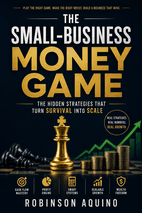
Robinson Aquino's The Small-Business Money Game reveals entrepreneurship as a strategic game where controlling the bank is key, teaching founders to escape the Technician trap, leverage data over instinct, and scale through repeatable systems. Written for owners stuck beyond $250K who want to build an asset, not a job.
Feature
Insta.Page
Blinkist
Shortform
Summary Depth
Full Chapter-by-Chapter
15-min overview
Section-by-section guides
Audio Narration
✓
✓
✓
Full access to all 700+ summaries
✓
✓
✓
Visual Mindmaps
✓
✕
✕
AI Q&A
✓
✕
✕
Missing a book? Request it, usually live within 48h
✓
✕
✕
Quizzes
✓
✕
✕
PDF Downloads
✓
✕
✓
Send to Kindle
✓
✓
✓
Price
$89.99/yr
$146/yr (PRO)
$199/yr
*Competitor data last verified July 2026.
1 Page Summary
This book redefines entrepreneurship not as a battle of hard work versus luck, but as a strategic game with hidden rules—specifically, the difference between playing a finite game (where one winner bankrupts all others) and an infinite game (where the goal is to keep playing and growing). Central to this thesis is the author's childhood lesson from a Monopoly game with his brother: whoever controls the bank controls the game. From this, the book argues that most small businesses are structurally designed to fail because founders get stuck in the "Technician" role, mistaking technical expertise for business acumen. To break free, entrepreneurs must embody three distinct roles—Technician, Manager, and Entrepreneur—and navigate through predictable growth breakpoints.
Aquino’s approach is distinctive for its blend of personal narrative, sports analytics, and a brutal financial framework. He introduces the "Moneyball Strategy" from baseball to argue that data beats gut instinct, organizing business information into a Financial Data Hierarchy (base data, operational metrics, and strategic indicators). The book also adapts a crisis-tested framework called PSPG (Pause, Shrink, Plan, Grow), born from watching a German tax system and realizing that 90% of revenue can be commoditized overnight. Scaling, the author argues, is not about working harder but becoming repeatable, captured in the formula Scaling = Growth x min(Systems, People, Capital). Other key tools include a breakpoint ladder detailing eight growth stages from $0 to $25M, and a focus on owning an asset rather than a demanding job.
The intended audience is the entrepreneur who has achieved some initial success—perhaps exceeding $250K in revenue—but feels stuck, broke while busy, or unsure whether to scale. What readers will gain is a clear, unsentimental playbook: instead of chasing SMART goals (which the author dismisses for being "achievable" and thus a trap), they are taught to pursue 10x thinking and a future-self statement that genuinely scares them. The book ultimately guides owners to make a conscious choice—not to follow someone else’s North Star, but to decide whether they want a lifestyle business or a scalable asset, and then to measure wealth not by what they earn, but by what they own.
Chapter One | The Theory of Games
Overview
That childhood thrill of clutching a dollar bill—it fades awfully fast, doesn't it? We start out thinking money is freedom, then grow up wondering where it all went. This opening chapter introduces a central metaphor that will anchor everything to come: money, at its core, is a game. But not the kind most of us think we're playing. The author draws a crucial distinction between finite games—like the Monopoly boards of our youth, where one player's victory depends on everyone else's bankruptcy—and the infinite game of real life, where the point isn't to defeat opponents but to keep playing, keep growing, and keep building.
My First Economics Teacher
The lesson began not in a boardroom, but in the cramped triplexes of Lawrence, Massachusetts, where the author's older brother Alex routinely demolished him at Monopoly. At first, it seemed like superior strategy. Then came the discovery: Alex was skimming from the bank. That moment crystallized something essential, summed up in Lesson #1: Whoever controls the bank controls the game. Once the author took over as banker, the tables turned. But even beyond the cheating, Alex had instincts the younger brother lacked—trading early, staking territory, forcing bad decisions. The game wasn't just luck. It was a miniature economy, teaching real principles about negotiation, risk, and strategy.
Finite Versus Infinite Games
Here's where the metaphor deepens. Monopoly ends when one player owns everything. But life? Life has no final whistle, no trophy ceremony. Philosopher James Carse's framework of finite versus infinite games becomes the book's backbone. Finite games are played to win; infinite games are played to continue playing. This distinction rewrites the rules of engagement:
Lesson #2: The true art of playing the money game lies not in bankrupting others but in continuously improving one's own position while also lifting others along the way.
Small-business owners who chase short-term wins at the expense of relationships, sustainability, or their own well-being are treating an infinite game like a finite one. It's a recipe for burnout, not prosperity.
Top Hats, Racecars, and Wheelbarrows
The author divides society into three economic groups, each represented by a classic Monopoly piece. The Top Hats—the top 1% and the next 9%—control nearly 70% of US wealth. They sit closest to the bank, design the rules, and deploy capital. They aren't inherently bad; they're simply playing the game as designed. The Racecars represent the middle class: high earners circling a track, following the rules, building respectable lives, but rarely escaping the invisible boundaries of the system. They trade freedom for stability, status for ownership. The Wheelbarrows are the backbone—essential workers, laborers, mom-and-pop shops—pushing uphill, often unaware that a hidden rulebook even exists.
Lesson #3: The top 10% owns nearly 70% of the assets. These players dominate the board.
But here's the critical truth: positions aren't permanent. The board keeps moving. The author's mother arrived from the Dominican Republic having never seen an indoor toilet, went bankrupt twice, and refused to stay a Wheelbarrow. Her determination became the template.
The Wealth Gap and the Monopoly Experiment
Social psychologist Paul Piff's rigged Monopoly experiment revealed something uncomfortable: when players were given massive advantages—more starting cash, double salary—they didn't feel grateful or empathetic. They grew dominant, ate more pretzels, talked down to opponents, and rationalized their victory as deserved. The rich aren't bad; they're human. And humans, when handed unearned advantages, tend to believe they earned them. This isn't a moral judgment—it's a systems insight. Understanding how the game is designed is the first step to changing how it's played.
Lesson #4: Create an infinite-game mindset. Stop aiming to defeat others; start designing systems that let everyone climb.
What This Book Will Give You
The author lays out what's coming: a data-driven Moneyball Strategy for replacing guesswork with clarity; the Breakpoint Ladder—eight predictable plateaus between $0 and $25 million in revenue; and the Strategic Scaling Playbook for growing without losing control or burning out. The goal isn't theory; it's a practical blueprint for turning survival into strategy.
Lesson #5: Prosperity doesn't have to be disconnected from decency.
Key Takeaways
Control the bank. Whoever controls the flow of capital—whether in a board game or real life—holds the power to shape outcomes.
Play the infinite game. Focus on sustainability, continuous improvement, and mutual growth rather than zero-sum victories.
Your position isn't permanent. The economic category you occupy today—Wheelbarrow, Racecar, or Top Hat—can change with the right mindset and strategy.
Wealth shapes behavior. The Monopoly experiment shows that advantages, even unfair ones, tend to breed entitlement, not gratitude. Awareness of this dynamic is key to playing wisely.
Profit and principle can coexist. Building prosperity doesn't require abandoning decency. The goal is to create systems where everyone can climb.
Key concepts: Chapter One | The Theory of Games
Chapter One | The Theory of Games
Money as a Game
Money is a game, not just currency
Finite games aim to win; infinite games aim to continue
Real life is an infinite game, not Monopoly
True art: improve own position while lifting others
Lessons from Monopoly
Whoever controls the bank controls the game
Alex's cheating taught real economic principles
Monopoly is a miniature economy of negotiation and risk
Winning requires understanding hidden rules
Three Economic Groups
Top Hats: top 10% control nearly 70% of wealth
Racecars: middle class trading freedom for stability
Positions aren't permanent; the board keeps moving
Wealth Gap and Behavior
Piff's experiment: advantages breed entitlement, not gratitude
Unearned advantages feel deserved to humans
This is a systems insight, not moral judgment
Understanding design is first step to changing play
Practical Blueprint Ahead
Moneyball Strategy replaces guesswork with clarity
Breakpoint Ladder: eight plateaus from $0 to $25M
Strategic Scaling Playbook for growth without burnout
Goal: turn survival into strategy with decency
💡 Try clicking the AI chat button to ask questions about this book!
Chapter Three | The Moneyball Strategy
Overview
Every downfall among entrepreneurs begins the same way: everything’s going great, they’ve got momentum, they’re trusting their gut—and then it leads them off a cliff. Instinct routinely mistakes luck for skill, misreads risk, and ignores evidence. But there’s a better way, and it starts with a lesson from baseball. The moneyball philosophy—pioneered by the Oakland A’s and perfected by the 2004 Red Sox—shows that data can level an unfair playing field, turning a curse-breaking comeback into a repeatable strategy. This same mindset transforms business, as revealed through two very different success stories. Sofia, a dental practice owner bleeding cash, discovered that the real problem wasn’t billing but administrative bloat and a failing location—data uncovered the truth in sixty days. Thomas Tull, who built Legendary Pictures from a childhood of laundromat surge pricing to billion-dollar Hollywood bets, proved that rigorous analysis of box office patterns beats creative whims. To put this into practice, the Financial Data Hierarchy organizes business information into three levels: base financial data (revenue, expenses, cash flow), operational metrics (staff utilization, productivity, marketing performance), and strategic indicators (market trends, competitive positioning). Most owners stall at the base, but breakthrough requires professionals who translate accounting language into actionable strategy. The critical lesson: without data, decisions are merely opinions. Choose financial partners who support your vision, and never assume the problem before examining the numbers. Data transforms luck into predictable outcomes—just as it did for a cursed baseball franchise, a struggling dental practice, and a quiet billionaire who got rich by providing value, not chasing status.
The Peril of Instinct and the Promise of Data
Every downfall among entrepreneurs begins the same way: everything’s going great, they’ve got momentum, they’re trusting their gut—and then it leads them off a cliff. We like to believe we’re rational about money, but we’re not. Instinct routinely mistakes luck for skill, misreads risk, and ignores the evidence right in front of us. Your gut can’t spot a cash-flow crisis or a bloated payroll; it only tells you how you feel. And I’ve watched confidence turn into crisis more times than I can count.
This isn’t just anecdotal. Nobel Prize winner Daniel Kahneman spent decades showing that our brains prioritize speed and emotional comfort over accuracy. We take mental shortcuts, and that creates blind spots that no amount of experience can fully erase. Recognizing this is the first step—but the real fix lies elsewhere.
That’s where baseball enters the picture. For a Dominican American kid, baseball wasn’t just a sport; it was culture. And it taught me that data can make all the difference in business growth, just as it revolutionized the game.
For a Dominican American kid growing up in the Bronx, baseball wasn't just a pastime—it was identity. Swapping Yankees pinstripes for the Red Sox's "B" after moving to Lawrence, Massachusetts felt like betrayal. But the team's embrace of the moneyball philosophy, pioneered by the Oakland A's under Billy Beane and statistician Paul DePodesta, turned out to be the real game-changer. The A's had shown that data could level an unfair playing field, winning 103 games with a payroll one-third of richer teams. Boston took it further: they hired Bill James (the godfather of sabermetrics), brought in young GM Theo Epstein, and built a roster around undervalued talent like David Ortiz. The result? The 2004 Red Sox shattered an 86-year curse, coming back from a 3-0 deficit against the Yankees by trusting analytics over gut instincts.
Sofia’s Journey: Uncovering the Truth Through Data
That same moneyball mindset works whether you're running a baseball team or a dental practice. Sofia ran three locations with $2.5 million in revenue but was bleeding cash. Everyone blamed the billing process—insurance reimbursements, payment delays. But assuming without data is dangerous. My team dove into her QuickBooks, payroll, revenue cycle management, and clearinghouse data. We built a Clinician Productivity Report tracking revenue per clinician, costs, margins, patient volume, and hours billed per insurer.
The real problem wasn't billing. It was administrative bloat and a failing third location. We developed a three-step plan: cut two unnecessary admin roles (including her husband and son), shut the unprofitable location, and refinance high-interest debt. Within 60 days, Sofia went from losing $10,000 per month to positive operating income of $12,000. By month six, salaries were restored, clinicians got raises, and the practice thrived. That's what happens when you let data—not assumption—make the calls.
Thomas Tull: The Quiet Billionaire’s Moneyball Approach
Thomas Tull started as a Wheelbarrow, raised by a single mother in New York. In college, while classmates chased minimum-wage gigs, he studied laundromat usage patterns and introduced surge pricing—decades before Uber. He applied the same analytical rigor to auto repair shops, then consolidated hundreds of Jackson Hewitt tax franchises. Each time, data revealed hidden value.
Then he took on Hollywood. He founded Legendary Pictures and analyzed decades of box office performance, casting combinations, marketing outcomes, and release timing. He backed Christopher Nolan's Batman films, Inception, the Monsterverse, and Dune. The result? A billionaire status built not on creative whims but on rigorous, data-driven decision-making. Tull's lesson: you get rich relative to the number of people you provide value to. He never chased fame—just the numbers.
The Financial Data Hierarchy: A Framework for Business Growth
Not all data is equal. My team developed a three-tier pyramid to organize business information:
Base Level: Base Financial Data – Revenue, expenses, margins, cash flow. This is your bookkeeping foundation. Without it, every decision is a guess.
Middle Level: Operational Metrics – Staff utilization, productivity per role, real estate efficiency, client demographics, marketing performance. This shows how efficiently your business runs.
Top Level: Strategic Indicators – Competitive positioning, market trends, pricing power, margin opportunities. These are forward-looking insights that require higher-level financial expertise to interpret.
Most business owners get stuck at the base level. To break through, you need professionals who can translate accounting language into actionable strategy.
Critical Lessons on Data and Leadership
Accounting is the language of business, and most entrepreneurs don't speak it fluently. Warren Buffett reads 500 pages of financial data per day—not because he has to, but because he knows that numbers tell the real story. You don't need to match his pace, but you do need quality financial professionals who understand your vision and want to help you grow.
Without data, your decisions are merely opinions. Make data the most important player on your team.
Key Takeaways
Never assume the problem before examining the data—self-diagnosis in business is often wrong.
Build a Financial Data Hierarchy: start with solid bookkeeping, layer on operational efficiency metrics, then use strategic indicators for growth.
Data transforms luck into predictable outcomes—just as it did for the 2004 Red Sox, Sofia's dental practice, and Thomas Tull's Hollywood empire.
Choose financial professionals who support your vision and understand the infinite money game.
You get rich in proportion to the value you deliver—not by chasing status or gut feelings.
Key concepts: Chapter Three | The Moneyball Strategy
Chapter Three | The Moneyball Strategy
The Peril of Instinct
Gut feeling mistakes luck for skill
Instinct misreads risk and ignores evidence
Kahneman: brains prioritize speed over accuracy
Confidence often turns into crisis
The Moneyball Philosophy
Data levels unfair playing fields
Oakland A's won with low payroll using analytics
2004 Red Sox broke curse by trusting data
Undervalued talent like David Ortiz was key
Sofia's Dental Practice Turnaround
Bleeding cash despite $2.5M revenue
Data revealed admin bloat, not billing issues
Cut roles, closed location, refinanced debt
From -$10K to +$12K monthly in 60 days
Thomas Tull's Data-Driven Success
Used surge pricing in laundromats as student
Analyzed box office data to build Legendary
Backed Batman, Inception, Monsterverse, Dune
Became billionaire by providing value, not status
Financial Data Hierarchy
Three tiers: base, operational, strategic
Base: revenue, expenses, cash flow
Operational: staff utilization, productivity
Strategic: market trends, competitive position
Actionable Strategy from Data
Translate accounting into actionable insights
Never assume problem before examining numbers
Choose financial partners who support vision
Data transforms luck into predictable outcomes
Key Lesson for Entrepreneurs
Without data, decisions are merely opinions
Breakthrough requires professional analysis
Data uncovers hidden problems and opportunities
Rigorous analysis beats creative whims
Chapter Four | Why Small Businesses Are Designed to Fail
Overview
Most entrepreneurs think mastering their craft is enough to build a thriving business, but that assumption is the first reason small businesses are designed to fail. The “entrepreneurial seizure” convinces skilled technicians—chefs, coders, plumbers—that technical expertise alone qualifies them to run a company, when a business actually needs three distinct roles: the Technician who does the work, the Manager who organizes, and the Entrepreneur who provides vision. Founders stuck in the Technician role hit a hard ceiling at predictable breakpoints—thresholds where growth stalls because structures that worked at $250K can’t handle $500K. Operational tension, leadership challenges, resource constraints, and the need for formal restructuring all converge, not because the founder lacks drive, but because the business’s design has reached its limit.
The system itself is stacked against small players. The Great Recession made this clear: big institutions got bailouts while 1.8 million small businesses disappeared. If some companies are too big to fail, millions are simply too small to succeed—not a cynical verdict, but clarity that forces smarter play: faster adaptation, better design, more leverage. Mapping that terrain reveals the breakpoint ladder—eight stages from survival mode at $0–$100K to the road to middle market at $10M–$25M. Each rung demands a new version of the founder. At $250–$500K you must learn to hire and delegate; at $500K–$1M systems must replace hustle; at $1M–$2M planning replaces guessing; and by $5M–$10M the business must become self-managing. You can’t skip a step—climb too fast and the foundation collapses, because the person who takes a business to a million isn’t the same person who takes it to ten.
The journey of Andy and Jill and their company, Accelerate, illustrates every breakpoint. They started with purpose—serving families with autistic children—and with dual leadership that covered the Technician, Manager, and Entrepreneur roles. But growth soon felt like a problem. They hit the recruiter phase, then the operational ceiling, where intuition no longer worked and simple systems like Microsoft 365 and shared trackers became survival tools. Cash flow was a timing puzzle: insurance reimbursements lagged weeks behind payroll. They hired experienced professionals rather than friends, building a culture from day one. Then COVID hit, forcing layoffs from 100 employees to 16, exposing every structural weakness. With help from a fractional CFO and controller, they professionalized finance, HR, and operations, and Accelerate crossed into the self-managing company stage at over $8 million in revenue. Today, Andy and Jill work on the business, not in it, and their headquarters runs on calm, steady systems.
The key insight is that business is behavior. Every company rises or falls on how people behave, and the systems you build either support them at their best or make great work impossible. If small businesses are designed to fail, the only way forward is redesign: rebuilding pricing, value models, cost structures, and systems so they work for you. That’s the work of the second half of this book.
Key Takeaways
Balance the three roles: Ensure your leadership covers Technician, Manager, and Entrepreneur—or find partners who fill the gaps.
Purpose over profit: Starting to solve a real problem attracts the right clients and sustains you through hardship.
Hire for culture and experience first: Industry professionals who already share your values build a stronger foundation than friends or relatives.
Growth creates friction: Every new hire delays cash flow; invest in systems before the chaos becomes structural.
Cash-flow constraint is about timing, not just amount: Manage the lag between spending and reimbursement carefully.
COVID exposed weak systems, not weak effort: Stress tests reveal whether your business can survive disruption; use crises to professionalize finance, HR, and operations.
Redesign is the solution when design is the problem: Focus on pricing, value models, cost structures, and systems that support human behavior at its best.
Key concepts: Chapter Four | Why Small Businesses Are Designed to Fail
Chapter Four | Why Small Businesses Are Designed to Fail
The Entrepreneurial Seizure
Technical skill alone doesn't qualify you to run a business
Three roles needed: Technician, Manager, Entrepreneur
Founders stuck as Technician hit growth ceilings
Too Small to Succeed
System favors big institutions over small businesses
1.8 million small businesses vanished during Great Recession
Small size demands faster adaptation and better design
The Breakpoint Ladder
Eight stages from survival to middle market
Each rung demands a new version of the founder
Can't skip steps without foundation collapsing
Accelerate Case Study
Purpose-driven start serving families with autistic children
Growth exposed operational and cash-flow ceilings
COVID forced layoffs and structural professionalization
Crossed into self-managing stage at $8M revenue
Redesign as the Solution
Business is behavior—systems enable or hinder it
Rebuild pricing, value models, and cost structures
Design systems that work for you, not against you
Chapter Five | Pricing Is an Art—Accounting Is A Science
Overview
Lesson #23: Most entrepreneurs don't charge enough for what they're selling becomes clear through John Screen, a master mason who simply doubled his material and labor costs. That formula ignored operating expenses, his own salary, and the reality that jobs don't always run smoothly. Gross profit only tells part of the story—net profit is what remains after rent, insurance, payroll, and every other overhead cost. When customers always say yes without hesitation, you're leaving money on the table. When you're busy yet broke, pricing is almost always the culprit.
Pricing is an art that communicates value. The goal isn't to be cheapest or most expensive but to land where customers feel they're getting more than they paid for while you earn enough to grow with integrity. Lesson #25: Money is a story of trust, recordkeeping, and human cooperation reminds us that humanity began writing to count, and every entrepreneur needs both personal financial literacy and a team of interpreters—accountants, bankers, advisors.
Every business fits one of nine business archetypes that determine typical cost structures and profit margins. John's construction archetype has gross profits between 15 and 30 percent and razor-thin net margins. By working with a fractional CFO, John transformed his approach: they analyzed three years of overhead, built a contingency buffer, and created five pricing calculators that adjusted profit percentages as project size increased. The result was a leap from $500,000 to $3 million in revenue, a tripled workforce, and cleared back taxes.
Replicating this requires understanding your current pricing, auditing all costs, setting appropriate margins (aim for at least 50% gross margin), and managing transitions with existing clients. Lesson #26: Understanding your financials and pricing is the key to your future success underscores the need to invest in professional help and never cheap out on accounting.
John's Pricing Blind Spot
John Screen, a skilled mason with thirty years of experience, hit a wall: more sales meant more time behind a computer. His core problem wasn't finding customers—it was his pricing model. He added up materials and labor, then doubled the number. If costs were $250,000, he'd charge $500,000, calling the difference "profit." This assumed every job would go perfectly with no delays, broken tools, or material shortages. It also assumed no other business expenses—no rent, insurance, or salary for John himself. That's not a system—it's a gamble.
The Real Measure: Net Profit
Gross profit tells you whether your product is priced efficiently. But net profit is what remains after paying for everything else: your compensation, admin staff, marketing, insurance, rent, taxes, debt payments. John's business grew, but his pricing didn't. What worked for a two-man crew collapsed under a team and payroll taxes. He'd finish the year proud of sales, then find himself short on cash at tax time. The business was busy but broke—a classic symptom of underpricing.
Two clear signs: no matter how much you sell, there's never enough left over. And every customer says yes immediately. The art of pricing is finding the point where you receive just enough "no's" to know you've landed in the right zone.
Pricing Is an Art, Not a Science
Lesson #24: Price communicates value. The goal isn't to be cheapest or most expensive. It's to find the point where customers feel they're getting more than they paid for, and you're earning enough to grow with integrity. Most entrepreneurs focus on cost when they should focus on value. Your price should reflect what your work is worth in the customer's eyes and what it takes to deliver it sustainably.
Money Is Psychology, Not Math
Understanding money starts with understanding people—their impulses, beliefs, and behaviors. Our feelings about money are shaped by early experiences. Becoming financially successful means recognizing those patterns and reshaping your beliefs if needed. Lesson #25: Money is a story of trust, recordkeeping, and human cooperation. Humanity started writing to count. You can't master this language entirely on your own—hire interpreters like accountants and advisors. But learn the basics yourself to avoid fraud and costly mistakes.
The Nine Business Archetypes
Every business fits one of nine archetypes: primary and energy, manufacturing, construction and real estate, trade and distribution, transportation and logistics, information/media/technology, financial services, professional and business services, and human and social services. Each has predetermined cost structures and profit margins. Construction typically sees gross profit margins of 15–30% and net margins of 3–10%. Financial services can achieve 70–100% gross margins and 15–35% net margins. Businesses in categories 6, 7, and 8 dominate wealth in America.
From Skilled Mason to Scalable Business
John's business was construction—a low-margin industry. My firm took over his bookkeeping in 2021. We scaled his field team with structured wage models tied to revenue. Then we conducted a forensic examination of three years of overhead. Every expense was scrutinized and embedded into project estimates. We added a 10 percent contingency buffer. We started with the desired net profit margin, then layered in every expense.
The Five Calculators and Their Impact
We created five pricing calculators, each tailored to a specific project type. As job size increased, the profit percentage was slightly reduced—a smaller slice of a much bigger pie. This kept bids competitive while preserving financial health. John's team could now produce accurate estimates in minutes. Between 2021 and 2025, his business soared from $500,000 to roughly $3 million in gross revenue, tripled its workforce, cleared years of back taxes, and bought his dream home.
Implementing Your Own Pricing Strategy
The path starts with accounting systems. You'll likely need to pay someone who speaks the language. Lesson #26: Understanding your financials and pricing is the key to your future success.
Step One: Analyze Your Current Pricing Structure – Review recent proposals and financials. Have an honest conversation with your team. Ask: Are your prices capturing all costs? Are you hitting profit targets? What would happen if you repriced clients?
Step Two: Identify True Costs – Audit all direct and indirect costs—materials, labor, rent, utilities, insurance, taxes, owner's salary. Factor in seasonal swings and a contingency buffer.
Step Three: Set Appropriate Margins – Aim for at least 50% gross margin. If margins are significantly below that, examine your business model closely.
Step Four: Manage Pricing Transitions – Prepare clear communication emphasizing value and fairness. Consider phased approaches—start with new clients or roll out incremental increases.
Action Steps to Lock It In
Complete cost analysis – Detail every direct and indirect cost.
Profit requirement calculation – Determine minimum net profit margin needed.
Market positioning assessment – Evaluate competitors and target customers.
Pricing structure development – Build clear pricing frameworks.
Implementation timeline creation – Set realistic milestones.
Key Takeaways
Strategic pricing shapes everything—delivery, resources, value perception. A lower price makes growth hard; a higher price (justified by value) lets you invest in team, quality, and profit.
Pricing is an art, but the foundation is accounting science. Don't skimp on professional help.
Use a structured, step-by-step approach to analyze costs, set margins, and transition smoothly.
The right pricing structure sets your pace for scaling, talent attraction, and long-term profitability.
Key concepts: Chapter Five | Pricing Is an Art—Accounting Is A Science
Chapter Five | Pricing Is an Art—Accounting Is A Science
The Pricing Blind Spot
Most entrepreneurs don't charge enough
Doubling costs ignores overhead and owner salary
Busy but broke signals underpricing
Customers saying yes immediately means prices too low
Gross Profit vs. Net Profit
Gross profit only measures product efficiency
Net profit remains after all overhead expenses
Rent, insurance, payroll, taxes reduce net profit
Growing sales without pricing adjustment leads to cash shortages
Pricing as an Art of Value
Price communicates value to customers
Goal is not cheapest or most expensive
Customers should feel they get more than they pay
Focus on value delivered, not just costs incurred
Money Is Psychology and Trust
Money beliefs shaped by early experiences
Financial success requires recognizing patterns
Money is a story of trust and recordkeeping
Hire interpreters like accountants and advisors
The Nine Business Archetypes
Every business fits one of nine archetypes
Each has predetermined cost structures and margins
Construction has 15-30% gross margins
Financial services dominate with 70-100% gross margins
John's Transformation to Scalable Business
Forensic examination of three years of overhead
Added 10% contingency buffer to estimates
Started with desired net profit margin
Scaled from $500K to $3M revenue
Five Pricing Calculators Strategy
Tailored calculators for each project type
Profit percentage reduced as job size increased
Smaller slice of bigger pie kept bids competitive
Team produced accurate estimates in minutes
You've reached the end of the free chapters
Next chapter: “Chapter Six | Starting Smart, Starting Small” is locked
Keep reading The Small-Business Money Game — and unlock all 700+ book summaries with audio, mindmaps and AI Q&A.
$0.00 due today · 7 days free, then $89.99/year ($7.49/mo) · Cancel anytime before day 7
plus sales tax where applicable
More ways to explore The Small-Business Money Game
Robinson Aquino is a historian and author specializing in Latin American colonial history, with a particular focus on the social and economic impacts of the Spanish silver trade. His notable works include *Silver and Society in Colonial Peru* and *The Merchants of Potosí*, which examine the lives of indigenous laborers and European settlers. Drawing on extensive archival research, Aquino’s expertise bridges economic history and cultural studies, offering nuanced insights into this transformative period.
Frequently Asked Questions about The Small-Business Money Game
What is The Small-Business Money Game about?
This book reframes business finance as a strategic game, contrasting finite games like Monopoly with the infinite game of entrepreneurship. It reveals why most small businesses are designed to fail and provides a data-driven moneyball strategy to level the playing field. Through real stories and frameworks like PSPG (Pause, Shrink, Plan, Grow), it guides owners from survival to scaling—emphasizing that real wealth comes from owning assets, not just earning a paycheck.
Who is the author of The Small-Business Money Game?
Robinson Aquino is an entrepreneur and advisor who learned early that 'whoever controls the bank controls the game' from his brother Alex's Monopoly tactics. He draws on decades of experience helping business owners navigate breakpoints and turnarounds, including personal stories of immigrant family businesses and a pivot sparked by COVID-19. His approach blends practical wisdom with frameworks like the Financial Data Hierarchy and nine business archetypes.
Is The Small-Business Money Game worth reading?
Absolutely—this book cuts through the hype to address the real reasons small businesses struggle and fail, offering actionable strategies rather than platitudes. It's worth reading because it provides a clear roadmap from the Technician trap to strategic scaling, backed by memorable stories and concrete tools like PSPG and 10x goal setting. Whether you're starting smart or turning around a struggling company, the insights here can help you shift from playing a finite game to building an infinite one.
What are the key lessons from The Small-Business Money Game?
The most important lesson is that controlling the bank—or your financial data—is essential, as data reveals truths gut instinct misses. Another key takeaway is that most entrepreneurs don't charge enough and need to understand net profit versus gross profit. The book also teaches that small businesses are designed to fail unless owners evolve from Technician to Manager to Entrepreneur, and that real wealth comes from owning assets that work without you, not from earning a salary. Finally, scaling requires repeatable systems, not just growth, and the PSPG framework offers a disciplined turnaround process.
📚 Explore Our Book Summary Library
Discover more insightful book summaries from our collection