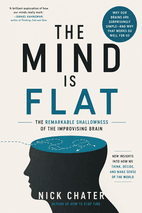
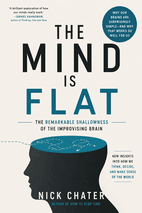
Nick Chater's The Mind Is Flat challenges the assumption of hidden mental depths, arguing that our beliefs, emotions, and self are improvised moment by moment rather than discovered. Drawing on cognitive experiments and fiction, it reorients how we understand consciousness, aimed at curious readers of psychology and philosophy.
Feature
Insta.Page
Blinkist
Shortform
The Mind Is Flat
✓
✕
✕
Summary Depth
Full Chapter-by-Chapter
15-min overview
Section-by-section guides
Audio Narration
✓
✓
✓
Visual Mindmaps
✓
✕
✕
AI Q&A
✓
✕
✕
Quizzes
✓
✕
✕
PDF Downloads
✓
✕
✓
Price
$89.99/yr
$146/yr (PRO)
$199/yr
*Competitor data last verified July 2026.
1 Page Summary
In this provocative work, cognitive scientist Nick Chater challenges one of our most deeply held assumptions: that beneath the surface of conscious thought lies a complete, coherent storehouse of beliefs, motives, and values—an "inner oracle" we can consult through introspection. Drawing on parallels with fiction, Chater argues that our mental lives carry the two defining marks of fictional worlds: inconsistency and sparseness. Just as a novel like Anna Karenina leaves its heroine's motives open to conflicting interpretations with no hidden truth to uncover, our own minds are not pre-loaded with fully formed attitudes and desires but are instead invented moment by moment. This "flat" view of the mind runs against the common-sense intuition that our inner lives are like deep seas waiting to be explored, positioning introspection not as a form of discovery but as an act of creative storytelling.
Chater builds his case through a wide range of compelling examples: impossible objects like Oscar Reutersvard's drawings reveal that vision is not an inner copy of reality but an improvised interpretation; the Kuleshov effect shows that the same neutral face can be read as grief, hunger, or lust depending solely on context, suggesting we read our own emotions from the world around us rather than from internal signals; and split-brain studies demonstrate that the brain's "interpreter" will invent fluent, plausible justifications for actions it has no access to. These insights converge on a central claim: consciousness is a narrow channel, limited to one interpretation at a time, while the brain operates as a vast, slow, cooperative network that solves problems through what Chater calls the "cycle of thought"—a strictly sequential process that prevents catastrophic interference. The rationality we prize is not grounded in hidden unconscious logic but in precedent and habit, as exemplified by grandmasters who grasp chess positions holistically rather than through superhuman calculation.
This book is aimed at curious general readers, students of psychology and philosophy, and anyone who has wondered about the nature of self-knowledge, free will, or intuition. Chater's narrative is accessible, free of jargon, and packed with vivid experiments and historical anecdotes that make abstract concepts tangible. What readers will gain is not just a new theory of mind but a practical reorientation: with no hidden depths to excavate, the self becomes a "unique history combined with a creative machine" that reuses past improvisations to generate new perceptions, thoughts, and justifications. The epilogue confronts the unsettling implications directly—if the mind is flat, what holds a life together?—and offers a genuinely liberating answer: we are not discovering who we are, but actively and continuously reinventing ourselves through the very act of living.
Prologue: Literary Depth, Mental Shallows
Overview
The assumption that our own motivations lie somewhere beneath conscious awareness, waiting to be uncovered, makes introspection and psychology seem like deep-sea diving. But what if the search for hidden mental truths is not difficult, but misplaced? The puzzle is why we treat our inner lives as if they had fixed contents at all.
Daniel Dennett has observed that what we call inner observation is always impromptu theorizing, and gullible theorizing at that, since there is little to observe and much to pontificate about without fear of contradiction. The test case is Anna Karenina's suicide. Tolstoy tells us Anna has dark hair, and that settles it. But he never tells us why she throws herself under the train, so her motives are a void. We can debate interpretations, yet no hidden truth exists about what a fictional character really wanted.
Now vary the story. If Anna were a historical figure and the novel reportage, the question becomes historical, but the method stays the same: the text becomes clues to a real person's state of mind. If Anna survives and we interview her convalescing in a Swiss sanatorium, she too is only interpreting her memories, and self-perception may distort things more than an outsider's view. Autobiography deserves skepticism. If a journalist corners her at the platform's edge to ask why she is about to leap, the inquiry is obviously doomed. One moral is that minds have hidden depths requiring delicate instruments to plumb. The alternative is that the depths are not hard to reach because they do not exist. A real Anna would have no more truths about her motivations than the fictional Anna, because beliefs, desires and fears are themselves inventions.
Two possible morals
The hidden depths picture treats the inner world as an inner space as mysterious as outer space, to be explored through word association, dream analysis, psychotherapy, experiments and brain imaging, with some postulating hidden unconscious agents. The contrary claim is that the project is not technically difficult but fundamentally misconceived: the mind is flat. Introspection is not perception but invention, the real-time generation of interpretations to make sense of our own words and actions. Nothing exists beneath the mental surface. No one has ever been guided by inner beliefs or desires, any more than by evil spirits or guardian angels. The stories we tell to explain ourselves are not wrong in detail but thoroughgoing fabrications. Still, the inventions are not chaotic: they are flimsy, fragmented and self-contradictory, like a film set built from cardboard, and the mind's task is to make them as coherent as possible, to "stay in character."
Questioned about Anna's motives, anyone can generate fluent answers in an instant, just as the author can rattle off reasons for taking the train rather than driving to London. The same inventiveness underlies the stream of justifications we offer for our own everyday lives.
A consummate improviser
The argument proceeds in two parts. Part One clears away misunderstandings. The common-sense story of the mind cannot be patched up; it must be abandoned, a position increasingly shared by philosophers, psychologists and neuroscientists. There is no rich inner perceptual world: at any moment we recognize one face, read one word, identify one object. Dreams and mystical or drug-induced states are streams of invention, and dream interpretation is one creative act set atop another. Part Two gives the positive account: the brain is an improviser that draws on memory traces of previous thoughts rather than a hidden store. Conscious experience is the output of a cycle of thought that imposes meaning on the sensory world, and we are never conscious of the inputs or inner workings, so we cannot say why a rock outcrop looks like a pack of dogs or a fleeting expression seems condescending. Perception is the focus because it is the best-understood area, and all thought is an extension of perception.
Unique traditions
Each of us is a unique tradition in continual creation, a character of our own making rather than a plaything of unconscious currents. Freedom and creativity are basic to the brain's operation, not rare gifts of genius. Yet there are limits: an amateur saxophonist cannot spontaneously play like Charlie Parker, a language learner cannot emulate Sylvia Plath, and physics students cannot reason like Einstein without the thousands of hours needed to lay down the traces of expertise. That is why each of us plays, writes and thinks in our own way.
Our ongoing thoughts and actions reprogram the mind, step by step. The book draws on cognitive, social and clinical psychology, philosophy and neuroscience, above all on treating the brain as a biological computing machine. Since the Second World War, vast networks of neurons have been viewed as computational devices. Connectionist, brain-style models work differently from digital computers, though as deep neural networks they currently dominate machine learning. The computation is cooperative: neurons fill in and arrange fragments like jigsaw pieces jiggling into place.
Common-sense psychology under pressure
This clashes with the everyday view that beliefs and desires guide the mind. Common-sense psychology explains a fruitless trip to buy a newspaper by beliefs about opening hours and stock, cash on hand, and a preference for print over online reading, arranged like a step-by-step proof. But recognising a face, a musical style or an object involves simultaneous jiggling of constraints, not sequential argument. No one has convincing reasons why a cartoon is plainly Churchill, a sound is Motown, or a shape in the water is a seal or the Loch Ness monster.
The same mistaken starting point runs through theories in artificial intelligence, cognitive, developmental and clinical psychology, linguistics and behavioural economics. After thirty years of computational modelling and experiments, the conclusion is that our intuitive conception of the mind is fundamentally flawed. Science has shocked us before, from the Earth orbiting the sun to our descent from single-celled organisms, so abandoning our picture of the mind should not surprise.
Sceptics from B. F. Skinner to Daniel Dennett have doubted introspection, and some judge beliefs and desires as unreal as the four humours or astrology. Doubts that the brain is a computer are misplaced: integrating perception and memory, working out the state of the world and deciding what to do are information-processing challenges, and information-processing is computation. The controversial claim, widespread since the 1950s, is that the brain's calculations line up with common-sense psychology. It would be convenient for these fields if minds were queryable belief databases; they are not. The mind invents, moment by moment, the rich inner story it seems to observe. A real Anna Karenina would have no more of an inner mental world than a fictional one; probing her brain would reveal no deep beliefs or true nature, any more than analyzing ink and paper would reveal the character's inner life.
Why this conclusion is hard to accept
Three obstacles delayed it.
The psychological data seem too extraordinary. Experiments say the brain identifies one word and one object at a time, yet reading a page or scanning a room brings an impression of whole paragraphs and many objects at once. Such a mismatch implies a systematic illusion: a hoax played by our own brains.
The radical view clashes with these theories, so discarding them feels like vandalism.
No credible alternative existed until advances in brain-style computation and machine learning. Programs for backgammon, chess and Go now beat the best humans, not by having top players' knowledge programmed in, but by learning bottom-up from vast numbers of games.
A speculative book
His academic work at Warwick Business School and with Decision Technology Ltd is usually circumspect. This book connects observations, extrapolates from the specific to the general, and speculates, asking what it all means. The picture from over a century of psychology, philosophy and neuroscience is strange, radical and liberating, demanding a systematic rethink of much of psychology, neuroscience and the social sciences, and of how each of us thinks about ourselves and others. Grants from the ERC, the ESRC Network and the Leverhulme Trust supported the writing; conversations with Mike Oaksford and Morten Christiansen shaped it.
Key Takeaways
When you explain your own actions, treat the reasons you give as freshly invented stories, not recovered records of inner states.
Stop looking for a privileged inner vantage point on your own mind; the self you feel inside is being constructed in the present, not discovered.
Discard the everyday assumption that beliefs and desires propel your behaviour; your judgments snap into place through many constraints working at once, not through a chain of reasoning.
See your brain as a machine that improvises each conscious moment from echoes of earlier thoughts, which makes originality and spontaneity ordinary rather than exceptional.
Expect the evidence about your own mind to feel alien, since the brain generates the impression of a rich inner world rather than reporting one.
💡 Try clicking the AI chat button to ask questions about this book!
1 The Power of Invention
Overview
Fictional worlds are always incomplete and self-contradictory, yet readers experience them as vividly real. The puzzle is not how authors manage this, but what it reveals about the status of our own minds and personalities.
The mind's inner workings resemble a fictional world more than a physical one. Fictional places like Gormenghast Castle, with its magnificent but mutually incompatible descriptions of hallways, kitchens and passageways, cannot be mapped or modelled; they are self-contradictory and sparsely specified. The same is true of characters. Tolstoy gives Anna Karenina almost no physical description, and her personality is equally open to conflicting readings. A real Anna, if the novel were biography, would be just as incoherent and incomplete, because her beliefs and values would be vague, inconsistent and only loosely held. The external world is entirely different: it is fully specified in every detail and relentlessly consistent. Our mental lives carry the two defining marks of fiction: inconsistency and sparseness.
This view runs against a deeply seductive assumption: that beneath the surface of conscious thought lies a complete, coherent storehouse of beliefs, motives and values, an "inner oracle" whose wisdom could be extracted if we searched hard enough. The early artificial intelligence researchers, from the 1950s onward, took this assumption for granted. Their strategy had three steps: excavate the hidden storehouse of beliefs, systematize it into a formal common-sense theory, and build computational methods to reason over that theory. After two decades of high hopes and confident forecasts that human-level intelligence was twenty or thirty years away, the project ground to a halt. It failed at the very first step. People can generate fluent explanations of their own behaviour and knowledge, but those explanations turn out to be loose fragments, riddled with gaps and contradictions. Chess grandmasters cannot explain how they play; doctors cannot explain how they diagnose. The task of arranging these fragments into a coherent database proved hopeless, and the whole programme was quietly abandoned in favour of machine-learning, which extracts information not from people but from large data sets.
The failure revealed what psychologists call the "illusion of explanatory depth": a stark mismatch between our felt sense of understanding and our actual inability to produce coherent explanations. Asked why coffee splashes and settles in puddles when dropped on a kitchen floor, while sugar forms a heap and ball-bearings scatter in all directions, people produce elaborate answers that are invented on the spot. Each explanation is incompatible with the previous one, and each step of each explanation can itself be interrogated. The explanations are not a confused report of inner clarity; they are a confused description of inner confusion. The inner oracle, consulted for common-sense physics, psychology, ethics and more, turns out to be a fraud, a fantasist, a master of confabulation.
The mind is flat: the momentary thoughts, explanations and sensory experiences of the stream of consciousness are all that mental life consists of. The illusion of depth has misled not only the AI pioneers but also two and a half millennia of philosophers who tried to systematize our intuitions about the good, causality, knowledge, mind and meaning. The analytic tradition, from Frege and Russell to the early Wittgenstein, attempted to regiment common sense by clarifying the logical structure of language. But our intuitions about meaning itself are as full of gaps and contradictions as everything else. Whatever gaps philosophers manage to fill and whatever contradictions they iron out, new ones continually appear.
Linguistics and economics
The same failure repeats in linguistics and economics. Linguists following Noam Chomsky's generative grammar tried to turn intuitions about which sentences are acceptable into a mathematically rigorous theory of each speaker's knowledge of language. That project foundered too: the structural patterns of language, not just its meaning, are a tangle of inconsistent regularities, sub-regularities and outright exceptions.
Economists assumed consumers and firms hold complete, consistent theories of the economically relevant world, including their own preferences, and that markets emerge from the interaction of these super-rational agents. The math was elegant but the story collapsed. Behavioral experiments show beliefs and preferences are spectacularly ill-defined and self-contradictory. Individual confusion, with its exuberant hopes, desperate panics, herding and over-reaction, produces turbulence at the level of whole economies. The same assumption infects business and policy: market researchers probe what we want, decision analysts try to extract beliefs and preferences from stakeholders in major projects, health economists attach stable monetary values to disease, disability and life. All run into the same wall. People offer wildly different answers to one question minutes apart, their answers across questions are inconsistent, and their choices contradict their stated values, as when someone rates their own life highly yet takes serious risks. On matters like nuclear power, climate change or whether a government should fund a new cancer drug, most explanations are as shallow as accounts of how a fridge works. Strong opinions do not spring from coherent, fully spelled-out common-sense theories. No such theories exist to extract.
The incoherence is not resolved by appealing to multiple selves. The idea that a conscious self struggles against a dark atavistic unconscious self merely postulates additional castles; it does nothing to make the description of Gormenghast Castle coherent.
Psychology as art or science?
Some people welcome the conclusion that the mind is flat. It seems to protect human freedom, creativity and ingenuity from being reduced to mere calculation, and it fits a long tradition in the arts and humanities of seeing people as endlessly reinterpreted and fragmented. Many scholars go further, arguing that human nature cannot and should not be studied scientifically. On this view psychology belongs with the arts: an open-ended conversation in which every perspective is valid, everything can be re-analyzed, contested, overturned or revived, and there are no right answers. That vision is hardly thrilling. It is not liberation but nihilism, the abandonment of the scientific project of self-understanding. Turning an untrustworthy imagination loose on itself, adding layers of speculation about dreams, archetypes, complexes and metaphors, is like explaining the origin of fairy tales by telling another fairy tale.
Clearing the ground
A science of the mind requires the opposite direction. It must work out how the engine of improvisation at the core of human intelligence could be built from the machinery of the brain, a biological machine made of roughly a hundred billion densely wired neurons. Early artificial intelligence followed a tempting path: treat the brain as a conventional computer and treat everyday verbal explanations as symbolic data, knock them into shape by filling gaps and ironing out contradictions, and reason over the resulting database. That path can never work because those stories are flimsy, inconsistent, invented on the spot, not clues to hidden inner theories. The alternative, long available, is that biological computation differs fundamentally from the symbolic computation of conventional computers. Part Two explores the brain's "cooperative" style of computation and what it implies for how the stream of thought arises. Before building anew, the rest of Part One keeps clearing the ground, since the impressions of depth that mislead us about our own minds run far deeper than these failures suggest.
Key Takeaways
Treat your conscious thoughts and explanations as the entire contents of your mind, not as windows into a hidden, coherent inner database.
When your answers wobble or contradict themselves, stop assuming a deeper consistent self is being obscured; the inconsistency is the reality.
Expect beliefs and values to be improvised on the spot, in yourself and others, rather than stored as stable facts waiting to be retrieved.
Don’t try to repair the mind’s incoherence by adding an inner agent or an unconscious “self”; that only multiplies the fiction.
Build any account of human intelligence from the biological machinery that improvises thought, not from tidied-up versions of everyday explanations.
Key concepts: 1 The Power of Invention
1 The Power of Invention
Fictional Worlds and the Mind
Fictional worlds are incomplete and self-contradictory
Mental lives mirror fiction: inconsistent and sparse
External world is fully specified and consistent
The Inner Oracle Illusion
Assumption of a coherent inner storehouse of beliefs
AI researchers tried to excavate and systematize it
Project failed; explanations are loose fragments
Illusion of Explanatory Depth
Felt understanding mismatches actual explanatory ability
People invent contradictory explanations on the spot
Inner oracle is a fraud and master of confabulation
The Flat Mind
Mental life is just the stream of consciousness
No hidden depths beneath momentary thoughts
Philosophers misled by illusion of depth for millennia
Failure in Linguistics
Chomsky's generative grammar aimed for rigor
Language structure is inconsistent and tangled
Project foundered on irregular patterns and exceptions
Failure in Economics
Assumed super-rational agents with complete preferences
Behavioral experiments show ill-defined, contradictory beliefs
Individual confusion creates economic turbulence
Rejecting Multiple Selves
Conscious vs. unconscious self is another fiction
Postulating extra selves doesn't resolve incoherence
No coherent theory exists to extract from anyone
2 The Feeling of Reality
Overview
We trust that our immediate sensory picture of the world is complete and coherent, but that confidence may be misplaced. What if the feeling of a fully detailed, unified visual reality is as fragile as the coherence of a fictional story?
Gormenghast feels coherent without being one. We touch a fictional world one word at a time, through a narrow window, so gaps slip by unnoticed. Invented stories are hard to tell from true ones, and both feel real; fictional creations can feel real even to their creators. The same suspicion attaches to the inner world of sensory experience: it seems loaded into the mind as a coherent picture, and a picture, unlike a story, cannot have gaps. That sense is a hoax.
Impossible objects
The Swedish artist Oscar Reutersvard (1915-2002) devoted his life to impossible objects: deceptively simple images that look, as wholes, like ordinary three-dimensional figures. Closer inspection shows the depth interpretations of the parts do not fit together. They look like 3D objects but are not. Three conclusions follow.
The common-sense view that perception copies the world into an inner mirror is wrong; no 3D mental copy of these figures could exist. Perception requires inference.
The brain grasps different parts of an image at different times. Each part alone is coherent; the parts refuse to combine into a whole. The brain glimpses the world fragment by fragment.
The feeling of solidity is misplaced. We view flat images with no possible 3D interpretation, yet the impression of depth is overwhelming. Such illusions of depth, literal and metaphorical, are everywhere.
The sparseness of sensory experience
Anatomy contradicts intuition. Colour sensitivity falls away steeply from the fovea, the dense pit of cone cells your eye points at whatever interests you. Outside a few degrees you are nearly colour blind, the rod cells detecting only light and dark, yet the visual world feels richly coloured. Visual acuity mirrors cone density. Whatever you are not looking at directly is an inchoate blur.
In the twelve dots illusion, by Jacques Ninio, dots large enough to be seen clearly vanish unless attended to. A scintillating grid reveals a patch of white dots wherever you look. Visual experience depends on where you are looking.
One word at a time
The decisive demonstration comes from gaze-contingent eye-tracking. Reading text on a screen, a window of meaningful text follows your fixation point, shifted to the right in left-to-right languages and to the left in Hebrew, with everything else replaced by blocks of xs. The window can shrink to ten to fifteen characters before anything seems wrong, and people read the mutating text without noticing. Reading proceeds one word at a time, so speed reading is simply skimming. The same limit applies to faces, objects and scenes.
These results refute the overflow theory, which claims we see far more than we can report. If people saw the full page and merely reported one word at a time, the gaze-contingent display would be noticed. That it fools us completely shows the full text is never seen. The sense of a whole page arises from integrating snippets while the eyes hop across the world.
Stabilized images
If so, the visual world should break down when the eye is held still. Stabilizing an image on a jittering eye was solved in the 1950s by Lorrin Riggs at Brown University and R. W. Ditchburn at Reading University. Within seconds the stabilized image disappears, giving way to a uniform grey field. A straight line is invisible 90 per cent of the time: the brain disengages from the stimulus and, with nothing new to lock onto, experiences a blank field. Complex stimuli last longer, reorganize dynamically, and always resolve into meaningful units. A profile head breaks into continuous regions; the letters HB jammed together yield a hidden 4; the word BEER decomposes into component words, never into meaningless substrings; a wire-frame cube loses whole faces. This imaginative power builds the deceptive feeling of reality.
The wire-frame cube sheds faces in whole regions rather than line by line, and sometimes only opposite faces remain, showing that the tendency to preserve discrete parts is not absolute. What matters is that the fragments the brain locks onto are meaningful, and the most natural reading is that the drawing has been interpreted as a three-dimensional object before attention selects what to keep. A grid of squares behaves the same way, decomposing into whole rows or a single square, never a random subset.
Meaningful units
These phenomena have been known for more than half a century and were long treated as a puzzling curiosity, marginal to the big questions of perception and consciousness. In fact they reveal the essence of how the mind works, and they suggest fundamental principles of perception and, by extension, of thought:
We see only meaningful organizations: visual chunks, patterns and whole letters, numbers and words, never a random scatter of fragments.
We see just one meaningful organization at a time. We can see BEER or PEEP, but not both at once.
Sensory information outside that organization is largely or entirely ignored, even though it stays clearly projected on the retina, to the point of becoming invisible.
The brain is continually churning. With no new input, it desperately tries to disengage from the current organization and find another; when it cannot, the image disappears entirely.
Perceiving is thinking
The stabilized-image experience is the closest window we have onto how we see, a glimpse behind the scenes at the brain's convincing magic show. Perceiving is a type of thinking, perhaps the most important, and every other kind of thought is a powerful extension of it, a line that retinal stabilization evidence foreshadows. These observations imply that our beliefs about what we see, whether text, objects, faces or colours, are systematically misleading: we see far less than we think. We see the world one snippet at a time, and we tie snippets together as we link successive sentences in a story.
The inner world of sensory experience is therefore entirely fake. It feels real, but so does Gormenghast Castle while reading its description line by line; in both cases the brain pieces together a stream of snippets rather than grasping a whole. There is no inner realm that mirrors the richness of the outer world. If there were, the gaze-contingent eye-tracker, creating tiny islands of coherence just where we look against a sea of xs, could not deceive us.
The grand illusion
The verbal accounts we give of our knowledge, motives and desires are flimsy improvisations invented after the fact, and we are equally fooled about the richness and coherence of sensory experience. We think we see a detailed, multicoloured world, but we do not. The hoax, sometimes known in philosophy and psychology as the grand illusion, is astonishing and all-encompassing.
The sensory world is no more solid than the worlds of stories or the bedrock of common-sense explanation. We vividly perceive solid three-dimensional impossible objects, just as we vividly imagine Gormenghast Castle and feel that we understand people and the world around us, yet such understanding is riddled with contradictions. The unavoidable conclusion is that the mind itself is an impossible object with only the superficial appearance of solidity. The stream of consciousness is no more a projection of an inner mental world than Oscar Reutersvard's impossible figures are projections from an alternative geometry. There is nothing more to the mind than the fleeting contents of that stream, and consciousness is astonishingly sparse: sensations, beliefs, desires, pronouncements, actions and choices arise one by one as required.
Key Takeaways
Stop thinking of your visual world as a detailed inner picture; you only take in one coherent chunk at a time, and the brain fills in the rest.
When reading, accept that you see only the word you are fixating on right now; any sense of a full page is stitched together from those glimpses, and speed reading is just skipping.
Remember that whatever you are not attending to, even if it is plainly in front of you, may be virtually absent from your experience; your eyes need constant new input just to keep an image from dissolving.
Treat perceiving as a kind of thinking rather than receiving a copy of the world: the brain grabs meaningful units one at a time, ignores everything outside them, and improvises the rest.
Take the apparent wholeness of conscious experience as a construction, not evidence of an inner realm; the mind is no more coherent than an impossible object, just a stream of fleeting contents.
Key concepts: 2 The Feeling of Reality
2 The Feeling of Reality
The Illusion of Coherent Reality
Sensory picture of world feels complete but is fragile
Fictional worlds feel real despite gaps
Inner visual experience is not a coherent picture
Impossible Objects Reveal Perception's Limits
Oscar Reutersvard's impossible objects look 3D but aren't
Perception is inference, not copying the world
Brain grasps fragments, not whole scenes
Feeling of solidity can be misplaced
Sparse Sensory Input
Color vision falls off sharply outside fovea
Visual acuity mirrors cone density
Unattended objects can vanish (twelve dots illusion)
Visual experience depends on where you look
Gaze-Contingent Reading
Text window shrinks to 10-15 characters unnoticed
Reading proceeds one word at a time
Speed reading is just skimming
Refutes overflow theory of full perception
Stabilized Images Break Down
Stabilized images disappear within seconds
Brain disengages from unchanging stimuli
Complex stimuli reorganize into meaningful units
Wire-frame cube loses whole faces
Meaningful Units Principle
We see only meaningful organizations, not random fragments
Only one meaningful organization at a time
Outside information is ignored or invisible
Brain constantly churns to find new organizations
Perception as Active Construction
Brain builds reality from fragments and inferences
Feeling of reality is a deceptive construction
Perception is a form of thinking
3 Anatomy of a Hoax
Overview
We take the richness and stability of our conscious view of the world for granted. Yet the harder we look, the less solid that view turns out to be. What could make something so thin feel so complete?
Misdirection underpins the grand illusion. Explanations are as illusory as sensory experience: no inner copy of reality, no unconscious depths, only the stream of consciousness. The same trick underlies the apparent solidity of beliefs, desires, hopes and fears. The fovea and attention fix on one spot at a time while the rest goes unregistered. Conjurors steer gaze away from the sleight; children spoil it by failing to follow cues. But the grand illusion cannot be caught that way, because looking at a location makes its detail spring into being. We take in the world in "nibbles", not a single gulp.
Feel a tennis racket with your eyes shut. Weight, strings and frame are discovered separately, each disappearing as attention moves on, yet the racket feels stable. Vision works the same: the eyes "touch" one detail after another so quickly that the answers feel preloaded. We are barely aware of where our eyes go, so it surprises us that reading proceeds in small jumps. Eye movement recordings, pioneered by Alfred Yarbus in Moscow in the 1950s and 1960s, show fixations clumped on a few locations. Stabilized images flip between "BEER", "BEE", "PEEP" and "PEER", but only one reading at a time.
The window of lucidity
Detailed colour vision exists only in a small central patch. Glasses that blur and drain the periphery would go unnoticed if the wearer looked straight ahead, but moving the eyes would expose the blur. With eye tracking to shift the clear patch with the gaze, the wearer would never notice. We are already in that position, because the retina and brain discard peripheral information. The sense of a fully coloured world is the sense of being able to answer any question about colour and detail on demand. Perception reports a stable world, and the world is full of detail; what the brain cannot do is present all of it at once. Richness is potential, mistaken for a snapshot.
One object at a time
Attention attaches to meaningful chunks, not continuous regions. We can see an animal through dense forest or read a billboard behind lamp posts. The meaningful unit is the object.
Huang and Pashler's coloured-grid experiments show how visual grasping works. Matching, symmetry and rotation are hard to judge by checking squares one by one, but easy after picking out a single colour, which forms a pattern. The chosen colour becomes a figure, the rest background. Albrecht Dürer (1471-1528) made animal drawings that work in reverse: complex images can be compared instantly because each is one object.
Huang and Pashler draw three conclusions:
Grasp is single: only one object or pattern can be held and manipulated at a time, as if the visual system has one metaphorical hand.
Grasping is a form of highlighting, or shrink-wrapping the pattern in plastic, so that only the selected pattern is actually seen.
Everything grasped must share the same label on a dimension such as colour; even a multicoloured image may only allow one colour at a time, with the others absent from experience.
Stabilized images confirm this: unattended input is ignored, and if the brain cannot dissolve one pattern to find another, parts of the scene vanish. The account predicts a neurological condition in which only one object is perceived at a time. A multicoloured circle accompanies the argument, inviting the reader to test the one-colour claim directly.
Two colours at once
Looking directly at the centre of the two-coloured wheel, we feel sure we grasp both blue and green. Huang and Pashler's account denies this: visually grasping the green segments means relinquishing the blue ones, and the colour we are not grasping is not seen. The mind hops between them so quickly that we imagine holding both.
Huang and Pashler tested it with John Duncan's method. Brief flashes were overwritten by a noisy mask; flash length varied, accuracy at detecting a target colour measured. The key comparison was between flashing the whole pinwheel at once and flashing each diagonal pair successively. If two colours could be seen together, accuracy should match. If only one colour loads at a time, the simultaneous condition should be worse, because switching takes time. That is what happens; performance fits sequential switching.
The parallel version with locations differs sharply: two spatial locations were grasped as easily as one, understandable, since perceiving even one pattern requires grouping locations. Multiple locations at once, but only one colour.
Counting colours slowly
Counting colours follows the same logic. Up to four spatially distinct blobs of one colour can be counted almost equally fast by recognising familiar patterns. Count the colours in a field of blobs, and responses slow as the number of colours grows, as if the mind flips from one colour to the next. The apparent richness of colour is itself a trick: the brain seems able to encode no more than one colour, shape or orientation at a time.
The unexplored field
Suppose we lost the ability to query part of the visual field and direct our eyes to it. We would know little of it; it would remain peripheral vision, fuzzy and colourless. The hoax covers the bleached fuzziness, because the brain reports the world as it is presumed to be, not our view of it.
People with visual neglect show this. They ignore a huge region, often the whole left half of visual space, without disturbance to their sense of a complete, rich visual world. Eye-tracking of a patient searching for Ts among Ls shows scan paths relentlessly right, the left never explored. Copying is dramatically affected, half the picture missing while the patient is unaware, and basic visual processing in the neglected region is intact. They simply do not attend to it, and may doubt that they have a deficit. The loaded-copy view would predict a shocking void; the sequential view expects none, because unprocessed regions no more feel missing than the unread second half of a novel.
One object, nothing else
If attention could never disengage and re-engage, we would see only the object or pattern being constructed. Simultanagnosia, a rare neurological condition, produces exactly this. One patient's reports illustrate:
Shown a comb, he sees a comb.
A spoon held in front of it, forming a cross: he sees only the comb.
Side by side: he sees the spoon, denies the comb.
Horizontally: both vanish, replaced by a blackboard with writing, the brain locked onto the wall behind.
Such patients see objects of varied distance and size, yet no sense of the rest of the visual world remains. It may reveal what we all see moment to moment: the environment no longer available on demand strips away the grand illusion.
Explanations invented on demand
A century and a half of psychology and neuroscience may not have moved far beyond philosophy, literature and common sense, yet the uncovering of the grand illusion shows intuition can be startlingly wrong. The same trick underlies verbal explanation. Just as the eye dashes to answer a visual question on demand, the inventive mind conjures justifications for actions, beliefs and motives, each created in the moment though it feels pre-formed. Whether imagination deludes us is left open.
Key Takeaways
Treat your stable, colourful view of the world as the ability to answer questions on demand about what is around you, not as a detailed snapshot stored in your head.
When inspecting a scene, assume you can grasp only one object, pattern, or colour at a time; the feeling of seeing several colours at once comes from switching so quickly you miss the switch.
Expect unattended parts of the visual field to be absent from experience, and do not interpret that absence as a gap; just as unread pages of a novel do not feel missing, the regions your attention never queries leave no hole.
When you explain why you want, believe, or did something, accept that the explanation may be composed on the spot to answer the current question, even though it feels like it was already there.
Key concepts: 3 Anatomy of a Hoax
3 Anatomy of a Hoax
The Grand Illusion
Conscious view feels rich and stable but is thin
Misdirection underpins the illusion of completeness
No inner copy of reality, only stream of consciousness
Nick Chater is a Professor of Behavioural Science at Warwick Business School and a leading cognitive scientist known for his work on bounded rationality and the psychology of language. He is the co-author of the influential book "The Language Game," and his other notable works include "The Mind is Flat" and "The Human Mind," which challenge conventional views of human thought and decision-making. His expertise bridges psychology, economics, and philosophy, making him a prominent voice in the field of behavioral science.
Frequently Asked Questions about The Mind Is Flat
What is The Mind Is Flat about?
This book challenges the widespread belief that our minds have hidden depths filled with pre-formed beliefs, desires, and memories waiting to be uncovered. Instead, it argues that our conscious thoughts, feelings, and justifications are improvised in the moment, making the mind fundamentally 'flat'—surface is all there is. Drawing on examples from perception illusions, split-brain patients, chess mastery, and consciousness research, it explores how our sense of a coherent inner life is a convincing but constructed story.
Who is the author of The Mind Is Flat?
The author is Nick Chater. In this book, he presents a radical view of the human mind as an improviser that creates meaning on the spot rather than retrieving it from hidden mental stores. His writing is based on evidence from psychology and neuroscience, making complex ideas accessible to general readers.
Is The Mind Is Flat worth reading?
Yes—this book offers a fascinating and counterintuitive perspective that will change how you think about your own mind. It uses vivid examples and clear reasoning to challenge deeply held assumptions about self-awareness, perception, and reason. If you enjoy having your intellectual assumptions questioned, this is a compelling and engaging read.
What are the key lessons from The Mind Is Flat?
The mind has no hidden depths; our beliefs, desires, and justifications are invented in the moment, not uncovered. Self-explanation is often confabulation, as shown by split-brain experiments where the brain creates plausible stories to explain actions it did not initiate. Consciousness is a narrow channel that processes only one interpretation at a time, making us blind to obvious information in plain view. Perception, memory, and expertise are based on improvisation and pattern recognition, not on storing complete internal copies of the world.
📚 Explore Our Book Summary Library
Discover more insightful book summaries from our collection




![The Explosive Child [Sixth Edition] by Ross W. Greene PhD - Book Summary](/_next/image?url=https%3A%2F%2Fapi.insta.page%2Fstorage%2Fv1%2Fobject%2Fpublic%2Fsmall_bookcovers2%2FB08NP52GTW.png&w=3840&q=75)