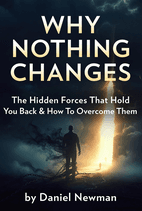
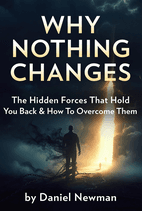
Daniel Newman's Why Nothing Changes reveals the hidden internal and external forces that keep people stuck, offering the Change Framework S™ and micro-actions to bypass the brain's threat-detection system. Written for anyone feeling trapped in career, health, or personal growth despite genuine effort.
Feature
Insta.Page
Blinkist
Shortform
Summary Depth
Full Chapter-by-Chapter
15-min overview
Section-by-section guides
Audio Narration
✓
✓
✓
Visual Mindmaps
✓
✕
✕
AI Q&A
✓
✕
✕
Quizzes
✓
✕
✕
PDF Downloads
✓
✕
✓
Price
$89.99/yr
$146/yr (PRO)
$199/yr
*Competitor data last verified July 2026.
1 Page Summary
Why Nothing Changes: The Hidden Forces That Hold You Back & How To Overcome Them argues that lasting, meaningful change fails not from a lack of willpower, but from unseen internal and external forces that keep people stuck. The book is structured in three parts: identifying what blocks you, applying effective tools, and sustaining progress. The author introduces the Change Framework S™ and uses his own personal journey to run a 5K as a relatable case study, illustrating that real change requires clarity, alignment, and deliberate action rather than frustration or sheer effort.
The book distinguishes itself by diagnosing specific, often invisible barriers. It explores the “quiet danger of comfort” and the role of the brain’s amygdala, which treats uncertainty as a threat, leading people to cling to stability that may actually erode their potential. Deeper traps include “cognitive armor”—identities that once protected us but now confine us—and confirmation bias, which bends facts to fit a self-limiting story. The solution is not more willpower but “micro-actions”: steps so small they bypass the brain’s threat-detection system, building momentum without triggering resistance. The author also explains that plateaus are not failures but signs of “skill saturation,” a point where your current approach has reached its limit.
The intended audience is anyone who feels stuck despite genuine desire and effort—whether in career, personal growth, health, or business. Readers will learn to reframe their struggles as a “design problem” of misalignment between values, identity, behaviors, and environment, rather than a character flaw. The book provides concrete, research-backed frameworks for weight loss, career growth, and organizational change, emphasizing that alignment is not a single heroic decision but a practice of tiny, consistent corrections. Ultimately, readers will gain a system for building a life where transformation not only happens but sticks.
INTRODUCTION
Overview
The Introduction lays out the book's three-part structure, each targeting a distinct phase of change: identifying what's blocking you, applying tools that actually work, and sustaining progress once it takes root. The author emphasizes that real, lasting change doesn't come from sheer willpower—it comes from understanding the hidden forces at play and learning to navigate them with intention. The framework here promises a path built on clarity, alignment, and deliberate action, not frustration. Interwoven throughout is the author's personal struggle to run a 5K, using that journey to illustrate the small wins, setbacks, and invisible barriers that shape all meaningful change. By the end, readers will have a concrete set of strategies and a framework—the Change Framework S™—to rely on.
Key Takeaways
Change fails not because we lack willpower, but because we don't see or address the underlying forces blocking us.
The book is organized into three clear layers: what's blocking you, what to do, and how to maintain change.
Practical, research-backed tools are offered in every chapter for immediate use, not just theory.
The author's own 5K journey serves as a relatable, honest case study of the principles in action.
Key concepts: INTRODUCTION
1. INTRODUCTION
Three-Part Structure of Change
Identify what's blocking you
Apply tools that actually work
Sustain progress once it takes root
Core Philosophy of Change
Real change doesn't come from sheer willpower
Understand hidden forces at play
Navigate with intention and clarity
Path built on alignment and deliberate action
Author's 5K Journey as Case Study
Illustrates small wins and setbacks
Reveals invisible barriers to change
Demonstrates principles in action
Shows Change Framework S™ in practice
💡 Try clicking the AI chat button to ask questions about this book!
Part I
Overview
The quiet danger of comfort lulls you into mistaking stability for success, as Jim discovered when his logistics empire stopped growing because he had stopped growing. The brain’s amygdala treats uncertainty as threat, so you cling to a job you neither love nor hate—until that very stability collapses, costing a decade of potential. The real toll of staying still is hidden: fragile resilience from never facing discomfort, a narrowed imagination that shrinks your sense of possibility, weakened courage from repeatedly practicing fear, and a status quo trap that keeps you standing on an eroding island because the cracks are familiar. Intentions rarely stand a chance against habits that run on autopilot, triggered by cues and rewarded with momentary relief. But once you name the cue and the reward, you can swap the routine while keeping the payoff. Deeper still lies cognitive armor—identities like “I’m not a singer” or “I’m the responsible one” that were once protective but now trap you. Your mind’s favorite defense is confirmation bias: it bends every fact to fit the story you already believe, even when that story leads to being fired while still convinced of a conspiracy. And you are not stuck only by internal stories; the systems around you—family, work, culture—enforce roles, maintain predictability, and interpret your growth as abandonment. Every meaningful change demands a funeral for the old life, and fear of looking like a beginner keeps you wobbling on the edge. The antidote is to shrink the change into micro-actions that bypass the brain’s threat detection. But none of this works if you only try to change behavior, because behavior sits on the surface. Underneath is identity—the answer to “Who am I?” Identity provides predictability, coherence, belonging, stability, and a sense of self. Changing it feels like losing the psychological glue holding you together. The behavior-evidence-identity loop shows how a single avoided budget becomes “proof” you’re bad with money, tightening the trap. Yet the same loop can work for you: one workout casts an identity vote for “I’m someone who takes care of my body.” Identity is built through repetition, not dramatic transformation. To shift it, you first name the old identity—see where it came from, what it fears, whether it still serves you. Then you define the new identity consciously: who do you want to become, what small action today would that person take? When identity shifts, habits align, environment cooperates, cognitive armor softens, and willpower becomes irrelevant. Identity is not who you are; identity is who you repeatedly become.
Jim's Comfort Trap
Jim built a logistics company from scratch, sleeping under his desk and delivering shipments himself. Within five years, the hustle paid off—glass walls, sparkling water, a sense of having "made it." But comfort became a silent architect. As he later reflected, "Comfort had disguised itself as success." His company grew, but his own growth plateaued. The very stability he'd worked for became the walls of his new prison. The trap is persuasive because it speaks the language of survival. A client who held a job for twelve years—neither loving nor hating it—illustrates the cost. He kept telling himself he'd leave "once things settled down." Then his manager told him he was being let go for lack of growth. Comfort had cost him a decade of potential.
The Real Costs of Staying Still
Comfort doesn't feel dangerous, but it exacts a toll. Four hidden costs stand out:
Fragile Resilience: Avoiding discomfort means you never develop the psychological muscle to handle life's challenges.
Narrowed Imagination: When you stop seeking new experiences, your brain stops generating new options. Your sense of what's possible shrinks.
Weakened Courage: Every time you avoid discomfort, you practice fear. Every time you step into it, you practice courage.
The Status Quo Trap: Even when the alternative is clearly better, most people choose the familiar path. Your brain whispers, "Let's keep things as they are."
Why Habits Outcompete Intention
Habits win because they're energy-efficient, fast, and emotionally rewarding. By the time you think about what you want to do, your habit has already done something different. A friend thought she lacked discipline, but the issue was simpler: boredom. Her brain responded to the same cue over and over. Once you identify the cue, the whole pattern becomes changeable. You don't have to fight your bad habits. You just need to understand what's pulling the strings.
The Routine: The Automatic Middle
Your brain is wired for immediacy. You scroll not because you like it, but because it gives momentary escape. You procrastinate not because you're lazy, but because it eases anxiety. Understanding the reward makes the behavior stop being a mystery. Then you can replace the routine: keep the cue, keep the reward, but give your brain a better route to the same destination.
Cognitive Armor
The author recalls a childhood moment when someone said, "You can't sing." She built an entire identity around that comment because familiarity felt safe. Years later, her music teacher gently insisted she try one note. He said, "See? You can sing. You just don't believe you can." That was cognitive armor at work—identity trapping rather than protecting. Cognitive armor often begins with statements like "I'm the responsible one" or "I'm the quiet one." These identities were useful once, but they don't update automatically. Identity creates behavioral gravity, pulling behavior toward itself so powerfully that you end up behaving according to who you believe you are, not what you want to become.
The Mind's Favorite Defense
Confirmation bias distorts how you behave in the world. An employee complained about communication issues, but her team saw her as controlling. When she got feedback, she dismissed it as jealousy. Complaints piled up, turnover spiked, and she was escorted out of the building—still convinced she was the victim of a conspiracy. Facts rarely change minds because beliefs come first. Your brain is more storyteller than scientist. It protects the story you already believe.
The Systems That Keep You Stuck
You're not stuck only because of you. You're stuck because the systems around you are designed to keep you in place. When a client tried to save money for a career change, unexpected medical bills wiped out his savings. When he carved out time, family obligations expanded to fill it. When he dreamed aloud, people reminded him to be grateful. These systems enforce roles, maintain predictability, prefer balance over progress, and interpret growth as abandonment. Breaking free requires naming the system. Ask yourself: "What invisible scripts am I following?"
The Emotional Cost of Change
Change requires letting go, and letting go hurts. Every meaningful transformation demands a funeral—grieving the old life, even when the new life is better. The fear of incompetence is a major barrier: the ego hates looking like a beginner. But you must wobble before you walk. The antidote is to shrink the change. Micro-actions bypass the brain's threat-detection system. A 1-minute walk beats getting in shape. One messy paragraph beats writing a book. Fear isn't a sign you're on the wrong path—it's a sign you've stepped beyond the known. Your brain is trying to restore equilibrium, because identity determines what feels natural, possible, and "like you."
The Identity Problem
Most people try to change their lives by changing behavior. But behavior is the surface layer. Underneath lies identity—the answer to "Who am I?" The mind is fiercely loyal to that answer because identity provides predictability, coherence, belonging, stability, and a sense of self. When you change your identity, you temporarily lose all of it. Even if the old identity was painful, it was known. Changing identity feels like losing the psychological glue holding your world together.
The Behavior → Evidence → Identity Loop
Consider someone who avoids budgeting. She avoids planning because it feels like pretending to be someone she isn't. Avoidance isn't a flaw—it's a logical response to an identity. But avoidance creates chaos. Late fees, overdrafts, missed payments become "proof." "See? I am bad with money." The loop tightens: the more she believes she's bad with money, the more she avoids being responsible. The more she avoids, the more evidence piles up. This loop works the other way too. One workout reinforces "I'm someone who takes care of my body." One avoided conversation reinforces "I'm someone who avoids conflict."
The Liberating Side: Identity Votes
You can create new evidence at any moment. Identity isn't built through dramatic transformation. It's built through repetition—tiny, almost invisible actions that accumulate into a new self-concept. Small habits and micro-actions are not just behaviors—they're identity votes.
Two Steps to Shift Identity
Step 1: Name the Old Identity. Ask yourself: What identity am I protecting? Where did it come from? Is it still serving me? What does this identity fear losing? Naming the identity weakens its grip by moving it from instinct to awareness.
Step 2: Define the New Identity. Identity cannot be left to chance. Ask: Who do I want to become? What does that person do naturally? What small action today would be consistent with that person?
The Chapter's Core Message
You cannot change your life by trying to behave differently. You change your life by becoming someone who behaves differently. Identity is the foundation of transformation.
**
Key concepts: Part I
2. Part I
The Comfort Trap
Comfort disguises itself as success
Stability can become a prison
Growth stops when comfort begins
A decade of potential can be lost
Hidden Costs of Staying Still
Fragile resilience from avoiding discomfort
Narrowed imagination shrinks possibilities
Weakened courage from practicing fear
Status quo trap keeps you on eroding ground
Why Habits Beat Intentions
Habits are energy-efficient and fast
Autopilot runs before conscious thought
Cues and rewards drive the pattern
Swap the routine, keep the payoff
Cognitive Armor
Old identities like 'I can't sing' trap you
Confirmation bias bends facts to fit stories
Identity creates behavioral gravity
Armor once protected, now limits growth
Systems That Enforce Stuckness
Family, work, and culture enforce roles
Systems interpret growth as abandonment
Predictability is maintained at your expense
Change requires a funeral for the old life
The Identity Loop
Behavior creates evidence for identity
One avoided budget proves 'bad with money'
One workout votes for 'takes care of body'
Identity is built through repetition
Shifting Identity
Name the old identity and its origins
Define who you want to become consciously
Take small actions that new identity would take
Identity is who you repeatedly become
Part II
Overview
The first half of Part II lays down a crucial insight: our brains are wired to see big change as a threat, not an opportunity. That’s why New Year’s resolutions crash and ambitious plans unravel. The brain’s threat-detection system treats massive shifts like a predator, triggering resistance, procrastination, and even self-sabotage. The solution isn’t more willpower—it’s shrinking the change until your nervous system stops raising alarms. That’s where micro-actions come in.
Micro-actions are so small they slip past your brain’s defenses. They don’t require courage, motivation, or a “new you.” They just need a step so tiny there’s no internal debate. And here’s the magic: once you take that step, momentum builds naturally. The book breaks down three types of micro-actions—those that reduce resistance, those that build consistency, and those that serve as entry points into bigger behaviors. Each type works because it strips away the complexity and pressure that normally kill progress.
But micro-actions alone aren’t enough. Sooner or later you hit a plateau—that flat stretch where nothing seems to happen. The text explains this is actually skill saturation: your current approach has taken you as far as it can. You’re not failing; you’re outgrowing. The problem is we expect linear progress, so when the line flattens we panic and quit. The real fix isn’t pushing harder—it’s using feedback loops to adjust your strategy.
That’s where the feedback loop becomes your secret weapon. It’s a simple cycle: act, measure, reflect, adjust, repeat. Without feedback, change is guesswork. With it, change becomes engineered. The weekly review is a powerful ritual for this—a chance to step off autopilot and ask what’s working, what’s not, and what needs tweaking. Even one small adjustment per week compounds over time.
Then the book covers self-regulation—the invisible skill behind every successful change. Most people think they fail from lack of motivation, but the real culprit is poor regulation of emotions, attention, and energy. When you’re tired, stressed, or overwhelmed, your brain’s survival mode hijacks your choices. You avoid, distract, or self-sabotage not because you’re weak, but because you haven’t learned to calm your internal intensity in the moment.
The solution is threefold: emotional regulation (using breath work or sensory resets to downshift your nervous system), attention regulation (protecting your focus with rituals and time blocks), and energy regulation (managing your capacity so you don’t run on fumes). These skills turn intention into action, even on your worst days.
The chapter closes with a powerful truth: plateaus aren’t walls—they’re workshops. Every meaningful transformation hits a flat stretch where growth feels invisible. But that’s exactly where the breakthrough is forged, provided you keep going, keep adjusting, and keep trusting the process.
Key Takeaways
Big change triggers threat responses. Shrink your actions until your brain doesn’t resist them.
Micro-actions build momentum without demanding willpower. Consistency beats heroism every time.
Feedback loops turn plateaus into progress. Review weekly—adjust one thing at a time.
Self-regulation is more important than motivation. Regulate emotions, attention, and energy to stay on track.
Plateaus are thresholds, not dead ends. They signal it’s time to change your approach, not your goal.
Key concepts: Part II
3. Part II
Big Change Triggers Threat Response
Brain sees large shifts as predators
Resistance, procrastination, self-sabotage follow
Solution: shrink change to bypass defenses
Micro-Actions Build Momentum
Tiny steps slip past brain's alarms
No courage or motivation required
Three types: reduce resistance, build consistency, entry points
Plateaus Signal Skill Saturation
Flat stretches mean outgrowing current approach
Not failure—need strategy adjustment
Feedback loops: act, measure, reflect, adjust
Self-Regulation Trumps Motivation
Real culprit: poor emotion, attention, energy regulation
Emotional regulation via breath work or sensory resets
Attention regulation with rituals and time blocks
Plateaus Are Workshops, Not Walls
Breakthrough forged in invisible growth
Keep going, keep adjusting, trust process
Weekly reviews compound small adjustments
Part III
Overview
Part III gets to the heart of why change so often stalls. It's not that you lack willpower or desire—it's that your inner world and outer actions are pulling in opposite directions. This section reframes the struggle as misalignment: a system of friction where your values, identity, behaviors, and environment don't match. The good news is that misalignment isn't a character flaw; it's a design problem you can fix. From here, the chapter walks you through what real alignment feels like, why relapse is predictable (not a moral failure), and how to build a life where transformation doesn't just happen but sticks. It also offers concrete frameworks for weight loss, career growth, and business change—each one rooted in the same underlying principles.
Alignment Is a Practice, Not a Declaration
Alignment isn't a single heroic decision. It's a series of tiny, consistent corrections—like tuning an instrument over and over until the sound matches the song you want to play. When you're aligned, life feels clearer, easier, and more authentic. You stop fighting yourself because your daily actions actually reflect what you care about. The chapter emphasizes that identity must evolve to match your values, not the other way around. If you value health but still see yourself as someone who hates exercise, you'll remain stuck until that story shifts.
Why Relapse Happens—and How to Recover
Relapse is not random; it's a predictable response to specific pressures. The five main causes are stress overload, emotional triggers, environmental cues, identity fatigue, and cognitive depletion. Stress, especially, hijacks the brain's executive function and drives you back to old comfort patterns. Environmental cues—like walking into the kitchen where you used to snack—bypass your conscious intention entirely. Identity fatigue happens when the new self isn't fully formed yet, so the old identity's gravitational pull is still strong. The key is to normalize relapse, identify the trigger, and recover quickly and compassionately. Success doesn't belong to people who never slip; it belongs to those who learn to return.
The Long Game: Endurance Over Intensity
Intensity feels powerful in the moment but collapses at the first sign of real life—tiredness, stress, fading motivation. Endurance, on the other hand, asks only that you keep showing up. The long game is about building systems that keep you moving forward even when inspiration disappears. Maintenance isn't stagnation; it's stewardship. It's the quiet, steady effort to preserve progress through routines, environmental design, micro-actions, and community. Community accelerates transformation by providing mirrors that reflect your growth, anchors during turbulence, and shared momentum. The goal isn't to arrive at some perfect, finished version of yourself—that person doesn't exist. The goal is to become a system that keeps developing.
Practical Frameworks for Real Change
The chapter closes with three applied frameworks—for weight loss, career advancement, and business growth. Each one translates the core principles into actionable steps:
For weight loss: identify the real habit loop (loneliness → overeating), build cognitive armor awareness, use micro-actions like 10 squats while waiting for coffee, and create feedback loops.
For your career: replace "trying harder" with systems, embrace micro-actions (one networking message every two days), set up weekly reflection loops, and align your daily actions with your professional identity.
For your business: challenge limiting beliefs like "we can't raise prices," let go of the old business identity, normalize relapse as learning, and implement long-term planning rhythms.
Each framework shows that change isn't about fighting yourself—it's about redesigning your ecosystem.
Key Takeaways
Misalignment feels like friction because your values, identity, and behaviors are out of sync. Alignment is achieved through small, deliberate corrections, not grand declarations.
Relapse is predictable and recoverable. It's caused by stress, triggers, environment, identity fatigue, and depletion. Normalize it, identify the trigger, and return without shame.
Endurance beats intensity. Intensity relies on ideal conditions; endurance is about staying in the game even when the rules change. Consistency isn't sameness—it's adaptation.
Maintenance is stewardship. What you've built needs ongoing care through routines, environment design, micro-actions, and a supportive community.
You will never “arrive.” Growth is not a project to finish but a system to develop. Embrace being unfinished—it removes the pressure and opens the door to continuous evolution.
Practical frameworks work best when they address the whole ecosystem: identity, environment, emotional patterns, feedback loops, and social support. Change is “you vs. your ecosystem,” not just “you vs. you.”
Key concepts: Part III
4. Part III
Alignment as a Practice
Tiny consistent corrections, not heroic decisions
Life feels clearer when actions match values
Identity must evolve to match values
Stop fighting yourself through daily alignment
Why Relapse Happens
Predictable response to stress, triggers, and cues
Five causes: stress, emotions, environment, identity fatigue, depletion
Daniel Newman is a technology and business analyst, author, and co-founder of the Futurum Research group. He is known for his expertise in digital transformation, artificial intelligence, and market strategy, and is a co-author of the book *The Future of Business: Navigating the AI Revolution*. Newman frequently contributes to Forbes and appears as a commentator on tech industry trends.
Frequently Asked Questions about Why Nothing Changes
What is Why Nothing Changes about?
The book explores why meaningful change often stalls despite our best intentions, arguing that the real culprit isn't a lack of willpower but unseen forces like comfort zones, cognitive armor, and misalignment between values and actions. It is structured in three parts: identifying what blocks you, applying practical tools like micro-actions to bypass the brain's threat response, and sustaining progress by designing alignment into your life. Through the author's own relatable struggle to run a 5K, it illustrates how small wins, setbacks, and hidden barriers shape all lasting transformation.
Who is the author of Why Nothing Changes?
Daniel Newman is the author and a thought leader on change, drawing on his personal journey and research to illuminate why people get stuck. In the book, he candidly shares his own attempt to run a 5K as a case study, making the principles relatable and grounded in real experience.
Is Why Nothing Changes worth reading?
Yes, because it moves beyond generic motivation to offer a concrete, research-backed framework—the Change Framework S™—for overcoming the specific psychological and environmental blocks that sabotage change. Each chapter provides immediately actionable tools, and the author's honest 5K journey makes the concepts feel achievable rather than theoretical.
What are the key lessons from Why Nothing Changes?
The primary lesson is that change fails not from a lack of willpower but from hidden forces like comfort, cognitive armor, and misalignment—which can be systematically addressed. Micro-actions, or steps so small they bypass the brain's threat response, are the most effective way to start building momentum without triggering resistance. Finally, lasting change requires ongoing alignment between your identity, values, behaviors, and environment; relapse is a predictable design problem, not a moral failure, and can be corrected through tiny, consistent adjustments.
📚 Explore Our Book Summary Library
Discover more insightful book summaries from our collection