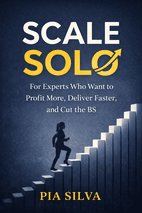
Pia Silva's Scale Solo provides a framework for coaches and consultants to achieve greater profitability by productizing their services into high-value standardized packages. It guides established solo experts toward a sustainable business model that maximizes impact while intentionally staying small.
Feature
Insta.Page
Blinkist
Shortform
Scale Solo
✓
✕
✕
Summary Depth
Full Chapter-by-Chapter
15-min overview
Section-by-section guides
Audio Narration
✓
✓
✓
Visual Mindmaps
✓
✕
✕
AI Q&A
✓
✕
✕
Quizzes
✓
✕
✕
PDF Downloads
✓
✕
✓
Price
$89.99/yr
$146/yr (PRO)
$199/yr
*Competitor data last verified July 2026.
1 Page Summary
In Scale Solo: For Experts Who Want to Profit More, Deliver Faster, and Cut the BS, Pia Silva argues against the conventional wisdom of scaling a business by building a large team. Her central thesis is that solo experts—coaches, consultants, designers, and other service providers—can achieve greater profitability, freedom, and impact by intentionally staying small and leveraging a high-value, productized service model. Silva contends that the relentless pursuit of team growth often leads to more complexity, lower margins, and burnout, whereas a strategically "scaled solo" practice focuses on maximizing the value and efficiency of a single expert's work.
Silva's distinctive approach, building on the principles from her first book Badass Your Brand, is to replace custom, scope-creep-prone service delivery with a streamlined "offer suite" of standardized, high-ticket packages. This involves creating a clear, repeatable process for a specific, well-defined problem, which allows the solo practitioner to deliver consistent results faster and command premium prices. The book is a practical guide to this mindset shift, providing a framework to eliminate administrative busywork, systematize marketing and sales, and confidently turn away clients who aren't a perfect fit for the optimized offer.
The intended audience is established experts and service-based entrepreneurs who are proficient in their craft but feel trapped in the "feast-or-famine" cycle or overwhelmed by the demands of a growing team. Readers will gain a clear roadmap to transition from a generalist, hourly-billed consultant to a specialist with a valuable, sellable product. The promised outcome is a more profitable and sustainable business that provides greater income per client, more free time, and the professional satisfaction of doing deeply impactful work without the traditional headaches of scaling.
INTRODUCTION
Overview
This chapter introduces the core problem facing modern service-based entrepreneurs: the chaotic pursuit of growth has robbed them of the freedom and autonomy that inspired them to start their business in the first place. The author shares how her previous book unexpectedly revealed a deep hunger for a practical business model that prioritizes lifestyle over scale. She positions this book as the "permission slip" and playbook for building a streamlined, profitable business without a large team, born from her own journey from debt to a lean, high-earning operation.
For the People Who Chose Freedom On Purpose
The author passionately defends the choice to stay small, pushing back against common entrepreneurial rhetoric that equates having a team with being a "real" business. She argues this mindset unfairly disparages skilled professionals who prioritize agency, craft, and life outside of work. She speaks directly to those who want a lean, flexible operation that provides enough—enough money, enough respect, and enough time—and shares her own story. Her entrepreneurial drive was always fueled by a desire to avoid traditional employment, leading to years of "gigging" before partnering with her husband to build their branding agency. This book is framed as the guide she lacked during that often-messy figuring-it-out phase.
Who This Book Is (and Isn't) For
The book is explicitly designed for expert service providers (designers, copywriters, coaches, consultants, etc.) whose greatest asset is their skill. It is for those who want to earn excellent money while maintaining a humane schedule and loving their work. It is not for founders seeking venture-funded, hyper-scale growth. The author clarifies that her model, dubbed The No BS Business Model, is not anti-growth but rather anti-unintentional growth. It’s a pro-model for staying small, profitable, and team-optional by cutting out inefficiency and time-wasting nonsense. She warns that some ideas will be radical or counter to common advice and encourages reading with a beginner's mindset.
The Core Model: A Path Out of the Clutter
The author promises a clear system to replace the overwhelm, built around five interconnected pillars:
A Financial Model: The 50/25/25 Rule to Profit and Freedom, which uses numbers to define "enough" and balance work with life.
A Marketing Model: A focus on a few consistent actions to fill the pipeline, eliminating all other marketing "shoulds."
A Sales Model: The Lead Product™ Method to replace free pitches, positioning the owner as an authority and saving time.
A Delivery Model: Built around Intensives—condensed, high-value engagements that benefit both client and provider.
A Money Mindset Model: A necessary cash flow strategy to achieve true freedom and ease.
The model is presented as a proven backbone, validated by the author's own results and the successes of her students, who have booked out months in advance, closed higher-priced projects, and claimed real time freedom.
Key Takeaways
The Freedom Gap: Many entrepreneurs are trapped by operational and strategic clutter, chasing a default model of growth that steals the very freedom they sought.
Permission to Stay Small: Building a "real" business does not require a large team. Choosing a lean, lifestyle-focused operation is a valid and respected path.
A System, Not Just Inspiration: The book provides a complete, actionable playbook—The No BS Business Model—comprising five core components designed to work together for profitability and ease.
Clarity on Audience: This book is specifically for expert service providers who want to earn more in less time, not for those pursuing venture-scale growth.
A Mindset Shift: Success requires suspending preconceived notions and embracing some radical, counterintuitive ideas about pricing, delivery, and sales.
Key concepts: INTRODUCTION
1. INTRODUCTION
The Core Problem: Freedom Gap
Growth obsession steals entrepreneurial freedom
Chaos replaces the autonomy they sought
Need for a practical, lifestyle-first business model
Defending the Choice to Stay Small
Valid path for skilled professionals
Prioritizes agency, craft, and life balance
Earn enough money, respect, and time
Target Audience: Expert Service Providers
For designers, coaches, consultants, etc.
Not for venture-funded hyper-scale growth
Wants excellent income with humane schedule
The No BS Business Model Pillars
Financial: 50/25/25 Rule for profit
Marketing: Few consistent actions only
Sales: Lead Product™ Method replaces pitches
Delivery: Intensives for condensed engagements
Required Mindset Shift
Embrace radical, counterintuitive ideas
Anti-unintentional growth, not anti-growth
System replaces overwhelm with clarity
💡 Try clicking the AI chat button to ask questions about this book!
PART ONE: THE DEFAULT MODEL
Overview
It all starts with a familiar story of frustration: a seemingly great project that devolves into endless revisions, stressful communication, and, after all the hours are counted, abysmal pay. This isn't just bad luck; it's the inevitable result of operating on what's called the Default Model. This is the standard, broken playbook for most experts and creatives, characterized by free upfront work, vague project pricing tied to hours, clients acting as de facto bosses, and scope creep that eats all the profit. It's a hamster wheel that trades the constraints of a job for a more chaotic version of the same thing, often leaving the business owner overworked, underpaid, and in debt despite decent revenue.
The turning point comes from realizing that the problem isn't a lack of clients or skill, but fundamentally unprofitable offers. A hidden experiment with a simple, one-day intensive service revealed a shocking truth: it generated three times the profit margin of a large, complex project. The Default Model persists because of tradition and mimicry—we copy what we see, not realizing we're following a recipe for burnout. The core misdiagnosis is focusing on revenue over profit, leading to hiring teams and adding complexity before the business can sustainably support it.
The escape route is The No BS Business Model, a framework built for maximum profit and freedom. It demands radical simplification across five key areas: one financial target, one core market, one sales method, one outreach strategy, and one delivery process. This focused approach begins by defining your Freedom Number—the precise annual revenue needed to fund both your desired personal life and your business operations after taxes. This isn't a vague dream figure; it's a calculated target based on your actual expenses and aspirations.
Knowing your number is only half the battle. The 50/25/25 Rule provides the structure to hit it sustainably, allocating your working year so that 50% of your time generates all revenue through client work, 25% is for working on your business, and 25% is protected freedom time. This formula allows you to work backward to determine the necessary price for your services. If your current pricing falls short, you have only two levers to pull: increase the real and perceived value of what you deliver, transforming from a vendor to a trusted advisor, and decrease the time it takes to deliver by ruthlessly cutting bloat and systematizing your process. By pulling both levers, you escape trading hours for dollars, creating a business that is both highly profitable and truly freeing.
A Painful Early Project
In 2012, landing a $7,250 branding and website project for a consulting firm felt like a major win. The process, however, was a nightmare. The proposal was a bloated 25-page deck built to justify the price. The three partners had conflicting visions, leading to endless rounds of revisions where designs were "close... almost there" but never quite right. The project stretched for months, communication was constant and stressful, and chasing the final payment was demoralizing. In the end, after calculating the hours, the profit worked out to a mere $20 per hour—less than a previous day job.
This experience wasn't an anomaly; it was a symptom of the broken system the author was using.
The Anatomy of a Broken System: The Default Model
This chaotic, unprofitable way of working is named the Default Model. It's the standard hamster wheel for most service-based businesses and is characterized by:
Free work up front (lengthy proposals, spec work).
Hourly or vague project pricing based on estimated hours.
Momentum-killing payment structures tied to client-dependent phases.
The client as the boss, leading to constant accommodation and fear.
Inevitable scope creep and endless revisions.
Retainers used as a band-aid that fail to solve the underlying chaos.
This model was learned by copying other small agencies. It guarantees being overworked and underpaid, trapping business owners in a cycle of feast and famine. You leave a job for freedom, only to find your clients have become demanding new bosses, and the business requires constant hustle just to survive.
The Failure That Revealed the Truth
Despite generating $250,000 in revenue over twelve months, the business was $40,000 in debt. The problem wasn't a lack of clients or skill; it was that the big, complex projects were fundamentally unprofitable. The administrative drag of emails, meetings, and revisions consumed all the profit.
The turning point was analyzing a small, hidden experiment called the "Brandup"—a one-day, $2,995 intensive where the team delivered as much as possible in eight hours with no revisions. While the author was initially embarrassed by this "small" offer, the math was undeniable: thirty days of work on a $30,000 project yielded $30,000, but thirty separate Brandup days would yield $90,000. The simpler, focused offer was dramatically more profitable.
Why We Get Stuck in the Default Model
The Default Model persists due to tradition and mimicry, likened to the story of a family who always cut the ends off a pot roast because a great-grandmother's oven was small—long after the original reason was irrelevant. Most experts start with a skill, not an MBA, and default to one of two patterns:
Copying the bloated agency model from a previous employer.
Charging hourly because it feels "safe," not realizing it creates an income ceiling and ties payment directly to time traded.
"Success" within this model often makes things worse, leading to more complexity, the stressful addition of under-profitably hired team members, and a treadmill that feels eerily similar to the job you left.
The Core Misdiagnosis: Profit vs. Revenue
A common mistake is believing that more clients and bigger budgets are the solution. This only adds more clutter and complexity. The real issue is that offers are unprofitable. Business owners often hire teams before their process reliably generates enough profit to support both payroll and their own salary. The result is high revenue but low personal income, as all the money goes to covering overhead.
Letting go of a team to simplify can feel like a step backward, but it's often the necessary step to regain profitability and sanity. The goal of business ownership is to pay yourself fairly and consistently—not just to generate revenue for others.
Introducing The No BS Business Model
The alternative is The No BS Business Model, designed for expert-led businesses that want maximum profit and freedom without a large team. It recognizes that as the primary expert, you cannot succeed with an overloaded, complex operation. The model requires radical simplification across five key areas:
One Freedom Number: Your precise financial target.
One Core Market: A specific, well-defined audience.
One Sales Mechanism: A reliable, repeatable way to close clients.
One Killer Outreach Strategy: A focused method for attracting your ideal market.
One Delivery Process: A streamlined, repeatable system for your work.
This focus provides clarity, reduces waste, and ensures your limited time is spent only on activities that directly drive toward your Freedom Number. The following section begins by breaking down how to calculate that critical number.
Calculating Your Freedom Number
The chapter challenges the vague aspiration of “I want to make $X” by introducing a concrete, tangible alternative: the Freedom Number. This is the total annual revenue your business must generate to fund both your desired personal life and your business operations, after taxes. It moves you from an abstract financial goal to a figure rooted in your actual costs and aspirations.
The calculation is a three-step process:
Determine Personal Income Needs: Tally all annual household expenditures for a life of "contentment"—covering needs, wants, and savings goals. This is the post-tax income you require.
Account for Taxes: Divide that personal income number by 0.7. This rough estimate (assuming a ~30% tax rate) gives you the pre-tax personal income you must generate.
Add Business Expenses: Add your total annual cost of running and strategically investing in your business (software, contractors, marketing, etc.) to the pre-tax personal income figure.
The resulting total is your Freedom Number. This exercise often reveals a significant gap—a goal of taking home $200,000 personally might require over $320,000 in revenue. Conversely, it can relieve pressure by showing that a seemingly modest number is actually sufficient for your desired freedom.
The 50/25/25 Rule to Profit and Freedom
Once you have your Freedom Number, you need a framework to hit it without sacrificing your freedom. The 50/25/25 Rule provides that structure. It dictates how to allocate your working hours across a year (calculated at 48 weeks to build in vacation time):
50% of your time (960 hours/year) is for client work that generates all your revenue.
25% of your time is for working on your business—marketing, systems, and long-term development.
25% of your time is protected "freedom" time for personal days or optional business reinvestment.
This formula allows you to work backward from your Freedom Number to determine the necessary price for your offers. For instance, if a common project takes 80 hours and your Freedom Number is $321,000, that project must be priced at approximately $26,750 to support your goals.
The Two Levers: Value and Efficiency
If your current pricing falls short of what the 50/25/25 calculation says you need, you have only two levers to pull:
Lever 1: Increase the Real—and Perceived—Value of What You Deliver. This involves shifting from being a vendor to a trusted advisor, transforming free work into paid engagements, and packaging your expertise as premium solutions. This allows for significant price increases without adding more time or overhead.
Lever 2: Decrease the Time It Takes to Deliver. This is about ruthlessly cutting bloat, installing repeatable systems, and condensing service delivery into focused, high-value periods (like "Intensives"). Streamlining delivery can reclaim 20-50% of the time spent on a project.
Pulling both levers simultaneously is transformative. By delivering greater value in less time, you escape trading hours for dollars. Real-world examples, like a designer moving from grueling, months-long $30,000 projects to $40,000+ two-day Intensives, demonstrate that this model leads to higher profits, greater freedom, and more satisfied clients.
Key Takeaways
Your Freedom Number is your true financial target—the revenue required to fund your ideal business and personal life after taxes. It’s calculated from your actual expenses, not an arbitrary dream figure.
The 50/25/25 Rule is a framework for achieving that number sustainably, ensuring you dedicate time not just to client work, but to business development and personal freedom.
To bridge the gap between current pricing and your required pricing, you must pull two key levers: increase the perceived value of your offers and dramatically decrease the time it takes to deliver them.
Success with this model requires challenging deep-seated beliefs that equate time, effort, and struggle with value. The resistance is normal, but the payoff is a profitable business that doesn’t consume your life.
Key concepts: PART ONE: THE DEFAULT MODEL
2. PART ONE: THE DEFAULT MODEL
The Default Model Problem
Standard broken playbook for experts and creatives
Leads to endless revisions, stress, and abysmal pay
Traps owners in a chaotic hamster wheel of work
Characteristics of the Default Model
Free upfront work and vague project pricing
Client acts as boss causing constant accommodation
Inevitable scope creep and endless revisions
Root Cause: Unprofitable Offers
Problem is not lack of clients or skill
Focus on revenue over profit is core misdiagnosis
Complex projects have high administrative drag
The Revealing Experiment
One-day intensive generated triple profit margin
Simple offer proved dramatically more profitable
Challenged assumption that bigger projects are better
Why the Model Persists
Tradition and mimicry without questioning
Copying bloated agency models from employers
Hourly pricing feels safe but creates income ceiling
The No BS Business Model Solution
Framework built for maximum profit and freedom
Demands radical simplification across five areas
Begins with calculating your Freedom Number
Escape Strategy: Two Key Levers
Increase real and perceived value of services
Decrease time to deliver by cutting bloat
Transform from vendor to trusted advisor
PART TWO: NO BS MARKETING
Overview
So many entrepreneurs feel paralyzed by modern marketing, chasing shiny objects and burning out on tactics that never seem to deliver. The real problem isn’t the strategy itself; it’s often the mindset and commitment behind it. Success requires ditching the search for a magic bullet and embracing the sustained, often unglamorous work of building real connections. A major hurdle is the "head trash"—the imagined criticism and fear of being seen as pushy—that holds people back. A simple mental exercise, like personifying that negative noise as "Chad" and dismissing it, frees you to focus solely on the ideal clients who are actively wishing for your help.
Effective marketing for a small business can be distilled into a simple, four-step framework: find, connect, nurture, and offer. Within this, referrals are the powerhouse shortcut, as they often complete the first three steps instantly. Therefore, the primary goal should be building a reliable referral system, which requires three things: clarity in your message, a network of people, and a leveraged outreach strategy. Gaining that clarity means moving beyond vague industry niches to find process fit—working with clients who share similar business models and needs, allowing you to master a repeatable service. The best way to discover this niche is to analyze past clients who paid well, were enjoyable, and received your best work.
Building your network starts with an inventory of who you already know, ranked by their connection to your ideal client and their trust in you. The initial phase of broadening this network can feel like a grind, but it’s dual-purpose: it builds connections while sharpening your message. The real leverage comes from shifting from collecting contacts to deepening relationships through strategic nurturing, most powerfully by hosting gatherings. Whether an intimate dinner or a curated online event, hosting positions you as a connector and builds profound trust, creating a natural referral engine.
While authority content like blogs or social media has its place, its primary role is to nurture the warm network you’re building through direct connection, not to attract cold strangers. The rise of AI has only cemented this, flooding the digital world with generic content and making authentic relationship-building more valuable than ever. The proven sequence is clear: build your referral machine first, then use content to support and deepen those relationships. This human-centric approach, exemplified by introverts and extroverts alike, proves that sustainable success comes from network over audience. Ultimately, your marketing works when your message is so clear that it immediately makes people think of someone you can help.
The Overwhelm of Modern Marketing
The experience of marketing often feels futile—hours spent on social posts yield little engagement, networking events feel like a waste of time, and paid ads can seem like burning money. This isn't just about having too many options; it's about pouring immense effort into strategies that yield unsatisfying, slow results. This constant pressure to do more creates a paralyzing cycle where the creative energy needed for effective marketing is suffocated by anxiety and "shoulds."
Why We Chase Shiny Objects
A major source of this overwhelm is the marketing sold to us by marketing experts. Their messaging often promises incredible results (like closing high-ticket clients with a single call) without the hard, unglamorous work. This cultivates a belief in a "magic bullet"—a secret trick that makes success easy and instant. This belief leads to a cycle of trying new tactics, giving up when results aren't immediate, and concluding the strategy doesn't work, rather than recognizing that all successful marketing requires consistent, committed action and skill development.
The Real Secret: Mindset and Commitment
The true "secret" to marketing isn't a hidden tactic; it's the marketer's own mindset, expectations, and willingness to commit. It's the internal fortitude to stick with a strategy long enough for it to work, making incremental improvements along the way. A strategy is only about 5% of the equation; the other 95% is sustained action. People often abandon strategies because, deep down, they don't truly believe they will work or they have unrealistic expectations about the timeline and definition of success. Your goal must be realistic for the effort you're willing to invest.
Clearing Your "Head Trash"
Most business owners carry mental baggage—or "head trash"—that sabotages their marketing. This is the tendency to imagine negative reactions (like being seen as "slimy") instead of focusing on the ideal clients actively searching for your help. Our brains are wired to give disproportionate weight to negative feedback, like a single critical comment amid a sea of praise. This fear can cause us to avoid putting ourselves out there, holding back messaging ideas and avoiding effective channels like email marketing for fear of being seen as "spammy."
Rewiring Your Focus: The "Chad" Exercise
To combat this, you must consciously retrain your brain. Your marketing is only for the people who want and need it. Imagine your ideal client at their kitchen table, desperately wishing for a solution you provide. They exist, but they don't know you're there. Your sole job is to find them and let them know you exist. Everyone else—the critics, the uninterested—is irrelevant background noise.
A practical tool is to personify this negative noise. Give it a name, like "Chad." Whenever you hesitate because of what "Chad" might think, you can consciously dismiss him: "This isn't for you, Chad. Buh-bye!" This mental shift frees your energy to focus on connecting with the people who will be ecstatic to find you.
The Four-Step Marketing Framework
For a small business selling expertise, marketing boils down to four essential steps that every client moves through:
FIND: Locate people in your target market.
CONNECT: Make them aware you exist.
NURTURE: Deepen the connection until you're the obvious choice (building like and trust).
OFFER: Present a solution to their problem.
A marketing plan is simply a series of weekly actions that systematically move new people through this funnel.
The Power and Priority of Referrals
When you receive a referral, steps 1 through 3 are often completed instantly. The referrer has found the person, connected you, and transferred their trust. The prospect usually already knows they have a problem you can solve. This makes referrals the shortest, most reliable path to profitable clients. Therefore, building a marketing system that generates referrals should be the primary goal, as it delivers qualified leads with the hardest work already done.
Why Content Comes Second
While creating online authority content (writing, speaking, teaching) is powerful for building trust at scale and clarifying your thinking, it is a long-term game requiring years of sustained effort to develop original, non-generic ideas. For most experts, content should initially serve to accelerate trust with referrals and sharpen your message. Prioritizing content before establishing a referral engine risks spending years creating into a void without revenue. The most reliable path to profitability is to put relationships and referrals first.
Building Your Referral Machine: The Three Requirements
To build an effective referral system, you need three core elements:
Clarity: A simple, clear message about who you work with, how you help them, and why you're different. Without this, even ideal clients in front of you won't recognize you as the solution. You can only attract the clients you are positioned to receive.
People: A warm network to speak to and a plan to grow it.
Leverage: One Killer Outreach (1KO) strategy—a repeatable process to nurture these relationships into clients and referrals.
Moving Beyond "Industry Only" Niching
Finding clarity often involves niching, but a niche isn't just an industry (e.g., "IT companies"). An industry-only niche can still be too broad, encompassing clients with vastly different needs, budgets, and processes. A more effective niche defines a specific stage, role, revenue level, business model, or problem. This allows you to develop a streamlined, repeatable process you can master and improve, which is essential for charging more while working less—a core principle of a profitable, sustainable business.
At its heart, effective marketing isn't about shouting into a void; it's about building a system where your ideal clients find you. This system starts with ruthless clarity about who you serve and is powered by a network that actively refers them to you.
The Foundation: Process Fit Over Industry Niche
The secret to delivering exceptional value efficiently isn't finding clients in a specific industry, but finding clients who fit seamlessly into a repeatable process you've mastered. The goal is to work with clients who have similar business models, inputs (like time and expertise), and goals. This means that, regardless of their industry, they will have fundamentally the same needs when it comes to branding, messaging, and strategy. When you achieve this process fit, your work can feel custom to the client while your delivery system remains consistent and effortless.
Choosing Your Niche with Real-World Data
Forget choosing a niche based on a hunch. The most reliable method is to analyze your past clients. Create three lists:
Clients who have paid you the most.
Clients you enjoyed working with the most.
Projects where you did your best work.
The overlap between these lists reveals your natural, profitable niche—clients you delivered real value to, who valued your expertise, and who could afford premium pricing. This is a validated niche, not a theoretical one.
True clarity comes from action, not introspection. You must "get your reps in" by consistently talking to and working with new clients. This real-world feedback teaches you what truly resonates. Trying to position yourself before this stage is just guessing. A brand strategist can later help distill your lived experience into a compelling message, but they can't create the experience for you.
The fear of niching is real—the worry that specificity means leaving money on the table. But a broad, vague message often causes you to miss the very dream clients you want to attract. They simply can't see that you're for them.
Building Authority Requires a Credibility Ladder
Experience at a large company doesn't automatically translate to credibility as a solo operator. Big clients often hire a firm's reputation, not an individual. The path to working with larger companies usually requires either leveraging existing relationships or deliberately "working your way up" by serving smaller clients first to build a track record and portfolio. You need to earn the authority to serve your ideal market.
Crafting Your Clarity Statement
Your marketing effectiveness is directly tied to the clarity of your message. A simple, specific statement about who you help and how is far more powerful than a vague description. Instead of "I work with small businesses," say, "I work with six-figure solopreneurs in professional services to help them transition to a million-dollar business with an in-house team."
Specificity makes you referable. When people hear a clear description, they can instantly picture someone in their network who fits, making you top-of-mind. This is like buying mental real estate.
People: Building Your Referral Network
A referral machine runs on a network of people who know, like, and trust you. The first step is to inventory who you already know—past clients, colleagues, friends, and acquaintances. Rate each contact on two scales (1-5):
How likely they are to be connected to your ideal client.
How much they know, like, and trust you.
This creates a tiered system (Tier 1: scores 8-10, Tier 2: 5-7, Tier 3: 4 and below). Your initial goal is to "shake the tree," reconnecting with your Tier 1 and 2 contacts to uncover immediate opportunities and evaluate who is worth investing in long-term.
The Grind and The Payoff of Network Building
Building a network requires consistent, often grueling effort—showing up to events, having countless conversations, and "kissing a lot of frogs." This phase, however, is dual-purpose: it builds connections while simultaneously honing your voice, your offer, and your understanding of what clients value. The network you build while finding your way becomes an incredibly powerful asset once you finally land on a clear message.
Strategic Nurturing: From Quantity to Quality
Once you have a warm network, shift from collecting contacts to deepening relationships. A powerful strategy is to host gatherings. Whether it's industry-specific breakfasts, cross-disciplinary happy hours, or unique social events (like poker nights), hosting allows you to:
Provide value without a direct ask.
Strengthen multiple relationships simultaneously.
Position yourself as a leader and connector.
Create a natural reason to stay in touch with new contacts.
Scheduling events months in advance creates a simple, repeatable system for ongoing nurture. The initial discomfort of hosting is often outweighed by the profound trust and camaraderie it builds, turning acquaintances into advocates.
Event-Based 1KO in Practice
Hosting gatherings, whether you start small like Sarah’s salons or launch a community like Eleanor’s Lincs Small Biz, creates a powerful referral engine. The magic isn't in the scale, but in the consistency and intention. By choosing a format that feels authentic—a simple dinner, a casual meetup, or a creative activity—you position yourself at the center of a community. People begin to see you as a connector and a leader. Eleanor’s story illustrates this perfectly: what began as a solution to loneliness transformed into a business where three-quarters of her clients came from the awareness and trust built through those fun, local events. The relationship deepens faster because you’re sharing a genuine experience, not a sales pitch.
Mastering the Logistics of Connection
The practical execution is what turns a good idea into a repeatable system. For in-person events, the small dinner formula is a proven winner. Keeping it to 5-10 people, handling logistics like separate checks in advance, and facilitating structured introductions makes the experience seamless and valuable. The host’s role is to be a warm, organized catalyst. Switching seats mid-meaning doubles the networking value, and a thoughtful follow-up email with everyone’s contact information cements the connections made. This level of care demonstrates professionalism and makes you incredibly referable.
This principle translates powerfully online. Réland Logan’s "Champagne Connection" shows how a virtual 1KO can be designed for high-impact results. By pre-qualifying attendees (in her case, past podcast guests) and curating their profiles into a shared deck, she removes the awkwardness and creates a collaborative, goal-oriented environment. The key in any format is confident leadership: a clear structure, intentional facilitation, and a focus on delivering real value. As Lynn Hawthorn discovered, you don’t need to be an extrovert to host successfully; you need a clear role and the willingness to facilitate connection.
Building Authority in a Noisy World
Visibility work, or "authority content," serves a specific purpose: it nurtures the relationships you’re building through your 1KO and keeps you top of mind. The author’s journey from camera-shy to putting her face on her book cover was a strategic decision to "Manufacture Fame"—to do consistently what established experts were doing, so she would be perceived as one. This effort, supported by systems like content scheduling software, allowed her to communicate her ideas widely without daily grind. The content reinforced her expertise for people who already knew her, making referrals easier and more credible. It was less about attracting cold strangers and more about warming up the network she was actively cultivating.
The AI Shift in Content Marketing
The landscape for this kind of authority building has fundamentally changed with the rise of AI. What was once a differentiator—consistent, polished content—has become commoditized. The barrier to entry has vanished, leading to an explosion of volume but a collapse in perceived value. When anyone can generate a book or a month’s worth of posts in an hour, simply "showing up" online no longer carries weight. For expert service businesses, using content marketing to attract high-quality clients from a cold audience has become an incredibly inefficient, uphill battle. The noise is deafening, and stand-out requires entertainment and vibe, not just depth.
This shift brings the strategy full circle, back to the unparalleled power of genuine human connection. The most reliable path is the original one: building your audience by hand, through conversations and curated gatherings. Your 1KO becomes the primary engine for lead generation, and your authority content then acts as a nurturing tool for that warm network. It’s a sustainable model that doesn’t rely on algorithmic favor but on the timeless value of trust built in community.
Key Takeaways
Your 1KO (One-Knockout) strategy should be a single, repeatable event or gathering you host to build community and connection, not to make a direct sale.
In-person gatherings, even small dinners, are profoundly effective for building local referral networks and establishing you as a connector.
Online events can be equally powerful when designed with clear structure, intention, and proactive facilitation, like curated networking or focused workshops.
Authority content (blogs, social media, books) is most effective as a tool to nurture existing relationships and support referrals, not as a primary cold lead generator.
The advent of AI has devalued generic content creation, making authentic relationship-building through events more crucial than ever for expert service businesses.
The True Purpose of Authority Content
The author recounts generating $500,000 in sales through a simple, human-centric strategy: real-world connections nurtured by consistent, twice-monthly emails and blog posts. This approach is framed as more relevant than ever in an overcrowded digital landscape. The critical insight is that authority content works not to attract strangers, but to nurture existing connections into clients and referral partners. Content should be viewed as one component within a larger marketing ecosystem, not the entire strategy.
A pivotal decision was made to write creatively and with a distinct brand voice, deliberately ignoring the SEO best practices of the time which involved awkward keyword stuffing. This choice was an authentic expression of their "Badass Branding" philosophy. The content succeeded because it was written for the "organic traffic" generated by showing up in person—it served to convert already-curious people into sold prospects. By the time someone scheduled a consultation, the content had already done the heavy lifting of establishing trust and alignment.
The Unchanging Foundation: Relationships and Trust
Despite a decade of rapid marketing changes, the core principle remains unchanged: human relationships and trust are the engine of sustainable business. The author advises resetting expectations and avoiding the exhausting, optimization-heavy fight for cold online attention unless massive audience growth is the explicit goal. For most business owners, the desired life and income can be achieved without it.
A crucial sequence is emphasized: a reliable referral marketing machine must be established before seriously investing in authority content. Creating content is time-intensive, and without a foundational referral process generating leads, entrepreneurs often fall into a feast-or-famine cycle—abandoning content to scramble for clients, then returning to content creation when leads dry up. Content is most valuable for deepening trust with warm leads, helping them choose you, and clarifying your own expertise as you articulate your ideas.
A Case Study in Relational Success: Kelly O’Connell
Kelly O’Connell of Kind & Funny exemplifies building a highly successful business without an initial platform or content backlog. As a self-identified introvert, she focused solely on consistent, agenda-free outreach to her existing network. Within six months, this led to her first $20,000 month. She deepened relationships through intentional gatherings like monthly craft nights, which naturally reinforced her creative authority. This foundation allowed her to build a business that provides freedom, enjoyable work, and a life aligned with her values—culminating in a transformative 40th birthday celebration in a French castle with friends.
Clarifying Your Path Forward
The chapter concludes with a call to define your unique vision of a "No BS business" and to build toward it intentionally. The focus must shift from seeking a bigger audience to actively strengthening your network.
Key Takeaways
Content's Real Role: Effective authority content is not for attracting cold traffic; it’s for nurturing warm connections and making the sales process effortless by pre-selling your expertise and point of view.
Sequence is Critical: Build a consistent referral marketing engine first. Use content to support and deepen the relationships that engine creates.
Network Over Audience: The fastest path to quality clients is through a strong network of people who know, like, and trust you. Stop trying to be everywhere online for everyone.
Authenticity Wins: Marketing strategies must align with your authentic brand voice and personal energy (e.g., an introvert can excel at relational marketing by doing it in a way that respects their boundaries).
The One-Sentence Test: If your elevator pitch doesn’t immediately make people think of someone who needs you, you have a messaging problem—not a visibility problem.
Key concepts: PART TWO: NO BS MARKETING
3. PART TWO: NO BS MARKETING
Core Marketing Mindset
Success requires mindset, not magic bullets
Commitment and sustained action are 95% of success
Clear 'head trash' of imagined criticism
The Four-Step Framework
Find, connect, nurture, and offer
Referrals shortcut the first three steps
Focus on building a reliable referral system
Building a Referral System
Requires clarity, network, and leveraged outreach
Find 'process fit' with similar client models
Host gatherings to become a trusted connector
Finding Your Niche
Move beyond vague industry niches
Analyze past ideal clients for patterns
Master a repeatable service model
Network Over Audience
Prioritize deep relationships over broad reach
Build network through strategic nurturing
Content nurtures warm network, not cold strangers
Overcoming Marketing Overwhelm
Avoid chasing shiny object tactics
Reject unrealistic 'magic bullet' promises
Focus on consistent, committed action
Practical Mental Tools
Personify negative noise as 'Chad' to dismiss it
Focus solely on ideal clients seeking help
Retrain brain to ignore irrelevant critics
PART THREE: NO BS SALES
Overview
The chapter opens with a powerful story about an expert charging $1,000 an hour, framing a core truth: real expertise is communicated through confidence and a fundamental respect for one's own time and value. It contrasts this with the flawed default sales approaches most service providers use, like free proposals and menus, which inadvertently frame their work as a commodity and position them as mere "order takers." These methods fail because clients, by definition, don't know the real solution to their problem; they only know their surface-level request, which often misses the deeper issue.
This sets the stage for The Lead Product Method, a complete system designed to solve this. Instead of giving away free strategic work, you replace the proposal with a paid, expert-led first step. This approach works for numerous interconnected reasons: it communicates your value upfront, builds trust rapidly through deep listening, qualifies serious clients, and has the power to expand a client's perceived budget by transforming their view of the investment from a cost into an opportunity. Crucially, it shifts the entire power dynamic, creating a collaborative partnership from the start and guaranteeing you get paid for your strategic thinking, even if a larger project doesn't materialize.
The method fundamentally redefines the sales conversation through discernment. By questioning whether a client's initial request is truly what they need, you immediately differentiate yourself as someone committed to results over a quick sale. This discernment, including the willingness to walk away from bad fits, dissolves any sense of being "salesy" and builds immense trust. The process is then laid out in practice: a genuine Fit Call to assess mutual suitability, the confident offering of the Lead Product as the essential next step, and a deep-dive Interview focused on empathetic listening to uncover the client's true desired outcomes.
The core deliverable is the Lead Product Brief, a strategic vision document—not a traditional proposal—designed to make the client feel profoundly understood and excited about the future. A powerful brief follows a specific anatomy: summarizing the current situation, presenting detailed, customized findings and recommendations, concluding with a summary and North Star alignment, and finally presenting a "Moving Forward" plan that uses "so that" statements to connect every deliverable to the client's ultimate goals. This leads to a Follow-Up Call that feels like a natural close rather than a sales pitch. The chapter warns against common pitfalls like making the brief too long or too generic, and offers advanced techniques to sell the strategy with energy and authority, emphasizing the use of active voice and vivid references.
Ultimately, adopting a Lead Product is about claiming control. It simplifies marketing and sales, filters for ideal clients, and builds unstoppable momentum for larger projects. A real-world story illustrates how this system grants true professional autonomy, allowing an expert to design her business and life on her own terms. The chapter closes with actionable challenges, urging the reader to quantify the cost of free work and examine the stories that hold them back from valuing their expertise appropriately from the very first interaction.
The $1,000/Hour Mindset
The author recalls a transformative moment at a networking meeting where a woman pitched her services at $1,000/hour. While initially seeming absurd compared to the author's $65/hour rate, this audacity planted a seed. It demonstrated the power of positioning oneself as an undeniable expert. True experts communicate with confidence, are discerning about their clients and projects, and visibly value their own time.
Why Default Sales Approaches Undermine Expertise
Most service providers use one of two flawed methods: a menu of services with prices or a custom proposal based on a client's stated needs. Both frame the service as a commodity, inviting price comparison and positioning the provider as an "order taker" who simply fulfills requests. This fails because clients, by definition, don’t know the solution to their problem. If they did, they wouldn’t need to hire an expert.
The Surface-Level Request Trap: Clients often ask for tactical fixes (e.g., "a new website" or "presentation skills coaching"). The expert, however, knows the real issue is deeper—like flawed business messaging or subconscious communication fears. Fulfilling only the surface request delivers temporary results at best and leaves the client's core problem unsolved. The provider gets paid like an order taker and misses the chance to deliver transformative value.
Introducing The Lead Product Method™
The solution is The Lead Product Method (LP), a sales system that replaces free proposals with a paid, expert-led first step. This method systematically builds the trust and clarity needed to close better-fit clients at higher prices.
Ten Reasons The Lead Product Method Works
It Communicates Your Value & Saves Time: Charging for the initial deep-dive work signals that your expertise and time are valuable. It eliminates the endless, unpaid hours spent on free pitching and redirects that energy into high-leverage activities like building referral networks.
It Shows You Have a Proven Process: A clear, repeatable next step signals experience and calms client anxiety by making the unknown feel predictable. It builds trust through the "Halo Effect."
You Cut the Line on Competition: By offering an immediate, low-risk way to move toward a solution, you bypass the purgatory of clients comparing lengthy, similar proposals from competitors.
It Positions You as an Expert: Just as no one expects Tony Robbins to pitch for free, a paid first step signals high demand and authority. Furthermore, the "endowment effect" means clients value and act on advice they pay for far more than identical free advice.
It Builds Trust Fast: The LP process is centered on asking profound, empathetic questions. This deep listening makes clients feel truly seen and understood, rapidly establishing you as a trusted advisor on their team, not just another salesperson.
It Increases the Client’s Budget: Clients initially operate with a "Fear Budget"—a scarcity-minded number focused on minimal cost. The LP process provides clarity on the true opportunity and outcome, transforming their view of the investment. Real-world examples show clients regularly approving budgets 2-3 times larger than their initial stated limit after experiencing an LP.
It Qualifies Clients for You: The simple act of paying for the first step acts as a powerful filter. It immediately separates serious, committed clients who value your expertise from tire-kickers who are just shopping on price.
It Creates a Tailored Roadmap: The deliverable (a "Brief") is a strategic plan that reframes the client's surface request into a deeper, more effective solution. This document becomes the incontestable foundation for the scope and price of the larger engagement.
It Shifts the Power Dynamic: Instead of you chasing the client with a free proposal, the client has invested in you. This creates a collaborative partnership from the very beginning.
It Guarantees You Get Paid for Your Strategic Thinking: Even if the client does not move forward with the larger project, you are compensated for the high-value diagnostic work and strategy you’ve already provided.
The Disarming Power of Discernment
The fear of being "salesy" often stems from our own experiences with pushy, transactional salespeople. The Lead Product method flips this dynamic entirely. When a prospect requests a service—like a website—and your immediate response is to question whether they truly need it, you create immediate differentiation. This approach signals that you are more interested in solving their actual problem than in making a sale. Walking away from business when you’re not the right fit, or advising someone they aren’t ready to invest, builds enormous long-term goodwill and trust. It demonstrates a commitment to results over revenue, which dissolves the "salesiness" from the conversation.
Getting Paid for Your Strategic Ideas
Giving away free proposals and strategic ideas devalues your expertise and often leads to working from incomplete information. Imagine two interior designers: one who quotes from a photo, and one who charges a fee to deeply understand your home and life before offering a plan. The second commands more trust. Free pitching is akin to the first designer—it’s a shot in the dark that gives away your valuable knowledge with no obligation from the client. The Lead Product allows you to sell your strategic thinking upfront. You get paid to do the necessary discovery work to create an informed plan, which the client values more because they’ve invested in it.
Filtering for Commitment
A core benefit of the Lead Product is its ability to separate serious clients from "tire-kickers." Many people enjoy the fantasy of solving a problem—collecting quotes, imagining outcomes—without any real intention to act or spend money. Requiring even a small payment activates a different part of the brain; it forces a decision on commitment. This simple filter saves you countless hours spent on endless meetings and free work with people who were never going to become clients. It attracts clients who are ready to take action and repels those who are just shopping.
Standing Out with a Clear Process
Having a defined Lead Product and process immediately sets you apart from competitors who rely on free proposals and negotiations. It signals that you are a true expert with a proven methodology, not someone who will bend over backwards to make any sale. This clarity puts prospects at ease, communicates integrity, and makes you more memorable and easier to refer. You stand out not by convincing, but by leading.
The Lead Product Method in Practice
The method transforms the traditional sales funnel into a structured, respectful process that builds value at every step.
Step 1: The Fit Call—Genuine Curiosity
The goal is reframed from a "discovery call" (where you secretly hope to sell) to a "Fit Call," where both parties collectively determine if working together makes sense. This removes pressure and adversarial dynamics. Your job is to ask direct questions to assess if the prospect fits your ideal client profile—considering their business model, readiness, and even cultural factors—not just their budget. If they aren’t a strong fit, you politely decline, preserving your time and their trust. The call only proceeds to an offer if a perfect fit is clear.
Step 2: Offering the Lead Product
When a strong fit is identified, you present the Lead Product not as a detour, but as the essential first step toward their goal. The key is to connect it directly to the outcome they just told you they want. Crucially, the offer includes two compelling elements:
The LP fee is credited toward the larger project if they proceed.
The LP is valuable on its own, giving them actionable insight even if they don’t hire you for the full engagement.
This positioning makes it an easy, logical "yes." A "no" at this stage is valuable information, saving you from pursuing someone who is not truly ready.
Step 3: The Lead Product Interview
This is a live, deep-dive conversation, not an intake form. Its power lies in making the client feel profoundly heard and understood. Your role is that of a detective and a compassionate listener, asking layered questions to uncover not just surface-level goals, but the true desired outcomes (e.g., not just "an organized tech stack," but "reclaiming time and energy for our lives"). You listen to understand, not just to reply. This deep connection builds immense trust and provides the rich insights needed to deliver exceptional value in the next step.
Crafting the Lead Product Brief
After a successful Lead Product interview, the next critical step is translating all that insight into a tangible document: the Lead Product Brief. This isn't a traditional proposal but a strategic deliverable designed to paint a clear, exciting vision of what's possible. Its goal is to make the client feel deeply understood, inspired by the future you outline, and absolutely clear on why you are the only person who can deliver it. The brief must walk a fine line—offering immense value without overwhelming, providing detailed examples without doing the actual work, and focusing on solutions within your expertise.
The Anatomy of a Powerful Brief
A well-structured brief follows a clear, strategic framework:
Part 1: Current Situation: Briefly set the stage. Describe the client's context, what they’re doing well, their core challenges, and their ultimate goals. This demonstrates deep understanding and anchors your upcoming advice.
Part 2: Findings and Recommendations: This is the core. Move beyond generic advice ("you need a good logo") to specific, strategic insight. Describe the opportunities and the exact upgrades needed. Use vivid, client-specific examples and references to bring ideas to life (e.g., "the sophistication of Meryl Streep with the edge of Sarah Silverman"). Crucially, connect every recommendation to the client's goals using "so that" statements to show how your plan drives their desired outcomes.
Part 3: Summary Conclusion: Recap the major opportunities and how the plan achieves the client's big-picture goals.
Part 4: North Star: Document key foundational decisions (e.g., target market, core messaging pillars, project scope) to get alignment upfront and streamline the final proposal.
Part 5: Moving Forward: Present the proposal for implementation. Each deliverable should be framed with a "so that" statement, connecting the tactical work to the client's ultimate results. This makes hiring you feel like the obvious, seamless next step.
The Follow-Up Call: The Natural Close
The final step is a follow-up call to discuss the brief. If the previous steps are done well, this doesn't feel like a sales pitch but a natural continuation. The purpose is to ensure alignment on the vision and guide the client toward a clear decision. Your role is to make the next step obvious and easy: immediately lock in timelines, explain what secures the project (contract, invoice), and outline onboarding details. This clarity and confidence at the close sets a positive tone for the entire engagement.
Pitfalls to Avoid in Your Brief
The author highlights three common mistakes that can undermine an otherwise strong Lead Product Brief:
Making It Too Long: Overloading the brief with excessive information, generic educational content, or every detail from the interview paralyzes the client. Conciseness conveys that solving their problem will be easy. Value lies in sharp, relevant insight, not volume.
Being Too Generic: Surface-level recommendations ("you need a consistent brand") are worthless. The brief's power comes from customization. If you could put another client's name on the advice, it's not specific enough. The client must feel the recommendations are uniquely for them.
Giving Advice You Can't Implement: Recommending solutions outside your service scope (e.g., suggesting a YouTube channel if you don't offer it) can lead to client overwhelm and inaction, or even send them to a competitor. Your "Moving Forward" proposal should neatly package only the deliverables you’ve recommended and can execute.
Advanced Techniques for Maximum Impact
To elevate your brief from good to irresistible:
Connect to Results Relentlessly: Always tie your plan to the client's deeper "why"—the emotional or life-changing outcome behind the tactical request. This transforms a project into a mission.
Use Specific References: Replace common descriptors with vivid cultural or stylistic references. This helps the client instantly visualize and fall in love with the vision you're crafting.
Sell Your Ideas: A brilliant strategy still needs compelling presentation. Frame your recommendations with the same care and persuasion you’d use in a campaign, ensuring the client feels the excitement and necessity of your plan.
Key Takeaways
The Lead Product Brief is a strategic vision document, not a proposal, designed to make the client see you as the only solution.
Structure it with a Current Situation, Findings/Recommendations, Summary, North Star, and Moving Forward section, using "so that" statements throughout to connect your work to client goals.
The Follow-Up Call is a natural close; lead it with confidence to secure next steps immediately.
Avoid fatal mistakes: keep the brief concise, make it deeply specific to the client, and only recommend what you can deliver.
Amplify your brief by connecting to emotional results, using vivid references, and deliberately selling your vision.
Selling Your Strategy with Energy
Simply having a brilliant strategy isn't enough; you must present it with contagious enthusiasm. Move beyond giving polite advice and instead, sell the vision. Frame your recommendations in a way that celebrates the client's unique strengths and ignites their excitement. The difference lies between a flat suggestion and a powerful statement that connects the work directly to their identity and ambition.
Embracing Active Voice for Authority
Jargon and passive voice drain the life from your communication, making you sound like a detached consultant. To truly lead, write with direct, active language. This means putting the client at the center of the action—telling them what they will do or need to do. This approach radiates confidence, pulls them into the narrative, and builds trust that you are firmly in the driver's seat. Your words should make them feel energized, not merely informed.
The Control of a Lead Product
The Lead Product strategy is a fundamental shift from chasing sales to commanding them. By offering one clear, paid entry point to your services, you simplify every aspect of your business: marketing, sales conversations, and client onboarding. This clarity transforms you from a custom solution vendor into a guide with a proven path. It naturally filters for committed clients and sets the stage for seamless upselling into larger, more valuable projects.
Real-World Autonomy: Rebecca McCarthy's Story
Career coach Rebecca McCarthy transformed her one-person business by adopting a paid Lead Product. This move allowed her to raise her prices, attract better-qualified clients, and consistently generate $10,000 months without overwork. The greatest payoff was the confidence and control it afforded. When she wanted to step back to focus on family, she could do so without fear, knowing exactly how to reignite her sales pipeline when ready. Her story illustrates how a simple system grants true professional freedom.
Building Momentum for Larger Projects
The impact of a Lead Product extends far beyond the initial transaction. It establishes the tone of the entire relationship. When a client invests in and experiences your strategic leadership from the very first step, they enter a larger project already bought into your process and vision. This built-up trust and momentum significantly reduce friction and increase the success rate of high-level engagements, making complex projects easier and more rewarding to manage.
Actions to Challenge Your Status Quo
Quantify the cost of free work by calculating the hours spent on unpaid proposals and multiplying that by your target hourly rate. This is revenue left on the table.
Write down the story you tell yourself about why you can't charge for discovery work. Then, critically ask if that narrative is serving your financial goals or holding you back.
Honestly assess your motivations for giving away strategic advice. Are you operating from a place of generous insight or from fear that you won't be hired unless you prove your worth for free?
Key Takeaways
Giving away your best thinking for free in proposals positions you as an order-taker, not an expert. Charging for a strategic Lead Product builds perceived value and trust before the sale even closes.
How you communicate is as important as what you communicate. Using the active voice asserts your authority and energizes your client, making them an active participant in their own success.
A paid Lead Product simplifies your business model, creates a predictable and qualified sales funnel, and gives you ultimate control over your time and income.
The system isn't just about making sales easier; it's about building the confidence and autonomy to design your business and life on your own terms.
Key concepts: PART THREE: NO BS SALES
4. PART THREE: NO BS SALES
The Flawed Default Sales Approach
Frames services as a commodity
Positions expert as an order taker
Fails to address client's deeper problem
The $1,000/Hour Expert Mindset
Communicate value with confidence
Be discerning about clients and projects
Visibly value your own time
The Lead Product Method Core
Replace free proposals with paid first step
Builds trust and qualifies serious clients
Shifts power dynamic to collaborative partnership
The Sales Process: Discernment & Fit
Question if client's request is what they truly need
Conduct a genuine Fit Call for mutual assessment
Willingness to walk away from bad fits builds trust
The Lead Product Brief
Strategic vision document, not a traditional proposal
Makes client feel profoundly understood
Uses 'so that' statements to connect deliverables to goals
The Follow-Up & Close
Follow-Up Call feels like natural close, not sales pitch
Sell the strategy with energy and authority
Use active voice and vivid references
Benefits of Adopting the Method
Simplifies marketing and sales
Filters for ideal clients automatically
Builds momentum for larger projects
You've reached the end of the free chapters
Next chapter: “PART FOUR: NO BS DELIVERY” is locked
Keep reading Scale Solo — and unlock all 700+ book summaries with audio, mindmaps and AI Q&A.
$0.00 due today · 7 days free, then $89.99/year ($7.49/mo) · Cancel anytime before day 7
Pia Silva is a business strategist and author known for helping service-based entrepreneurs build streamlined, profitable businesses. She is the author of "Badass Your Brand" and co-founder of Worstofall Design, where she applies her expertise in branding and business simplification. Her background includes over two decades of experience as a designer and business coach.
📚 Explore Our Book Summary Library
Discover more insightful book summaries from our collection