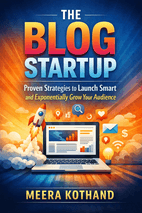
Meera Kothand's The Blog Startup offers a strategic framework for building a blog as a business, covering niche definition, content planning, and monetization for new entrepreneurs launching in a saturated market.
Feature
Insta.Page
Blinkist
Shortform
Summary Depth
Full Chapter-by-Chapter
15-min overview
Section-by-section guides
Audio Narration
✓
✓
✓
Visual Mindmaps
✓
✕
✕
AI Q&A
✓
✕
✕
Quizzes
✓
✕
✕
PDF Downloads
✓
✕
✓
Price
$89.99/yr
$146/yr (PRO)
$199/yr
*Competitor data last verified July 2026.
1 Page Summary
Meera Kothand's The Blog Startup is a modern, action-oriented guide that moves beyond generic blogging advice to offer a structured, strategic framework for building a successful blog from the ground up. Written against the backdrop of a saturated digital landscape, the book directly addresses the overwhelm new bloggers face by advocating for a "start smart" philosophy. Kothand emphasizes the critical importance of foundational work—such as defining a clear niche, understanding a specific audience's needs, and creating a strategic content plan—before ever publishing a first post. This focus on planning and positioning is presented as the essential antidote to the common pitfall of creating content aimlessly without a business or growth strategy in place.
The core of the book is built on practical systems for exponential growth, covering key concepts like audience building, email list development, content monetization, and sustainable workflows. Kothand breaks down complex topics such as crafting irresistible opt-in offers, designing effective email sequences, and creating multiple income streams through products, services, and affiliates. A lasting contribution of the guide is its emphasis on the blogger's mindset and sanity, offering strategies to batch tasks, avoid burnout, and maintain consistency without succumbing to frustration—directly addressing the "tears" promised in the subtitle. The approach is highly tactical, providing templates and step-by-step processes intended for immediate implementation.
The Blog Startup's lasting impact lies in its synthesis of entrepreneurial strategy with practical blogging mechanics, effectively reframing a blog from a casual publishing platform to a launchpad for a deliberate, audience-centric business. It has become a valued resource for aspiring online entrepreneurs because it demystifies the path from zero to a functional, growing blog with income potential. By prioritizing strategic foundations and sustainable systems over quick tricks, Kothand's work provides a coherent roadmap that helps new bloggers launch with confidence and scale their influence methodically in the crowded digital marketplace.
INTRODUCTION — THE BIG, BOLD PROMISE
Overview
Many aspiring bloggers find themselves disillusioned by the gap between the promised "laptop lifestyle" and their actual experiences. This chapter opens with a compassionate acknowledgment of the exhaustion and discouragement that can come from trying to make a blog profitable. It then cuts through the hype by presenting sobering statistics: most bloggers make very little money, with surveys showing that the majority earn less than $100 or $2,500 annually. But instead of leaving readers in despair, it introduces a promise: this book offers a clear, practical roadmap to transform your blog into a thriving business by focusing on essential strategies that work for beginners.
The Sobering Statistics Behind Blogging Dreams
The author confronts the romanticized image of blogging head-on, citing data from 2012 and 2015 that reveals the financial reality for most bloggers. Over 80% never make $100, and only a tiny fraction reach high earnings. This isn't to discourage but to normalize the struggle and emphasize that success requires more than just hard work—it demands a smart plan.
Why This Book Stands Out in a Crowded Space
In a market flooded with blogging guides, this book distinguishes itself by rejecting false promises and one-size-fits-all advice. It acknowledges that many popular strategies don't work for beginners and commits to sharing unsexy but effective tactics. The tone is honest: blogging isn't a magic pill; it's easier in terms of accessibility but harder due to intense competition, with millions of posts published daily. The book prepares you to answer critical questions about why readers should choose your blog over others.
Shifting from Blog to Business Mindset
A pivotal insight is that blogs themselves don't make money; businesses do. Unless relying on ads, which require massive traffic, monetization comes from having a business model behind the blog. The author introduces two foundational approaches: starting "content first" (building an audience before offering products) or "offer first" (using a blog to support existing products). Most beginners will start with content first but must eventually transition to a business-focused model, identifying problems to solve, a monetization pathway, and a core brand essence.
Laying the Foundation with Core Components
Regardless of your blogging path, certain nonnegotiable elements are crucial for profitability. This book breaks these down into bite-sized strategies and pro tips, serving as a 90-day roadmap to lay a solid foundation. It's designed for those feeling lost, stuck, or overwhelmed, offering clarity on priorities like traffic platforms, content choices, and monetization steps. The goal is to help you focus amidst distractions and build a blog that grows leaps and bounds by following a deliberate, stage-appropriate plan.
Tools for Your Journey: Bonuses and Self-Assessment
To support implementation, the chapter points readers to a bonus pack with resources like a 90-day task list, free stock photo sites, social media swipe files, and affiliate program lists. A workbook is available for deeper planning, including niche identification, content types, and legal cheat sheets. Importantly, the author provides a Stage Identification Sheet to help bloggers assess whether they're in the Startup, Growth, or Scale stage, focusing only on milestone-appropriate tasks to prevent overwhelm. This practical tool underscores the book's theme of strategic, phased progress.
Key Takeaways
The majority of bloggers earn very little, so struggle is common and not a personal failure.
Success requires moving beyond blog-as-hobby to treat it as a business with a clear model.
Beginners should be wary of trendy strategies and focus on proven, foundational tactics.
Two main approaches exist: content first (audience building) or offer first (product support), with most starting from content.
A staged roadmap, like the 90-day plan, helps prioritize actions and avoid overwhelm.
Utilize provided resources like the bonus pack, workbook, and stage identification sheet to streamline your journey.
Key concepts: INTRODUCTION — THE BIG, BOLD PROMISE
1. INTRODUCTION — THE BIG, BOLD PROMISE
The Reality of Blogging Success
Most bloggers earn very little (under $100 or $2,500 annually)
The 'laptop lifestyle' promise often leads to exhaustion and disillusionment
Success requires a smart plan, not just hard work
Struggle is common and should not be viewed as personal failure
Differentiating This Book's Approach
Rejects false promises and one-size-fits-all advice
Focuses on unsexy but effective tactics for beginners
Acknowledges blogging is easier to start but harder to succeed due to intense competition
Prepares readers to answer why their blog deserves attention
The Business Mindset Shift
Blogs don't make money; businesses behind blogs do
Introduces two foundational approaches: content-first vs. offer-first
Most beginners start content-first but must transition to a business model
Requires identifying problems to solve, monetization pathways, and core brand essence
Core Components for Profitability
Certain nonnegotiable elements are crucial regardless of path
Provides a 90-day roadmap to lay a solid foundation
Designed to help those feeling lost, stuck, or overwhelmed
Focuses on priorities like traffic platforms, content choices, and monetization steps
Implementation Tools and Resources
Bonus pack includes 90-day task list, stock photos, swipe files, and affiliate lists
Workbook available for niche identification, content planning, and legal guidance
Stage Identification Sheet helps assess Startup, Growth, or Scale stage
Focuses on milestone-appropriate tasks to prevent overwhelm
💡 Try clicking the AI chat button to ask questions about this book!
CHAPTER 1 — NAIL YOUR LUCRATIVE NICHE
Overview
The chapter begins by acknowledging the common frustration and paralysis many feel when trying to choose a niche. It argues that the hesitation isn't about a lack of options, but a deep-seated fear of commitment and the potential for wasted effort. The author shares her own experience of being stalled for six months by this fear before launching a successful blog in a crowded, unoriginal niche where she had no prior expertise.
Debunking Niche Selection Myths
The author directly challenges three pervasive myths that hold people back:
Avoid crowded niches with big, established blogs. She flips this, arguing that a crowded niche validates audience demand. The key is that not every reader resonates with the dominant voices; there is always room for a relatable, authentic new voice.
You need deep expertise to start. She counters with her own story, showing that a deep interest and a willingness to learn are sufficient foundations. Often, a newcomer's fresh perspective can address questions the "experts" overlook.
Your niche must be completely original. This is dismissed as unnecessary. Success comes not from a never-before-seen topic, but from your unique approach, voice, and the specific solutions you offer within a known space.
The Four-Fold Foundation of a Good Niche
Moving beyond passion alone, the chapter establishes a robust, four-part framework for selecting a viable niche. A good niche sits at the intersection of:
Your Target Audience's Pain Points: What specific problems do they need to solve?
Your Strengths and Interests: What are you good at and genuinely curious about?
These must align with two critical, often overlooked, business-minded factors:
3. Evidence of a Monetizable Market: Are there other blogs or businesses successfully making money in this space? You must look for "signs of money flows" like digital products, coaching, or services. This proves people are willing to pay for solutions.
4. Recurring Transformation Potential: Your niche should not solve a one-time problem. Instead, it should offer a path of continuous improvement—an "evergreen" journey where you can guide your audience through multiple stages of growth, creating ongoing value and recurring revenue opportunities.
Addressing Common Concerns (FAQ)
The chapter anticipates and answers two frequent questions:
What if I’m passionate about multiple topics? The advice is to assess which idea has the clearest monetization path and which you can see yourself dedicated to for 3-5 years. Passion without a business model remains a hobby.
Can I cover multiple topics like a lifestyle blog? Yes, but they must be unified by a single, core message (e.g., intentional living, minimalism). A clear, central value proposition prevents confusing your audience.
Your Action Plan
The reader is instructed to actively brainstorm niche ideas using the four-fold criteria as a vetting checklist. The author directs them to a companion workbook for structured prompts and a niche finder tool to facilitate this process.
Key Takeaways
Fear of commitment, not a lack of ideas, is the primary barrier to choosing a niche.
Crowded niches are validated markets; your unique voice is your competitive advantage.
A lucrative niche is defined by the alignment of audience pain points and your strengths, supported by proof of monetization and the potential for ongoing audience transformation.
Look for evidence that people are already spending money to solve the problems in your chosen area.
Passion must be paired with a practical monetization strategy to build a business, not just a hobby.
Key concepts: CHAPTER 1 — NAIL YOUR LUCRATIVE NICHE
2. CHAPTER 1 — NAIL YOUR LUCRATIVE NICHE
Overcoming Niche Selection Paralysis
Fear of commitment and wasted effort, not lack of options, is the primary barrier
Author's personal experience: launched a successful blog in a crowded niche with no prior expertise
Hesitation often stems from deep-seated fear rather than practical constraints
Myth 2: Need deep expertise - Deep interest and willingness to learn are sufficient; fresh perspective can address overlooked questions
Myth 3: Must be completely original - Success comes from unique approach, voice, and specific solutions within known spaces
Four-Fold Foundation Framework
Target Audience Pain Points: Specific problems they need to solve
Your Strengths and Interests: What you're good at and genuinely curious about
Evidence of Monetizable Market: Look for 'signs of money flows' like digital products, coaching, or services
Recurring Transformation Potential: Should offer continuous improvement path with ongoing value and revenue opportunities
Addressing Common Concerns
Multiple passions: Choose based on clearest monetization path and 3-5 year commitment potential
Multiple topics: Possible if unified by single core message (e.g., intentional living) to prevent audience confusion
Passion without business model remains a hobby rather than viable business
Actionable Implementation
Brainstorm niche ideas using four-fold criteria as vetting checklist
Use companion workbook for structured prompts and niche finder tool
Focus on practical application of framework rather than theoretical planning
Core Principles for Niche Success
Unique voice is competitive advantage in validated markets
Look for evidence people are already spending money to solve problems in chosen area
Niche must align audience needs with personal strengths plus monetization proof
Passion must pair with practical monetization strategy for business, not hobby
CHAPTER 2 — IDENTIFY YOUR BLOG’S CORE MESSAGE
Overview
This chapter emphasizes the crucial step of defining a singular, compelling purpose for your blog, which will serve as the foundation for every piece of content you create. It moves beyond simply choosing a niche to articulating a clear value proposition that attracts and serves your audience, ensuring your blog educates, entertains, inspires, teaches, or helps readers in a meaningful way.
The Foundation of Attraction
While wanting to make money or share experiences is a valid starting point, your blog must first attract people. Your content is the hub that draws them in, and it must provide genuine value. This begins with crafting a core message or value proposition that answers how you specifically benefit your readers.
The Process of Specificity
To create an all-encompassing purpose, you start broad and drill down with precision. Begin with your big business umbrella, then narrow it to your core niche. Next, define Niche Level 1 by identifying your specific audience (the "who"), and further refine with Niche Level 2 by specifying the problem you solve or the action you enable (the "to do what"). For instance, moving from "photography" to "DIY photography for food blogger moms who need to take catalogue-like photos" transforms a general idea into a targeted mission.
Crafting Your Guiding Statement
With your parameters defined, you can formulate a clear value proposition using one of two statement templates. These are: "I educate/inspire/entertain/teach/help [who] who want to [what]," or "I show [who] how [what]." Examples include "I help single moms who want to build a successful VA business" or "I show food bloggers how easy it is to take their own pictures and edit them." This statement becomes your anchor, ensuring every blog post, email, or product aligns with your core message.
Putting Your Message to Work
This guiding statement isn't just for your notes; it's a strategic tool. You can use it internally to filter content ideas or feature it prominently on your website—like in the header—to immediately communicate your purpose to visitors and resonate with your ideal audience.
Key Takeaways
Your blog's core message is the essential filter for all content and offerings, moving beyond niche selection to a clear value proposition.
Attracting an audience requires content that provides real value—through education, inspiration, entertainment, or help.
Define your message by drilling down from a broad category to a highly specific audience and their precise need.
Formulate a simple, actionable statement (e.g., "I help [who] to [what]") to guide all creative decisions and communicate your purpose.
This statement can be used both as an internal compass and a public declaration on your blog to attract the right readers.
Key concepts: CHAPTER 2 — IDENTIFY YOUR BLOG’S CORE MESSAGE
3. CHAPTER 2 — IDENTIFY YOUR BLOG’S CORE MESSAGE
The Importance of a Core Message
Defines a singular, compelling purpose for your blog
Serves as the foundation for all content creation
Moves beyond niche selection to a clear value proposition
Ensures content educates, entertains, inspires, or helps readers
Attracting an Audience Through Value
Content must provide genuine value to attract people
Begins with crafting a core message or value proposition
Answers how you specifically benefit your readers
Content is the hub that draws readers in
Drilling Down to Specificity
Start broad and drill down with precision
Begin with big business umbrella, narrow to core niche
Define Niche Level 1: identify specific audience (the 'who')
Refine with Niche Level 2: specify problem solved or action enabled (the 'to do what')
Example: 'photography' → 'DIY photography for food blogger moms'
Formulating Your Value Proposition
Use statement templates: 'I educate/inspire/entertain/teach/help [who] who want to [what]'
Alternative template: 'I show [who] how [what]'
Examples: 'I help single moms who want to build a successful VA business'
Statement becomes your anchor for all content alignment
Implementing Your Guiding Statement
Use internally to filter content ideas
Feature prominently on website (e.g., in header)
Immediately communicates purpose to visitors
Resonates with ideal audience as a strategic tool
CHAPTER 3 — YOUR ONE READER
Overview
This chapter introduces the concept of "your one reader" as a foundational tool for effective writing. It explains that honing in on a single, well-defined audience member allows you to tailor your content precisely, ensuring it resonates deeply and avoids the pitfalls of trying to please everyone.
Why a Single Reader Matters
Focusing on one ideal reader transforms your writing process. It enables you to communicate at the right level, conserve energy by not catering to incompatible audiences, and eliminate content confusion because you clearly understand what your reader needs. The alternative—writing for everyone—often leads to generic, ineffective messaging.
Crafting Your Reader Profile
A traditional persona exercise involves exploring psychographics and motivational factors. Psychographics delve into frustrations, worries, online habits, hobbies, social media presence, and mental blocks. Motivational factors examine desires, fears, challenges, and long-term goals. This dual approach helps paint a vivid picture of who you're speaking to.
A Helpful Shortcut: Start with Exclusion
If defining your ideal reader feels daunting, begin by identifying who they are not. Consider statements like: "My ideal reader is unlikely to be..." or "unlikely to identify with the term...". This exclusionary method often clarifies boundaries, making it easier to pinpoint the core audience you truly wish to serve.
A Real-World Example
The author shares her initial ideal reader description: a mother of two seeking to start a home business, who identifies as a solopreneur rather than a "mompreneur." This persona grapples with time constraints, money mindset issues, and imposter syndrome, yet is action-oriented and willing to invest in herself. This example demonstrates how specific and human a reader profile should be.
Addressing Audience Diversity
It's natural for various readers to visit your site. The binding force isn't demographics but shared psychographics—common desires, frustrations, and aspirations related to the change you're facilitating. By writing consistently for your one ideal reader, you inherently attract others who align with those core motivations.
Researching with Precision
To build an accurate persona, actively research your audience. A highly effective hack is to search relevant Facebook groups using specific keywords like "need help," "desperate for," or "newbie" to uncover raw pain points quickly. Additionally, mine reviews on platforms like Amazon, Udemy, and Product Hunt to collect authentic language describing challenges and desires. This "swipe file" of audience wording becomes invaluable for crafting relatable website copy.
Key Takeaways
Defining a single ideal reader sharpens your content, making it more engaging and efficient.
Use psychographics and motivational factors to build a detailed reader persona.
If stuck, start by defining who your reader is not to clarify your target.
Your core audience is united by shared psychographics, not just demographics.
Research using Facebook group searches and review analysis to gather authentic audience language.
Apply these insights consistently across your writing to connect deeply with your readers.
Key concepts: CHAPTER 3 — YOUR ONE READER
4. CHAPTER 3 — YOUR ONE READER
The Concept of Your One Reader
A foundational tool for effective writing
Focus on a single, well-defined audience member
Tailor content precisely to resonate deeply
Avoid pitfalls of trying to please everyone
Benefits of Focusing on One Reader
Enables communication at the right level
Conserves energy by not catering to incompatible audiences
Eliminates content confusion through clear understanding of needs
Prevents generic, ineffective messaging that comes from writing for everyone
Building a Reader Profile
Use psychographics: frustrations, worries, online habits, hobbies, mental blocks
Meera Kothand is a marketing strategist and author specializing in email marketing and digital business growth for entrepreneurs. She is best known for her book "The One Hour Content Plan" and her practical online courses. Her expertise helps small business owners build effective, automated marketing systems.
📚 Explore Our Book Summary Library
Discover more insightful book summaries from our collection