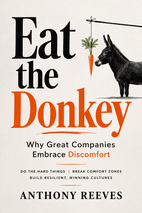
Anthony Reeves's Eat the Donkey argues that sustainable success requires organizations to deliberately embrace productive discomfort, offering leaders and strategists a framework to escape market sameness by identifying their core Foundation, establishing costly Principles, and refreshing their expressive Characteristics.
Feature
Insta.Page
Blinkist
Shortform
Summary Depth
Full Chapter-by-Chapter
15-min overview
Detailed analysis
Audio Narration
✓ (AI narration)
✓
✓
Visual Mindmaps
✓
✕
✕
AI Q&A
✓ Voice AI
✕
✕
Quizzes
✓
✕
✕
PDF Downloads
✓
✕
✓
Price
$59.99/yr
$146/yr (PRO)
$199/yr
*Competitor data last verified February 2026.
About the Author
Anthony Reeves
Anthony Reeves is a philosopher and ethicist specializing in bioethics and the philosophy of technology. He is best known for his work on moral status, artificial intelligence, and the ethics of human enhancement, frequently contributing to academic journals and public discourse on these topics. He serves as an associate professor in the Department of Philosophy at Binghamton University.
1 Page Summary
In 'Eat the Donkey: Why Great Companies Embrace Discomfort,' Anthony Reeves argues that sustainable success requires organizations to deliberately move between states of comfort and productive discomfort. The book's central thesis, drawn from the author's formative experiences in the Australian Outback, is that real growth stems from choosing difficult paths—symbolized by the book's title—rather than seeking safety. Reeves contends that modern businesses are trapped in a "convergence cascade," where reliance on data and best practices leads to market-wide sameness and mediocrity. To escape this, companies must identify their unchanging core "Foundation," establish guiding "Principles" that incur real cost, and refresh their expressive "Characteristics" to stay relevant.
The book's distinctive approach blends vivid personal memoir with practical business frameworks, moving from philosophical foundations to operational tactics. Reeves critiques common corporate failures, such as inside-out thinking and innovation-stifling bureaucracy, while advocating for models like the "Explorer" and "Static" states, a rhythm between them, and a "Flywheel 2.0" with a defined center. It emphasizes that brand leadership must come from the CEO, that HR should be an engine for growth, and that breakthrough thinking requires protected space and visible, collaborative processes.
The intended audience includes leaders, entrepreneurs, and strategists seeking to build enduring, differentiated companies. Readers will gain a system for diagnosing organizational stagnation, a blueprint for fostering authentic innovation, and the conviction that transcending mediocrity requires embracing strategic discomfort to build something meaningfully unique.
The chapter opens with memories of childhood trips across the Australian Outback. It sets up a lifelong idea: that real growth and toughness come from staying in difficult situations on purpose. The author compares this early lesson to the complacency he later saw in corporate offices. He introduces the book's main goal—to give businesses a way to use productive discomfort for lasting growth.
The Pedagogy of the Outback
The story is built around family trips in an old Land Rover, through extreme heat, dust, and with very few supplies. This "beautiful nothingness" was an unusual school. Without comfort or entertainment, they had to engage deeply with the land and their own thoughts. This built a core belief that exploration and hardship are directly tied to learning. One story makes this clear: the family gratefully ate meat, only to find out later it was spoiled donkey. It shows how far they would go, choosing exploration over comfort every time.
The Explorer's Ethos
The author describes his parents as classic, old-school explorers. Their adventures—like kayaking wild rivers with hand-drawn maps and little supplies—were all about self-reliance, taking smart risks, and having a "spectacular disregard for their own mortality." They showed that exploration wasn't a hobby, but a way of life. Seeing "what was beyond the next ridge" was always more important than material comfort. This gave the author a "bone-deep understanding" that exploration was everything.
From Desert to Boardroom: The Core Framework
The chapter then connects these childhood lessons to today's business problems. The author says companies face a choice, just like his family did: embrace productive discomfort, or let comfort lead to a slow rot. He argues decline starts in a company's culture and mindset long before the finances show it. To fight this, the book introduces a two-part system for business growth, pictured like a tree:
Foundation Theory (The Roots): This is who a company is—its Foundation, Principles, and Characteristics.
Explorer and Static States (The Seasons): This is where a company is in its growth cycle—the rhythm between aggressive exploration and necessary consolidation.
The main idea is that to last, a company must master both its identity (roots) and its rhythm (seasons). A company that only explores without strong roots will fall. A company that never leaves a state of comfortable optimization will stagnate.
A Personal Creed
The author brings it all together by following his own path from the Outback to Ironman races and corporate leadership. The same rules applied everywhere. The mindset to "make do, endure, and don’t complain" became a skill he could use anywhere. He sees his whole journey as a series of choices to take the harder path, ending with the book's direct call to action: "Eat the donkey."
Key Takeaways
Growth is born from discomfort. Purposeful hardship and boredom are more effective teachers than comfort and constant stimulation.
Complacency is a silent killer. In business, cultural and strategic decay often set in long before financial metrics decline, because teams stop pushing boundaries while relying on past successes.
Enduring success requires both identity and rhythm. A company must have a strong, rooted foundation (who it is) and must consciously cycle between seasons of exploration and consolidation (where it is).
"Eat the donkey" is a metaphor for voluntarily embracing necessary, difficult challenges—taking on what seems impossible with honesty and resilience, trusting your foundation to carry you further than comfort ever could.
Key concepts: Introduction
1. Introduction
The Pedagogy of the Outback
Childhood trips as a school of hardship
Growth from embracing difficulty over comfort
Deep engagement born from lack of entertainment
The Explorer's Ethos
Exploration as a core way of life
Self-reliance and smart risk-taking
Prioritizing discovery over material comfort
Core Business Framework
Companies face comfort vs. productive discomfort
Foundation Theory: who a company is (roots)
Explorer/Static States: growth rhythm (seasons)
The Danger of Complacency
Decline starts in culture before finances
Stagnation from never leaving comfort
Silent killer of past success reliance
The Call to Action
Personal creed: make do, endure, don't complain
Apply explorer mindset everywhere
Metaphor: 'Eat the donkey' - embrace hard challenges
If you like this summary, you probably also like these summaries...
💡 Try clicking the AI chat button to ask questions about this book!
Chapter 2: 1. The Convergence Cascade
Overview
A pervasive yet often invisible force shapes modern industries: the convergence cascade. It's the process where relentless optimization—chasing data, best practices, and market consensus—steers companies toward identical solutions, resulting in a landscape of sameness and forgettable mediocrity. Through vivid examples from art to automotive design, we see how the pursuit of perfection based on what everyone says they want ultimately leads to products and brands that no one truly loves or remembers.
The Unseen Current Toward Sameness
In the 1990s, researchers polled thousands across eleven countries to design the "perfect" painting. Despite expectations of cultural diversity, each nation's ideal painting converged on nearly the same blueprint: a blue-hued landscape with figures and animals. Artists Komar and Melamid wryly noted that in seeking freedom, they found a kind of creative slavery. This pattern echoes in business, as seen with Quibi's spectacular failure in 2020. Armed with $1.75 billion and exhaustive research on millennial preferences for short-form video, Quibi delivered exactly what the data demanded, only to discover that optimizing for assumed desires without human context led to a product that felt hollow and unnecessary.
The Mechanics of the Cascade
Convergence doesn't happen by accident; it follows a predictable five-stage trajectory. It starts with Discovery, where someone stumbles upon something that works—like Edison bulbs creating cafe ambiance. Validation follows as success attracts imitators and buzz. Then comes Codification, where these successes harden into industry best practices and templates. Saturation sets in when the exception becomes the rule, visible in how every direct-to-consumer brand now uses similar sans-serif fonts and pastel palettes. Finally, Invisibility occurs, where the very elements meant to differentiate a brand render it anonymous in a sea of look-alikes.
When Creativity Follows the Algorithm
In creative fields, this cascade is amplified by what designer Elizabeth Goodspeed calls the "moodboard effect." Globally, designers draw inspiration from the same digital platforms—Pinterest, Behance, Instagram—unconsciously homogenizing aesthetics because they're all responding to the same signals of what gets likes and awards. The author shares a personal moment from advertising: hours spent debating the color of a button in an online ad, only to arrive at the same safe blue everyone uses. This isn't copying; it's independent optimization leading to identical outcomes, stripping away distinctiveness in the name of risk aversion.
Porsche: Engineering Against the Tide
The automotive industry reveals how technological tools can accelerate convergence, but also how defiance is possible. As cars were shaped by wind tunnels and shared platforms, silhouettes became eerily similar—a Hyundai SUV now mirrors a Volvo or Mercedes. Physics seemed to dictate sameness. Yet Porsche's 911 stands as a triumphant counterexample. For over seventy years, it has clung to its "aerodynamically wrong" rear-engine design, a trait that creates handling challenges. Instead of surrendering, Porsche invested in advanced engineering—active aerodynamics, sophisticated suspensions—to turn this liability into a beloved signature. The 911 costs more to build and defies conventional wisdom, but its distinctiveness is instantly recognizable, proving that embracing unique constraints can carve out an irreplaceable market position.
Jaguar: The Cost of Conformity
In stark contrast, Jaguar's recent history illustrates the existential risks of converging. Born from a legacy of grace, speed, and daring design—embodied in icons like the E-Type—Jaguar decided in 2024 to reinvent itself as an all-electric marque with a minimalist identity, abandoning its iconic "leaper" logo and racing heritage. Every decision was data-backed: electric is the future, minimalism tests well, technology appeals to youth. But by optimizing for what competitors like Tesla were doing, Jaguar forgot its own foundation. The result was a brutal collapse in sales, with global volumes plummeting by around 85%. Jaguar traded its soul for relevance and became just another face in the crowded electric luxury market, demonstrating that when you forget who you are, customers forget why they cared.
The Accelerating Force of Digital Tools
The internet, once hailed as a democratizing force for creativity, has become the world's most efficient convergence machine. With the rise of AI and accessible templates, every Shopify store, startup website, or streaming service now defaults to the same layouts, features, and content strategies. They're all using the same A/B testing tools, responding to the same metrics, and following the same playbooks. When everyone has access to identical data and optimization frameworks, differentiation evaporates. Industries from airlines to banking now offer nearly indistinguishable experiences, trapped in a cycle of mimicking each other's "best practices."
The Persistent Pull and the Path Forward
Every company faces the gravitational pull of the convergence cascade—pressured by investors for predictable returns, employees for clear guidance, and customers who often default to the familiar. The only way to resist this pull is to protect a foundational belief, a core identity that no amount of data or optimization can replace. It's not about ignoring trends, but about engineering around them, as Porsche did, to maintain what makes you uniquely you.
Key Takeaways
Optimization leads to homogeneity: When industries relentlessly chase data, best practices, and market consensus, they independently arrive at identical solutions, resulting in mediocrity.
The five-stage cascade is predictable: Discovery, Validation, Codification, Saturation, and Invisibility describe how innovations become industry-wide norms and then invisibility.
Distinctiveness requires defiance: As shown by Porsche, resisting convergent pressures—even when it's harder and costlier—can create lasting brand recognition and loyalty.
Identity is your anchor: Jaguar's decline highlights the peril of abandoning core foundations in pursuit of trends; without a unique identity, brands become forgettable.
Technology accelerates convergence: Digital tools, AI, and template-driven design homogenize creativity, making intentional divergence more critical than ever.
The human context matters: Data alone can't capture the nuances of desire; products that resonate often transcend optimized checklists to connect on a deeper level.
Key concepts: 1. The Convergence Cascade
2. 1. The Convergence Cascade
Definition of Convergence Cascade
Relentless optimization leads to identical solutions
Results in sameness and forgettable mediocrity
Pursuit of perfection creates unloved products
Mechanics of the Cascade
Five-stage trajectory: Discovery to Invisibility
Successes harden into industry best practices
Differentiating elements eventually render brands anonymous
Digital Amplification of Convergence
Internet acts as efficient convergence machine
Global designers use same digital inspiration platforms
AI and templates accelerate homogenization
Porsche: Defiance Through Engineering
Clung to unique rear-engine design for 70+ years
Invested in engineering to turn liability into signature
Proves embracing constraints creates irreplaceable position
Jaguar: Risks of Conformity
Abandoned iconic heritage for data-backed trends
Optimized for what competitors were doing
Resulted in 85% sales collapse by forgetting identity
Creative Field Homogenization
Moodboard effect from same digital platforms
Independent optimization leads to identical outcomes
Risk aversion strips away distinctiveness
Resisting the Pull
Protect foundational belief and core identity
Engineer around trends rather than surrender to them
⚡ You're 2 chapters in and clearly committed to learning
Why stop now? Finish this book today and explore our entire library. Try it free for 7 days.
Chapter 3: 2. Welcome to Average
Overview
The dangerous allure of averageness in business is a slow path to irrelevance. In an age of AI and instant access to best practices, being "good enough" is no longer safe. The tools we use to measure success often mask mediocrity. True, lasting success requires the courage to be strategically terrible at many things in order to be extraordinary at one.
The AI-Powered Rise of the Average
Consider the consulting giant McKinsey. In 2025, the firm cut thousands of jobs while deploying thousands of AI agents. A senior partner revealed that projects that once required 15 people now need just a handful, augmented by AI. AI can be trained on decades of proprietary frameworks and reports, automating the strategic analysis that was once the consultants' unique value.
This creates a convergence cascade. When McKinsey, Bain, and BCG all use similar AI-trained models on similar data for similar clients, they inevitably produce similar recommendations. Entire industries begin moving in lockstep toward the same "proven solutions." When everyone has access to the same automated best practices, what truly differentiates a company? McKinsey’s own research shows the average lifespan of an S&P 500 company collapsing from 61 years to a projected 12. These companies didn’t fail dramatically; they simply became adequate until adequacy was no longer enough.
The Metrics of Mediocrity
We often use data to normalize and celebrate average performance. Two key metrics illustrate this self-deception:
Net Promoter Score (NPS): The average across industries is about 30. Companies celebrate being above zero, effectively celebrating a state where for every three promoters, there are three people who are indifferent or actively detract. This benchmarks against mediocrity instead of striving for greatness.
Employee Engagement: Gallup data shows only about 33% of employees are engaged. We’ve normalized a reality where two-thirds of the workforce is checked out or undermining success, creating a burnout and performance death spiral.
Byron Sharp found that average brands must spend above average just to be noticed. When you lack distinction, you must shout louder and more often.
Strategic Terribleness vs. The Lure of "Relevancy"
The core argument is presented through two opposing case studies:
Southwest Airlines chose "strategic terribleness." They are deliberately terrible at everything other airlines deem essential: no assigned seats, first class, meals, or hub system. Their foundational question, guided by founder Herb Kelleher, was simple: "Will this help us be a low-cost airline?" Every "terrible" choice reinforces their one extraordinary strength: getting you from point A to B cheaply, on time, and with a smile. This clarity allowed them to be profitable for 47 consecutive years, turning constraints into beloved character.
Cracker Barrel fell into the trap of chasing "relevancy." Their foundation was nostalgia—a defiantly analog, unchanging experience. In 2025, leadership, believing they needed to modernize, changed their classic logo to a clean, contemporary design. The market reaction was immediate and brutal, wiping out $100 million in value. Customers saw the change as a betrayal, a signal the company was embarrassed by its own identity. They had confused a disposable characteristic for their foundation. The blame lay not with the design agency, but with the leadership who approved the brief to become average.
Key Takeaways
Average is now the ceiling. AI and democratized best practices mean that what was once "above average" strategy is now readily available to all, making differentiation through optimization impossible.
Beware metrics that celebrate mediocrity. Benchmarks like average NPS or engagement scores can mask a slow leak in your business's hull, making adequacy feel like success.
You cannot be great at everything. Lasting success requires choosing what to be extraordinary at and having the courage to be deliberately terrible at everything else.
"Relevancy" is often code for "average." Chasing industry trends and modernizing for its own sake can erase the distinctive foundation that makes your brand matter. Your perceived weaknesses are often the source of your greatest strength.
Clarity requires "no." Building a distinctive foundation means consistently saying no to profitable opportunities, customer requests, and industry standards that dilute your one extraordinary thing.
Key concepts: 2. Welcome to Average
3. 2. Welcome to Average
The Danger of Average in Business
Average is a slow path to irrelevance
Good enough is no longer safe in AI age
Success requires courage to be strategically terrible
AI-Powered Convergence Cascade
AI automates strategic analysis and best practices
Average brands must spend above average to be noticed
Strategic Terribleness vs. Relevancy
Southwest Airlines: deliberately terrible at non-essentials
Cracker Barrel: betrayed identity chasing modern relevancy
Relevancy often means becoming average
Principles for Lasting Success
Choose one extraordinary strength to cultivate
Perceived weaknesses can be greatest strengths
Clarity requires saying no to dilution
Chapter 4: 3. Foundations
Overview
Before any brand or business can successfully evolve, it must first identify and commit to its unchanging core—its Foundation. A Foundation is the deeply embedded truth, born from formative experiences, that defines what a company truly stands for, beyond the products it sells. It acts as an anchor, preventing a dangerous drift toward market-driven mediocrity and enabling authentic transformation. Without this solid base, organizations risk losing their way, confusing mechanisms for meaning, and ultimately failing, no matter how successful they may seem in the short term.
The Invisible Architecture of Identity
A Foundation is like the invisible architecture of a person or organization, built during messy, formative early experiences. The author’s personal revelation came during a psychological evaluation for a job at Kohler, designed to uncover the patterns formed in his “formative years”—like surviving a trip in the Australian Outback on spoiled donkey meat. These experiences create a framework for interpreting the world, teaching lessons like adapting to discomfort and making progress with what's available. For individuals, psychologists like Erik Erikson and Carol Dweck show how early stages of development create a cognitive and emotional operating system. For companies, this formative period is the scrappy, early startup phase where its real DNA is encoded through survival decisions, tensions, and trade-offs.
What a Foundation Is (And What It Is Not)
A true Foundation is not a product, a mission statement, a set of generic values, or an origin story. These are often just outputs or surface-level descriptions. Instead, a Foundation is the unchanging truth that gives those things meaning. It is the answer to the fundamental question: “What business are you actually in?”
Weak Answer (Product): “We are in the coffee business.”
Strong Answer (Foundation): “We are in the people business serving coffee” (Starbucks).
The Foundation is the deeper purpose—belonging (Airbnb), gracious living (Kohler), removing friction (Amazon), or enabling human potential through movement (Nike). It is the input; the product is merely the current vessel for delivering it.
Forged in the Fire: Company Case Studies
Foundations are solidified during difficult, improvisational “donkey moments” of a company’s youth.
Amazon: Its foundation of obsessive customer focus was an existential necessity when shipping books from a garage. Mantras like “It’s always Day 1” and “Start with the customer and work backwards” became its bedrock.
Apple: In a garage, the foundation was formed that technology and liberal arts—function and beautiful, human-centric design—are inseparable.
Airbnb: Its foundation of “belonging anywhere” was discovered when the founders, unable to pay rent, rented out air mattresses and realized guests craved authentic connection, not just a cheap room.
Michelin: Facing a tiny market for cars in 1900, the brothers defined their foundation as being in the mobility business. To create a reason for mobility to exist, they published the Michelin Guide to restaurants, creating a new market and becoming culinary tastemakers.
The Slow Drift: How Foundations Are Lost
As companies scale, they layer on process and hire specialists far removed from the founding hunger. The foundational instinct fades. The first stage of decline, as Jim Collins identified, is not financial loss but hubris born of success and a slow drift from core truths. The cautionary tale is Washington Mutual Bank. Founded to help working people build stable lives after a disaster, it drifted over a century from the foundation of “stability and trust” to a sales machine obsessed with loan volume. This confusion of mechanism (mortgages) for meaning (stable lives) led directly to its catastrophic collapse. Companies lose their way by promoting the people who understand the foundation into roles disconnected from it, leaving no one to guard the core truth.
Key Takeaways
Define Your “What Business?”: Your Foundation is not what you sell, but the deeper need you fulfill or truth you represent (e.g., mobility, not tires).
Honor Your “Donkey Moments”: The difficult, formative early struggles are not just stories; they are the furnace where your unshakeable core is forged. Do not let success make you forget that discomfort.
Use It as a Filter: A clear Foundation makes strategic decisions—especially what to say “no” to—remarkably clear. Does this initiative strengthen or dilute our core truth?
Guard Against Drift: The greatest failure is a slow, unnoticed drift from your Foundation to a focus on products, sales, or quarterly targets. This is often a leadership and promotion problem.
Build to Last: A true Foundation allows a company to transform its products and services radically (e.g., Amazon moving from books to AWS) without ever losing its identity, because the core truth remains constant.
Key concepts: 3. Foundations
4. 3. Foundations
Definition of a Foundation
Deeply embedded truth from formative experiences
Defines what a company truly stands for
Not a product, mission statement, or generic values
Acts as an anchor against market-driven mediocrity
Formation of Foundations
Built during messy, formative early experiences
For companies, formed in scrappy startup phase
Encoded through survival decisions and trade-offs
Solidified during difficult 'donkey moments'
Examples of Company Foundations
Amazon: Obsessive customer focus and removing friction
Apple: Technology and liberal arts as inseparable
Airbnb: Belonging anywhere, not just cheap rooms
Michelin: Mobility business, not just tires
How Foundations Are Lost
Hubris born of success leads to slow drift
Process and specialists replace founding hunger
Confusing mechanism for meaning (products vs purpose)
Promoting foundation guardians away from core truth
Practical Applications
Define what business you're actually in
Use foundation as filter for strategic decisions
Guard against drift from core truth
Enables radical transformation without losing identity
📚 Explore Our Book Summary Library
Discover more insightful book summaries from our collection