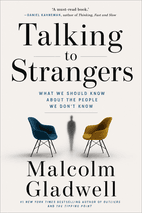
Malcolm Gladwell's Talking to Strangers exposes the systematic failures in how we judge people we don't know, using case studies from Sandra Bland to Amanda Knox to reveal why our default assumptions about honesty and emotional transparency lead to catastrophic misunderstandings. For anyone who has wondered why smart people make terrible decisions about others.
Feature
Insta.Page
Blinkist
Shortform
Summary Depth
Full Chapter-by-Chapter
15-min overview
Detailed analysis
Audio Narration
✓ (AI narration)
✓
✓
Visual Mindmaps
✓
✕
✕
AI Q&A
✓ Voice AI
✕
✕
Quizzes
✓
✕
✕
PDF Downloads
✓
✕
✓
Price
$59.99/yr
$146/yr (PRO)
$199/yr
*Competitor data last verified February 2026.
About the Author
Malcolm Gladwell
Malcolm Gladwell is a renowned journalist and bestselling author celebrated for his unique ability to explore the hidden forces that shape human behavior. His groundbreaking books, including *The Tipping Point*, *Blink*, and *Outliers*, have sold millions of copies worldwide and have profoundly influenced public discourse on topics ranging from social epidemics to success and decision-making. A staff writer for *The New Yorker*, Gladwell's work masterfully synthesizes sociology, psychology, and history to challenge conventional wisdom. His insightful analyses and compelling storytelling have established him as a leading thinker in non-fiction. All of his acclaimed books are available for purchase on Amazon.
1 Page Summary
In Talking to Strangers, Malcolm Gladwell challenges our fundamental assumptions about how we interact with and judge people we don't know. The book's central thesis is that we are systematically terrible at understanding strangers, and this failure has devastating real-world consequences. Through a series of case studies—from the death of Sandra Bland after a routine traffic stop, to the misjudgment of Adolf Hitler by Neville Chamberlain, to the wrongful conviction of Amanda Knox—Gladwell argues that our default approach is based on two flawed ideas: the "truth-default" (our tendency to assume people are honest) and the "transparency fallacy" (our belief that we can accurately read people's emotions and intentions from their behavior). These default behaviors, he shows, make us vulnerable to deception, blind to danger, and prone to catastrophic misunderstandings.
What makes this book distinctive is Gladwell’s method of weaving together seemingly unrelated stories from history, psychology, criminology, and neuroscience to illuminate a single, uncomfortable truth about human nature. He draws on research like Tim Levine's Truth-Default Theory, which explains why even trained professionals fail to spot liars; the "alcohol myopia" theory, which reframes how intoxication affects judgment in sexual assault cases; and David Weisburd's Law of Crime Concentration, which shows that crime is not random but tightly coupled to specific places and methods. Gladwell also revisits classic experiments—the Kansas City preventive patrol study and Stanley Milgram’s obedience experiments—to show how systemic failures arise when institutions rely on flawed assumptions about human behavior. The book is not a simple indictment of individual bad actors but a deeper investigation into the structural and psychological conditions that make tragedy predictable.
The intended audience is broad: anyone who has ever wondered why smart people make terrible decisions about others, or why scandals like the Sandusky abuse or the Madoff Ponzi scheme persist for years despite apparent red flags. Readers will come away with a new framework for understanding interactions with strangers—one that is skeptical of our ability to "read" people, attentive to the power of context and environment, and cautious about the stories we tell ourselves about others’ intentions. Gladwell does not offer easy solutions, but he provides a powerful lens for recognizing the traps we fall into when we assume we know what a stranger is thinking or feeling. The book is both a warning and a call for humility in the face of the profound mystery that other people remain.
Chapter 1: Introduction: “Step out of the car!”
Overview
The introduction opens with the heartbreaking story of Sandra Bland, a young African American woman who, in July 2015, drove from Chicago to a small Texas town for a job interview at her alma mater, Prairie View A&M University. She was vibrant and accomplished—a sorority member, marching band musician, volunteer, and creator of inspirational YouTube videos where she addressed her followers as “my beautiful Kings and Queens,” celebrating gratitude and growth. Yet what should have been a routine traffic stop turned fatal. The encounter between Bland and Texas State Trooper Brian Encinia by the side of the road exemplifies the profound difficulty of two strangers meeting across deep divides of race, gender, geography, and power. He was a white male officer from Texas; she was a Black woman from Chicago, unarmed and civilian. They had no prior connection. The author insists that if our society were more thoughtful about how we approach and make sense of strangers, Bland would not have ended up dead in a jail cell.
But instead of rushing to judgment, the book poses two questions—two puzzles about strangers—that will guide the investigation. The first begins with a story from Florentino Aspillaga, told years ago in a German debriefing room. There’s also a hint at the enduring myth that Montezuma believed Cortés was a god—a misunderstanding rooted in language and cultural confusion, since the Nahua people had no existing category for these unknown beings. This sets the stage for a larger exploration: how we interpret people we don’t know, and why we so often get it wrong.
Key Takeaways
The Sandra Bland tragedy illustrates the high stakes of encounters between strangers who lack shared context or understanding.
The author argues that societal soul-searching about how we approach strangers could prevent such outcomes.
Two puzzles about strangers are introduced: one from a spy’s confession, one from a historical misinterpretation of identity.
Misunderstandings often arise not from malice but from the absence of frameworks to categorize unfamiliar people.
Key concepts: Introduction: “Step out of the car!”
1. Introduction: “Step out of the car!”
Sandra Bland Tragedy
Heartbreaking story of a vibrant young woman
Routine traffic stop turned fatal
Highlights deep divides of race and power
Shows stakes of stranger encounters
Core Argument
Society lacks thoughtful approach to strangers
Better understanding could prevent tragedies
Misunderstandings often not from malice
Need for societal soul-searching
Two Guiding Puzzles
First puzzle from spy Florentino Aspillaga
Second puzzle from Montezuma-Cortés myth
Explores how we interpret unknown people
Why we often get it wrong
Misinterpretation Roots
Absence of frameworks to categorize strangers
Language and cultural confusion
No existing categories for unknown beings
Misunderstandings from lack of shared context
Book's Investigation
Examines encounters across deep divides
Focus on race, gender, geography, power
Analyzes how strangers meet and fail
Aims to prevent similar outcomes
Scroll to load interactive mindmap
If you like this summary, you probably also like these summaries...
💡 Try clicking the AI chat button to ask questions about this book!
Chapter 2: Chapter One: Fidel Castro’s Revenge
Overview
Florentino Aspillaga was a star of Cuba’s intelligence service—a decorated officer who’d personally received a commendation from Fidel Castro. But while running a front company in Bratislava, his disillusionment with Castro’s arrogance hardened into a decision to defect. On the anniversary of Cuba’s Ministry of the Interior, he smuggled his girlfriend in the trunk of a Mazda, drove through the border using his diplomatic passport, and walked into the U.S. Embassy in Vienna. He was a “walk-in,” and he carried information that would devastate the CIA’s Cuban operations.
The Defector’s Bombshell
After his defection, Aspillaga insisted on speaking to the CIA’s former Havana station chief, known only as “the Mountain Climber.” When they finally met, Aspillaga delivered the news: nearly every CIA spy inside Cuba was actually a double agent, feeding the Americans information cooked up by Havana. He named name after name—dozens of them. The room went silent. The Mountain Climber, who had once worked those agents with confidence, realized his entire network had been a sham. “I was not the one pulling the wool over their eyes,” he later said. “That was a bit of a blow.”
The Fallout and the Documentary
Fidel Castro didn’t just keep the secret—he turned it into a weapon. Once he learned Aspillaga had spilled it, Castro rounded up the pretend agents and paraded them across Cuba, then released an eleven-part TV documentary called La Guerra de la CIA contra Cuba. It showed CIA officers stuffing cash into fake rocks, fumbling with dead drops in junkyards, and being filmed from cinematic angles. The audio was crystal clear; the Cubans had clearly known every meeting spot in advance. The FBI’s Miami office even requested a copy, which arrived thoughtfully dubbed in English. The world’s most sophisticated intelligence service had been played for a fool, and Castro wanted everyone to know it.
The Puzzle of Deception
What makes this story so unsettling is that the CIA had every reason to catch the deception. The agency ran lie-detector tests on those agents—six passed cleanly and turned out to be doubles. When others failed, case officers dismissed the results as unreliable. They trusted their own judgment, built over years of face-to-face meetings. Yet they were wrong. The same pattern played out in East Germany, where not a single CIA agent operated without being turned, and inside the CIA itself, where senior officer Aldrich Ames—a lazy drunkard everyone trusted—was selling secrets to the Soviets.
It raises a deeply uncomfortable question: if the CIA’s best can be fooled that thoroughly, that many times, then how good are any of us at spotting a liar?
Key Takeaways
Aspillaga’s defection exposed that nearly all CIA spies in Cuba were double agents, a humiliation the CIA had not suspected.
Castro weaponized the revelation with a documentary that showed exactly how the CIA had been filmed and recorded for years.
The agency had polygraph results that should have raised red flags, but case officers trusted their gut over the machine.
Similar failures occurred in East Germany and within the CIA’s own ranks, showing a systemic vulnerability to deception.
Key concepts: Chapter One: Fidel Castro’s Revenge
2. Chapter One: Fidel Castro’s Revenge
Aspillaga's Defection
Star Cuban intelligence officer defected in Bratislava
Smuggled girlfriend in car trunk to U.S. Embassy
Carried devastating information about CIA operations
Double Agent Revelation
Nearly all CIA spies in Cuba were double agents
Information fed to Americans was fabricated by Havana
Former Havana station chief realized network was a sham
Castro's Propaganda Weapon
Castro paraded pretend agents across Cuba
Released 11-part documentary exposing CIA operations
Documentary showed CIA filmed and recorded for years
Systemic Deception Failures
Polygraph tests passed by six double agents
Case officers trusted gut over machine results
Similar failures in East Germany and CIA's own ranks
Uncomfortable Question
How good are we at spotting liars?
CIA's best were fooled thoroughly and repeatedly
Systemic vulnerability to deception exposed
Scroll to load interactive mindmap
⚡ You're 2 chapters in and clearly committed to learning
Why stop now? Finish this book today and explore our entire library. Try it free for 7 days.
Chapter 3: Chapter Two: Getting to Know der Führer
Overview
When Neville Chamberlain boarded a plane for the first time in his life in September 1938, he was betting that a handshake and a long look into Adolf Hitler’s eyes would unlock the mystery of whether Europe would slide into war. His Plan Z was born from desperation, but also from a deep-seated belief that personal contact could cut through diplomatic fog. Chamberlain returned from Berchtesgaden convinced he had “established a certain confidence” with a man who seemed “entirely undistinguished” yet “a man who could be relied upon when he had given his word.” The irony is that those who spent the most time with Hitler—Chamberlain, Lord Halifax, Ambassador Nevile Henderson—systematically misjudged him, while distant observers like Winston Churchill saw the threat clearly. This strange pattern isn’t a one-off fluke. It repeats in a New York City courtroom, where Judge Solomon looks defendants in the eye every Thursday to decide bail, believing personal observation sharpens his judgment. Yet a Harvard study of over half a million cases proved that an AI using only age and criminal record outperformed the judges, releasing fewer high-risk defendants. Extra information—eye contact, lawyer arguments, nervous tics—made the judges worse at predicting future crime. Chamberlain made two more trips to Germany, signing the Munich Agreement in September 1938 with Hitler’s enthusiastic “Ja! Ja!” and returning to wave “Peace for our time” at the crowd. Six months later, Hitler swallowed the rest of Czechoslovakia. The promise was broken, and the question lingers: Why does meeting a stranger sometimes make us worse at understanding them?
The answer lies in a psychological trap called the illusion of asymmetric insight. Psychologist Emily Pronin demonstrated it with a simple word-completion test: when people filled in blanks like GL__ or _TER, they dismissed their own dark choices as random, but when shown a stranger’s identical list, they confidently diagnosed competitiveness, vanity, even menstrual cycles. Nobody saw the contradiction. We treat ourselves as complex and opaque, yet assume strangers are transparent—easy to read from flimsiest clues like a brief conversation, a few minutes in a dock, or a shared stag hunt with Göring. This asymmetry is dangerous. Neville Chamberlain never questioned his ability to gauge Hitler’s soul in a few hours. Judges trust their gut despite evidence of bias. The chapter’s core plea is simple: strangers are not easy. Approach them with humility, default to truth only after careful consideration, and resist the arrogant certainty that a handshake or a set of word completions reveals the whole truth.
Chamberlain's Plan Z
On the evening of August 28, 1938, Neville Chamberlain gathered his closest advisor at 10 Downing Street. The prime minister, barely a year into his term, was a businessman at heart, more comfortable with domestic policy than foreign crises. But Hitler’s threats against the Sudetenland had put the world on edge. War seemed inevitable. Chamberlain wanted to sidestep it. His idea was so unconventional that it left Foreign Secretary Lord Halifax breathless: he would fly to Germany and demand a face-to-face meeting with Hitler.
The plan was called Plan Z, and it was top secret. At the time, Hitler was a mystery to most world leaders. Franklin Roosevelt never met him. Joseph Stalin never met him. Winston Churchill had come close in 1932 but was twice stood up. The only Brits who spent time with Hitler were aristocratic Nazi sympathizers like Diana Mitford, who found him “very funny” at parties. But Chamberlain wasn’t after social entertainment. He needed to read the man who was dragging Europe toward war. Was Hitler someone who could be reasoned with? Trusted? The answer, Chamberlain believed, lay in a handshake and a long look into those blue eyes.
The First Encounter
Chamberlain flew for the first time in his life on September 15, 1938. Thousands greeted him at Munich’s airport. He was driven in a convoy of fourteen Mercedes to Hitler’s mountain retreat at Berchtesgaden. At five in the evening, Hitler appeared on the steps: bareheaded, khaki coat, red armband, black trousers and patent leather shoes. Chamberlain wrote to his sister Ida that Hitler looked “entirely undistinguished”—you’d take him for the house painter he was.
They talked for hours, sometimes heatedly. Hitler declared he was ready for a world war. He would seize the Sudetenland, no matter what. Chamberlain pressed him: Was that all? Hitler said yes. Chamberlain studied his face—the “hardness and ruthlessness”—and decided he believed him. He wrote home that he had “established a certain confidence” and that Hitler seemed “a man who could be relied upon when he had given his word.”
The next morning, Chamberlain flew back to Heston Airport and told the crowd, “I feel satisfied now that each of us fully understands what is in the mind of the other.” He promised another meeting, closer to England, “to spare an old man such another long journey.” The crowd laughed and cheered.
The Puzzle of Personal Contact
History remembers Chamberlain’s meetings as a folly. He was outmaneuvered, charmed, blind. But the puzzle runs deeper. Chamberlain returned to Germany twice more. He spent hours with Hitler—talking, eating, walking. He noted the storm signals, the double handshake reserved for special friends. He told his cabinet that Hitler showed “no signs of insanity but many of excitement.” He was rational, determined. Yet Chamberlain still misread his intentions.
And he wasn’t alone. Lord Halifax, Chamberlain’s worldly, charming foreign secretary—a man who had negotiated brilliantly with Gandhi—met Hitler at Berchtesgaden in 1937. He witnessed five hours of sulking, shouting, denouncing. He left thinking Hitler didn’t want war and was open to peace. Britain’s ambassador to Germany, Nevile Henderson, attended Hitler’s rallies, wore a carnation in his lapel, and after the Nuremberg Rally thought Hitler might be insane—yet believed he “hates war as much as anyone.”
Meanwhile, those who never met Hitler saw him clearly. Winston Churchill called Chamberlain’s visit “the stupidest thing that has ever been done.” Duff Cooper, Chamberlain’s own cabinet minister, resigned in protest. They knew Hitler only from reports and intuition. The pattern is strange: the people who spent time with Hitler were the ones who got him wrong. The people who kept their distance saw the truth.
The Judge and the Stranger
This same puzzle appears in a most unexpected place: a New York City courtroom. Judge Solomon—tall, white-haired, thoughtful—spends every Thursday arraigning defendants who have spent the night in a holding cell. He must decide: set bail, or set them free? It’s a moment of high-stakes judgment, and he does what anyone would do: he looks the defendant in the eyes. He listens to the lawyers. He searches for the glint of mental illness, the failure to make eye contact, the hints of instability.
But does that personal contact actually help? A team led by Harvard economist Sendhil Mullainathan put the question to the test. They gathered records of 554,689 defendants in New York from 2008 to 2013. The human judges had released about 400,000 of them. Mullainathan then built an artificial intelligence system that had only the defendant’s age and criminal record—no courtroom observations, no lawyer arguments, no eye contact. He asked the computer to pick its own 400,000 people to release.
The results were lopsided. The computer’s list produced 25 percent fewer crimes while awaiting trial than the judges’ list. The machine flagged 1 percent of defendants as “high risk”—people who, if released, would likely reoffend. The judges released nearly half of those high-risk individuals. As the researchers put it, “judges are not simply setting a high threshold for detention but are mis-ranking defendants.” Extra information—the very stuff that should make a judge’s decision sharper—seemed to make it worse.
The Broken Promise
Chamberlain made his third and final trip to Germany at the end of September 1938. This time, the meeting was in Munich—the Führerbau. Mussolini and French Prime Minister Daladier were there. On the second morning, Chamberlain asked for a private word with Hitler. He brought out a simple agreement he had written, asking for a commitment. Hitler, as the interpreter read it, “frequently ejaculated, ‘Ja! Ja!’” He signed. Chamberlain flew home waving the paper to a cheering crowd. “Peace for our time,” he declared.
Six months later, Hitler invaded the rest of Czechoslovakia. On September 1, 1939, he invaded Poland. The world was at war.
All of this—the misjudged spies, the misjudged defendants, the misjudged dictator—points to a single, unsettling question: How is it that meeting a stranger can sometimes make us worse at understanding them than not meeting them at all?
The Word-Completion Trap
Psychologists really know how to mess with your head. Take this simple exercise: fill in the blanks. GL__. I wrote GLUM. Next: TER. HATER. Then S__RE, P__N, TOU_, and so on. My list ended up full of words like SCARE, ATTACK, BORE, FLOUT, SLIT
Key concepts: Chapter Two: Getting to Know der Führer
3. Chapter Two: Getting to Know der Führer
Chamberlain's Plan Z
Desperate gamble to meet Hitler face-to-face
Believed personal contact could prevent war
Top secret mission to Germany in 1938
The First Encounter
Chamberlain flew for first time to Berchtesgaden
Hitler seemed 'entirely undistinguished' like a house painter
Chamberlain claimed to 'establish a certain confidence'
Believed Hitler was a man of his word
The Illusion of Asymmetric Insight
We see ourselves as complex, strangers as transparent
Pronin's word-completion test proved this bias
We confidently judge others from flimsiest clues
This asymmetry makes us worse at understanding strangers
Systematic Misjudgment of Hitler
Chamberlain, Halifax, Henderson all misread him
Distant observers like Churchill saw the threat clearly
Spending more time with Hitler led to worse judgment
Promise broken when Hitler swallowed Czechoslovakia
The Judicial Parallel
Judge Solomon trusts eye contact for bail decisions
Harvard study: AI outperformed judges using less data
Extra information like eye contact made predictions worse
Personal observation can degrade judgment accuracy
The Danger of Overconfidence
Chamberlain never questioned his ability to gauge Hitler
Judges trust gut despite evidence of bias
Handshakes and brief meetings don't reveal truth
Arrogant certainty leads to catastrophic misjudgment
Core Lesson: Strangers Are Not Easy
Approach strangers with humility and caution
Default to truth only after careful consideration
Resist the illusion that people are transparent
Personal contact can make understanding worse
Scroll to load interactive mindmap
Chapter 4: Chapter Three: The Queen of Cuba
Overview
The shoot-down of two Brothers to the Rescue planes by Cuban MiGs in 1996 sparked international outrage, but the story twisted when retired Admiral Eugene Carroll revealed he had warned U.S. officials days before. That warning, arranged by DIA star analyst Ana Belen Montes, raised suspicions for counterintelligence officer Reg Brown. He began digging, uncovering a pattern pointing to a mole. Brown’s fears were dismissed after investigator Scott Carmichael interviewed Montes, who explained away every red flag—the hastily scheduled briefing, her early departure from the Pentagon on the day of the attack, a mysterious phone call she claimed not to remember. Carmichael rationalized each anomaly and moved on.
Five years later, in 2001, the truth came out: Montes had been a Cuban spy since joining the DIA. She wasn’t a master of tradecraft; she kept encrypted codes in her purse and a shortwave radio in a shoebox. Her coworkers cried when she was arrested. The reason she evaded detection wasn’t her brilliance but people’s willingness to be deceived. The chapter then shifts to psychologist Tim Levine, whose Truth-Default Theory explains why lies flourish. In experiments, people correctly identify liars only slightly better than chance, because evolution wired us to assume honesty unless hit with overwhelming proof. We’re great at believing truth-tellers but terrible at spotting deception. Even obvious signals get rationalized away. Levine’s work connects to Stanley Milgram’s obedience experiments, where volunteers delivered fake shocks because they couldn’t muster enough doubt to stop. Belief isn’t the absence of doubt; it’s the failure to accumulate enough of it.
The chapter returns to Carmichael’s interview with Montes, where subtle tells—her frozen silence, a flash of fear when pressed about her after-work movements—were dismissed as stress, allergies, or a secret love affair. Only when an NSA analyst decoded a Cuban message referencing a spy who traveled to Guantanamo Bay and a routine database search spit out Montes’s name did the game end. The analyst literally wheeled his chair backward from the screen in shock. The chapter also notes how Montes’s odd behaviors—extreme diets, ritualistic showers, driving with gloves—were brushed off as quirks. It contrasts Levine’s truth-default theory with the Paul Ekman school claiming a rare few can reliably spot liars, a debate that remains unsettled. Ultimately, the Queen of Cuba’s reign was broken not by a brilliant leap of intuition but by a mundane data pull, a reminder that the most dangerous trap for spies is routine accumulation of evidence.
The Shoot-Down That Changed Everything
In the early 1990s, desperate Cubans fled Castro’s regime on homemade rafts. Miami exiles called Hermanos al Rescate—Brothers to the Rescue—flew single-engine Cessnas to spot refugees and guide the Coast Guard. They became heroes but grew bolder, dropping leaflets over Havana urging rebellion. On February 24, 1996, Cuban MiGs shot down two of their planes in international airspace, killing all four aboard. The world condemned Castro. Then the story pivoted.
The Admiral and the Convenient Warning
Retired Rear Admiral Eugene Carroll revealed on CNN that, just before the shoot-down, he met with Cuban officials in Havana. The Cubans asked what would happen if they shot a plane down. Carroll relayed the warning to the State Department and DIA the day before the attack. The implication: American officials were warned and did nothing. The timing was suspiciously perfect—a neutral expert appearing right after the event saying, “I warned them.”
A Counterintelligence Analyst’s Unease
Reg Brown, a DIA counterintelligence analyst, couldn’t shake the feeling the crisis was orchestrated by Havana. He knew the Cubans had a spy inside Hermanos al Rescate. So why did the Carroll briefing happen on the 23rd? Who arranged it? Brown found the name: Ana Belen Montes, the “Queen of Cuba,” a star analyst who had won medals and an award from CIA Director George Tenet. She organized the briefing. Brown agonized—accusing a superstar of treason was career-ending. But he had other reasons: years earlier, a report he wrote on Cuban officials involved in drug smuggling led to their executions days before release. There was a leak. In 1994, two Cuban defectors said Havana had a high-level mole inside U.S. intelligence.
The Strange Night of the Shoot-Down
The shoot-down happened on a Saturday. Montes was called into the Pentagon’s situation room. On Sunday evening, Brown phoned her office and was told she left early after a personal call made her agitated. She said nothing was happening and went home. Brown was stunned—nobody leaves a crisis early. If Montes was a spy, her handlers would be desperate for information. Did she leave to meet them? Brown took his fears to Scott Carmichael, a DIA counterintelligence officer. Carmichael reviewed Montes’s file: she passed her polygraph, had no financial red flags. He thought Brown was off base but brought Montes in for an interview.
The Interview That Almost Worked
Montes was sharp, poised, and answered directly. The Carroll meeting? She explained a colleague’s son accompanied Carroll to Cuba; the father suggested she talk to the admiral. She just checked schedules and picked the 23rd. Carmichael said he’d verify; she said, “Please do.” The phone call? She didn’t remember—it was a chaotic day nine months ago. Leaving early? She had allergies, the cafeteria was closed, she was starving. “Nothing was going on,” she said. “I decided to go home and eat.” Carmichael checked: the colleague confirmed her story. Her allergies were real. He decided there was nothing there and told Brown to drop it.
The Truth Behind the Queen
Five years later, in 2001, the truth emerged. Ana Montes had been a Cuban spy since joining the DIA. Every night, she typed up everything she learned and sent it to Havana. Her espionage wasn’t sophisticated—codes in her purse, a shortwave radio in a shoebox. She once requested a paid sabbatical to Cuba under the CIA’s Distinguished Analyst Program, where she almost certainly met Castro. When she returned, she wrote a paper so biased it read like Cuban propaganda. No one noticed. Her brother, an FBI agent, had no idea. Her sister, also an FBI agent, helped expose a Cuban spy ring in Miami and never suspected her. When arrested, her coworkers cried. The DIA brought in counselors. In her cubicle, she had taped a quote from Shakespeare’s Henry V: “The king hath note of all that they intend, by interception which they dream not of.”
The Lab Test That Reveals Our Blindness
The focus shifts to psychologist Tim Levine, who studies why we’re so easily fooled. In his classic experiment, students take a trivia test for cash with a stranger secretly working for Levine. A proctor leaves, and the partner suggests checking the answers. About 30% cheat. Levine interviews them. One student, “Philip,” is a terrible liar—everyone sees through him. But the next tape is harder. Levine’s point: in controlled settings, we detect obvious lies, but in real life with real stakes, we miss signals. The story of Ana Montes is a case in point.
More Than Just a Hunch
Levine’s second case, Lucas, was handsome, articulate, confident—he denied cheating with such conviction that even Levine believed him. Yet Lucas was lying. That’s the heart of Levine’s research: we’re spectacularly bad at detecting lies. In his study, people correctly identified liars only 56% of the time. Other experiments: 54%. The pros—police, judges, CIA officers—are no better. Levine’s “Truth-Default Theory” explains why. We’re excellent at believing truth-tellers but worse than chance at spotting liars. Our default assumption is honesty. We guess “true, true, true” and get most truths right and most liars wrong. To snap out of truth-default requires a trigger—not suspicion, but a definitive case that can’t be explained away.
The Milgram Experiment Reconsidered
Stanley Milgram’s obedience experiment is a textbook illustration. Volunteers delivered what they thought were lethal shocks to a screaming “learner.” The setup was transparently fake, yet people believed it. Why? They defaulted to truth. Over 40% had doubts but didn’t have enough to trigger disbelief. Levine’s point: belief isn’t the absence of doubt. You believe because you don’t have enough doubts.
The Queen of Cuba’s First Test
Ana Montes grew up in Baltimore, a passionate Sandinista supporter recruited by Cuban intelligence in 1985. By the time she met Carmichael, she had been a spy for years. Carmichael’s investigation began with a routine pretext. He pushed back bluntly: “I have reason to suspect you might be involved in a counterintelligence influence operation.” Her reaction was odd—she sat silently, no denial, no confusion. An innocent person would have demanded an explanation. Carmichael noticed but rationalized it. They talked about the briefing, her early departure, the phone call. She had answers. She became flirty, bouncing her toe, making jokes. He relaxed. Then he asked about her movements after work. Her demeanor shifted—she looked scared
Key concepts: Chapter Three: The Queen of Cuba
4. Chapter Three: The Queen of Cuba
The Shoot-Down and Suspicious Warning
Cuban MiGs shot down two Brothers to the Rescue planes in 1996
Retired Admiral Carroll revealed he warned U.S. officials days before
Timing of warning seemed suspiciously orchestrated by Havana
Reg Brown's Suspicion of Ana Montes
DIA analyst Brown discovered Montes arranged the Carroll briefing
Montes was a star analyst with medals and CIA director's award
Brown had prior evidence of a mole from Cuban defectors
Accusing a superstar of treason risked career destruction
Montes's Strange Behavior on Shoot-Down Day
Montes left Pentagon early after a mysterious personal call
Brown found it odd to abandon a crisis situation
Her early exit suggested possible meeting with handlers
The Interview That Missed the Truth
Investigator Carmichael interviewed Montes and accepted her explanations
She rationalized the briefing, phone call, and early departure
Carmichael verified her story and dismissed Brown's concerns
Subtle tells like frozen silence were ignored as stress or allergies
Truth-Default Theory Explains Deception
Psychologist Levine's theory: humans assume honesty by default
People detect lies only slightly better than chance
Even obvious signals get rationalized away
Belief is failure to accumulate enough doubt
Montes's Careless Tradecraft and Discovery
She kept encrypted codes in purse and radio in shoebox
Odd behaviors like extreme diets and driving with gloves ignored
NSA decoded Cuban message referencing a spy at Guantanamo
Routine database search revealed her name, ending her reign
Why Spies Evade Detection
Montes evaded not by brilliance but people's willingness to be deceived
Coworkers cried when she was arrested
Routine accumulation of evidence is most dangerous for spies
Debate continues between truth-default theory and Ekman's lie detection
Scroll to load interactive mindmap
Frequently Asked Questions about Talking to Strangers
What is Talking to Strangers about?
The book explores why people systematically misunderstand strangers, using gripping stories like Sandra Bland's fatal traffic stop, Fidel Castro's double agents, and Neville Chamberlain's misjudgment of Hitler. It examines cognitive biases such as the truth-default theory and the transparency assumption, showing how these lead to disastrous outcomes in espionage, policing, and personal encounters. Through psychology, history, and case studies, it reveals the flaws in our approach to strangers and suggests ways to improve.
Who is the author of Talking to Strangers?
Malcolm Gladwell is a bestselling author and staff writer for The New Yorker, known for his books like The Tipping Point, Blink, and Outliers. His work combines engaging storytelling with social science research to challenge conventional thinking. He is recognized for making complex ideas accessible and thought-provoking.
Is Talking to Strangers worth reading?
Yes, this book is a compelling and eye-opening examination of how we interact with people we don't know. Gladwell weaves together gripping stories from espionage, criminal justice, and history, backed by psychological research. It challenges readers to rethink their assumptions and offers valuable insights for navigating a world full of strangers.
What are the key lessons from Talking to Strangers?
Key lessons include the truth-default theory, which explains why people are poor lie detectors, and the transparency assumption, which shows that inner states are not reliably read from behavior. The concept of coupling reveals that behavior is often tied to specific contexts and means, as seen in suicide rates and crime concentration. The book also warns that defaulting to truth in high-stakes situations can have devastating consequences, and that we must be more thoughtful about how we judge strangers.
📚 Explore Our Book Summary Library
Discover more insightful book summaries from our collection