Chapter 1: Understanding the Nature of Uncertainty
Chapter 1/4
Lang
1x
Voice
PDF
0:00
0:00
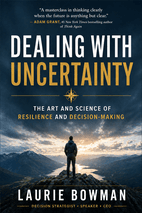
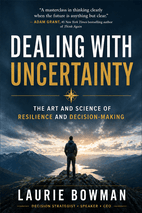
Dealing with Uncertainty
by Laurie Bowman · Summary updated
What is the book Dealing with Uncertainty about?
Laurie Bowman's Dealing with Uncertainty provides a practical framework for managing uncertainty through structured analysis and psychological awareness, blending neuroscience, behavioural economics, and mindfulness techniques for professionals facing high-stakes decisions and individuals navigating career or personal stress.
Feature
Insta.Page
Blinkist
Shortform
Summary Depth
Full Chapter-by-Chapter
15-min overview
Detailed analysis
Audio Narration
✓ (AI narration)
✓
✓
Visual Mindmaps
✓
✕
✕
AI Q&A
✓ Voice AI
✕
✕
Quizzes
✓
✕
✕
PDF Downloads
✓
✕
✓
Price
$59.99/yr
$146/yr (PRO)
$199/yr
*Competitor data last verified February 2026.
About the Author
Laurie Bowman
Laurie Bowman is an expert in historical fiction and military history, known for their meticulously researched novels. Bowman’s notable works include the acclaimed *The Broken Lance* and *Echoes of the Front*, which explore the human cost of war. With a background in archival research and a career as a history professor, Bowman brings deep authenticity to narratives of conflict and resilience.
1 Page Summary
In Dealing with Uncertainty, Laurie Bowman argues that uncertainty is not an obstacle to be eliminated but a fundamental reality to be managed through a deliberate combination of structured analysis and psychological awareness. The book's central thesis is that genuine resilience—whether for individuals or organizations—requires confronting the cognitive biases and emotional reflexes that lead to paralysis or poor decision-making, such as the amygdala's hijack of rational thought or the distortion caused by optimism bias. Bowman redefines financial resilience not as relentless cost-cutting but as a strategic investment in safety, relationships, and long-term value, warning against the catastrophic consequences of "strategic misrepresentation" where costs are underestimated and benefits overstated.
The author's distinctive approach blends hard data with human stories, moving fluidly between neuroscience, behavioural economics, and practical mindfulness. He presents decision-making frameworks like decision trees and cost-benefit analysis alongside personal narratives—from professionals navigating career transitions to corporate case studies like the Dreamworld tragedy and Qantas's outsourcing failure. Bowman draws on techniques from Navy SEAL breathing exercises to Dr. Susan David's emotional agility, and he uses his own experience with blood clots to illustrate how ignoring physical symptoms of stress can lead to crisis. This integration of the technical (Monte Carlo simulations, the Hierarchy of Controls) with the introspective (self-compassion, journaling) makes the book both rigorous and deeply personal.
The intended audience is broad: professionals facing high-stakes decisions, leaders navigating organizational change, and individuals grappling with career uncertainty or personal stress. Readers will gain not only a toolkit of frameworks—from SMART goals and scenario planning to digital literacy and personal branding—but also a mindset shift toward viewing uncertainty as a creative space rather than a threat. The book emphasizes that adaptability is a proactive skill built on self-awareness, emotional intelligence, and a willingness to sit with discomfort until new possibilities emerge. Ultimately, the text equips readers to move from instinctive flight-or-freeze responses to thoughtful, grounded decision-making that honors both data and human experience.
Chapter 1: Chapter 1: Understanding the Nature of Uncertainty
Overview
Uncertainty feels like a predator lurking in the shadows, but the real danger isn’t the unknown itself—it’s our instinct to flee or freeze. The opening story of a frantic parliamentary submission on the Gabba Stadium redevelopment shows what happens when leaders treat uncertainty as an inconvenience rather than a reality to be managed. That $1 billion project ballooned past $3 billion before collapsing, and the real tragedy isn’t just wasted taxpayer money—it’s the lives that could have been saved with that same investment, measured by the Value of a Statistical Life. The psychology behind our paralysis runs deep: the amygdala hijacks rational thought, intolerance of uncertainty affects millions, and cognitive biases like confirmation bias, optimism bias, and the availability heuristic distort every risk assessment. Neuroscience explains why a curt email can trigger physical panic, and why techniques like Box Breathing or simply asking “What do we gain by acting now?” can restore the prefrontal cortex to the driver’s seat. The placebo effect reveals that belief itself rewires the brain, making learned optimism a genuine strategic tool. Behavioural science digs into why loss aversion makes us cling to outdated spreadsheets, and how simple nudges can shift entire organizational cultures. Then the chapter takes an unexpected turn into a chaotic Chennai intersection, where a local boy’s hand through traffic becomes a masterclass in cultural navigation—a reminder that different societies approach uncertainty with vastly different tolerances. Trust emerges as the invisible architecture of resilience, illustrated by the trust earned on a Queensland rail project with traditional owners and the trust shattered in the Boeing 737 MAX crisis. Grit, as defined by Angela Duckworth, isn’t born—it’s built through structured habits, like a 50-year-old body transformation challenge during COVID. Failure becomes fuel rather than dead-end, as shown by Steve Jobs and the author’s own raw exit from a role where change was impossible. Values-based resilience, exemplified by Paul Polman’s leadership at Unilever, ties everything together: when you anchor decisions in core principles, uncertainty becomes navigable, even energizing. The final takeaway is simple but profound—uncertainty isn't something to conquer; it's something to befriend.
A Personal Awakening to Uncertainty
Two days to prepare a parliamentary submission. That was the test that taught me the raw shape of uncertainty. The Queensland government had just announced a $1 billion Gabba Stadium redevelopment tied to Brisbane’s 2032 Olympic bid, and I saw troubling gaps: no rigorous risk assessment, no real stakeholder engagement, no solid business case. Worse, they planned to dismantle Building Queensland, the independent body that kept long-term planning honest. I was a novice to such submissions, and fear nearly won. But I pushed through, learning that preparation isn’t about eliminating the unknown—it’s about acting with integrity despite it.
The Gabba Fiasco: Uncertainty Ignored
The Gabba story quickly became a public cautionary tale. What started as a gleaming 50,000-seat venue in 2021 spiraled to $2.7 billion within two years, then beyond $3 billion by 2024. Local sports teams faced displacement with no clear plan. A heritage-listed school was slated for closure; a park was disrupted for temporary facilities. Public trust eroded. The International Olympic Committee pushed for simpler alternatives. Meanwhile, the abolition of Building Queensland removed independent oversight from all major infrastructure. By March 2024, the Gabba plan collapsed, wasting $6.4 million in planning. A new $3.79 billion stadium at Victoria Park emerged in 2025, with Olympic expenses possibly hitting $7 billion. The root cause? Leaders assumed stable costs and support, ignoring inflation, stakeholder pushback, and heightened cyber and terrorism risks. No comprehensive risk assessment appears to have been conducted. The lesson is stark: uncertainty isn’t a delusion to be shunned—it’s a reality to confront head-on.
A Missed Opportunity to Save Lives
When public money is wasted due to poor governance, the impact reaches beyond inefficiency—it squanders the chance to save lives. Australia uses the Value of a Statistical Life (VSL), estimated at $5.7 million in 2024, to inform policy. Every time a major project goes off track, we should ask: how many lives might have been protected or enhanced with that same investment?
The Psychology of Uncertainty: Why We Freeze
I recall a high-stakes meeting in Sydney, stalled by uncertainty over funding and risk. Our team—engineers, economists, executives—was frozen. That paralysis mirrors a primal response: our ancestors treated the unknown as a threat. Psychologists call it “intolerance of uncertainty,” and nearly 40 million American adults grapple with it. Our brains treat ambiguous situations like predators. In that meeting, the amygdala screamed danger. Stress quieted the prefrontal cortex, leaving panic in charge. I broke the spell by reframing: “What do we gain by acting now?” That question quieted the amygdala and let logic steer us toward manageable steps. Indecision costs more than acting imperfectly.
Cognitive Biases: How They Skew Risk Perception
Our brains take mental shortcuts that distort risk, especially under uncertainty. Confirmation bias makes us favour information that supports existing beliefs. Optimism bias leads us to overestimate positive outcomes, setting unrealistic timelines. The availability heuristic makes us judge probability by how easily examples come to mind—fearing plane crashes more than car accidents, despite statistics. To counteract them, use structured tools like scenario planning, red-team exercises, or a decision journal to track predictions and outcomes.
The Neuroscience of Decision-Making
When the unknown looms, our brain becomes an orchestra of reactions. The amygdala triggers fear and stress; the prefrontal cortex tries to restore order. I once received a curt late-night email: “We need to talk tomorrow. This isn’t working.” My chest tightened—amygdala takeover. But I paused, waited until morning, and found it was a constructive conversation about scope alignment. That pause gave my prefrontal cortex time to lead. Stress mutes the prefrontal cortex, so practical strategies like Box Breathing can restore calm.
Exposure to Uncertainty: The Placebo Effect
We can train our minds to handle uncertainty by taking small, calculated risks. The placebo effect shows that belief alone can trigger measurable changes in the body: a sugar pill releases natural painkillers because the brain expects relief. For leaders, a clear, hopeful vision becomes biochemical—it shifts risk perception, boosts confidence, and sparks effort. This isn’t naive positivity; it’s a strategic advantage.
Behavioural Science Insights: Patterns and Predictions
Traditional models assume rational choices, but real life is messier. Prospect theory reveals that people value gains and losses differently. Loss aversion—the pain of losing is twice as intense as the pleasure of an equivalent gain—can make us overly cautious. I once worked with a manager who refused to upgrade outdated spreadsheets to modern risk tools. I reframed it: “What’s the cost of staying stuck?” He tested the tools and never looked back. Simple nudges, like putting healthier food at eye level, lead to better decisions without forcing anyone.
Cultural Perspectives on Uncertainty: A Global View
Visiting Chennai for a friend’s wedding, I took a side trip to Mamallapuram. I allowed three hours for the 90-minute return, but Chennai traffic was relentless. My taxi driver suggested dropping me on the opposite side of the road to save 15 minutes. I agreed—until I faced a torrent of vehicles with no pedestrian crossing. Then a young boy appeared, laughed at my hesitation, grabbed my hand, and walked me straight into the traffic. That unexpected cultural lesson—trusting human flow rather than rigid systems—is a metaphor for navigating uncertainty globally. Different cultures handle ambiguity differently, and embracing those differences can unlock new ways to move forward.
WELCOMING TRANSFORMATION: THE FIRST STEP TOWARDS RESILIENCE
Change feels intimidating because it threatens the certainty we cling to. I resisted stepping away from my technical identity in risk management. Colleagues pushed me toward training in neuroscience and neuro-linguistic programming (NLP). Curiosity won out, and that detour transformed how I engage with stakeholders. The lesson was clear: change is not something to resist but to actively engage with.
WHY TRUST IS YOUR GREATEST ASSET
Trust is the invisible thread that holds effective decision-making together, especially under uncertainty. Psychological safety—the sense that one can speak up without fear of embarrassment or retribution—is essential. When team members fear repercussions, critical insights are lost. When psychological safety is established, risks are identified earlier, and innovative solutions emerge. The Boeing 737 MAX crisis stands as a dark reminder of what happens when trust erodes. Engineers raised internal concerns; senior executives pushed forward with poorly tested software changes. Two crashes killed 346 people. Leaders must cultivate environments where assumptions can be challenged without fear.
Case in Point: Trust, Uncertainty and Cultural Resilience
During a major rail infrastructure project in Queensland, cultural heritage management emerged as the most significant risk. Traditional owner groups had legitimate concerns. Initially, negotiations were adversarial. As a project manager with no experience in cultural heritage, I became a quiet observer. I grew genuinely curious about the culture. One tense meeting, the traditional owners turned to the lawyer and said, "We want Laurie to run these meetings from now on." I was shocked. But because I wasn't approaching discussions with pre-set assumptions, I had built trust. The Cultural Heritage
**
Key concepts: Chapter 1: Understanding the Nature of Uncertainty
1. Chapter 1: Understanding the Nature of Uncertainty
The Gabba Fiasco: Uncertainty Ignored
Cost ballooned from $1B to over $3B
No comprehensive risk assessment was conducted
Leaders assumed stable costs and support
Project collapsed, wasting $6.4M in planning
Psychology of Uncertainty: Why We Freeze
Amygdala hijacks rational thought under ambiguity
Intolerance of uncertainty affects millions
Stress quiets the prefrontal cortex
Reframing question restores logical thinking
Cognitive Biases Distorting Risk Perception
Confirmation bias favors existing beliefs
Optimism bias sets unrealistic timelines
Availability heuristic skews probability judgment
Use scenario planning and decision journals
Neuroscience and Practical Tools
Box Breathing restores prefrontal cortex control
Placebo effect shows belief rewires the brain
Learned optimism is a strategic tool
Simple nudges shift organizational culture
Cultural Navigation of Uncertainty
Different societies have varying uncertainty tolerances
Chennai intersection example shows cultural navigation
Trust is the invisible architecture of resilience
Trust earned on Queensland rail project with owners
Building Grit and Learning from Failure
Grit is built through structured habits
Failure becomes fuel, not a dead-end
Steve Jobs and author's raw exit examples
50-year-old body transformation during COVID
Values-Based Resilience as Foundation
Anchor decisions in core principles
Paul Polman's Unilever leadership example
Uncertainty becomes navigable and energizing
Befriend uncertainty rather than conquer it
If you like this summary, you probably also like these summaries...
💡 Try clicking the AI chat button to ask questions about this book!
Chapter 2: Chapter 2: Decision-Making Frameworks: An Introduction
Overview
Structured decision-making helps you handle uncertainty. You need frameworks because instinct and analysis both have limits—whether a firefighter reads smoke patterns mid-crisis or a city planner budgets for resilient infrastructure years ahead. Decision trees break complex choices into branches, turning probabilities into clear expected values, like when a hospital weighs fixed versus flexible capacity. Cost-benefit analysis (CBA) pushes further, asking you to value both tangible and intangible trade-offs. Personal stories—like Rachel, who used CBA to stay and grow after a missed promotion, or Marcus, who mapped worst-case scenarios before launching a consultancy—show how the method turns disappointment into opportunity. Yet a dam failure in 2008 reveals what happens when CBA is incomplete: cheap materials led to a fatal rupture, proving that skipping thorough evaluation costs lives.
Modern decision-making uses data and AI to counter human bias. Monte Carlo simulations and regression analysis sharpen forecasts, while AI flags unrealistic timelines—but only if trained on quality data and paired with human judgment. Scenario planning prepares you for multiple futures rather than betting on one. The contrasting energy transitions in China and Australia highlight how openness, not just technical tools, determines success. On a personal level, Priya and John Templeman each used scenario mapping to realize that a lucrative move clashed with deeper values. Updating your beliefs turns decision-making into an ongoing process: start with prior beliefs, gather new evidence, update probabilities. Swami Vivekananda’s intellectual journey and Philip Tetlock’s research both show that humility and a willingness to change your mind are learned skills, not innate gifts.
Intuition has its place—but only under specific conditions. Psychologists Kahneman and Klein found that intuition is reliable in stable environments with rapid feedback, like firefighters’ split-second calls. In messy, slow-feedback settings, biases take over. Pairing gut feelings with structure, such as the PDCA cycle (Plan-Do-Check-Act), creates a rhythm of learning and adjustment. The More/Less/Better/Different reflection tool sharpens focus, and the PPL case study shows how embedding a Total Cost Management framework shifted an organization from intuition-driven to risk-informed project governance.
Finally, ethics and sustainability are built into every framework. Unilever’s supply-chain redesign boosted both profit and trust, while Volkswagen’s emissions scandal cost billions and shattered reputation. BlackRock’s shift to ESG investing proves climate risk is financial risk. Even AI tools must be checked for bias. The chapter closes by challenging you to recognize when financial logic hides real risks and to rethink resilience beyond mere cost-cutting—because every decision, from a corporate merger to a career pivot, reflects what you truly value.
Why Structured Decision-Making Matters
Every day, you face decisions—some trivial, others life-altering. Research shows that structured frameworks help strip away emotional bias and give you systematic ways to evaluate risks, trade-offs, and confidence levels. Firefighters make split-second choices under pressure, reading subtle cues like wind shifts or structural strain. But equally critical are strategic decisions made long before flames ignite—how to invest in resilient infrastructure or maintain connectivity when traditional networks fail. In California’s 2024 fire season, satellite-based systems like Starlink proved invaluable. Structured frameworks bridge both levels, guiding urgent action and long-range planning.
In business, especially under high pressure, there’s rarely time to methodically apply every framework. That’s where a risk-based mindset becomes essential. Mature organizations embed these frameworks as guardrails, preventing poor decisions even when time is short. Less mature environments fall back on bias and short-term pressures. The goal is agility—knowing when to use full frameworks and when to rely on simpler heuristics. Ultimately, the principle is to align decisions with core values and strategic intent, no matter the pressure.
Decision Trees: Visualizing Your Options
Decision trees break complex choices into manageable branches, each representing a path and its outcome. They let you weigh probabilities and expected values, turning uncertainty into clear trade-offs. Consider a healthcare provider deciding between building a fixed-capacity hospital versus a flexible one that can be upgraded later. With two possible demand scenarios—expected or overshooting—the flexible option yields an expected value of $27.5M, while the fixed option nets $0M. That clarity comes from mapping costs, benefits, and probabilities directly. Decision trees are widely used in finance, healthcare, and engineering wherever systematic analysis of outcomes matters.
Cost-Benefit Analysis: Weighing What Truly Counts
Cost-benefit analysis (CBA) compares total expected costs with benefits, both tangible and intangible. It’s crucial in financial planning, but today’s world demands more. Values-based decision-making integrates social, environmental, and governance (ESG) factors, ensuring decisions reflect what matters to communities. A personal example: deciding on a job offer using CBA—listing higher salary versus longer commute, plus the company’s environmental stance. Weighted scoring clarifies the choice.
Real-world stories bring this to life. Rachel, passed over for promotion, used CBA to see that staying offered rich learning and a supportive team. Instead of reacting impulsively, she sought feedback and was promoted 18 months later. Marcus, a project controls expert, used CBA to weigh leaving corporate for his own consultancy. He mapped best, middle, and worst cases, saved six months of expenses, and jumped—surviving a tough first year to build a thriving niche. Both examples show that stepping back to weigh true costs and benefits turns disappointment or fear into opportunity.
But CBA failures can be catastrophic. A regional weir needed expansion; a proper CBA was skipped. The operator chose a cheap inflatable rubber dam over more reliable steel flap gates. Years of defects followed, culminating in a 2008 rupture that drowned a four-year-old girl. The coroner found that a thorough CBA would have revealed steel gates offered lower lifecycle costs and greater safety. The lesson: CBAs must evaluate all options, identify hazards early, and include social and environmental risks. Skipping that step can cost lives.
Leveraging Data and AI for Smarter Decisions
Traditional CBA relies on qualitative judgment, which can be biased. Organizations now push for data-driven approaches: using historical project data to overcome optimism bias, and tools like Monte Carlo modeling to simulate thousands of possible outcomes. Regression analysis identifies key success factors. But past data alone isn't enough—emerging risks like climate change or AI require forward-looking scenario planning.
The real opportunity lies in structuring data to support AI-driven insights. AI can uncover patterns humans miss, flag unrealistic timelines, and improve forecasts. Yet AI isn’t perfect—it amplifies biases if fed flawed data. The best approach pairs AI with human oversight, testing outputs against values. Start simple: use predictive budgeting apps or explore AI analytics at work. This keeps you nimble and grounded, turning technology into a partner for navigating uncertainty.
Scenario Planning: Navigating Multiple Futures
Scenario planning gives you glimpses of possible paths so you can steer with foresight instead of fear. Instead of betting on a single optimistic outcome, you develop narratives for best-case, worst-case, and most probable futures. The contrast between China and Australia's energy transitions shows why this matters. At a 2018 forum in China, industry leaders and engineers were deeply engaged with quantitative risk analysis and scenario planning. Seven years later, Australia still struggles with political and ideological resistance that blocks a full assessment of energy options. The lesson: managing uncertainty requires more than technical tools—it demands openness and a willingness to challenge assumptions.
Updating Your Beliefs as New Evidence Emerges
This approach turns decision-making into an ongoing process. You start with prior beliefs, assign probabilities to outcomes, and then constantly update those probabilities as fresh data arrives. Swami Vivekananda’s journey from skeptic to spiritual leader exemplifies this mindset. Initially, he dismissed Ramakrishna’s mystical experiences as fantasy. But Ramakrishna’s invitation to “try to see the truth from all angles” nudged Vivekananda to reconsider. He updated his beliefs and eventually became a bridge between Eastern and Western thought. That same openness to new information underpins the science of accurate forecasting. Philip Tetlock’s research found that the most accurate forecasters weren’t necessarily experts—they were people with intellectual humility, a habit of questioning assumptions, and a willingness to update their views.
Conditions for Intuition: When to Trust Your Gut
Psychologists Daniel Kahneman and Gary Klein reconciled their views on intuition by identifying three conditions that make it reliable: a stable, structured environment; frequent opportunities to learn from experience; and rapid feedback loops. Firefighters and other experts thrive under these conditions, reading subtle cues from years of practice. But when the environment is volatile, feedback is delayed, or experience is limited, biases like overconfidence take over.
Key Takeaways
Structured frameworks like decision trees and cost-benefit analysis help you break down complex choices and reduce emotional bias.
Data and AI tools improve forecasts but need human oversight to avoid bias.
Scenario planning prepares you for multiple futures, not just one.
Updating your beliefs with new evidence leads to better decisions.
Intuition works best in stable environments with fast feedback.
Ethics and sustainability must be part of every decision framework.
Key concepts: Chapter 2: Decision-Making Frameworks: An Introduction
2. Chapter 2: Decision-Making Frameworks: An Introduction
Why Structured Decision-Making Matters
Frameworks strip away emotional bias from decisions
They bridge urgent action and long-range planning
Risk-based mindset prevents poor decisions under pressure
Aligns choices with core values and strategic intent
Decision Trees: Visualizing Options
Break complex choices into manageable branches
Weigh probabilities and expected values clearly
Example: flexible hospital capacity yields $27.5M expected value
Used in finance, healthcare, and engineering
Cost-Benefit Analysis (CBA)
Compares total costs with tangible and intangible benefits
Integrates ESG factors for values-based decisions
Personal example: weighted scoring for job offers
Incomplete CBA can lead to fatal failures like dam rupture
Data, AI, and Bias Reduction
Monte Carlo simulations and regression sharpen forecasts
AI flags unrealistic timelines with quality data
Must pair AI with human judgment to counter bias
Tools only as good as the data they are trained on
Start with prior beliefs, update with new evidence
Humility and willingness to change are learned skills
Intuition and the PDCA Cycle
Intuition reliable only in stable, fast-feedback environments
Pair gut feelings with structured PDCA cycle
More/Less/Better/Different tool sharpens focus
Embedding frameworks shifts from intuition to risk-informed governance
Ethics, Sustainability, and Values
Unilever boosted profit and trust via supply-chain redesign
Volkswagen scandal cost billions from ignoring ethics
BlackRock proves climate risk is financial risk
Every decision reflects what you truly value
⚡ You're 2 chapters in and clearly committed to learning
Why stop now? Finish this book today and explore our entire library. Try it free for 7 days.
Chapter 3: Chapter 3: When Finance Becomes the Risk: Rethinking Resilience Beyond Cost-Cutting
Overview
Financial risk is far more than a number on a spreadsheet; it is a force that reshapes lives, organizations, and entire communities. This chapter redefines financial resilience not as relentless cost-cutting but as a deliberate investment in safety, relationships, and long-term value. Through a blend of corporate case studies and a personal story, it reveals how short-sighted decisions—driven by overconfidence, pride, or pressure to save money—can spiral into catastrophe, and how the same principles of transparency, contingency, and trust can prevent or recover from such crises.
The 2016 Dreamworld tragedy, where four people died on a ride, illustrates the fatal cost of prioritizing profit over safety. The Hierarchy of Controls framework shows that the most effective protective measures—elimination, substitution, isolation, engineering—require upfront investment, yet Dreamworld relied on weak administrative controls that pushed risk onto undertrained operators. The result was systemic failure, hidden prior incidents, and lives lost. Similarly, Qantas’s 2022 outsourcing of ground-handling roles, later ruled unlawful, demonstrates stakeholder risk—ignoring frontline staff’s insights led to operational chaos and reputational damage. Both cases expose a common pattern: strategic misrepresentation, where costs are underestimated and benefits overstated to push projects through, as seen in 9 out of 10 megaprojects.
The author’s own 2017 crisis—losing his home, car, and assets despite being a globally recognized cost engineer—brings these lessons home. A high risk appetite, overcommitment to unpaid work, and pride that kept him from asking for help turned passion into ruin. Opening up to a few friends became the turning point, revealing that resilience depends on humility and connection as much as on calculations. For entrepreneurs, the chapter distills three hard-won truths: know your worth by charging fairly and using clear contracts, balance passion with pragmatism by securing your own foundation before serving others, and build a support network because hiding struggles only deepens them.
Practical strategies for building financial resilience span personal and professional life: proactive risk management through buffers, contingencies, and risk registers; stakeholder engagement to catch blind spots early; and ethical and sustainable planning that aligns profit with safety and values. The chapter closes with a reflective exercise—a simple call to identify one concrete action and one person to turn to for support—reminding readers that small, consistent steps compound into lasting strength. Ultimately, true financial resilience is not about avoiding all risk but about investing in what truly matters: the people, systems, and self-care that make growth possible.
Redefining Financial Risk as a Human and Organizational Force
Financial risk isn’t just a line on a balance sheet—it reshapes lives, companies, and communities. Poor planning, overconfidence, and neglect of safety or relationships can turn ambition into catastrophe. The author draws from decades as a cost engineer, seeing projects fail not from lack of funds but from failing to anticipate uncertainty. A personal 2017 crisis—losing home, car, and assets—taught that resilience depends on humility and connection as much as on calculations.
True financial resilience means more than avoiding risk or slashing costs. It requires building trust with stakeholders, adapting to change, and maintaining contingencies that account for human factors. Organizations that ignore these principles court failure; individuals too can falter when passion outpaces pragmatism. This chapter redefines resilience through corporate and personal lenses, probing hidden costs of short-sighted decisions and cognitive biases, then sharing a cautionary personal story of pride and recovery.
Case Study: Dreamworld’s Fatal Oversight
The 2016 Dreamworld tragedy—four deaths on the Thunder River Rapids Ride—exposes how cost-cutting that trumps safety becomes catastrophic. The Coroners Court found a systemic failure: neglect of automation, skimped maintenance, overburdened operators. Using the Hierarchy of Controls framework, the most effective measures—elimination, substitution, isolation, engineering—require management-level investment and strategic commitment. Dreamworld’s leadership instead relied on weak administrative controls, pushing responsibility onto undertrained operators.
Elimination would have meant decommissioning the 30-year-old ride. Substitution could have replaced it with modern safety systems. Isolation might have separated rafts from conveyor risk. Engineering controls like automated sensors were inexpensive yet absent. Instead, operators faced confusing panels and 38 signals under stress. The coroner noted prior incidents—raft collisions in 2001 and 2014—hidden by shoddy recordkeeping. Cost-cutting eroded the systems needed to identify dangers. The lesson: safety demands investment in robust controls, not patchwork fixes. Financial resilience begins with leadership choices that prevent harm, not just react to it.
Qantas: Outsourcing and Stakeholder Risk
In 2022, Qantas outsourced over 1,600 ground-handling roles to cut costs during COVID. The Federal Court later ruled the decision unlawful, but damage was done: delays, mishandled luggage, reputational loss. Critics argued short-term savings ignored long-term service quality and staff morale. This case reinforces that financial decisions without frontline stakeholder input backfire. Those closest to operations hold critical insight into real risks. Ignoring them weakens resilience and trust, and undermines ethical risk culture where those closest to failure must be heard.
These issues are compounded by strategic misrepresentation—deliberately underestimating costs or overstating benefits to get projects approved. Flyvbjerg’s research shows 9 out of 10 megaprojects go over budget, over time, and underdeliver. The pattern isn't limited to infrastructure; wherever reputation and legacy are at stake, executives champion pet projects with hidden risks. Avoiding these traps requires honest reflection on incentives, stakeholder consultation, and commitment to long-term value.
Personal Story: Losing My Home to Financial Risk
In 2017, the author—a globally recognized cost engineer advising on billion-dollar projects—lost his home, car, and assets. A high appetite for risk and deep passion for mission-driven work led to overcommitment: saying yes to unpaid roles, ignoring boundaries, neglecting personal financial stability. The 2011 Brisbane flood had already reduced property value, adding pressure. Mortgage payments slipped, and a forced sale left over $200,000 in debt, two huskies, and no paid work.
The hardest part was isolation—too proud to ask for help, embarrassed to have failed at the very principles he taught. Opening up to a few close friends brought unexpected support and revealed true friends. That clarity became a gift. From that low point, he rebuilt financially, emotionally, spiritually. He embraced contingency planning, clear boundaries, and a strong support network. Most importantly, he learned to respect himself. Adversity, he realized, is often the beginning of a better story. The same principles of resilience—transparency, contingency, trust—apply to personal budgets as to corporate projects.
Entrepreneurial Considerations: Navigating Financial Risk in Business
Starting a business demands clarity, self-awareness, and navigating uncertainty without losing yourself. Three lessons emerge:
Know Your Worth: The author gave away expertise for years, believing it served the greater good. But honouring purpose doesn’t mean ignoring needs. Fair compensation is sustainable. Research your value, use clear contracts, set boundaries. Self-respect is foundational to service.
Balance Passion and Pragmatism: Passion without pragmatism leads to burnout. Commit to unpaid roles only after ensuring your own financial foundation is strong. Create space for inspiring work while keeping the business viable—budgeting, diversifying income, resting.
Build a Support Network: Hiding struggles diminishes you; sharing opens doors to connection and honest feedback. Entrepreneurs need community—mentors, peers, friends who challenge with kindness. You don’t have to carry the load alone.
Strategies for Financial Resilience: Personal and Professional
True resilience means growing stronger, not just bouncing back. The same principles apply in business and life.
Proactive Risk Management: Plan for uncertainty by identifying risk appetite, critical thresholds, mapping risks, and preparing contingencies. The author now lives what he teaches—buffers, realistic plans, personal and professional risk registers. Tools like scenario modelling, contingency budgets, emergency funds, and insurance act like layers in the Hierarchy of Controls, absorbing shocks. Uncertainty is inevitable; preparation is a choice.
Stakeholder Engagement and Trust: Qantas’s blunder and the author’s isolation show the cost of ignoring stakeholders. Engagement builds resilience by harnessing collective wisdom. In organizations, regular check-ins with employees, clients, regulators create feedback loops to catch risks early. Personally, openness with trusted friends provides perspective pride blocked. Build a network and check in: “Am I missing something?” Transparency turns stakeholders into allies.
Ethical and Sustainable Planning: Dreamworld’s tragedy stemmed from prioritizing profit over safety—a morally bankrupt choice. Ethical planning anchors resilience in values like fairness, accountability, and sustainability. Adopt an “all-hazards” risk approach; let environmental and social impacts guide decisions. Long-term thinking prevents shortcuts. Diversify investments, engage with ESG funds. The author learned that ethics and pragmatism can coexist. Serve the world sustainably only when you also care for yourself. These strategies unite personal and professional resilience—planning, engagement, and ethics form the foundation.
The Reflective Exercise: A Practical Tool for Resilience
The chapter closes with a powerful invitation: move from theory to practice. A simple reflective exercise asks you to confront a real financial risk—tight budgets, new ventures, or unexpected costs.
Key concepts: Chapter 3: When Finance Becomes the Risk: Rethinking Resilience Beyond Cost-Cutting
3. Chapter 3: When Finance Becomes the Risk: Rethinking Resilience Beyond Cost-Cutting
Redefining Financial Resilience
Risk is a human force, not just a spreadsheet number
Resilience requires investment in safety and relationships
Short-sighted decisions driven by pride or pressure cause catastrophe
Humility and connection are as vital as calculations
Ethical planning aligns profit with safety and values
Small consistent steps compound into lasting strength
Chapter 4: Chapter 4: Mindfulness and Stress Management Techniques
Overview
The modern workplace demands a polished image that often hides internal stress. That gap between the person you show others and who you really are creates constant pressure, but mindfulness offers a way to change how you relate to that pressure rather than eliminate it. Science shows that practices like Mindfulness-Based Stress Reduction literally reshape brain regions linked to focus and self-regulation. Simple techniques like controlling your breath can anchor you in chaos—from box breathing used by Navy SEALs to alternate nostril breathing from yoga. These activate the parasympathetic nervous system for instant calm. Meditation deepens that work through body scans, transcendental meditation, or loving-kindness practices, and even micro-meditations during a commute can become anchor points of clarity.
After ignoring physical symptoms of grief, the author discovered blood clots. That hospital bed becomes a turning point, leading to exploration of practices from Dr. Joe Dispenza’s meditation to Sadhguru’s Inner Engineering and a local Buddhist temple. All point to the same lesson: stillness brings clarity, and observing feelings builds resilience. Emotional agility, as articulated by Dr. Susan David, teaches how to pause, accept emotions, and respond thoughtfully rather than react impulsively. Self-compassion, championed by Dr. Kristin Neff, offers resilience rooted in treating yourself with kindness and accepting mistakes as universal. The story of Maya, a project manager who turned self-blame into self-inquiry through morning journaling, shows how shifting from “What’s wrong with me?” to “What can I learn?” can rebuild confidence.
Mindful journaling becomes a deeper dialogue with yourself—a space to untangle thoughts and spot recurring patterns. Voice transcription apps make this accessible, while prompts about gratitude, emotions, and overlooked details train the mind toward presence. Stillness also comes from outward listening: Dadirri, the Aboriginal practice of deep listening, and Shinrin-yoku (forest bathing) from Japan invite quiet attunement with nature, reducing stress hormones and opening the heart to what is already present. From that space, gratitude arises naturally—not as a duty but as a conscious focus on what you have, which engages the brain’s reward system and strengthens relationships. Finally, daily rituals—morning meditation and movement, evening wind-downs with journaling or tea, and above all protecting sleep—create small sanctuaries of predictability in a chaotic world. These aren’t about perfection but presence: small, intentional practices that ground your day, calm your nervous system, and help you face uncertainty with steady optimism.
Key Takeaways
Adopt mindfulness and breathing techniques to regulate stress and enhance mental and emotional clarity.
Use journaling, meditation, and gratitude practices for emotional balance and self-awareness.
Cultivate self-compassion through loving-kindness meditation and reflective writing to build resilience.
Incorporate stillness practices like Dadirri and forest bathing to deepen connection and calm.
Build daily rituals—morning and evening—that anchor your day, prioritize sleep, and create a foundation for long-term calm.
Key concepts: Chapter 4: Mindfulness and Stress Management Techniques
4. Chapter 4: Mindfulness and Stress Management Techniques
Mindfulness and Breathing Techniques
MBSR reshapes brain regions for focus and self-regulation
Box breathing activates parasympathetic nervous system for calm
Alternate nostril breathing from yoga for instant calm
Micro-meditations during commute create anchor points of clarity
Emotional Agility and Self-Compassion
Pause, accept emotions, and respond thoughtfully not reactively
Self-compassion builds resilience through kindness to self
Shift from 'What's wrong with me?' to 'What can I learn?'
Morning journaling transforms self-blame into self-inquiry
Mindful Journaling and Gratitude
Untangle thoughts and spot recurring patterns through journaling
Voice transcription apps make journaling accessible
Gratitude engages brain's reward system and strengthens relationships
Prompts about gratitude and emotions train mind toward presence
Stillness Practices and Nature Connection
Dadirri deep listening from Aboriginal practice for quiet attunement
Evening wind-downs with journaling or tea create predictability
Protecting sleep is essential for nervous system regulation
Small intentional practices build foundation for steady optimism
Frequently Asked Questions about Dealing with Uncertainty
What is Dealing with Uncertainty about?
This book explores the nature of uncertainty and why our instinct to flee or freeze often leads to poor decisions. It blends neuroscience, behavioral science, and real-world case studies—from the Gabba Stadium fiasco to the Dreamworld tragedy—to show how cognitive biases and emotional hijacks distort risk assessment. The guide offers practical frameworks like decision trees, cost-benefit analysis, scenario planning, and mindfulness techniques such as box breathing to restore rational thinking. Ultimately, it redefines resilience as proactive investment in safety, relationships, and long-term value rather than reactive cost-cutting.
Who is the author of Dealing with Uncertainty?
Laurie Bowman is the author, drawing on personal experiences—including a health crisis triggered by ignored grief—and professional insights from organizational leadership and risk management. The writing reflects a deep understanding of neuroscience, behavioral science, and practical decision-making, making complex concepts accessible. Bowman combines heartfelt stories with rigorous analysis to help readers navigate uncertainty in both life and work.
Is Dealing with Uncertainty worth reading?
Yes, this book is worth reading because it goes beyond theory to provide practical, science-backed tools for managing uncertainty in high-stakes situations. Through vivid case studies and personal narratives, it reveals how cognitive biases and emotional reactions can derail decisions—and offers clear techniques to counter them. Whether you're facing a career move, a financial crisis, or everyday stress, you'll find actionable strategies to build resilience and make smarter choices.
What are the key lessons from Dealing with Uncertainty?
Key lessons include understanding that uncertainty triggers the amygdala and cognitive biases, but techniques like box breathing and reframing questions can restore rational thought. Structured decision frameworks—decision trees, cost-benefit analysis, and scenario planning—help turn ambiguity into manageable probabilities. Financial resilience requires upfront investment in safety and transparency, not just cost-cutting, as shown by the Dreamworld and Qantas failures. Finally, emotional intelligence and adaptability, built through mindfulness and self-compassion, are essential for navigating change and building strong relationships.
📚 Explore Our Book Summary Library
Discover more insightful book summaries from our collection