Chapter 1: The Matching Principle: How to Fail at Recruiting Spies
Chapter 1/4
Lang
1x
Voice
PDF
0:00
0:00
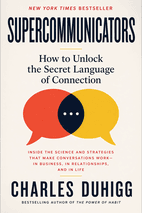
Supercommunicators
by Charles Duhigg · Summary updated
What is the book Supercommunicators about?
Charles Duhigg's Supercommunicators reveals the science of genuine connection, teaching how to identify and align with the three conversational mindsets. It provides practical techniques for anyone seeking to deepen relationships through more authentic and effective dialogue.
Feature
Insta.Page
Blinkist
Shortform
Summary Depth
Full Chapter-by-Chapter
15-min overview
Detailed analysis
Audio Narration
✓ (AI narration)
✓
✓
Visual Mindmaps
✓
✕
✕
AI Q&A
✓ Voice AI
✕
✕
Quizzes
✓
✕
✕
PDF Downloads
✓
✕
✓
Price
$59.99/yr
$146/yr (PRO)
$199/yr
*Competitor data last verified February 2026.
About the Author
Charles Duhigg
Charles Duhigg is a Pulitzer Prize-winning reporter and author, best known for his books on habits and productivity, including *The Power of Habit* and *Smarter Faster Better*. His expertise lies in examining the science of productivity and the patterns that shape human and organizational behavior. He previously worked as a reporter for *The New York Times*.
1 Page Summary
In Supercommunicators, Charles Duhigg argues that the most effective conversations are not accidental but are a learnable skill, rooted in the science of connection. The book's central thesis is that genuine connection occurs when our brains and bodies synchronize, a state best fostered by "supercommunicators." These individuals excel by practicing the matching principle—identifying and aligning with one of the Three Conversational Mindsets present in every discussion: the practical Decision-Making Mindset ("What's This Really About?"), the empathetic Emotional Mindset ("How Do We Feel?"), or the identity-focused Social Mindset ("Who Are We?"). Miscommunication, Duhigg explains, often stems from people talking in different, unrecognized modes.
Duhigg's approach is distinctive for its blend of narrative storytelling and accessible social science. He builds his case through vivid, real-world examples—from a CIA officer failing to recruit spies to a jury deliberating a case and a Netflix crisis over radical candor—to illustrate abstract concepts like neural coupling, emotional contagion, and identity threat. The book moves beyond simple communication tips, delving into the underlying psychology of how we "hear" unspoken emotions through nonverbal cues like laughter, navigate conflict by looping for understanding, and make difficult conversations safer by shifting from flawed perspective-taking to genuine perspective-getting.
The intended audience is anyone seeking to deepen their personal and professional relationships by mastering the art of conversation. Readers will gain a practical framework for understanding what any given conversation is truly about and learn specific techniques to connect more authentically. By the end, they will understand that every meaningful discussion begins with a subtle negotiation of its purpose and that fostering connection requires recognizing the powerful role of social identities and the transformative power of reciprocal vulnerability.
Chapter 1: Chapter 1: The Matching Principle: How to Fail at Recruiting Spies
Overview
The chapter opens with a young CIA officer, Jim Lawler, who is failing spectacularly at his most important job: recruiting spies. His clumsy attempts are ineffective until he meets a potential asset named Yasmin. Just as he seems to succeed, his boss orders him to reveal his true identity, a confession that horrifies Yasmin. Lawler understands that real recruitment requires a genuine connection but doesn’t know how to create one. This frames the central question: How do we truly connect with another person?
The answer lies in the science of how people “click.” When we connect, our brains and bodies synchronize through neural coupling. The people best at fostering this are supercommunicators, who ask far more questions, listen deeply, and practice matching—adjusting their style to mirror their companions.
Effective matching depends on navigating the Three Conversational Mindsets. Every discussion operates in one of three modes: a practical Decision-Making Mindset (“What’s This Really About?”), an empathetic Emotional Mindset (“How Do We Feel?”), or an identity-focused Social Mindset (“Who Are We?”). Miscommunication often happens when people are in different, unrecognized mindsets.
The matching principle is the skill of identifying what kind of conversation is happening and aligning with it. This transforms Lawler’s story. In a final meeting with Yasmin, he matches her emotional despair, sharing his own vulnerabilities. In that moment of genuine connection, she agrees to work with him. Success came from authentic communication, not manipulation.
Mastering this begins with a simple rule: Pay attention to what kind of conversation is occurring. We can listen for cues or ask a pivotal question: “Do you want to be helped, hugged, or heard?” This probes whether someone seeks practical advice, emotional support, or social validation. Conscious alignment turns confusing talks into learning conversations.
This is formalized in the What’s This Really About? dialogue, a meta-conversation that negotiates both the topics and the rules for a discussion. Engaging in this clarifying negotiation—whether at the start or when a talk drifts—prevents frustrating exchanges. The art of connection is a learnable skill, rooted in the effort to sync up with the mindset of the person in front of us.
Jim Lawler's Recruitment Crisis
Jim Lawler, a young CIA officer in 1982, is failing at his core task: recruiting spies. His training emphasized that espionage is a communications job built on genuine connection, but his field attempts fall flat. His best hope is "Yasmin," a lonely, disillusioned foreign ministry worker. Posing as an oil speculator, he builds rapport and offers her a consulting job, which she accepts.
His triumph is short-lived. His boss insists he must reveal his CIA identity for ethical reasons. When Lawler confesses, Yasmin is horrified and recoils. He realizes that to recruit someone, you must truly connect with them. Faced with a final chance to reach her, he has no idea how to forge that bond, setting up the central question of the chapter.
The Science of Synchronization
Researchers study how people "click." Experiments show "neural coupling" or synchronization: when people engage deeply in a shared activity, their brain activity, breathing, and heart rates can align. This synchronization is communication; the more brains sync, the better people understand each other.
Studies of group discussions reveal that some groups synchronize more deeply. The key isn't a dominant leader but the presence of "high centrality participants" who make conversations flow.
These individuals, or supercommunicators, share distinct traits:
They ask 10 to 20 times more questions than others.
They listen intently, repeat others' ideas, and admit confusion.
They encourage others and manage the emotional tone.
Most importantly, they practice matching: adjusting their communication style to mirror their companions.
Supercommunicators wield subtle influence, often guiding groups to consensus without anyone realizing it. Their skill involves navigating the "Three Mindsets" that guide different types of conversations.
The Three Conversational Mindsets
Our brains engage in different types of dialogue, simplified into three core mindsets:
The Decision-Making Mindset ("What's This Really About?")
This practical mindset is for discussing choices, plans, or intellectual concepts. It activates the brain's frontal control network for evaluating options. A conversation about a problem at work is a "What's This Really About?" dialogue.
The Emotional Mindset ("How Do We Feel?")
This mindset emerges when discussions touch on feelings, beliefs, and memories. It's at work when sharing a story or seeking empathy. When a friend vents and wants comfort, not solutions, they are in a "How Do We Feel?" conversation.
The Social Mindset ("Who Are We?")
This mindset is for conversations about relationships, social identity, and how we are perceived. Gossiping or discussing shared acquaintances are "Who Are We?" discussions. Research suggests a large portion of our conversations are social.
Miscommunication happens when participants are unknowingly in different modes. If one person speaks emotionally while the other responds practically, it creates dissonance.
The Matching Principle in Action
The matching principle is the key: recognize what kind of conversation is occurring and align with it. This isn't mimicry, but a genuine effort to connect with the other person's mindset. Studies of happy marriages show couples frequently mirror each other's emotional tones, creating closeness.
Jim Lawler's story illustrates this. After his disastrous confession, he met Yasmin for a final, tense dinner. She was despondent. Lawler initially tried to cheer her up, failing to connect. He then remembered a past lesson where honesty and shared vulnerability forged a connection.
He stopped pitching and matched her emotional mindset. He shared his own fears, insecurities, and feelings of failure. This vulnerable honesty allowed Yasmin to feel truly heard. In that moment of aligned emotion, she unexpectedly agreed to become an asset. Recruitment succeeded through genuine connection established by matching.
Mastering the Skill of Connection
Lawler developed teachable methods for the CIA, emphasizing deep relationships through synchronized communication. The core skill is learning to distinguish between the three mindsets and engaging authentically within each.
This translates to everyday life. The foundation is Rule One: Pay attention to what kind of conversation is occurring. Before a discussion, clarify your own goal. During, observe clues: Are others emotional, practical, or socially focused? A powerful question to ask is: "Do you want to be helped, hugged, or heard?" This probes whether someone seeks practical advice ("helped"), emotional support ("hugged"), or social validation ("heard").
By consciously identifying the type of conversation and striving for alignment, we transform dueling monologues into genuine dialogue.
The Essence of a Learning Conversation
A learning conversation is a deliberate effort to bridge the internal worlds of people. It’s about actively seeking to understand others while courageously sharing our own thoughts. This encourages attentive listening, open speaking, and voicing hidden thoughts. The aim is to foster a genuine alignment—a shared belief in mutual understanding—which reveals pathways for connection.
Initiating the "What’s This Really About?" Dialogue
Conversations often begin with unspoken decisions about tone and timing. This is where the What’s This Really About? conversation can take root. This meta-dialogue serves two purposes:
Establishing the 'What': It clarifies the core topics everyone needs to discuss.
Negotiating the 'How': It sets the unspoken rules for how the discussion will proceed.
While this often happens at the start, it can emerge at any point, especially when talk turns to practical choices. Every conversation contains a quiet negotiation where the goal is to discover what each person truly wants.
The Cost of Avoidance and the Path Forward
Skipping the What’s This Really About? conversation leads to frustration and a lack of direction. We’ve all had discussions that feel like talking past each other. The antidote is to develop the skill to recognize when this crucial negotiation is needed and to learn how to collaboratively shape its course.
Key Takeaways
A learning conversation prioritizes mutual understanding to create genuine alignment.
The What’s This Really About? conversation is a meta-dialogue that defines both topics and rules for discussion.
This negotiation can occur at the start of a talk or arise during practical decision-making.
Failing to engage in this dialogue often leads to frustrating, directionless exchanges.
The solution is to cultivate awareness of when this conversation is needed and develop skills for negotiating its flow.
Key concepts: Chapter 1: The Matching Principle: How to Fail at Recruiting Spies
1. Chapter 1: The Matching Principle: How to Fail at Recruiting Spies
The Recruitment Failure
Jim Lawler fails to recruit spies via clumsy methods
Forced confession destroys connection with asset Yasmin
Reveals need for genuine connection, not manipulation
The Science of Connection
Neural coupling synchronizes brains during deep engagement
💡 Try clicking the AI chat button to ask questions about this book!
Chapter 2: Chapter 2: Every Conversation Is a Negotiation: The Trial of Leroy Reed
Overview
Picture twelve ordinary people in a Wisconsin jury room, tasked with deciding the fate of Leroy Reed, an ex-convict who bought a gun under bizarre circumstances. Before they can even debate guilt or innocence, they face a more fundamental challenge: how to begin talking to one another. This moment reveals a powerful truth—the start of any meaningful discussion is a subtle, often invisible negotiation. We all engage in this quiet negotiation, a delicate dance to figure out what everyone really wants from the exchange and to establish the unspoken rules for how we’ll listen and make decisions together. This foundational process is called the "What's This Really About?" conversation.
This struggle to uncover the real subject isn’t confined to a jury room. Consider Dr. Behfar Ehdaie, a surgeon who for years logically presented data to prostate cancer patients, only to see 40% choose unnecessary surgery. He realized he was lecturing on the wrong topic. By shifting to ask questions like, “What does this diagnosis mean to you?” he began to discover their deeper fears about family, legacy, and control. He first negotiated the conversation’s true subject, aligning with his patients' core values, and unnecessary surgeries fell dramatically.
Back with the jury, a literature professor named John Boly intuitively understands this principle. He acts as a supercommunicator, beginning not with arguments but with open-ended questions. He listens intently, cataloging what each juror truly desires. This mirrors the revolutionary idea from negotiation theory of "expanding the pie," which moves beyond a fixed, win-lose mindset. It starts with deep listening to understand underlying interests. But listening is only the first step. The next is to experiment with the conversation itself, using probes like jokes or new topics to discover how the group will reason together.
As the jury debate grows heated and tilts toward conviction, Boly conducts a pivotal experiment. He interrupts with an almost whimsical observation about Reed’s gun looking like a toy, then spins an empathetic story. This probe works, shifting the group’s focus. It succeeds because Boly has correctly diagnosed that many jurors are operating on the logic of similarities—an empathetic, values-based mindset where decisions are made through stories and shared identity—rather than a purely analytical logic of costs and benefits.
The final holdout, Karl, is firmly in the cost-benefit camp, focused solely on the rule of law and public safety. To reach him, Boly makes a final, creative negotiation. He reframes the entire case, arguing that convicting Reed would be a catastrophic waste of the justice system’s resources. Acquittal, he contends, would actually direct police toward real threats, making the community safer. This practical argument aligns perfectly with Karl’s own stated interest in public order. The negotiation succeeds, and the verdict is unanimous: not guilty.
The principles demonstrated here are universal. Connecting in a "What's This Really About?" conversation is a two-step process: first, discovering everyone’s true desires through listening and asking open-ended questions, and second, engaging in that quiet negotiation to meet those needs while addressing our own. This requires matching—aligning with whether someone is using an empathetic or analytical mindset and making our own thought process clear. We constantly send and receive clues about our engagement, and by preparing mentally, asking good questions, noticing nonverbal signals, and being willing to experiment with new approaches, we can learn to navigate these hidden negotiations in every conversation we have.
The Jury Begins Its Deliberation
The scene opens in a Wisconsin jury deliberation room in November 1985. The twelve jurors must decide the fate of Leroy Reed, a 42-year-old ex-convict arrested for illegally possessing a firearm. The facts are not in dispute: Reed, a felon, bought a .22 caliber gun. His defense hinged on his severe mental limitations and the bizarre circumstances of the purchase. He had bought the gun as part of a private detective correspondence course, following the instructions literally.
Both the prosecutor and the judge instructed the jury that the law was clear: if Reed was a felon who knowingly acquired a gun, he was guilty. Now sequestered, the jurors face the task of reaching a unanimous verdict. Their first challenge is not the verdict itself, but starting the conversation—they must negotiate the unspoken rules for how they will speak, listen, and make decisions together.
The "Quiet Negotiation" in Every Conversation
This jury’s predicament illustrates a universal phenomenon: the opening of any meaningful conversation involves a subtle, often subconscious negotiation. Before the substantive discussion can begin, people engage in a delicate dance to establish the conversation’s focus, tone, and rules. This process involves offers, counteroffers, and signals through tone, body language, and asides.
This "quiet negotiation" has two core goals:
Determining what everyone wants from the conversation.
Establishing the rules for how to speak, listen, and make decisions together.
This foundational exchange is what the chapter calls the "What’s This Really About?" conversation. It requires moving past surface topics to uncover the deeper desires and concerns that will truly guide the dialogue.
Dr. Ehdaie’s Revelation: Asking What Patients Want
The struggle to identify what a conversation is really about is starkly demonstrated by Dr. Behfar Ehdaie, a prostate cancer surgeon. For years, he logically presented data to patients, advocating for "active surveillance" (monitoring) over risky surgery for low-risk cases. Despite his expertise, a staggering 40% of patients opted for unnecessary surgery.
Ehdaie realized he was failing because he assumed he knew what patients wanted: objective medical advice. In reality, they were wrestling with deeper questions about family, mortality, and legacy. He wasn’t negotiating; he was lecturing on the wrong topic.
He changed his approach. He stopped presenting data first and began asking open-ended questions: “What does this cancer diagnosis mean to you?” These questions revealed patients' true values—fears about burdening family, desires for legacy, needs for control. By first negotiating the conversation's true subject, Ehdaie aligned with his patients' needs. Unnecessary surgeries among his patients fell by 30%.
The Deliberation Unfolds: A Supercommunicator Emerges
Back in the jury room, the initial vote shows three jurors firmly for conviction, two for acquittal, and seven undecided. The debate centers on a philosophical question: Should they follow the strict letter of the law, or apply their conscience?
A juror named John Boly begins to speak. He acknowledges the clear facts of the case but expresses deep uncertainty. Boly’s manner and his open admission of doubt suggest an intuitive understanding of the group's dynamic. He does not push for a verdict but instead models a more exploratory approach, subtly inviting the group to negotiate what their deliberation should truly encompass—not just the facts, but the purpose of their own judgment.
Boly's Supercommunicator Strategy in the Jury Room
Juror John Boly, a literature professor, stands out for his deliberate communication strategy. He consciously operates as a "supercommunicator," beginning the deliberation by asking a series of seemingly casual, open-ended questions. To others, these seem like asides, but Boly is actively listening and cataloging each juror's core desires. He identifies that Henry wants guidance, Barbara seeks compassion, and Karl wants to strictly follow the rules. This is the first critical step in the "What's This Really About?" conversation: figuring out what everyone wants from the discussion.
The second, equally important part is determining how the group will make decisions together. Every conversation involves a quiet negotiation over the rules of engagement.
The Art of "Expanding the Pie" in Negotiation
This concept of conversation-as-negotiation was revolutionized by the idea of "expanding the pie"—finding creative, win-win solutions that make everyone better off. This "interest-based bargaining" starts exactly as Boly did: with asking questions and deep listening to understand underlying interests and values.
But listening is only the foundation. The next step is experimenting with the conversation itself to establish how choices will be made. Skilled communicators introduce new topics or shift tones as "probes" to see how others react and to collaboratively discover a path forward. In daily life, we do this when we make a joke, ask a probing question, or reframe a problem—all are experiments in setting the rules for dialogue.
The Tipping Point and Boly's Pivotal Experiment
Back in the jury room, after Boly's initial questioning, momentum builds toward a guilty verdict. As voices rise in heated debate, Boly shifts from asking questions to conducting a decisive experiment. He interrupts the tension with a light-toned observation: Leroy Reed’s gun “looks like a toy.”
He then spins a narrative, imagining what he would do with a gun and contrasting it with how Reed treated it—as a "sacramental thing" locked in a closet. Boly is experimenting by introducing a new, empathetic frame. This narrative probe works. Other jurors pick up the thread, building a speculative story that Reed might not even know how to use the gun, thereby introducing "reasonable doubt." Boly has successfully shifted the negotiation over how the jury will reason together.
The Two Logics of Persuasion: Costs vs. Similarities
"What's This Really About?" conversations ultimately align around one of two persuasive logics:
The Logic of Costs and Benefits: A practical, analytical mindset where decisions
Key concepts: Chapter 2: Every Conversation Is a Negotiation: The Trial of Leroy Reed
2. Chapter 2: Every Conversation Is a Negotiation: The Trial of Leroy Reed
The 'What's This Really About?' Conversation
Foundational negotiation before substantive talk begins
Uncovers deeper desires beyond surface topics
Establishes unspoken rules for listening and deciding
The Quiet Negotiation Process
A subtle, often subconscious dance in every conversation
Goal: determine what everyone truly wants
Goal: establish rules for how to interact
Dr. Ehdaie's Case Study
Surgeon shifted from lecturing to asking questions
Discovered patients' fears about family and legacy
Reduced unnecessary surgeries by aligning with values
Supercommunicator Strategy
Begin with open-ended questions, not arguments
Practice deep listening to understand interests
Use 'expanding the pie' mindset beyond win-lose
Diagnosing Conversational Logic
Logic of similarities: empathetic, values-based
Logic of costs and benefits: analytical, rule-based
Success requires matching the other person's mindset
The Power of Experimentation
Use probes like jokes or new topics to test dynamics
Boly's gun-as-toy observation shifted group focus
Creative reframing can align with opposing interests
Universal Connection Principles
Two-step process: discover desires then negotiate
Requires making your own thought process clear
Notice nonverbal signals and be willing to adapt
⚡ You're 2 chapters in and clearly committed to learning
Why stop now? Finish this book today and explore our entire library. Try it free for 7 days.
Chapter 3: Chapter 3: The Listening Cure: Touchy-Feely Hedge Funders
Overview
In a Connecticut hedge fund auditorium, elite investors learn about listening from psychologist Nicholas Epley, prompted by a costly mistake where emotional signals were missed. Epley argues that genuine interest—not forced gestures—fuels real listening. He suggests steering conversations toward intimate, emotional territory to capture attention. This idea stems from his own teenage failures, where authority figures tried empathy but missed the mark until a counselor asked direct questions that triggered emotional introspection. From this, Epley developed perspective-getting, an alternative to guesswork that involves asking people to describe their inner worlds.
This aligns with research by Elaine and Arthur Aron, who used 36 questions to engineer closeness between strangers through sustained, escalating, reciprocal, personalistic self-disclosure. Their work shows that vulnerability—sharing beliefs, values, and meaningful experiences—acts as a catalyst for emotional contagion, where we sync emotions with others. However, this connection requires reciprocity, with both parties alternating vulnerability. Yet, expressing vulnerability carries gendered risks; women often face professional backlash for emotions that men might be praised for.
Practical applications emerge. Transforming everyday questions from factual to emotional—like asking "What do you love about your work?" instead of "What do you do?"—invites deeper dialogue. Follow-up questions signal active listening and keep conversations flowing. Epley tests this with skeptical hedge funders in an exercise that leads to tearful, heartfelt exchanges, showing people underestimate how much they'll enjoy vulnerable talks. This contrasts with everyday emotional avoidance, where we often miss chances for real connection by not asking deeper questions. Ultimately, leaning into emotional depth, through asking and sharing, unlocks the profound human need for understanding.
An Unorthodox Workshop for the Masters of the Universe
Elite investors gather for a session with psychologist Nicholas Epley on listening. One attendee recalls losing $20 million by missing a broker's emotional distress signals. Epley dismisses cliché tactics like forced eye contact. His insight is that people listen when genuinely interested. The problem in professional settings is dry, transactional talk. His solution: steer conversations toward intimate, emotional territory. Discussing feelings creates a magnetic pull that commands attention.
To test this, Epley pairs strangers for an exercise. The final question—“Can you describe a time you cried in front of another person?”—prompts dismay. This illustrates a common choice: acknowledge emotion or retreat to small talk. Epley argues glossing over emotion is usually the wrong choice, bypassing a deep process essential for building trust.
The Listener Who Couldn't Hear: Epley's Origin Story
Epley’s passion stems from personal failure. As a teenage football star, he was pulled over for drunk driving. Police and his parents gave earnest lectures, trying to empathize. Epley found their efforts unconvincing.
A counselor took a different approach. She asked direct, non-judgmental questions about his choices and consequences (“How would you have reacted if your car had hit someone?”). These triggered deep emotional introspection. Exhausted after sessions, Epley began to truly listen. A pivotal conversation emerged where his father shared the visceral terror of once fearing Epley had harmed himself. For the first time, Epley heard the love and fear behind his parents’ actions.
This led Epley to challenge "perspective-taking"—trying to step into another’s shoes. He realized it failed because they never actually learned how he felt. He proposed "perspective-getting." Instead of guessing someone’s inner state, ask questions that prompt them to describe it.
The Architecture of Intimacy: The Arons' Research
Epley’s theory aligned with work by psychologists Elaine and Arthur Aron. In a 1995 study, they had strangers ask 36 curated questions. The results were profound: 57% of pairs sought each other out afterward, and one couple married. This "Fast Friends Procedure" proved closeness could be engineered.
The questions elicited "sustained, escalating, reciprocal, personalistic self-disclosure." They began simply (e.g., “Would you like to be famous?”) and progressed to profound depths (e.g., “Of all the people in your family, whose death would you find most disturbing?”). The most effective questions prompted people to describe their beliefs, values, and meaningful experiences—topics that naturally led to vulnerability.
The Engine of Connection: Vulnerability and Contagion
The Arons’ research pinpointed vulnerability as the active ingredient. A question like “What do you value most in a friendship?” can unlock stories of betrayal or loyalty, creating an opening for connection.
This works because of emotional contagion. We automatically synchronize our emotions with those around us. This contagion is a primitive social glue, observable even in infants. It evolved to facilitate bonding.
Vulnerability triggers this contagion. When someone reveals a deeply held belief or a raw feeling, it makes us more likely to “catch” their emotional state and open up in return. This creates a self-reinforcing cycle: shared vulnerability sparks emotional contagion, which deepens connection.
The Critical Role of Reciprocity
The Fast Friends Procedure only works when participants alternate asking and answering. A one-sided monologue feels awkward. True bonding requires reciprocity—a mutual exchange of vulnerability. Effective reciprocity is about responsive empathy, acknowledging the other's emotions and showing you care.
The Uneven Landscape of Vulnerability
Expressing vulnerability carries different risks. Research shows a double standard: in workplaces, men expressing emotions like anger or crying are often seen as passionate, while women face negative consequences, being labeled "overly emotional." This makes displays of vulnerability feel unsafe for some.
Transforming Everyday Questions
The core insight is highly applicable. Reframe shallow, factual questions into ones that draw out feelings. Instead of "Where do you live?" ask "What do you like about your neighborhood?" This invites a personal response and makes it easy to reciprocate, creating a natural, deepening back-and-forth.
The Superpower of Follow-Up Questions
Analysis of successful conversations highlights a crucial tool: follow-up questions. They signal active listening, demonstrate a genuine desire to know more, and make reciprocity effortless. Follow-ups keep the conversational ball rolling, driving a deep conversation forward naturally.
Epley's Real-World Experiment
Nicholas Epley tested starting deep immediately with skeptical hedge funders. Despite participants dreading the exercise (involving questions about crying and gratitude), the conversations were transformative—lasting longer than allotted, involving tears and hugs. Surveys show people consistently underestimate how much they will enjoy and connect through vulnerable dialogue. We all crave real connection.
The Consequence of Emotional Avoidance
The author shares a personal story about his father's death. While people offered condolences, almost no one asked questions about his dad or his experience. This avoidance, often born from politeness, leaves a profound need unmet. We miss opportunities by shying away from the very questions that could forge connection.
Key Takeaways
Reciprocity is non-negotiable: Connection requires a mutual exchange of vulnerability, not one-sided confession.
Reframe to go deep: Transform factual questions into emotional ones to invite vulnerability.
Master the follow-up: Follow-up questions are the most powerful tool for demonstrating listening and deepening dialogue.
Start deeper than you think: People enjoy vulnerable conversations more than they anticipate; expected awkwardness is usually overblown.
Ask, don't assume: When someone shares an emotional experience, asking a thoughtful question is almost always better than silent sympathy or changing the subject.
Key concepts: Chapter 3: The Listening Cure: Touchy-Feely Hedge Funders
3. Chapter 3: The Listening Cure: Touchy-Feely Hedge Funders
The Problem: Emotional Avoidance in Professional Settings
Dry, transactional talk prevents real connection
Missing emotional signals can lead to costly mistakes
We often retreat to small talk over acknowledging emotion
Epley's Core Insight: Perspective-Getting
Ask questions to learn inner states, don't guess
Genuine interest, not forced gestures, fuels listening
Vulnerability about beliefs/values acts as catalyst
Vulnerability as Connection Engine
Triggers emotional contagion - syncing emotions
Creates self-reinforcing cycle of openness
Requires reciprocity - alternating sharing
Practical Application: Transforming Questions
Ask 'What do you love?' not 'What do you do?'
Follow-up questions signal active listening
People underestimate enjoyment of vulnerable talks
The Gendered Risk of Vulnerability
Women face professional backlash for emotions
Men might be praised for same expressions
Creates uneven landscape for emotional sharing
Ultimate Human Need: Understanding Through Depth
Leaning into emotional depth unlocks connection
Asking and sharing fulfills profound human need
Contrasts with everyday emotional avoidance
Chapter 4: Chapter 4: How Do You Hear Emotions No One Says Aloud?: The Big Bang Theory
Overview
Even geniuses can struggle with the simplest human connection. This was the core problem facing the creators of The Big Bang Theory, who built a show around brilliant but socially awkward characters. Their initial pilot failed because the audience couldn't decipher the characters' feelings. At the same time, a NASA psychiatrist named Terence McGuire was tackling a similar challenge: how to select astronauts with the emotional intelligence to handle the intense social environment of space, where unspoken emotions could spell disaster.
The breakthrough, for both NASA and the sitcom, came from understanding nonverbal cues, particularly laughter. Research shows laughter is less about humor and more a social tool for connection. The quality of matched laughter—whether people align the intensity and energy of their response—reveals genuine rapport. This points to the mechanism we all use to "hear" unspoken feelings: we subconsciously assess others on a spectrum of mood (valence) and energy (arousal). Connection is built by authentically aligning with someone's position on this mood-energy map.
NASA's McGuire put this into practice by varying his own emotional pitch during interviews to see if candidates would naturally match him. Those who did demonstrated the emotional aptitude crucial for an astronaut. The writers of The Big Bang Theory unconsciously mastered the same principle. They crafted scenes where characters, despite their social clumsiness, would match each other's vocal energy and speed. This subtle alignment signaled to the audience that the characters were trying to connect, making them empathetic.
The show’s success and NASA’s effective screening both underscore a universal lesson: profound connection happens beneath the words. Supercommunicators excel by habitually observing nonverbal cues and allowing themselves to authentically match or acknowledge the mood and energy of others.
The Failed Pilot: When Geniuses Fall Flat
The creators of The Big Bang Theory built the show around socially inept geniuses—characters humorously bad at expressing and reading emotions. This created a fundamental writing problem. Sitcoms rely on the audience instantly understanding characters' emotional states. The writers couldn't have characters announce their feelings, yet by design, these characters couldn't show their feelings in recognizable ways.
Their initial solution was to introduce contrast characters to highlight the main group's innocence. However, when the pilot was tested, audiences were emotionally bewildered. They couldn't decipher how to feel about the characters or understand their relationships. The pilot failed to connect.
NASA’s Emotional Intelligence Problem
Concurrently, NASA psychiatrist Terence McGuire recognized that technical skill was no longer sufficient for astronauts on long missions. He needed to screen candidates for emotional intelligence to navigate the intense, confined social environment of space. Historical incidents, like arguments on Apollo 7, underscored this need. Existing screenings were inadequate; applicants gave the "right" answers. McGuire needed a way to identify genuine emotional aptitude.
Laughter as Emotional Barometer
McGuire’s review of astronaut interviews led him to a surprising clue: laughter. Psychological research shows most everyday laughter is not in response to jokes but is a social tool to foster connection. It is a form of emotional contagion.
Critically, the quality of matched laughter matters. Truly connecting people laugh with similar intensity. A mismatch in intensity is perceived as a lack of alignment. This is because genuine, aligning laughter is difficult to fake; people can instinctively distinguish between the laughter of real friends and that of strangers forcing connection.
The Mood-Energy Framework
This insight points to the mechanism we use to "hear" unspoken emotions: we subconsciously assess people along two primary dimensions—mood (valence) and energy (arousal).
Mood tells us if an emotion is generally positive or negative.
Energy tells us its intensity, from low to high.
We read these cues through tone of voice, expression, and posture. Successful emotional connection isn't about precisely mimicking a specific emotion. It's about aligning on this broader mood-energy spectrum. When two people's nonverbal expressions share congruent mood and energy levels, it signals a genuine desire to connect and creates a feeling of being in sync.
Mood and Energy as Emotional Connectors
Emotional connection is built by aligning with two universal signals: mood and energy. When we match someone on these dimensions, we send an empathetic message: "I hear your feelings." Supercommunicators excel at this by observing the energy in gestures, vocal volume, and posture, then allowing themselves to match or acknowledge it. It’s not superficial imitation; if the underlying mood and energy are mismatched, the interaction feels inauthentic.
Terence McGuire at NASA used this principle to assess astronaut candidates. By deliberately expressing varied emotions during interviews, he observed whether candidates naturally matched him. Successful candidates would authentically align their laughter and demeanor with his. Less successful candidates might laugh along, but with mismatched energy, making their efforts seem like pandering. The goal was to find individuals who demonstrated a clear desire to emotionally align, a critical skill for long-term confinement in space.
The Big Bang Theory's Unconscious Mastery
The creators of The Big Bang Theory stumbled upon this same principle while rewriting their pilot. To make awkward characters emotionally intelligible, they crafted scenes where characters repeated the same word—“Hi!”—but with matching energy and speed. This alignment signaled to the audience that everyone was trying to connect. Conversely, scenes where characters deliberately did not match mood and energy instantly highlighted conflict. The director noted that if the vocal tones hadn’t been aligned, the scene would have fallen apart, confusing the audience.
The Lasting Impact and Universal Lesson
The show’s success underscored the power of this nonverbal communication. This framework provides a practical tool for anyone: Instead of struggling to name a specific emotion, focus on whether a person’s mood seems positive or negative and their energy high or low. Then, consciously match or acknowledge those states to show you are working to understand them. Making the effort to align emotionally is a form of generosity that builds empathy and bonding.
Key Takeaways
Emotional connection is built by aligning with two universal signals: mood (valence) and energy (arousal).
Supercommunicators habitually observe and match or acknowledge these signals in others.
Authentic matching is key; superficial mimicry with mismatched energy feels inauthentic.
This principle has practical applications, from NASA selecting emotionally intelligent astronauts to creating beloved television characters.
You can use this by focusing on someone’s basic mood and energy level and consciously aligning your own responses.
Key concepts: Chapter 4: How Do You Hear Emotions No One Says Aloud?: The Big Bang Theory
4. Chapter 4: How Do You Hear Emotions No One Says Aloud?: The Big Bang Theory
The Core Communication Problem
Socially awkward characters confused audiences
Emotions must be conveyed without explicit statements
NASA faced similar emotional intelligence challenges
Laughter as Social Connection Tool
Most laughter serves social bonding, not humor
Matched intensity reveals genuine rapport
Mismatched laughter signals lack of alignment
Mood-Energy Framework
We assess others on mood (valence) and energy (arousal)
Connection requires alignment on this spectrum
Nonverbal cues communicate these dimensions
NASA's Emotional Screening Method
Varied emotional pitch during interviews
Observed candidates' natural matching responses
Identified genuine emotional aptitude
Successful Character Development
Characters matched vocal energy and speed
Subtle alignment signaled connection attempts
Made socially awkward characters empathetic
Supercommunicator Principles
Observe nonverbal cues habitually
Authentically match mood and energy
Connection happens beneath spoken words
Universal Applications
Same principles work for sitcoms and astronaut selection
Emotional alignment crucial for confined environments
Genuine connection requires authentic matching
📚 Explore Our Book Summary Library
Discover more insightful book summaries from our collection