Supercommunicators Key Takeaways
by Duhigg, Charles
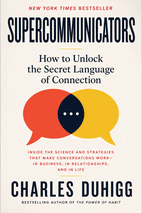
5 Main Takeaways from Supercommunicators
Define the Conversation's Purpose to Avoid Frustration and Misalignment.
Supercommunicators start by asking 'What's this really about?' to negotiate both the topic and rules of discussion. This meta-dialogue ensures everyone is on the same page, preventing directionless exchanges and fostering genuine understanding, as seen in spy recruitment failures and everyday talks.
Build Connection Through Mutual Vulnerability and Emotional Attunement.
Deep conversations require a reciprocal exchange of feelings, not one-sided sharing. By reframing questions to invite emotions and authentically matching the other person's mood and energy, you create a safe space for connection, illustrated by hedge funders and TV character interactions.
Master the Art of Listening with Looping and Follow-Up Questions.
Demonstrating true listening involves paraphrasing what you hear (looping) and asking thoughtful follow-ups. This shows empathy, validates the speaker's experience, and encourages deeper dialogue, crucial in conflicts like gun debates and routine conversations.
Persuade by Aligning with Social Identity, Not Just Presenting Facts.
People accept information based on how it affects their social belonging. Effective persuasion uses trusted in-group messengers and frames messages around shared identities, making new behaviors seem normative, as proven in vaccination campaigns and community outreach.
Prepare for Difficult Conversations with Structure and Validation.
Acknowledging awkwardness and planning for obstacles can make tough talks safer. Validating personal experiences, rather than debating facts, builds psychological safety and strengthens relationships, key to long-term health and happiness, as shown in Netflix's team dynamics.
Executive Analysis
The book's central thesis is that supercommunication is a learnable skill built on interconnected practices: defining conversation purposes, attuning to emotions, listening deeply, navigating conflict through identity awareness, and preparing for tough talks. These elements form a framework for transforming any dialogue into a meaningful connection, moving beyond debate to mutual understanding.
This book matters because it provides evidence-based, actionable strategies for improving relationships in personal and professional life. Blending psychology, neuroscience, and practical advice, it stands out in the communication genre by offering specific tools—like emotional matching and identity framing—that empower readers to become more empathetic and effective communicators in a divided world.
Chapter-by-Chapter Key Takeaways
The Matching Principle: How to Fail at Recruiting Spies (Chapter 1)
A learning conversation prioritizes mutual understanding to create genuine alignment.
The What’s This Really About? conversation is a meta-dialogue that defines both topics and rules for discussion.
This negotiation can occur at the start of a talk or arise during practical decision-making.
Failing to engage in this dialogue often leads to frustrating, directionless exchanges.
The solution is to cultivate awareness of when this conversation is needed and develop skills for negotiating its flow.
Try this: Initiate a meta-dialogue at the start of any complex discussion to explicitly align on what the conversation is truly about and how it should proceed.
The Listening Cure: Touchy-Feely Hedge Funders (Chapter 3)
Reciprocity is non-negotiable: Connection requires a mutual exchange of vulnerability, not one-sided confession.
Reframe to go deep: Transform factual questions into emotional ones to invite vulnerability.
Master the follow-up: Follow-up questions are the most powerful tool for demonstrating listening and deepening dialogue.
Start deeper than you think: People enjoy vulnerable conversations more than they anticipate; expected awkwardness is usually overblown.
Ask, don't assume: When someone shares an emotional experience, asking a thoughtful question is almost always better than silent sympathy or changing the subject.
Try this: Transform surface-level questions into invitations for emotional sharing and prioritize follow-up questions to show genuine engagement and deepen the exchange.
How Do You Hear Emotions No One Says Aloud?: The Big Bang Theory (Chapter 4)
Emotional connection is built by aligning with two universal signals: mood (valence) and energy (arousal).
Supercommunicators habitually observe and match or acknowledge these signals in others.
Authentic matching is key; superficial mimicry with mismatched energy feels inauthentic.
This principle has practical applications, from NASA selecting emotionally intelligent astronauts to creating beloved television characters.
You can use this by focusing on someone’s basic mood and energy level and consciously aligning your own responses.
Try this: Consciously observe and mirror the other person's fundamental mood and energy level in your tone and body language to establish authentic rapport.
Connecting Amid Conflict: Talking to the Enemy About Guns (Chapter 5)
Structured, patient dialogue can change how we see each other. It may not change minds, but it makes the "other side" human and can build lasting connections.
"Looping for understanding" is a powerful tool to move from debate to real listening.
Feelings are at the center of conflict. You must acknowledge them by asking good questions and paying close attention.
Real connection is a two-way street. It involves empathetic support and sharing your own feelings.
Online communication needs more care. Be overly polite, avoid sarcasm, and show more respect to make up for the lack of face-to-face cues.
Try this: In conflicts, use the 'looping for understanding' technique—paraphrase what you've heard and ask if you've understood correctly—to validate feelings and de-escalate tension.
Next chapter: “Our Social Identities Shape Our Worlds: Vaccinating the Anti-Vaxxers” is locked
Keep learning from Supercommunicators — and unlock all 600+ book summaries with audio, mindmaps and AI Q&A.
$0.00 due today · 7 days free, then $89.99/year ($7.49/mo) · Cancel anytime before day 7
plus sales tax where applicable