Supercommunicators — Interactive Mindmaps

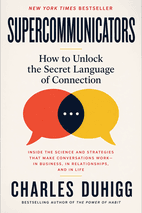
Supercommunicators by Charles Duhigg Book Cover

by Charles Duhigg

Charles Duhigg's Supercommunicators reveals the science of genuine connection, teaching how to identify and align with the three conversational mindsets. It provides practical techniques for anyone seeking to deepen relationships through more authentic and effective dialogue.

On Insta.page you also get an Apply This Book tool that lets you combine insights from up to 3 books to solve your specific situation.

Chapter mindmaps

Free preview: chapters 1–4 are fully interactive. Click any node to expand or collapse. Subscribe to unlock the rest.

Chapter 1: Chapter 1: The Matching Principle: How to Fail at Recruiting Spies

Key concepts: Chapter 1: The Matching Principle: How to Fail at Recruiting Spies

1. Chapter 1: The Matching Principle: How to Fail at Recruiting Spies

The Recruitment Failure

  • Jim Lawler fails to recruit spies via clumsy methods
  • Forced confession destroys connection with asset Yasmin
  • Reveals need for genuine connection, not manipulation

The Science of Connection

  • Neural coupling synchronizes brains during deep engagement
  • Synchronization equals better mutual understanding
  • Measured through aligned brain activity and physiology

Supercommunicator Traits

  • Ask 10-20 times more questions than others
  • Practice matching: mirroring companions' communication style
  • Listen deeply and manage emotional tone subtly

Three Conversational Mindsets

  • Decision-Making: Practical discussions about choices
  • Emotional: Conversations about feelings and empathy
  • Social: Talks about relationships and identity

The Matching Principle

  • Identify conversation type and align with it
  • Not mimicry but genuine connection effort
  • Transforms communication when correctly applied

Practical Application Tools

  • Ask: 'Do you want to be helped, hugged, or heard?'
  • Initiate 'What's This Really About?' meta-conversations
  • Pay conscious attention to conversation type

Lawler's Transformation

  • Matches Yasmin's emotional despair in final meeting
  • Shares own vulnerabilities to create genuine connection
  • Success comes through authentic communication

Chapter 2: Chapter 2: Every Conversation Is a Negotiation: The Trial of Leroy Reed

Key concepts: Chapter 2: Every Conversation Is a Negotiation: The Trial of Leroy Reed

2. Chapter 2: Every Conversation Is a Negotiation: The Trial of Leroy Reed

The 'What's This Really About?' Conversation

  • Foundational negotiation before substantive talk begins
  • Uncovers deeper desires beyond surface topics
  • Establishes unspoken rules for listening and deciding

The Quiet Negotiation Process

  • A subtle, often subconscious dance in every conversation
  • Goal: determine what everyone truly wants
  • Goal: establish rules for how to interact

Dr. Ehdaie's Case Study

  • Surgeon shifted from lecturing to asking questions
  • Discovered patients' fears about family and legacy
  • Reduced unnecessary surgeries by aligning with values

Supercommunicator Strategy

  • Begin with open-ended questions, not arguments
  • Practice deep listening to understand interests
  • Use 'expanding the pie' mindset beyond win-lose

Diagnosing Conversational Logic

  • Logic of similarities: empathetic, values-based
  • Logic of costs and benefits: analytical, rule-based
  • Success requires matching the other person's mindset

The Power of Experimentation

  • Use probes like jokes or new topics to test dynamics
  • Boly's gun-as-toy observation shifted group focus
  • Creative reframing can align with opposing interests

Universal Connection Principles

  • Two-step process: discover desires then negotiate
  • Requires making your own thought process clear
  • Notice nonverbal signals and be willing to adapt

Chapter 3: Chapter 3: The Listening Cure: Touchy-Feely Hedge Funders

Key concepts: Chapter 3: The Listening Cure: Touchy-Feely Hedge Funders

3. Chapter 3: The Listening Cure: Touchy-Feely Hedge Funders

The Problem: Emotional Avoidance in Professional Settings

  • Dry, transactional talk prevents real connection
  • Missing emotional signals can lead to costly mistakes
  • We often retreat to small talk over acknowledging emotion

Epley's Core Insight: Perspective-Getting

  • Ask questions to learn inner states, don't guess
  • Genuine interest, not forced gestures, fuels listening
  • Steer conversations toward intimate, emotional territory

The Arons' Research: Engineering Closeness

  • 36 questions create 'Fast Friends Procedure'
  • Sustained, escalating, reciprocal self-disclosure
  • Vulnerability about beliefs/values acts as catalyst

Vulnerability as Connection Engine

  • Triggers emotional contagion - syncing emotions
  • Creates self-reinforcing cycle of openness
  • Requires reciprocity - alternating sharing

Practical Application: Transforming Questions

  • Ask 'What do you love?' not 'What do you do?'
  • Follow-up questions signal active listening
  • People underestimate enjoyment of vulnerable talks

The Gendered Risk of Vulnerability

  • Women face professional backlash for emotions
  • Men might be praised for same expressions
  • Creates uneven landscape for emotional sharing

Ultimate Human Need: Understanding Through Depth

  • Leaning into emotional depth unlocks connection
  • Asking and sharing fulfills profound human need
  • Contrasts with everyday emotional avoidance

Chapter 4: Chapter 4: How Do You Hear Emotions No One Says Aloud?: The Big Bang Theory

Key concepts: Chapter 4: How Do You Hear Emotions No One Says Aloud?: The Big Bang Theory

4. Chapter 4: How Do You Hear Emotions No One Says Aloud?: The Big Bang Theory

The Core Communication Problem

  • Socially awkward characters confused audiences
  • Emotions must be conveyed without explicit statements
  • NASA faced similar emotional intelligence challenges

Laughter as Social Connection Tool

  • Most laughter serves social bonding, not humor
  • Matched intensity reveals genuine rapport
  • Mismatched laughter signals lack of alignment

Mood-Energy Framework

  • We assess others on mood (valence) and energy (arousal)
  • Connection requires alignment on this spectrum
  • Nonverbal cues communicate these dimensions

NASA's Emotional Screening Method

  • Varied emotional pitch during interviews
  • Observed candidates' natural matching responses
  • Identified genuine emotional aptitude

Successful Character Development

  • Characters matched vocal energy and speed
  • Subtle alignment signaled connection attempts
  • Made socially awkward characters empathetic

Supercommunicator Principles

  • Observe nonverbal cues habitually
  • Authentically match mood and energy
  • Connection happens beneath spoken words

Universal Applications

  • Same principles work for sitcoms and astronaut selection
  • Emotional alignment crucial for confined environments
  • Genuine connection requires authentic matching

Continue exploring Supercommunicators