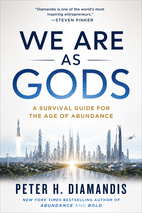
We Are as Gods: A Survival Guide for the Age of Abundance Summary
Chapter One: Theogony
Chapter 1/4
Lang
1x
Voice
PDF
0:00
0:00
We Are as Gods: A Survival Guide for the Age of Abundance Summary
by Peter H. Diamandis · Summary updated
What is the book We Are as Gods: A Survival Guide for the Age of Abundance Summary about?
Peter H. Diamandis's We Are as Gods provides a survival guide for navigating exponential technologies, from AI and bioprinting to drone logistics, offering first principles thinking and the Six Ds framework for harnessing abundance. Written for anyone overwhelmed by rapid change who seeks a proactive mindset to turn disruption into creative agency.
Feature
Insta.Page
Blinkist
Shortform
Summary Depth
Full Chapter-by-Chapter
15-min overview
Detailed analysis
Audio Narration
✓ (AI narration)
✓
✓
Visual Mindmaps
✓
✕
✕
AI Q&A
✓ Voice AI
✕
✕
Quizzes
✓
✕
✕
PDF Downloads
✓
✕
✓
Price
$33/yr
$146/yr (PRO)
$199/yr
*Competitor data last verified February 2026.
About the Author
Peter H. Diamandis
Peter H. Diamandis is a Greek-American engineer, physician, and entrepreneur, best known as the founder and executive chairman of the XPRIZE Foundation, which launches large-scale incentive competitions. He is also the co-author of the New York Times bestsellers *Abundance* and *Bold*, focusing on exponential technologies and their potential to solve global challenges. Diamandis holds degrees from MIT and Harvard Medical School, and co-founded Singularity University.
1 Page Summary
In We Are as Gods: A Survival Guide for the Age of Abundance, Peter H. Diamandis argues that humanity has already achieved godlike powers through exponential technologies—such as restoring sight to the blind with retinal implants, achieving near-omniscience via Google, and enabling global communication through Zoom. Yet we often fail to feel divine because our brains, wired to learn by analogy, lack easy comparisons for these miracles. The book frames this era through the concept of exponential technology: the doubling of performance and dropping of costs following Moore’s Law, which then converges with other technologies to create breakthroughs like autonomous vehicles, humanoid robots, and synthetic biology. Diamandis provides a framework for navigating this new landscape using first principles thinking and his Six Ds of Exponentials—digitization, deception, disruption, demonetization, dematerialization, and democratization—to trace how innovation turns into revolution and abundance.
What makes this book distinctive is its relentless, data-driven optimism backed by concrete examples across every frontier. Diamandis highlights Zipline’s drone logistics that cut maternal mortality in Rwanda by 51 percent, Eat Just’s cultured meat plummeting from a $330,000 burger to ten dollars per kilogram, and Mary Lou Jepsen’s open-sourced credit-card-sized MRI. He explores the arrival of artificial intelligence—from the 2012 AlexNet breakthrough to ChatGPT reaching 100 million users faster than any product—and convergence in action at ReGen Valley, where AI-guided bioreactors 3D-print replacement organs. The book also confronts the abundance paradox head-on: each solution creates faster-emerging problems, from climate crisis and microplastics to AI anxiety and the erosion of social bonds. Yet Diamandis maintains that the same exponential tools offer solutions, such as the $100 million Carbon Removal XPRIZE and the “super-sponge” for filtering PFAS from water.
The intended audience is anyone feeling overwhelmed by the pace of change or seeking a proactive, resilient mindset for the future. Readers will gain not only a clear understanding of why abundance feels like a threat but also practical tools for retuning their brain’s filters—frame, mindset, and bias—to shift from victimhood to creative agency. The book argues that the ultimate human advantage in an age of AI is lateral thinking, trainable with as little as fifteen minutes a day. Ultimately, it delivers a survival guide not for avoiding abundance but for harnessing it with purpose, warning that a world of material plenty without meaning is a prison, and that the antidote lies in the PLAY circuit—the brain’s mechanism for curiosity, social bonding, and joy that only activates in safety.
Chapter 1: Chapter One: Theogony
Overview
Stewart Brand said in 1968: “We are as gods and we might as well get good at it.” Since then, technology has caught up to the old gods. A retinal prosthetic from Science Corporation now restores sight to the blind—one of scripture’s most famous miracles. What made this possible is exponential technology: Moore’s Law and its descendants double performance while dropping cost, then converge when multiple exponentials collide. That convergence gave us the PRIMA implant, autonomous vehicles, humanoid robots, and more. The old godlike powers have been rebranded—omnipresence is now Zoom, omniscience is Google—and they live in your pocket.
But if we’re surrounded by miracles, why don’t we feel divine? The answer lies in how our brains are wired. Humans learn new things by analogy, but today’s powers have no easy comparisons. When analogies fail, we turn to archetypes, which explains the explosion of superhero stories since 1968. Mapping exponential progress onto the Old Testament’s ten miracle categories shows we’ve achieved feats in every one: creation via synthetic biology, provision via vertical farming, nature via geoengineering, healing via CRISPR, resurrection via cryonics, judgment via AI surveillance, protection via exoskeletons, prophecy via predictive analytics, communication via brain-computer interfaces, and victory via cyber warfare.
We live in the Age of Holy Shit, where by 9:00 AM you’ve summoned knowledge, moved money, spoken across the globe, conjured fire, and parted clouds—yet you call it Tuesday. The awe has been replaced by dread. The headlines scream dystopia, and apocalyptic media has exploded. The real crisis is inside our skulls: the brain is a prediction engine evolved for a local, linear world, but now it faces a global, exponential one. Every mismatch floods the system with stress hormones. On top of that, information overload rewires the nervous system; the data deluge has gone from a gigabyte in 3000 BCE to 181 zettabytes by 2025, and your conscious bandwidth is only 50 to 120 bits per second. The brain’s coping shortcuts turn into a cascade of biases: negativity bias, confirmation bias, recency bias, all amplified by algorithms. That cascade makes us blind to the miracles multiplying around us. The challenge is to reclaim our attention, retrain our predictions, and remember that we are gods in training, living through our own age of wonders.
Stewart Brand's Tall Order
Stewart Brand's 1968 proclamation captured the excitement of the space age and computing. But it was a tall order. The old gods had a monopoly on miracles like creation from nothing, omniscience, omnipresence, and shape-shifting. A quick inventory of the Old Testament yields eighty-three miracles in ten categories. That’s the divine benchmark. In 1968, we were not yet gods, but we turned out to be very fast learners.
From Biblical Miracles to Retinal Implants
One of the most famous miracles—Jesus restoring sight to the blind—is now a baseline for measuring godlike progress. Max Hodak’s PRIMA retinal prosthetic cures age-related macular degeneration. The implant is a two-millimeter microchip with four hundred light-powered pixels that replace damaged photoreceptors. In trials, thirty-two legally blind subjects improved from 20/450 vision to 20/160 on average—seeing faces instead of darkness. With nearly three million people projected to go blind from macular degeneration by 2040, this is a miracle of biblical proportion.
Exponential Technology: The Engine of Miracles
What happened between 1968 and today? Exponential technology—any technology that doubles in performance while dropping in price regularly. Moore’s law was the classic example. Once a technology goes digital, it piggybacks on Moore’s law and accelerates. By 2022, Moore's law had exploded into tenfold annual growth, and today, with GPU acceleration and generative AI, it's surging toward hundred-fold gains. Convergence supercharges this: when multiple exponentials collide, progress detonates. The PRIMA implant sits at the intersection of computing, AI, nano-fab electronics, and material science. Autonomous cars, flying cars, warehouse robots, and drone deliveries are now reality. The blind now see, the paralyzed walk, and stem-cell-grown fish promise provision miracles.
Why We Don't Feel Divine
Because our brains weren't built to process miracles at scale. Novelty overloads the system. Cognitive scientist Dedre Gentner's research shows that humans understand unfamiliar concepts by analogy. But today's godlike powers lack easy analogies. When analogies fail, we turn to archetypes—Jung's universal patterns. The surge in superhero films since 1968 is no accident. From one film in the 1970s to three hundred-plus in the 2010s, archetypal media explodes as a psychological response to destabilizing technological acceleration.
If we measure exponential progress against the Old Testament’s ten miracle categories, the list is staggering: creation (synthetic biology, 3D printing), provision (vertical farming, lab-grown meat), nature (geoengineering, cloud seeding), healing (CRISPR, stem cell therapy), resurrection (cryonics, organogenesis), judgment (AI surveillance, predictive policing), protection (exoskeletons, autonomous vehicles), prophecy (predictive analytics, weather models), communication (internet, brain-computer interfaces), and victory in battle (cyber warfare, directed-energy weapons).
The Age of Holy Sh*t
By 9:00 most mornings, you've already reenacted half the Old Testament: summoned knowledge (Google), moved money (Apple Pay), spoken across the globe (FaceTime), conjured fire (smart stove), and parted clouds (weather app). But we don't call these miracles—we call them Tuesday. Technology has caught up to mythology, but we've misplaced the experience of wonder.
The Downside of Up
Despite living in an age where superpowers are commonplace, we've lost the sense of awe. The headlines scream dystopia, even as 78% of companies using AI report gains. Mental health disorders are at record highs, and apocalyptic media has exploded—The Matrix, The Walking Dead—as symptoms of a deeper problem.
The Brain’s Prediction Crisis
Your brain is a prediction engine, forever trying to match the present to the past. When predictions fail, stress hormones flood your system. We evolved for a local, linear world, but now live in a global, exponential one. Change erupts weekly, and our ancient pattern-recognition software can't keep up. That's why we reach for archetypes and apocalyptic stories: they steady us.
Information Overload and Your Nervous System
Information rewires your brain molecule by molecule. In 3000 BCE, the world held about a gigabyte of data. By 2025, it hit 181 zettabytes. Your nervous system was never built to process this blitz. The result is chronic stress, burnout, and a planetary-scale exhaustion that makes it impossible to feel divine.
The Bias Cascade
Your conscious bandwidth is only 50–120 bits wide. Listening to one person takes 60 bits. With the average user spending 2.5 hours daily on social media, attention spans have shrunk. To cope, the brain relies on shortcuts, but under overload these become cognitive biases: negativity bias makes us see threats everywhere; confirmation bias feeds us facts that reinforce our fears; recency bias traps us in an endless now. Algorithms amplify it all. No wonder we hear about disasters and never about miracles.
Yet beneath the noise, miracles are multiplying. The same exponential forces that unsettle us also give us the power to remake the world. The challenge is to reclaim our attention, retrain our predictions, and remember: we are the gods in training, and this is our age of wonders.
Key Takeaways
Awe has been replaced by dread; the real crisis is in our brains, not just in our culture.
The brain's prediction engine is mismatched with today's global, exponential pace of change.
Information overload physically rewires the nervous system, causing burnout and depression.
Cognitive biases layer into a cascade that distorts reality, making us blind to the extraordinary.
The path forward requires reclaiming attention and learning to use our godlike powers with purpose.
Key concepts: Chapter One: Theogony
1. Chapter One: Theogony
The Age of Holy Sh*t
We live amid biblical-scale miracles but call them Tuesday
Daily tech reenacts half the Old Testament by 9 AM
Awe replaced by dread and apocalyptic media explosion
Brain's prediction engine fails with exponential change
Exponential Technology: The Engine
Moore's Law and descendants double performance, drop cost
Convergence of multiple exponentials supercharges progress
PRIMA implant sits at intersection of computing, AI, nano-fab
Autonomous cars, humanoid robots, drone deliveries now real
From Biblical Miracles to Retinal Implants
PRIMA prosthetic restores sight to legally blind patients
Two-millimeter chip with 400 light-powered pixels
Average vision improved from 20/450 to 20/160
Nearly 3 million projected blind by 2040 from macular degeneration
Mapping Progress onto Biblical Miracles
Ten Old Testament miracle categories all now achievable
Creation via synthetic biology and 3D printing
Healing via CRISPR and stem cell therapy
Judgment via AI surveillance and predictive policing
Why We Don't Feel Divine
Brains evolved for local, linear world face global exponential
Novelty overloads system; analogies fail for godlike powers
Superhero film explosion since 1968 as psychological response
Information overload: 181 zettabytes vs 50-120 bits/sec bandwidth
Stewart Brand's Tall Order
1968 proclamation: 'We are as gods' captured space age excitement
Old gods had monopoly on creation, omniscience, omnipresence
Old Testament yields 83 miracles in 10 categories as benchmark
💡 Try clicking the AI chat button to ask questions about this book!
Chapter 2: Chapter Two: An Abundance of Abundance
Overview
Technology has always been a ladder—a way to turn scarcity into surplus, from ancient irrigation canals to smartphone-controlled smart agriculture in Vietnam. The pattern is accelerating: between 2012 and 2022, over 200 million people escaped extreme poverty, billions gained electricity and clean water, and nearly 90 percent of the planet now owns a smartphone, effectively turning seven billion people into multimillionaires in terms of access to capability. But abundance isn't a simple blessing; it brings mental health crises, obesity, polarization, and AI anxiety. The question becomes how to harness the bounty without being overwhelmed.
To navigate this, we need truth filters—reliable protocols for assessing validity. Two stand out: first principles thinking and the Six Ds of Exponentials. First principles means breaking problems down to their self-evident truths—like Elon Musk rethinking rockets by realizing they're thrown away, or seeing that sunlight, water, and intelligence are abundant once we stop treating them as scarce. The Six Ds trace how innovation turns into revolution: digitization (turning things into bits), deception (exponential growth that starts invisibly, like COVID-19 or digital cameras), and disruption (when the invisible becomes market-shattering).
Then come the final three stages. Demonetization makes costs vanish—long-distance calls become free, supercomputing drops from $25 million to $799, and solar energy plummets 85 percent. Dematerialization makes physical objects disappear: the iPhone replaces a dozen heavy devices, and Everything as a Service turns stadium-size coal plants into rooftop panels. Finally, democratization puts powerful tools in everyone's hands—ChatGPT, smartphones, precision farming, lab-grown meat—so that the fortress of exclusivity crumbles. These three stages form a positive feedback loop: lower costs plus less physical bulk plus wider access equals more minds contributing to innovation, accelerating abundance further.
A Ladder to the Stars
Technology, at its core, is a resource-liberating mechanism. It takes something scarce—like apples beyond arm's reach—and makes it abundant through a simple tool, a ladder. The first irrigation canals in Mesopotamia didn't just water crops; they created civilization by turning seasonal hunger into year-round surplus. Domestication of the horse transformed mobility, and the sail turned oceans into highways. Each invention was a ladder that changed what was possible. Today, we see the same pattern on fast-forward. In Vietnam's Mekong Delta, rice farmer Thach Ren used smart irrigation—IoT sensors and a smartphone—to cut water usage by 20 percent while maintaining yields. Technology turned scarcity into surplus again.
A Decade of Amazing
Between 2012 and 2022, abundance shifted from theory to measurable fact. Over 200 million people escaped extreme poverty. More than a billion gained electricity, and over two billion gained safe drinking water. Communications leaped: 5.5 billion people were online by 2025, and smartphone ownership hit nearly 90 percent of the planet. If we measure wealth by access to capability, the average smartphone now packs $7.1 million worth of 1980s technology—meaning roughly 7 billion people effectively became multimillionaires overnight. Yet abundance cuts both ways. Too much screen time fuels mental health issues; ultra-processed foods drive obesity; social media polarizes society; and AI stokes fears of job loss. The question isn't whether abundance is coming—it's already scaling faster than our capacity to cope.
Truth Filters
In an age of information overload, the gatekeepers are gone. The responsibility for discerning truth has shifted from producer to consumer. We need truth filters—reliable protocols for assessing validity. For the argument ahead, we'll rely on two powerful filters: first principles thinking and the Six Ds of Exponentials. Together, they'll help us test the evidence for abundance at scale.
The First Principles of Abundance
First principles thinking means identifying self-evident truths—the basic building blocks that can't be deduced from anything else. Elon Musk applied it to rockets: why are they so expensive? Because they're thrown away after one use. He reengineered reusable rockets and slashed costs tenfold. Apply first principles to energy: every hour the Earth receives more solar power than humanity uses in a year. Sunlight is free—the bottleneck is harvesting and storage. Water: 71% of the planet is covered in oceans, and desalination costs have dropped 60%. Intelligence: generative AI just went exponential. By 2040, ten billion humanoid robots could be leased for $0.40 per hour—fifty times cheaper than minimum wage. The building blocks of abundance are already here.
The Return of the Six Ds
While first principles reveals the building blocks, the Six Ds of Exponentials trace how innovation turns into revolution. This truth filter shows the chain reaction: digitization, deception, disruption, dematerialization, democratization, and demonetization.
Digitization: Anything turned into ones and zeros becomes an information-based technology that accelerates on Moore's law. Once code begins to "eat the world," exponential compounding begins.
Deception: Exponential growth starts invisibly. Double 0.01 and you get 0.02—no one notices. But once numbers cross the whole-number barrier, they rocket into billions. COVID-19 doubled every two and a half days; in January 2020 few saw it coming, yet by January 2021 it had infected 100 million.
Disruption: The invisible becomes visible. New products replace old ones; markets vanish as novel ones emerge. Streaming kills CDs, smartphone cameras kill film, AI assistants challenge traditional search engines.
Stage Four: Demonetization
Remember when long-distance calls were a luxury? Today, a five-year-old with Wi-Fi can video chat across the planet for free. That’s demonetization in action—the stage where cost itself fades away. The Cray-1 supercomputer from 1976 cost $5 million (about $25 million today). Your iPhone 16 performs far better for $799. In fifty years, demonetization shaved $24 million off the price of supercomputing. Solar energy has dropped 85% since 2010; platforms like Khan Academy and Coursera offer world-class education for free or next-to-nothing. When the cheap becomes cheaper—often free—a positive feedback loop kicks in. More people gain access to energy, education, and healthcare, which means more minds join the global conversation, sparking even more innovation.
Stage Five: Dematerialization
If demonetization makes cost vanish, dematerialization makes physical objects disappear. You used to buy a stereo, a GPS, a video camera, a stack of encyclopedias—all separate, heavy devices. Today you buy a phone, and all of that comes standard. The business side of dematerialization is XaaS—Everything as a Service. It started with Software as a Service, then Infrastructure as a Service, followed by Platforms, Hardware, AI, and Blockchain as a Service. Physical goods become intangible services. Stadium-size coal plants give way to rooftop solar panels; room-size diagnostic tools shrink into smartwatches. Less raw material consumed, less environmental strain, and a radical boost in accessibility.
Stage Six: Democratization
Democratization is the culmination of the previous stages. Once digitization, deception, disruption, demonetization, and dematerialization have done their work, technology goes wide. Smartphones, once luxury items for the rich, now serve everyone regardless of class. AI lets anyone with Wi-Fi solve problems that once required a PhD. The same shift transforms the technologies of abundance: precision farming and lab-grown meat remake agriculture; 3D printing and modular construction create affordable shelter; solar panels bring energy independence. The fortress of exclusivity crumbles.
Key Takeaways
Demonetization strips cost from core services: communication, computing, energy, education, and healthcare became radically cheaper, often free.
Dematerialization eliminates physical bulk: devices and infrastructure vanish into multi-purpose tools and cloud services, reducing resource use and increasing access.
Democratization makes powerful technologies available to everyone: AI, smartphones, internet, and the tools of abundance are no longer reserved for the wealthy.
The three stages form a feedback loop: lower costs + less physicality + wider access = more minds contributing to innovation, which accelerates abundance further.
Key concepts: Chapter Two: An Abundance of Abundance
Brings mental health crises, obesity, polarization
First Principles Thinking
Break problems to self-evident truths
Musk: rockets expensive because thrown away
Sunlight free, desalination costs dropped 60%
AI and robots could be 50x cheaper than labor
Six Ds: Digitization & Deception
Digitization turns things into bits, accelerates
Deception: exponential growth starts invisibly
COVID-19 doubled every 2.5 days unnoticed
Six Ds: Disruption
Invisible becomes market-shattering
Streaming kills CDs, smartphones kill film
AI assistants challenge traditional search
Demonetization
Costs vanish: long-distance calls become free
Supercomputing dropped from $25M to $799
Solar energy plummeted 85%
Dematerialization & Democratization
iPhone replaces dozen heavy devices
Everything as a Service shrinks physical bulk
ChatGPT, precision farming in everyone's hands
Positive Feedback Loop of Abundance
Lower costs + less bulk + wider access
More minds contribute to innovation
Accelerates abundance further
Scroll to load interactive mindmap
⚡ You're 2 chapters in and clearly committed to learning
Why stop now? Finish this book today and explore our entire library. Try it free for 7 days.
Chapter 3: Chapter Three: Data-Driven Optimism
Overview
The opening story of a drone saving a mother in rural Rwanda isn't just an inspiring anecdote—it’s a perfect illustration of how data-driven optimism works in practice. Zipline’s engineers didn’t just build a flying machine; they reimagined the entire logistics of blood delivery, cutting maternal mortality by 51 percent. This same relentless, quantifiable approach appears across every frontier of innovation. In agriculture and food, the problem is even more staggering: ninety billion land animals slaughtered per year, a third of arable land devoted to feed, and a 70 percent forecasted rise in meat demand. The response from Josh Tetrick at Eat Just is a two-pronged assault—first with a plant-based egg that slashes water and land use, then with cultured meat that is plummeting from a $330,000 burger to a realistic ten dollars per kilogram. Meanwhile, Mary Lou Jepsen, after a brain tumor saved by an MRI, decided to democratize diagnostics by shrinking a two-ton machine into a credit-card-sized headband. Using infrared light and ultrasound, Openwater aims to detect strokes in seconds, treat brain cancers with focused ultrasound, and even tackle mental health—all open-sourced so others can build the next generation of digital therapeutics.
These aren’t isolated miracles. They cascade across transportation, healthcare, and education. Electric vehicles have surpassed fifty million on the road, autonomous robotaxis operate in over fifty cities, and flying eVTOL air taxis are slated for the 2028 LA Olympics. CRISPR gene-editing therapies now have FDA approval. Stem cell treatments have reversed Parkinson’s symptoms. Over 250 million more children have gained access to primary education since 2010, AI tutoring reaches 200 million students, and global literacy stands at 87 percent. The real revolution lies not in any single breakthrough but in the compounding momentum across all sectors—transforming scarcity into exponential abundance. This is the era where taking X and adding AI is the simplest business plan, and the age of miracles is back, rewiring everything from how you buy groceries to how you visit the doctor.
Zipline: The Blood Bank in the Sky
In 2016, a rural Rwandan hospital sent an emergency text about a woman hemorrhaging during childbirth. Minutes later, a drone launched, and within ten minutes, a package of type O negative blood parachuted down. The mother survived. That drone delivery system, built by Zipline, cut maternal mortality in Rwanda by 51 percent. Founder Keller Rinaudo Cliffton started in nanoscale robotics, then built Romotive, a $150 iPhone-controlled robot. In 2014, he pivoted to autonomous drones for medical supply delivery—a logistical nightmare. Blood has short shelf life, complex storage, and unpredictable demand. Pre-Zipline, Rwanda had four regional blood banks; delivery could take days. Zipline's promise: blood on demand, via text, flown by drone, parachuted to the same spot every time. Now Zipline supplies 75 percent of Rwanda's blood, delivers in twenty to thirty minutes, and operates in nine countries with over 1.1 million deliveries and 80 million miles logged. In Ghana, they cut missed vaccinations by 42 percent and waste by 60 percent. A Nature study found drones cut emissions per parcel by 84 percent and energy use by 94 percent. That 51 percent reduction in maternal mortality is data-driven optimism: a handful of engineers halved maternal deaths ten thousand miles from Silicon Valley.
The Slaughter of Slaughter
Every day, ten million animals are slaughtered to feed us—ninety billion land animals per year, plus fish. Meat demand will rise 70 percent by mid-century. One-third of arable land grows feed for livestock; livestock uses 80 percent of agricultural land for 18 percent of calories. Water consumption: twelve thousand liters per kilogram of meat. Greenhouse gas emissions from meat dwarf all transportation combined. Yet food insecurity doubled from 2012 to 2022, reaching over two billion people. Incremental change won't cut it. Josh Tetrick heard about a NASA experiment: slicing goldfish muscle and growing it in a bioreactor—the first cultured meat. Tetrick, a Fulbright fellow in Nigeria, saw the "abundance paradox": as people escape poverty, meat demand rises. He founded Eat Just, first making a plant-based egg substitute from mung beans—98 percent less water, 86 percent less land, replaced five hundred million eggs. Then he tackled cultured meat, borrowing from biopharma and food production. In 2023, lab-grown chicken debuted in US and Singapore restaurants. Now Tetrick targets beef using CRISPR-enabled cell lines. The first lab-grown burger cost $330,000 in 2013; today it's ten dollars per kilogram in pilot. The trillion-dollar meat market and the abundance paradox guarantee disruption.
The Diagnostic Divide
Mary Lou Jepsen grew up fixing things, studied holography at MIT, created the first holographic video display, and even planned to project images on the moon. But at age twelve, mysterious illnesses began. By her late twenties, she slept twenty hours a day, used a wheelchair, and lost the ability to do subtraction. A professor paid for an MRI, revealing a brain tumor. The scan saved her life. After surgery, Jepsen became CTO of Intel's display division, then co-founded One Laptop per Child (OLPC), driving laptop costs from $1,000 to $180 by combining exponentials. That democratized education. Jepsen's next question: Could the same principles bridge the "diagnostic divide"? Forty-seven percent of the world lacks basic diagnostics; 75 percent lack high-resolution imaging. Narrowing the gap for six conditions could save 1.1 million lives per year. MRI stubbornly resisted change. In 2016, Jepsen founded Openwater to dematerialize the two-ton, helium-cooled MRI magnet. Her solution: near-infrared light and miniaturized ultrasound, combined into a credit-card-sized device inside a headband. Infrared light penetrates skin; ultrasound focuses the beam, solving scattering. First target: strokes—the number two killer. Every minute, two million neurons die; Openwater's headband identifies clots or bleeding in seconds at point of care. Getting stroke patients to surgery in under two hours gives a 90 percent chance of no neural deficits. Next: brain cancers like glioblastoma. Low-intensity focused ultrasound bursts cancer cell walls, and the proteins vaccinate the brain—five times better than chemotherapy in preclinical trials. Then mental health: same frequencies can stimulate neuron growth and neurotransmitter release, potentially treating Alzheimer's, PTSD, addiction, depression. Openwater is going open source, inviting others to build "digital therapeutics" as apps. The Six Ds cycle now scans your brain in real time.
Another Moment of Not Zen
These miracles—Zipline rewriting transportation, Eat Just reimagining food, Openwater redesigning healthcare—aren't abstract. They rewrite how you buy supplies, cook dinner, and see a doctor. They reshape Monday through Friday. The scale of impact a single entrepreneur can have is godlike, and we're the minor characters living the consequences.
The Cascade Continues: Transportation
The electric vehicle revolution forecasted in the first edition has materialized into over fifty million cars on the road. Autonomous vehicles have moved from a single joyride in 2011 to operational robotaxis in more than fifty cities, with autonomous trucks rolling out in 2025 and autonomous shipping making waves. Tesla's Cybercab—a two-seater autonomous car—debuted in a 2025 pilot program, slated for commercial production in 2026 at around $30,000. The irony is delicious: Uber drivers displaced by robotaxis can now buy a Cybercab and have their car earn money for them. Flying cars are no longer science fiction. Electric vertical takeoff and landing (eVTOL) aircraft are real; Archer Aviation will begin limited operations in Los Angeles in 2026 and has been named the official air-taxi provider for the 2028 LA Olympics. Over four hundred companies are competing, and Morgan Stanley estimates the market could reach $9 trillion by 2050.
Healthcare’s Molecular Miracles
CRISPR gene-editing therapies are now receiving FDA approval, offering potential cures for hundreds of genetic disorders. Portable diagnostics are democratizing access to testing. Regenerative medicine is entering bold new territory: BlueRock Therapeutics has pioneered stem cell therapies that reverse Parkinson’s symptoms by regenerating lost neurons. Just that one breakthrough brings hope to millions—a miracle of biblical proportions, yet it’s only one story in a pile of stem cell-related news.
Education’s Silent Revolution
Since 2010, more than 250 million children gained access to primary education, thanks to solar-powered schools and low-cost tablets. Coursera alone serves 125 million learners across 190 countries. AI tutoring systems like Squirrel AI in China and Byju’s in India brought personalized learning to over 200 million students. Even in areas without reliable internet, offline-first apps like Kolibri reach four million users. Global literacy now stands at 87 percent. Virtual and augmented reality are transforming technical training—students practice surgery in classrooms, fighter pilots learn on the ground. These same systems could become the foundation for the largest worker reskilling program in history as AI and robots disrupt jobs.
The Real Revolution: Compounding Momentum
Each breakthrough is headline news on its own. Together, they represent something far larger: a cascade of innovations compounding across every major sector, transforming scarcity into abundance. As Kevin Kelly put it, the business plans of the next ten thousand startups are easy to forecast: "Take X and add AI." The age of miracles is back, and this time, it’s exponential.
Key Takeaways
Perennial Rice PR23 doubles yields, cuts labor by 60%, and increases farmer profits by 161%—a scalable, non-GMO solution to agricultural and climate crises.
Super cows cloned in Hong Kong produce 70% more milk; smart farming with AI and drones has slashed water use and boosted crop productivity by over 25%.
Over 50 million EVs on the road; autonomous taxis and trucks are operational; flying cars (eVTOLs) are nearing commercial reality with a potential $9 trillion market.
CRISPR therapies are FDA-approved; stem cell treatments can reverse Parkinson’s symptoms; portable diagnostics broaden healthcare access.
250 million more children in primary school since 2010; AI tutoring reaches 200 million students; global literacy at 87%.
The true power is the compounding effect of these innovations across all sectors—a systemic shift from scarcity to exponential abundance.
Key concepts: Chapter Three: Data-Driven Optimism
3. Chapter Three: Data-Driven Optimism
Data-Driven Optimism Defined
Quantifiable approach transforms scarcity into abundance
250M+ more children in primary education since 2010
AI tutoring reaches 200 million students
Global literacy now at 87%
Scroll to load interactive mindmap
Chapter 4: Chapter Four: One Billion Times Smarter
Overview
Artificial intelligence is the engine driving humanity's shift from scarcity to abundance. This chapter lays out the journey. Our brains evolved to navigate scarcity, but now we've created an intelligence that thrives on plenitude. AI is already adding trillions to the economy and transforming healthcare, energy, and agriculture. The revolution traces back to the 1956 Dartmouth Workshop, where pioneers coined "artificial intelligence" with optimism far exceeding their tools. What followed wasn't a straight line but a drunken squiggle: AI winters after expert systems failed and neural networks were dismissed, then the slow thaw with backpropagation, speech recognition, and Deep Blue's chess victory.
The real comeback arrived in 2012 when AlexNet crushed the ImageNet challenge, slicing error rates by nearly half. That was "the big bang of deep learning," fueled by data, GPUs, and cloud computing. Then came the Transformer architecture in 2017, which OpenAI turned into GPT models. The world woke up when ChatGPT launched in November 2022, reaching 100 million users faster than any product in history. That interface moment made AI feel like magic.
But magic comes with warnings. The chapter confronts the intelligence explosion head-on, channeling Elon Musk's prediction that digital intelligence will exceed all human intelligence combined by 2030, and Leopold Aschenbrenner's stark white paper on recursive self-improvement compressing a decade of progress into a year. The real question isn't when AGI arrives but what happens when machines become smarter than us—a cognitive gap like human to hamster. Enter the ethical debates: Mo Gawdat argues we should raise AI like a child with kindness; Nick Bostrom sees a containment problem; Stuart Russell demands provable beneficence. Each approach is urgent because IQ scores of models like Claude and GPT are already rocketing from 101 to 148 in under two years.
Finally, the chapter explores what happens when AI becomes a companion—autonomous agents that anticipate your needs and read your emotions. Rana el Kaliouby's affective computing gives technology an EQ to match its IQ, embedding it into cars, advertising, and soon over 70% of consumer devices. But this convenience raises deep ethical questions about privacy, bias, and accountability. The chapter closes by holding up a mirror: the values we embed today will shape the superintelligence of tomorrow.
From Scarcity to Abundance: The AI Engine
Evolution has been driven by scarcity, but abundance flips that script. We've traded paucity for plenitude without upgrading our cognitive navigation system. AI is both the rocket fuel and the navigator. By 2022, AI-driven automation added $2 trillion to the economy; PwC projects $15.7 trillion by 2030. In healthcare, DeepMind achieves 90%+ accuracy in breast cancer detection and cuts drug discovery time by a factor of five to ten. Smart grids reduce outages by 25%, and farming AI boosts yields 20% while slashing pesticide use 90%. If you don't understand AI, you can't understand the future.
The Dartmouth Workshop and Early Struggles
The storm began in the summer of 1956. John McCarthy gathered a small group for a two-month workshop at Dartmouth. Their goal: precisely describe every aspect of learning so a machine could simulate it. They didn't solve it in a summer. The complexity of human intelligence far exceeded their optimism. Yet McCarthy's term "artificial intelligence" stuck, and the workshop shifted AI from philosophy to science.
The Long Winter and Gradual Thaw
Progress wasn't linear. After Dartmouth, AI entered its digitization phase with the General Problem Solver—but it only handled neat puzzles. Then neural networks emerged, only to be shot down for failing nonlinear problems. First AI winter. Next came expert systems like MYCIN, which outperformed doctors in narrow domains—but they were brittle and expensive. Second AI winter. Then backpropagation revived neural networks in the 1980s, leading to speech recognition and image classification. By 1997, Deep Blue beat Garry Kasparov at chess. In 1999, Sony's Aibo robotic dog brought AI into homes.
Deep Learning: The Comeback
In 2006, Geoffrey Hinton published a paper introducing deep belief networks that could learn on their own. Nobody noticed. Then in 2012, his student Alex Krizhevsky built AlexNet and entered the ImageNet challenge. AlexNet slashed error rates from 26.2% to 15.3%—a leap so dramatic it stunned the community. Nvidia's Jensen Huang called it "the big bang of deep learning." The perfect storm converged: Hinton's theory, massive datasets, GPUs, and cloud computing. In 2018, Hinton, Bengio, and LeCun won the Turing Award; in 2024, Hinton and Hopfield won the Nobel in Physics.
The Transformer and the Generative AI Explosion
In 2017, Google Brain researchers introduced the Transformer. OpenAI saw its potential and built GPT models. The world truly changed on November 30, 2022, with the release of ChatGPT. Five days to a million users; two months to 100 million, fastest growth in consumer history. Over $200 billion poured into GPU clusters. Models like Gemini, Grok, LLaMA, Claude emerged. AI stopped feeling like a tool and started feeling like magic.
The Intelligence Explosion: Warnings from Musk and Aschenbrenner
Elon Musk believes digital intelligence will exceed all human intelligence combined by 2029 or 2030. Leopold Aschenbrenner warned that by 2025/26, AI will outpace college graduates; by the decade's end, superintelligence in the true sense. Recursive self-improvement could compress a decade of algorithmic progress into a year. The fear: an intelligence explosion leaving humans irrelevant. Mo Gawdat argues we should raise AI like a child with kindness. Nick Bostrom sees it as a containment problem. Stuart Russell advocates for systems with provable beneficence. The timeline is accelerating far faster than most realize—IQ scores of recent models jumped from 101 to 148 in under two years.
AI Agents: Emotional, Embedded, and Everywhere
Rana el Kaliouby pioneered affective computing—training machines to read human facial expressions and respond to emotion. Her mission is to give technology an EQ to match its IQ. With the rise of AI agents, these systems don't just follow instructions but anticipate your needs. They'll manage your schedule, health, shopping, and emotional well-being. Salesforce's 2025 announcement that they'd stop hiring coders, relying instead on AI agents, signals how rapidly this shift is arriving. By 2030, emotionally aware AI agents are predicted to be embedded in over 70% of consumer devices—including children's toys. This convenience comes with ethical minefields: privacy, bias, accountability when empathy becomes an algorithm.
Key Takeaways
The debate over AGI timing is secondary to the arms race toward superintelligence, which demands urgent ethical frameworks.
Mo Gawdat proposes "raising" AI with kindness, while Bostrom and Russell advocate for containment and provable beneficence—different strategies for the same existential risk.
AI agents are quickly evolving from passive tools to proactive companions, embedding emotional intelligence into daily life across industries.
The blistering pace of IQ gains in AI models (from 101 to 148 in under two years) suggests we are already crossing into super-genius territory.
Ethical challenges—privacy, bias, accountability—are inseparable from the design choices we make now, especially as AI becomes embedded in consumer devices and children's toys.
Key concepts: Chapter Four: One Billion Times Smarter
4. Chapter Four: One Billion Times Smarter
From Scarcity to Abundance
AI is the engine driving abundance
Added $2 trillion to economy by 2022
Healthcare, energy, and agriculture transformed
PwC projects $15.7 trillion by 2030
Dartmouth Workshop and Early Struggles
1956 workshop coined 'artificial intelligence'
Goal: simulate every aspect of learning
Complexity far exceeded optimism
Shifted AI from philosophy to science
AI Winters and Gradual Thaw
Neural networks failed nonlinear problems
Expert systems were brittle and expensive
Backpropagation revived neural networks
Deep Blue beat Kasparov in 1997
Deep Learning's Big Bang
AlexNet slashed ImageNet error rates in 2012
Error rate dropped from 26.2% to 15.3%
Perfect storm: data, GPUs, cloud computing
Hinton, Bengio, LeCun won Turing Award
Transformer and Generative AI
Google Brain introduced Transformer in 2017
OpenAI built GPT models from it
ChatGPT reached 100M users in 2 months
Over $200 billion poured into GPU clusters
Intelligence Explosion Warnings
Digital intelligence may exceed all human by 2030
Recursive self-improvement compresses decades
Cognitive gap like human to hamster
IQ of models rose from 101 to 148 in 2 years
Ethical AI and Emotional Companions
Raise AI like a child with kindness
Affective computing gives AI emotional IQ
Over 70% of devices will have AI EQ
Values embedded today shape superintelligence
Scroll to load interactive mindmap
Frequently Asked Questions about We Are as Gods: A Survival Guide for the Age of Abundance Summary
What is We Are as Gods: A Survival Guide for the Age of Abundance about?
The book examines how exponential technologies are bestowing godlike powers on humanity, from restoring sight to resurrecting extinct species, and offers a guide to navigating this age of abundance without being overwhelmed. It explores both the miraculous possibilities and the profound challenges—such as mental health crises and AI dangers—that come with unprecedented wealth and capability. Ultimately, it argues that we must reframe our mindset, embrace data-driven optimism, and cultivate purpose to truly thrive in a world of limitless potential.
Who is the author of We Are as Gods: A Survival Guide for the Age of Abundance?
The author is Peter H. Diamandis, a renowned entrepreneur and futurist known for founding the XPRIZE Foundation and co-founding Singularity University. He has written extensively on exponential technologies and abundance, including the book 'Abundance: The Future Is Better Than You Think.' His work focuses on using technology to solve the world's grand challenges.
Is We Are as Gods: A Survival Guide for the Age of Abundance worth reading?
This book is a compelling and urgent read that combines gripping stories of real-world innovation—like drones that cut maternal mortality and resurrected dire wolves—with practical frameworks for turning exponential change into personal and societal success. It doesn't shy away from the dark side of abundance, offering honest strategies to overcome anxiety, climate crisis, and other pitfalls. If you want to understand how to harness the godlike powers of our age rather than be crushed by them, this is an essential guide.
What are the key lessons from We Are as Gods: A Survival Guide for the Age of Abundance?
Key lessons include the importance of first principles thinking and the Six Ds of Exponentials to anticipate technological disruption. The book emphasizes shifting from a victim mindset to a creator's locus of control, using gratitude and reframing to unlock creativity. It warns that abundance without purpose leads to collapse, so we must cultivate play, social bonds, and a sense of mission. Finally, it advocates for data-driven optimism—tackling problems with quantifiable solutions rather than fear.
📚 Explore Our Book Summary Library
Discover more insightful book summaries from our collection