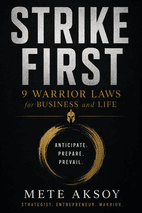
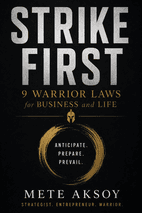
Mete Aksoy's STRIKE FIRST presents nine warrior laws drawn from military history as a strategic framework for overcoming obstacles in business and personal life, distinguishing decisive action from aggression and self-mastery from conquest. Written for leaders and entrepreneurs seeking clarity in competitive environments.
Feature
Insta.Page
Blinkist
Shortform
Summary Depth
Full Chapter-by-Chapter
15-min overview
Section-by-section guides
Audio Narration
✓ (AI narration)
✓
✓
Visual Mindmaps
✓
✕
✕
AI Q&A
✓ Voice AI
✕
✕
Quizzes
✓
✕
✕
PDF Downloads
✓
✕
✓
Price
$59.99/yr
$146/yr (PRO)
$199/yr
*Competitor data last verified February 2026.
About the Author
Mete Aksoy
Mete Aksoy is a Turkish author and economist specializing in economic history and political economy. He is best known for his book *The History of Economic Policy in Turkey*, which examines the country’s economic transformation from the Ottoman Empire to today. Aksoy’s expertise combines academic scholarship with policy analysis, drawing on his background as a former advisor to several international organizations.
1 Page Summary
Summary
Mete Aksoy’s STRIKE FIRST: 9 Warrior Laws for Business and Life presents a strategic framework drawn from millennia of military history, arguing that the same universal principles governing victory and defeat on battlefields apply equally to business, leadership, and personal growth. The author is careful to distinguish these nine Laws from mere tactics, positioning them as an inherited hierarchy that shapes strategy, which in turn drives operations and guides tactics. Anticipating skepticism about importing military thinking into civilian life, Aksoy offers a moral grounding: the “enemy” here represents obstacles, internal weaknesses, or inefficient systems, not other people; “attack” means decisive action rather than aggression; and the ultimate goal is self-mastery, not conquest. The book’s core contribution is a system of practical “Maxims” the author derived from decades of observing how these Laws operate in real-world contexts, from ancient battlefields to modern boardrooms.
Each chapter examines a single Law through historical examples, philosophical insight, and concrete business applications. The Law of the Objective demands unsentimental clarity, requiring that every action serve a single, absolute goal. The Law of Offense asserts that defense alone cannot produce victory—true success comes from seizing initiative. The Law of Security warns against vulnerabilities both literal and metaphorical, from the rear in battle to digital backdoors in business (as Nokia and Colonial Pipeline discovered). The Law of Maneuver emphasizes attacking where the enemy isn’t, using indirect approaches to win without head-on confrontation. The Laws of Mass and Economy of Force teach the critical distinction between raw resources and their concentration at the decisive point, requiring the courage to accept weakness everywhere else. The Law of Simplicity strips away complexity to reveal essential clarity, while the Law of Unity of Command insists that at the decisive moment, one person alone must hold authority to avoid paralysis. Finally, the Law of Surprise targets the enemy’s will through shock, timing, and mystery.
The intended audience includes leaders, entrepreneurs, and professionals seeking strategic clarity in competitive environments. Readers will gain a structured mental model for analyzing challenges, making decisions under uncertainty, and executing with precision. What distinguishes this book is its systematic integration of classical military doctrine with practical business wisdom, neither glorifying conflict nor demonizing competition, but treating strategy as a neutral tool for overcoming obstacles. The author’s five maxims per Law provide actionable checkpoints, while historical figures like Alexander the Great, Napoleon, and Sherman, alongside modern examples from YouTube to Chrysler, ground abstract principles in vivid reality. Ultimately, the book equips readers to think like strategists—balancing offensive initiative with defensive security, concentrating force at the right moment, and maintaining simplicity amid complexity.
The nine universal Laws of strategy have governed victory and defeat across millennia of military history. The author argues they apply just as powerfully to business, leadership, and personal growth. Rather than claiming to discover these Laws, he introduces them as inherited principles—Objective, Offensive, Security, Maneuver, Mass, Economy of Force, Simplicity, Unity of Command, and Surprise—and explains how they are distinct from mere tactics. The real contribution of this book, he explains, is the system of practical "Maxims" he has derived from decades of studying how these Laws actually play out in the real world, both on battlefields and in boardrooms.
The chapter also directly addresses a skepticism many readers may feel: isn't it dangerous or inappropriate to import military thinking into civilian life? The author offers a careful, moral answer—these Laws are about structure, not violence. The "enemy" throughout the book refers to obstacles, internal weaknesses (fear, ego, hesitation), or inefficient systems, not other people. "Attack" means decisive action, not aggression. And the ultimate goal is not conquest of others, but mastery of oneself.
The Nine Laws as a Framework
The nine Laws form a hierarchy: Laws shape strategy, strategy drives operations, operations guide tactics. They are not a bag of tricks but a set of conditions that must be true for victory to be possible. Military thinkers like J.F.C. Fuller systematized them, but armies have practiced them intuitively for centuries. The author insists that violating these Laws doesn't just make victory harder—it makes failure almost inevitable.
Why These Laws Apply Everywhere
The author draws on more than twenty years of experience in business across thirty countries. Again and again, he observed that successful people and organizations applied these Laws without ever having studied military theory. Winners treated business as a campaign of discipline, not a game of chance. The logic of strategy—focus, timing, momentum, coordination—appears in any arena with uncertainty, limited resources, and competition. That's why corporate leaders speak of "campaigns" and "centers of gravity": the metaphors capture real dynamics.
A Moral Compass for Strategic Thinking
Lest anyone worry this book advocates ruthless competition, the author establishes two ethical pillars. First, always target systems and internal barriers—inefficiency, fear, procrastination, the comfort zone—never people. Second, legitimate self-defense: if an adversary initiates conflict, you are entitled to protect your position within legal and ethical bounds. The deepest victory is always over your own limits, not over another person.
On Language and Sources
The author deliberately uses "Law" rather than "principle" to emphasize the binding nature of these ideas. He consulted hundreds of military field manuals, scholarly works, and over a hundred business books to test the concepts across domains. He acknowledges the possibility of small errors but invites the reader's patience. The chapter closes with a clear promise: the Laws are the timeless warp; the Maxims in the rest of the book are the weft that makes them actionable.
Key Takeaways
The nine Laws (Objective, Offensive, Security, Maneuver, Mass, Economy of Force, Simplicity, Unity of Command, Surprise) are universal conditions for victory, not tactical gimmicks.
These Laws apply far beyond the battlefield—to business, leadership, and personal growth—because they address universal realities of competition, uncertainty, and limited resources.
The "enemy" in this book is always an obstacle or internal barrier (fear, ego, inefficiency), not a person to be harmed.
The ultimate conquest is of the self, not others; strategic thinking is a tool for legitimate self-defense and disciplined pursuit of goals, not aggression.
The author uses "Law" instead of "principle" to stress their binding nature: violate them and you move toward failure.
Key concepts: WHAT ARE THESE NINE LAWS?
1. WHAT ARE THESE NINE LAWS?
The Nine Universal Laws
Objective, Offensive, Security, Maneuver, Mass
Economy of Force, Simplicity, Unity of Command, Surprise
They are conditions for victory, not tactical gimmicks
Violating them makes failure almost inevitable
Laws vs. Tactics and Maxims
Laws are timeless; tactics are situational
Laws form a hierarchy: strategy, operations, tactics
Maxims are practical derivations from studying the Laws
Maxims make the Laws actionable in real life
Application Beyond the Battlefield
Laws apply to business, leadership, and personal growth
Winners treat business as a campaign of discipline
Strategy logic works under uncertainty and competition
Corporate metaphors like 'campaigns' reflect real dynamics
Ethical Framework and Moral Compass
Target systems and internal barriers, never people
Legitimate self-defense within legal and ethical bounds
Deepest victory is over your own limits, not others
Laws are about structure, not violence
Language, Sources, and Promise
Use 'Law' to emphasize binding nature over 'principle'
Drawn from military manuals and business books
Laws are the timeless warp; Maxims are the actionable weft
Book offers practical system for real-world strategy
If you like this summary, you probably also like these summaries...
💡 Try clicking the AI chat button to ask questions about this book!
Chapter 2: LAW I: THE LAW OF THE OBJECTIVE
Overview
This law strips away sentimentality from strategy, demanding that every action serve a single, absolute goal: the elimination of the enemy's ability to resist. The chapter opens with Scipio Aemilianus weeping as Carthage burns—a reminder that victory requires unsentimental clarity. Emotions don’t matter; alignment with the final objective does. Sherman’s march through Georgia illustrates the brutal logic: make war so unbearable that generations refuse to consider it again. In business, the same principle applies—win so decisively that continuing makes no sense for the rival.
To operationalize this law, five maxims emerge. Strategic Coldness is the refusal to let sentiment override the objective. Truman firing MacArthur and Seinfeld cutting jokes that are only “good” both demonstrate the same nerve—protect the goal even when the crowd turns against you. Map the Campaign forces leaders to identify intermediate objectives that serve the final goal; anything that doesn’t lacks justification. Isolate the Vital, Sacrifice the Rest channels Napoleon’s ability to concentrate effort on a single hinge point, abandoning secondary targets without hesitation. Clarify the First Objective demands specificity—if you can’t explain it in one sentence to a junior employee, it’s hope, not an objective. Solve the Equation of Ends and Means treats victory as a math problem. Soichiro Honda shelved his car dream when post-war Japan lacked steel and gasoline, launching a motorized bicycle instead—strategic patience that waited seventeen years. David Stirling, facing fixed objectives and failing means, didn’t ask for bigger bombers; he redefined the tool with modified Jeeps, speed, and surprise. Scarcity sharpens the mind. The equation includes an invisible variable: spirit, will, courage, and intelligence. The genius commander calculates these intangibles, multiplying physical force with morale.
Sherman’s march to Atlanta applied the law with cold precision. His objective was breaking the South’s will by destroying logistics. He rejected pleas for mercy, knowing a long, “gentle” war would kill more people than a short, brutal one. He sacrificed his reputation for victory. Lee Iacocca faced the same calculus at Chrysler. Firing over sixty thousand people, closing factories, cutting his own salary to one dollar—he acted as a battlefield surgeon, amputating what couldn’t be saved to keep the patient alive. He mapped the campaign, isolated the vital, clarified the first objective, and matched ends to means. The result: Chrysler went from a $1.7 billion loss to a $2.4 billion profit. He earned the moral authority to demand sacrifice by sharing the burden himself.
Decades later, Elon Musk applied the same logic to Twitter. Carrying a sink into headquarters, he cut thousands of roles, replaced leadership, dissolved the board, and gave survivors a brutal choice: commit or leave. The platform survived and sped up. Yet something felt cold. Musk used the scalpel of the Law of the Objective for pure efficiency, without the shared sacrifice that legitimized Iacocca’s cuts. The law is a neutral tool; the character of the leader determines whether victory is worth celebrating.
Machiavelli’s distinction between cruelty well used and cruelty ill used clarifies the moral ground. Cruelty well used is done once, for the necessity of securing survival, then turned to benefit. Sherman burned Atlanta once to end a war. Iacocca fired 60,000 once to save 85,000. Cruelty ill used drags pain out—hesitation that bleeds the organization to death. Injuries should be “done all at one time” to offend less. This is never a license for illegal abuse; hard, lawful cuts—ending projects, roles, strategies—while respecting human dignity. Success is never a pardon.
Discipline requires staying unsentimental when necessary and acting without hesitation. Strategic Coldness is the first maxim that enables all others. History grades on outcomes, not gentleness. The final objective must serve the greater good, generating more good than evil. The human costs don’t vanish; success explains the choice but doesn’t erase the bill. Those who fail to reach the objective are still held accountable for their unsentimental actions. The paradox remains: to reach the objective, you must stay unsentimental, solve the equation of ends and means in every intermediate step, and carry out decisions without letting emotion take control. The objective stays the same—neutralize resistance, lawfully and without harm.
Key Takeaways
Triage is the model: Save what can be saved first, cut what cannot, act fast – and don’t mourn the amputated limb while the patient is still bleeding.
Intermediate objectives must be clear and prioritized: Iacocca mapped the chaos. He rebuilt finance, marketing, and quality control before anything else, sacrificing lesser goals to protect the critical one.
Leaders must earn the right to demand sacrifice: Iacocca reduced his salary to $1. Sherman accepted lasting hatred. Shared burden legitimizes hard cuts. Without it, ruthlessness feels cold and hollow.
Cruelty well used is swift and final: Machiavelli’s distinction applies. Cut decisively once, for the survival of the whole, then rebuild. Hesitation that drags out pain is cruelty ill used.
Character determines whether victory is worth celebrating: The Law of the Objective is a scalpel. Used with discipline and shared sacrifice, it saves. Used for pure efficiency without human connection, it severs something essential.
Ends and means must be matched: Miscalculate, and you become the sacrifice. Solve the equation in your intermediate steps, and always act lawfully.
Key concepts: LAW I: THE LAW OF THE OBJECTIVE
2. LAW I: THE LAW OF THE OBJECTIVE
Core Principle: Unsentimental Elimination of Resistance
Victory requires absolute focus on the final objective
Emotions and sentiment must not override strategic goals
Win so decisively that resistance becomes unthinkable
History judges outcomes, not gentleness of methods
Five Operational Maxims
Strategic Coldness: Protect the goal despite opposition
Map the Campaign: Identify only objectives serving the final goal
Isolate the Vital, Sacrifice the Rest: Concentrate on key hinge points
Clarify the First Objective: Explain it simply to a junior employee
Cruelty Well Used vs. Cruelty Ill Used
Swift, decisive cuts offend less than prolonged hesitation
Sherman burned Atlanta once to end a war faster
Iacocca fired 60,000 once to save 85,000 jobs
Hard cuts must be lawful and respect human dignity
Leadership Character and Shared Sacrifice
Leaders must earn moral authority to demand sacrifice
Iacocca cut his salary to $1; Sherman accepted lasting hatred
Musk's Twitter cuts felt cold without shared burden
Character determines if victory is worth celebrating
The Equation of Ends and Means
Victory is a math problem: match resources to objectives
Honda shelved car dream, launched motorized bicycle instead
Stirling redefined tools with Jeeps and surprise, not bigger bombers
Include intangible variables: spirit, will, courage, intelligence
⚡ You're 2 chapters in and clearly committed to learning
Why stop now? Finish this book today and explore our entire library. Try it free for 7 days.
Chapter 3: LAW II: THE LAW OF OFFENSE
Overview
The Law of Offense starts with a hard truth: defense alone cannot produce victory. No war was ever won by sitting back. Defense hands the enemy control over timing, location, and method. It manages decay instead of building anything. To break an enemy's will, you have to attack. Alexander the Great proved this at Gaugamela. He ignored cautious advice and drove straight at the Persian center on open ground. What looked safest was deadly, while striking at the enemy's heart was the safest move.
The ground shapes how you fight. Europe's forests and rivers reward chess-like play—hold, push, anchor, reinforce. The open Steppe forces a poker mindset: control information, provoke mistakes, fake retreats. America sits between these worlds, mixing Western industrial power with Steppe-like openness. Its global role drives home that how people see you is part of the battlefield. The fighter who blends Western discipline with Steppe flexibility tends to win.
This law goes beyond battlefields. Constant defense against an aggressor never wipes out the aggression. Problems aren't solved by defense alone. Even birth is a struggle under pressure. The warrior who stays on defense rejects reality. But the author makes a key point: this is a metaphor. Attack targets systems, obstacles, and circumstances—slow processes, bad decisions, chaos—not people. Legitimate self-defense stays within legal and ethical bounds. The first victory is to conquer yourself.
Six maxims form a system for offense. The first is Strike First: taking the initiative forces the opponent to react, messes up their plan, and shakes their confidence. Initiative isn't just about time—it's about space, as LBJ showed by crowding senators physically and verbally. But striking blind is stupid. Sun Tzu's rule to know yourself and your enemy is essential. If your strength matches the opponent's, choose the strategic offensive.
The moral side often freezes leaders: fear of losing the moral high ground. But if conflict is unavoidable and your direction serves the greater good, waiting for the other side to strike first is a moral failure. History judges the winner, not the one who waited. The story of Uzeyir Garih, who pledged his right little finger to secure a project, shows absolute commitment—raising the stakes so high that failure becomes unacceptable. This isn't self-harm but a mental trick to hack survival instincts. The warrior's sense of superiority isn't arrogance; it's the inner fire to move first.
The second maxim, Wage Offensive Defense, is simple on the surface: every offensive plan must include defense. Moltke's formula is strategic offense, tactical defense—advance hard but take cover when hit. Jeff Bezos's "Day 1" philosophy at Amazon shows this: even as a giant, the company moves like a startup, always pressing forward. Wellington perfected the reverse flank: strategic defense, tactical offense—hiding his main force, inviting attack, then striking from cover. Patience isn't passivity; it's loading the weapon. In business, you go after a rival's market share strategically. When they counter, shift briefly to tactical defense, then strike back.
Attackers can't keep attacking without a break—a clenched fist tires, a runner must slow. Warfare is rhythm, not one long push. Defense is the setup for the knockout blow.
The third maxim, Multiply Force with Velocity, treats speed as a multiplier. Sun Tzu demands a strike like lightning, so fast the opponent's nervous system can't process it. Speed makes the blow invisible and unstoppable. First movers write the default; latecomers fight uphill. Speed prevents wasted time—a McKinsey study found that a major delay can wipe out a third of profit. Kinetic energy is mass times velocity squared: double velocity, quadruple impact. Bruce Lee generated devastating power through speed. The OODA Loop shows that winners have higher decision speed, fighting in the opponent's future.
The fourth maxim, Concentrate the Strike, demands hitting the pillar that holds up the opposition with overwhelming force at the point of impact. Law of Mass: one hard blow cracks the rock; ten light taps waste energy. Law of Economy: be weak in non-critical areas to be overwhelmingly strong at the decisive point. Sun Tzu's image is a millstone falling on an egg. In modern terms, a light bulb spreads energy; a laser focuses it into a pinpoint that cuts steel. Napoleon concentrated forces at the decisive point; a single battalion sometimes decides the day.
The fifth maxim, Unleash Total Force, strikes with energy bordering on madness. Clausewitz: war is violence pushed to its outer limits. Moderate war is stupidity—a short, brutal war ends suffering quickly. Total force is a hydraulic press applying steady pressure until the structure fails. A fair fight is a failed plan. Colin Powell brought back the doctrine of overwhelming force from Grant and World War II. The Powell Doctrine demanded ruthless clarity: is the objective clear? Is the force overwhelming? If yes, don't hold back—crush. Desert Storm folded the fourth-largest army in 100 hours. In business, don't starve a critical project or test a market "just to see." Prepare, gather intelligence, then move with total force or don't move at all.
The modern battlefield is mental. The arrows are stress, debt, competition. Unleash total force not against an enemy but against the obstacles of life. Don't try; execute with full intensity.
The sixth maxim, Finish Decisively, commands pressing the advantage after victory. A wounded opponent comes back when you're weakest. There is no better time to seal the outcome than when they are already damaged. Decisive action is the most humane path—the sooner a conflict ends at its root, the less suffering for both. Jomini warned against letting a defeated rival slip away. This is not cruelty but efficiency: a surgeon removing dysfunction so the body can heal. Think like a gardener: remove weeds to protect the garden, not out of hatred. The "weeds" are dysfunctions, bad incentives, broken processes. If you leave them half alive, they return and choke the harvest.
Ancient sources back this up. The Kutadgu Bilig warns that if you don't chase a fleeing enemy, they will turn back and seize victory. The Book of Dede Korkut shows the cost of mercy twice: first when Selcen Hatun spares fleeing enemies only to have them strike later, and second when Basat refuses the giant Tepegoz's plea for mercy. Schopenhauer's philosophy explains why: the universe is driven by a blind will to live, so a defeated enemy is possessed by a stubborn drive to survive. True victory requires putting out that will to fight. The cost of mercy is clear at Kosovo, where Sultan Murad was killed by a wounded enemy noble after the battle.
Patton understood this at the Bulge: spend everything now, press until the enemy is finished. Peter Thiel's idea—"Competition is for losers"—is structural: head-to-head rivalry steals your attention from building the future. His solution is to leave the arena by building something so specific and protected that rivalry struggles to form. The PayPal merger and Palantir's government focus show this. Bill Gates's method is to close the rival's runway: protect your positive-feedback loop and keep the challenger from plugging into your distribution. Own the chokepoints—distribution, defaults, bundling—and make their momentum stall. Lose skirmishes but win if you control the ground.
Pursuit must be measured. Yusuf Has Hacib warned that a desperate enemy who accepts death resists with terrifying power. This maxim may seem ruthless, but our duty is not to applaud the mask of humanism; it is to lift the veil. Make the win structural and legal so the same battle can't restart next month.
Two masters embody the Law of Offense. John D. Rockefeller attacked the mechanisms that kept rivals alive—transportation costs, supply chains, access to capital. His "Cleveland Massacre" bought twenty-four of thirty refineries in less than a year by squeezing railroads for secret rebates, giving him a 50% cost advantage. His attack wasn't vandalism; before Standard Oil, kerosene was unreliable and deadly. By destroying chaos, he built order. General James Mattis, the "Warrior Monk," embodied offense through fierce intellect. He carried Marcus Aurelius into battle, studied everything about a region before deploying, and drilled the OODA loop until his units could cycle faster than any opponent. In 2001, he launched an amphibious insertion 400 miles inland before the Pentagon finished debating logistics. His credo "No Better Friend, No Worse Enemy" distilled offensive defense: be polite, but when you meet resistance, end it fast. Fallujah in 2004 showed the cost of half-measures—political pressure forced a halt, and the enemy regrouped for a bloodier battle.
The chapter closes with a call to action. Sartre declared that existence precedes essence—you are what you do, not what you think. If you do not command, you are not a commander. This freedom comes with total responsibility: you cannot blame the economy, your boss, or the enemy. Even indecision is a decision to surrender. The cavalry is not coming; you are the cavalry. Camus saw the world as absurd and indifferent. The weak freeze; the warrior looks into that emptiness and imposes order. To strike first is an act of existence—by taking the initiative, you refuse to be a victim. Action creates the self.
**
Key concepts: LAW II: THE LAW OF OFFENSE
3. LAW II: THE LAW OF OFFENSE
Defense Alone Cannot Win
No war won by sitting back
Defense hands enemy control of timing
Alexander proved attack at heart is safest
Constant defense never wipes out aggression
Ground Shapes Fighting Style
Europe's forests reward chess-like play
Open Steppe forces poker mindset
America blends Western power with Steppe openness
Blended fighter tends to win
Strike First
Initiative forces opponent to react
Know yourself and enemy before striking
Waiting for first strike is moral failure
Absolute commitment raises stakes to win
Wage Offensive Defense
Every offensive plan must include defense
Moltke: strategic offense, tactical defense
Wellington: strategic defense, tactical offense
Defense is setup for knockout blow
Multiply Force with Velocity
Speed makes blow invisible and unstoppable
First movers write default; latecomers fight uphill
Double velocity quadruples impact
OODA Loop winners fight in opponent's future
Concentrate the Strike
Hit the pillar holding up opposition
Be weak elsewhere to be strong at decisive point
Sun Tzu: millstone falling on egg
Napoleon concentrated forces at decisive point
Unleash Total Force
War is violence pushed to outer limits
Fair fight is a failed plan
Powell Doctrine: overwhelming force or don't move
Execute with full intensity against obstacles
Chapter 4: LAW III: THE LAW OF SECURITY
Overview
The Law of Security is a refusal to be a victim—taking absolute precautions against rear and surprise attacks as the foundation of aggression. You can't swing a sword effectively if you're worried about the dagger at your back. History shows the greatest catastrophe for any army is being attacked from the rear, shattering morale and creating panic. This instinct is primal: in prisons, men with enemies sit with their backs to the wall; in Sicilian coffeehouses and Anatolian teahouses, no one sat with their back to the door. The lesson is to eliminate the blind spot, whether in a prison yard or a corporate boardroom.
In the professional world, rear security is just as critical. Coworkers can exploit an exposed vulnerability while you fight for a promotion. Nokia failed spectacularly when they dominated hardware but left their software ecosystem exposed to Apple's rear attack, changing what a phone should be. Colonial Pipeline was crippled not by physical assault but by a neglected digital backdoor, proving the Law of Security tolerates no negligence.
To prevent such disasters, the chapter lays out seven maxims.
Maxim #1: Fortify the High Ground – Occupy a mental or operational terrain so strong you can't be easily toppled. Sun Tzu advised making your army invincible first, then waiting for the enemy to expose an opening. In business, this means owning a unique position in the customer's mind, like Rolex with Swiss luxury or Tesla as the electric future. Admiral Hyman Rickover made himself indispensable by holding two conflicting roles, designing the system to function only through his personal will.
Maxim #2: Conceal Intentions – Deny your rival visibility through disciplined execution, tight channels, and controlled disclosure. Mustafa Kemal Atatürk hid his goal of a republic during the Turkish War of Independence, implementing each phase at the right time. Harriet Tubman exemplified concealment on the Underground Railroad, controlling disclosure and moving before the rival could react, turning secrecy into speed. True power lies in choosing what to reveal and when.
Maxim #3: Be Formless – Don't marry one position. Sun Tzu advises making your dispositions invisible so no spy can map you. Rolex maintains mystery around its processes. Netflix exemplifies adaptation by cannibalizing its own profitable DVD model to become a streaming service, then a production studio—water never argues with the terrain.
Maxim #4: Deploy Intelligence – Fighting blind is death. At the Battle of Midway, Commander Joseph Rochefort cracked the Japanese code and used a fake message to confirm the target, allowing Nimitz to ambush the carrier fleet. George Washington built the Culper Ring, using coded laundry lines to uncover British intentions. In business, Andrew Grove of Intel made paranoia doctrine, hunting for weak signals because comfort is the first symptom of defeat.
Maxim #5: Master Strategic Misdirection – Control the story by curating truth and letting rivals fill in wrong conclusions. Operation Mincemeat planted a fake corpse with a meticulously constructed life story, convincing Germans to shift forces from Sicily. If you don't control the story, you become its victim.
Maxim #6: Rehearse the Execution – Practice for reality before it happens. Herman Lamm, a Prussian officer turned bank robber, drilled timelines until the body remembered, enforced hard exit rules, and designed redundant contingencies. Bill Belichick wins through preparation—walking the field alone before kickoff, trapping opponents with rehearsed scenarios. Tamerlane secured his rear before the Battle of Ankara by clearing Syria, seizing water sources, and secretly winning over enemy commanders.
Maxim #7: Act Decisively – Taking calculated risks is safer than extreme caution. Obsessive self-preservation signals fear and invites predators. Ted Turner regained his father's company by weaponizing irrationality—bluffing that he would destroy its value to force a sale. Gentleness can broadcast permission for aggression. The greatest turning points in history—Hannibal crossing the Alps, Washington crossing the Delaware, Joan of Arc—cannot be explained by cold calculation but by faith, courage, and will. Attacking the threat is itself a form of security; the best defense is often offense.
These maxims form a complete, layered system: establish an invulnerable position, conceal intentions, remain formless, gather intelligence, use misdirection, prepare for every contingency, and be willing to take calculated risks. The most secure posture is one that moves, adapts, and strikes when the moment is right, because retreating only invites attack.
Key Takeaways
Pseudo-rationalism kills the courage and perseverance needed for great acts. Real security comes from decisive action, not endless calculation.
Self-protection must be balanced with offense; sometimes attacking is the best form of defense.
The seven maxims form a complete system: establish an invulnerable position, conceal intentions, remain formless, gather intelligence, use misdirection, prepare for every contingency, and be willing to take calculated risks.
Retreating only invites attack. The most secure posture is one that moves, adapts, and strikes when the moment is right.
Key concepts: LAW III: THE LAW OF SECURITY
4. LAW III: THE LAW OF SECURITY
Core Principle: Refuse to Be a Victim
Eliminate blind spots to prevent rear attacks
Primal instinct: sit with back to wall
Coworkers exploit exposed vulnerabilities
Nokia and Colonial Pipeline failed from neglect
Maxims 1-3: Position and Concealment
Fortify high ground: own unique position
Conceal intentions: control what you reveal
Be formless: adapt like water to terrain
Netflix cannibalized DVD model to survive
Maxims 4-5: Intelligence and Misdirection
Deploy intelligence: fighting blind is death
Midway: code-breaking enabled ambush
Master strategic misdirection: control story
Operation Mincemeat fooled German forces
Maxims 6-7: Preparation and Action
Rehearse execution: practice before reality
Act decisively: calculated risk beats caution
Best defense is often offense
Hannibal and Washington defied cold logic
Key Takeaways
Pseudo-rationalism kills courage and action
Balance self-protection with offense
Seven maxims form a complete system
Retreat invites attack; adapt and strike
Frequently Asked Questions about STRIKE FIRST
What is STRIKE FIRST about?
This book presents nine universal Laws of strategy drawn from millennia of military history, arguing they apply equally to business, leadership, and personal growth. It distinguishes these laws from mere tactics and provides a system of practical Maxims derived from decades of real-world study. The author carefully addresses moral concerns, clarifying that 'enemy' refers to obstacles and internal weaknesses, while 'attack' means decisive action toward mastery of oneself rather than aggression.
Who is the author of STRIKE FIRST?
Mete Aksoy is the author who has spent decades studying how the nine universal Laws of strategy play out on battlefields and in boardrooms. He has derived a system of practical Maxims from this study, presenting them as inherited principles rather than original discoveries.
Is STRIKE FIRST worth reading?
Absolutely—this book offers a timeless strategic framework that has governed victory and defeat across centuries, distilled into nine clear laws with actionable maxims. It bridges the gap between military history and modern challenges in business, leadership, and personal growth, using vivid examples from Alexander the Great to Nokia and Colonial Pipeline. The structured hierarchy from laws to strategy to tactics provides a practical toolkit for anyone facing obstacles, competition, or the need for decisive action.
What are the key lessons from STRIKE FIRST?
The nine Laws—Objective, Offensive, Security, Maneuver, Mass, Economy of Force, Simplicity, Unity of Command, and Surprise—form a hierarchy where each law shapes strategy. Key takeaways include: always serve a single absolute goal (Law of Objective), accept that defense alone cannot produce victory (Law of Offense), eliminate blind spots to prevent rear attacks (Law of Security), attack where the enemy isn't to avoid head-on slaughter (Law of Maneuver), concentrate your force at the decisive point (Law of Mass), sacrifice secondary objectives to pour everything into the vital one (Law of Economy), strip away everything unnecessary until only the essential remains (Law of Simplicity), ensure one person owns the decisive call (Law of Unity of Command), and deliver a decisive blow from an unexpected direction at an unexpected time to paralyze the opponent's will (Law of Surprise).
📚 Explore Our Book Summary Library
Discover more insightful book summaries from our collection