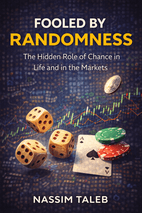
Nassim Nicholas Taleb's Fooled by Randomness explores the hidden role of chance in life and markets, arguing we mistake luck for skill. It’s for professionals and anyone seeking intellectual humility in a world of unpredictable events.
Feature
Insta.Page
Blinkist
Shortform
Summary Depth
Full Chapter-by-Chapter
15-min overview
Section-by-section guides
Audio Narration
✓
✓
✓
Visual Mindmaps
✓
✕
✕
AI Q&A
✓
✕
✕
Quizzes
✓
✕
✕
PDF Downloads
✓
✕
✓
Price
$89.99/yr
$146/yr (PRO)
$199/yr
*Competitor data last verified July 2026.
1 Page Summary
Nassim Nicholas Taleb's Fooled by Randomness serves as the accessible and provocative opening volume to his Incerto series, exploring the hidden role of chance in life and markets. The central thesis is that humans are psychologically wired to misunderstand randomness, constructing flawed narratives of cause and effect to explain what is often mere luck. Taleb introduces key characters like the fortunate but unskilled "Nero Tulip" and the temporarily successful trader "John," to illustrate how survivorship bias and the narrative fallacy lead us to confuse luck with skill, especially in fields like finance where randomness reigns supreme. The book argues that we systematically underestimate the prevalence of "black swan" events—rare, high-impact occurrences—by living in "Mediocristan," a domain of mild randomness, while the modern world increasingly operates in "Extremistan," where a single outlier can dominate all results.
Historically, the work emerged from Taleb's direct experience as a quantitative trader during volatile markets, and it draws deeply on philosophical thought, particularly the skeptical empiricism of Sextus Empiricus and the probabilistic insights of Henri Poincaré. It positions itself against the prevailing orthodoxy in finance—exemplified by models like Modern Portfolio Theory—which relies on the Gaussian bell curve and dangerously assumes market movements are mostly mild and predictable. By emphasizing the pervasive and wild nature of randomness, Taleb challenges the credibility of financial forecasts, the blind faith in economic indicators, and the accolades heaped upon professionals who may simply have been on the right side of a random streak.
The lasting impact of Fooled by Randomness is profound, having popularized a new vocabulary for discussing uncertainty and risk that extends far beyond Wall Street. It laid the essential groundwork for Taleb's more famous concept of the "Black Swan" and inspired a generation of readers in fields from economics to psychology to question their models and their stories. The book's enduring legacy is its call for intellectual humility, advocating for robust strategies that survive inevitable rare events (via "antifragility") over fragile predictions, and reminding us that in a world governed by chance, the most prudent stance is often one of skeptical caution toward apparent success and failure alike.
Prologue
Overview
The Prologue, "Mosques in the Clouds," introduces the central, pervasive theme of the book: our fundamental inability to distinguish between luck and skill, and between randomness and deterministic cause-and-effect. We are wired to weave narratives that replace the unsettling influence of chance with satisfying, but often false, explanations of our own talent or discernible patterns. This confusion manifests everywhere, from finance and politics to science and literary criticism, often with costly consequences.
The Lucky Fool and the Instinct for Pattern
At the heart of the confusion is the "lucky fool": someone who benefits immensely from random luck but credits their success to personal skill or a specific strategy. This is not a rare error but a default human condition, traceable to our superstitious ancestors who linked nose-scratching to rain. Today, we perform the same mental trick by attributing economic recoveries to central bank policies or a company’s success to a new CEO. We are pattern-seeking animals in a noisy world, prone to seeing "mosques in the clouds"—imposing profound meaning on random shapes, as the poet Rimbaud did, with sometimes tragic personal results.
The Asymmetric Cost of Confusion
The author presents a crucial table of confusion, contrasting concepts like Luck/Skill, Probability/Certainty, and Noise/Signal. His primary concern is the high-cost error of mistaking the left column (luck, randomness, noise) for the right column (skill, determinism, signal). While the opposite error (ignoring a real pattern) is possible, he argues it is far less common and less damaging. We are inundated with false patterns, from palm readings to data-mining financial models, making us more likely to be fooled by randomness than to miss a hidden signal. This error is most visible and perilous in the world of markets, where luck is routinely paraded as trading genius.
A Tragic Vision of Human Nature
The discussion situates itself within a "Tragic Vision" of humankind, which acknowledges our inherent cognitive flaws and limitations. This contrasts with a "Utopian Vision" that believes we can overcome our nature through reason and willpower. The author, a skeptical empiricist, sides with the tragic view: we are "faulty and there is no need to bother trying to correct our flaws." Instead of futile moralizing or attempts to rationalize our emotions, we need practical "wily tricks" to work around our biological wiring, which is ill-equipped to handle probability and vulnerable to emotional hijacking.
Setting the Stage: Solon’s Warning
The Prologue concludes by foreshadowing the book’s three-part structure, rooted in the ancient story of King Croesus and the lawmaker Solon. When the wealthy king asked if he was the happiest man alive, Solon replied that no one can be judged happy until their life is over, for fortune is fickle. This encapsulates the book’s forthcoming meditation on invisible histories, rare events ("black swans"), and the critical asymmetry of fate: what randomness gives, it can take away with devastating speed. The tale underscores that any position built largely on luck is fragile, setting the stage for an exploration of probability, survival, and resilience.
Key Takeaways
Core Confusion: Humans systematically mistake luck for skill and randomness for determinism, creating the figure of the "lucky fool."
Pattern Seeking: Our minds instinctively impose narrative and meaning on random noise, a tendency exploited in everything from finance to literary criticism.
Asymmetric Error: The cost of mistaking luck for skill (e.g., investing with a "guru" who is just lucky) is far greater than the cost of occasionally missing a hidden pattern.
Tragic Flaw: Our cognitive apparatus is inherently flawed for assessing probability; we must work around these flaws, not vainly try to correct them through reason alone.
Fragility of Fortune: Solon’s warning is the book’s mantra: nothing that depends heavily on randomness can be deemed stable or successful until the final outcome is known and all cycles of luck have played out.
Key concepts: Prologue
1. Prologue
The Lucky Fool and Pattern-Seeking Instinct
Humans default to attributing success to skill rather than random luck
We are biologically wired to impose meaning on random noise
This manifests as seeing 'mosques in the clouds' - finding patterns where none exist
The error traces from superstitious ancestors to modern economic and business analysis
Asymmetric Cost of Confusion
High-cost error: mistaking luck for skill, randomness for determinism, noise for signal
Opposite error (missing real patterns) is less common and less damaging
We are inundated with false patterns from palm reading to financial data-mining
Most perilous manifestation is in markets where luck is paraded as trading genius
Tragic Vision of Human Nature
Acknowledges inherent cognitive flaws and limitations in human nature
Contrasts with Utopian Vision that believes we can overcome flaws through reason
We are 'faulty' and should not try to correct flaws but work around them
Requires practical 'wily tricks' rather than moralizing or rationalizing emotions
Solon's Warning and Fragility of Fortune
No one can be judged happy/successful until life is over due to fickle fortune
Encapsulates meditation on invisible histories and rare 'black swan' events
Highlights critical asymmetry: what randomness gives, it can take away swiftly
Any position built largely on luck is inherently fragile and unstable
💡 Try clicking the AI chat button to ask questions about this book!
Chapter One
Overview
It begins with a single, electric moment on the streets of Chicago, where a young Nero Tulip sees a life of pure action in a trader’s Porsche and abandons the quiet halls of academia for the trading floor. Yet Nero is no typical gambler; he’s a scholar of probability who crafts an intensely conservative strategy. His goal isn’t wild riches but survival—to never “blow up” and be forced back into a mundane existence. This philosophy secures him a comfortable, stable fortune, but it also leaves him vulnerable to envy when compared to his neighbor, John.
John is a high-yield bond trader, a man of flashy cars and unread books who embodies the opposite of Nero’s careful restraint. His visible, explosive success creates a social pecking order that grates on Nero, who must console himself with the belief that John is merely a lucky fool riding a dangerous wave. This belief is vindicated when the market turns and John is wiped out, proving the durability of Nero’s methods over the seductive but fragile gains of sheer chance.
The narrative then probes the deeper, biological machinery behind such booms and busts. It explains how serotonin and other neurochemicals create self-reinforcing cycles, where any success—whether earned or accidental—breeds a confident demeanor that the world mistakes for skill. This makes the "lucky fool" incapable of acknowledging luck, setting them up for a brutal reversal when randomness inevitably strikes back.
Ultimately, the chapter reframes the very idea of success and wealth. True prosperity, it argues, shouldn’t be judged by a single spectacular outcome but by considering all the unseen alternatives. This concept of probabilistic wealth values the stable, repeatable success of a career like dentistry—or Nero’s prudent trading—over the rare, unsustainable jackpot. It’s a lesson in humility, resilience, and seeing the invisible hands of chance at work in every fortune.
A Coup de Foudre in Chicago
The chapter opens not with theory, but with a vivid scene: a young man named Nero Tulip witnesses a frenzied trader screech to a halt in a Porsche at the Chicago Mercantile Exchange. This moment is a lightning strike—a coup de foudre—that convinces him a trader’s life of action is his destiny, a stark alternative to the silent offices of academia or corporate business.
The Intellectual Trader
Nero is a complex, self-contradictory character. He holds degrees in ancient literature, mathematics, and statistics, and completed a thoughtful doctorate in the philosophy of statistical inference. He left academia not because it couldn’t feed him, but because it couldn’t entertain him; the debates felt futile and minute. After his Chicago revelation, he trained on the frenetic trading floor but ultimately settled into a proprietary trading role, which gave him the independence and intellectual freedom he craved. He avoids businesspeople and their hollow jargon, preferring a social and intellectual life filled with reading, gyms, museums, and conversations with erudite scientists.
A Philosophy of Conservative Risk
Nero’s trading methodology is deeply conservative, shaped by his probabilistic training and a core objective: longevity. His primary goal is not to maximize profits but to avoid ever “blowing up”—losing so much he’s ejected from the business and forced back into a boring life. He exits trades after small, predetermined losses, never exposes himself to unlimited downside risk (like selling “naked options”), and invests his substantial savings exclusively in safe Treasury bonds. This extreme risk aversion has prevented him from becoming extravagantly wealthy, but has built him a stable, comfortable fortune. He believes mild success is explainable by skill and labor, but “wild success is attributable to variance.”
The Neighbor: John, The High-Yield Trader
Nero’s philosophical equilibrium is disrupted by his neighbor, John. John is a high-yield (“junk bond”) trader who is everything Nero is not: intellectually shallow, conspicuously wealthy, and brimming with unrefined, nouveau riche confidence. He flaunts multiple luxury cars, a constantly expanding mansion, and a library of unread leather-bound books. His wife boasts of exotic vacations and decorators, openly looking down on Nero’s wife.
The Gnawing of Social Pecking Order
Despite his intellectual contempt, Nero is afflicted by envy and social pressure. John’s visible success, his larger house, and his condescending attitude make Nero feel like a “beta male,” his own considerable achievements suddenly feeling insufficient. He wrestles with the psychological insight that people often care more about relative standing than absolute wealth. He tries to rationalize that John is merely lucky, a “confident shallow-thinker” taking enormous hidden risks in a market that resembles “a nap on a railway track,” destined for a spectacular blow-up.
Vindication and Schadenfreude
Nero’s probabilistic intuition is proven correct in September 1998. He finds John, humbled and out of a suit, smoking in his yard—fired and nearly wiped out. Nero experiences intense Schadenfreude, though he feels ashamed of it. His joy stems less from John’s downfall and more from the validation of his own careful methods and beliefs. His conservative strategy, which seemed to cause him to “miss out” during boom times, now positions him for credibility and opportunity in the aftermath, proving that his commitment to avoiding ruin was the wiser long-term path.
Serotonin and the Illusion of Skill
The chapter examines the biological reinforcement of success, regardless of its source. A key player is serotonin, a neurotransmitter that creates a positive feedback loop. A rise in performance—whether from genuine skill or sheer luck—triggers a serotonin boost, which in turn promotes confident, "dominant" behavior that society often misinterprets as leadership and earned competence. This creates a "virtuous cycle" where success begets more apparent credibility. However, the cycle is fragile. When randomness inevitably delivers a setback, the reverse can occur: a drop in status reduces serotonin, leading to behaviors that accelerate a downward "vicious cycle."
The text notes that these emotional states are almost impossible to conceal. While people can control their facial expressions, their gait, posture, and subtle behaviors broadcast their fortunes. This signaling, rooted in evolutionary psychology, makes winners and losers rapidly identifiable, much like in animal hierarchies. The dangerous result is that "lucky fools"—those who profited from randomness—are flooded with serotonin and become convinced of their own infallible skill. They do not, and often cannot, attribute their success to chance.
The Dentist's "Probable" Wealth
The narrative concludes by introducing a provocative framework for measuring true prosperity: considering all possible alternative lives, not just the one observed. Nero, the conservative trader from earlier, is "extremely rich" when you average out all the potential paths his low-risk career could have taken. He sacrificed the chance of spectacular windfalls to eliminate the risk of catastrophic ruin.
This is illustrated by comparing a lottery-winning janitor to a career dentist. If the janitor's life were replayed a million times, he would be cleaning floors in almost every version, with one miraculous exception. The dentist’s life, replayed thousands of times, would show a remarkably stable and comfortable outcome. While the janitor’s observed wealth is higher, the dentist’s probabilistic wealth—his wealth across all possible scenarios—is far greater and more robust. This perspective challenges the common view that probability only applies to the future, arguing that to properly understand an observed outcome, we must consider the unseen alternatives that did not occur.
Key Takeaways
Success, whether from skill or luck, biologically reinforces overconfidence through chemicals like serotonin, creating cycles that can reverse abruptly.
True "wealth" or success should be measured probabilistically, by considering the stability of outcomes across all possible scenarios, not just the single observed reality.
A stable, less glamorous career often yields greater probabilistic wealth than a volatile one with a spectacular but rare payoff, because it is more resistant to randomness.
Key concepts: Chapter One
2. Chapter One
Nero Tulip's Transformation
Witnesses a trader's Porsche in Chicago, sparking a decisive shift from academia to trading
Leaves academia not for money but for intellectual engagement and action
Combines scholarly background in probability with real-world trading
Conservative Trading Philosophy
Primary goal is survival—avoiding 'blow up' and return to mundane life
Uses strict risk management: small predetermined losses, no unlimited downside
Believes mild success comes from skill, wild success from variance
Invests savings only in safe Treasury bonds, prioritizing stability over spectacular gains
Social Comparison with John
John is a high-yield bond trader representing flashy, conspicuous wealth
His visible success creates social pecking order that grates on Nero
Nero rationalizes John as a 'lucky fool' taking dangerous hidden risks
Vindication of Conservative Strategy
Market downturn wipes out John, proving fragility of his approach
Nero experiences Schadenfreude but also validation of his methods
Conservative positioning allows credibility and opportunity post-crash
Biology of Boom and Bust
Serotonin and neurochemicals create self-reinforcing confidence cycles
Success (earned or accidental) breeds demeanor mistaken for skill
Lucky fools become incapable of acknowledging luck's role
Sets up inevitable brutal reversal when randomness strikes back
Probabilistic Wealth Concept
True prosperity judged by considering all unseen alternatives, not single outcomes
Values stable, repeatable success over rare unsustainable jackpots
Examples: dentistry or prudent trading versus lottery-like wins
Lesson in humility and seeing invisible hands of chance in every fortune
The Biological Reinforcement of Success
Serotonin creates a positive feedback loop where performance boosts trigger confident, 'dominant' behavior
Society often misinterprets this chemically-induced confidence as earned leadership or competence
This creates a fragile 'virtuous cycle' where success begets apparent credibility, but setbacks can trigger a rapid reversal into a 'vicious cycle'
The emotional states from these cycles are nearly impossible to conceal, broadcasting through gait, posture, and subtle behaviors
The Danger of the Lucky Fool
Individuals who profit from randomness ('lucky fools') become flooded with serotonin and convinced of their own infallible skill
They typically cannot attribute their success to chance due to the biological reinforcement mechanism
This evolutionary signaling makes winners and losers rapidly identifiable, similar to animal hierarchy displays
Probabilistic Wealth Framework
True prosperity should be measured by considering all possible alternative lives, not just the observed outcome
The dentist represents 'probabilistic wealth' - stable, comfortable outcomes across thousands of potential scenarios
The lottery-winning janitor represents high observed wealth but low probabilistic wealth across most alternative realities
This challenges the common view that probability only applies to the future, arguing we must consider unseen alternatives to understand observed outcomes
A stable, less glamorous career often yields greater probabilistic wealth than volatile paths with rare spectacular payoffs
Probabilistic wealth is more robust and resistant to randomness than observed wealth from singular outcomes
Chapter Two
Overview
Imagine a game of Russian roulette where the sole survivor becomes a millionaire and a celebrated success story. This jarring analogy captures the book's core warning: we often confuse a lucky outcome with skill, because we only see the single, realized history of what did happen, ignoring all the invisible, failed alternatives. This is the trap of results-oriented thinking. To escape it requires alternative accounting—judging decisions by all possible outcomes, not just the one that occurred.
This probabilistic view finds echoes in philosophy, physics, and economics, all suggesting we live in just one of many possible worlds. Yet reality is an even more dangerous game than Russian roulette because its risky "generator" is hidden; we see the wealth but not the precarious process that created it. This makes people who naturally grasp probability rare. They often have a scientific curiosity, while many others, especially those with a conventional, bottom-line mindset, remain fools of randomness. This is starkly illustrated by two bosses: the respectable, results-focused executive who fails to see hidden risks, versus the flamboyant risk-obsessive who cares only about the underlying process.
Seeing the world this way forces a skeptical rereading of history and current events. It explains why media figures like George Will can triumph with simplistic, narrative arguments over an economist's complex, probabilistic truth. Our brains are wired for this distortion; cognitive biases ensure that emotion and vividness, not logic, dictate our perception of risk. Journalism exploits this, making us fear rare, sensational threats far more than common dangers.
This creates a cultural bias where simple, intelligible explanations are mistaken for correct ones. The pressure to simplify complex, random systems is dangerous, often embodied in the futile role of the corporate risk manager. This position is structurally impotent, unable to see the true probability "generator" and often reduced to creating an illusion of control.
The author concludes with a personal paradox: his entire career depends on the majority remaining fools of randomness, so he can profit from their errors. Yet, he needs a select few who understand his methods. His greatest risk, ironically, would be widespread enlightenment, which would erase his edge. This defines the strange business of navigating a world ruled by chance.
The Perils of Results-Oriented Thinking
The chapter opens with a powerful, unsettling analogy: Russian Roulette. Imagine being offered ten million dollars to play. If you win, you’re rich; if you lose, you’re dead. To an outside observer, the survivor is just a new millionaire, a success story to be admired. Yet, this "success" is purely a matter of luck, a single outcome plucked from six possible histories, five leading to wealth and one to death. The core problem is that we only see the realized history—the lucky winner—and mistake a random outcome for skill. This winner might become a role model, his "method" studied, while the invisible, more probable alternative histories of failure are ignored.
The author personalizes this, noting a friend lost to this "game" and reflecting on how literature nearly lost Graham Greene to a childhood bout of the same recklessness. This leads to the central concept: alternative accounting. Ten million dollars earned through Russian roulette is qualitatively different from the same sum earned through skilled dentistry, because its dependence on randomness is infinitely higher. Yet, to an accountant or a neighbor, they are identical. This sets the stage for a probabilistic view of the world, where the value of a decision is judged by the spectrum of what could have happened, not just what did.
Possible Worlds and Parallel Universes
The idea of alternative histories isn't new. It finds echoes in:
Philosophy: Leibniz’s "possible worlds," where God selected our reality from an infinity of options.
Physics: The "many-worlds" interpretation of quantum mechanics, where the universe branches at every possibility.
Economics: The "state space" method and scenario analysis, which formally study outcomes under different conditions.
These disciplines converge on a similar point: what we experience is just one realized path, and understanding risk requires considering the paths not taken.
An Even More Vicious Reality
The author argues reality is a far more dangerous game than standard Russian roulette. First, the "bullet" is exceedingly rare—like a revolver with thousands of chambers. This creates a numbing false sense of security, a problem later linked to the "black swan." Second, unlike the visible barrel of the revolver, the "generator" of reality is almost never visible. We see the wealth, not the risky process that created it, leading people to engage in high-risk behavior while calling it something else. Finally, there's an "ingratitude factor": protecting someone from a rare disaster seems like a waste of money if the disaster doesn't occur, making probabilistic wisdom a tough sell.
Smooth Peer Relations: Who Gets It?
Embracing this probabilistic mindset is counterintuitive and often met with resistance. The author observes that people with scientific training often grasp it more naturally, not necessarily from the training itself, but because the kind of curiosity that draws one to science aligns with this introspection. He places people on a spectrum: those who completely deny randomness, and those who are tortured by it.
He notes a cultural shift on Wall Street in the 1990s, from MBAs with a simplistic, results-oriented "business orientation" to more scientifically-minded individuals (often physicists). While not all were successful—some lacked practical intelligence—they improved the intellectual tenor and were more naturally inclined to think in terms of probabilities and hidden risks.
A Tale of Two Bosses: Kenny vs. Jean-Patrice
This theoretical clash with conventional wisdom is illustrated through the stark contrast between two former bosses:
Kenny: The epitome of the respectable, no-nonsense executive. Articulate, presentable, and results-focused, he admired traders who performed well, dismissing the author's warnings about survivorship bias and randomness. He rose quickly but ultimately exited the business.
Jean-Patrice: A flamboyant, temperamental Frenchman with a deep, obsessive understanding of risk. He lived colorfully but was solely concerned with the "generator"—the underlying process and all possible disastrous outcomes—not just past results. He encouraged the author's study of randomness, despite having a less conventionally "successful" career.
The lesson is clear: beware the smooth, bottom-line oriented person who cannot see beyond immediate results. The markets are littered with their remains.
George Will Is No Solon: On Counterintuitive Truths
Living with "probabilistic glasses" is difficult, as it reveals "fools of randomness" everywhere. It forces a skeptical rereading of history: figures like Alexander the Great or Julius Caesar were intelligent and courageous, but they also took great risks. We know them because they won in this history; countless others with similar qualities were defeated and forgotten. Their acclaim often tells us more about their luck than the unassailable quality of their strategy. The author finds a purer model in Homer's Iliad, where heroes are judged by their heroic behavior, not their victories, as fate was often determined by capricious gods, not merit alone.
The Media's Distortion of Arguments
The encounter between journalist George Will and economist Robert Shiller serves as a prime example of how media dynamics favor simplistic, narrative-driven "wisdom" over rigorous, probabilistic truth. Will publicly challenged Shiller's long-standing view that the market was overvalued by pointing out that prices had doubled since Shiller first made the claim. This argument, while compelling to a general audience, is logically flawed. It criticizes a forecaster for not being a prophet, failing to grasp that a market can remain irrational far longer than a analyst can remain solvent. Shiller, trained in scientific argument, was unprepared to compress his complex understanding of market randomness into a sound bite, leaving him unable to effectively counter Will’s journalistic “gotcha” moment.
Cognitive Biases and Risk Perception
Our innate wiring makes us poor intuitive statisticians. Experiments by psychologists like Kahneman and Tversky reveal systematic errors in how we judge probability. For instance, people will pay more for insurance against a vivid, specific risk (like terrorism) than a broader policy that includes that same risk, demonstrating that emotion and ease of imagination trump logic. This “risk as feelings” theory is critical: risk avoidance is mediated by the emotional brain, not the rational one. Rational thought often merely rationalizes our emotionally-driven decisions after the fact.
Journalism exploits this wiring by presenting a sensationalized, emotionally charged map of the world. Risks like mad cow disease receive disproportionate attention compared to far deadlier but mundane threats like car accidents or malnutrition. Similarly, market volatility is perceived as higher during periods of salient negative news (like post-9/11) even if actual price movements are smaller than in calmer times. This sensationalism distorts our empathy and our probabilistic assessment of real dangers.
The Danger of Proverbs and Conventional Wisdom
There is a deep cultural bias that equates intelligibility with correctness—the idea that if something can be explained simply, it must be right. Proverbs like Boileau's "What is well conceived is clearly said" are dangerously misleading in the realm of randomness. Truly groundbreaking ideas, from Einstein's relativity to complex probabilistic arguments, often seem like lunacy when first presented. The pressure to simplify complex, non-linear realities into MBA-style clarity can be catastrophic in fields like finance, where it leads to underestimating tail risks and eventual blow-ups.
The Illusory Role of the Risk Manager
The modern corporate response to uncertainty has been to create the role of the risk manager. While ostensibly there to prevent firms from playing Russian roulette, the role is fraught with paradox. Because the generator of reality—the true underlying probability distribution—is not observable, a risk manager cannot definitively prove a trader is taking unsustainable risks until it’s too late. Their position becomes political: they must issue warnings vague enough to cover themselves if a blow-up occurs, yet not so forceful as to stop profitable (but risky) activities and be blamed for lost gains. Their function often becomes an epiphenomenon—creating an illusion of control and risk reduction rather than its substance.
A Personal Paradox of Randomness
The author concludes with a central, ironic dilemma of his career. His entire edge relies on the fact that most people are fools of randomness, allowing him to profit from their misperceptions. Yet, to operate and be valued, he also needs a small minority of people intelligent enough to understand his methods and provide capital or partnership. His greatest professional risk, therefore, is widespread success, which would imply his edge has disappeared. This defines his "strange business": dependent on pervasive error, yet seeking selective enlightenment.
Key Takeaways
Media discourse often rewards compelling, simplified narratives over rigorous, probabilistic truth, creating a hostile environment for complex ideas.
Human risk perception is governed more by emotion and vividness than by rational calculation, a flaw that journalism systematically exploits.
The cultural mandate to simplify complex realities can be dangerously misleading, especially in probabilistic domains where true understanding is often counterintuitive.
The role of a corporate risk manager is often structurally impotent, serving more as a fig leaf of control than a true mitigator of risk due to the unobservable nature of probability generators.
Profiting from an understanding of randomness creates a paradox: one's advantage depends on the continued ignorance of the majority, while requiring the understanding of a select few.
Key concepts: Chapter Two
3. Chapter Two
The Core Analogy: Russian Roulette
Survivors of risky games are mistaken for skilled successes
We only see the realized outcome, ignoring invisible failed alternatives
Results-oriented thinking confuses luck with skill
Alternative Accounting
Judging decisions by all possible outcomes, not just the one that occurred
Same monetary result can be qualitatively different based on risk dependence
Requires probabilistic view of decision value
Possible Worlds Framework
Philosophy: Leibniz's possible worlds concept
Physics: Many-worlds interpretation of quantum mechanics
Economics: State space method and scenario analysis
Reality's Hidden Dangers
Real-world risk generators are invisible unlike Russian roulette barrels
Extremely rare 'bullets' create false sense of security
Ingratitude factor: preventing disasters seems wasteful if they don't occur
Cognitive Biases and Perception
Brains wired for emotion and vividness over logic in risk assessment
Media exploits biases, making rare sensational threats seem more dangerous
Simple, intelligible explanations mistaken for correct ones
The Fool of Randomness
Results-focused executives fail to see hidden risks
Risk-obsessive individuals focus on underlying process
Scientific curiosity often correlates with probabilistic understanding
Structural Impotence of Risk Management
Corporate risk managers often create illusion of control
Unable to see true probability generators in complex systems
Position reflects cultural pressure to simplify random systems
Author's Paradoxical Position
Career depends on majority remaining fools of randomness
Profits from others' probabilistic errors
Greatest risk would be widespread enlightenment erasing his edge
The Intellectual Shift on Wall Street
1990s shift from simplistic, results-oriented MBAs to more scientifically-minded individuals (e.g., physicists)
New thinkers improved intellectual tenor by thinking in terms of probabilities and hidden risks
Not all were successful—some lacked practical intelligence despite strong theoretical backgrounds
A Tale of Two Bosses: Contrasting Approaches to Risk
Kenny: Epitome of respectable, results-focused executive who dismissed warnings about survivorship bias
Jean-Patrice: Flamboyant risk-obsessed Frenchman focused on the 'generator' of all possible outcomes
Lesson: Beware smooth, bottom-line oriented people who cannot see beyond immediate results
Historical Figures and the Role of Luck
Living with 'probabilistic glasses' forces skeptical rereading of history
Figures like Alexander the Great and Julius Caesar succeeded in 'this history' but countless similar others were forgotten
Homer's Iliad offers purer model: heroes judged by heroic behavior, not victories determined by capricious gods
Media's Distortion of Probabilistic Arguments
George Will vs. Robert Shiller exemplifies media preference for simplistic narratives over probabilistic truth
Media criticizes forecasters for not being prophets, failing to grasp markets can remain irrational longer than analysts solvent
Complex probabilistic understanding cannot be compressed into effective sound bites against journalistic 'gotcha' moments
Cognitive Biases in Risk Perception
People are poor intuitive statisticians due to systematic errors in probability judgment
'Risk as feelings' theory: emotional brain mediates risk avoidance, not rational thought
Journalism exploits biases by presenting sensationalized, emotionally charged maps of the world
The Danger of Simplistic Proverbs and Conventional Wisdom
Cultural bias equates intelligibility with correctness—if explained simply, must be right
Groundbreaking ideas (Einstein's relativity, complex probability) often seem like lunacy when first presented
MBA-style clarity can be catastrophic in finance, leading to underestimation of tail risks
The Paradox of the Risk Manager Role
Risk managers cannot definitively prove unsustainable risks until it's too late
Their position becomes political: warnings must be vague enough for coverage but not too forceful to stop profits
Function often becomes epiphenomenon—creating illusion of control rather than substance
The Irony of the Risk Professional's Edge
A practitioner's advantage depends on the majority remaining fools of randomness, misperceiving risk and probability.
Operational survival requires a small, intelligent minority who understand the methods to provide capital or partnership.
The greatest professional risk is widespread success, as it would signal the disappearance of the very edge being exploited.
This defines a 'strange business' built on pervasive error yet dependent on selective enlightenment.
Media Narratives vs. Probabilistic Truth
Media discourse systematically rewards compelling, simplified stories over rigorous, probabilistic realities.
This creates a hostile environment for complex, counterintuitive ideas that are essential for understanding randomness.
The cultural mandate to simplify complex realities is dangerously misleading in domains governed by probability.
Flaws in Human Risk Perception
Risk perception is governed more by emotion and vividness than by rational, statistical calculation.
Journalism and public discourse exploit this flaw, amplifying narrative-driven fears over actual probabilities.
This systemic misperception creates the market inefficiencies that savvy operators can profit from.
The Structural Impotence of Corporate Risk Management
The role often serves as a ceremonial fig leaf of control rather than a true mitigator of risk.
This impotence stems from the unobservable nature of the true probability generators behind events.
Risk managers are frequently powerless against the narrative-driven decisions of an organization.
The Paradox of Profiting from Randomness
One's financial or professional advantage is contingent on the continued ignorance and emotional reactions of the majority.
This creates a tension with the need for a knowledgeable elite to enable and validate the operation.
The business model is inherently fragile, as education or widespread enlightenment would destroy its foundation.
Chapter Three
Overview
This chapter explores how Monte Carlo simulation serves as a profound metaphor for the random twists that shape our world, allowing us to generate countless "alternative histories" to see how events might have unfolded differently. It contrasts the abstract pure mathematician with the pragmatic practitioner who uses these methods to calculate real-world odds, embracing a blend of intuition and practicality. The mechanics involve creating artificial sample paths through stochastic processes, turning computers into toys for simulating everything from stock prices to evolutionary scenarios, originally rooted in physics and finance.
From this foundation, the narrative shifts to the author's personal journey, where building Monte Carlo engines in the 1990s became an addictive pursuit. These simulations fostered an evolutionary way of thinking, applied to markets by modeling traders and revealing insights like the resilience of option buyers. This mindset helps visualize any outcome against the backdrop of all that could have happened, borrowing from physicist Richard Feynman.
However, humans struggle to learn from such virtual or real history, often ignoring past warnings due to a "congenital denigration of others' experiences." This flaw is compounded by hindsight bias, which makes past events seem inevitable once known, leading us to judge decisions based on outcomes rather than the information available at the time. The illusion of historical determinism further distorts our view, as people in the moment rarely feel they're living through monumental events.
The discussion then turns to the toxicity of information, where constant news updates drown us in noise, while history offers distilled wisdom that has survived over time. This preference for ancient texts over breaking news highlights how evolutionary principles favor ideas that endure. In trading, this translates to valuing experience through gerontocracy, where older survivors signal resilience against rare events, much like historical practices recognized.
Understanding noise through time scales clarifies why frequent monitoring of markets is exhausting; at short intervals, movements are mostly random, but over longer periods, the signal emerges. This ties into the physiology of emotional responses, where gains and losses are processed differently in the brain, leading to irrational decisions after setbacks. The path to wealth affects well-being more than the destination itself, with turbulent journeys leaving deeper scars.
Faced with these vulnerabilities, the author advocates for imposed silence as a practical defense. By acknowledging his own non-rational tendencies, he strategically avoids information overload, seeking quiet spaces to think clearly. This self-awareness becomes a key advantage, emphasizing that in a world of randomness, managing one's environment is often more effective than striving for pure rationality.
Monte Carlo Simulation as a Metaphor
The chapter opens by framing Monte Carlo simulation not just as a computational tool, but as a powerful metaphor for understanding the sequence of random events that shape history. It allows us to generate "alternative sample paths"—virtual histories that show how events might have unfolded differently under the same initial conditions. This is far richer than simple scenario analysis; it lets us examine the entire journey over time, not just the endpoint. Think of tracking an investor's wealth through every heart-wrenching dip and peak over a year, not just their final balance.
The Practical Mathematician
A vivid contrast is drawn between two stereotypes. The first is the archetypal pure mathematician—abstracted, grubby, and absorbed in theorems with no real-world analog. The second is the "Europlayboy" of Monte Carlo mathematics: urbane, practical, and adept at calculating real-world odds, much like a savvy casino gambler. The author embraces a blend of both: the Monte Carlo practitioner's realism paired with the mathematician's depth of intuition. This branch of math is presented as immensely practical and addictive, shaping the author's entire approach to randomness. It's more a way of thinking than mere computation—a tool for meditation.
The Tools of Artificial History
The core mechanics are explained. A Monte Carlo generator creates these artificial histories by simulating random sample paths, which are sequences of events over time subjected to uncertainty. These paths are not all equally likely; some outcomes have higher probabilities than others. This process falls under stochastic processes—the mathematics of history that incorporates time. The computer becomes an instrumental toy, allowing us to simulate millions of possible paths, from the temperature chart of a fever to the chaotic journey of a stock price. Originally pioneered in physics for the A-bomb project, these methods became crucial in finance for modeling the random walk of asset prices.
A Quaint's Perspective
There's a candid admission that "true" mathematicians often disdain Monte Carlo methods as "brute force," robbing mathematics of its elegance. The author, identifying as a "quant" (like a physicist), prioritizes application over purity. Monte Carlo simulators are celebrated for their pedagogical power, allowing intuitive understanding—like estimating Pi by shooting random bullets at a circle—without getting bogged down in abstract equations. Probability is framed as an introspective field, fundamental to the science of knowledge itself, with giants like Einstein and Keynes having deeply engaged with it.
Personal Experiments and Evolutionary Thinking
The narrative shifts to the author's personal addiction to building Monte Carlo engines in the early 1990s. Working from a well-equipped attic, he found thrill in generating virtual histories, watching the dispersion of results to gauge resilience to randomness. This freedom to think and simulate led to adventures beyond finance, like modeling fast-mutating creatures called Zorglubs or cancer cell evolution. These simulations fostered an evolutionary way of thinking, applied to markets by modeling populations of traders. A key insight emerged: while bullish and bearish traders often wiped each other out, option buyers—those who insured against blowups—displayed remarkable staying power. This ingrained in the author an ability to visualize any realized outcome against the backdrop of all non-realized possibilities, a mindset borrowed from physicist Richard Feynman.
The Human Failure to Learn from History
A critical theme emerges: humans do not naturally learn from history. We resemble children who must touch a hot stove themselves to learn, ignoring warnings. This "congenital denigration of the experience of others" is evident in business and investing, where decision-makers repeatedly ignore past crashes, believing "this time is different." The author notes that every colleague who dismissed history eventually blew up spectacularly, often with similar justifications. Psychological studies, like those on amnesic patients, show that risk avoidance often resides in non-conscious, non-declarative memory, not in textbook learning. The author confesses to developing a respect for history only by consciously acknowledging this innate flaw.
Historical Determinism and a Bureaucratic Interlude
The discussion turns to "historical determinism"—the illusion that people witnessing past major events knew they were living through history. In reality, the present rarely feels so momentous. This is illustrated with an anecdote: after Jean-Patrice was replaced, a civil servant analyzed trading transactions and was shocked to find only 1% generated significant profits, questioning why traders didn't focus more on winners. This highlights a disconnect between retrospective analysis and the lived, uncertain experience of navigating randomness in real-time.
Hindsight Bias and the Deterministic Past
The civil servant's demand to double winning trades and avoid losers underscores a fundamental flaw in how we perceive past events. Hindsight bias makes outcomes seem inevitable once they're known, leading us to overestimate what we could have predicted. Our minds are wired for survival, not for accurate historical analysis, causing us to view history backward rather than forward. This bias transforms unpredictable events, like market fluctuations or personal setbacks, into "obvious" mistakes or successes after the fact. The author reflects on his own heritage, where family fortunes in the Eastern Mediterranean rose and fell abruptly, illustrating that true mistakes should be judged by the information available at the time, not by their results. This perspective challenges the common tendency to conflate luck with skill, especially in fields like trading where randomness plays a significant role.
The Toxicity of Information and Distilled Thinking
Journalism, with its constant stream of updates, often delivers noise rather than meaningful information. In contrast, history provides distilled thought—wisdom that has endured because it has been filtered through time. The author argues that new information is frequently toxic, distracting us with clutter while older ideas have proven their fitness through survival. Evolutionary principles suggest that ideas persisting across generations are more reliable, as noise has been stripped away. This leads to a preference for ancient texts over breaking news, emphasizing that the media's primary goal is to capture attention, not to enlighten. For decision-makers navigating uncertainty, minimizing exposure to such noise is crucial, as it prevents overreaction and preserves clarity.
Gerontocracy: The Value of Experience in Trading
When selecting traders or investors, longevity and experience often trump short-term profitability. Monte Carlo simulations reveal that older traders, having survived more market cycles, are better equipped to withstand rare, unexpected events. This aligns with evolutionary insights where older individuals signal resilience—gray hair or survival into later life indicates robustness against life's vagaries. Historical practices, such as Renaissance Italian life insurance pricing, recognized this, charging similar rates for older survivors. Thus, in a world of randomness, prioritizing those who have endured over time, rather than those with recent wins, can lead to more stable and informed decision-making.
Understanding Noise Through Time Scales
A dentist investor's experience illustrates how time scale dramatically affects our perception of performance. At high frequencies—like second-by-second monitoring—market movements are predominantly noise, with minimal signal about true returns. This constant exposure to volatility triggers emotional stress, as losses feel more painful than gains feel pleasurable. As the time scale expands to monthly or yearly reviews, the noise diminishes, allowing the underlying performance to emerge. For instance, checking portfolio returns annually reveals a clear picture, while daily updates drown in randomness. This explains why frequent news consumption is exhausting and counterproductive, advocating instead for distilled information absorbed at longer intervals to maintain emotional balance and cognitive focus.
The Physiology of Emotional Responses
The text reveals a crucial neurological insight: gains and losses are not processed identically by our brains. They are mediated in different regions, leading to a stark asymmetry in our subsequent decision-making rationality. A financial gain might allow for clearer, more logical thinking, while a loss can trigger emotional responses that overwhelm reason. This ties directly to the deeper implication that well-being is less about the absolute state of wealth and more about the psychological journey taken to acquire it. A turbulent, loss-strewn path to a fortune can leave deeper scars than a slower, steadier ascent to a smaller amount.
The Practical Defense: Imposed Silence
Faced with this inherent vulnerability, the author confesses his own weakness. He identifies as fundamentally non-rational, acutely susceptible to being drowned in random market noise and subjected to "emotional torture" by the constant flow of news. His defense is not to become more rational—he deems himself incapable of that—but to strategically manage his environment. His "sole advantage" is the self-knowledge of these flaws. Therefore, his practice is deliberate deprivation: he avoids the daily newspaper's details, dismisses short-term noise, and seeks out park benches and cafés where he can think in silence, away from the inflammatory input of information. For him, silence isn't merely peaceful; it's a necessary tool for clarity.
Key Takeaways
The brain processes gains and losses differently, leading to a significant gap in the rationality of decisions made after each.
The path to wealth impacts well-being more than wealth itself; a stressful journey can negate the benefits of the destination.
Self-awareness of cognitive and emotional weaknesses is a critical form of advantage.
For those prone to emotional reaction, strategic information avoidance—seeking silence—can be a more effective tool than attempting to become purely rational.
Key concepts: Chapter Three
4. Chapter Three
Monte Carlo Simulation as a Metaphor
Generates 'alternative histories' to explore how random events shape outcomes
Focuses on the entire journey (sample paths) rather than just final results
Provides a richer understanding than simple scenario analysis
The Practical vs. Pure Mathematician
Contrasts abstract pure mathematicians with pragmatic Monte Carlo practitioners
Embraces a blend of mathematical intuition and real-world practicality
Monte Carlo mathematics is presented as addictive and meditative
Mechanics of Artificial History
Uses stochastic processes to simulate random sequences over time
Computers enable simulation of millions of possible paths
Originally developed in physics, now crucial in finance for modeling randomness
Human Cognitive Biases in Learning from History
Hindsight bias makes past events seem inevitable after they occur
Historical determinism distorts our perception of events as they unfold
People tend to judge decisions based on outcomes rather than available information
Toxicity of Information and Evolutionary Wisdom
Constant news creates noise while history offers distilled wisdom
Evolutionary principles favor ideas that endure over time
Gerontocracy in trading values experience as resilience against rare events
Time Scales and Emotional Responses
Frequent monitoring reveals mostly random noise; signals emerge over longer periods
Gains and losses are processed differently in the brain, leading to irrational decisions
The path to wealth affects well-being more than the final destination
Practical Defenses Against Randomness
Imposed silence as a strategy to avoid information overload
Self-awareness of non-rational tendencies becomes a competitive advantage
Managing one's environment is more effective than striving for pure rationality
The Simulation Mindset and Evolutionary Thinking
Personal addiction to Monte Carlo simulations in the 1990s fostered a thrill for generating virtual histories and gauging resilience to randomness.
Simulations extended beyond finance to model evolutionary systems like fast-mutating creatures (Zorglubs) and cancer cells.
Applied to markets by modeling populations of traders, revealing that option buyers (those insuring against blowups) showed remarkable staying power compared to bullish/bearish traders.
Cultivated an ability to visualize any realized outcome against the backdrop of all non-realized possibilities, inspired by physicist Richard Feynman.
The Human Failure to Learn from History
Humans exhibit a 'congenital denigration of the experience of others,' resembling children who must touch a hot stove themselves to learn.
In business and investing, decision-makers repeatedly ignore past crashes under the belief that 'this time is different.'
Colleagues who dismissed historical lessons eventually blew up spectacularly, often with similar justifications.
Psychological studies suggest risk avoidance resides in non-conscious, non-declarative memory rather than textbook learning.
Overcoming this flaw requires conscious acknowledgment and deliberate respect for historical patterns.
Hindsight Bias and the Deterministic Past
Hindsight bias makes past outcomes seem inevitable once known, leading to overestimation of predictability.
The mind is wired for survival, not accurate historical analysis, causing us to view history backward rather than forward.
Unpredictable events (market shifts, personal setbacks) become 'obvious' mistakes or successes in retrospect.
True mistakes should be judged by information available at the time, not by results, to avoid conflating luck with skill.
Illustrated by family fortunes in the Eastern Mediterranean rising and falling abruptly due to randomness.
The Toxicity of Information and Distilled Thinking
Journalism and constant updates often deliver noise rather than meaningful information, distracting with clutter.
History provides distilled thought—wisdom filtered through time, with noise stripped away.
Evolutionary principles suggest ideas persisting across generations are more reliable due to survival fitness.
Preference for ancient texts over breaking news, as media primarily aims to capture attention, not enlighten.
For decision-makers, minimizing exposure to noise prevents overreaction and preserves clarity in uncertainty.
Gerontocracy: The Value of Experience in Trading
Longevity and experience in traders often trump short-term profitability for resilience.
Monte Carlo simulations show older traders, having survived more market cycles, are better equipped for rare events.
Evolutionary insights: older individuals signal robustness (e.g., gray hair indicates survival against life's vagaries).
Historical practices, like Renaissance Italian life insurance, recognized similar rates for older survivors.
In randomness, prioritizing those who have endured over time leads to more stable decision-making.
Understanding Noise Through Time Scales
Time scale dramatically affects perception of performance: high-frequency monitoring (e.g., second-by-second) is predominantly noise.
Constant exposure to volatility triggers emotional stress, as losses feel more painful than gains feel pleasurable.
Expanding time scales (monthly/yearly reviews) diminishes noise, allowing underlying performance to emerge.
Frequent news consumption is exhausting and counterproductive; distilled information at longer intervals maintains emotional balance.
Illustrated by a dentist investor's experience: annual portfolio reviews reveal clarity, while daily updates drown in randomness.
Neurological Asymmetry of Gains and Losses
The brain processes gains and losses in different neurological regions
This leads to a significant asymmetry in decision-making rationality
Gains may facilitate clearer, logical thinking, while losses trigger emotional responses that overwhelm reason
Psychological Journey vs. Absolute Wealth
Well-being depends more on the psychological path to wealth than on the absolute amount
A turbulent, loss-strewn journey to fortune can leave deeper psychological scars
A slower, steadier ascent to smaller wealth may result in greater overall well-being
Strategic Environmental Management as Defense
Self-awareness of cognitive and emotional weaknesses is a critical advantage
For the fundamentally non-rational, managing the environment is more effective than attempting pure rationality
Deliberate information deprivation and avoidance of market noise are key strategies
The Power of Imposed Silence
Silence serves as a necessary tool for clarity rather than merely a source of peace
Avoiding daily news details and short-term noise prevents emotional torture
Seeking environments like park benches and cafés facilitates clear thinking away from inflammatory information
You've reached the end of the free chapters
Next chapter: “Chapter Four” is locked
Keep reading Fooled by Randomness — and unlock all 600+ book summaries with audio, mindmaps and AI Q&A.
$0.00 due today · 7 days free, then $89.99/year ($7.49/mo) · Cancel anytime before day 7
Nassim Nicholas Taleb is a renowned scholar, statistician, and former risk analyst whose work focuses on problems of randomness, probability, and uncertainty. He is the author of the landmark five-volume philosophical essay, the Incerto, which includes the international bestsellers *The Black Swan*, *Fooled by Randomness*, and *Antifragile*. His books have profoundly influenced how we think about risk and decision-making in an unpredictable world. Taleb's concepts, such as "black swan events," have become part of the modern lexicon in finance, economics, and beyond. His influential and provocative works are widely available for purchase on Amazon.
📚 Explore Our Book Summary Library
Discover more insightful book summaries from our collection