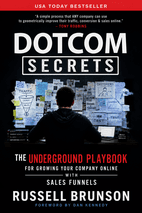
Russell Brunson's Dotcom Secrets provides a step-by-step system for building sales funnels that transform websites from passive brochures into customer-generating machines, covering the Secret Formula, Value Ladder, Attractive Character, and 25 scripts for entrepreneurs struggling to convert online traffic into sales.
Feature
Insta.Page
Blinkist
Shortform
Summary Depth
Full Chapter-by-Chapter
15-min overview
Section-by-section guides
Audio Narration
✓
✓
✓
Visual Mindmaps
✓
✕
✕
AI Q&A
✓
✕
✕
Quizzes
✓
✕
✕
PDF Downloads
✓
✕
✓
Price
$89.99/yr
$146/yr (PRO)
$199/yr
*Competitor data last verified July 2026.
1 Page Summary
Dotcom Secrets opens with a blunt premise: most websites are expensive, passive digital brochures that rely on luck rather than strategy. Russell Brunson argues that a successful online business requires a sales funnel—a structured, sequential process that mirrors the actions of a top salesperson by guiding a prospect from stranger to customer to client with a single goal at each step. The book’s foundational framework is built around four questions known as “The Secret Formula,” which act as the backbone for all funnel-building. Brunson emphasizes that a funnel is not a product but a system. He stresses that a website without a clear process treats visitors with confusion, which violates the golden rule that a confused mind always says no.
The book introduces several core concepts to construct and optimize this system. Key among them are the Value Ladder (a strategic sequence of offers from free to high-ticket), the Attractive Character (a brand personality built through backstory, parables, flaws, and polarity to create emotional connection), and the Hook, Story, Offer framework (which insists the irresistible offer must be built first, wrapped in a trust-building story, and then fronted by a compelling hook). Brunson also details the Seven Phases of a Funnel (pre-framing, traffic temperature, and a phased ask) and Funnel Hacking (modeling proven sales funnels rather than reinventing them). A crucial distinction is made between the funnel’s structure (the “easy part”) and the sales copy or script (the “real engine”), which is explored in depth through 25 distinct scripts for everything from headlines to high-ticket closes.
This book is written for entrepreneurs and business owners who feel their current online presence is underperforming, particularly those who have built a product but struggle to attract the right customers. Brunson challenges the reader to identify their “dream customer” (rather than fishing with whatever bait is available) and to treat their business as an active, systematic tool. The intended outcome is a complete, repeatable funnel system that moves a customer from lead to a high-ticket offer, using tools like follow-up funnels (Soap Opera Sequences and Daily Seinfeld Emails) and “Funnel Stacking” (connecting multiple funnels ascending the value ladder). The book concludes with a 12-step blueprint for launch, test, and iteration, framing the entire process as a game to be won.
Publisher’s Note
Overview
The Publisher’s Note wastes no time calling out a painful truth: most websites are just digital brochures. They look stunning, they're packed with links to every service imaginable, but there's zero strategy or process behind them. The author draws a blunt comparison—it's like hiring a salesperson to stand outside your store, shove flyers at passersby, and simply hope someone finds something interesting enough to come back and buy. If a real salesperson operated that way, you'd fire them on the spot. Yet that's exactly what businesses do with their websites: they publish content, add flashy design, and then wait for magic to happen.
The note underscores that a website isn't a set-it-and-forget-it asset; it's an active tool that needs a purpose, a funnel, and a clear call to action. Without that, it's just expensive real estate gathering digital dust. The tone is direct, frustrated, and refreshingly honest—a wake-up call disguised as a publisher's introduction.
Key Takeaways
A website without a strategy is no better than a paper brochure handed out at random.
Passive websites rely on luck, not a process—and luck is a terrible business plan.
Treat your website like an employee: give it a job, measure its performance, and fire it if it's just standing around.
Key concepts: Publisher’s Note
1. Publisher’s Note
The Digital Brochure Problem
Most websites are just digital brochures
They have zero strategy or process behind them
Like hiring a salesperson to shove flyers at passersby
Businesses publish content and wait for magic
Website as an Active Tool
A website is not a set-it-and-forget-it asset
It needs a purpose, a funnel, and a clear call to action
Without these, it's expensive real estate gathering dust
The Wake-Up Call
Passive websites rely on luck, not a process
Luck is a terrible business plan
Treat your website like an employee with a job
Measure its performance and fire it if it's useless
💡 Try clicking the AI chat button to ask questions about this book!
Foreword
Overview
The foreword sets the stage by contrasting a traditional website with a well-designed sales funnel. Think of a typical website as a brochure that throws everything at you at once—dozens of buttons, menus, and calls to action. That approach violates a golden rule of marketing: a confused mind always says no. Visitors get overwhelmed, so sales suffer.
A sales funnel, on the other hand, is built for clarity. It mirrors the process of a top-notch salesperson: first, they greet you and get your name and contact info. Then they ask what you need, guide you past distractions, and help you find exactly that. After the sale, they offer a relevant upsell. The result? A better experience for the customer and more revenue for the business. Each page in a funnel has only one goal, one call to action, and a strategic sequence that moves a prospect from lead to customer to client.
The chapter also introduces the “Secret Formula,” a framework of four simple questions that will guide everything in Section One. Those questions act as the backbone for the funnel-building process you’ll explore in detail.
Key Takeaways
Traditional websites confuse visitors with too many options, leading to lost sales.
A sales funnel simplifies the journey: one call to action per page, a clear sequence, and strategic upsells.
The funnel process improves user experience and increases revenue.
The “Secret Formula” (four guiding questions) is the foundation for the strategies ahead.
Key concepts: Foreword
2. Foreword
Traditional Website vs. Sales Funnel
Traditional sites confuse with too many options
Confused visitors say no, hurting sales
Funnels mirror a top salesperson's process
Each funnel page has one goal and CTA
Benefits of a Sales Funnel
Better customer experience through clarity
Strategic sequence moves lead to client
Upsells increase revenue after sale
The Secret Formula Foundation
Four simple questions guide funnel building
Formula is backbone for Section One strategies
Note to the Reader
Overview
Early in my entrepreneurial journey, I was obsessed with the product. I’d dream up an idea, build it, throw it into the marketplace, and then wait to see who bit. That approach felt smart—after all, isn’t the product king? But a mentor dropped a line on me that cracked everything open: “If you change your bait, you’ll change your customer.” In that moment, I realized I had never once asked myself who I actually wanted to serve. I was just fishing with whatever bait I had, and the people who showed up were not the ones I enjoyed being around. They drained my energy, and no amount of revenue could fill the emptiness.
That realization led me to a question that reshaped my entire business: “Who is the person I really want to serve?” Up until then, I treated customers like interchangeable targets. I’d chosen a spouse carefully, but I’d never applied the same thought to the clients I’d spend more time with than my own family. The result? I built a successful software company, then launched a teaching arm to show others how to replicate my success. We made good money, but my dream clients were not the beginners who couldn’t afford higher-tier offers and needed hand-holding on basic stuff like buying a domain. I was stuck teaching fundamentals when I wanted to share advanced scaling secrets. I was miserable, and my family felt the fallout.
So I took a week to think deeply about the who. I created two customer avatars—one for men, one for women. For the women, I named her Julie. She was successful, driven, had a message, valued personal growth over money, and already had some business experience but wanted to grow. That clarity changed everything. The first question every entrepreneur must ask—whether starting fresh or pivoting to grow—is: Who is your dream customer? Don’t let the excitement of a product idea skip this step. If you don’t consciously choose, you’ll one day wake up working with people who exhaust you, wishing someone could fire you from the business you built.
Key Takeaways
Your bait determines your catch. Changing your offer attracts a different customer. If you’re unhappy with the people you serve, change the bait.
Don’t start with a product—start with the person. Most entrepreneurs focus on the what before the who, leading to frustration and burnout.
Your dream customer deserves the same intentionality as choosing a life partner. You’ll spend more time with them than with friends and family.
Define your ideal client’s goals, passions, and desires. Then create offers that attract them and repel everyone else.
If you’re already in business and feeling drained, pause. Ask yourself: Who do I really want to work with? Then redesign your bait accordingly.
Key concepts: Note to the Reader
3. Note to the Reader
The Bait Determines the Catch
Changing your offer attracts different customers
Unhappy with clients? Change the bait
Product obsession ignores who you serve
Start with the Person, Not the Product
Most entrepreneurs focus on what before who
Define your dream customer first
Avoid frustration and burnout from wrong clients
Intentionality Like Choosing a Life Partner
You spend more time with clients than family
Choose clients as carefully as a spouse
Wrong clients drain energy despite revenue
Define Your Dream Customer Avatar
Create detailed avatars for ideal clients
Include goals, passions, and desires
Example: Julie—successful, driven, experienced
Pause and Redesign If Drained
Ask: Who do I really want to work with?
Redesign your bait to attract dream clients
Repel everyone else with targeted offers
SECTION ONE: Sales Funnel Secrets
Overview
It’s spring break, and I’m stuck in Boise while my teammates hit Vegas. My buddy Nate and I are bored, broke, and married to women who are actually working. So we decide to build a potato gun. We research obsessively, learn the barrel-to-chamber ratios, the right propellants, and which pipes won’t blow up in our faces. We build it, shoot it, and have a blast. Then a light bulb goes off: thousands of people are searching for “potato gun” on Google every month, but nobody is selling anything about it. So we make a DVD, start buying Google ads for $0.25 per click, and sell one $37 DVD per day. Profit: $27 a day. Not bad for a couple of college wrestlers.
Then Google slaps me. Overnight, my cost per click jumps to $3.00. Suddenly I’m spending $50 to sell one DVD—losing $13 every day. I shut down the ads, convinced the internet is no longer for little guys.
The Upsell That Saved Everything
A couple weeks later, my friend Mike Filsaime calls. He’s grinning on the other end of the line. “We figured it out.” He tells me about McDonald’s: they spend $1.91 per customer just to get them in the drive-through, and they only make $0.18 on that first burger. But then the cashier asks, “Do you want fries and a Coke with that?” That upsell adds $1.32 of pure profit—eight times what they made on the burger. Mike had added a similar “One-Time Offer” (OTO) after his core product, and it let him turn his ads back on. One out of three people took the upsell.
I realized I could do the same. My customers’ biggest complaint was hunting down all the parts to build the gun. So I partnered with a supplier in Idaho and created a $197 potato gun kit as my OTO. After the DVD purchase, I offered it as an upsell. Suddenly, every sale averaged $102 instead of $37. I was spending $50 a day on ads, but my revenue per order jumped so high that I was making $52 profit per sale—more than before the slap.
What a Sales Funnel Really Is
Most people confuse a website with a sales funnel. A typical website is like a brochure: it shows everything at once, with dozens of buttons and links. That confuses visitors, and a confused mind always says no. A funnel, by contrast, is simple. Each page has one clear call to action. It’s like having your best salesperson guide each prospect step by step—first capture their name, then sell them exactly what they want, then offer a perfect upsell. The customer gets a better experience, and you make more money.
The Secret Formula: Four Questions That Change Everything
After that potato gun experience, I became obsessed with funnels. I tested them in dozens of industries. Eventually I distilled everything into four questions that I now charge companies $100,000 per day to answer.
Who is your dream customer? Define the person you’d love to serve.
Where are they congregating? Find the specific places they hang out online.
What bait can you use to attract them? Use a hook, a story, and an offer to pull them into your world.
What unique result can you create for them? Think beyond your product—what life-changing outcome can you deliver?
These four questions are the skeleton for everything else in this book. They’ll guide the funnels, the scripts, and the value ladder we’re about to build.
Key Takeaways
A sales funnel isn’t just a website—it’s a guided journey that removes confusion and increases average order value.
Adding a single upsell (like McDonald’s fries-and-Coke question) can multiply your profit per customer, letting you spend more to acquire them.
The business that can spend the most to acquire a customer wins—because each customer is worth more.
The Secret Formula (Who, Where, Bait, Result) is the foundation for every funnel you’ll create. Master these four questions, and you’ll know exactly how to build a system that attracts, converts, and ascends your dream customers.
Key concepts: SECTION ONE: Sales Funnel Secrets
4. SECTION ONE: Sales Funnel Secrets
The Potato Gun Origin Story
Built a potato gun out of boredom
Sold DVDs via Google ads for $0.25 per click
Google slapped, cost per click jumped to $3.00
Shut down ads, lost money on every sale
The Upsell That Saved Everything
Mike Filsaime shared McDonald's upsell strategy
McDonald's makes $0.18 on burger, $1.32 on upsell
Added $197 potato gun kit as One-Time Offer
Revenue per sale jumped from $37 to $102
What a Sales Funnel Really Is
A funnel is not a brochure website
Each page has one clear call to action
Guides prospects step by step like a salesperson
Removes confusion, improves customer experience
The Secret Formula: Four Questions
Who is your dream customer?
Where are they congregating online?
What bait can attract them?
What unique result can you deliver?
Key Takeaways from Section One
A funnel is a guided journey, not just a website
One upsell can multiply profit per customer
Business that spends most to acquire customers wins
Master the four questions for every funnel
You've reached the end of the free chapters
Next chapter: “Secret #1: The Secret Formula” is locked
Keep reading Dotcom Secrets — and unlock all 600+ book summaries with audio, mindmaps and AI Q&A.
$0.00 due today · 7 days free, then $89.99/year ($7.49/mo) · Cancel anytime before day 7
Russell Brunson is a bestselling author and entrepreneur best known for his books *DotCom Secrets* and *Expert Secrets*, which focus on digital marketing and sales funnel strategies. As the co-founder of ClickFunnels, he has built a platform that revolutionized online sales, leveraging his expertise in direct response marketing. His background as a software entrepreneur and speaker has made him a pivotal figure in the internet marketing community.
Frequently Asked Questions about Dotcom Secrets
What is Dotcom Secrets about?
This book reveals a proven system for transforming a passive website into a high-converting sales funnel. It moves beyond the traditional brochure-style site by introducing a step-by-step framework that mirrors the process of an expert salesperson: attract, engage, and ascend customers through a value ladder. The core principles include identifying your dream customer, crafting an irresistible offer with the Hook-Story-Offer formula, and building an Attractive Character that builds emotional connections. Readers learn funnel types like squeeze, survey, summit, book, cart, challenge, and webinar funnels, along with the scripts that make them work—all based on real-world case studies and decades of testing.
Who is the author of Dotcom Secrets?
Russell Brunson is the cofounder of ClickFunnels, a software company that simplifies building sales funnels. He started as an entrepreneur with early failures, including a potato gun DVD business, before discovering the power of funnels. His personal stories of struggle—like laying off his team and later building a multimillion-dollar business—ground the book's teachings in hard-won experience.
Is Dotcom Secrets worth reading?
Absolutely—if you're tired of a website that acts like a digital brochure and want a system that actually generates leads and sales. The book replaces guesswork with a repeatable process: from identifying your dream customer to stacking funnels that scale. It's packed with actionable scripts, real examples (like the $750,000 iPhone auction), and a clear 12-step blueprint that has been battle-tested by thousands of entrepreneurs.
What are the key lessons from Dotcom Secrets?
First, define your dream customer before building any product—'change your bait, change your customer.' Second, structure every offer around Hook, Story, Offer and create a Value Ladder that starts with a low-cost or free entry point. Third, become an Attractive Character through vulnerability and storytelling to build trust. Fourth, master the seven phases of a funnel and use scripts like the Perfect Webinar, OTO, and Four-Question Close to guide prospects from cold traffic to high-ticket clients. Finally, funnel stack: launch one profitable funnel, then connect it to the next, using data to iterate until your average customer value exceeds your cost per acquisition.
📚 Explore Our Book Summary Library
Discover more insightful book summaries from our collection