Dotcom Secrets Quotes
by Russell Brunson
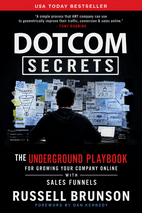
Welcome to our collection of the most impactful quotes from Dotcom Secrets. Here you will find lines that cut through the noise and get straight to the heart of what makes a business work. From the importance of a clear funnel to the power of choosing your dream customer, each quote offers a lesson you can apply right away.
Russell Brunson has a gift for turning marketing wisdom into simple, sticky phrases. His direct and honest style makes the book a goldmine for anyone looking to improve their sales and messaging. These quotes are not just words. They are proven principles that can shift your entire approach to business.
Top Quotes from Dotcom Secrets
“One of the fundamental rules of marketing is that “a confused mind always says no.””
Explaining why traditional websites with too many options cause sales to suffer.
This line encapsulates a core marketing principle that is easy to remember and instantly clarifies why simplicity in sales processes is critical.
“If you change your bait, you'll change your customer.”
The author recalls a mentor's line that triggered a realization.
This concise metaphor powerfully illustrates that the offers you create determine who you attract and serve.
“People don't come to you because they want your product, they come to you because they want a specific result.”
Russell explains the fourth question in the Secret Formula: What unique result can you create?
It reframes marketing around customer outcomes rather than features, a powerful shift that helps entrepreneurs focus on delivering true value.
“If you don’t like your customers, that’s your fault, not theirs. You attract your customers based on the content and offers that you put into the marketplace.”
A friend tells the author this during a conversation about his dissatisfaction with his clients.
This line forces readers to take ownership of their customer base, shifting blame from the market to their own strategy, which is both empowering and challenging.
“You have to understand there are two ways to have the lowest price product in your market. The first is to decrease the price of what you sell (and cut out your margins and profit). The second is to increase the value so much that when you sell it for what it's worth, it seems inexpensive.”
Russell Brunson says this to the audience after the iPhone auction at the Wake Up Warrior event.
It reframes pricing strategy from a race to the bottom to a value-creation mindset, which is a powerful shift for entrepreneurs.
“If you're neutral, no one will hate you, but no one will know who you are either.”
Russell Brunson emphasizes the value of polarity in the Attractive Character to stand out and attract dedicated followers.
It starkly contrasts the safety of blandness with the risk of obscurity, motivating readers to take a stand and be memorable even at the cost of criticism.
“If you want to achieve success, all you need to do is find a way to model those who have already succeeded.”
The author references Tony Robbins' advice as the foundation for the funnel hacking concept.
It encapsulates the entire chapter's philosophy in a simple, actionable statement, making success feel achievable through emulation.
Themes Behind the Quotes
One major theme is that confusion kills sales. A simple, well designed funnel guides customers step by step, making it easy for them to say yes. Another theme is that your business must be built around the result your customers want, not just your product. This shifts the focus from features to transformation.
A third theme is the value ladder. You attract customers with a valuable front end offer and then deliver increasing value so they naturally want to ascend. Finally, the quotes emphasize the importance of knowing exactly who you want to serve and modeling proven success rather than trying to invent everything from scratch. These ideas together form a practical framework for any online business.
Quotes by Chapter
Publisher’s Note
“Looked a lot like a glorified brochure: they looked awesome and had links to everything that the business could potentially do for a customer.”
The author describes the typical business website he encountered.
This line captures the deceptive appeal of a well-designed but strategy-free website, making readers question whether their own site is just a pretty front with no purpose.
“It was similar to hiring a salesperson, having them stand outside your store and hand out brochures to people who were walking by, with the only sales strategy being the hope that they'd look at the brochure, find something they liked, and then come back to buy something.”
The author expands on the brochure metaphor to illustrate the lack of a real sales process.
The vivid analogy makes the point instantly relatable and exposes the folly of passive web design, prompting readers to rethink their approach.
“If I had a salesperson who just handed out brochures and only waited for people to come and buy, I'd fire them immediately, yet this is what most people are doing with a website.”
The author delivers a blunt verdict on the common website strategy.
This line is a powerful wake-up call that challenges the status quo, using the threat of being fired to emotionally drive home the need for active marketing.
Foreword
“A funnel, on the other hand, is created to be simple.”
Contrasting the complexity of traditional websites with the focused design of a sales funnel.
It states the defining characteristic of a funnel in a direct, memorable way, setting the foundation for the entire book.
“Each page is simple, has a hook that will grab your attention, tells a story to create value, and makes you an offer that will move you to the next page of the funnel.”
Describing the structure of every page within a sales funnel.
This sentence provides a clear, actionable blueprint for creating effective funnel pages that readers can immediately apply.
“When a salesperson takes someone through a funnel like this, two things happen: + The customer has a better user experience. They aren't confused, and they can find exactly what they're looking for. + You as the store owner actually make more money.”
Summarizing the benefits of using a sales funnel analogy with a real-world salesperson.
It presents a compelling win-win outcome—better customer experience and higher profits—that motivates readers to adopt the funnel approach.
Note to the Reader
“Who is the person I really want to serve?”
The author asked himself this question after realizing his previous approach left him unhappy.
This simple question reframes the entire business strategy, shifting focus from product to people.
“You choose your significant other carefully, so why wouldn't you take the same time and care in deciding who your dream client or customer will be?”
The author challenges readers to apply the same rigor to client selection as to personal relationships.
The analogy makes the importance of choosing customers feel obvious and emotionally resonant.
“I promise you that if you don’t consciously choose your dream client, one day you will wake up like I did, working with people who exhaust you and wishing that someone could fire you from the business you created.”
The author warns readers from personal experience about the consequences of ignoring the 'who' question.
This vivid warning taps into the fear of burnout and regret, motivating readers to act before it's too late.
SECTION ONE: Sales Funnel Secrets
“Ultimately, the business that can spend the most to acquire a customer wins. A business beats its competition by making the same prospect worth more to his business than to that of his competition.”
Russell cites Dan Kennedy after learning how to use upsells to stay profitable.
This quote encapsulates the strategic advantage of increasing customer value, empowering businesses to outspend competitors and dominate their market.
Secret #1: The Secret Formula
“A business is not about products and services. A business is about what result you can get for your clients.”
The author explains the fourth question of the secret formula, focusing on unique results.
This succinct statement reframes business purpose from transactional to transformational, a core principle that resonates with anyone seeking deeper impact.
Secret #2: Hook, Story, Offer
“If you have price resistance when trying to sell your offer, the problem is not that your customers don’t have money, it's that you haven't increased the value to a point where what you are selling becomes inexpensive.”
Russell Brunson explains the core principle behind overcoming objections to price.
It shifts blame from the customer to the offer itself, empowering business owners to solve the real issue.
“If something isn’t working in your funnel, it's always either the hook, the story, or the offer.”
Russell Brunson introduces the Hook, Story, Offer framework as a diagnostic tool for funnels.
This simple, memorable line gives entrepreneurs a clear starting point for troubleshooting any marketing problem.
“We never know which ones will grab our market's attention, so it’s important that we keep throwing out hooks until we find the ones that effectively hook our dream customers.”
The author explains the need to test multiple hooks because you can't predict which ones will work.
This line underscores the importance of persistence and experimentation in marketing, reminding readers that success comes from consistent testing rather than a single perfect attempt.
Secret #3: The Value Ladder
“When we receive value, we naturally want more, and the same is true here inside your business.”
Russell Brunson explains the human tendency that drives the value ladder.
It distills the core psychological principle behind the value ladder—reciprocity and desire for more—making it easy to remember and apply.
“Your value ladder is your actual business plan. It shows how you are going to acquire your customers, where you will make money as the business owner, and the result you are going to help your dream customers achieve.”
Russell Brunson emphasizes the importance of the value ladder as a strategic framework.
It reframes a business plan as a customer journey, giving entrepreneurs a clear, actionable structure to build their company around.
“If you keep providing more and more value, people will spend more and more money to keep working with you.”
Russell Brunson discusses the unlimited potential of back-end offers.
It’s a simple, powerful summary of the value ladder’s economics: value drives revenue, encouraging entrepreneurs to focus on serving rather than just selling.
“We provide insane amounts of value at each step of our value ladder, so our clients naturally want to ascend, get more value, and pay us more money.”
Russell Brunson describes how his company sells high-ticket packages through the value ladder.
It vividly illustrates the natural progression from low-cost to high-cost offers, reinforcing that the key is to overwhelm with value at every step.
Secret #4: The Attractive Character
“If you want to attract someone, you have to be attractive, and I’m not talking about your looks. I’m talking about your personality.”
John Alanis, a speaker at an event, explains the core concept of the Attractive Character to the audience.
This line reframes attraction from physical appearance to personality, making it accessible and actionable for building a brand that draws customers naturally.
“People won't care about any of the success you've had, and they won't follow you or your advice until they know that you’ve been where they are now.”
Russell Brunson teaches the importance of sharing your backstory to build trust with your audience.
It reveals a counterintuitive truth: vulnerability and relatability matter more than showcasing success, which resonates with anyone struggling to connect with their market.
“No one wants to hear about the perfect person—because you can't relate.”
The author discusses why Attractive Characters must share their flaws to be believable and relatable.
This short, punchy sentence challenges the impulse to appear flawless and validates the power of authenticity in building emotional bonds with an audience.
Secret #5: Funnel Hacking
“You can always tell who the pioneers are because they have arrows in their backs and are lying facedown in the dirt.”
The author recalls a college professor using this quote to explain the disadvantage of being a first mover.
It vividly captures the risk of innovation without proven models, setting up the value of reverse-engineering success.
“Every year we have people who want to try to compete with us at Agora. They always come in thinking that they'll undercut us on price or sell through a different method or model than we do, and every year we watch as they try and fail. It always amazes me that they don’t look at what we're doing now and just model it.”
Porter Stansberry, keynote speaker at a Dan Kennedy event, explains why competitors fail against Agora's proven funnel.
This directly advocates for modeling instead of reinventing, which is the core lesson of funnel hacking and resonates with anyone seeking a proven path.