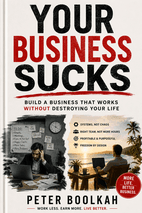
Peter Boolkah's Your Business Sucks offers a raw, practical guide for entrepreneurs trapped by their own success, using diagnostic tools like the Personal Sustainability Audit and Daily Hamster Wheel Tracker to break free from the exhaustion cycle. Written for founders who are working harder but losing freedom, health, and fulfillment.
Feature
Insta.Page
Blinkist
Shortform
Summary Depth
Full Chapter-by-Chapter
15-min overview
Section-by-section guides
Audio Narration
✓
✓
✓
Visual Mindmaps
✓
✕
✕
AI Q&A
✓
✕
✕
Quizzes
✓
✕
✕
PDF Downloads
✓
✕
✓
Price
$89.99/yr
$146/yr (PRO)
$199/yr
*Competitor data last verified July 2026.
1 Page Summary
This book opens with an uncomfortable premise: most business owners have built companies that cannot function without them, trapping themselves in a cycle of exhaustion and self-imposed indispensability. Through the stories of four fictional business owners—Sarah, Marcus, Elena, and David—the author illustrates common patterns of dysfunction, from the solopreneur who treats burnout as a badge of honor to the founder whose constant availability has trained his team to be helpless. The core argument is that the qualities owners mistake for responsible leadership—always being available, making every decision, never disconnecting—are actually suffocating their businesses. The book introduces three archetypes of business ownership (Technician, Manager, Entrepreneur) and uses a recurring "Hamster Wheel" metaphor to describe the exhausting cycle where working harder makes the owner more essential but less free.
The author's distinctive approach blends raw personal confession with practical, actionable frameworks. He shares his own story of losing his marriage and falling into depression despite outward business success, using that vulnerability to challenge readers' assumptions about self-sacrifice. Each chapter is structured as a combination of narrative (the four owners' struggles) and concrete tools: a Personal Sustainability Audit, a financial cost comparison between employment and ownership, a "Daily Hamster Wheel Tracker" for identifying reactive versus intentional work, and a Quarterly Life-Business Alignment audit. The book emphasizes that marketing, scaling, and leadership all fail if built on a foundation of personal desperation. Key concepts include the "Oxygen Mask Principle" (you cannot give what you don't have), the distinction between working from strength versus desperation, and the idea that self-care is not a luxury but the most important business investment.
The intended audience is entrepreneurs and business owners who feel trapped by their own success—those who are working harder than ever but have less freedom, health, and fulfillment. Readers will gain a structured path to building a business that operates without them, complete with diagnostic tools to identify exactly where their business is breaking down. The book promises a shift from being the indispensable technician to becoming a strategic leader who enables others. Ultimately, it delivers a stark message: sustainable success isn't built on sacrifice and exhaustion, but on the unglamorous daily discipline of taking care of yourself first, because business sustainability and personal sustainability fuel each other in a positive cycle. An accompanying online portal (accessed via QR code) provides interactive versions of all frameworks, industry-specific guides, and troubleshooting resources.
The Uncomfortable Truth
Overview
You’re about to meet four business owners—each at a different stage of growth, each wrestling with problems that will likely feel uncomfortably familiar. There’s also James, a coach who helps them face the truths they’ve been avoiding and start building something healthier. These characters are fictional, but the struggles they represent? Entirely real. I’ve watched these patterns play out again and again in my coaching work, and they form the backbone of this chapter’s honest, no‑fluff introduction.
This book isn’t just a story you consume passively. It’s a workbook. Throughout the chapters you’ll find practical tools, assessments, and audits designed to help you pinpoint exactly where your business is breaking down—and, more importantly, how to fix it. Frameworks are woven into the material so you can stop guessing and start building with real clarity.
Now, I won’t soften this: some of what’s coming will be hard to read. You’ll be challenged. You might feel called out. That’s okay—it means you’re paying attention. But change never comes from shame; it comes from awareness followed by action. That’s why you’ll notice a recurring illustration that signals a pause point—a cue to stop, breathe, and take stock. This work isn’t only tactical; it’s emotional too. These breaks are here to give you space. Use them. You don’t need to fix everything in one go. But you do need to start. And if you’re ready to be honest with yourself, take responsibility, and do the work, this book will help you build a business that doesn’t just work—but one that serves your life instead of stealing it.
Key Takeaways
The four fictional business owners mirror real, common struggles—you’ll likely see yourself in at least one.
The book is both a story and a hands‑on workbook with assessments and frameworks.
Discomfort is part of the process; being called out means you’re paying attention.
Awareness must be paired with action—shame alone doesn’t create change.
Built‑in pause points give you emotional space to reflect as you work through the material.
Key concepts: The Uncomfortable Truth
1. The Uncomfortable Truth
The Four Business Owners
Each at a different growth stage
Struggles feel uncomfortably familiar
James the coach helps them face truths
Fictional characters, real patterns
This Book is a Workbook
Not passive consumption—active engagement
Practical tools, assessments, and audits
Frameworks for clarity and action
Pinpoint breakdowns and fix them
Embrace the Discomfort
Some parts will be hard to read
Feeling called out means you're paying attention
Change comes from awareness plus action
Shame alone doesn't create change
Pause and Reflect
Recurring illustration signals a pause point
Stop, breathe, and take stock
Work is emotional, not just tactical
Use these breaks for space
Start with Honesty
Don't need to fix everything at once
Take responsibility and do the work
Build a business that serves your life
Awareness must lead to action
💡 Try clicking the AI chat button to ask questions about this book!
The Mirror
Overview
James holds up an unflinching mirror to a roomful of overwhelmed business owners, forcing them to confront a painful truth: the very qualities they consider responsible leadership—constant availability, hands-on decision-making, never fully disconnecting—are actually suffocating their companies. Through direct, uncomfortable questions and a damning show of hands about holidays, he reveals a collective pattern of self-imposed indispensability. The chapter pivots from diagnosis to a framework, introducing the three archetypes of business ownership—Technician, Manager, Entrepreneur—and challenges each person to see that the only way out of the hamster wheel is to stop being the one spinning it.
The Technician Trap and the Hamster Wheel
James starts by naming the core problem: most owners have built businesses that can’t function without them. Sarah, Marcus, Elena, and David each feel the sting of recognition. James’s “Personal Sustainability Audit” forces them to quantify their neglect of health, sleep, and emotional well-being—metrics they’ve never stopped to measure. The slide “THE HAMSTER WHEEL TRAP” crystallizes the cycle: the harder they work, the more essential they become, and the less free they feel. The only variable they haven’t examined is themselves.
Three Roles, One Escape
James introduces Michael Gerber’s classic distinction to cut through the confusion. A Technician does the work—and most owners are brilliant technicians. A Manager organizes others to do the work. An Entrepreneur builds systems so the work gets done without them. The trap is staying in the first role while pretending to run a business. Each character in the room sees themselves: Sarah remembers her marketing manager roots, David feels the weight of his daughter’s question about dinner-table calls, and Marcus and Elena silently acknowledge their marital strain. James offers a promise: if they’re willing to do the hard inner work, their story can change.
Key Takeaways
The business owner is often the bottleneck, not the solution—constant involvement is a sign of a system, not a leader.
The Technician Trap keeps owners doing the work instead of building an organization that runs independently.
Personal sustainability metrics reveal the hidden costs of over-functioning: health, relationships, and mental clarity.
Real change begins when the owner admits they are both the problem and the only one who can fix it.
Key concepts: The Mirror
2. The Mirror
The Technician Trap
Owners build businesses dependent on them
Harder work increases indispensability
Personal Sustainability Audit reveals hidden costs
The hamster wheel cycle traps owners
Three Business Archetypes
Technician does the work directly
Manager organizes others to do work
Entrepreneur builds self-running systems
Most owners stay in Technician role
Confronting Self-Imposed Indispensability
Constant availability suffocates company growth
Hands-on decision-making is a leadership flaw
Never disconnecting harms health and relationships
The Alignment Foundation – What Do You Actually Want?
Overview
Most entrepreneurs don't start from a place of strategic clarity. The reality is messier—we begin from trauma, frustration, or desperation, and only later realize we're trying to build a life we never actually defined. The chapter asks a simple question that almost no one stops to answer: What do you actually want? Not just from your business, but from the life your business is supposed to serve.
Starting from Trauma, Not Strategy
Almost nobody launches a business with a calm, deliberate blueprint for how it will fit into their ideal day. Instead, we're running from something—a boss who drained us, a paycheck that felt like a cage, a fear of being replaceable. The chapter opens with a quiet confession from a founder whose entire drive was rooted in the terror of being indispensable, then abandoned. That fear was already warping every decision he made, even though he couldn't admit it. This is the raw starting point for most entrepreneurs: a wound, not a vision. And until you name that wound, you'll keep building a business that's really just an elaborate coping mechanism.
Defining Non-Negotiables
The chapter introduces a concrete tool: a true cost comparison between employment and entrepreneurship. Sarah's story shows how she thought she was gaining freedom, but her business demanded 3,280 hours a year compared to 1,880 in her old job—and her hourly rate was actually lower. That uncomfortable math forces her to ask: What am I really getting for this sacrifice?
From that reckoning, you're asked to list your own non-negotiables—the things you refuse to compromise, no matter how much revenue your business generates. Real examples include genuine holiday time where you can fully disconnect, the freedom to do spontaneous activities without business consequences, the ability to say no to opportunities that don't align, and financial security that doesn't rest entirely on this month's revenue. These aren't vague aspirations; they're lines in the sand.
Auditing Your Business Demands
Once you've named your non-negotiables, the next step is brutally honest: where is your current business preventing you from living by them? This isn't about what you wish your business was doing—it's about what it's actually demanding.
The chapter provides a series of diagnostic questions that cut through self-deception. On time conflicts: When does business demand conflict with relationship time? How often do you sacrifice health for business? What personal interests have you abandoned entirely? On friendships: How many friendships have you damaged? When was the last conversation you had that wasn't about work? Do people see you as a friend or as someone who's always too busy?
These questions aren't meant to shame—they're meant to reveal the gap between the business you're running and the life you're trying to live.
The Legacy Question
Then comes the hardest layer: the long view. If you continue on your current path, what will your family remember about these building years? What kind of example are you setting about success and life priorities? Will your business achievements justify the personal cost? And more piercingly: What would you regret not prioritizing twenty years from now?
This isn't about guilt—it's about giving yourself permission to want more than just a successful business. Most entrepreneurs are so indoctrinated in the grind culture that they've forgotten they're allowed to desire a life that feels whole.
Permission to Want More
The chapter offers a quiet, powerful moment of permission. James looks around the room and tells the entrepreneurs that most of them need to hear this: you are allowed to want a business that supports your life, not one that consumes it. You didn't start a company just to trade one set of chains for another.
This section reframes the entire purpose of entrepreneurship. Your business should be a vehicle for creating your ideal life, not an obstacle to it. Without alignment, all the efficiency in the world just makes you more efficiently miserable.
The Ultimate Test
There's a simple, devastating question that crystallizes everything: If your business were to disappear tomorrow, would you be proud of the life you've built and the person you've become through the process of building it?
If the answer is no, then realignment isn't optional—it's urgent. Because you'll spend more time building your business than almost anything else in your adult life. If that process isn't making you a happier, healthier, more fulfilled person, then you're not building a business. You're constructing an elaborate prison.
Key Takeaways
Most entrepreneurs start from trauma, not strategy—and never stop to question their deeper motivations.
Non-negotiables are the bedrock of alignment; without them, you'll drift into a business that demands everything and gives back less than you sacrificed.
A honest audit of time, relationships, and personal sacrifices reveals the true cost of your current trajectory.
The legacy question forces you to consider whether your business achievements will justify the personal costs twenty years from now.
You have permission to want a business that serves your life, not one that consumes it.
The ultimate test: If your business disappeared tomorrow, would you be proud of who you became building it?
Key concepts: The Alignment Foundation – What Do You Actually Want?
3. The Alignment Foundation – What Do You Actually Want?
Starting from Trauma, Not Strategy
Most entrepreneurs begin from a wound, not a vision
Fear of being replaceable warps business decisions
Unnamed trauma turns business into a coping mechanism
Strategic clarity is rare; messiness is the norm
Defining Non-Negotiables
Compare true costs: entrepreneurship vs. employment hours
List things you refuse to compromise for revenue
Examples: genuine holiday time, spontaneous freedom
Non-negotiables are lines in the sand, not aspirations
Auditing Your Business Demands
Identify where business prevents living by non-negotiables
Diagnose time conflicts with relationships and health
Assess damaged friendships and work-only conversations
Reveal the gap between current business and desired life
The Legacy Question
What will family remember about these building years?
Will business achievements justify personal costs?
What would you regret not prioritizing in 20 years?
Permission to want more than just a successful business
The Ultimate Test
Would you be proud of who you became if business vanished?
Realignment is urgent if answer is no
Building process should make you happier and healthier
Otherwise, you're constructing an elaborate prison
The Solopreneur’s Prison
Overview
Sarah finds herself in a conversation that cuts through her usual justifications. James points out that exhaustion isn’t a badge of honor—it’s a sign she’s been operating from desperation instead of strength. He introduces the idea that self-care isn’t a luxury but the most important business investment she can make. Then he shares his own painful journey: the wife who left, the clinical depression that followed, the hollow success that nearly destroyed him. That honesty cracks something open in Sarah. The chapter moves from raw confession into a practical framework—the six levers of growth and a structured sales approach—but it’s grounded in the recognition that working more isn’t the answer. Working differently is. Sarah ends the chapter with a small but powerful act: setting an out-of-office message, leaving the office before midnight for the first time in months.
The Personal Sustainability Connection
James challenges the assumption that constant busyness equals commitment. “When I’m working from strength,” he says, “I make better decisions, have clearer thinking, and actually serve clients better.” Working from desperation produces the opposite: poor choices and mediocre work. Sarah realizes she’s been desperate for months without acknowledging it.
The real punch comes when James asks about her effective hourly rate when rested versus exhausted. She admits the math is brutal—she works longer, produces worse results, and clients feel it. Self-care becomes reframed as the ultimate business strategy, not a distraction from it.
The Cost of Success
James reveals his own story with raw vulnerability. His wife told him she felt married to his calendar. She took the kids and left. He had the awards, the magazine features, the staff. And six months later, he couldn’t get out of bed. Clinical depression, not just burnout. “I had built a life out of noise and momentum and none of it actually belonged to me.”
Sarah feels the recognition like a physical weight. The tension in her chest now has a name: fear. James’s honesty isn’t just cathartic—it’s the first time she believes there might actually be a way out.
The 6 Ways Revelation
James sketches a simple formula: Customers × Transactions × Margins = Revenue. From that, he derives six levers for growth:
Increase number of customers
Increase average transaction value
Increase frequency of purchase
Increase profit margins
Improve customer retention
Reduce costs
“Most business owners try to do all six at once and end up doing none of them well,” he says. The insight is that growth comes from focusing on a few levers at a time, not scattering energy everywhere. This is the ActionCOACH methodology in action—practical, systematic, repeatable.
The Straight Line System
James introduces a sales framework from Jordan Belfort, stripped of its manipulative reputation. The core is three elements: establish need, build trust, create urgency—all done conversationally, not aggressively. The structure:
Opening — build rapport quickly
Fact-finding — understand the real problems
Presentation — show how you solve those problems
Handling objections — address concerns directly
Closing — help the prospect decide
The genius, James explains, is that the client feels like they’re making the decision themselves. The coach just leads the conversation in a straight line toward the logical conclusion.
The Long-Term Vision
Applying the methodology consistently over six months creates predictable systems for lead generation, conversion, delivery, and retention. Then scaling becomes systematic instead of hopeful. “Instead of being limited by your personal capacity, you can leverage systems and eventually other people.”
Sarah feels the word liberating float up. Outside, Manchester is settling into evening. Her sister Kate’s text stings: “When did you last take a proper holiday? Or go on a date? Mum’s right, you’re becoming Dad.” The comparison to her father—who worked himself into an early grave promising next year would be different—hits hard. Her personal savings are down to £8,000, all poured into keeping the business afloat. She hasn’t bought anything for herself that wasn’t a business expense.
A Small Breakthrough
Sarah opens her laptop and types an autoresponder: “Thank you for your email. I’m currently unavailable and will respond on Thursday. For urgent matters, please contact emma@sarahchenmarketing.com.” Then she closes the laptop, picks up her keys, and for the first time in months, leaves the office before midnight.
It’s not a grand transformation. It’s one decision, repeated and enacted. But that decision—to stop believing the business will collapse without her immediate availability—is the crack in the prison wall.
Key Takeaways
Working from desperation (exhaustion, stress, anxiety) lowers decision quality and service delivery—self-care is a strategic investment, not a distraction.
The six growth levers (customers, transactions, margins, frequency, retention, costs) work best when you focus on a few at a time, not all at once.
A structured sales process that feels conversational respects the client’s autonomy while moving them toward a logical decision.
Systematic documentation and measurement create predictability, freeing you from the tyranny of your own personal capacity.
The first step out of the solopreneur’s prison is often a small one: setting a boundary, leaving early, letting someone else handle the “urgent” email.
Key concepts: The Solopreneur’s Prison
4. The Solopreneur’s Prison
The Personal Sustainability Connection
Exhaustion signals desperation, not commitment
Self-care is the ultimate business strategy
Rested work produces better decisions and results
Effective hourly rate drops when exhausted
The Cost of Success
James lost his family to his calendar
Clinical depression followed hollow success
Fear named as the tension in Sarah's chest
Honesty reveals a possible way out
The 6 Ways Growth Levers
Revenue = Customers × Transactions × Margins
Six levers: customers, value, frequency, margins, retention, costs
Focus on a few levers at a time for growth
Systematic approach prevents scattered energy
The Straight Line Sales System
Sales framework: establish need, build trust, create urgency
Five steps: opening, fact-finding, presentation, objections, closing
Client feels they make the decision themselves
Conversational structure leads to logical conclusion
A Small Breakthrough
Setting an out-of-office message is a boundary act
Leaving before midnight breaks the prison pattern
One decision repeated creates transformation
Business won't collapse without immediate availability
You've reached the end of the free chapters
Next chapter: “When Partners Become Strangers” is locked
Keep reading Your Business Sucks — and unlock all 600+ book summaries with audio, mindmaps and AI Q&A.
$0.00 due today · 7 days free, then $89.99/year ($7.49/mo) · Cancel anytime before day 7
Peter Boolkah is a business coach and author known for his book *The Transition: A Guide to Helping You Achieve Personal and Professional Success*. He specializes in mindset and leadership development, drawing on his experience as a former high-performance athlete and entrepreneur to guide individuals through transformative change.
Frequently Asked Questions about Your Business Sucks
What is Your Business Sucks about?
This book follows four business owners at different growth stages, each wrestling with problems that feel uncomfortably familiar. It functions as a workbook packed with practical tools, assessments, and audits to help you pinpoint exactly where your business is breaking down and how to fix it. The content challenges readers with uncomfortable truths but provides clear frameworks for building a sustainable, healthy business that doesn't depend on heroic effort.
Who is the author of Your Business Sucks?
Peter Boolkah is a coach who draws from real patterns he has observed repeatedly in his coaching practice. He brings personal honesty to the material, sharing his own painful journey of losing his wife and suffering clinical depression from hollow success. His firsthand experience gives the advice an unflinching, grounded quality.
Is Your Business Sucks worth reading?
Absolutely, because it's brutally honest and offers actionable tools rather than just theory. The book forces you to confront hard truths about your business and yourself, then provides clear frameworks to break free from the hamster wheel of overwork. It's ideal for owners who are exhausted, overwhelmed, and ready for real change.
What are the key lessons from Your Business Sucks?
The book teaches that owners must stop being the indispensable Technician and instead operate as an Entrepreneur by systematizing and delegating. It emphasizes defining what you actually want from life—not just reacting to trauma—and understanding that growth without profit is a more expensive hamster wheel. Other critical lessons include the importance of self-care as a business investment, building systems to eliminate 'it varies' energy leaks, and recognizing that true leadership means enabling others rather than being the center of every decision.
📚 Explore Our Book Summary Library
Discover more insightful book summaries from our collection