Your Business Sucks Key Takeaways — Chapter-by-Chapter Lessons | Insta.Page

Your Business Sucks Key Takeaways

by Peter Boolkah
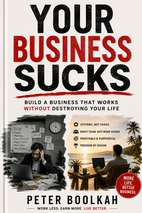
Your Business Sucks by Peter Boolkah Book Cover

5 Main Takeaways from Your Business Sucks

You Are the Bottleneck, Not the Solution

The business owner's constant involvement signals a broken system, not strong leadership. To escape the Technician Trap, you must document processes, delegate decisions, and build a team that can run without you—freeing you to focus on strategy and life.

Non-Negotiables Protect Your Life from Your Business

Without clear personal non-negotiables, you'll drift into a business that demands everything. Asking what you truly want, auditing your sacrifices, and designing a business that serves your life—not the other way around—is the only path to sustainable success.

True Profit Requires Paying Yourself First

Real profitability means subtracting a fair market salary for yourself. If less than 10% remains, your model is broken. Also, audit client and product profitability—fire anything that pays below minimum wage after accounting for your time.

Systems Beat Heroics Every Time

Reinventing processes wastes energy and leads to burnout. Use checklists, continuous small improvements (Kaizen), and written procedures to reduce mental chaos. Systems aren't just operational—they're a health strategy that frees you for creative and relational work.

Self-Care Is a Strategic Investment, Not a Distraction

You cannot lead or build sustainably from an empty tank. Treat personal well-being with the same discipline as business systems. Success and sacrifice are not synonymous; integrated growth enhances life, and the most valuable asset in your business is you.

Executive Analysis

These five takeaways form the book's central argument: the biggest obstacle to a thriving business is the owner's own behavior, and the only way out is intentional alignment, systematic operations, and personal sustainability. Boolkah insists that financial success without personal well-being is a failure—true growth requires the owner to step out of the technician role, build systems, and prioritize self-care as a strategic necessity.

This book matters because it moves past generic business advice into a raw, actionable framework that addresses the emotional and psychological traps entrepreneurs face. It combines storytelling, assessments, and real-world tactics, standing out in the crowded business genre by treating the owner's health and relationships as non-negotiable metrics of success. For any business owner feeling stuck in the hamster wheel, this book offers a clear, uncomfortable, but liberating path forward.

Chapter-by-Chapter Key Takeaways

The Uncomfortable Truth (Chapter 1)

  • The four fictional business owners mirror real, common struggles—you’ll likely see yourself in at least one.

  • The book is both a story and a hands‑on workbook with assessments and frameworks.

  • Discomfort is part of the process; being called out means you’re paying attention.

  • Awareness must be paired with action—shame alone doesn’t create change.

  • Built‑in pause points give you emotional space to reflect as you work through the material.

Try this: Pause at each chapter's reflection point and honestly write down where you see yourself in the four fictional owners—then commit to one small action that breaks that pattern today.

The Mirror (Chapter 2)

  • The business owner is often the bottleneck, not the solution—constant involvement is a sign of a system, not a leader.

  • The Technician Trap keeps owners doing the work instead of building an organization that runs independently.

  • Personal sustainability metrics reveal the hidden costs of over-functioning: health, relationships, and mental clarity.

  • Real change begins when the owner admits they are both the problem and the only one who can fix it.

Try this: Track your involvement in every task for one week and identify which ones only you can do; then delegate or systemize the rest to stop being the bottleneck.

The Alignment Foundation – What Do You Actually Want? (Chapter 3)

  • Most entrepreneurs start from trauma, not strategy—and never stop to question their deeper motivations.

  • Non-negotiables are the bedrock of alignment; without them, you'll drift into a business that demands everything and gives back less than you sacrificed.

  • A honest audit of time, relationships, and personal sacrifices reveals the true cost of your current trajectory.

  • The legacy question forces you to consider whether your business achievements will justify the personal costs twenty years from now.

  • You have permission to want a business that serves your life, not one that consumes it.

  • The ultimate test: If your business disappeared tomorrow, would you be proud of who you became building it?

Try this: Write down your top three non-negotiables (e.g., family dinner, exercise, sleep) and schedule them as fixed appointments before you plan any business activity.

The Solopreneur’s Prison (Chapter 4)

  • Working from desperation (exhaustion, stress, anxiety) lowers decision quality and service delivery—self-care is a strategic investment, not a distraction.

  • The six growth levers (customers, transactions, margins, frequency, retention, costs) work best when you focus on a few at a time, not all at once.

  • A structured sales process that feels conversational respects the client’s autonomy while moving them toward a logical decision.

  • Systematic documentation and measurement create predictability, freeing you from the tyranny of your own personal capacity.

  • The first step out of the solopreneur’s prison is often a small one: setting a boundary, leaving early, letting someone else handle the “urgent” email.

Try this: Pick one growth lever from the six (e.g., increase frequency of purchase) and set a single measurable goal for it this month, ignoring all others.

When Partners Become Strangers (Chapter 5)

  • Financial stress often masks deeper emotional fears; addressing both is essential for partnership repair.

  • Understanding the human fears behind business behavior transforms conflict from personal attacks into shared problem-solving.

  • Communication breakdown, not strategy, is the real threat to partnerships—Lencioni’s five dysfunctions provide a useful diagnostic.

  • Weekly structured check-ins and permission for proper disagreements build the trust that prevents quiet erosion.

  • Even if a business doesn’t survive, protecting personal finances and learning to work through conflict leaves partners stronger for the next venture.

Try this: Schedule a weekly 30-minute structured check-in with your business partner where you each share one personal fear and one business concern, using 'I feel' statements.

The Indispensable Trap (Chapter 6)

  • The trap is self-made: Indispensability isn’t a badge of honor—it’s a pattern of behavior that teaches everyone to depend on you, even for routine tasks.

  • Decision levels clarify authority: Sort decisions into strategic (Level 1), departmental (Level 2), and operational (Level 3). Leaders should only make Level 1 choices.

  • Testing the boundaries reveals hidden capacity: A one-hour observation experiment showed David that his team could likely handle far more if given the chance.

  • The cost of being indispensable is personal: Endless work hours, missed holidays, and strained relationships are the real price—not success.

  • Courage to trust your team is the first step: David’s hesitation after James left is relatable, but without that trust, change can’t begin.

Try this: For one day, refuse to answer any Level 2 or 3 decision (departmental or operational) and let your team solve it—observe what happens.

The Numbers Don’t Lie (Chapter 7)

  • True profit requires paying yourself a fair market salary and subtracting it from revenue. If what’s left is less than 10%, your business model needs fixing.

  • Client and product profitability audits reveal subsidies. Track time spent per client or product for one month, calculate real hourly rate, and fire anything paying below minimum wage.

  • Systematic revenue is the goal—automated onboarding, partner channels, long-term contracts, and a management team that generates sales without you.

  • Personal financial health metrics are non‑negotiable. If your business dependence ratio is too high or your stress level too consistent, the system isn’t working—even if revenue looks good.

  • The cost of the hamster wheel includes stress and missed opportunities. Once you see that full cost, investing in transformation no longer feels scary—it feels necessary.

Try this: Calculate your real hourly rate by dividing your monthly salary by actual hours worked, then fire any client or product that pays less than minimum wage.

Systems Are Your Salvation (Chapter 8)

  • “It varies” is an energy leak – Every time you reinvent a process instead of following a proven one, you drain decision-making and memory energy, leading to burnout.

  • Checklists for complex work – Even skilled professionals perform better with written, step-by-step processes. Getting them out of your head allows improvement, delegation, and consistency.

  • Kaizen beats overhaul – Continuous small improvements are easier to maintain when you’re tired and produce better long-term results than trying to change everything at once.

  • Systems are a health strategy – Reducing mental chaos lowers stress and frees energy for creative, relational, and restorative work.

Try this: Pick one recurring task you often say 'it varies' for and write a step-by-step checklist; use it next time and note the energy saved.

Marketing Isn’t Magic (Chapter 9)

  • Marketing from desperation is unsustainable. Address personal financial stress first so you can create from service, not need.

  • Sell the feeling, not the feature. Customers buy transformation—confidence, control, or security—not a product spec.

  • Build trust through vulnerability. Share your own mistakes and lessons; they make you credible and human.

  • Protect your creative energy. Reserve your best 90 minutes daily for marketing, free from distractions.

Try this: This week, create one piece of marketing that shares a real mistake you made and what you learned—sell the transformation, not the feature.

Leadership Isn’t a Title (Chapter 10)

  • Self-leadership is the foundation. You can’t lead others well if you haven’t learned to manage your own energy, emotions, and priorities.

  • Your need to be needed can hold your team back. The fear of irrelevance often keeps leaders from empowering others fully.

  • Leadership is situational. Adapt your style to each person’s competence and commitment for a given task—don’t treat everyone the same.

  • True value comes from enabling others, not from being indispensable. When you take pride in the business running well without you, you’ve escaped the hamster wheel.

  • Strong leadership increases business valuation. A company with developed people and systems is worth far more than one that depends on the owner’s constant presence.

Try this: Identify one team member with low competence on a task and use a directive leadership style for that task; for another with high competence, switch to a delegating style.

The Scaling Breakthrough (Chapter 11)

  • Scaling is only sustainable when personal finances are secure and you can make long-term decisions instead of survival moves.

  • Automation doesn’t make service less personal—it frees people to focus on high-value human interactions.

  • Every scaling decision should be evaluated against your personal life goals, not just business targets.

  • Track your own involvement for two weeks to discover hidden constraints and temptations to step back into operations.

  • Use a phased scaling plan with explicit personal sustainability metrics to ensure growth enhances your life rather than destroying it.

Try this: Block 90 minutes daily for deep work on strategic growth; during that time, ignore all operational requests and track how many times you're tempted to jump back in.

Building Something That Lasts (Chapter 12)

  • Personal and business sustainability are inseparable. Taking care of yourself makes you a better leader, which increases business value, which in turn gives you more freedom to take care of yourself.

  • Economic moats—brand trust, customer switching costs, proprietary processes—are what make a business sellable and durable. Identify yours and protect them.

  • The freedom test is real: can you step away for a month without guilt or crisis? If not, your business still owns you.

  • Success doesn’t require sacrifice. A systematically built business performs better when you trust your team and let go.

  • Legacy isn’t just what you leave behind—it’s how you live today. Prioritize relationships, health, and decisions that will matter in twenty years.

Try this: Define your business's main economic moat (e.g., brand trust) and list three actions this quarter to strengthen it, even if revenue takes a short-term hit.

Implementation Reality (Chapter 13)

  • Implementation reality is messy; use the Hamster Wheel Tracker to identify why you’re doing each task and whether it’s sustainable.

  • Differentiate between tasks driven by immediate cash needs versus future income—one is a hamster wheel, the other a lever.

  • Conduct quarterly alignment audits to ensure your daily actions reflect your values and preserve your health.

  • Course correction isn’t failure—it’s the core practice of building a business that serves your life, not the other way around.

Try this: Run the Hamster Wheel Tracker for one week: note every task and whether it's for immediate cash or future leverage—then eliminate or automate two immediate-cash tasks.

The Ultimate Truth About Transformation (Chapter 14)

  • You cannot lead, energize, or build sustainably from an empty tank—self-care is a prerequisite for effective leadership.

  • Treat personal well-being with the same systematic discipline you use for business systems.

  • Success and sacrifice are not synonymous; integrated growth enhances life rather than depleting it.

  • The most valuable asset in your business is you—investing in yourself is never a distraction, it’s the most strategic move you can make.

Try this: Schedule a weekly non-negotiable 'tank-filling' activity (e.g., a walk, a hobby, a nap) and treat it as seriously as a client meeting—no rescheduling.

A Note from the Author (Chapter 15)

  • The online portal replaces traditional appendices with interactive, practical resources.

  • It includes frameworks, extra methodologies, industry‑specific guides, and a troubleshooting guide.

  • Lifetime access is gained by scanning the book’s QR code—no additional cost.

Try this: Scan the book's QR code to access the online portal and immediately download one framework relevant to your biggest current struggle.

Continue Exploring