Your Business Sucks Quotes
by Peter Boolkah
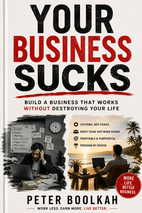
Inside this collection you will find tough truths and uncomfortable challenges. These are the lines that stop you mid paragraph and make you put the book down for a second. Peter Boolkah doesn't sugarcoat. He points directly at the gap between where your business is and where your life needs it to be.
What makes this book so quotable is how it mixes blunt reality with a clear path forward. Every line lands like a conversation with someone who has been exactly where you are. You will nod in recognition. You might wince. But you will keep reading because the honesty is exactly what you need to hear.
Top Quotes from Your Business Sucks
“Some of this will be hard to read. You'll be challenged. You might feel called out. That's OK. It means you're paying attention.”
The author addresses the reader directly at the beginning of the chapter.
This line validates the reader's discomfort and reframes it as a sign of engagement, making it both confrontational and reassuring.
“Build a business that doesn’t just work but one that serves your life instead of stealing it.”
The author states the ultimate goal of the book at the end of the chapter.
An aspirational and vivid image that reframes success as life-serving rather than life-consuming, resonating deeply with struggling entrepreneurs.
“Which means you haven't built a business — you've built yourself an expensive, complicated job.”
James says this to David after David admits he can't remember his last full week off.
This line crystallizes the painful truth many entrepreneurs avoid: they have a job, not a scalable business.
“A technician does the work. A manager organises people to do the work. An entrepreneur builds systems, so the work gets done without their constant involvement.”
James explains the three types of business owners as a new slide appears.
This clear, memorable distinction helps readers diagnose their own role and aspire to true entrepreneurial thinking.
“You started this business to improve your life. If it’s not doing that, it’s time to ask what needs to change - because you deserve a business that serves the life you actually want to live.”
The closing lines of the chapter directly addressing the reader.
It offers a compassionate yet direct call to action, reminding readers of their original intention and giving permission to realign their priorities.
“So self-care isn't taking time away from your business — it’s investing in your business's most important asset: you.”
James concludes the discussion on hourly rate and self-care.
This reframes self-care as a business strategy, alleviating guilt and encouraging sustainable practices.
“Building systems wasn't just a business strategy — it was a health strategy.”
Sarah realizes the personal toll of chaos after turning off her laptop early.
It connects operational efficiency to personal well-being, resonating with anyone whose work stress affects their health.
Themes Behind the Quotes
A major theme running through these quotes is the difference between building a real business and just creating a demanding job for yourself. Many owners get stuck doing the work instead of designing systems that run without them. That trap leads to exhaustion, dependency, and a life that feels more like a prison than a success. The book pushes you to step back and question whether your business actually serves your life or just drains it.
Another strong thread is the cost of ignoring self care and authenticity. Working nonstop is not a badge of honor. It is a sign of poor strategy. The quotes also highlight how desperation and fear drive bad decisions both in operations and in marketing. The real shift comes when you stop confusing activity with progress, and start building something that gives you freedom rather than taking it away.
Quotes by Chapter
The Uncomfortable Truth
“Change doesn’t happen through shame; it happens through awareness and action.”
The author explains the core philosophy behind the book's approach.
A concise, memorable mantra that shifts the focus from guilt to constructive steps, appealing to readers seeking practical improvement.
“You don’t have to fix everything in one go. But you do have to start.”
The author encourages the reader to take the first step without overwhelm.
It delivers a powerful call to action with a gentle permission to move at one's own pace, balancing urgency with realism.
The Mirror
“You think you're being responsible, hands-on leaders. Actually, you're strangling your own companies.”
James speaks directly to the group of business owners.
It flips the common belief that constant involvement equals good leadership, revealing it as a destructive habit.
The Alignment Foundation – What Do You Actually Want?
“Almost nobody starts a business from a place of strategic clarity about what they want their life to look like. They start from trauma, frustration, and desperation.”
The author states this as the raw reality of why people start businesses.
It challenges the common myth of strategic business planning and resonates because it validates the messy, emotional origins many entrepreneurs actually experience.
“If that process isn’t making you a happier, healthier, more fulfilled person, then you're not building a business — you're just constructing an elaborate prison.”
James delivers this as part of the ultimate test of business-life alignment.
The vivid prison metaphor makes the point unforgettable, forcing readers to confront whether their business serves or enslaves them.
“Without alignment, all the efficiency in the world just makes you more efficiently miserable.”
The author concludes a key section on alignment.
This short, punchy line flips the common obsession with productivity on its head, delivering a memorable truth about purpose over hustle.
The Solopreneur’s Prison
“When I'm working from strength, I make better decisions, have clearer thinking, and actually serve clients better. When I’m working from desperation — exhausted, stressed, anxious — I make poor choices and deliver mediocre work.”
James responds to Sarah's question about working from strength versus desperation.
This line directly contrasts the two states, making self-awareness a clear business metric that many solopreneurs can relate to.
“They think being constantly busy proves they’re committed. Actually, it proves they haven't learned to work strategically.”
James explains why constant busyness is not a sign of commitment.
It challenges the hustle culture norm and offers a strategic reframe that resonates with overworked entrepreneurs.
“I was scared of how empty I felt. Scared of stopping. But also... scared of continuing.”
James describes the emotional paralysis of his depression after his wife left.
The raw honesty captures the catch-22 of burnout, making readers feel seen and understood.
When Partners Become Strangers
“I mean, I've got eight weeks of personal expenses left in my savings. If we don't fix this business model, I'll have to get a job. A real job.”
Elena says this to Marcus during a tense call about their struggling business.
It strips away denial and forces both partners to confront the raw, personal financial stakes of their business decisions.
“Eric cried. Proper tears. Told Sandra about watching his dad lose everything, about the shame, about how terrified he was that he’d make the same mistakes.”
James recalls how Eric finally opened up about his deepest fear during a partnership mediation.
The stark vulnerability in this moment shows that true partnership repair begins with sharing the human fears hidden beneath business conflicts.
“In the end business decisions become personal battles instead of shared problem-solving.”
The narrator reflects on why partnerships break down.
It captures the insidious shift that destroys collaboration, reminding readers that unresolved communication turns every decision into a fight.
The Indispensable Trap
“You trained them to need you,’ Helen had said when he apologised for the fifth time about cutting their trip short. ‘And now you're all trapped by that training.”
Helen, David's wife, tells him this after he repeatedly interrupts their holiday to handle work crises.
It perfectly captures the paradox of indispensability: the leader creates the dependency and then becomes a prisoner of it. Readers recognize how their own desire to be needed can become a cage.
“I can't stop running,’ he told her, ‘because the moment I do, everything stops with me.”
David confesses to Helen his fear of delegating after realizing his team can't function without him.
This line viscerally describes the burnout cycle many leaders face—the relentless pace that feels necessary but is actually self-imposed. It resonates with anyone who feels trapped by their own role.
“David, what's the alternative? You're fifty-five years old, working sixty-hour weeks, and you haven't taken a proper holiday in three years. Your business is successful but entirely dependent on you. Is that really success?”
James challenges David to rethink his definition of success during their coaching session.
This blunt question reframes success from business metrics to personal well-being, forcing readers to confront the hidden costs of being indispensable. It's a wake-up call for any overworked leader.
“What if this transformation failed? What if he spent a year developing his team and building systems, only to discover that the business couldn't survive without his personal involvement?”
David's internal doubt after James leaves, as he contemplates the risk of delegating control.
This captures the deep fear that keeps leaders from letting go—the terrifying possibility that their value is actually a weakness. It's a honest look at the vulnerability behind the indispensable persona.
The Numbers Don’t Lie
“We've been confusing turnover with profit, growth with success.”
David, a business owner, reveals the fundamental mistake he made after calculating his real profit margins.
This line crystallizes a common and dangerous confusion between activity and actual profitability, making it a stark wake-up call for any entrepreneur who equates busyness with success.
“Turns out, half my clients are costing me more than they're paying me.”
An unnamed business owner confesses this realization to Elena early in the chapter.
It exposes the painful truth that more customers don't necessarily mean more money, forcing readers to confront the unglamorous math behind their own client lists.
“When you calculate the true cost of constant revenue generation — the stress, the missed opportunities, the personal financial risk - the investment in systematic transformation becomes obviously worthwhile.”
James explains why financial honesty makes the hard work of transformation feel necessary and rational.
This line validates the emotional and hidden costs of business ownership, reframing investment in better systems as an act of self-preservation rather than risk.
“If it costs you five hundred pounds to acquire a customer who only generates three hundred pounds in lifetime profit, you're in trouble.”
James gives Marcus and Elena a concrete example of a broken customer acquisition model.
This simple arithmetic makes the abstract concept of unprofitable growth instantly tangible and unforgettable, a metric every entrepreneur can immediately apply to their own business.
Systems Are Your Salvation
“Systems weren't just about efficiency; they were about freedom. Freedom from chaos, freedom from constant worry, and freedom to focus her energy on the work that truly mattered.”
The narrator reflects on Sarah's transformation after implementing systems.
This elevates systems from mundane tools to enablers of a better life, offering an inspiring and aspirational payoff.
“Your business would collapse, your clients would be stranded, and Emma would be unemployed. Is that the legacy you want to create?”
James confronts Sarah with the grim consequences of her undocumented processes.
The stark, urgent imagery forces readers to confront their own business fragility, making the need for systems feel existential.
Marketing Isn’t Magic
“Authentic marketing comes from a place of strength and service, not desperation and need.”
James tells Elena and Marcus during the coaching call.
It reframes marketing as a generous act rather than a desperate plea, empowering businesses to lead with confidence.