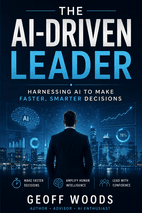
Geoff Woods's The AI-Driven Leader provides a strategic playbook for senior executives overwhelmed by rapid change, showing how to use AI as a daily Thought Partner to collapse data-to-decision timelines, overcome cognitive biases, and balance short-term pressures with long-term growth.
Feature
Insta.Page
Blinkist
Shortform
Summary Depth
Full Chapter-by-Chapter
15-min overview
Section-by-section guides
Audio Narration
✓
✓
✓
Visual Mindmaps
✓
✕
✕
AI Q&A
✓
✕
✕
Quizzes
✓
✕
✕
PDF Downloads
✓
✕
✓
Price
$89.99/yr
$146/yr (PRO)
$199/yr
*Competitor data last verified July 2026.
1 Page Summary
This book argues that leaders are currently drowning in operational chaos and data overload, but the solution is not to disconnect, but to transform into an AI-driven leader. The central thesis is that artificial intelligence should be used not as a replacement for human judgment, but as a daily Thought Partner that provides strategic clarity. By adopting a "strategy first, technology second" mindset, leaders can use AI to overcome cognitive biases, collapse the time from data to decision from months to minutes, and balance short-term pressures with long-term growth. The author presents this as a necessary evolution, noting that while AI won't replace leaders, those who harness it will replace those who don't.
The author, Geoff Woods, makes the book distinctive by framing AI adoption as a leadership and mindset challenge, not a technical one. He draws on historical parallels (like the Industrial Era's impact on thinking and Nokia's downfall) and introduces practical frameworks, such as the CRIT communication framework and the AI Empowerment Curve, which normalizes the struggle of moving from skepticism to mastery. Through case studies of companies like Microsoft, Herbalife, and Domino's, Woods demonstrates that true transformation requires shifting from a "know-it-all" to a "learn-it-all" culture. The book emphasizes that the real power of AI lies not in giving answers, but in prompting leaders to ask better questions.
The intended audience is senior leaders and executives who are feeling overwhelmed by the rapid pace of change and the pressure to adopt AI. For them, this book offers more than just a technical guide; it provides a strategic playbook for reclaiming their role as a composer and conductor of their organization. Readers will gain a clear, step-by-step process for going from zero AI adoption to integrating it seamlessly into their strategic planning, decision-making, and team management. Ultimately, the book promises to help leaders not just work 25% faster with 40% higher quality, but to redefine their leadership identity—shifting their focus from what they do to who they become.
1. The Rise of AI and the AI-Driven Leader
Overview
A CEO on the brink of bankruptcy, exhausted and out of ideas, discovers a non-obvious strategy after a ten-minute conversation with an AI using the CRIT framework. That strategy breathes life back into his company. This story sets up a central tension: nearly every senior leader knows strategic thinking matters, but most are drowning in operational chaos, waiting for data teams, or paralyzed by too much information. The solution isn't to unplug for days but to redefine your relationship with technology—to become an AI-driven leader who uses artificial intelligence as a daily Thought Partner for strategic clarity. That shift unlocks three immediate wins: turning overwhelming data into sharp decisions, doing more with less (a Harvard-BCG study shows 25% faster work with 40% higher quality), and aligning short-term pressures with long-term vision. The urgency is real: Eric Schmidt predicts a fundamentally different world in five years, and the leaders who learn faster will compound their advantage.
What this book offers is not comfort or chasing the latest shiny tool—it’s strategy first, technology second. The author’s own path, from a college lesson about mastering transferable skills to leading growth at a company that went from $750 million to $12 billion, reveals a critical gap: the tech world sells AI as a magic bullet, but real gains come from leaders who know how to wield it. Your job isn’t to become an AI expert; it’s to become an AI-driven leader who casts vision, aligns teams, and accelerates execution. The biggest bottleneck isn’t the pace of AI—it’s that organizations move too slowly. The answer is to flip the equation: instead of using AI for busywork, focus it on the 20% of priorities that drive 80% of results—your ability to think strategically and make faster decisions. This means shifting from treating AI as a smart assistant to embracing it as a Thought Partner that asks you the right questions. The chapter closes with a clear message: every technological divide separates adapters from hesitators. Those already using AI as their partner are pulling ahead; this book is both a guide to making that shift and an invitation to join the movement defining the future of leadership.
The businessman across from me looked exhausted. He wore a crisp collared shirt and sat with a stiff posture, but his face gave him away. He was worried. Really worried. It was mid-2024 at a YPO forum in Austin, Texas, and the question I asked the eight leaders gathered around the table was strategic: What are the biggest problems you're facing that, if solved, would unlock a completely new level of growth?
One CEO of a manufacturing company answered bluntly. He had leased all his capital equipment from a Japanese company, market conditions had shifted, and the debt was crushing him. He tried five strategies—nothing worked because the Japanese board refused to restructure, fearing loss of face in their society. He had no next steps. He was making peace with bankruptcy. Then he asked the question that changed everything: Can AI help me?
I opened ChatGPT and used my CRIT framework—Context, Role, Interview, Task. The prompt was specific: Act as an investment banker with deep expertise in restructuring debt. Interview me one question at a time, up to three questions, to gain deeper context. Then generate five non-obvious strategies to get the board to restructure.
Instead of a typical Q&A, AI began to interview us. Its first question: Do you have relationships with any other influential executives in Japan that the board would respect? The CEO was stunned. “Wow. I would have never asked that question.” He did have those relationships. AI had centuries of Japanese cultural context in its training that he didn’t carry in his own head.
After two more surgical questions, AI delivered five non-obvious strategies. The first: The Saving Face Consortium. Approach the CEO’s influential Japanese contacts to acquire the debt on favorable terms, restructure it, and let the board save face. The man’s body language shifted. He was on the verge of tears. “I haven’t slept in 90 days. In less than 10 minutes, I’ve got hope.”
Months later, he messaged me: The ball is moving. I actually think this is going to get done.
Why Strategic Thinking Is Still Broken for Most Leaders
Every leader knows strategic thinking matters—a Management Research Group survey of 10,000 senior leaders, published in Harvard Business Review, found that 97% ranked it as the most important leadership behavior. But knowing and doing are worlds apart.
The problem? Leaders don’t have time. Their calendars are Tetris games. They’re stuck in operational tasks, drowning in emails and notifications. In the end, they’re busy but question what they actually accomplished. Work bleeds into personal life, sacrificing family, health, and well-being.
Even those who carve out time face other barriers: waiting for data teams, making decisions with incomplete info, or suffering from decision paralysis as the flood of data obscures genuine insights. The result? Strategy gets delayed or steered in the wrong direction.
This is where the game changes. For the first time in history, you don’t have to unplug for days to do deep thinking. You can harness artificial intelligence as your strategic Thought Partner—making faster, smarter decisions without the sacrifice.
The AI-Driven Leader: A New Category
The true game changer isn’t using AI to craft better emails. It’s using AI to elevate your strategic thinking.
Step one is changing your limiting beliefs. See AI as an enhancer, not a replacement. It’s not a threat; it’s an ally that shifts you from operational overwhelm to strategic clarity.
Step two is shifting your behavior. Stop asking “How can I do this?” and start asking “How can AI help me do this?” That one shift unlocks a new thought partner at your fingertips.
Three Big Problems AI Can Solve Immediately
1. Turning Data into Decisions
The issue isn’t a lack of information—it’s too much of it, compounded by personal biases and assumptions. As Keith Cunningham said after losing over $100 million due to unchecked optimism, “Nothing is worse than running enthusiastically in the wrong direction.” AI filters the noise, challenges your biases, and serves up relevant insights in seconds. Try this prompt: Attached is our strategic plan. Act as my AI Thought Partner by asking me one question at a time to challenge my biases and assumptions. Once you have enough information, give me a summary of strengths, weaknesses, and improvements.
2. Doing More with Less
AI automates routine tasks and streamlines processes, freeing your team for high-impact priorities. A Boston Consulting Group study with Harvard showed that consultants using AI completed tasks 25% faster, had a 40% increase in work quality, and tackled 12.2% more tasks than those without AI.
3. Aligning Short-Term Efforts with Long-Term Vision
Pressure for quick wins can skew focus away from sustainable growth. Use AI as a Thought Partner to conduct virtual interviews, run scenario plans, and balance immediate results with strategic goals. It’s simply a matter of asking the right questions.
Why You Can’t Afford to Wait
Former Google CEO Eric Schmidt predicts we will live in a fundamentally different world within five years, not ten. This is your wake-up call. I won’t say you’ll be put out of business if you don’t adopt AI—that’s hype. But your job as a leader is to prepare your company to thrive amid change. If your competitors learn faster, they’ll beat you to the advantage. There’s a learning curve, and this isn’t something you can delegate. You need to start now.
What This Book Offers (and What It Doesn’t)
This book is for innovative executives, strategically minded leaders, and impact-driven visionaries. It’s structured in three parts: redefining your leadership in the AI era, becoming an AI-driven leader, and building an AI-driven organization. You’ll find real use cases, proven prompts, and a companion AI Thought Partner trained on the book’s content available at AiLeadership.com.
What you won’t get is comfort with the status quo. If you’re waiting for someone else to figure out AI, this isn’t for you. And this isn’t about AI technology—tools change fast. The focus is strategy first, technology second. Your leadership is what will make the difference.
My Path to Becoming an AI-Driven Leader
My own journey started in my senior year of college when a CEO told me, “You’re asking the wrong question. Ask instead: What skills can I master that will serve me no matter where I go?” That question shaped everything.
Seven years into medical device sales, I was unfulfilled. Growth was my core value, and I felt I was playing below my potential. Then I heard Jay Papasan speak about The ONE Thing. I ran to the stage, we developed a relationship, and eventually I partnered with him and Gary Keller to turn their book into a training and consulting company.
My first ninety days were brutal—cast a compelling vision and generate $100,000 in revenue or be fired. I hit the goal but then learned a harder lesson: Gary told me, “Your product sucks. You’ll know you have a world-class product when every customer brings you another customer
Key Takeaways
Use AI as a strategic Thought Partner, not
Key concepts: 1. The Rise of AI and the AI-Driven Leader
1. The Rise of AI and the AI-Driven Leader
The CRIT Framework in Action
CEO saved from bankruptcy via AI conversation
CRIT framework: Context, Role, Interview, Task
AI asked non-obvious questions with cultural insight
Result: 'Saving Face Consortium' strategy emerged
Why Strategic Thinking Is Broken
97% of leaders rank strategic thinking as vital
Leaders drown in operational chaos and emails
Data teams and decision paralysis block progress
Strategy gets delayed or steered wrong
The AI-Driven Leader Defined
Uses AI as daily Thought Partner for clarity
Shifts from operational overwhelm to strategy
Sees AI as enhancer, not replacement or threat
Asks 'How can AI help me?' instead of 'How can I?'
Three Immediate Wins
Turn overwhelming data into sharp decisions
25% faster work with 40% higher quality (Harvard-BCG)
Align short-term pressures with long-term vision
Strategy First, Technology Second
Focus on 20% of priorities driving 80% of results
AI is for strategic thinking, not just busywork
Biggest bottleneck is organizational speed, not AI
The Urgency to Adapt
Eric Schmidt predicts fundamentally different world in 5 years
Faster learners compound their advantage
Technological divide separates adapters from hesitators
Your Role as AI-Driven Leader
Cast vision, align teams, accelerate execution
Don't become AI expert—become strategic wielder
Flip equation: AI asks you the right questions
💡 Try clicking the AI chat button to ask questions about this book!
2. We’ve Been Here Before: What Past Technological Revolutions Can Teach AI-Driven Leaders
Overview
John D. Rockefeller recognized a mismatch between what the Industrial Era needed and what education was producing. He allegedly quipped, "I don't want a nation of thinkers. I want a nation of workers," and poured millions into reshaping public education to churn out compliant workers. Strategic thinking and creativity were sidelined. That legacy lingers today—employees defer to leaders instead of thinking strategically. But AI gives us a chance to break that cycle and reclaim human strengths. McKinsey estimates that 50% of paid activities could be automated. That's not a threat; it's an invitation. AI won't replace you—those who harness AI will replace those who don't.
Nokia's Cautionary Tale
Nokia once commanded 49% of the mobile phone market. Their downfall? An inability to adapt. Leadership, blinded by hardware dominance, underestimated the smartphone revolution. But the real killer was marketing laziness. Nokia's N95, released before the iPhone 2G, had fourteen of the iPhone's fifteen features, plus extras. No one knew. Apple poured marketing muscle behind each improvement. Nokia's leaders thought the product would speak for itself. It didn't.
The Author's Discovery
When I launched AI Leadership, I interviewed over 200 executives and found three patterns: 100% believed AI is the future, 100% believed their company would adopt AI, but less than 5% had done anything about it. Three obstacles kept them stuck: they were too busy, they didn't understand AI, and no one had shown them a simple starting point. The breakthrough was putting AI directly in leaders' hands to sharpen strategic decision-making.
Historical Turning Points
The Printing Press democratized knowledge, sparked literacy, and toppled old power structures. Scribes lost jobs, but the net effect was a massive step forward.
The Assembly Line sacrificed craftsmanship for efficiency. Craftsmen lost work, but overall jobs skyrocketed, cars became affordable, and new industries boomed.
The Internet added trillions to the economy and created millions of jobs, but also brought addiction, misinformation, and cybersecurity nightmares. The lesson: technology is a tool—its impact depends on leadership choices.
Lessons for AI-Driven Leaders
Embrace change and keep people at the center. Your leadership is the difference between AI being a net positive or negative.
Become a practice leader. Use AI yourself first. Build credibility by walking the journey alongside your team.
Communicate effectively and transparently. Paint a compelling vision while being honest about risks. Help people understand their jobs will transform, not disappear.
Lead with empathetic strength. Hold space for concerns while making tough decisions in the company's best interest.
Develop skills for the future. Shift from "learn once, apply forever" to "learn constantly, thrive continuously."
Empower your people to shape the future. Authorship is ownership. Involve them in building the AI adoption vision.
Your Role as the Thought Leader
You are the Thought Leader. You direct AI where to focus and provide context and perspective. AI becomes your Thought Partner—clarifying thinking, enhancing decisions, and challenging biases. This shifts you from operational overwhelm to strategic clarity.
Change may be uncomfortable, but it’s where growth happens. The final section distills the journey into seven actionable insights: treat change as an invitation, lead by example, communicate with transparency and empathy, invest in transferable skills, empower others through authorship, shift from operational to strategic, and prioritize human strengths for fulfillment over burnout.
Key Takeaways
Change is where growth happens—treat it as an invitation, not a threat.
Be a practice leader: demonstrate AI’s benefits and risks, and learn alongside peers.
Communicate with transparency and empathy, centering people’s interests.
Invest in transferable skills; learning together compounds progress.
Empower others to shape the future—authorship drives ownership.
Move from operational firefighting to strategic leverage on the vital few priorities.
Focus on work that taps human strengths, ensuring fulfillment over burnout.
Key concepts: 2. We’ve Been Here Before: What Past Technological Revolutions Can Teach AI-Driven Leaders
2. We’ve Been Here Before: What Past Technological Revolutions Can Teach AI-Driven Leaders
Historical Lessons from Past Revolutions
Printing press democratized knowledge and toppled old structures
Assembly line sacrificed craftsmanship but boomed jobs
Internet added trillions but brought addiction and misinformation
Technology's impact depends on leadership choices
Nokia's Cautionary Tale
49% market share lost due to inability to adapt
Leadership blinded by hardware dominance
N95 had 14 of 15 iPhone features but no marketing
Product doesn't speak for itself—communication matters
Common AI Adoption Obstacles
100% believe AI is future but under 5% act
Leaders too busy to start
Lack of understanding about AI
No simple starting point shown
Lessons for AI-Driven Leaders
Embrace change and keep people at center
Become a practice leader using AI yourself first
Communicate transparently about job transformation
Lead with empathetic strength and tough decisions
Your Role as Thought Leader
Direct AI focus and provide context
Shift from operational overwhelm to strategic clarity
Empower others through authorship and ownership
Focus on human strengths for fulfillment over burnout
3. Shift From Operational Overwhelm to Strategic Clarity: The Essential Mindset for AI-Driven Leaders
Overview
True transformation doesn’t begin with a new tool—it begins with a new way of thinking. This chapter opens with the story of Satya Nadella’s turnaround at Microsoft, where he moved the company from a culture of “know-it-alls” to “learn-it-alls” by embracing a growth mindset. That same principle applies to leading with AI: mindset drives actions, which drive results. From there, the chapter reframes the leader’s role as both composer and conductor—someone who crafts a strategic vision (the score) and then guides teams and technology to execute it in harmony, rather than getting lost in day-to-day operations. But change is hard, and the chapter confronts the psychological, organizational, and leadership barriers that resist it, from our brain’s preference for predictability to the pull of the status quo.
To navigate this, leaders must understand the adoption curve—from innovators to laggards—and meet people where they are, focusing on one group at a time to build critical mass. The chapter then introduces the AI Empowerment Curve, a five‑stage journey (plus a Starting Point) that normalizes the struggle: from a “Lightbulb Moment” of seeing AI’s potential, through a frustrating “Reality Check,” into “Building Momentum,” “Accelerating Progress,” and finally “Expanding What’s Possible” where AI becomes an invisible, integrated partner. Throughout, the key is to treat AI as a Thought Partner—not a replacement—and to practice relentlessly, celebrating small wins. The chapter closes with a distilled set of essential insights: shift from operational to strategic leadership, embrace your composer‑conductor role, accept that resistance is normal, surround yourself with other AI‑driven leaders, and use the Empowerment Curve as your roadmap. Ultimately, this mindset shift is about leading with empathetic strength, communicating both potential and risk, and building a better business by first shifting how you think.
The Nadella Transformation: From Know-It-Alls to Learn-It-Alls
In 2014, Microsoft was struggling—lagging behind Google and Apple in the shift to mobile and cloud. When Satya Nadella took over as CEO, he didn’t just need a new product strategy; he needed a cultural overhaul. He brought with him the concept of a growth mindset from psychologist Carol Dweck, believing that abilities can be developed through effort. His goal was to shift Microsoft from a culture of “know-it-alls” to “learn-it-alls.”
Nadella made bold moves: acquiring LinkedIn, building Azure, and investing in OpenAI. But the core change was in thinking. By treating challenges as learning opportunities, he turned a struggling giant into a cloud computing leader, tripling its market cap. The lesson? Mindset drives actions, which drive results—and that same principle applies to leading with AI.
The Leader as Composer and Conductor
Think of yourself as a composer at a grand piano, imagining the future of your organization. You craft a strategic plan—your musical score—that outlines long-term competitive advantage. But your genius also lies in clarifying the simple actions your people can take in the short term so they play in harmony.
Now step up to the podium. As a conductor, you don’t play an instrument yourself; you turn the composer’s vision into reality. You guide your team, manage tempo, and ensure every department plays in sync. Technology and AI become your instruments—enhancing human performance to create something greater than the sum of its parts. Your baton might be a strategic meeting or a technology update. You ensure everyone understands their role and feels empowered to perform.
This dual role—composer of strategy, conductor of teams and technology—is what separates an AI-driven leader from an industrial-era manager. It requires a fundamental shift in leadership behavior: instead of telling people what to do, you tell them the vision and the strategic plan, then let them tell you how they’ll make it happen.
Why Change Is Hard
Change is the foundation of evolution—and we hate it. Three forces block the way:
Psychological factors: Our brains prefer predictability. AI introduces uncertainty about jobs and skills, triggering a threat response. A leader who’s used to gut instincts may feel AI threatens their control. Understanding these fears helps reframe AI as a tool for freedom, not replacement.
Organizational resistance : Silos, bureaucracy, and cognitive biases like the sunk cost fallacy keep companies stuck. Status quo bias makes us prefer the current state even when it’s failing.
Leadership factors : Without a clear vision, strong communication, and accountability, change initiatives stall. Many leaders struggle to inspire transformation or build buy-in.
Addressing these barriers head-on is crucial for helping people adapt and thrive.
The Adoption Curve: Meeting People Where They Are
Not everyone will adopt AI at the same pace. The adoption curve shows five groups:
Innovators (2.5%) – excited to dive in, build best practices.
Early Adopters (13.5%) – bridge between innovators and majority, create energy.
Early Majority (34%) – need clear evidence of value. Getting them on board is critical mass.
Late Majority (34%) – skeptical, adopt only when AI is the established norm.
Laggards (16%) – resist until there’s no other option.
Big changes start with small actions. Focus on one group at a time: start with innovators, help them get value, then move to early adopters, and so on. For late majority and laggards, decide whether AI adoption is a standard or a suggestion—then hold the line or offer flexibility.
The AI Empowerment Curve: A Five-Stage Journey
Starting Point – You have limited knowledge, maybe fear or skepticism. Remember: AI will enhance you, not replace you. Your success depends on developing new skills, not on the technology itself.
Stage 1: The Lightbulb Moment – You see AI turn a relatable moment into a remarkable experience. “Wow! What else can it do?” This moment is your catalyst. Create one by asking AI to be a Thought Partner: “What’s one thing I need to think through this week where I could use help?”
Stage 2: Reality Check – Excitement fades. Results are lackluster. You think, “It’s easier to just do it the old way.” This is normal. You just haven’t learned how to communicate with AI yet. Give yourself grace, commit to practice (e.g., 10 hours in a month), and celebrate small wins.
Stage 3: Building Momentum – Better prompts yield better answers. You hit a home run occasionally. Now expand use: try strategic thinking, decision-making, content creation. Stay curious more than results-driven. Start sharing your wins with your team to help others get their lightbulb moments.
Stage 4: Accelerating Progress – You’re comfortable across use cases. AI feels like a Thought Partner. No turning back. Become purposeful—block time for your best thinking with AI. Start identifying cumbersome processes to free your team for higher-value work.
Stage 5: Expanding What’s Possible – AI is seamlessly integrated, like a calculator in math. Your focus shifts to helping your people and processes become AI-driven. Support them through their curve, evolve roles, prioritize use cases for efficiency, and consider weaving AI into products or services.
Putting the Mindset Shift into Practice
Your thinking drives actions, which drive results. To become an AI-driven leader, start by shifting your mindset. Understand where you and your people are on the curve. Use AI as your Thought Partner:
If unsure where to start, ask AI to interview you.
Clarify your vision by having AI help you articulate benefits and risks.
Identify a champion by role-playing a conversation with AI as an early adopter.
The journey is about leading with empathetic strength—communicating potential and risk, then maximizing benefits while minimizing harm. That’s how you build a better business and better lives for your people.
The chapter concludes with a powerful distillation of its core lessons—the "20% from This Chapter"—and a clear call to action. Rather than overwhelming you with theory, it offers a compact, actionable blueprint for the mindset shift ahead.
The 20% That Will Get You 80% of the Results
These five points capture the essence of becoming an AI-driven leader:
Shift from operational to strategic. Your job is no longer just doing the work; it’s orchestrating the work through AI. This redefines leadership itself.
You’re a composer and conductor. Compose the strategy, then conduct your teams and technology to execute it. Less hands-on, more visionary.
Change is hard—accept it. Resistance to change is wired into our DNA, but acknowledging that struggle is the first step to moving through it.
Surround yourself with AI-driven leaders. Transformation accelerates when you’re in a community of peers who are also pushing forward. Isolation breeds stagnation.
The AI Empowerment Curve is your roadmap. It’s a six-stage journey:
Starting Point: Meet yourself where you are.
The Lightbulb Moment: Let AI turn a mundane task into a remarkable experience.
The Reality Check: You’ll question if AI is a priority or a distraction. The real problem isn’t AI—it’s how you’re talking to it.
Building Momentum: You start producing better work in less time.
Accelerating Progress: AI becomes your trusted Thought Partner across multiple use cases.
Expanding What’s Possible: Your focus shifts from your own adoption to helping others build an AI-driven organization.
The final insight ties it all together: who you go through this transformation with determines how far you go. This chapter sets the stage for Part Two, where the practical how-to begins.
Key Takeaways
Leadership in the AI era is about strategic orchestration, not operational exhaustion.
The AI Empowerment Curve normalizes the struggle and provides a clear path forward.
Community and communication are your two greatest accelerators.
Commit to the journey today—start with the mindset, and the tools will follow.
Key concepts: 3. Shift From Operational Overwhelm to Strategic Clarity: The Essential Mindset for AI-Driven Leaders
3. Shift From Operational Overwhelm to Strategic Clarity: The Essential Mindset for AI-Driven Leaders
Mindset Shift: Know-It-Alls to Learn-It-Alls
Nadella transformed Microsoft's culture with growth mindset
Abilities develop through effort, not fixed traits
Mindset drives actions, which drive results
Treat challenges as learning opportunities
Leader as Composer and Conductor
Composer crafts strategic vision (the score)
Conductor guides teams and tech to execute
Don't tell what to do; share vision and let them decide how
Technology enhances human performance, not replaces it
Silos, bureaucracy, and sunk cost fallacy block progress
Status quo bias keeps companies stuck
Clear vision and communication overcome resistance
Adoption Curve: Meet People Where They Are
Five groups: innovators to laggards
Focus on one group at a time to build critical mass
Start with innovators, then early adopters
Decide if AI adoption is standard or suggestion for laggards
AI Empowerment Curve: Five-Stage Journey
Starting Point: limited knowledge, fear, or skepticism
Lightbulb Moment: seeing AI's potential
Reality Check: frustration and struggle
Building Momentum, Accelerating Progress, Expanding Possibilities
AI as Thought Partner, Not Replacement
Treat AI as a collaborator, not a threat
Practice relentlessly and celebrate small wins
Focus on developing new skills, not just technology
AI enhances human capability when integrated
Essential Insights for AI-Driven Leaders
Shift from operational to strategic leadership
Embrace composer-conductor role
Accept resistance as normal and use Empowerment Curve
Lead with empathetic strength, communicating potential and risk
4. Understand AI: What It Is, How It Works, and How to Get Started
Overview
Artificial intelligence operates on a simple cycle of input, processing, output, and learning, predicting what comes next based on vast datasets measured in tokens—think of it as a prediction machine, not an oracle. This means it can hallucinate, so the human remains the essential Thought Leader who evaluates its outputs. The technology comes in layers, like Russian nesting dolls: broad AI, then Machine Learning, Deep Learning, Generative AI, Large Language Models, and the still-theoretical Artificial General Intelligence. But the key is to start with your business problem, not the tool itself; AI brings value by making people more productive, operations more efficient, or products and services more valuable, with productivity as the biggest lever.
Understanding the risks is just as important as the capabilities—job displacement, biases, hallucinations, privacy concerns, the danger of prioritizing machine relationships over human ones, and the risk of abdicating Thought Leadership in favor of simply accepting AI's outputs. These aren't reasons to avoid the technology, but to manage it proactively. Mastering communication with AI is a skill built on a recipe: describe the task clearly, give it rich context, assign a specific role (like CEO or coach), specify requirements and limits, ask it to explain its reasoning, and even invite it to interview you one question at a time. Provide examples or templates, and structure prompts with clear formatting (e.g., ALL CAPS for titles, hashtags like #YOUR TASK#) to help the AI process your intent.
The real power emerges when you hit an "I don't know" moment—instead of stalling, you can ask AI to challenge you or generate prioritized suggestions, collapsing weeks of indecision into minutes. Growth in this area isn't linear; you'll feel stuck, and that struggle signals you're learning a new language. The fastest path to competence is daily use, with a simple reminder: "How can AI help me do this?" The chapter’s key takeaways reinforce that AI is your Thought Partner, not your Thought Leader—you provide the context and judgment while it generates options and challenges your thinking.
What AI Is and How It Works
Artificial intelligence is a technology that enables computers to perform tasks requiring human intelligence—think of it as a powerful tool to augment human potential. AI operates through a straightforward cycle: Input → Processing → Output → Learning. Data enters the system, the model processes it, produces an answer, and then learns from feedback to improve.
Data is measured in tokens, a universal unit. For perspective, Meta trained one model on fifteen trillion tokens—the equivalent of 200 million books. But AI isn't an oracle; it's a prediction machine. If you prompt it with “I bark like a…” it predicts “dog.” If you say “The sky is…” it predicts “blue.” This predictive capability is the hallmark of generative AI.
A critical pitfall: AI can hallucinate—make up information. That’s why you remain the Thought Leader, using your expertise to evaluate its outputs.
The Different Types of AI
Think of AI models as Russian nesting dolls, each fitting inside a larger one:
Artificial Intelligence (AI) – The broadest term for machines that simulate human intelligence.
Machine Learning (ML) – Uses large datasets to train models via supervised learning (human feedback) or unsupervised learning (pattern recognition). Great for linear tasks like Netflix recommendations, but struggles with unstructured data like images or language.
Deep Learning – A subset of ML, but “on steroids.” Uses neural networks (like your brain’s neurons) to process images, audio, and text. Example: Face ID scanning your face.
Generative AI – Since 2017, it creates new content—text, images, music—by learning from massive data. Billions of nodes allow it to handle complexity fast.
Large Language Models (LLMs) – Popularized by ChatGPT, these generate humanlike text and understand context (e.g., “bank” as financial institution vs. riverbank). This is the type you’ll use as a Thought Partner.
Artificial General Intelligence (AGI) – Still theoretical, aiming to match all human abilities—cognitive, creative, physical. The ultimate goal.
Using AI as a Tool, Not an End Goal
As Chris Winton (former CPO of FedEx and Tesla) put it: “If you don’t understand your business problem… then asking ‘How do we use AI?’ is the wrong question.” Start with your goals and challenges, then decide which tools (including AI) can help you achieve them.
The Three Ways AI Can Bring Value
Make people more productive – Your biggest cost center. Much of employee time goes to low-value tasks. Boosting productivity raises ROI and builds better lives.
Make operations more efficient
Make products/services more valuable
Every AI use case falls into one of these categories. Start with the first: employee productivity.
Understanding the Risks and How to Manage Them
A personal story highlights this: While driving my daughter Daphne to school, she started chatting with AI, sharing personal feelings. I realized the risks were real and needed proactive management.
Key risks:
Job displacement – Every job will change. Focus on building adaptable skills.
Biases – AI inherits biases from its training data. Apply critical judgment.
Hallucinations – Always fact-check and ask for sources.
Privacy – Public AI models may train on your input. Use secure solutions for sensitive data.
Relationships with machines vs. humans – AI can seem empathetic, but real fulfillment comes from human connection.
Abdicating Thought Leadership – Don’t outsource thinking. AI is your partner, not your leader.
End of the world fears – Technology is neutral; it’s how we use it that matters. Regulation will be needed. The train has left the station – your job is to steer it for good.
Mastering AI Communication
The quality of your prompts determines the quality of your results. Treat prompting like writing a recipe. Essential ingredients:
Describe the task – Be clear, like delegating to a team member.
Give context – AI lacks your human perspective. The more context, the better.
Assign a role – Ask AI to act as a CEO, CFO, coach, or other expert. It instantly accesses relevant data.
Specify requirements – Tone, format (bullets, tables), length, priority order.
Establish limits – Boundaries like “avoid recommending layoffs” or “don’t change core content.”
Explain why – Request reasoning behind recommendations to improve quality.
Ask AI to interview you – This is the game-changer. Tell it to ask one question at a time, gather context, then complete the task.
Enhance further with:
Share examples or templates – Upload your writing style or a template.
Write in paragraphs – Avoid blocks of text. Use bullets, ALL CAPS for titles, or hashtag markers like #YOUR TASK# to help AI process.
A real-world example: Florian Zernstein, CFO of Bayer Indonesia, used the prompt to think through an upskilling program during a reorganization. The prompt included context, role (strategic thought partner), and tasks (strengths/weaknesses of AI, alternatives, benchmarks with sources). The result? “Wow, that’s really good.”
The anecdote with Florian beautifully illustrates the transformative power of using AI as a challenger, not just a content generator. When Florian hit his "I don’t know" moment, the natural tendency would have been to stall. Instead, by asking AI to step into the role of a Challenger and then asking for prioritized suggestions, he collapsed weeks of indecision into a thirty-minute, high-quality decision. That’s the kind of speed and depth that turns a good leader into a great one. The key wasn’t the AI’s answers—it was Florian’s willingness to treat the AI as a Thought Partner who could push his thinking further, while he remained the Thought Leader who made the final call.
The Power of Perspective
Becoming an AI-driven leader isn’t a straight line. You’ll hit walls, feel stuck, and maybe even want to give up. That struggle is a sign of growth. The secret lies in how you communicate with AI. It’s not a new skill, but in this context, it’s the difference between playing with a tool and wielding a competitive advantage. When you feel lost, remind yourself: you haven’t yet learned the language of effective prompting. Better communication ingredients lead to better results. Keep trying.
The chapter wraps with a set of practical insights distilled into the “20% from This Chapter.” These cover what AI is, how it works (Input > Processing > Output > Learning), the key risks (job displacement, biases, hallucinations, privacy, relationship with machines vs. humans, abdicating thought leadership), and the recipe for mastering communication with AI.
Key Takeaways
AI is your Thought Partner, not your Thought Leader. You provide context and judgment; AI challenges and generates options.
When you hit “I don’t know,” use AI to ask you questions or generate prioritized suggestions. It keeps momentum and collapses weeks of thinking into minutes.
Master the communication ingredients: describe the task, give context, assign a persona, specify requirements, establish limits, explain why, and ask AI to interview you.
Use the CRIT™ prompt recipe for strategic thinking: Context, Role, Interview, Task.
The fastest path to competence is daily use. Put a sticky note on your monitor: “How can AI help me do this?”
Key concepts: 4. Understand AI: What It Is, How It Works, and How to Get Started
4. Understand AI: What It Is, How It Works, and How to Get Started
AI Core Concept: Prediction Machine
Operates on input, processing, output, learning cycle
Predicts next token based on vast datasets
Can hallucinate, so human judgment is essential
You remain the Thought Leader, not AI
Types of AI (Russian Nesting Dolls)
Broad AI simulates human intelligence
Machine Learning uses data for pattern recognition
Deep Learning uses neural networks for complex data
LLMs generate humanlike text as your Thought Partner
Start with Business Problem, Not Tool
Ask 'What problem am I solving?' first
AI is a means, not an end goal
Match tools to your specific challenges
Three Ways AI Brings Value
Make people more productive (biggest lever)
Make operations more efficient
Make products or services more valuable
Key Risks to Manage Proactively
Job displacement and biases in outputs
Hallucinations and privacy concerns
Risk of abdicating Thought Leadership
Don't prioritize machine over human relationships
Mastering Communication with AI
Describe task clearly with rich context
Assign a specific role (e.g., CEO, coach)
Ask AI to explain its reasoning
Use structured prompts with clear formatting
Path to Competence: Daily Practice
Ask 'How can AI help me do this?' daily
Growth feels stuck; that signals learning
Collapse weeks of indecision into minutes
AI is your Thought Partner, not Thought Leader
You've reached the end of the free chapters
Next chapter: “Supercharge Your Leadership: Five AI Use Cases You Can Use Today” is locked
Keep reading The AI-Driven Leader — and unlock all 600+ book summaries with audio, mindmaps and AI Q&A.
$0.00 due today · 7 days free, then $89.99/year ($7.49/mo) · Cancel anytime before day 7
Geoff Woods is a recognized expert in leadership and podcasting, known for his work as the host of "The Mentee Podcast" and as the author of *The 7 Day Startup*. With a background in creating and scaling businesses, he specializes in helping entrepreneurs and professionals develop actionable strategies for growth and influence. His writing and speaking focus on practical, results-driven approaches to personal and professional development.
Frequently Asked Questions about The AI-Driven Leader
What is The AI-Driven Leader about?
The AI-Driven Leader is a comprehensive guide that explores key concepts and practical insights. The book provides readers with actionable strategies and frameworks. It has become a must-read in its field.
Who is the author of The AI-Driven Leader?
The AI-Driven Leader is written by Geoff Woods, a renowned expert and thought leader in their field.
Is The AI-Driven Leader worth reading?
Yes, The AI-Driven Leader is definitely worth reading. It offers valuable insights and practical takeaways that can be applied immediately. Many readers have found it transformative.
What are the key lessons from The AI-Driven Leader?
The key lessons from The AI-Driven Leader include understanding fundamental principles, applying practical strategies, and developing new mindsets for success.
📚 Explore Our Book Summary Library
Discover more insightful book summaries from our collection