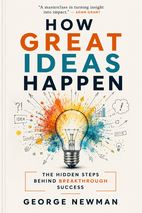
George Newman's How Great Ideas Happen reveals that creativity is a learnable skill of discovery, not a mysterious gift, offering a systematic framework of exploration, constraint design, and idea transplanting for entrepreneurs, artists, and professionals seeking practical strategies to find breakthrough ideas.
Feature
Insta.Page
Blinkist
Shortform
Summary Depth
Full Chapter-by-Chapter
15-min overview
Section-by-section guides
Audio Narration
✓
✓
✓
Visual Mindmaps
✓
✕
✕
AI Q&A
✓
✕
✕
Quizzes
✓
✕
✕
PDF Downloads
✓
✕
✓
Price
$89.99/yr
$146/yr (PRO)
$199/yr
*Competitor data last verified July 2026.
1 Page Summary
In How Great Ideas Happen, George Newman dismantles the myth that creativity is a mysterious, inborn spark reserved for geniuses. Instead, he argues that great ideas are not invented but found—they already exist in the environment, waiting to be discovered through a learnable set of skills. The book introduces the concept of Surveying, the creative equivalent of reading a landscape for hidden treasure, drawing on examples from fossil hunters to artists like Jackson Pollock and Henri Matisse. Central to the thesis is the principle of Explore, then exploit: creativity begins with a messy, frustrating phase of searching, followed by a productive "hot streak" of focused execution, a pattern found in over 90% of creative professionals.
Newman’s approach is distinctive for its systematic, evidence-based framework, blending psychological research, case studies, and practical exercises. He identifies common traps like the Originality Ostrich effect—the mistaken belief that more originality equals greater appeal—and shows that the most impactful ideas are about 90–95% conventional, with only 5–10% novelty. The book offers concrete tools such as the What and Why Grid for designing constraints, close looking for problem-finding, and transplanting ideas from one domain into another (e.g., the Shinkansen train inspired by a kingfisher’s beak). Newman also emphasizes that creativity rewards methodical iteration over dramatic pivots, using Wright’s Law and Pixar’s Toy Story pivot as examples.
The intended audience includes anyone who has ever felt stuck or doubted their creative abilities—entrepreneurs, artists, scientists, and professionals seeking practical strategies for breakthrough ideas. Readers will gain a clear, actionable framework for transforming creativity from a mystical gift into a systematic practice. They will learn to embrace constraints, seek feedback, diversify their experiences, and trust that their best ideas often emerge after the obvious ones are exhausted. Ultimately, the book teaches that becoming a creative explorer—shifting focus outward, resisting the urge to start from scratch, and treating ideas as discoveries rather than inventions—is the key to unlocking lasting success.
Introduction: Dig for Fire
Overview
The chapter opens with a provocative challenge to the conventional myth of creativity—that ideas are born from within, a mysterious inner spark reserved for geniuses. Instead, it proposes a radically different view: great ideas are not invented but found. They already exist in the environment, waiting to be discovered by those who know how to look. This isn't mere poetry; it's a principle echoed by Thomas Edison himself, who insisted he created nothing, that everything comes from the outside.
To ground this idea, the chapter introduces Kamoya Kimeu, a Kenyan fossil hunter who discovered more hominid remains than anyone in history despite having no formal scientific training. What set Kimeu apart wasn't luck or innate magic, but a masterful ability to read the terrain—to notice subtle disturbances in the landscape that hinted at buried treasure. His skill was so refined that visiting scientists relied entirely on him and his team. Crucially, Kimeu could teach this ability to others, demonstrating that discovery is a learnable craft, not a mystical gift.
From Kimeu's story, the chapter extracts the concept of Surveying—the creative equivalent of reading a landscape for fossils. Instead of searching for bones, you search for the spark of an idea within a vast conceptual realm. This skill can be cultivated: knowing where to look, looking outward rather than inward, and attending closely to every detail in your environment. The most powerful creative insights, the chapter argues, often come from what is new to you, not necessarily what is new to the world. Like unearthing a fossil, your next great discovery might be lying just beneath your feet—but only if you've trained your eye to spot it.
Key Takeaways
Creativity is an act of discovery, not invention; ideas are found in the environment, not conjured from nowhere.
The skill of creative "Surveying" involves learning to read your conceptual terrain, notice subtle clues, and form hypotheses about where promising ideas might hide.
Exceptional discoverers like Kamoya Kimeu show that this ability can be taught and refined through experience, attention, and a willingness to look outward.
The real breakthrough often lies in what is new to the individual, not what is objectively novel—so prioritize fresh encounters over originality for its own sake.
Key concepts: Introduction: Dig for Fire
1. Introduction: Dig for Fire
Creativity as Discovery
Ideas are found, not invented
Great ideas exist in the environment
Thomas Edison claimed he created nothing
Kamoya Kimeu's Example
Fossil hunter with no formal training
Mastered reading the terrain for clues
Discovery is a learnable craft, not magic
The Skill of Surveying
Creative equivalent of reading a landscape
Search for idea sparks in conceptual realm
Cultivate by looking outward and attending details
What to Prioritize
Focus on what is new to you
Not what is objectively novel
Fresh encounters over originality for its own sake
Key Takeaways
Creativity is discovery, not invention
Surveying involves noticing subtle clues
Ability can be taught through experience and attention
💡 Try clicking the AI chat button to ask questions about this book!
Chapter 1: Burn the Cabin Down
Overview
The romanticized image of a solitary creator retreating to a cabin in the woods is a fantasy that does more harm than good. Henry Thoreau’s own Walden experiment was far from isolated—he regularly entertained guests and walked into town. This myth encourages us to cut ourselves off from feedback and internalize failure when genius doesn't strike. In reality, creativity thrives on collaboration and external input. A landmark study of successful creative professionals shows they share a core belief: creativity is a skill to be developed, not an inborn trait. They reject ideas like sudden inspiration and constraint-free creation, instead viewing ideas as external entities to be discovered. This shift from generating to finding transforms the creative process into an invitation to learn and explore.
Jackson Pollock’s career exemplifies a crucial pattern. After a decade of experimenting with different styles, he moved to Long Island and developed his iconic drip technique, sparking a prolific "hot streak" from 1947 to 1950. Researchers at Northwestern University analyzed thousands of artists, scientists, and filmmakers and found that such hot streaks occur in over 90% of cases, following a simple formula: Explore, then exploit. Creativity begins with a messy, frustrating phase of searching—trying false starts—and then shifts to exploiting a promising idea. Great discoveries don’t come from sudden flashes but from sifting through possibilities until you find an idea worth mining.
Interestingly, Pollock’s drip paintings aren’t random; computer analysis reveals a fractal pattern—the same branching structure found in trees and in the negative spaces of the Ryoanji Zen Garden in Kyoto, created over 500 years earlier. This is a case of multiple discovery: independent creators arriving at the same underlying idea. History is full of examples—Darwin and Wallace, Bell and Gray, and even simultaneous releases in movies and comics. Psychologist Dean Keith Simonton compares creativity to natural selection: people select ideas that best fit their environment’s needs. When multiple people face similar pressures, they may converge on the same solution. This doesn't mean discovery is random; rather, the right process can dramatically improve your odds.
The message "just do something that changes the field" is harmful because it implies failure is due to lack of effort or talent. Instead, the focus should be on the process of exploration. Just as an archaeologist can't guarantee a fossil find but can improve their chances by knowing where to dig, creative success comes from developing a keen sense for spotting promising ideas. That "taste" or "intuition" is a skill, not a gift. Moreover, telling people to be creative can backfire—experiments show that asking for "as many creative ideas as possible" produces 20% fewer ideas and worse quality than simply asking for "as many ideas as possible." The pressure to be original constrains thinking. When stuck, turn outward: explore others’ work, visit new places, talk to people. Margaret Atwood draws extensively from archives; Rick Rubin told Serj Tankian to grab a random book for inspiration. The author experienced this firsthand while writing—simply reading, looking, and listening again sparked new inspiration. Creativity doesn't need to be original to everyone; it only needs to feel new and exciting to you.
The chapter then offers practical exercises to help survey your own creative landscape. Exercise 1: Identifying Your Passions walks through a two-part reflection—looking backward at childhood loves and proud achievements, then at present energies and rants—to find patterns and abandoned projects that reveal mismatches. Exercise 2: A Conversation About Your Passions borrows from psychologist Arthur Aron’s famous 36 questions, focusing on creative drive with a trusted partner to uncover surprises. Exercise 3: Finding Inspiration Through Attachments asks you to gather favorite media and objects, then identify the common thread—a ready-made creative territory. Exercise 4: Your Anti-Passions flips the script: list what you avoid and why, then brainstorm opposites to reveal hidden desires. Exercise 5: Your Perspective on Creativity is a self-assessment scale rating statements like "Creativity is a process of discovery" to gauge how much you hold an "explorer" mindset. Scores above 8 indicate a strong exploratory frame; below 0 suggests a burden of needing to be an original genius. These exercises clarify what genuinely lights you up, turning the creative process into an outward-looking, explorative journey rather than a pressurized hunt for originality.
Key Takeaways
Looking outward—to archives, libraries, random books, or your own environment—can break creative blocks more effectively than forcing originality.
Your passions, both current and childhood, are rich soil for ideas. The exercises help you unearth themes you might overlook.
Conversations with others can reveal hidden motivations; you don't have to figure it all out alone.
"Anti-passions" (what you hate or avoid) are just as revealing as what you love.
Your beliefs about creativity shape your process—checking in on that mindset can free you up to explore rather than strive.
Key concepts: Chapter 1: Burn the Cabin Down
2. Chapter 1: Burn the Cabin Down
The Myth of the Solitary Creator
Thoreau's cabin was not truly isolated
Creativity thrives on collaboration and feedback
Creativity is a skill, not an inborn trait
Shift from generating ideas to finding them
The Explore-Then-Exploit Formula
Hot streaks follow a simple pattern: explore, then exploit
The disastrous Michelin-starred meal at Bros—twenty-seven courses of foam, flavored paper, and a plaster mouth for dessert—perfectly illustrates a creative trap: novelty without value. The chef pursued originality but forgot to make food taste good. This isn’t rare. Research with amateur sandwich makers and Top Chef contestants reveals the Originality Ostrich effect: people assume the more original an idea, the more others will like it, but judges and customers consistently preferred less novel offerings. Contestants who emphasized originality were more than twice as likely to be eliminated. The real lesson isn’t to avoid novelty but to balance it. An analysis of 18 million scientific papers found the most impactful research was about 90–95% conventional, with only 5–10% novelty. Major breakthroughs come from remixing the familiar—Virgil Abloh’s “3% approach,” Bob Dylan repurposing an old ballad, and the second-mover advantage (Airbnb after CouchSurfing, Play-Doh after wallpaper cleaner) all show that tweaking an existing idea beats inventing from zero.
Applying the 5% rule doesn’t mean trivial work. Look at Piet Mondrian: for decades he imitated Dutch masters, then Post-Impressionists, then experimented with abstraction before his signature grids emerged around 1920. He then exploited that motif for years, uncovering deep mathematical principles. Originality isn’t a single leap; it’s a gradual excavation. Start by emulating heroes—not to copy, but to understand. Imitation is high-resolution Surveying: studying a narrow topic in exhaustive detail, like shadowing a master. Korean filmmakers did this during censorship, poring over foreign films until they understood storytelling deeply. When restrictions lifted, they adapted those structures to Korean themes, creating a cinematic renaissance.
Exercise 7: The 5% Workshop puts theory into action. Select a simple work you admire, copy it identically, then brainstorm at least ten ways to modify just 5% while keeping the rest intact. Try out your favorite change, then another. Small precise deviations can radically transform the entire work. Next, Interview Your Hero shifts focus from technique to motivation. Choose a creative hero, prepare questions about career choices and challenges, research them, then answer from their perspective, filling gaps with your own understanding. This builds a richer empathy for what drives original work, letting you internalize not just what they made, but why. Constraining change to 5% forces deliberate precision; copying before altering builds deep familiarity; mock-interviewing uncovers reasoning and personal context; and filling gaps with your own instincts bridges admiration and self-discovery.
The Originality Ostrich Effect
That disastrous Michelin-starred meal at Bros—twenty-seven courses of foam, flavored paper, and a plaster mouth for dessert—makes for unforgettable reading. But it also illustrates a crucial creative trap: novelty without value. The chef aimed for originality, but forgot to make the food taste good. That miscalculation isn’t rare. In studies with both amateur sandwich makers and Top Chef contestants, my research with Jin Kim uncovered the same pattern. People assume that the more original an idea is, the more others will like it. But customers and judges consistently preferred the less novel offerings. On Top Chef, contestants who emphasized being original were more than twice as likely to be eliminated. We called this blind spot the Originality Ostrich effect—sticking your head in the sand about the importance of convention.
The lesson isn’t to avoid novelty, but to balance it. Brian Uzzi’s analysis of 18 million scientific papers revealed the sweet spot: the most impactful research was about 90–95% conventional, with only 5–10% novelty. Major breakthroughs don’t come from starting from scratch; they come from remixing the familiar. Virgil Abloh called this his “3% approach.” Bob Dylan repurposed an old ballad to write “A Hard Rain’s A-Gonna Fall.” And the second-mover advantage in business—Airbnb after CouchSurfing, Play-Doh after wallpaper cleaner—shows that tweaking an existing idea often beats inventing from zero.
The Slow Crawl to Signature Style
Applying the 5% rule doesn’t mean your work will be trivial. Think of Piet Mondrian. For the first half of his career, he imitated Dutch masters, then Post-Impressionists, then experimented with abstraction. Only around 1920 did his signature grids emerge—and then he exploited that motif for decades, uncovering deep mathematical principles of visual balance. His originality wasn’t a single leap; it was a gradual excavation. Your own creative journey can follow the same path: start by emulating heroes, not to copy, but to understand. As Austin Kleon puts it, “free from the burden of trying to be completely original,” you can reverse-engineer what works.
Imitation isn’t mindless. Studies with toddlers show that when copying, we try to understand the why behind each step. That’s high-resolution Surveying—studying a narrow topic in exhaustive detail, like shadowing a master. Korean filmmakers did exactly that during decades of censorship, poring over foreign films until they understood storytelling on a deep level. When restrictions lifted, they didn’t just imitate; they adapted those structures to Korean themes, creating a cinematic renaissance. Effective Surveying means knowing where successful ideas have clustered and learning their grammar before writing your own sentences.
The shape exercise naturally leads into a more structured exploration of deliberate constraints. Exercise 7: The 5% Workshop pushes you to find the sweet spot between convention and novelty by limiting your creative changes to exactly 5% of an existing work. Start by selecting a piece of creative work you admire—something simple enough to emulate, like a short story, poem, song, or drawing. Copy it identically, word for word or note for note. Then brainstorm at least ten different ways you could modify just 5% while keeping the rest intact. Pick your favorite change and actually try it out. Experiment with a different change, then another. You’ll notice how these subtle shifts begin to alter the entire nature of the work, proving that small, precise deviations can unlock surprising new directions.
Interview Your Hero shifts the focus from mimicking technique to understanding motivation. Choose a creative hero—living or deceased—whose work you admire. Prepare a set of interview questions covering career choices, challenges, motivations, and their views on creativity (the text offers great starting questions). Research your hero through interviews or biographies to gather as much real information as possible. Then, from their perspective, answer each question. Where information gaps exist, fill them in using your understanding of their character and philosophy. Document the mock interview in a concrete format—a written transcript works well—so you can revisit it later. This exercise builds a richer, more empathetic understanding of what drives original work, helping you internalize not just what your hero made, but why.
Key Takeaways
Constraining change to 5% forces you to be precise and deliberate, revealing how small tweaks can radically transform a work.
Copying a piece identically before altering it builds deep familiarity, making your modifications more intentional.
Mock-interviewing a creative hero goes beyond surface imitation; it uncovers the reasoning and personal context behind their choices.
Filling in gaps with your own understanding bridges admiration and self-discovery—you learn to think like your hero while honoring your own instincts.
Key concepts: Chapter 2: Originality Ostriches
3. Chapter 2: Originality Ostriches
The Originality Ostrich Effect
Novelty without value is a creative trap
People overestimate how much others like original ideas
Judges and customers prefer less novel offerings
Emphasizing originality doubles elimination risk on Top Chef
The 5% Rule for Balanced Novelty
Most impactful work is 90-95% conventional
Only 5-10% novelty is the sweet spot
Breakthroughs come from remixing the familiar
Second-mover advantage beats inventing from zero
The Slow Crawl to Signature Style
Originality is gradual excavation, not a single leap
Mondrian imitated masters for decades before his grids
Start by emulating heroes to understand their craft
Exploit a motif deeply to uncover hidden principles
High-Resolution Surveying
Imitation helps understand the why behind each step
Study a narrow topic in exhaustive detail
Korean filmmakers mastered foreign films during censorship
Adapt learned structures to your own themes
Exercise 7: The 5% Workshop
Copy a work identically to build deep familiarity
Brainstorm ten ways to modify just 5%
Try your favorite change, then another
Small precise deviations can transform the whole
Interview Your Hero Exercise
Shift focus from technique to motivation
Prepare questions about career choices and challenges
Answer from their perspective, filling gaps yourself
Build empathy for what drives original work
Constraining Change for Precision
Limiting change to 5% forces deliberate precision
Copying before altering builds deep understanding
Mock-interviewing uncovers reasoning and context
Filling gaps bridges admiration and self-discovery
Chapter 3: Bottoms Up!
Overview
The chapter opens with the bizarre tale of giant ferrets disguised as poodle puppies—a perfect illustration of bottom-up processing versus top-down processing. When we rely too heavily on prior expectations, we end up seeing what we assume is there rather than what actually exists. This sets the stage for a deep exploration of how creativity flourishes when we let raw data and observation guide us instead of preconceived notions. Joanna Griffiths built a global brand by practicing digital anthropology, listening to what women actually needed rather than what the market assumed, discovering a hidden goldmine in leakproof underwear. Her success mirrors the creative breakthroughs of Alexander Fleming and John Cage, who both found power in negative space—what's missing, silent, or overlooked.
A landmark study from the 1960s tracked artists who engaged in problem finding early in their process, letting the challenge emerge rather than imposing a fixed vision. Decades later, those artists were far more successful than their technically skilled peers, proving that discovering the right problem often matters more than having the right solution. To bypass our habitual filters, the technique of close looking trains us to spend extended time examining a single scene or interaction, revealing hidden frictions and connections. But expertise can also blind us, so the knowledge funnel provides a resolution: become deeply expert in one or two domains while maintaining broad curiosity in others, then translate insights across fields—as neurologist Alice Flaherty did when she used her own hypergraphia to study the neuroscience of drive and creativity.
Practical exercises reinforce these ideas. One asks you to photograph a static scene multiple times, then isolate the negative spaces to see how they transform perception. Another invites you to examine a worn object and invent its biography, training you to see objects as records of use and human behavior. These habits build the foundational skill of surveying—letting go of ego, borrowing from heroes, and letting curiosity drive exploration.
The second half of the chapter introduces gridding, a systematic method borrowed from archaeology. By mapping your conceptual space into a grid and exploring each combination methodically, you uncover ideas that haphazard brainstorming would miss. This structured approach doesn't kill spontaneity; it deepens flow state and ensures no nook or cranny goes unchecked. Whether you're an entrepreneur, scientist, or artist, the message is clear: let bottom-up processing lead, attend to what's absent, and methodically excavate every possibility. That's where the real breakthroughs hide.
Key Takeaways
Creativity thrives on bottom-up processing: let raw data and observations shape your direction, not preconceived notions.
Pay attention to negative space—what's missing, silent, or overlooked often holds the biggest breakthroughs.
Problem finding, especially early in a project, is a stronger predictor of long-term success than skill or ambition.
Close looking trains you to see beyond surface-level expectations, revealing hidden frictions and connections.
Build a knowledge funnel: deep expertise in a core area, broad curiosity in others, and the ability to translate insights across domains.
Key concepts: Chapter 3: Bottoms Up!
4. Chapter 3: Bottoms Up!
Bottom-Up vs Top-Down Processing
Giant ferret poodle story illustrates perceptual bias
Prior expectations can blind us to reality
Creativity thrives on raw data, not assumptions
Problem Finding Over Problem Solving
1960s study: problem finders more successful long-term
Discovering the right problem matters more than solutions
Joanna Griffiths found hidden need in leakproof underwear
Negative Space and Close Looking
Alexander Fleming and John Cage found power in absence
Close looking reveals hidden frictions and connections
Photograph scenes, isolate negative spaces to transform perception
The Knowledge Funnel
Deep expertise in 1-2 domains plus broad curiosity
Translate insights across fields like Alice Flaherty
Expertise can blind; funnel prevents tunnel vision
Gridding for Systematic Exploration
Map conceptual space into a grid methodically
Explore each combination to uncover hidden ideas
Gridding deepens flow state, not kills spontaneity
You've reached the end of the free chapters
Next chapter: “The Guiding Question” is locked
Keep reading How Great Ideas Happen — and unlock all 600+ book summaries with audio, mindmaps and AI Q&A.
$0.00 due today · 7 days free, then $89.99/year ($7.49/mo) · Cancel anytime before day 7
George Newman is a cognitive psychologist specializing in the psychology of belief, magic, and persuasion. He is a faculty member at Yale University's School of Management, and his notable works include the book *The Power of Magic: The Extraordinary World of Human Belief*. His research explores how irrational beliefs persist and the psychological mechanisms behind magical thinking and consumer behavior.
Frequently Asked Questions about How Great Ideas Happen
What is How Great Ideas Happen about?
This book challenges the myth that great ideas are born from inner genius, arguing instead that they are discovered by those who know how to look. Drawing on research from cognitive science and real-world examples—from fossil hunters to Pixar—it reveals a systematic process of surveying, exploring, and remixing existing elements. Key concepts include the 'explore then exploit' pattern, the 5% rule for balancing novelty, and the power of constraints and subtraction. Ultimately, it provides a practical framework for turning creative discovery into lasting success.
Who is the author of How Great Ideas Happen?
The author, George Newman, is a cognitive scientist and researcher whose work explores how people discover and evaluate ideas. Drawing on his own graduate school experiences and numerous scientific studies, he unpacks the hidden mechanics behind creativity and innovation. His writing blends rigorous research with engaging storytelling to make the science of ideas accessible to everyone.
Is How Great Ideas Happen worth reading?
Yes—this book is a must-read for anyone who wants to move beyond romanticized notions of creativity and learn a repeatable, evidence-based method for generating breakthrough ideas. It’s packed with counterintuitive insights (like why constraints boost innovation and why most great ideas already exist) and actionable techniques such as the 'What and Why Grid' and 'transplanting' across domains. Whether you're an entrepreneur, artist, or problem-solver, you’ll come away with a fresh toolkit for finding—not forcing—your next big idea.
What are the key lessons from How Great Ideas Happen?
Great ideas are not invented from scratch but discovered by surveying the environment and remixing what already exists. The most successful creators follow an 'explore, then exploit' pattern—experimenting widely before doubling down on what works—and they resist the urge to pile on novelty by applying the 5% rule (90–95% familiar, 5–10% new). Setting intentional constraints, transplanting concepts from other fields, and methodically iterating rather than pivoting are proven ways to turn a promising spark into a lasting breakthrough. Equally important is learning to trust discomfort with new ideas and to systematically generate far more options than you think you need.
📚 Explore Our Book Summary Library
Discover more insightful book summaries from our collection