How Great Ideas Happen Quotes
by George Newman
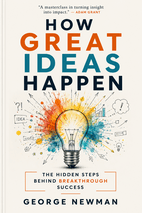
This page brings together the sharpest lines from George Newman's book. You'll find quotes that flip the script on creativity, showing it's less about sudden lightning bolts and more about digging, noticing, and blending what already exists. Some lines are practical nudges. Others are playful jabs at the romantic myth of the lone genius.
What makes the book so quotable is its mix of hard research and vivid storytelling. Newman uses metaphors like fossil hunting and archaeology to make abstract ideas feel real. These quotes stick with you because they reframe creative work as something accessible, not mystical. They're worth sharing because they change how you see the process.
Top Quotes from How Great Ideas Happen
“My so-called inventions already existed in the environment—I took them out. I've created nothing. Nobody does. There's no such thing as an idea being brain-born; everything comes from the outside.”
Thomas Edison reflecting on the nature of invention.
This challenges the romantic notion of creativity as purely internal magic, suggesting instead that ideas are discovered from the environment—a liberating and humbling perspective for creators.
“Writing is easy; all you do is sit staring at the blank sheet of paper until the drops of blood form on your forehead.”
The author quotes journalist Gene Fowler to describe the painful experience of creative blocks.
This vivid, visceral image captures the frustration and struggle of creativity in a way that instantly resonates with anyone who has faced a blank page.
“What if we instead think of ideas as entities that are external to us—things that we find, respond to, and manipulate rather than conjure out of thin air?”
The author proposes a new perspective on creativity, shifting from internal generation to external discovery.
This simple reframing relieves the pressure of needing to be a 'genius' and opens up a more exploratory, less anxious path to creative breakthroughs.
“Your next project doesn’t need to reinvent the wheel. It just needs to make it spin a little differently.”
The author summarizes the 5% Novelty Rule’s practical takeaway for creative work.
The metaphor is simple, memorable, and liberating—it reframes innovation as a small, manageable tweak rather than an intimidating leap into the unknown.
“Our failure to copy our heroes is where we discover where our own thing lives. That is how we evolve.”
Artist Austin Kleon, as quoted in the chapter, explains why imperfect imitation leads to original voice.
This line reframes the anxiety of being derivative as a productive, even essential, step in finding one’s own creative identity.
“Sometimes the most profound insights are discovered by noticing what isn’t there.”
Discussing the power of negative space and absence.
A short, aphoristic line that challenges the instinct to focus only on what is present. It is easy to remember and apply.
“If there's one principle—one secret—that reliably improves creative success, it’s this: Generate more ideas. Dig more holes. Go longer than feels reasonable. Then keep going.”
This is the opening principle of the chapter 'More Is More'.
It captures the core message of the chapter in a memorable, imperative style, urging readers to push past comfort zones and generate abundance.
Themes Behind the Quotes
One major theme is that ideas come from outside, not from inside. Creativity is a process of discovery, not invention. You find ideas by searching widely, copying what works, and making small tweaks. Another theme is that constraints are not obstacles but tools that actually boost creativity. The best breakthroughs often come from working within limits, not from total freedom.
A third theme is the power of generating many ideas. The secret to creative success is not waiting for the perfect one, but producing enough raw material so the right idea can emerge. Finally, the book emphasizes looking at what is missing. Some of the most powerful insights come from noticing gaps, silences, and spaces that others overlook. These themes together offer a practical, grounded view of how great ideas really happen.
Quotes by Chapter
Introduction: Dig for Fire
“To some of our visitors who are inexperienced in fossil-hunting, there is something almost magical in the way Kamoya or one of his team can walk up a slope that is apparently littered with nothing more than pebbles and pick up a small fragment of black, fossilized bone.”
Richard Leakey describing Kamoya Kimeu's skill in finding fossils.
It captures the perceived magic of expert observation while setting up the chapter's argument that such skill is learned, not innate—inspiring readers to cultivate their own powers of attention.
“Your next great discovery could be lying just beneath your feet.”
Closing line of the chapter's introduction.
A memorable and hopeful metaphor that encapsulates the chapter's message: great ideas are all around us, waiting for a trained eye to spot them.
Chapter 1: Burn the Cabin Down
“The problem with this approach to creativity is not that it is impractical or that it makes us feel bad. The problem is that this whole way of thinking is simply wrong.”
The author critiques the common romanticized view of the isolated cabin as the ideal creative environment.
It boldly reframes a widely held belief as fundamentally flawed, challenging readers to rethink the very foundation of how they approach creativity.
“Creative success isn’t about waiting for genius to strike. It's about searching widely until you find an idea worth mining.”
The author summarizes the key takeaway from research on hot streaks and multiple discoveries.
It delivers an empowering and actionable message, replacing the myth of sudden inspiration with a practical, process-oriented approach to creativity.
Chapter 2: Originality Ostriches
“The most influential research papers were not the most novel. In fact, the biggest “hits” all clustered in a particular sweet spot: research that was roughly 90% to 95% conventional and only 5% to 10% novel.”
The author describes Brian Uzzi’s landmark study of 18 million scientific articles revealing the optimal balance of novelty and convention.
This finding challenges the common assumption that radical novelty drives breakthroughs, offering a data-backed counterintuitive insight that creativity thrives on a foundation of the familiar.
“Take what inspires you and make it just a little bit better, a little bit different, a little bit more you.”
The author encourages readers to apply the 5% novelty approach to their own projects.
It distills the chapter’s core message into an actionable, empowering mantra that removes the pressure of total originality and emphasizes personal expression.
Chapter 3: Bottoms Up!
“We are often too eager to focus on what's already there, perhaps convinced that certain creative paths have been exhausted. But as Griffiths, Fleming, and Cage remind us, breakthrough ideas often emerge from the spaces in between—the gaps, absences, and silences that others overlook.”
Summarizing the lesson from examples of Griffiths, Fleming, and Cage.
This line encapsulates the central theme of the chapter—that breakthrough ideas often lie in overlooked gaps and silences. It is memorable and thought-provoking.
“The most successful artists were the ones who engaged in problem finding at the very beginning of the task. They were the artists who approached the drawing task without any preconceived notions—or at least, none that they expressed—and allowed the shape and structure of their still life to emerge from the situation itself.”
Findings from the Csikszentmihalyi and Getzels study on artists.
It powerfully demonstrates how open-ended exploration at the start of a creative task predicts long-term success. The vivid contrast with preconceived notions makes it impactful.
“Creative breakthroughs do not come from choosing between expertise and fresh eyes but from learning to use both.”
Conclusion about balancing expertise and fresh perspective.
This concise statement resolves the apparent tension between deep knowledge and fresh eyes. It offers a practical, balanced approach to creativity.
Chapter 4: The Guiding Question
“A guiding question is like a compass, clarifying your goal and helping you recognize when you've achieved it.”
The author explains the function of a guiding question in the creative process.
This line vividly captures the essential purpose of a guiding question, making an abstract concept concrete and memorable. It resonates because it promises clarity and direction in the often chaotic journey of creation.
“Instead of wandering aimlessly, having a guiding question points you in a particular creative direction.”
The author contrasts aimless exploration with the focus provided by a guiding question.
It directly addresses the common fear of creative drift, offering a simple but powerful remedy. Readers connect with the relief of having a clear path forward.
“The power of the outside-in method lies in its ability to transform creative blocks into opportunities.”
The author describes the benefits of adopting an audience-first perspective in creative work.
This line reframes a negative experience (being stuck) as a positive catalyst, which is both encouraging and actionable. It inspires readers to see obstacles as stepping stones.
“When a writer feels stuck, they can shift from asking, “What do I want to say?” to “What does my reader need to hear?””
The author gives a practical example of applying the outside-in method to overcome writer's block.
This concrete pivot is instantly relatable for anyone who has struggled with creative output. It provides a simple, immediately useful technique that opens up new possibilities.
Chapter 5: Think Inside the Box
“By embracing and adapting to his constraints, Matisse reinvented his own creative process and, in doing so, helped push the boundaries of art at that time.”
The author summarizes Henri Matisse's late-career shift to paper cutouts after being bedridden.
It shows that embracing limitations can lead to reinvention and artistic breakthroughs, making it a powerful example of the chapter's thesis.
“In fact, research by psychologists Page Moreau and Darren Dahl shows exactly the opposite: People generate better ideas when they're given more constraints, not fewer.”
The author presents findings from a study on toy design.
This directly challenges conventional wisdom about creativity and freedom, delivering a counterintuitive and memorable insight.
“The key takeaway is that constraints are tools.”
Near the end of the chapter, the author distills the lesson into a simple statement.
This short, quotable line is easy to remember and sums up the core message of the chapter.
“Constraints are not the enemies of creativity—they are its catalysts.”
From the section 'Constraints Are Creativity's Engine', the author states this core principle.
It flips the common notion that constraints hinder creativity, instead positioning them as a driving force. This reframe can inspire readers to embrace limitations.
Chapter 6: Transplanting
“I often feel not so much like an artist as an archaeologist, reconstructing a shattered picture that has been lying latent for decades, waiting for me to come along and discover it.”
Artist Tim Klein describing his process of combining puzzle pieces from different puzzles.
This metaphor captures the essence of transplanting—finding hidden connections that were always there, waiting to be discovered.
“The most innovative thinkers recognize that expertise in one domain can illuminate insights in another, and they remain alert to the applications that others might overlook.”
The author summarizing the trait of innovative thinkers near the end of the chapter.
It encapsulates the mindset needed to apply transplanting, encouraging openness and cross-domain curiosity.
“Many breakthrough ideas exist already, just in unexpected places.”
From the discussion of 'sleeping beauties'—ideas that lie dormant until applied in a new domain.
It succinctly states the core thesis of the book that breakthroughs often come from discovering existing ideas in unexpected places.
“Constraints are not the enemy of creativity; they are the engine.”
This appears in the 'Gridding: The Big Takeaways' section, advising how to use constraints when brainstorming.
It reframes a common frustration—limitations—as the very force that drives innovation, offering a counterintuitive and empowering perspective for creators.
Chapter 7: More Is More
“You rarely find a great idea by aiming directly at it. You find it by generating enough raw material for the right idea to emerge.”
The author explains why prolific output is necessary for breakthrough ideas.
This reframes creativity as an indirect process, relieving pressure and encouraging experimentation and volume over perfection.
“Creative search is not about finding the right idea. It is about finding the right set of ideas.”
The author reflects on the Post-it Notes story and the importance of exploring a cluster of possibilities.
It challenges the common 'eureka' myth, emphasizing that great ideas often come from exploring adjacent variations.