How Great Ideas Happen Key Takeaways
by George Newman
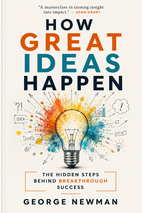
5 Main Takeaways from How Great Ideas Happen
Creativity is found by surveying your environment, not inventing from scratch.
Newman argues that great ideas are discovered, like fossils. By looking outward—to archives, conversations, and even childhood passions—you can uncover hidden connections. The skill of 'surveying' can be trained, as shown by paleontologist Kamoya Kimeu.
Constraints and tiny modifications unlock systematic creativity.
'Think Inside the Box' shows that constraints like 5% changes force precision and reveal breakthroughs. One-dimensional grids map gaps, and mock-interviewing heroes uncovers reasoning behind their choices.
Transplanting ideas across domains is a reliable engine for breakthroughs.
Monopoly came from an anti-monopoly game; train noses from kingfishers. The process—recognition, relevance, refinement—works by applying known solutions to new contexts, as seen in 'sleeping beauties' like the Möbius strip.
Generate volume and embrace bad ideas to push past the obvious.
Aiming for 200 ideas forces you beyond the surface; tweaking a promising idea in 12 ways reveals unexpected angles. Bad ideas are data that expose hidden assumptions and can be flipped into value.
Use structured feedback and discomfort as creative compasses.
Great ideas feel uncomfortable; that discomfort is a clue. Mid-stakes events with specific audiences provide real testing, while perspective-shifting exercises help you see blind spots. Psychological distance prevents overvaluing your own ideas.
Executive Analysis
These five takeaways form the backbone of Newman's central argument: creativity is not a mysterious flash of genius but a systematic, learnable process of discovery. By surveying your environment, embracing constraints, transplanting concepts, generating volume, and using discomfort as a guide, anyone can uncover great ideas. The book demystifies creativity into repeatable practices that replace luck with method.
This book matters because it offers actionable frameworks—guiding questions, grid exercises, and feedback rituals—that make creativity accessible to all. It directly counters the 'genius' myth and provides tools to overcome blocks. In its genre (creativity/innovation), it stands alongside works like 'Creative Confidence' but with a more structured, research-based approach that emphasizes process over personality.
Chapter-by-Chapter Key Takeaways
Dig for Fire (Introduction)
Creativity is an act of discovery, not invention; ideas are found in the environment, not conjured from nowhere.
The skill of creative "Surveying" involves learning to read your conceptual terrain, notice subtle clues, and form hypotheses about where promising ideas might hide.
Exceptional discoverers like Kamoya Kimeu show that this ability can be taught and refined through experience, attention, and a willingness to look outward.
The real breakthrough often lies in what is new to the individual, not what is objectively novel—so prioritize fresh encounters over originality for its own sake.
Try this: Start treating your next creative project as a field expedition: look outward, notice subtle clues, and form hypotheses about where promising ideas might hide, rather than trying to invent from nothing.
Burn the Cabin Down (Chapter 1)
Looking outward—to archives, libraries, random books, or your own environment—can break creative blocks more effectively than forcing originality.
Your passions, both current and childhood, are rich soil for ideas. The exercises help you unearth themes you might overlook.
Conversations with others can reveal hidden motivations; you don't have to figure it all out alone.
"Anti-passions" (what you hate or avoid) are just as revealing as what you love.
Your beliefs about creativity shape your process—checking in on that mindset can free you up to explore rather than strive.
Try this: Break a creative block by actively exploring your environment—archives, random books, or conversations—and journaling both your passions and 'anti-passions' to unearth hidden themes.
Originality Ostriches (Chapter 2)
Constraining change to 5% forces you to be precise and deliberate, revealing how small tweaks can radically transform a work.
Copying a piece identically before altering it builds deep familiarity, making your modifications more intentional.
Mock-interviewing a creative hero goes beyond surface imitation; it uncovers the reasoning and personal context behind their choices.
Filling in gaps with your own understanding bridges admiration and self-discovery—you learn to think like your hero while honoring your own instincts.
Try this: To make a work truly your own, first copy a piece you admire identically, then constrain your changes to just 5%—this forces deliberate, meaningful modifications.
Bottoms Up! (Chapter 3)
Creativity thrives on bottom-up processing: let raw data and observations shape your direction, not preconceived notions.
Pay attention to negative space—what's missing, silent, or overlooked often holds the biggest breakthroughs.
Problem finding, especially early in a project, is a stronger predictor of long-term success than skill or ambition.
Close looking trains you to see beyond surface-level expectations, revealing hidden frictions and connections.
Build a knowledge funnel: deep expertise in a core area, broad curiosity in others, and the ability to translate insights across domains.
Try this: Let raw observations shape your direction: spend time closely looking for what's missing or silent, and build a knowledge funnel with deep expertise and broad curiosity across domains.
The Guiding Question (Chapter 4)
A guiding question acts as a creative compass—it clarifies your goal and helps you recognize when you've achieved it
Effective guiding questions are specific, open-ended, motivating, and measurable
The outside-in perspective (imagining your audience's experience) often yields better results than starting with your own interests
Guiding questions are dynamic—they evolve as you gather information and test ideas
Share your guiding question early to test your intuitions and identify blind spots
Try this: Craft a guiding question that is specific, open-ended, and measurable; share it early with others to test your intuitions and evolve it as you learn.
Think Inside the Box (Chapter 5)
Constraints create a structured space for systematic exploration, making creativity less about luck and more about navigation.
One-dimensional grids reveal gaps by mapping existing options and highlighting unserved combinations.
Turning constraints into opportunities requires imagining real people who might actually benefit from the limitation you're facing.
Try this: Map your current options on a one-dimensional grid to spot unserved combinations, then imagine a real person who might benefit from the constraint you're facing.
Transplanting (Chapter 6)
Elizabeth Magie’s The Landlord’s Game is the true origin of Monopoly; the Darrow myth is a sanitized cover-up.
Transplanting moves concepts from one domain to another—board games from economics, train noses from kingfishers, hairstyles from archaeology.
The process follows three stages: Recognition (spotting a connection), Relevance (mapping overlaps via analogical reasoning), Refinement (iterative prototyping with expert help).
Brokers—people who connect different networks—are essential at each stage, as seen in carbon dating’s development.
“Sleeping beauties” are dormant ideas that explode when transplanted into new fields; the Möbius strip is a classic example.
To transplant effectively, cultivate curiosity, talk across disciplines, and remain alert to hidden patterns.
The transplanting card exercise turns cross-disciplinary borrowing into a repeatable process: explain, generate (with a five-minute timer), and don’t censor.
A clear guiding question keeps your search purposeful and open to refinement.
Constraints and a grid structure your exploration rather than limit it.
Transplanting—applying known solutions to new contexts—is a reliable engine for creative breakthroughs.
Try this: Practice transplanting by taking a solution from one domain (e.g., a train nose design from a kingfisher) and applying it to your problem using a three-stage process: recognize a connection, map overlaps, and refine with expert help.
More Is More (Chapter 7)
Volume matters. Two hundred ideas isn’t a target—it’s a forcing function that pushes you past the obvious.
Tweak, don’t start over. The most promising idea can be mutated in twelve different ways to reveal unexpected angles.
Reverse the timeline. Imagining yourself in the future, looking back, can break you free from present constraints.
Bad ideas are data. They reveal hidden assumptions and can be flipped into something valuable. Don’t skip the cringe.
Try this: Force yourself to generate 200 ideas without self-censorship, then pick the most promising and mutate it in twelve different ways to reveal unexpected angles.
Search Far and Wide (Chapter 8)
King of the Mountain uses multiple rounds of anonymous voting and group discussion to refine ideas without any one person dominating, while preserving all generated thoughts for later consideration.
Engaging Your Weak Ties transforms distant connections into sources of untainted insight by sharing only your guiding question and letting their raw reactions spark new directions.
Both exercises are designed to push past your usual circle—leveraging collective intelligence and unfamiliar perspectives to find the inspiration that’s waiting just beyond your comfort zone.
Try this: Use anonymous voting rounds with a diverse group to refine ideas without dominance, and seek raw reactions from weak ties by sharing only your guiding question.
Create by Subtracting (Chapter 10)
A mid-stakes event applies just enough pressure to motivate real progress without triggering self-preservation mode.
Choose an audience that can give useful feedback but isn't in a position to permanently derail your career.
Use the preparation phase to imagine audience reactions; treat it as a rehearsal for refining your idea.
After the event, compare your predictions to reality. The gaps between expectation and outcome are where the most valuable insights live.
The real benefit is not the event itself but the clarity gained from the process of preparing and the learning from being wrong about your audience.
Try this: Organize a mid-stakes presentation with a supportive but honest audience, prepare by imagining their reactions, then compare predictions to reality to learn from the gaps.
How Ideas ‘Feel’ (Chapter 11)
Great ideas often feel uncomfortable and unfamiliar; that discomfort is a clue, not a reason to stop.
Curiosity is strongest when we have a vague sense of the answer—lean into that gap.
Power and praise can stifle creativity by making us too confident or too cautious.
The “genius” label is biased and exclusionary; it distorts how we evaluate ideas and who we invite to the table.
The ability to sit with uncertainty, stay humble in success, and seek honest feedback is what separates breakthrough ideas from the ones we discard too soon.
Try this: When an idea feels uncomfortable or unfamiliar, lean into that discomfort—it's a sign of potential; stay humble and seek honest feedback rather than being swayed by praise or power.
The Learning Curve (Chapter 12)
Identify the feedback you’ll act on and the elements you’ll protect, then organize comments by frequency and watch for blind spots.
Use perspective-shifting exercises (audience member, creative hero) to surface hidden strengths and weaknesses.
Cultivate psychological distance to counteract overvaluing your own ideas, embrace discomfort as a sign of potential, and remain willing to let go.
Try this: After getting feedback, sort comments by frequency, protect non-negotiable elements, and use perspective-shifting exercises (e.g., view as an audience member or hero) to surface blind spots.
Getting Unstuck (Conclusion)
New ideas become possible only when existing technologies and concepts reach a particular threshold, creating the "adjacent possible"
Recognizing a fruitful mistake requires expertise; most missed opportunities vanish precisely because the person lacked the knowledge to spot them
The polished final product hides the messy, expansive process that produced it—don't confuse the two
Try this: Recognize that every polished product hides a messy, expansive process—embrace the adjacent possible by being expert enough to spot fruitful mistakes and willing to let go of weak ideas.
Continue Exploring
- Read the full chapter-by-chapter summary →
- Best quotes from How Great Ideas Happen → (coming soon)
- Explore more book summaries →