How Great Ideas Happen — Interactive Mindmaps

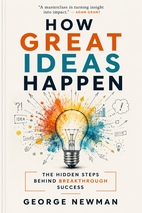
How Great Ideas Happen by George Newman Book Cover

by George Newman

George Newman's How Great Ideas Happen reveals that creativity is a learnable skill of discovery, not a mysterious gift, offering a systematic framework of exploration, constraint design, and idea transplanting for entrepreneurs, artists, and professionals seeking practical strategies to find breakthrough ideas.

On Insta.page you also get an Apply This Book tool that lets you combine insights from up to 3 books to solve your specific situation.

Chapter mindmaps

Free preview: chapters 1–4 are fully interactive. Click any node to expand or collapse. Subscribe to unlock the rest.

Chapter 1: Introduction: Dig for Fire

Key concepts: Introduction: Dig for Fire

1. Introduction: Dig for Fire

Creativity as Discovery

  • Ideas are found, not invented
  • Great ideas exist in the environment
  • Thomas Edison claimed he created nothing

Kamoya Kimeu's Example

  • Fossil hunter with no formal training
  • Mastered reading the terrain for clues
  • Discovery is a learnable craft, not magic

The Skill of Surveying

  • Creative equivalent of reading a landscape
  • Search for idea sparks in conceptual realm
  • Cultivate by looking outward and attending details

What to Prioritize

  • Focus on what is new to you
  • Not what is objectively novel
  • Fresh encounters over originality for its own sake

Key Takeaways

  • Creativity is discovery, not invention
  • Surveying involves noticing subtle clues
  • Ability can be taught through experience and attention

Chapter 2: Chapter 1: Burn the Cabin Down

Key concepts: Chapter 1: Burn the Cabin Down

2. Chapter 1: Burn the Cabin Down

The Myth of the Solitary Creator

  • Thoreau's cabin was not truly isolated
  • Creativity thrives on collaboration and feedback
  • Creativity is a skill, not an inborn trait
  • Shift from generating ideas to finding them

The Explore-Then-Exploit Formula

  • Hot streaks follow a simple pattern: explore, then exploit
  • Messy searching precedes focused exploitation
  • Great discoveries come from sifting possibilities
  • Jackson Pollock's career exemplifies this pattern

Multiple Discovery and Natural Selection

  • Independent creators often arrive at same ideas
  • Examples: Darwin/Wallace, Bell/Gray, Pollock/Zen Garden
  • Creativity resembles natural selection of ideas
  • Right process improves odds of discovery

Process Over Pressure to Be Original

  • Asking for creativity backfires, reducing output
  • Focus on exploration, not originality
  • Turn outward: read, visit, talk to break blocks
  • Creativity only needs to feel new to you

Practical Exercises for Creative Exploration

  • Identify passions from childhood and present
  • Discuss passions with a trusted partner
  • Find common threads in favorite media
  • Explore anti-passions to reveal hidden desires

Chapter 3: Chapter 2: Originality Ostriches

Key concepts: Chapter 2: Originality Ostriches

3. Chapter 2: Originality Ostriches

The Originality Ostrich Effect

  • Novelty without value is a creative trap
  • People overestimate how much others like original ideas
  • Judges and customers prefer less novel offerings
  • Emphasizing originality doubles elimination risk on Top Chef

The 5% Rule for Balanced Novelty

  • Most impactful work is 90-95% conventional
  • Only 5-10% novelty is the sweet spot
  • Breakthroughs come from remixing the familiar
  • Second-mover advantage beats inventing from zero

The Slow Crawl to Signature Style

  • Originality is gradual excavation, not a single leap
  • Mondrian imitated masters for decades before his grids
  • Start by emulating heroes to understand their craft
  • Exploit a motif deeply to uncover hidden principles

High-Resolution Surveying

  • Imitation helps understand the why behind each step
  • Study a narrow topic in exhaustive detail
  • Korean filmmakers mastered foreign films during censorship
  • Adapt learned structures to your own themes

Exercise 7: The 5% Workshop

  • Copy a work identically to build deep familiarity
  • Brainstorm ten ways to modify just 5%
  • Try your favorite change, then another
  • Small precise deviations can transform the whole

Interview Your Hero Exercise

  • Shift focus from technique to motivation
  • Prepare questions about career choices and challenges
  • Answer from their perspective, filling gaps yourself
  • Build empathy for what drives original work

Constraining Change for Precision

  • Limiting change to 5% forces deliberate precision
  • Copying before altering builds deep understanding
  • Mock-interviewing uncovers reasoning and context
  • Filling gaps bridges admiration and self-discovery

Chapter 4: Chapter 3: Bottoms Up!

Key concepts: Chapter 3: Bottoms Up!

4. Chapter 3: Bottoms Up!

Bottom-Up vs Top-Down Processing

  • Giant ferret poodle story illustrates perceptual bias
  • Prior expectations can blind us to reality
  • Creativity thrives on raw data, not assumptions

Problem Finding Over Problem Solving

  • 1960s study: problem finders more successful long-term
  • Discovering the right problem matters more than solutions
  • Joanna Griffiths found hidden need in leakproof underwear

Negative Space and Close Looking

  • Alexander Fleming and John Cage found power in absence
  • Close looking reveals hidden frictions and connections
  • Photograph scenes, isolate negative spaces to transform perception

The Knowledge Funnel

  • Deep expertise in 1-2 domains plus broad curiosity
  • Translate insights across fields like Alice Flaherty
  • Expertise can blind; funnel prevents tunnel vision

Gridding for Systematic Exploration

  • Map conceptual space into a grid methodically
  • Explore each combination to uncover hidden ideas
  • Gridding deepens flow state, not kills spontaneity

Chapter 5: Chapter 4: The Guiding Question

Mindmap locked. Subscribe to unlock all chapters of How Great Ideas Happen.

Subscribe to unlock

Chapter 6: Chapter 5: Think Inside the Box

Mindmap locked. Subscribe to unlock all chapters of How Great Ideas Happen.

Subscribe to unlock

Chapter 7: Chapter 6: Transplanting

Mindmap locked. Subscribe to unlock all chapters of How Great Ideas Happen.

Subscribe to unlock

Chapter 8: Chapter 7: More Is More

Mindmap locked. Subscribe to unlock all chapters of How Great Ideas Happen.

Subscribe to unlock

Chapter 9: Chapter 8: Search Far and Wide

Mindmap locked. Subscribe to unlock all chapters of How Great Ideas Happen.

Subscribe to unlock

Chapter 10: Chapter 9: The Spark

Mindmap locked. Subscribe to unlock all chapters of How Great Ideas Happen.

Subscribe to unlock

Chapter 11: Chapter 10: Create by Subtracting

Mindmap locked. Subscribe to unlock all chapters of How Great Ideas Happen.

Subscribe to unlock

Chapter 12: Chapter 11: How Ideas ‘Feel’

Mindmap locked. Subscribe to unlock all chapters of How Great Ideas Happen.

Subscribe to unlock

Chapter 13: Chapter 12: The Learning Curve

Mindmap locked. Subscribe to unlock all chapters of How Great Ideas Happen.

Subscribe to unlock

Chapter 14: Conclusion: Getting Unstuck

Mindmap locked. Subscribe to unlock all chapters of How Great Ideas Happen.

Subscribe to unlock

Continue exploring How Great Ideas Happen