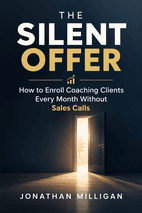
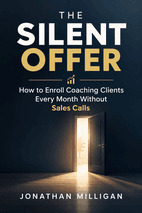
Jonathan Milligan's The Silent Offer presents a four-phase system—Design, Document, Demand, Deadline—for coaches who freeze at sales calls, built around a plain-text offer document, the OFFER Star, the Belief Bridge, and deadline-and-scarcity rhythm, written for introverted coaches who want enrollment without pitching.
Feature
Insta.Page
Blinkist
Shortform
Summary Depth
Full Chapter-by-Chapter
15-min overview
Section-by-section guides
Audio Narration
✓
✓
✓
Visual Mindmaps
✓
✕
✕
AI Q&A
✓
✕
✕
Quizzes
✓
✕
✕
PDF Downloads
✓
✕
✓
Price
$89.99/yr
$146/yr (PRO)
$199/yr
*Competitor data last verified July 2026.
1 Page Summary
Jonathan Milligan's The Silent Offer argues that coaches who are brilliant at transformation but freeze at the prospect of a sales call have been handed the wrong playbook—one built for salespeople, not teachers. The book's central thesis is that enrollment does not require scripts, funnels, or discovery calls; it requires an offer clear enough to sell itself. Milligan traces this idea through a set of interlocking concepts: the Silent Offer Test, inspired by John Wanamaker's move to fixed prices in 1876 and the way that change removed the gate between buyer and purchase; the OFFER Star, modeled on Harry Scherman's five-part Book-of-the-Month Club offer; and the "one belief" principle illustrated by Bernard Sadow's wheeled suitcase, whose early rejection showed that offers fail when they contradict what buyers already believe. From there, the book builds its practical system: a roughly twelve-hundred-word plain-text offer document (often a shared Google Doc) that walks a reader through the offer piece by piece, structured around Eight Pieces, including scarcity at the top, an unmissable outcome, and a model phrased as benefits. The Wrapper Offer solves the monthly treadmill by running each month's teaching inside an existing membership rather than building a separate product beside it, and the Belief Bridge—five arches crossed through ten short story emails—shifts what readers believe before any sale is asked for.
What makes the book distinctive is its rejection of pressure-based selling in favor of teaching, structure, and rhythm. Milligan frames marketing as "useful, hopeful information given freely," contrasting the speed-to-lead funnel—which works only for certain budgets and personalities and leaves nothing underneath it—with weeks of teaching that let people arrive warm and half-decided. The same story travels across email, social posts, and video, so ten emails become thirty or forty pieces of content without a daily content-machine grind. The Airline Secret supplies the missing rhythm: every ticket has both a departure time and a limited number of seats, and an offer needs the same pairing of deadline and scarcity, because an always-open offer loses to anything that reads as today. The book also addresses a launch's quiet middle by describing four buyer types—Spontaneous, Methodical, Social Proof, and one who simply moves on a different clock—and closes with a choice-based enrollment model: people apply or buy through the Offer Doc, and the coach reviews applications rather than chasing leads. The 90-Day Author Accelerator is cited as proof: thirty clients in twelve months across three rounds, with no sales calls.
The intended audience is coaches who are strong at the work and afraid of the pitch—particularly introverts who dislike being sold to and who cannot sell without becoming someone else. The book speaks directly to the coach whose business looks like a success story on paper, with a team and systems, yet who dreads every call, and to those whose skill and experience sit in an unshaped mass that no stranger can grasp or buy. Readers will gain a repeatable four-phase system—Design, Document, Demand, Deadline—that replaces the calendar link, the Zoom square, and the knot in the stomach with an offer that persuades on their behalf. The closing reassurance is that the system does not replace the coach's experience, story, message, or way of seeing the problem and the path through it; it simply puts them on the page. Nobody was bad at business, Milligan concludes—they were handed the wrong playbook.
Introduction
Overview
Coaches who are brilliant with clients freeze the moment enrolling someone means getting on a call. They have income targets, a calendar full of dread, and a growing suspicion that selling was never meant for them. What replaces it cannot be another script.
The playbook that was never written for coaches
Coaches did not sign up to become salespeople. They signed up to hand what they learned the hard way to someone who needs it. But someone else's playbook landed in their hands anyway, and it has drained them since. Hundreds of coaches stall because enrollment means booking a call. They are strong at the transformation and afraid of the pitch.
The season that nearly broke the business
By mid-2023 the business looked like a success story: climbing income, a team, systems. Fifteen people were on payroll, including a director of coaching and several coaches, so clients paid to learn from him and never got him. Two salespeople ran a book-a-call funnel, and twelve thousand dollars bought a sales coach's script, yet every call was still dreadful. An introvert who dislikes being sold to, he could not sell without becoming someone else. Everyone, Charity included, got paid before he did.
He and Charity, his wife and business partner, chose to tear it down rather than quit. Back to the two of them and a little help from Al: the team went, the sales department closed, and he promised never to take another sales call. Three years later he still enrolls premium coaching clients most months from a simple document.
The 4D Enrollment Framework
The 4D Enrollment Framework runs through four phases:
Design: an offer so clear it sells itself.
Document: that offer on one simple page.
Demand: teach your audience what to want.
Deadline: open enrollment monthly, with real urgency and real scarcity.
Enrollment opens Monday. Emails written weeks earlier go out. By Friday the right people have said yes from a page read on their own time. No chasing, no no-shows, no ghosting, no costume. Ashley, a gym owner, crossed six figures in monthly revenue this way, without a sales team or a call.
Who it is for
Coaches, writers, speakers, and teachers who love serving people and hate selling to them. The introvert who over-coaches and lets the client leave free. Anyone who has hidden prices or dreads the calendar. Work it, not just read it: pick one offer and one month. A companion workshop holds the exercises and worksheets.
Key Takeaways
Tear down the parts of your business built around someone else's strengths. Do not quit the business you actually want.
Make the offer clear enough that a prospect can say yes from a single page, on their own time, without ever getting on a call.
Teach your audience what to want before enrollment opens, then open it on a fixed monthly cycle with a genuine closing date and a genuine cap on how many you take.
Choose one offer and one month, and work the framework rather than reading it.
Key concepts: Introduction
Introduction
The Problem with Traditional Enrollment
Coaches freeze when enrolling requires a sales call
They are strong at transformation but afraid of the pitch
Someone else's sales playbook drains them
Hundreds of coaches stall because enrollment means booking a call
A Business Nearly Broken by Sales
By mid-2023, business looked successful: income, team, systems
Fifteen on payroll, but clients never got the founder
Two salespeople and a $12k script still made calls dreadful
Tore it down: team gone, sales closed, no more sales calls
The 4D Enrollment Framework
Design: an offer so clear it sells itself
Document: that offer on one simple page
Demand: teach your audience what to want
Deadline: open enrollment monthly with real urgency and scarcity
Who This Approach Is For
Coaches, writers, speakers, and teachers who love serving but hate selling
The introvert who over-coaches and lets clients leave free
Anyone who has hidden prices or dreads the calendar
Work it, not just read it: pick one offer and one month
Key Takeaways
Tear down parts built around someone else's strengths, don't quit
Make the offer clear enough to say yes from a single page
Teach audience what to want, then open enrollment on a fixed cycle
Choose one offer and one month, and work the framework
💡 Try clicking the AI chat button to ask questions about this book!
1. The Silent Offer Test
Overview
A hundred hopeful clicks can end in a single yes. The usual fix is to work harder on the conversation that follows. But every call a buyer must book to learn a price is a gate, and most never reach it. Better scripts don't solve this.
The Price in the Clerk's Head
In 1870, nothing in an American store carried a price. Not the coats, not the boots, not the fabric on the counter. A clerk read your shoes and your accent, guessed at your bank account, and named a number. Two neighbors could leave the same afternoon with the same coat. One paid four dollars, the other seven. Shopping was a performance of haggling, bluffing, and pretending to walk away. It rewarded whoever talked best. The quiet, the newly arrived, and the woman shopping alone paid more for identical goods.
Wanamaker's Card
In 1876, the Philadelphia merchant John Wanamaker took over an abandoned railroad depot. He tagged everything inside at one price, the same for banker and bricklayer, with a money-back promise attached. Rivals said he gave up his advantage. He believed people deserved equal treatment and could decide for themselves. Shoppers flooded in. Not for better goods, but because a buyer could finally look, think, and choose without winning an argument. The tag was kindness, not marketing. A system that made people jump through hoops for a number was failing the people it depended on.
The Same Store, Rebuilt on Zoom
Coaching sells the 1870s way. Price, promise, process, and deliverables stay hidden behind a button that says "book a call." Of 100 people who click a link in a month, about 10 book. Three of those don't show. Roughly four of the seven remaining calls go well. The rest are mismatches, off days, or calls where he coached so well the person left with three things to work on and no reason to pay. Of the four good calls, a couple say they must talk to a spouse, then go silent through two follow-ups. One client, maybe two in a strong month. Only four or five of the hundred ever saw the actual offer. A $12,000 sales coach could not repair it. The model was broken, not the closer.
The Silent Offer Test
What if you could sell without speaking? Write the whole offer on one page. Slide it to the exact person you want to help. Stay silent while they read. They look up and either ask where to sign or decline. A page that earns a yes alone is a Silent Offer. One that needs talk and persuasion isn't ready, and no call will save it. The objection is that nobody spends real money without a conversation. Yet coaches enroll clients into $10,000 and even $30,000 programs from a document. The rule that anything over a couple thousand dollars needs a call is gone.
Four Beliefs Behind It
Sales calls were never built for coaches. The process came from corporate America, selling a $100,000 software system with a pipeline, proposal, and procurement team. Borrowed into coaching, it turns care against you. You see someone struggling, start helping, hand over the roadmap, and they leave further from paying.
Clarity does the persuading. Changing four words, from "learn how to grow your audience" to "you will discover how to grow your audience," beat any scripted close. Learn feels like homework. Discover feels like a door opening.
Choose people instead of chasing them. When all hundred read the real offer, most quietly decide it isn't for them. That's sorting, not rejection. The ten who step forward are already sold.
Hiding your offer is not humility. Staying vague to avoid looking pushy was fear, and it hides the door someone on your list is looking for. Clarity is generosity.
Action Steps
Twenty minutes, measured against the test:
Write the offer on one page, as if it will never be explained aloud.
Read it cold, as your ideal client would.
Mark every unanswered question about cost, length, and deliverables.
Score whether a stranger would sign up from the page alone.
Circle the weakest spot and fix it first.
The OFFER Star, the five elements every irresistible offer needs, comes next.
Key Takeaways
Build every offer so it can be accepted from a single page handed over without a word from you. If it needs your voice to land, the offer is unfinished, not the buyer unconvinced.
Read that page cold, in the shoes of the person you most want to serve. Hunt down every blank around cost, duration, and what they actually receive. Repair the weakest gap before touching anything else.
Retire the corporate sales machinery of pipelines and proposals when selling coaching. Helping someone deeply on a call can send them home with a full to-do list and no reason to pay you.
Let the majority of people who read your offer decide it isn't for them. The handful who step forward are already agreed. Chasing the rest wastes the effort you could spend serving them.
Publish what you sell and what it costs to everyone on your list. Staying vague to avoid seeming pushy keeps the answer hidden from the person already looking for it.
Key concepts: 1. The Silent Offer Test
The Silent Offer Test
The Broken Sales Call Model
Coaching hides price and offer behind a 'book a call' button.
Only 4-5 of 100 clicks ever see the actual offer.
The model, not the closer, is broken.
Wanamaker's One-Price Revolution
1870s shopping required haggling; quiet buyers paid more.
Wanamaker tagged everything at one price for all.
Shoppers flooded in for equal treatment, not better goods.
The Silent Offer Test
Write the full offer on one page and hand it over silently.
A page that earns a yes alone is a Silent Offer.
If it needs talk to land, the offer is unfinished.
Four Beliefs Behind It
Sales calls were built for corporate software, not coaching.
Clarity persuades better than any scripted close.
Choose people instead of chasing them; sorting is not rejection.
Hiding your offer is fear, not humility; clarity is generosity.
Action Steps
Write the offer on one page as if never explained aloud.
Read it cold as your ideal client would.
Mark unanswered questions about cost, length, deliverables.
Score if a stranger would sign up from the page alone.
2. The OFFER Star
Overview
You know your coaching changes lives, yet you put the offer out and hear crickets. People nod, call it interesting, and walk away without buying. If the work is good, why won't the offer land?
Scherman's five-part offer
In 1926 Harry Scherman and two partners put up forty thousand dollars to build the Book-of-the-Month Club. Readers wanted to read and never got to it. Many towns had no bookstore. Scherman sold the pride of keeping up, of not being the dinner guest who had missed the book. The books were the promise.
Judges with real taste, Dorothy Canfield Fisher, William Allen White, Heywood Broun and Christopher Morley, gave members the judgment of people they respected. A monthly notice let them swap the main selection for an alternate or skip it. Membership made it a club. A dated reply card meant doing nothing shipped the book. So members had to act each month. All five parts together carried the club past a million members by the century's end.
A lock with five dials
That year, his titles sat in every publisher's warehouse. Leave out any one of the five parts and Scherman is forgotten. That is why publishers with better books and bigger budgets could not beat him. Think of a combination lock with five numbered dials. Four dials set correctly still will not budge it, because close does not open a lock.
Outcome and Fear Reversal
The dials spell OFFER: Outcome, Fear Reversal, Fast-Track Bonuses, Exclusivity and Real Deadline. Nobody wants modules, coaching hours or a video library. They want the result, and that leads. "You will discover" opens a door where "learn how to" sounds like homework.
The buyer is not only excited but afraid: that it will not work for them, that the money is wasted, that they will be the one who fails. Fear Reversal moves that risk onto the seller. The menu:
a first-result guarantee, promising a specific early win
a milestone guarantee tied to a step they reach
pay-on-results, where the larger sum arrives only after they succeed
done-with-you support, so they are never doing it alone
a reduced first payment to lower the leap
love-it-or-leave-it terms that let them walk
One-on-one coaching skips the money-back guarantee, since the hours already given cannot be recovered. It uses a first-result promise or done-with-you structure instead. The point is not which mechanism, but that one gets chosen.
Bonuses, caps, deadlines
A three-year-old PDF with a price slapped on it adds clutter. A Fast-Track Bonus makes the transformation easier or faster by dissolving the spot where people always get stuck. A template that does in five minutes what took five hours reads as a shortcut.
Exclusivity means naming the limit that already exists: only so many hours, only so many people coached well, ten seats, five, or two. The cap is a real limit, not manufactured scarcity. What is scarce reads as valuable, and what is unlimited can wait.
A Real Deadline must be true, anchored to a cohort start, the first live call, or the day doors close. A countdown that resets on refresh, or an offer ending at midnight again tomorrow, teaches readers to ignore deadlines. Most people do not decide until they must, and a real date gives permission to finally choose.
Action steps
Write the Outcome in one sentence, the result they get, swapping "learn how to" for "you will discover."
Name one Fear Reversal mechanism that fits how you deliver.
Choose one Fast-Track Bonus that removes a known sticking point.
Set the Exclusivity cap, the honest number you can serve well this round.
Pick a Real Deadline tied to something true, then check how many of the five elements you already have.
Key Takeaways
Build the offer from all five elements at once. A strong outcome, bonus or guarantee on its own will not move anyone.
Write the outcome as the result in a single sentence. Frame it as something the buyer will discover, not something they will be taught.
Choose one fear-reversal mechanism that fits how you actually deliver. When the hours given cannot be taken back, use a first-result or done-with-you promise instead of a refund.
Include only bonuses that clear a specific sticking point. Set the exclusivity cap at the number of people you can serve well this round.
Tie the deadline to something true, such as a cohort start or the day enrollment closes.
Key concepts: 2. The OFFER Star
The OFFER Star
The Five-Part OFFER Framework
Scherman's Book-of-the-Month Club succeeded through five combined elements
All five parts together carried the club past a million members
Like a five-dial combination lock, four correct dials still won't open it
Publishers with better books and bigger budgets couldn't beat him
Outcome and Fear Reversal
Buyers want the result, not modules, hours, or video libraries
Use 'you will discover' instead of 'learn how to'
Fear Reversal moves risk onto the seller with guarantees or pay-on-results
One-on-one coaching uses first-result or done-with-you instead of refunds
Fast-Track Bonuses
A bonus must dissolve a specific sticking point, not add clutter
A template doing in five minutes what took five hours reads as a shortcut
Only include bonuses that make the transformation easier or faster
Exclusivity and Real Deadline
Name the honest limit that already exists: ten seats, five, or two
Real scarcity reads as valuable; unlimited offers can wait
Tie the deadline to a cohort start, first live call, or closing day
Resetting countdowns teach readers to ignore deadlines
Action Steps and Key Takeaways
Write the outcome in one sentence as a result they discover
Choose one fear-reversal mechanism fitting how you deliver
Set the exclusivity cap at the number you can serve well
Build all five elements at once; one alone moves no one
3. Your One Belief
Overview
You have something that works, and the people who need it still say no. You keep changing the offer, and the same silence comes back. The real question is what has to change before any of that matters.
In 1969, we put a man on the moon. Not until 1970 did anyone put wheels on a suitcase. The wheel was five thousand years old. The suitcase was a century old. Travelers hauled heavy bags down long corridors and never suspected anything was wrong.
In 1970, Bernard Sadow stood in a Puerto Rico airport with two heavy 27-inch suitcases. He watched a worker roll a machine past him on a wheeled platform. Back at his factory in Fall River, Massachusetts, he added casters and a tow strap. It worked on the first try. The patent came in 1972.
New York department stores turned him down. Not over price or design. Buyers said a man would feel wimpy pulling a bag, and a woman who traveled would have her husband along to carry hers. They refused because the offer went against what they already believed about who carries what. A Macy's vice president overruled his own buyers. In October 1970, the bags hit the sales floor as "The Luggage That Glides." After that, selling was inevitable.
Sadow's problem was never the product. It was the belief. The same holds when your offer meets people who need it and they say no. Rewriting the bullets, dropping the price, adding another bonus — that's redesigning a suitcase that was never broken. Your readers hold a belief that makes the offer impossible: I can't charge that yet. Nobody spends real money without talking to a person. You can't sell a new offer to an old belief.
Evaldo Albuquerque's The 16-Word Sales Letter supplied the sentence: a sale transfers belief, not money. The money follows the belief. Everything rests on one sentence. X is the new thing you want them to believe. Desire is what they already want with their whole heart. Mechanism is the specific path that gets them there — your path. Put together, it reads: X is the key to desire, and it's attainable only through mechanism. The word "only" closes the side doors, so you are the path rather than one option among many.
A belief lands harder when it pushes against something. Your angle is the fresh take that contradicts common advice: don't get better at the sales call, replace it. Your enemy is a system, never a person — like the "always be closing" culture built for corporate salespeople and handed to coaches. Naming it tells readers their struggle was never their fault.
Your big promise is the bold, specific result in the reader's words, like enrolling new clients every month without ever getting on a sales call. The real problem is deeper, and usually not what they think. These readers are not bad coaches. They freeze when growth requires booking a call and selling. Under "not enough clients" sits someone who dreads opening the laptop and wonders whether leaving the day job was foolish.
Proof is evidence the belief is real. The strongest proof is that you use it yourself. The mechanism is the named path that delivers the promise — here, Design, Document, Demand, Deadline.
Albuquerque lists ten components of a complete belief: angle, promise, proof, problem, enemy, urgency, credibility, mechanism, offer, and consequences. Urgency is why now. Credibility is why you. Consequences are the honest cost of another year stuck, told with warmth rather than shame. A companion GPT walks through all ten and returns a finished belief statement.
Treat a "no" from someone who genuinely needs what you offer as evidence of a belief gap. Fix the belief, not the price, the headline, or the bonus. Assemble one sentence that names the new belief, the desire already present, and the mechanism that delivers it. Let "only" close the side doors so your path is the path. Build the belief to push against something: an angle that contradicts standard advice, an enemy framed as a system and never a person, a promise in your reader's own words, and the deeper problem sitting beneath the one they complain about. Earn the right to be believed by running your own mechanism on yourself first. Then give that mechanism a name and steps a client can picture walking through. Complete the belief with urgency, credibility, and the honest cost of another unchanged year. Deliver that last part with warmth, not shame.
Key Takeaways
A sale transfers belief, not money — the money follows the belief.
When someone who needs your offer says no, fix the belief, not the price, headline, or bonus.
Build one sentence: X is the key to desire, attainable only through your mechanism.
Make the belief push against something — a fresh angle, an enemy framed as a system, a promise in the reader's own words.
Complete the belief with urgency, credibility, and the honest cost of another unchanged year, delivered with warmth.
Key concepts: 3. Your One Belief
Your One Belief
The Core Principle: Belief Drives Sales
A sale transfers belief, not money; money follows belief.
When a qualified prospect says no, fix the belief, not the offer.
Rewriting bullets, dropping price, or adding bonuses misses the real issue.
The One-Sentence Belief Formula
X is the key to desire, attainable only through your mechanism.
X is the new belief; desire is what they already want.
Mechanism is your specific path; 'only' closes side doors.
Making the Belief Push Against Something
Angle: a fresh take that contradicts common advice.
Enemy: frame as a system, never a person, to absolve readers.
Promise: bold, specific result in the reader's own words.
Problem: the deeper issue beneath what they complain about.
Proof and Mechanism
Proof is evidence the belief is real; strongest proof is using it yourself.
Mechanism is the named path that delivers the promise.
Example mechanism: Design, Document, Demand, Deadline.
Completing the Belief: Urgency, Credibility, Consequences
Urgency: why now.
Credibility: why you.
Consequences: honest cost of another unchanged year, told with warmth.
You've reached the end of the free chapters
Next chapter: “The Page That Sells While You Sleep” is locked
Keep reading The Silent Offer — and unlock all 600+ book summaries with audio, mindmaps and AI Q&A.
$0.00 due today · 7 days free, then $89.99/year ($7.49/mo) · Cancel anytime before day 7
Jonathan Milligan is an author and productivity expert known for his work in helping individuals design intentional lives. He wrote *Your Message Matters* and *The 4 Disciplines of Execution* for creatives, drawing on his background as a coach and blogger. Milligan's expertise centers on goal-setting, time management, and overcoming overwhelm to achieve meaningful work.
Frequently Asked Questions about The Silent Offer
What is The Silent Offer about?
The book presents a step-by-step system for coaches to enroll clients without sales calls or high-pressure tactics. It introduces a written offer document—often a simple Google Doc—that persuades readers on its own. The system covers designing the offer, teaching through marketing, building belief, using deadlines and scarcity, and understanding different buyer types. It aims to replace traditional sales funnels and scripts with a repeatable, low-stress enrollment process.
Who is the author of The Silent Offer?
Jonathan Milligan is a coach and entrepreneur who built a successful coaching business but found traditional sales calls agonizing. As an introvert, he struggled to sell without feeling like someone else, so he created a call-free enrollment method. He now teaches this approach to help other coaches fill their programs without dread.
Is The Silent Offer worth reading?
This book is worth reading for any coach who dreads sales calls or feels stuck with ineffective scripts. It offers a practical, repeatable system that replaces high-pressure tactics with teaching and a written offer that sells on its own. The step-by-step framework makes it easy to implement and can transform how you enroll clients.
What are the key lessons from The Silent Offer?
Key lessons include designing an offer document with eight essential pieces—such as scarcity, a clear outcome, and a benefit-driven model—to make the offer easy to grasp. Marketing should be helpful teaching, not chasing, and the Belief Bridge uses story emails to shift what readers want before you ask for a sale. Using both urgency and scarcity, like a flight with a fixed departure and limited seats, motivates people to act now. Additionally, understanding four buyer types (spontaneous, methodical, social proof, and deadline-driven) helps you tailor your offer, and choosing applicants rather than chasing leads creates a sustainable enrollment rhythm.
📚 Explore Our Book Summary Library
Discover more insightful book summaries from our collection