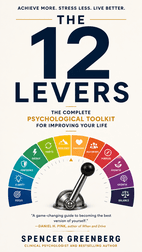
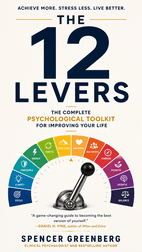
Spencer Greenberg's The 12 Levers integrates hundreds of self-help techniques into one framework of twelve core strategies, from cognitive restructuring to mindfulness, offering a practical map for knowing when to use which method. Written for readers who feel stuck despite reading widely, it provides an evidence-informed toolkit for reducing suffering and building happiness.
Feature
Insta.Page
Blinkist
Shortform
The 12 Levers
✓
✕
✕
Summary Depth
Full Chapter-by-Chapter
15-min overview
Section-by-section guides
Audio Narration
✓
✓
✓
Visual Mindmaps
✓
✕
✕
AI Q&A
✓
✕
✕
Quizzes
✓
✕
✕
PDF Downloads
✓
✕
✓
Price
$89.99/yr
$146/yr (PRO)
$199/yr
*Competitor data last verified July 2026.
1 Page Summary
In a crowded field of self-help advice, Spencer Greenberg’s The 12 Levers sets out to solve a specific problem: not a lack of techniques, but the absence of a map connecting the right one to the right situation. The book’s central thesis is that hundreds of methods from bestselling books and clinical therapies—from CBT’s cognitive restructuring to mindfulness and acceptance—can be integrated into a single framework of twelve core strategies, or “levers.” These levers cover the full spectrum of psychological improvement: unraveling the causes of distress, clarifying values, preparing for storms, shifting the body, stewarding thoughts, communicating skillfully, and choosing resilience, among others. The aim is not just to reduce unnecessary suffering, but to help readers gain a bird’s-eye view of what they can directly control.
Greenberg’s approach is distinctive in its clinical grounding and its insistence that understanding precedes intervention. The book opens with a case study of panic attacks resolved only after the sufferer understood the disorder’s mechanics, illustrating the foundational ABC analysis (Activating event, Beliefs, Consequences). Each chapter drills into a specific lever, blending theoretical origins—such as Aaron Beck’s cognitive restructuring, Richard Schwartz’s Internal Family Systems, and Arthur Aron’s 36 questions—with practical, step-by-step exercises. The book also emphasizes that self-improvement is not always the answer; changing one’s environment or seeking professional help can matter more, and the techniques are presented as transdiagnostic, meaning one method (like cognitive restructuring) can ease depression, anxiety, shame, and procrastination alike.
The intended audience is anyone who has read widely in self-help yet still feels stuck, suspecting they are missing the one technique that would actually work. The 12 Levers offers a structured, evidence-informed toolkit for those seeking happiness, stronger relationships, and less suffering. Readers will gain not only a suite of actionable strategies—from grounding exercises and savoring practices to assertiveness training and Stoic resilience—but also a framework for knowing when to use which lever, closing the gap between knowing what could help and actually doing it. The book’s conclusion acknowledges the paradox of having too many options, and offers the twelve levers as a simplified, navigable path forward.
INTRODUCTION
Overview
The self-help aisle is a flood of conflicting advice, and after a decade of reading, most people still suspect they are missing the one technique that would actually work. The problem is not a shortage of answers. It is that no map exists for connecting the right one to the situation at hand.
The toolkit
The self-help world floods readers with advice on depression, productivity, and peace. This book claims to be the first to integrate techniques from best-selling books and clinical therapies into one framework of 12 Levers, a "complete psychological toolkit." The techniques are transdiagnostic: cognitive restructuring from CBT eases depression, anxiety, shame, and even procrastination, and mindfulness helps with chronic pain, urges, and worry. The aim is less unnecessary suffering. Self-improvement is not always the answer; changing the environment or seeking professional support can matter more.
Understanding
Understanding precedes intervention: Andrea Petersen's panic attacks resolved only when she understood panic disorder and the avoidance feeding it. The ABC analysis from CBT, extendable to background vulnerability factors, breaks problems down.
A: the activating event
B: beliefs about it
C: emotional and behavioral consequences
The most controllable parts are usually beliefs and behaviors. The inner why technique catches sudden emotion shifts and asks why. Bright spot analysis studies when the problem was absent. Non-psychological causes exist: Carrie Poppy's haunting was carbon monoxide poisoning.
Guiding foundations are directional, never completed, like compass points.
Three types
They come in three forms:
Intrinsic values: valued for their own sake, distinct from instrumental values, which serve only as means to ends.
Principles: pre-decided decision rules.
Priorities: chosen areas of life to focus on.
Without clarity, others' values hijack life decisions. Jane, Spencer's friend, recovered from depression after realizing her partner matched her parents' values rather than her own.
How to clarify
Three approaches clarify foundations. Exploratory questions cover childhood dreams, admired figures, emotional triggers, actions without barriers, and the content of a future speech about you. The life-domains approach asks how you want to behave within areas like relationships, work, and health. Existing lists offer the most concrete route, including ClearerThinking.org's wheel of twenty-two intrinsic value categories from research plus Spencer's own studies.
Settling on five to ten foundations, printing them, and reviewing them occasionally prevents overwhelm. As ACT founder Steven Hayes puts it, in your pain you find your values.
VAST goals
Goals should be VAST:
Valuable: aligned with values.
Aspirational: challenging but plausibly achievable.
Streamlined: one to four goals, one primary.
Targeted: overarching goal, subgoals, timeframes, and repeated actions specified.
Habits
Habits are automatic regular actions; routines require effort. Creation takes three steps:
Specify the action.
Specify when: attach a trigger (time, recurring situation, or existing habit).
Overcome resistance by making the habit relatively more pleasant and less painful.
A 2019 Clearer Thinking study of nearly five hundred people comparing twenty-two techniques found habit reflection best: write what helped you form a past habit, then apply those lessons. Breaking bad habits reverses this: avoid triggers, make the habit more painful, and substitute a healthier replacement.
Choice points and reviews
ACT's term for important daily decisions is choice points, each a binary: move toward your guiding foundations or away from them. Quarterly reviews ask how successful you were, what you learned, and the next quarter's plan.
Next lever
When change begins, challenges arise; the next lever prepares for the storm through preparation plans.
Preparation plans
Preparation plans, the "Prepare for the Storm" lever, cut recurring problems before they start: a suicide safety plan reduced attempts by 43 percent in a British Journal of Psychiatry meta-analysis. Build one with RID:
Recognize risk factors: external situations that trigger the problem.
Identify early warning signs: internal thoughts, feelings, or behaviors showing it has begun.
Develop prevention and coping strategies: personalized if-then commitments.
Two principles shape the coping step. Opposite action (from dialectical behavior therapy) means doing the opposite of what a distressing emotion demands when that emotion doesn't fit the facts. Strategy-scaling matches technique intensity to distress. The STOP technique interrupts the autopilot pattern:
Stop.
Take a step back.
Observe.
Proceed effectively.
Facing fear
Fear itself, not the feared thing, is often the problem. John Watson's 1920 Little Albert experiment showed fear can be learned by association and then generalize; Mary Cover Jones's 1924 rabbit study showed it can be unlearned. The mechanism is exposure: confronting a fear repeatedly, with no harm following, shrinks the distress curve.
Gradual exposure
Distress peaks shrink with repetition: a first solo drive may spike anxiety from nine to seven to four across attempts. That is exposure, the most validated anxiety treatment. Flooding, plunging into the worst case, can work but often makes people flee, reinforcing fear. Prefer gradual exposure: build a fear hierarchy, from easiest to hardest, and repeat each step until distress drops to three or below.
Framing exposure as an experiment sharpens it. Albert Ellis, a CBT pioneer, spent a month in 1933 approaching women on park benches; 130 conversations ended in rejection or no-shows, yet no catastrophe occurred, and his shyness broke. State predictions as "IF I [action], THEN [feared outcome]" with a probability, then test them.
Safety behaviors like avoiding eye contact, rechecking locks, or seeking reassurance block learning by seeming protective, so fade them fast. For OCD, gold-standard treatment is exposure and response prevention: dropping the compulsion. The next Lever shifts the body to shift the mind, beginning with sleep, which research shows lowers depression, anxiety, and stress.
Sleep and light
Screens stimulate through social media and games; before bed favor reading, meditation, stretching, or quiet talk. Morning exercise and bright sunlight set the body clock. For a delayed clock, wake thirty minutes earlier daily with immediate outdoor light. For insomnia, raise sleep efficiency, the percentage of bed time spent asleep; CBT-I's key ingredient, sleep restriction, caps bed time, bans naps, sets a five-hour minimum, and adds thirty minutes once efficiency hits 85 percent.
Relaxation and breathing
Progressive muscle relaxation tenses each body part five seconds, releases for ten, moving upward. Slow breathing counters overbreathing: six to ten seconds per breath, following SNAPE (slow, nose, abdomen, paced, exhale). Ten quick forceful reps energize but risk fainting.
Cold and exercise
Cold exposure is hormesis, low-dose stress with mixed evidence; as distress tolerance, thirty seconds of face in cold water triggers the dive response. Exercise is the most evidence-backed technique: 2.5 hours of moderate cardio plus two strength sessions weekly, with twenty minutes at 70 percent of maximum heart rate to blunt distress.
Key Takeaways
Treat the 12 Levers as a transdiagnostic toolkit: because a single technique like cognitive restructuring or mindfulness works across depression, anxiety, pain, and urges, pick levers based on what you can most control in your situation rather than on a diagnosis.
Before trying to change anything, break the problem down with ABC analysis, catch sudden emotional shifts with inner why, and look for bright spots and non-psychological causes, since understanding itself can resolve what seems unmanageable.
Clarify your values, principles, and priorities as directional compass points rather than finish lines; settle on five to ten, write them down, and review them occasionally so other people's values do not quietly take over your decisions.
Turn values into VAST goals and habits by specifying the action, attaching a trigger, and reducing resistance; use habit reflection to learn from past successes, and for bad habits, avoid triggers and replace them with something more appealing.
When fear and recurring problems show up, prepare and face them directly: build RID-based preparation plans with if-then coping strategies, use gradual exposure experiments without safety behaviors, and support yourself with sleep, slow breathing, cold, and exercise to lower overall distress.
Key concepts: INTRODUCTION
INTRODUCTION
The 12 Levers Toolkit
Integrates self-help and clinical therapies into one framework
Techniques are transdiagnostic, treating multiple conditions
Aims to reduce unnecessary suffering
Environment changes and professional support can matter more
💡 Try clicking the AI chat button to ask questions about this book!
7.1 – COGNITIVE RESTRUCTURING
Overview
Emotions that spin out of proportion to the situation can make life feel unmanageable, yet no amount of telling yourself to snap out of it seems to work. The thoughts behind those feelings can seem so solid that questioning them feels impossible. Something has to break that loop.
In the late 1960s, Aaron Beck asked a patient to justify her belief that no one cared about her. Examining the evidence shifted her beliefs, and patients using his technique improved in months rather than years. The method became cognitive restructuring, a core technique of CBT. It is not positive thinking: disappointment is healthy, but persistent, disproportionate negative emotions rest on exaggerated thoughts.
The four steps
Identify the main distressing thought or belief.
Identify cognitive distortions.
Ask reframing questions.
Create an alternative, more balanced belief.
Step one
Target only distressing thoughts, not fleeting ones. Name the feeling first, then the thought behind it: interpretations, judgments, or predictions. If unclear, the downward arrow technique repeats "If that's true, why does it matter?" until a negative core belief about self, others, or the world emerges.
Steps two and three
Beck noticed overgeneralization, Albert Ellis named rigid self-rules "musturbating," and David Burns's Feeling Good consolidated ten distortions. For any belief, weigh the evidence for and against it; otherwise, one of these reframing questions may help:
What would I tell a friend?
How can I think about this on a continuum?
What are the worst, best, and most likely outcomes, and how can I cope if the worst occurs?
What are some alternative explanations?
How much responsibility do I actually have?
Step four
Form an alternative balanced belief, as believable as the old thought but more helpful. Practice it ten to twenty times.
Belief change takes practice
The alternative balanced belief is what you reach for in high-stakes moments, and it works best alongside the reframing steps. Still, it is common to accept a new thought logically without feeling any different. Someone may know they are not worthless, yet continue to feel worthless. Reg Nixon, an Australian PTSD researcher, compares reframing to slowly cutting a fresh channel in the ground to reroute water from an established stream. The new path only takes over after enough repetition, so emotional conviction lags behind intellectual agreement. Patience and practice are essential.
Weekly exercises
For a week, whenever you feel bad, stop and ask what story you are telling yourself. Write down the core distressing belief, identify at least one cognitive distortion, and weigh evidence for and against the belief. For one recurring negative thought, write the old belief beside a new one that is at least as accurate but more helpful. Keep the paper somewhere visible, and once a day say the old thought and then the new belief ten times in a row. For the following week, replace the unhelpful thought each time it surfaces. The book also mentions a free online tool for reframing negative emotions.
A different angle
Cognitive restructuring is powerful, but some people connect more with a different approach: thinking in terms of parts of the mind.
Key Takeaways
Pin down a distressing feeling first, then name the story behind it, and if no story surfaces, use the downward arrow technique to keep asking why it matters until a negative core belief about yourself, others, or the world becomes visible.
Test the belief against the evidence on both sides; if the case remains one-sided, use reframing questions such as what you would tell a friend, how you would judge the situation on a continuum, or what portion of responsibility is actually yours.
Replace the old belief with an alternative that is as accurate but more useful, and repeat it aloud many times, understanding that emotional trust in the new belief will trail far behind your intellectual assent.
For one week, whenever you feel bad, capture the core thought, name at least one cognitive distortion, weigh evidence for and against it, and write the old and new beliefs side by side; then speak the new one in a string of ten repetitions daily, and the next week swap it in whenever the old thought returns.
If reframing leaves you cold, try viewing the struggle as a conversation between parts of the mind, an alternative framework with the same goal of changing how you respond.
Key concepts: 7.1 – COGNITIVE RESTRUCTURING
7.1 – COGNITIVE RESTRUCTURING
Core Concept
Beck's 1960s patient evidence shifted beliefs
Cognitive restructuring is core CBT technique
Not positive thinking; targets exaggerated thoughts
You feel like one self, yet conflicted internal voices pull you in opposite directions. Trying to silence or win the argument tends to leave the conflict intact. Something else is needed.
In the early 1980s, therapist Richard Schwartz treated Quinn, whose bulimia persisted despite full cooperation. Breaking with family therapy's external-only focus, he asked what she experienced before a binge-purge episode. She described four parts: a critic, a blamer, a hopeless one, a bingeing one. Clients who identified parts found them less threatening. Schwartz saw an "inner family" of well-meaning parts, with a leader-like ideal caregiver. This became internal family systems (IFS).
Other therapies use parts work. According to the book, compassion focused therapy has stronger evidence than IFS; this approach follows it. Parts is a metaphor for recurring patterns of beliefs, emotions, and behaviors. The label creates distance from painful feelings; imagining a part as a person activates empathy.
Identify the Triggered Part
Name the most prominent part, such as the Critic, Procrastinator, or People-Pleaser. Parts cause distress, feel it, or both.
Activate the Compassionate Self
It goes by Self, Healthy Adult, or Compassionate Self. Access it by recalling skillfully caring for someone, picturing a compassionate person, or embodying warmth, calm, confidence, a half smile.
Engage with the Triggered Part
Switch perspectives: let the part speak, ask what it wants; often it protects you. Express gratitude, set boundaries, offer reassurance. Practice silently or aloud as chair work. If flooded, calm your body; if stuck, consult emotional needs.
A technique in Lever 7 takes the opposite approach: disengage from thoughts entirely, because sometimes leaving negative thoughts alone is the best option.
Parts work, by contrast, should never involve uncovering repressed memories. According to the book, that practice is not evidence-based and can be harmful, since memory is reconstructive and suggestible. Most trauma memories are actually remembered more clearly than ordinary memories. Internal family systems has sometimes drifted into repressed-memory practices, and that entanglement is exactly what to avoid.
Key Takeaways
Name the part currently driving you, whether Critic, Procrastinator, or People-Pleaser, so you can observe it rather than be swallowed by it.
Step into your Compassionate Self before interacting with the part, using a caring memory, an imagined compassionate figure, or a posture of warmth and calm.
Give the part a voice and ask what it wants and what it protects; then thank it, reassure it, and set clear limits, using chair work if spoken dialogue feels too abstract.
When engaging the part floods or immobilizes you, drop the effort and fully disengage from your thoughts instead; parts work is one option, not a requirement.
Keep parts work firmly on present patterns and never let it turn into an attempt to recover repressed memories, which can distort what you actually remember.
Key concepts: 7.2 – PARTS WORK
7.2 – PARTS WORK
Core Concept of Parts Work
Parts are recurring patterns of beliefs, emotions, behaviors
Parts metaphor creates distance and activates empathy
Inner family of well-meaning parts with a leader
Originated from Richard Schwartz's IFS therapy
Identify the Triggered Part
Name the most prominent part (Critic, Procrastinator)
Parts cause distress, feel it, or both
Naming allows observation instead of being swallowed
Activate the Compassionate Self
Access via caring memory or imagined compassionate person
Embody warmth, calm, confidence, half smile
Known as Self, Healthy Adult, or Compassionate Self
Engage with the Triggered Part
Let the part speak and ask what it wants
Often the part is protecting you
Express gratitude, set boundaries, offer reassurance
Use chair work if dialogue feels abstract
Safety Boundaries and Alternatives
If flooded, calm body or fully disengage from thoughts
Never uncover repressed memories—not evidence-based
Memory is reconstructive and suggestible
Avoid IFS's drift into repressed-memory practices
7.3 – POSTPONEMENT
Overview
Overthinking feels urgent, as if a thought must be followed immediately. Yet trying to interrupt it directly often backfires. What would it take to break the spiral without suppressing it?
Beliefs about thinking
In the mid-1980s, psychologist Adrian Wells concluded that cognitive therapy had overlooked something: everyone has negative thoughts, yet only some people get stuck in them. According to a 2023 article in Cognitive and Behavioral Practice, he spent a decade answering the puzzle with beliefs about thinking itself. Worry and rumination are both repetitive negative thinking, worry aimed at future threats and rumination at past or present problems. Brief spells are harmless; prolonged spirals create distress. Overthinkers tend to hold three unhelpful beliefs:
overthinking is useful, because it motivates, solves problems, or prevents bad events
overthinking is dangerous, because it could lead to losing control
overthinking is uncontrollable
These beliefs run silently, but reframing questions, a form of changing how you think, can expose them. Wells described an older patient who believed worrying prevented mistakes; the patient admitted they had not worried about everything, and nothing bad had happened when they forgot to worry. Comparable questions show that rumination rarely yields solutions and that worry is sometimes interrupted, disproving uncontrollability.
Postponement as an experiment
Avoidance fails: suppression makes thoughts return, and distraction like doomscrolling leaves you feeling worse. Between avoidance and overthinking sits postponement, a deal with yourself to think about it later. Steps:
Choose a daily fifteen-minute worry time, not before bed.
Notice each urge to worry or episode of worrying, ideally as a game of catching yourself.
Tell yourself you will think about it later, write it down once if you fear forgetting, and refocus.
At worry time, think about the worries for fifteen minutes, then stop.
Worry time is optional; if used, it works best for structured problem-solving or changing how you think. The aim is not to make the thought disappear but to decline to engage, again and again if needed.
What postponement teaches
Later, many thoughts that felt urgent seem trivial, even funny. An old saying holds that most worries never come true. Postponement tests the belief that urgent thoughts demand immediate attention, and it directly challenges the belief that overthinking is uncontrollable, because it provides a method for disengaging. Each postponement is a repetition that builds the skill.
Key Takeaways
Test the silent beliefs that overthinking helps you, harms you, or cannot be stopped by asking whether a worry has ever truly prevented a bad outcome or whether you have ever once broken off a spiral.
Postpone each worrying urge to a daily fifteen-minute window outside bedtime: catch the urge, write it down once, refocus, and work through it later with problem-solving or changing how you think.
Let postponement serve as the experiment: by the time the window arrives, the thought often looks trivial, and each refusal to engage shows that overthinking is neither uncontrollable nor in need of instant response.
Because peak experiences, endings, and impact bias distort how you remember or predict emotions, rate your mood before and after each activity instead of trusting memory or forecast.
Build behavioral activation from those ratings: replace regretted activities with glad-you-did-it ones, add two or three scheduled activities weekly if you are underactive or cut and swap commitments if overactive, and when resistance appears, follow the plan, not the mood.
Spencer Greenberg is a mathematician and entrepreneur who founded the AI research firm Rebellion Research and the behavioral science startup ClearerThinking.org, where he designs tools to improve decision-making. He is known for his work on applied rationality, conducting large-scale social science experiments, and co-authoring research on topics like moral psychology and the spread of misinformation. His notable writings and podcast appearances, including his "Clearer Thinking" podcast, explore how to reason more effectively and understand human behavior.
Frequently Asked Questions about The 12 Levers
What is The 12 Levers about?
This book presents a complete psychological toolkit organized into twelve core strategies, or levers, for reducing unnecessary suffering and improving well-being. It integrates techniques from clinical therapies like CBT, internal family systems, and mindfulness with practical approaches for deeper conversations, assertiveness, optimism, acceptance, resilience, appreciation, kindness, and attention control. Rather than offering another pile of conflicting advice, it provides a map for matching the right technique to the right situation, with a central framework for breaking problems into activating events, beliefs, consequences, and vulnerability factors.
Who is the author of The 12 Levers?
Spencer Greenberg is the author of this work. The book draws on decades of psychological research, clinical therapies, and real-world case studies, from Aaron Beck's cognitive restructuring to the Harvard Study of Adult Development, to build its integrative framework.
Is The 12 Levers worth reading?
Yes, this book is worth reading because it finally organizes the overwhelming flood of self-help advice into a clear, actionable set of strategies rather than leaving you hunting for the one missing technique. It is grounded in established clinical methods and supported by concrete examples and research, making it a practical guide for anyone looking to reduce suffering, strengthen relationships, and build genuine resilience.
What are the key lessons from The 12 Levers?
A major lesson is that understanding precedes intervention: breaking problems into activating events, beliefs, consequences, and background factors makes them more solvable, and the most controllable part is usually your thinking. Another is that self-improvement isn't always the answer—changing your environment or seeking professional support can matter more. Accepting what cannot be changed resets your psychological baseline and reduces suffering, while redirecting attention and practicing mindfulness help break the loop of distressing thoughts. Finally, skills like assertiveness, deeper conversations, appreciation, kindness, and realistic optimism are learnable tools that meaningfully improve relationships and well-being.
📚 Explore Our Book Summary Library
Discover more insightful book summaries from our collection








![The Explosive Child [Sixth Edition] by Ross W. Greene PhD - Book Summary](/_next/image?url=https%3A%2F%2Fapi.insta.page%2Fstorage%2Fv1%2Fobject%2Fpublic%2Fsmall_bookcovers2%2FB08NP52GTW.png&w=3840&q=75)