The 12 Levers Quotes
by Spencer Greenberg
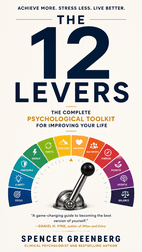
You will find lines that cut through mental fog and say something true about how we think, feel, and get stuck. Some are sharp. Some are warm. Many feel like a hand on your shoulder, telling you that change is possible.
This book is quotable because it turns complicated psychology into everyday language and images that stay with you. These ideas are practical, but they also invite deeper reflection. A single sentence can reframe a struggle you have carried for years, which makes each quote worth returning to.
Top Quotes from The 12 Levers
“[People] are disturbed not by things, but by the views which they take of things.”
The book cites the ancient Greek Stoic Epictetus to explain how thoughts shape emotions.
It states a timeless psychological truth in one memorable sentence. Readers recognize that their interpretations, not events themselves, drive much of their suffering.
“It's like they're in the same car, fighting for the driver's seat.”
The book explains the metaphor of an internal family of parts.
The image is instantly memorable and captures how competing inner impulses can hijack our behavior.
“It's like scratching a mosquito bite—the more you do it, the worse it gets.”
The author explains why prolonged worry and rumination make negative feelings stronger.
The mosquito-bite metaphor makes the self-reinforcing nature of overthinking instantly relatable. It turns a psychological concept into a vivid, memorable image.
“Just because something feels urgent or important doesn’t mean it actually is.”
The author explains the lesson learned when postponed worries lose their emotional weight.
This challenges the reflex to treat every anxious thought as a command. It offers a simple criterion for separating emotional intensity from true priority.
“Shame can be the source of our deepest pain, but it can also be the source of our deepest connections.”
From the chapter's final discussion of vulnerability and shame.
It captures the paradox that the thing we most want to hide can be the very thing that bonds us to others.
“A person's success in life can be measured by the number of uncomfortable conversations he or she is willing to have.”
The authors quote Tim Ferriss from The 4-Hour Workweek.
It gives a bold, memorable metric for success and normalizes discomfort as a growth signal.
“Once I had ceased craving for a miracle cure and accepted my situation as disabled, with little hope of climbing again, I was free. Not in some vague metaphorical sense, but really free. I could choose whether to suffer or not.”
Paul Pritchard writes this in The Mountain Path about accepting life after his injury.
This is the emotional heart of the chapter: acceptance can transform suffering into genuine freedom.
Themes Behind the Quotes
One clear theme is the power of interpretation. Pain is real, but how we talk to ourselves about it can make it worse or lighter. Several quotes point to the idea that our habitual thoughts are often exaggerated, and a more accurate view can bring real relief. This is not about forcing positivity. It is about noticing that we have a choice in what we dwell on.
Another theme is the importance of other people. Growth often happens in conversation, in setting boundaries, and in having the uncomfortable talks we usually avoid. At the same time, the quotes suggest that we need to turn compassion inward. We contain conflicting parts, and accepting them beats fighting ourselves. Combined, these ideas say that healing involves both honest self-reflection and honest contact with others.
Quotes by Chapter
INTRODUCTION
“In other words, there are a handful of Levers for a bucketload of problems.”
The authors explain why the book is technique-focused rather than problem-focused.
It turns the book’s thesis into a vivid, memorable metaphor. Readers feel that a finite set of tools can address many different struggles.
“But plenty of suffering is actually unnecessary, like feeling anxious about something that isn't dangerous or feeling guilty when you did nothing wrong.”
From the introduction's section on the biggest benefit of the book.
It validates the hope that not all pain must be accepted as permanent. The concrete examples make the idea easy to recognize in everyday life.
“Sometimes we need to change our environment rather than ourselves—we might need to leave a toxic relationship, dangerous neighborhood, or terrible job.”
The authors acknowledge that self-improvement isn't the right answer for every situation.
It smartly avoids overpromising and reminds readers that not every struggle is an internal one. This nuance builds trust and compassion.
“The Levers and techniques in this book are no miracle cure.”
The authors temper expectations near the end of the introduction.
It is refreshingly honest in a genre full of hype. Readers are more likely to trust advice that doesn't promise instant transformation.
7.1 – COGNITIVE RESTRUCTURING
“How do you know that those thoughts are true?”
Aaron Beck asks a patient after she describes leaving a party overwhelmed by negative thoughts.
It cuts through spiraling self-doubt with a single, evidence-based question. This line captures the core challenge of cognitive restructuring.
“If you change your exaggerated and distorted thoughts to make them more realistic, you tend to feel better.”
The book summarizes a central claim of cognitive behavioral therapy.
It offers a clear, hopeful mechanism for emotional change. This line makes the purpose of cognitive restructuring feel both simple and attainable.
“To put it simply, cognitive restructuring is not about pretending a bad thing is good—it's about having the most helpful (but still accurate) view of the world possible.”
The author clarifies what cognitive restructuring is and is not.
It gracefully separates realistic optimism from toxic positivity. This resonates because it honors genuine pain while still offering a path toward relief.
7.2 – PARTS WORK
“In the course of ten minutes I go from being a professional who has it all together, to a scared, insecure child, to a raging bitch, to an unfeeling, single-minded eating machine. I have no idea which is the real me. But I know I hate this.”
A client describes her experience of shifting between inner parts to Richard Schwartz.
It gives raw, first-person voice to the confusion and suffering of internal fragmentation, making the need for parts work feel urgent and human.
“This is the biggest promise of parts work: It can transform your inner dialogue.”
The book describes what parts work can offer.
It's a concise, hopeful statement that connects the technique to real emotional change.
“Usually though, we direct its compassion outward rather than inward. Parts work is about turning the arrow of compassion back toward ourselves and our internal parts, even the difficult ones.”
The book is discussing the Compassionate Self.
It names the core shift of self-compassion and reframes inner work as turning care toward the parts we usually reject.
7.3 – POSTPONEMENT
“Negative thoughts are inevitable, but we can choose how to respond to them.”
The author introduces the technique of postponement after describing common unhelpful responses to negative thoughts.
This line locates agency in the space between a thought and a reaction. It reframes the goal not as eliminating thoughts but as choosing a response.
“They're like puppeteers in the shadows, pulling the strings of our thinking habits and shaping how we respond when a negative thought arises.”
The author describes how hidden metacognitive beliefs drive overthinking.
This metaphor makes invisible mental processes feel concrete. It helps readers recognize that unexamined beliefs, not just thoughts, are influencing their behavior.
10.1 – CULTIVATE DEEPER CONVERSATIONS
“The good life is built with good relationships.”
Robert Waldinger distills the Harvard Study of Adult Development into one line in his TED Talk.
It turns decades of complex research into a clear, human truth about what makes life satisfying.
“Small talk should be the starting point of conversations, not the destination.”
From the section on moving past small talk to deeper conversations.
It reframes small talk as a useful first step, not a place to stay, and gives readers permission to go further.
“The goal of these conversations isn't to debate or be right. It's to enjoy the process of trying to understand the world together, like two curious scientists.”
From the discussion about sharing ideas and opinions in conversation.
It removes the pressure to win arguments and makes conversation feel like a shared adventure.
10.2 – IMPROVE ASSERTIVENESS
“But sometimes, we are just one difficult conversation away from a dramatic shift in our lives.”
The authors reflect on the Korean Air crash and the hidden stakes of speaking up.
It reframes difficult conversations as opportunities rather than threats, making discomfort seem worthwhile.
“Assertiveness is the best default communication style for everyday situations because it balances your needs with the needs of others.”
The authors summarize why assertiveness should be the go-to approach.
It captures the book’s core message in one concise line and offers a practical standard for everyday communication.
“Passivity might save you from conflict and discomfort in the short term, but in the long term it can erode your self-esteem.”
The authors describe the long-term cost of avoiding confrontation.
It speaks to anyone who has stayed quiet to keep the peace, validating the hidden damage of passivity.
11.1 – OPTIMISM
“The quality I look for most is optimism: especially optimism in the face of reverses and apparent defeat. Optimism is true moral courage.”
Ernest Shackleton explains what he looked for when screening candidates for his Antarctic expedition.
It reframes optimism not as blind positivity but as a form of bravery, which makes it feel both noble and attainable.
“It's to combine optimism with truth—to find interpretations of setbacks that are both helpful and accurate.”
The author warns against excessive optimism and toxic positivity.
It captures the balanced, practical heart of optimism: seeing reality clearly without losing hope.
“There's no real reason why the next ten minutes in the gym can’t be the best you've had in years. There's no real reason why you can’t put this conversation that's almost over on a new footing by saying something that is truly useful.”
Sam Harris on his meditation app Waking Up, encouraging people to begin again in small moments.
It makes optimism feel instantly actionable, showing that a fresh start is always available in the present moment.
“The next moment is the beginning of the rest of your life. And the future doesn’t have to resemble the past.”
The author's closing reflection after discussing the 'begin again' technique.
It is a simple, poetic reminder that we are not trapped by what has already happened.
11.2 – ACCEPTANCE
“Sometimes the best strategy in life is acceptance rather than resistance.”
The author sums up the lesson from Paul Pritchard's accident and recovery.
It reframes acceptance as a powerful choice, not a passive surrender.