The 12 Levers Key Takeaways
by Spencer Greenberg
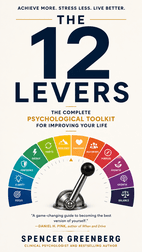
5 Main Takeaways from The 12 Levers
Pull levers based on controllability, not diagnosis label.
Techniques like cognitive restructuring and mindfulness work across depression, anxiety, pain, and urges, so lead with the question of what you can most control in your situation. Use ABC analysis and inner-why questioning to understand the problem first. Choosing a lever based on your point of leverage is more useful than waiting for a diagnostic label.
Turn core values into VAST habits with triggers and less friction.
Clarify five to ten values as directional compasses, not finish lines, then turn each into a VAST goal: a specific action attached to a trigger with reduced resistance. Use habit reflection to learn from past successes, and for bad habits, avoid triggers and replace them with something more appealing. This closes the gap between knowing what matters and actually doing it.
Face fear with preparation, gradual exposure, and lower physical arousal.
When fear or recurring problems appear, build RID-based plans with if-then coping strategies, then run gradual exposure experiments without safety behaviors. Support yourself with sleep, slow breathing, cold, and exercise to lower overall distress. Preparation turns courage into a repeatable practice rather than a lucky accident.
Train attention to interrupt spirals and build mindful awareness daily.
Attention is the brake on emotional momentum: in a spiral, shift from thoughts to physical sensation or use the 3-3-3 grounding exercise. Daily five-minute sound-switching drills build control, while mindfulness teaches you to change your relationship to pain. Suffering equals pain times resistance, so acceptance and meta-awareness can stop panic even when medication fails.
Deepen relationships with assertiveness, deeper talk, and daily kindness.
Assertiveness is the middle path between passive and aggressive, grounded in rights like saying no and being heard. Closeness grows when you move from small talk to vulnerable exchange, aim for a 40-60 speaking ratio, and share shame or gratitude rather than hiding it. Daily acts of kindness and loving-kindness meditation turn social connection into a trained skill.
Executive Analysis
The 12 Levers works by shifting the question from what is my diagnosis to which lever can I pull right now. Its five core moves—clarify the actual problem, turn values into triggered habits, face fear with preparation and exposure, train attention and mindfulness, and deepen relationships through assertiveness, listening, and kindness—are mutually reinforcing. Greenberg assembles a transdiagnostic toolkit in which cognitive restructuring, acceptance, parts work, stoic rehearsal, and attention drills each target a different point of influence. The central argument is that wellbeing improves most when you treat psychological struggle as a skill domain, let controllability guide your choice of technique, and keep experimenting until something moves.
This book matters because it abandons the passive patient role and hands readers a concrete, evidence-aware menu they can customize. It sits at the intersection of CBT, ACT, positive psychology, stoicism, and contemplative practice, but avoids dogma: Greenberg ranks techniques by research support, treats relational skills as core rather than soft, and tells readers when an attitude shift should complement action rather than replace it. The practical impact is immediate—pick a lever, open Key Actions, start today—while the deeper lesson is empowering: distress is not a verdict, and the capacity to respond to it is trainable.
Chapter-by-Chapter Key Takeaways
INTRODUCTION (Introduction)
Treat the 12 Levers as a transdiagnostic toolkit: because a single technique like cognitive restructuring or mindfulness works across depression, anxiety, pain, and urges, pick levers based on what you can most control in your situation rather than on a diagnosis.
Before trying to change anything, break the problem down with ABC analysis, catch sudden emotional shifts with inner why, and look for bright spots and non-psychological causes, since understanding itself can resolve what seems unmanageable.
Clarify your values, principles, and priorities as directional compass points rather than finish lines; settle on five to ten, write them down, and review them occasionally so other people's values do not quietly take over your decisions.
Turn values into VAST goals and habits by specifying the action, attaching a trigger, and reducing resistance; use habit reflection to learn from past successes, and for bad habits, avoid triggers and replace them with something more appealing.
When fear and recurring problems show up, prepare and face them directly: build RID-based preparation plans with if-then coping strategies, use gradual exposure experiments without safety behaviors, and support yourself with sleep, slow breathing, cold, and exercise to lower overall distress.
Try this: Break any struggle into ABC (antecedent-behavior-consequence), ask inner why when emotions shift suddenly, scan for bright spots and non-psychological causes, then convert your values into VAST actions by giving each a trigger and reducing friction.
7.1 – COGNITIVE RESTRUCTURING (Chapter 1)
Pin down a distressing feeling first, then name the story behind it, and if no story surfaces, use the downward arrow technique to keep asking why it matters until a negative core belief about yourself, others, or the world becomes visible.
Test the belief against the evidence on both sides; if the case remains one-sided, use reframing questions such as what you would tell a friend, how you would judge the situation on a continuum, or what portion of responsibility is actually yours.
Replace the old belief with an alternative that is as accurate but more useful, and repeat it aloud many times, understanding that emotional trust in the new belief will trail far behind your intellectual assent.
For one week, whenever you feel bad, capture the core thought, name at least one cognitive distortion, weigh evidence for and against it, and write the old and new beliefs side by side; then speak the new one in a string of ten repetitions daily, and the next week swap it in whenever the old thought returns.
If reframing leaves you cold, try viewing the struggle as a conversation between parts of the mind, an alternative framework with the same goal of changing how you respond.
Try this: Catch the core thought behind a distressing feeling, weigh evidence on both sides, then craft a more accurate useful belief and repeat it aloud ten times daily for a week.
7.2 – PARTS WORK (Chapter 2)
Name the part currently driving you, whether Critic, Procrastinator, or People-Pleaser, so you can observe it rather than be swallowed by it.
Step into your Compassionate Self before interacting with the part, using a caring memory, an imagined compassionate figure, or a posture of warmth and calm.
Give the part a voice and ask what it wants and what it protects; then thank it, reassure it, and set clear limits, using chair work if spoken dialogue feels too abstract.
When engaging the part floods or immobilizes you, drop the effort and fully disengage from your thoughts instead; parts work is one option, not a requirement.
Keep parts work firmly on present patterns and never let it turn into an attempt to recover repressed memories, which can distort what you actually remember.
Try this: Notice the part driving you, step into Compassionate Self, ask what it wants and protects, thank it and set limits; if you feel flooded, stop and ground yourself instead of pushing through.
10.1 – CULTIVATE DEEPER CONVERSATIONS (Chapter 4)
Use small talk as the opening move, then steer toward what matters; give the other person complete, genuinely interested attention, because most people only listen at partial capacity.
Ask about interests first, then pivot from facts to opinions with “how do you think” and “why do you think” prompts; your aim is joint understanding, not winning a debate.
When you ask about highlights, anchor to a concrete moment so they tell a scene, then contribute your own story; Spencer's 2019 study found people prefer a speaking ratio of 40 to 60 percent.
Offer vulnerability by sharing first, using honesty markers like “actually” or “to be honest”; the deepest move is a shame story, because shame loses its grip when an empathetic listener meets it with validation.
Use a structured ladder of intimacy like Aron’s thirty-six questions when you want to accelerate closeness with someone you are just getting to know.
Try this: Turn small talk toward what matters by asking about interests and opinions, offer vulnerability first, and use concrete highlights to keep the conversation near a 40-60 speaking ratio.
10.2 – IMPROVE ASSERTIVENESS (Chapter 5)
Treat assertiveness as the middle option on a continuum, and notice that the harm from staying passive usually outweighs the discomfort of speaking up.
Ground every assertive exchange in your inborn rights: to say no, to change your mind, to be heard, and to ask for what you need.
Lead with your own feelings and needs rather than accusations, and when you must criticize someone, describe what they did, not who they are.
Use politeness to make the message palatable, but know when to strip it away and shift to firm repetition, stated consequences, and ending the exchange without guilt.
If someone keeps ignoring your needs, call out the pattern directly; if it continues, treat the relationship itself as the real issue.
Try this: State your feelings and needs without accusations, then use polite firmness, repeated consequences, and a direct call-out when someone ignores your boundaries, treating the relationship itself as the issue if it persists.
11.1 – OPTIMISM (Chapter 6)
To keep failure from becoming a reason to quit, put on paper why the setback is time-limited, confined to one area, and only partly your doing.
Treat intelligence and talent as buildable rather than fixed: remember that the brain rewires itself, recall skills you acquired gradually, and tell yourself "not yet" when you hit a limit.
Spend four consecutive days writing for twenty minutes about your life having gone as well as possible; this best possible self exercise, tested by Laura King, produces a durable optimism boost.
When you catch yourself catastrophizing or spiraling, declare a new beginning: the previous moment is just a memory, and you can choose a different action now.
Cultivate optimism as a deliberate discipline, like Shackleton did, but never at the cost of accuracy; unchecked optimism becomes toxic positivity and invites unnecessary risk.
Try this: Rewrite setback stories as temporary, specific, and partly your doing, spend four days of 20-minute best-possible-self writing, and declare a new beginning whenever you catch yourself catastrophizing.
11.2 – ACCEPTANCE (Chapter 7)
Treat acceptance as a new normal, not a verdict: acknowledging paralysis or loss while still doing rehabilitation puts the standard of “normal” under your control.
Divide the world by the Serenity Prayer’s test: act on what you can change, and stop negotiating with what you cannot, whether that is the past, other people, your genetics, recessions, or death.
Separate emotions by proportionality: let natural grief stand, then work to dismantle manufactured feelings of shame or guilt that pile a second layer onto an already painful situation.
Spot resistance by its external signs, then do the opposite: after a breakup or job loss, break contact, stop checking, sit with the discomfort, and open up instead of distracting.
Make self-acceptance unconditional: reject binary self-ratings and accept yourself as an unfinished person whose worth does not depend on achievement.
Try this: Sort each problem with the Serenity Prayer test, act on what you can change, stop negotiating the unchangeable, and let natural grief stand while dismantling secondary shame or guilt.
11.3 – STOIC RESILIENCE (Chapter 8)
Do a brief daily mental rehearsal in which you picture the day's specific difficulties and yourself handling them calmly; this prepares you in advance, unlike rumination.
Reframe every obstacle as an opportunity, because adversity always carries at least the chance to train your resilience, whether the obstacle is a prison cell or a daily setback.
Deliberately impose small discomforts on yourself from time to time, so that you know from experience that hardship is bearable and won't crumble when real suffering arrives.
Adopt the mindset that hardship is inevitable and not a surprise; the person who expects pain and plans a response to it is far less likely to be broken by it.
Try this: Rehearse each day's difficulties and your calm responses in a brief morning preview, reframe every obstacle as resilience training, and impose small discomforts so real hardship feels bearable.
11.4 – APPRECIATION (Chapter 9)
Learn to treat moments as gifts by deliberately slowing down, putting away distractions, and paying close attention to the pleasant details of what you are experiencing.
Ask yourself how a current moment would feel if you were experiencing it for the first time or for the last, and that shift in perspective will deepen both your attention and your enjoyment.
Fight your tendency to take good things for granted by writing a detailed, overdue thank-you letter to someone who shaped your life, then either send it or read it to them in person.
Make a daily habit of writing down three things that went well and why they mattered, or take a gratitude walk, scanning your surroundings to consciously register what you appreciate.
Let appreciation extend beyond experiences to people: deliberately noticing the good in others is a practical way to cultivate loving-kindness toward them.
Try this: Slow down and register a moment as a gift with first-time or last-time questions, then write a detailed thank-you letter and list three things that went well each day.
11.5 – KINDNESS (Chapter 10)
Commit to a year of one small unexpected kindness a day, and record it each evening with the reaction it drew. The practice itself does the work.
Extend the same warmth you give others to yourself. Buy a favorite treat, take a lie-in, or write a week of five-minute self-compassionate letters that address your own upsets as a kind friend would.
Sit for loving-kindness meditation by repeating a goodwill phrase like "may you be happy" through a graded sequence: beloved figure, friends and family, acquaintances, yourself, disliked person, then all beings. Move on only when goodwill flows freely, and keep at it over weeks to build lasting positive emotion.
Treat metta as a training, not a mood. Expect a settled warmth rather than euphoria; if boredom or sadness creeps in, touch your chest or add "anyway" to your phrases and continue.
Try this: Commit to one unexpected kindness daily and record reactions, write self-compassionate letters to yourself, and practice loving-kindness meditation in the graded sequence until warmth flows freely.
12.1 – REDIRECT ATTENTION (Chapter 11)
To break an emotion's momentum, shift your attention from the thought loop to physical sensation; this act of presence is the brake that keeps the plane on the runway.
In high distress, run the 3-3-3 grounding: name three things you see, three you hear, and three you feel, and add a strong taste or familiar song if the anchors need more pull.
If focusing on your body feeds catastrophic thoughts, reverse course: sensing the inside isn't grounding, so aim your attention at the outside world.
Practice the five-minute attention drill daily: two minutes of slow sound-switching, two minutes of fast switching, and one minute of free roaming attention, to build control over what you notice.
When a spiral begins, run that same sound-switching drill on the spot; Adrian Wells used it to stop a client's panic attacks within a week, and it works as an emergency reset as well.
Try this: Interrupt a spiral by shifting attention to physical sensation or running the 3-3-3 grounding drill; if interoception worsens panic, focus outward, and practice the five-minute sound-switching drill daily.
12.2 – MINDFULNESS (Chapter 12)
Recovery from panic, even when medication fails, comes from changing your relationship to the experience rather than from eliminating it.
Accept Shinzen Young's equation: suffering equals pain times resistance, so the lever is acceptance; meta-awareness, knowing you are having an experience while it unfolds, is how you get distance.
To train mindfulness, anchor on the breath or note whatever arises as “feeling” or “thinking”; when distress hits, expand around body sensations and defuse thoughts with techniques like silly voices or mismatched tunes.
Nondual mindfulness is not losing yourself in work or community but a direct, immediate collapse of the felt self-world boundary; you can explore it by looking for the self behind the eyes and finding nothing solid, and the goal is to stabilize that state over longer stretches.
A first attempt can be as short as ten minutes of breath attention or mental noting; if you already practice, make room for nondual inquiry into what is aware to probe the sense of self.
Try this: Anchor on the breath or note whatever arises as thinking or feeling, expand around body sensations when distress hits, and explore nondual inquiry by looking for the self behind the eyes to stabilize a sense of awareness.
CONCLUSION (Conclusion)
Start by choosing the one lever that resonates most, open its Key Actions, and begin today; if a Key Action fails, try another from the same lever or a different lever, since trial and error with persistence is what produces results.
Let evidence guide your priorities: sleep, exercise, behavioral activation, cognitive restructuring, and acceptance have the strongest support, while breathwork, premortems, and nondual mindfulness are too weakly or inconsistently supported to anchor your practice.
Treat relational skills as core techniques, not soft extras: assertiveness, listening, closeness-building conversations, and acts of kindness each carry evidence for improving well-being, so work them into your regular routine.
Master attention and worry habits, because attention training and worry postponement have controlled-trial support, with brief attention-training sessions already showing stress reduction.
Keep optimism, stoicism, gratitude, and similar attitude-shifting techniques in your repertoire, but use them to complement action-based techniques rather than replace them, since their effects are generally small.
Try this: Start with the one lever that resonates, let evidence prioritize sleep, exercise, behavioral activation, cognitive restructuring, and acceptance, and keep relational and attention skills in your regular routine.