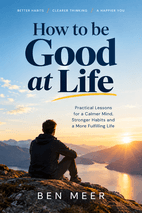
Ben Meer's How to Be Good at Life argues that lasting achievement comes from systems, not willpower, introducing the DRIVE framework, the Life Engine Audit, and a seven-engine model of fulfillment for readers who feel busy yet stuck.
Feature
Insta.Page
Blinkist
Shortform
Summary Depth
Full Chapter-by-Chapter
15-min overview
Section-by-section guides
Audio Narration
✓
✓
✓
Visual Mindmaps
✓
✕
✕
AI Q&A
✓
✕
✕
Quizzes
✓
✕
✕
PDF Downloads
✓
✕
✓
Price
$89.99/yr
$146/yr (PRO)
$199/yr
*Competitor data last verified July 2026.
1 Page Summary
Ben Meer's How to Be Good at Life argues that lasting achievement comes not from discipline or willpower but from systems—collections of components working together toward a specific goal. Drawing on figures like Jerry Seinfeld, who was systematic before he was successful, and Warren Buffett, Meer shows that what looks like superhuman ability is usually an invisible structure. He introduces the DRIVE framework for building any system that works, and the Life Engine Audit, which treats fulfillment as seven multiplying engines—Physical Health, Emotions, Mind, Relationships, Career, Money, and Environment—where a single zero drags down the whole. Rather than treating symptoms, Meer urges readers to fix root causes, as when biologist Donald Messersmith traced the erosion of the Lincoln and Jefferson Memorials to midges drawn by floodlights rather than bird droppings.
What distinguishes Meer's approach is its emphasis on behavioral design over effortful self-control. He draws on the Dutch Waterline's defensive logic to argue that routines protect the base while projects pursue breakthroughs, and on pattern matching—Beyoncé studying Michael Jackson, who studied James Brown—to show that success leaves clues. He explains chunking and sequencing through LEGO's numbered bags and Paula Radcliffe's counting method, warns against brittle plans via the cautionary tale of bank robber Herman Lamm, and advocates chosen constraints like Demosthenes shaving half his head. The book treats professionalism as a mindset backed by infrastructure, illustrated by Serena Williams scheduling relaxation and Andy Warhol's Factory, and closes with practices like System Sunday, a one-hour weekly reset, and the recognition that every system eventually hits a plateau requiring a different move rather than a harder one.
The book is written for readers who feel busy yet stuck—those who consume endless advice, accumulate productivity apps, and still watch priorities slip. Meer positions himself as a former broke grad student who discovered that more information wasn't the answer; a system for building systems was. Through tools like the Life Engine Audit, root-cause diagnosis, feedback loops that correct invisible blind spots, and strategies for navigating systems you didn't choose, readers gain a practical framework for achieving more while stressing less—learning to protect what matters, pursue breakthroughs deliberately, and treat a plateau as a signal to level up rather than quit.
Chapter 1: The Hidden Magic of Systems
Overview
Discipline and daily habits don't fix everything. The moments that matter most rarely happen the same way twice, so you can't automate them. And when things keep changing, working harder doesn't tell you what to do next.
The Hidden Architecture of Achievement
Jerry Seinfeld's precision looks like pure gift. It comes from a system: a daily writing session with a yellow legal pad and coffee in fixed positions, a wall calendar marked with an X for each day he showed up, new material tested at Gotham Comedy Club, and roughly 95 percent of the work going into rewriting what audience reaction reveals. At seventy-one he still performs at a level most comedians never reach, and in 2025 he was reported to be worth $1.1 billion. He was systematic before he was successful, not the reverse.
Warren Buffett built a system for evaluating companies. Serena Williams built one for training and recovery. What looks like superhuman ability is usually a structure you can't see.
What a System Is
A system is a collection of components working together toward a specific goal. A car shows how: each part does one job, and coordination moves you. Seinfeld's comedy system has five components: writing on a yellow legal pad, performing for small, low-stakes audiences, gathering feedback from those audiences, rewriting jokes based on feedback, and maintaining stamina through weight training and meditation. Remove one and effectiveness collapses. Without feedback, writing is flying blind. Without rewriting, testing wastes insight. Without stamina, perfect material falls flat.
Myth 1: Good Habits Are All We Need
Habits only go so far. Duke University research found about 40 percent of daily actions are habitual, and habits can cover only the repeatable 40 to 50 percent of life. When situations stop repeating, you have to switch into planning and strategizing. Disciplined people stall at that limit. Three layers make up your personal system: routines like habits and checklists, projects that are one-time initiatives, and the ongoing areas of health, emotions, mind, relationships, career, money, and environment. Habits are the bricks. Systems are the building.
Myth 2: Systems Take Too Much Time
You don't need time to build systems. You need systems to create time. Building one is like digging a well instead of carrying water from the river: hard work up front, then easy access for years. Friday Highlights is the small version: one weekly email to a manager summarizing accomplishments and what's coming, one template, one calendar reminder, and no scrambling at review time. The hours freed fund templates for the three most-sent emails.
Myth 3: Systems Make You Robotic
Social media is built to capture attention. The news cycle is built to keep us anxious. Workplaces are built to serve company goals. So the real question is who's doing the building. An intention only holds up if a system supports it. "We should spend more time together" means never, until a rhythm exists. Saturdates protect two to three hours every Saturday.
Myth 4: We Shouldn't Need Help
Pride is the biggest barrier. In The Checklist Manifesto, Atul Gawande describes Johns Hopkins surgeons who dismissed a five-step checklist as beneath them. Infections fell from 11 percent to zero. Michigan hospitals using it saved 1,500 lives in eighteen months. High performers stay open to being beginners.
Key Takeaways
When something looks like pure talent, look for the machine underneath. List the parts that produce it, then imagine what breaks if you remove each one.
Don't ask habits to carry your whole life. They only cover what repeats. Sort everything else into one-time projects and the ongoing areas of health, relationships, work, money, and environment.
Do the hard work once on things you repeat often, like your weekly accomplishments email and your most-sent replies. Those templates give you back hours for years.
Put the relationships and pastimes you care about on the calendar as regular blocks. An intention with no rhythm attached becomes something you never actually do.
Keep checklists in play even when your experience makes them feel beneath you. Atul Gawande's account of the Johns Hopkins safety checklist shows what expertise alone fails to catch.
Key concepts: Chapter 1: The Hidden Magic of Systems
Chapter 1: The Hidden Magic of Systems
The Hidden Architecture of Achievement
Seinfeld's precision comes from a daily system, not pure gift
Buffett and Williams built systems for investing and training
What looks like superhuman ability is usually a structure
What a System Is
A system is components working together toward a specific goal
Seinfeld's comedy system has five interdependent components
Remove one component and effectiveness collapses
Myth 1: Good Habits Are All We Need
Habits cover only the repeatable 40-50% of life
Three layers: routines, projects, and ongoing areas
Habits are the bricks; systems are the building
Myth 2: Systems Take Too Much Time
You need systems to create time, not time to build systems
Building a system is like digging a well instead of carrying water
Friday Highlights: one weekly email saves hours at review time
Myths 3 & 4: Robotic Systems and Needing Help
Systems protect intentions from being captured by others
Saturdates protect two to three hours every Saturday
Checklists saved lives; high performers stay open to being beginners
💡 Try clicking the AI chat button to ask questions about this book!
Chapter 2: DRIVE: How to Build Any System That Works
Overview
Knowing that systems beat willpower is not the same as being able to build one in your own life. Most people respond by consuming more advice. The gap does not close. Most people never figure out what will.
At 2 a.m. outside a Shanghai McDonald's, the author sat in a booth with his suitcase against the wall. He was jet-lagged and locked out of his Airbnb. Check-in had closed at nine. He had a notebook full of goals, a phone full of productivity apps, and fifty self-help books behind him. None of it helped. He was a broke grad student. He let that night push him. Everyone has a version of that story: a preventable lapse, then a rule or checklist built so it cannot happen again. He did not need more information. He needed a system for building systems.
He studied people who are great at what they do. He hunted the pattern, not the tactics. He looked at how NASA plans missions. How doctors diagnose and treat disease. How championship athletes train. How businesses launch products. How the military decides under pressure.
The Pattern Underneath the Pattern
All of them share one rhythm: clarify the aim, plan backward from the outcome, execute, check whether it works, improve as you learn. The scientific method follows it. So do the Lean Startup method and an athlete's training program. He named it DRIVE. The same structure shows up wherever people turn intention into outcome. Other fields have their own names for it: the clinical method, NASA's systems engineering process, the Agile sprint cycle, architectural design, the military's OODA loop.
The Five Steps
Define: get crystal clear on the goal. Most people skip this and jump into action. But direction beats speed.
Reverse Engineer: work backward from the destination. Marathon planning starts at race day and maps back through milestones to weekly goals to daily actions.
Implement: build routines and structures that survive the travel days, sick days and weeks when everything works against you.
Validate: measure what matters without obsessing over it. The feedback you avoid is usually the feedback you need.
Evolve: treat the first version as a prototype. Then scale what works and cut what does not.
Goal-setting theory, behavioral psychology and feedback loops sit underneath the phases, according to the book.
Alex's Website
Alex spent three years working on a photography site. She bought a domain in 2022. She had two folders marked final. She had a Pinterest board of 847 pins. She had no live site. Her skills and her consistency were fine. She had no system to ship with. Define turned a wish into a one-page portfolio of five project examples live by March 15, so clients could find her work. Reverse engineering produced four weekly blocks:
pick a template, set up hosting, outline the structure
choose five client shoots, gather assets, draft copy
write descriptions, test the mobile view
launch and share it on Instagram
She had been stuck on the first week for three years. Implement meant ninety minutes every Tuesday and Thursday morning that she refused to skip. A sixty-dollar template instead of a custom design. A rule to ship on March 15 and improve afterward. And choosing all five examples in one sitting. She finished on March 12. Two of three friends said the About section read like a résumé rather than creative energy. So she rewrote it and published. Version two began immediately. A boutique owner found her through Instagram in week five. A Hire Me page with testimonials arrived in week six. A process blog post in week seven. All inside the blocks she had already carved out. Six months later the site had drawn more than twelve hundred views and three freelance clients who found her organically. But the bigger win was feeling like someone who finishes.
Where Systems Break
Five failure modes. Each one is a missing step:
The Enthusiastic Start, with no Define: copying a 5 a.m. routine you have no reason to keep.
The Foggy Middle, with no Reverse Engineer: random workouts, diets and supplements, because no path was ever mapped.
The Inconsistent Execution, with no Implement: a strong start with nothing designed for travel or sick days.
The Blind Spots, with no Validate: real effort, no results, because nobody checked.
The Stagnation, with no Evolve: running a playbook the world has already moved past.
Gall's Law and a First System
Systems theorist John Gall observed that every complex system which works evolved from a simpler system that worked first. So the instruction is to build the simplest useful version and let it evolve. A five-minute exercise applies this to meal prep. Define the takeout problem. Reverse engineer into eight prepared meals and eight containers plus protected shopping and cooking time. Implement a Friday, Saturday and Sunday routine. Validate by tracking takeout spending. Evolve in a five-minute Friday review. A downloadable template accompanies it.
AI as a Systems Coach
The method clients paid tens of thousands of dollars to have applied runs as a prompt. Supply your situation, desired outcome, resources and constraints. Say whether the goal is a one-time outcome or a repeating one. Then work each DRIVE step in turn. The model flags assumptions, blind spots and friction points that could weaken the system. Human judgment stays in the driver's seat.
Key Takeaways
Before you act, write the goal as one concrete outcome with a date attached. An unclear aim will absorb unlimited effort and return nothing.
Work backward from that outcome into weekly blocks and daily actions. Then give the work a fixed slot on the calendar and a ship date that travel, illness or a bad week cannot move.
Start with the simplest version that works and let complexity grow out of it. Functional systems are built from smaller functional ones, not designed whole.
Treat the first release as a prototype and put a recurring check on the calendar. The measurement you would rather skip is the one carrying the fix.
When progress stalls, look for the phase you left out rather than blaming your discipline. Then add the phase instead of adding effort.
Key concepts: Chapter 2: DRIVE: How to Build Any System That Works
Chapter 2: DRIVE: How to Build Any System That Works
The Need for a System-Building System
Systems beat willpower, but knowing that isn't enough
More advice doesn't close the gap; a meta-system does
Author's 2 a.m. McDonald's story: broke, stuck, no system
Studied NASA, doctors, athletes, military for the pattern
The DRIVE Framework
Universal rhythm: clarify aim, plan backward, execute, check, improve
Same structure as scientific method, Lean Startup, OODA loop
Five steps: Define, Reverse Engineer, Implement, Validate, Evolve
Built on goal-setting theory, behavioral psychology, feedback loops
The Five Steps Explained
Define: get crystal clear on the goal; direction beats speed
Reverse Engineer: work backward from destination to daily actions
Implement: build routines that survive travel, sick days, chaos
Validate: measure what matters; face the feedback you avoid
Alex's Website: DRIVE in Action
Three years stuck: two 'final' folders, 847 pins, no live site
Define: one-page portfolio of five projects live by March 15
Reverse engineered into four weekly blocks; finished March 12
Implemented 90-min Tuesday/Thursday sessions; shipped and evolved
Five Failure Modes (Each a Missing Step)
Enthusiastic Start (no Define): copying routines with no reason
Foggy Middle (no Reverse Engineer): random workouts, diets, supplements
Inconsistent Execution (no Implement): strong start, no travel/sick-day plan
Blind Spots (no Validate): real effort, no results, nobody checked
Gall's Law and the Simplest First System
Every complex working system evolved from a simpler working one
Build the simplest useful version and let it evolve
Five-minute meal prep example applies all five DRIVE steps
Downloadable template accompanies the method
AI as a Systems Coach
The paid method runs as a prompt: situation, outcome, resources, constraints
Specify one-time outcome vs. repeating system
AI flags assumptions, blind spots, and friction points
Human judgment stays in the driver's seat
Chapter 3: The Life Engine Audit
Overview
You can look successful on paper while feeling off. You may have no clear way to tell which part of life is actually failing. Without separate signals, you keep fixing the loudest symptom or the easiest area. Meanwhile, something else quietly drains the whole. What would it take to find the weak point before it pulls everything down?
Seven Engines, One Dashboard
One warning light cannot say whether the problem is the engine or a tire. A life runs on seven Life Engines:
Physical Health: vitality and well-being
Emotions: mental health and emotional resilience
Mind: intellectual growth and cognitive development
Relationships: social connections and community
Career: professional growth and impact
Money: financial health and wealth building
Environment: physical space and surroundings
Each engine contains recurring routines that keep it stable and one-time projects that move it forward. Human nature pours attention into the engines that already feel good. Meanwhile, health drifts and relationships thin out.
The Rule of Multiplying by Zero
The engines do not add, they multiply. Fulfillment = Physical Health x Emotions x Mind x Relationships x Career x Money x Environment. One engine multiplied by a million cannot rescue another multiplied by zero. Wealth means little without health to enjoy it. Career victories ring hollow without people to share them. No engine has to be perfect, only above zero.
Gap Analysis and Two Broken Curses
Theo Epstein broke the Boston Red Sox's eighty-six-year drought. Then he broke the Chicago Cubs' 108-year one in October 2016. He did it through gap analysis: define where you need to be, see where you are, build the bridge between. For the Cubs, that meant rebuilding scouting and facilities to match winning franchises. A stalled career, credit card debt and fading friendships are not curses. They are signals that a system is not yet strong enough for the life you want.
Define your ideal life with clarity.
Assess your current life honestly.
Design systems to span the gap.
Where the Audit Began
In January 2020, past nine on a Tuesday, he was alone on the nineteenth floor. He was on slide forty-seven of a deck nobody would remember by Friday. He had three texts from friends who had stopped expecting a reply. He sketched the first Life Engine Audit. A downloadable worksheet and an online version exist.
Step 1: Envision Your Ideal Life
For every engine, picture a true 10 out of 10 and ignore the how. Olivia, a senior product leader at a major tech company, had spent two years considering a practice coaching female leaders. Her title and stock options felt like golden handcuffs, meaning they kept her trapped in a job she wanted to leave. She wanted to wake rested and ride her bike again. She wanted to own her calendar and earn without trading time for money. Career flexibility was the key that made everything else possible. Writing it down turns vague hope into a blueprint.
Step 2: Take Stock of Your Current Reality
The Life Engine Dashboard rates each engine from 1, deeply draining, to 10, truly energizing. Olivia scored Physical Health 3, Emotions 4, Relationships 6, Money 8, and Career lowest at 2. The surprise was not the career gap but its spread. Dissatisfaction was draining her emotional reserves, fraying relationships and wrecking her health. Her emotions score mirrored her physical health. When you are short on sleep and movement, your nervous system struggles to stay steady. Two signals to watch for:
Ripple Effects: one low engine drags the others down.
Hidden Strengths: a strong engine can fund change, like financial stability bankrolling a pivot.
Step 3: Prioritize Your Gaps
Gaps everywhere create the urge to fix everything at once, which hurts more than it helps. Life moves in seasons. Olivia was in a career transformation season. She did not want health or relationships collapsing while she built her practice. Put your peak energy into the engine that matters most right now and keep the rest steady. For her, that meant meeting current obligations at work and declining extra initiatives. Her primary engine was Career, because a leadership coaching practice would restore her autonomy and creative energy.
Why Knowing Isn't Doing
Clarity does not guarantee movement. Nine months after sketching the first audit, with Career at a 2 and Physical Health at a 3, he was in an emergency room at 2 a.m. convinced he was having a heart attack. Tests found no cardiac event. The doctor called it stress and fatigue, not sustainable. The notebook had stayed in its drawer through one project and then the next. Good wind, a clear destination and the right equipment still get you nowhere if the anchor is down. The anchors are old stories and assumptions that stopped being questioned.
Key Takeaways
Score each of the seven engines from 1 to 10. Read the results as a product, not a sum. One engine at zero cancels everything the others contribute.
Describe what a 10 looks like in every engine. Record where you honestly stand today. Then build the routines and projects that close the distance.
Watch for two patterns: a single low engine pulling the rest down, and a strong engine whose surplus can finance a change.
Choose the one engine that most needs your peak energy this season. Hold the other six at maintenance.
Treat the gap between your scores and your actions as the real problem. Go after the old assumptions holding the anchor down.
Each engine has routines for stability and projects for growth
Human nature neglects engines that feel good, causing drift
Rule of Multiplying by Zero
Fulfillment = product of all seven engine scores
One engine at zero cancels all others, no matter how high
No engine needs perfection, only above zero
Gap Analysis and Two Broken Curses
Theo Epstein used gap analysis to end 86- and 108-year droughts
Define ideal, assess current, build systems to bridge the gap
Stalled areas are signals, not curses
Three-Step Life Engine Audit
Step 1: Envision a true 10 in every engine, ignore the how
Step 2: Rate current reality 1-10, watch for ripple effects and hidden strengths
Step 3: Prioritize the one engine needing peak energy this season
Why Knowing Isn't Doing
Clarity does not guarantee movement; old stories anchor you
Stress and fatigue can lead to health scares like ER visits
Treat the gap between scores and actions as the real problem
Chapter 4: Fix the Right Thing, Fix Almost Anything
Overview
Most people attack the problem in front of them, and the relief feels good enough to keep them coming back. Effort piles up, the same difficulty returns in a new shape, and nothing you can see explains why. Until that changes, every fix is a guess.
Fixing the Root Cause
In 1990 the Lincoln and Jefferson Memorials were eroding faster than their marble should have been. Bird droppings looked like the culprit, but the harsh chemicals used to scrub them off only made the damage worse, and metal spikes looked like the next fix. Biologist Donald Messersmith asked why instead. Cleaning was frequent because of the birds, the birds were there for the spiders, the spiders for the midges, and the midges came only at dusk, drawn by the floodlights. Delaying the lights an hour past sunset broke the chain, with no spikes needed.
According to the book, the same deeper diagnosis explains other stubborn problems:
Novak Djokovic traced his fatigue to a hidden gluten intolerance, then won more than ten Grand Slams after turning thirty.
Tiger Woods adjusted his swing before realizing his eyesight was the issue; LASIK preceded eight majors in six years.
DDT was thinning bald eagle eggshells, and after the ban nesting pairs recovered from 417 to over 71,000.
The Tomorrow Tax
Symptom relief is faster and creates the illusion of progress without the discomfort of change. Systems thinking calls this shifting the burden; here it is the Tomorrow Tax, the growing cost of pushing today's problems onto a future self. It bites hardest when people are most vulnerable. A manager avoids a hard conversation and loses a top performer mid-launch. A professional skips checkups and lands in the ER during the busiest quarter. A spouse keeps saying "I'm fine" until the distance becomes permanent.
In Buddhist terms these are samyojana, knots that tighten the longer they are left untied. The loop repeats: something hurts, the symptom is soothed, the relief feels good, the problem hardens.
Where the Tax Shows Up
Across the Life Engines, the pattern comes in pairs:
Physical Health: makeup covering acne instead of a changed routine; ibuprofen for headaches without asking about eye strain.
Emotions: scrolling to numb loneliness; retail therapy instead of facing the deeper issue.
Mind: cramming for tests; productivity content consumed as procrastination.
Environment: things set down instead of put away; a fresh planner every few months.
Money: credit cards covering shortfalls; late fees instead of automatic payments.
Relationships: apologizing after arguments instead of fixing the recurring pattern; gifts instead of presence.
Career: staying in a job or major to please others; overtime instead of fixed priorities.
The Iceberg Model
Events: what just happened? React.
Patterns: what keeps happening? Notice.
Systems: what is creating the pattern? Redesign.
Beliefs: what assumptions drive the system? Rewire.
For an artist stressed about money, the event is a low balance and an invoice unsent weeks after delivery; the pattern is invoicing delayed every time; the system is the missing template, tracker and twenty-four-hour billing reminder; the belief is that caring about money corrupts art. Beliefs are the source code, and the deeper you go, the more leverage you get. Donella Meadows, a pioneer of systems thinking, found it comforting that the solutions sit in our hands and disturbing that we must see things differently.
Three Tools for the Layers
The Spock Method (patterns). Other people's problems look obvious because emotional distance strips out the noise, so examine your own from outside: state facts rather than interpretations, notice when the problem recurs, propose a system change. A 25 percent workout completion rate at 6 p.m. points to depleted energy and unreliable meetings, not laziness, when morning sessions once reached 90 percent adherence.
The Three Whys Method (systems). Toyota's Five Whys drills to the root, and three are usually enough. A partner seems distant, affection has dropped, mornings are rushed to beat traffic, and the goodbye kiss, their love language, keeps getting skipped. Set the alarm ten minutes earlier.
Story Editing (beliefs). Byron Katie's "The Work" asks whether the thought is true, whether you can absolutely know it is, how you react when you believe it, and who you would be without it. Olivia assumed coaching meant quitting at once and replacing her full salary; her savings, stock options and supportive partner showed half her salary would work and the practice could be built slowly.
Retiring Old Rules
An elephant chained as a calf stands still as an adult, held back by an old conclusion rather than a stake. The common limits and their edits:
Perfectionism: progress beats perfection.
Age: an advantage, whether fresh perspective or experience.
Asking for help: wisdom and self-awareness.
Money: shows who you already are, only louder.
Parents' permission: respect their view while owning your choices.
Family patterns: shaped but not defined.
Self-worth: from who you are, not what you earn.
Trauma and deeply rooted blocks need a qualified therapist rather than a framework. Fix the right thing, and much else follows.
Key Takeaways
When a fix keeps failing, stop soothing the visible symptom and trace the chain that produces it, because the thing worth changing is usually several links back from the thing that hurts.
Treat quick relief as borrowing against your future self: pick one problem you have been managing rather than solving, name the cost it keeps adding up, and pay it down before it hardens into a knot you cannot untie.
Shift from reacting to what just happened toward redesigning what keeps creating it, and expect the deepest leverage to sit in your assumptions rather than your circumstances.
Give your own behavior the outside view you give other people's: list observations instead of interpretations, keep asking why until the real driver surfaces, and test whether the belief holding the pattern in place is actually true.
Retire the limits that are inherited conclusions rather than present constraints, and where the block is trauma rather than habit, hand it to a qualified therapist instead of a framework.
Key concepts: Chapter 4: Fix the Right Thing, Fix Almost Anything
Chapter 4: Fix the Right Thing, Fix Almost Anything
Fixing the Root Cause
Lincoln Memorial: bird droppings caused by midges drawn to floodlights; delaying lights solved it.
Novak Djokovic traced fatigue to gluten intolerance, then won 10+ Grand Slams after 30.
Tiger Woods adjusted swing before LASIK revealed eyesight issue; 8 majors in 6 years.
DDT ban led bald eagle nesting pairs to recover from 417 to over 71,000.
The Tomorrow Tax
Symptom relief creates illusion of progress without discomfort of change.
Shifting the burden: pushing today's problems onto a future self.
Examples: avoiding hard conversation, skipping checkups, saying 'I'm fine'.
Buddhist samyojana: knots that tighten the longer they are left untied.
Where the Tax Shows Up
Physical Health: makeup covering acne; ibuprofen for headaches without addressing eye strain.
Emotions: scrolling to numb loneliness; retail therapy instead of facing deeper issues.
Money: credit cards covering shortfalls; late fees instead of automatic payments.
Relationships: apologizing after arguments instead of fixing recurring patterns.
The Iceberg Model
Events: what just happened? React.
Patterns: what keeps happening? Notice.
Systems: what is creating the pattern? Redesign.
Beliefs: what assumptions drive the system? Rewire.
Three Tools for the Layers
Spock Method (patterns): examine your own problems from outside; state facts, notice recurrence, propose system change.
Three Whys Method (systems): Toyota's Five Whys; three usually enough to drill to root.
Story Editing (beliefs): Byron Katie's 'The Work' questions thoughts; Olivia's coaching assumption challenged.
Retiring Old Rules
Elephant chained as calf stands still as adult, held by old conclusion.
Perfectionism: progress beats perfection.
Age: an advantage, whether fresh perspective or experience.
Asking for help: wisdom and self-awareness.
When to Seek Professional Help
Trauma and deeply rooted blocks need a qualified therapist rather than a framework.
Fix the right thing, and much else follows.
You've reached the end of the free chapters
Next chapter: “Protect and Pursue: The Systems That Create Breakthroughs” is locked
Keep reading How to Be Good at Life — and unlock all 600+ book summaries with audio, mindmaps and AI Q&A.
$0.00 due today · 7 days free, then $89.99/year ($7.49/mo) · Cancel anytime before day 7
Ben Meer is a productivity expert and writer best known as the creator of the System Sunday newsletter, where he shares frameworks for personal and professional growth. His work focuses on systems thinking, habit design, and intentional living, drawing on his background in engineering and business. Meer has built a large audience across social media and is recognized for translating complex productivity concepts into practical, actionable advice.
Frequently Asked Questions about How to Be Good at Life
What is How to Be Good at Life about?
It's a practical guide to building systems that quietly outperform willpower, motivation, and raw effort. The chapters walk through a repeatable framework for designing any system, auditing the seven Life Engines (physical health, emotions, mind, relationships, career, money, and environment), and fixing root causes rather than symptoms. Readers learn to chunk and sequence big goals, set chosen constraints, schedule priorities instead of leaving them to chance, automate routine work, and upgrade the tools they rely on. Later chapters address feedback and blind spots, the weekly System Sunday ritual, plateaus, and how to navigate systems you didn't choose — from workplace calendars to attention-hijacking apps.
Who is the author of How to Be Good at Life?
Ben Meer is a writer, consultant, and coach who spent years collecting productivity advice before realizing he needed a system for building systems. He drew the book's patterns from studying how NASA plans missions, how doctors diagnose disease, how championship athletes train, and how organizations launch products. He also writes from personal experience, including a broke grad-student phase and a period spent consulting by day while writing and coaching at night.
Is How to Be Good at Life worth reading?
Yes — it replaces vague encouragement with concrete, reusable structures you can apply the same week you read it. The examples range from Jerry Seinfeld's calendar and Andy Warhol's Factory to the Dutch Waterline and a seven-year-old's LEGO set, which keeps abstract ideas grounded. If you've ever worked hard without moving forward, the emphasis on diagnosing the right problem before fixing it is genuinely useful.
What are the key lessons from How to Be Good at Life?
Systems, not willpower, drive consistent achievement — and they can be deliberately designed through clarifying a goal, breaking it into parts, and ordering those parts well. Life runs on seven multiplying engines, so a single neglected area can drag down everything else, making root-cause diagnosis more valuable than patching symptoms. High performers protect their base with routines, then pursue breakthroughs, using pattern matching, chunking, sequencing, and chosen constraints as guardrails. Progress also requires honest feedback, scheduling what matters, automating the repetitive, and recognizing that plateaus are a signal to move differently rather than push harder.
📚 Explore Our Book Summary Library
Discover more insightful book summaries from our collection