As an Amazon Associate, we earn from qualifying purchases.
What is the book How to Make People Like You in 90 Seconds or Less about?
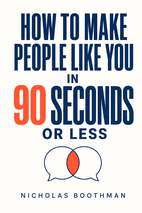
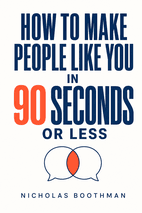
Nicholas Boothman's How to Make People Like You in 90 Seconds or Less breaks connection into three stages—meeting, rapport, and communicating—with tools like the five-part greeting, a Really Useful Attitude, and sensory-preference profiling. Written for professionals, job seekers, salespeople, and socially hesitant readers who want to build trust quickly through practice.
Feature
Insta.Page
Blinkist
Shortform
Summary Depth
Full Chapter-by-Chapter
15-min overview
Section-by-section guides
Audio Narration
✓
✓
✓
Full access to all 700+ summaries
✓
✓
✓
Visual Mindmaps
✓
✕
✕
AI Q&A
✓
✕
✕
Missing a book? Request it, usually live within 48h
✓
✕
✕
Quizzes
✓
✕
✕
PDF Downloads
✓
✕
✓
Send to Kindle
✓
✓
✓
Price
$89.99/yr
$146/yr (PRO)
$199/yr
*Competitor data last verified July 2026.
1 Page Summary
Nicholas Boothman's How to Make People Like You in 90 Seconds or Less is built on the premise that people are our greatest resource—supplying money, work, service, comfort, and care throughout life—and that the ability to connect with them can be learned rather than left to chance. Boothman argues that first encounters offer only a narrow window (roughly 90 seconds, often less) in which trust can form, and that the actions filling that window are usually automatic and unexamined. He breaks connection into three overlapping stages—meeting, establishing rapport, and communicating—and introduces core tools such as the five-part greeting sequence (Open, Eye, Beam, "Hi!", Lean), the concept of a "Really Useful Attitude," and the idea that "I like you" can be deliberately created from "I am like you" through matching body language, voice tone, and words. He also draws on research, including studies cited via the Alameda County Study and the MacArthur Foundation, to support the claim that socially active people live longer and stay mentally sharper.
What makes the book distinctive is its systematic, component-by-component approach to something most people treat as instinctive. Boothman treats rapport as a learned default rather than a lucky accident: he explains why open body language (which exposes the heart and signals cooperation) matters more than rehearsed words, why attitude shapes tone, word choice, and facial signals before we can consciously control them, and how conversation is driven by questions—open questions that invite detail versus closed ones that stall momentum. He also incorporates sensory-preference profiling drawn from Neuro-Linguistic Programming (Bandler and Grinder), dividing people into Visual, Auditory, and Kinesthetic types and showing readers how to spot preferences through words, pace, gestures, clothing, and eye movement, then adjust their communication accordingly.
The intended audience is anyone who wants to build trust and connection quickly—professionals, job seekers, salespeople, and socially hesitant readers alike—since the book assumes no natural charisma, only a willingness to practice. Readers gain a practical, step-by-step toolkit: a greeting routine, techniques for synchronizing with others, strategies for keeping conversation alive through open questions and feedback, and the sensory awareness to adapt to different people. The underlying promise is that these skills, once practiced into normal behavior, become an unforced response rather than a checklist—making connection feel natural, fluid, and enjoyable.
1. People Power
Overview
Many people chase success as if they could do it alone. They ignore relationships until they need something. But everyone depends on other people for things nothing else can provide. Why is the most ordinary resource also the hardest to use well?
People as the Greatest Resource
Connecting with others is the greatest resource. People supply money, work, service, comfort, and care at every stage of life. Even solitary artists and poets usually hope their work will reach an audience. People grow through being around other people, whether it's a band of hunters or coworkers at a pizzeria. A connected community gives strength and safety, which frees up energy for social, cultural, and spiritual growth.
Connection and Health
The brain thrives on making connections. Lawrence Katz and Manning Rubin, in Keep Your Brain Alive, cite studies by the MacArthur Foundation, the International Longevity Center in New York, and the University of Southern California showing that socially and physically active people live longer. Getting out and making new friends keeps the brain young and alert. Edward M. Hallowell's Connect cites the 1979 Alameda County Study by Dr. Lisa Berkman of the Harvard School of Health Sciences. Berkman's team followed 7,000 people aged 35 to 65 for nine years and found that those lacking social and community ties were almost three times as likely to die of medical illness as those with many contacts, regardless of income, smoking, alcohol, obesity, or physical activity.
Cooperation and Emotional Need
If people like you, they give time and effort. Whatever a person wants, from romance to a dream job to a Rose Bowl ticket, usually requires help, and better rapport raises cooperation. Emotionally, people are not closed systems that regulate themselves. We are shaped by feedback from others. Love can arrive through body language, gestures, facial expressions, tone, or words. Going without contact is devastating: children in orphanages grow sickly despite adequate food and clothing, autistic people may want contact but struggle without social skills, and a medically healthy spouse can die soon after a 50-year marriage ends.
Face to Face
The Internet can gather communities of interest and helps people who are housebound, but screen time is a poor substitute for face-to-face experience. Being there in person reveals verbal and nonverbal cues and whether two people offer openness, supportiveness, and companionship.
Why Likability Works
Likable people signal that they are willing to be sociable and that they are open to talking. Those signals carry self-confidence, sincerity, and trust. A warm, easygoing public face with outgoing radiance says that a person is ready to connect and open to contact. Likability has something to do with looks but much more to do with how someone makes people feel. A nanny called this a "sunny disposition" and laughed at the "sourpusses" on the promenade.
The 90-Second Window
The window for establishing likability is 90 seconds or less. People rush through deadlines, make appraisals in seconds, and decide friend or foe, fight or flight, opportunity or threat, familiar or foreign, often before a word is spoken. If someone cannot present themselves quickly and favorably, they risk being passed over. The book puts the average attention span at about 30 seconds. Attention jumps to whatever is new and fresh, like a troop of wild monkeys, and leaps away when nothing interesting holds it. Likability captures attention; rapport holds it. Three things matter: presence, which is what you look like and how you move; attitude, which is what you say, how you say it, and how interesting you are; and how you make people feel. These are connecting skills, not a personality transplant, and they are meant to be used when needed.
Key Takeaways
Treat social ties as part of staying healthy, not just your social calendar. Isolation carries risks that healthy habits alone do not erase.
Build a wide network before you need it. People are the practical source of work, help, comfort, and care across a lifetime.
Keep face-to-face contact in your routine. Online groups can sustain interests and reach the housebound, but they cannot replace the cues that reveal openness and support.
In the first 90 seconds, make your availability visible through posture, expression, and warmth, because people sort friend from stranger before conversation begins.
When you want cooperation, put people at ease first. Goodwill turns into time and effort on your behalf, and you can switch on connecting skills when a situation calls for it.
Key concepts: 1. People Power
People Power
People as the Greatest Resource
Connecting with others is the greatest resource for success.
People supply money, work, service, comfort, and care.
Even solitary artists hope their work reaches an audience.
A connected community frees energy for growth.
Connection and Health
Socially active people live longer and keep brains young.
Lacking social ties triples risk of death from illness.
Isolation harms health regardless of other factors.
Emotional well-being depends on feedback from others.
Face-to-Face vs. Online
Online groups help but are poor substitutes for in-person contact.
Face-to-face reveals nonverbal cues and true openness.
In-person interaction builds supportiveness and companionship.
Keep face-to-face contact in your routine.
Why Likability Works
Likability signals willingness to connect and builds trust.
It's more about how you make people feel than looks.
A warm, easygoing demeanor attracts others.
Likability captures attention; rapport holds it.
The 90-Second Window
People judge friend or foe in 90 seconds or less.
Presence, attitude, and how you make people feel matter.
Make availability visible through posture, expression, warmth.
Connecting skills can be switched on when needed.
💡 Try clicking the AI chat button to ask questions about this book!
2. First Impressions
Overview
A first encounter offers a narrow window in which trust can form, yet the actions that fill that window are usually automatic and unexamined. The difficulty is that what happens before conversation begins can close the door before any real exchange is possible.
Connecting with people involves three overlapping stages: meeting, establishing rapport, and communicating. They move quickly and blend together, so the aim is to make them natural, fluid and enjoyable. Meeting may be chance or arranged, but the first three or four seconds do most of the work. If they convey sincerity, safety and trustworthiness, an opening for rapport appears.
The Greeting as a Five-Part Sequence
The first seconds of contact are the greeting, a five-part welcome sequence:
Open: adopt a positive attitude, open the body, aim the heart at the other person, keep the arms from covering it, and unbutton a jacket when possible.
Eye: make eye contact first and let the eyes reflect that attitude; practice by naming eye colors on television, then with people met the next day.
Beam: smile first, as a reflection of attitude.
Hi!: speak pleasantly, attach your own name, extend a hand, and use the other person's name two or three times naturally.
Lean: tilt forward slightly to signal interest and begin synchronizing.
The Handshake and the Hands-Free Version
A handshake should be firm and respectful, like ringing for room service. A bonecrusher or wet noodle violates expectations, and since confusion is aversive, the first instinct can be withdrawal. The hands-free handshake keeps the heart pointed at the person, eyes lit and smile present, but drops the hand; it also builds rapport with a presentation audience.
Firing Energy
An exercise for groups builds the same flash. Make a circle about 12 feet across. One person chooses someone opposite, gathers energy from the body into the heart, then in one second looks at the person, says "Hi!", claps, and points the right hand at the other's heart. Six channels must fire together:
body
heart
eyes
smile
clap
voice and breath
The receiver immediately fires it to someone else, and the round continues until everyone has been struck at least three times. The aim is subtlety, and the same flash can be used with a supermarket cashier, a cafe waiter, a sister-in-law, the photocopier repairer, who may read it as "star quality."
Rapport and the Communication Cycle
Rapport is shared ground, a comfortable zone where minds meet. Each person brings attentiveness, warmth or humor and receives empathy, sympathy or jokes. It lubricates social exchange and earns positive acceptance, an unspoken willingness to trust a new person with attention. Four capacities support it:
a positive attitude
synchronizing behavior such as body language and voice tone
conversation skills
discovering whether someone relies most on Visual, Auditory or Kinesthetic experience
Communication is goal-directed. Richard Bandler and John Grinder, in early Neuro-Linguistic Programming, defined its meaning by its result: the response it receives. Responsibility for success therefore lies with the sender. The formula has three parts:
Know what you want: state intention affirmatively, in the present and with sensory detail, not as a negation such as not wanting to be lonely.
Find out what you're getting: assess your actions and their responses, including whether a setting such as a bar is a poor way to meet people.
Change what you do until you get what you want: design a plan, gather feedback, redesign, and repeat. Inviting three friends to dinner and asking each to bring someone is one example.
The KFC initials make the sequence memorable: know what you want, find out what you're getting, change what you do until you get what you want.
Key Takeaways
Make the opening four seconds a fixed sequence: settle your attitude before contact, turn your torso toward them, meet their eyes first, smile before you speak, give your name and use theirs, then lean slightly forward.
Use a firm, respectful grip when a handshake fits, and drop the hand entirely when it does not, keeping your chest, eyes and smile aimed at the other person so the greeting still lands.
Run the circle exercise with a group until one coordinated burst of body, eyes, smile, voice and gesture becomes automatic, then use that same burst with cashiers, waiters and repair people.
Create ease by giving steady attention, warmth or humor, echoing the other person's pace and posture, and reading whether they favor sights, sounds or physical sensation.
Own the result of every exchange: name your goal as something you want, in the present, with concrete sensory detail; watch the responses you actually receive; and keep redesigning your approach until the response changes.
Key concepts: 2. First Impressions
First Impressions
The Greeting Sequence
Open: positive attitude, open body, heart aimed, arms uncrossed
Eye: make eye contact first, practice naming eye colors
Beam: smile first as reflection of attitude
Hi!: pleasant voice, own name, handshake, use their name
Handshake and Hands-Free Alternative
Firm, respectful grip like ringing for room service
Avoid bonecrusher or wet noodle; confusion causes withdrawal
Hands-free: keep heart, eyes, smile aimed but drop hand
Useful for presentations and when handshake doesn't fit
Firing Energy Exercise
Circle ~12 feet; one person fires energy to another
Six channels: body, heart, eyes, smile, clap, voice/breath
Receiver fires to someone else until all struck three times
Aim for subtlety; use same flash with cashiers, waiters, etc.
Rapport and Communication Cycle
Rapport: shared ground, comfortable zone where minds meet
Four capacities: positive attitude, synchronizing, conversation, VAK
Communication meaning = response received; sender responsible
KFC: Know what you want, Find out what you're getting, Change until you get it
Key Takeaways
Make opening four seconds a fixed sequence: attitude, torso, eyes, smile, name, lean
Use firm handshake or hands-free; keep chest, eyes, smile aimed
Practice circle exercise until coordinated burst becomes automatic
Own results: state goal affirmatively, watch responses, redesign approach
3. “There’s Something About This Person I Really Like!”
Overview
You can be decent, even charming, and still fail to connect with someone who should be easy to like. Some encounters click instantly while others stall no matter what you say, and the first moments leave little room to recover. What do you do when natural rapport never arrives?
Rapport is when two people are in sync and feel at ease with each other, and first-meeting routines determine whether it forms. When they work, you can speak with confidence that the other person will take you seriously. That matters because rapport makes you believable, and being believable leads to mutual trust. Without it, people focus on you instead of what you're saying, and that attention feels uncomfortable. When you see the world through another person's eyes, ears and feelings, you get in sync with them, and they feel understood. That creates a quiet sense that there's something likable here. Research cited in the book gives you about 90 seconds to make a good first impression, often less.
Natural Rapport
People are drawn to each other and sync up naturally, just like animals and even plants. We learn by aligning with signals from parents, peers, teachers and friends, picking up postures, gestures and ways of doing things we like. Shared interests create natural rapport, and close friends tend to share interests, opinions and habits even when they argue. Humans are social animals, and getting along is more normal and logical than fighting. Still, society trains people to fear one another, and headlines and ads stoke anxiety about disasters, insurance, body size, smoke detectors and funeral costs. We need rapport to stay sane, to grow and to survive.
Rapport by Chance
Traveling where no one speaks your language can make you uneasy or suspicious, until you meet someone from your own country or state. Shared language quickly creates a vacation friendship: you exchange experiences, opinions, restaurant tips, bargains, family and work details. Back home, the friendship may fade when language and location prove the only common ground. Such chance encounters happen daily at work, in the supermarket, at the Laundromat or at the bus stop. Building rapport with strangers means learning to become like them, an approach that turns each encounter into a puzzle, a game and a pleasure.
Rapport by Design
People are in rapport when their interests or behavior are in sync. Rapport by design applies when no shared interest or circumstance exists: you deliberately reduce distance and difference by finding common ground and becoming like the other person. At a formal dinner for eight, Mark knows no one except an accountant at the far end of the hall. Tanya, seated across from him, mentions that she collects stamps. Mark collects too, and he describes his rare 1948 Poached Egg stamp, found when his Pontiac broke down in Cortlandville in upstate New York. Tanya leans toward him with an elbow on the table and a finger near her cheek. Her pupils dilate and her shoulders relax. Mark leans forward, smiles when she smiles, nods when she nods and sips water when she does. Their cues and rhythms line up without conscious effort. They like each other because they are alike, and the connection forms fast, often in a minute and a half or less.
Rapport by design means briefly changing your behavior on purpose so you can adapt to the other person. The tools you need are:
attitude
appearance
body
facial expressions
eyes
tone and rhythms of voice
skill at structuring words into engaging conversation
a knack for spotting the sense a person relies on most
listening and observation
curiosity
No gadgets, appliances, aphrodisiacs, pills, checkbook or big stick are required. The tools are your native gifts and a desire for other people's company.
Key Takeaways
Spend the opening minute or so of any meeting making the other person feel understood, because credibility and trust come through that impression, not through your content.
When no interest or circumstance connects you, create the connection on purpose: mirror posture, gestures, facial expression and vocal rhythm until both of you are moving at one tempo.
Enjoy the easy warmth of a stranger who shares your hometown or your language, but give the friendship more to stand on, or it fades once the shared setting does.
Treat each encounter with a stranger as a puzzle to solve and a game to enjoy, and work with the equipment you already carry: attitude, appearance, body, voice, conversational structure, an ear for the other person's dominant sense, close observation and genuine curiosity about people.
Key concepts: 3. “There’s Something About This Person I Really Like!”
“There’s Something About This Person I Really Like!”
The Critical First Impression
You have about 90 seconds to make a good first impression.
Rapport makes you believable, leading to mutual trust.
Without rapport, people focus on you, not your message.
Spend the opening minute making the other person feel understood.
Natural Rapport
Humans naturally sync with others, like animals and plants.
Shared interests create instant connection and ease.
Society often trains us to fear strangers, hindering rapport.
Rapport is essential for sanity, growth, and survival.
Rapport by Chance
Shared language or hometown quickly creates temporary friendship.
Chance encounters happen daily at work, stores, and transit.
Friendships may fade when only language or location connects you.
Give such friendships more to stand on to make them last.
Rapport by Design
Deliberately reduce distance by finding common ground and becoming like the other person.
Mirror posture, gestures, facial expressions, and vocal rhythms.
Use your native tools: attitude, appearance, body, voice, and curiosity.
Treat each encounter as a puzzle to solve and a game to enjoy.
Key Takeaways
Credibility and trust come from making the other person feel understood.
Create connection on purpose when no natural link exists.
Enjoy easy warmth but build deeper foundations for lasting friendship.
Work with your existing equipment: observation, curiosity, and adaptability.
4. Attitude Is Everything
Overview
People try to control an encounter through words and gestures, yet others pick up on plenty before the moment arrives. So what can you choose in advance, and does it change what comes back?
Mind and body work as one system. Attitude shapes your thoughts, your tone, your word choice, and especially your face and body language. Once an attitude takes hold, you have limited conscious control over those signals. Your body just plays out the pattern. That's why attitude shapes how relationships go and much more.
A Really Useful Attitude
Take a bank branch one man used for eight years. Two competing banks opened closer, and service, rates and offerings were no better. The reason he stayed was Louanne, a teller. She made customers feel cared for and brightened the whole branch. She knew what she wanted: to please customers and do the job well. And she held two matching Really Useful Attitudes: cheery and interested. The benefit reached customers, colleagues, the company, her family and herself, at no cost.
A Really Useless Attitude
People who don't know what they want from a conversation tend to give off a Really Useless Attitude. The mnemonic KFC puts it as K for Know what you want. Without a target, there's no message and no basis for connection. Anger shows in a hostile stance, a harsh tone and threatening words, but useless attitudes also show up quietly:
infuriated parents berating a child for knocking over supermarket bananas
bored shop assistants
cranky, impatient doctors
Wanting a boss to stop yelling carries a different attitude from wanting the boss's job or a promotion. Being tired of selling neckties differs from wanting to run a charter fishing boat in Honey Harbor. Imagination is stronger than willpower. It works through pictures, sounds, feelings, smells and tastes, and it twists reality for better or worse, so what you feed it matters.
It's Your Choice
Ask what you want right now and which attitude serves it. At Miami International Airport, missing a connection to Omaha and shouting at the desk is useless if the goal is maximum help; rapport works better. The same logic explains escaping dozens of traffic stops, though not all. The last stop involved an officer following into a village supermarket parking lot. Reading him as a feeling-based type, the first words were "Fair and square." He gave a deserved speech and a warning. Warm is the favorite first-meeting attitude, and according to the book scientists have found warm contact can trigger a feel-good chemical release in the brain; curious, enthusiastic, inquiring, helpful and engaging also work. A useful attitude makes people like you, and people who know what they want tend to get it.
Attitude Triggering Happy Memories
A clenched fist can serve as a trigger. At eight, at a resort, standing beside a man making fresh doughnuts while Paul Anka sang "Diana," the song became linked to the doughnut smell and a happy holiday. The exercise uses a fist after clenching and releasing it a few times.
Pick a Really Useful Attitude you have felt before and can recall on demand, such as curious, resourceful, warm or patient. Sit for 10 minutes in a quiet, dim place, feet on the floor, breathing slowly into the abdomen. With eyes closed, picture a memory of that attitude, note its detail, then step inside and look through your own eyes. Add sounds, noting direction, volume, tone and rhythm. Add physical sensations, smells and tastes, then locate the inner feeling and let it move. Make images sharper, brighter and bigger, sounds stronger and feelings deeper, looping them to intensify. Double the intensity repeatedly, clench the fist hard at the peak to anchor it, release, repeat once, relax, then test the trigger after a minute and again after a couple of minutes.
Key Takeaways
Decide what you want out of an interaction before it begins; an attitude formed without a goal has nothing to aim at and leaks out as boredom, impatience or hostility.
Pick your attitude on purpose for each encounter rather than letting circumstances hand you one, since once it takes hold the facial and bodily signals it produces run largely beyond conscious control.
Lead with warmth on first meetings, and reach for rapport instead of indignation when you need something from a stranger, because the person across from you can only work with what you give them.
Feed your imagination vivid, concrete material, since it works in pictures, sounds, smells and feelings and will magnify whatever you supply it.
Build a physical anchor for an attitude you want on demand: relive a memory of it at full sensory intensity, clench your fist at the peak to bind the state to that gesture, then test the trigger until it fires reliably.
Key concepts: 4. Attitude Is Everything
Attitude Is Everything
Mind and Body as One System
Attitude shapes thoughts, tone, word choice, and body language.
Once an attitude takes hold, conscious control over signals is limited.
Body plays out the pattern, affecting relationships and outcomes.
Really Useful vs. Really Useless Attitudes
Useful attitudes like cheery and interested benefit everyone at no cost.
Useless attitudes stem from not knowing what you want (KFC: Know what you want).
Useless attitudes leak out as boredom, impatience, or hostility.
Choose Your Attitude with a Goal
Ask what you want and which attitude serves it.
Rapport works better than indignation when seeking help.
Warmth is the favorite first-meeting attitude; it triggers feel-good chemicals.
Imagination Drives Attitude
Imagination is stronger than willpower and works through senses.
Feed it vivid, concrete material to magnify desired attitudes.
It twists reality for better or worse, so choose inputs carefully.
Anchor Attitudes with Physical Triggers
Relive a memory of the attitude at full sensory intensity.
Clench fist at peak to bind the state to the gesture.
Test the trigger until it fires reliably.
You've reached the end of the free chapters
Next chapter: “Actions Do Speak Louder Than Words” is locked
Keep reading How to Make People Like You in 90 Seconds or Less — and unlock all 700+ book summaries with audio, mindmaps and AI Q&A.
$0.00 due today · 7 days free, then $89.99/year ($7.49/mo) · Cancel anytime before day 7
plus sales tax where applicable
More ways to explore How to Make People Like You in 90 Seconds or Less
Nicholas Boothman is a British-born author and communications expert best known for his books on nonverbal communication and persuasion, including How to Make Someone Fall in Love with You in 90 Minutes or Less and How to Read a Person Like a Book. A former fashion and advertising photographer, he developed his expertise in body language and rapport-building after studying behavioral research, and he now works as a corporate speaker and consultant on communication skills.
Frequently Asked Questions about How to Make People Like You in 90 Seconds or Less
What is How to Make People Like You in 90 Seconds or Less about?
This guide breaks down the mechanics of those first few seconds of contact, when trust either forms or never gets a chance. It walks through a simple five-part greeting sequence — open posture, eye contact, a smile, a spoken hello, and a slight lean in — along with the attitude, body language, and conversational habits that make it work. Later sections explain how to synchronize with someone by matching their posture, tone, and word choices, how to recognize whether a person thinks visually, auditorily, or kinesthetically, and how open questions keep a conversation moving. Throughout, the emphasis is on turning these skills into natural defaults rather than a checklist to run through.
Who is the author of How to Make People Like You in 90 Seconds or Less?
Nicholas Boothman is a communication specialist who built his method around the idea that people form impressions of each other incredibly quickly — research he cites suggests roughly 90 seconds, often far less. His approach blends practical body-language coaching with findings and frameworks from other researchers, including the Alameda County Study, work on keeping the brain active through social connection, and Richard Bandler and John Grinder's Neuro-Linguistic Programming. The result is a hands-on, exercise-driven system rather than a purely theoretical one.
Is How to Make People Like You in 90 Seconds or Less worth reading?
It is, especially if you have ever walked away from a conversation wondering why it never clicked. The advice is concrete and immediately testable — practicing eye color naming on television, trying open versus closed questions for a day, or deliberately choosing a Really Useful Attitude before you walk into a room. Few people ever examine the automatic behaviors that fill the first seconds of a meeting, and simply becoming aware of them changes the outcome.
What are the key lessons from How to Make People Like You in 90 Seconds or Less?
First impressions are decided before you say anything meaningful, so the greeting sequence of open body language, eye contact, a smile, a warm hello, and a lean forward carries enormous weight. Attitude comes first and shows up in your face, tone, and word choice whether you want it to or not, which is why choosing one deliberately — cheery and interested, for example — shapes how an exchange goes. People trust those who seem like themselves, so matching posture, voice tone, and vocabulary creates rapport by design instead of by luck. Finally, conversation runs on questions: open ones that begin with who, what, when, where, why, or how draw people out, while closed ones stall momentum — and observing whether someone speaks in pictures, sounds, or feelings lets you talk to them in their own language.
📚 Explore Our Book Summary Library
Discover more insightful book summaries from our collection