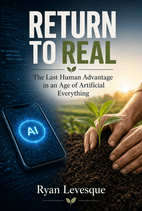
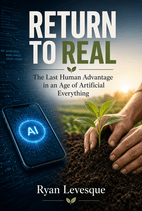
Ryan Levesque's Return to Real argues that as synthetic substitutes become cheaper and marketed as improvements, a countermovement toward what is genuine is forming. Through three shifts—Hands in the Dirt, Heart, Humor, Humanity, and Seek & Speak Truth—Levesque offers builders, operators, and parents language for their unease and a framework for recognizing what is human and trustworthy.
Feature
Insta.Page
Blinkist
Shortform
Summary Depth
Full Chapter-by-Chapter
15-min overview
Section-by-section guides
Audio Narration
✓
✓
✓
Visual Mindmaps
✓
✕
✕
AI Q&A
✓
✕
✕
Quizzes
✓
✕
✕
PDF Downloads
✓
✕
✓
Price
$89.99/yr
$146/yr (PRO)
$199/yr
*Competitor data last verified July 2026.
1 Page Summary
Ryan Levesque's Return to Real: The Last Human Advantage in an Age of Artificial Everything argues that as synthetic substitutes—of products, experiences, and even human voice—become cheaper, faster, and marketed as improvements on the originals, the countermovement forming against them is the "Return to Real." Levesque frames the stakes through three colliding forces: AI's transformative speed, the sobering precedent of the Industrial Revolution (which displaced the majority of England's farming workforce within two centuries while real wages stagnated for decades), and the resulting question at the heart of the book—with everything changing this fast, how do you build something that actually lasts? Opening with a personal wake-up call during the February 2021 Texas winter storm, in which he found his sister-in-law Clara alone and near death in a freezing house, the book grounds its argument in lived experience rather than abstraction, extending it to a technologist's realization that work which once took a lifetime to learn could now be replicated in twenty minutes.
What distinguishes the book is Levesque's approach: he builds his case through concrete, often deeply personal stories and three named "shifts" rather than a conventional business framework. The first, "Hands in the Dirt," draws on his time on a two-hundred-year-old Vermont hill farm and the lesson of goldenrod and aster—species that coevolved as collaborators rather than competitors—to argue that openings never surface on a screen or in a strategy session. The second, "Heart, Humor, Humanity," explores what makes people trust that another person is real when every signal can be manufactured, illustrated by a moment of personal low in a pasture with a yearling heifer named Athena and by his candid newsletter confession about years of ghostwritten emails. The third, "Seek & Speak Truth," makes the case that ignored truth does not disappear but returns with more damage. A closing chapter on "Returning to What's Real for You" insists the path to what is real is not safe—it runs toward challenge, perspective, and the death of an identity that no longer fits.
The book is aimed at builders, operators, and parents—readers who have achieved conventional success yet sense something is off, and who wonder, as Levesque's fellow fathers in the Ozarks did, what they are leaving for their kids. Rather than offering wellness habits or strategy sessions, it promises a way of seeing: readers will gain language for the unease they cannot quite name, a framework of three shifts for recognizing what is genuinely human and trustworthy, and the conviction that the last human advantage lies not in outrunning the machines but in returning to what is real—honestly reckoning with what was lost along the way.
Chapter 1: The Wake-Up Call
Overview
A life can look successful and still feel like it is happening at a distance, all screens and speed and no hands in the dirt. The harder question is whether the same drive that builds that life can ever be turned toward something more real without walking away from it.
In February 2021 a winter storm buried Texas, the grid failed, and the cell towers went dark for nearly forty-eight hours. Ryan Levesque was home with his wife Tylene and their two young boys when she insisted something was wrong with her sister Clara, who lived alone in the next town. He drove past sparking lines into a house cold enough to show his breath and found Clara in a closet, on the floor, gray and blue-lipped, tears dried to salt on her face, holding her dog. She told him he had saved her life. Two hundred forty-six people died in that storm, two thirds of them from the cold, making it the deadliest winter storm in Texas history.
The Night by the Fire
Clara stayed with them while the storm passed. They built fires and cooked chili in a cast-iron pot, and one evening the five of them sat around the hearth telling stories, dogs asleep, boys in sleeping bags on the floor, no screens anywhere. He found himself wishing the power would stay off. He had not unplugged that far in a decade, and he felt no pull to check anything. It should not have taken a grid collapse to remind him what being alive felt like.
Life from the Neck Up
Ordinary days now happen mostly from the neck up: phone first, then hours in the inbox, in meetings, on video calls, the body softening inside four walls. AI is rewriting the rules of work in real time, and the fear nobody says aloud is that slowing down means being left behind, so each efficiency gain buys a faster hamster wheel rather than peace. Parents ration their children's screens while their own lives stay tethered to a device. The pull toward mountains, ocean, garden, or plain slowness is not a wish to go off-grid; it is a wish for financial success and a lived life that no longer pull in opposite directions. Without deliberate shifts, the trillion-dollar attention industry wins by default, and not analog by design means digital by default.
The Trap He Built
He planted his first vegetable garden at twelve, the same age he decided to become a doctor or a millionaire. His mother cut hair and his father sorted mail and loaded trucks at night, and because money was a constant worry he formed an equation: hands meant a life to escape, mind a life to create. He studied neuroscience and Chinese at Brown, worked in finance on Wall Street and in Asia, and moved to Austin to start a company. As it scaled he hired out the lawn, the cleaning, the calendar and the cooking. He rationed his sons' screens while spending his own days in front of one, reading teleprompter copy he had not written and did not believe. The company made the Inc. 5000 seven times and passed $100 million in revenue, and he wanted out.
The Deal That Fell Through
With his partner Richard Cussons he decided to sell. The first deal collapsed at the eleventh hour, so they fired the broker, ran the business another year, and hired a bigger firm. A $70 million offer for a majority stake came days before Russia invaded Ukraine; markets panicked, rates jumped, and the buyer withdrew. What stung more than the money was how badly he had wanted out.
The Farm
While AI promised the biggest opportunity in a generation, his mind kept going back to the garden. He read philosophy, futurism and biology, and took a permaculture design certification in Vermont's Mad River Valley, living in a tent and bathing in a pond. There he asked what he would have done with the money had the sale closed, and the answer was to move to the country and farm with his family; then he asked what was stopping him. Tylene listed the house. The first couple offered full ask, all cash, closing in fourteen days. After a year of Airbnbs and nearly fifty farm visits they bought a two-hundred-year-old hill farm in the Green Mountains and set out to raise 80 percent of their own food, reaching 100 percent of their protein, fat and sweetener and more than 80 percent of their calories. A bear destroyed twenty-four hives; a raccoon tangled itself in electric netting; a fence-post driver split his scalp. Choose your hard, he tells his children, or your hard will choose you.
The Third Path
The escape fantasy is nearly universal among ambitious people, and so is the reflex that kills it. The wish to move to an island, vanish into mountains, buy a farm or travel indefinitely collides with children, a mortgage, a team and investors, and most people conclude there is nothing to do but keep grinding while ignoring what their body and soul are asking for. The premise worth testing is whether that is a false choice. Wanting a life you actually want and running a business that pays the bills may not be enemies at all, and what is good for the body may turn out to be the sharpest business strategy available. In a world of artificial everything, real may be the last human advantage left.
That reframing sets the book's purpose. This is not a case for burning it all down or rejecting technology; it is a case for a series of small, deliberate adjustments that let a business and a life feel like their owner again. The starting point is the shifting ground beneath everyone's feet.
Three Cravings, Three Shifts
The argument then turns on three cravings, each paired with a shift and an advantage to be built. The body craves what is tangible. Neuroscience and evolutionary biology are invoked to argue that physically engaging with the real world activates neural pathways screens cannot reach, and that the hunger for this is acute enough to make certain brands and businesses primed to serve it. This is Hands in the Dirt, and it builds toward what the book calls the Analog Advantage.
The heart craves what is trustworthy. Modern business is largely engineered around dopamine, the chemistry of the click, the open and the scroll, while oxytocin, the chemistry of trust and human bonding, drains out of daily life. A market starving for genuine connection follows. This is Heart, Humor, Humanity, building toward the Oxytocin Advantage.
The spirit craves what is true. Everyone carries a voice that knows what is real and speaks up when the surrounding consensus says otherwise. This is not contrarian as opposition, but contrarian as fidelity to what is true for you even when it contradicts the conventional path. Building a life and business around that voice produces a strange result: no one can out-compete you at being you, comparison loses its grip, price pressure fades, and you become a category of one. This is Seek & Speak Truth, building toward the Contrarian Advantage.
A later stage turns the framework inward, asking what Return to Real looks like in a given person's work, life and current season, and how to find a path that fits. The book pairs the research and examples with thirty concrete practices meant to be usable immediately. No farm and no exit are required; the instruction is to start wherever you already are.
Why Now
The question that organizes the next stretch is timing. Extreme automation is spreading from food to content, and a counter-movement is gaining momentum behind the claim that what people actually want is what is real. Whether AI alone explains the hunger is left open. The promised answer is that a rare alignment is underway, three seismic forces colliding at once, which together make the return to real not merely a cultural preference but a business necessity. Most people, the book argues, do not yet see how far these forces are reshaping ordinary life.
Key Takeaways
Treat the choice between a business that pays and a life you actually want as unproven, and run the experiment with small deliberate adjustments rather than a burn-it-down exit.
Write down what you would do the week after the sale closes, then ask what is genuinely stopping you now; the honest answer is rarely money.
Assign your hours before anything else claims them, because the time you leave unallocated will be shaped by someone else's business model rather than yours.
Expect the alternative to be harder in ways you did not plan for; the goal is a hardship you picked, not an easier life.
Build what you sell around the three hungers for the tangible, the trustworthy, and the true, since a position rooted in someone's actual point of view is the one place competitors cannot follow you.
Key concepts: Chapter 1: The Wake-Up Call
Chapter 1: The Wake-Up Call
The Wake-Up Call
2021 Texas winter storm: grid failure, 246 deaths, Clara found near death
Ryan drove past sparking lines to save his sister-in-law
Clara's rescue revealed fragility of modern life
The Night by the Fire
Family gathered around hearth, no screens, telling stories
Ryan wished the power would stay off
Rediscovered what being alive felt like
Life from the Neck Up
Ordinary days happen mostly from the neck up: phone, inbox, meetings
AI fear drives faster hamster wheel, not peace
Without deliberate shifts, digital wins by default
The Trap He Built
Childhood equation: hands meant escape, mind meant creation
Built $100M company but outsourced life's tasks
Rationed sons' screens while living on one himself
The Deal That Fell Through
Two failed attempts to sell the company
$70M offer withdrawn after Ukraine invasion
Real sting: how badly he wanted out
The Farm
Permaculture certification led to asking what money was for
Bought 200-year-old hill farm, raised 80% of own food
Choose your hard, or your hard will choose you
The Third Path
Escape fantasy collides with real obligations, but false choice
Business and life need not be enemies; real may be last human advantage
Three cravings, three shifts: Hands in the Dirt builds Analog Advantage
💡 Try clicking the AI chat button to ask questions about this book!
Chapter 2: Three Colliding Forces
Overview
The ground is shifting, and every room has a different diagnosis. The instinct is to pick one and act, but what if the diagnoses are all true at once and no single response can hold?
The Ozarks Question
In the Ozarks, out of cell range with six other fathers from a group called Front Row Dads, the conversation turned to an unease none of them could name. Ali Jafarian, who had spent over a decade building custom digital platforms, said the work that took him a lifetime to learn could now be replicated in twenty minutes, and he had no idea what that meant for his kids. The question that followed is the one the book exists to answer: with everything changing this fast, how do you build something that actually lasts?
The Industrial Precedent
AI may prove the most transformative technology in history, and the Industrial Revolution is the sobering comparison. Roughly 60 percent of England's workforce farmed in 1700; by 1850 the figure was just over 20 percent, and by 1900 under 10. Mechanization pushed millions into unprepared cities, real wages stagnated for decades, and the Luddite uprisings were displaced workers smashing the machines that had taken their livelihoods. New professions and labor protections arrived fifty to one hundred years later, held back by physical limits that AI barely faces. A client of the author's, a former attorney with a seven-figure business, watched revenue collapse within eighteen months and found that in-house counsel roles paid less than he had earned straight out of law school a decade earlier.
Three Camps and a Fourth
Reactions divide by room, but sorted they form three camps, plus a fourth:
Foolishly optimistic: AI fixes everything.
Painfully ignorant: nothing will change.
Cripplingly afraid: techno-feudalism and serfdom.
Realism without collapse, hope without naivety.
Morgan Housel, in The Psychology of Money, places the failure to see what is coming in imagination rather than analysis. What is converging is not one crisis but three:
an Economic Unraveling
an Ecological Breaking Point
an Existential Reckoning
Force One: Economic Unraveling
Ray Dalio's Big Cycle traces nations rising through productivity and innovation, dominating through trade and military strength, then declining under debt, internal conflict and eroding trust. Dalio places the United States late in the arc, and the World Inequality Database shows the top 1 percent's wealth share climbing from 24.5 to 34.9 percent across forty years. The cycle turns every seventy-five to one hundred years and ends in deleveraging. The author's own seventy-million-dollar exit collapsed when interest rates rose, the world destabilized and mergers and acquisitions froze, a reminder of how easily luck and timing get mistaken for skill.
Force Two: Ecological Breaking Point
Nate Hagens's Great Simplification names the reckoning that follows a century of growth powered by cheap energy. Donella Meadows and her MIT team warned in 1972's The Limits to Growth that exponential growth on a finite planet ends badly. Hagens's Carbon Pulse is the one-time burst from burning 4.2 billion years of accumulated sunlight in barely a century. Once extracting fuel costs more energy than the fuel yields, surplus becomes sinkhole. Earlier warnings failed because technology extended the same energy base rather than replacing it: fracking unlocked more fossil fuel, the Green Revolution ran on fossil-fuel agriculture, and renewables still need fossil fuel and mineral inputs. On the farm, thousand-pound round bales are efficient until the diesel runs out.
Force Three: Existential Crisis
Yuval Noah Harari's Homo Deus holds that AI threatens purpose, not merely employment. Human value has rested on unique problem-solving and complex judgment, and lawyers, accountants, management consultants, developers, doctors and PhDs now watch that claim erode. The author meets his own version of it while writing: if the thing you spent a lifetime getting good at no longer requires you, who are you? People reach for faith, or for the tangible, the local, the land.
These are not three separate warnings so much as a single collision, and the thinkers behind them rarely share a room. Their audiences barely overlap:
Finance knows Dalio well but barely knows Hagens.
Permaculture and regenerative agriculture treat Hagens as deeply influential, yet he is almost unknown outside those circles.
Harari is famous in literary and intellectual circles but often unfamiliar to the entrepreneurs and investors who work in finance.
These rooms seldom intersect. Laid side by side, the three forces reveal a deeper pattern, and that pattern is hard to ignore after time spent in all of them.
The Edge Effect
In permaculture, the Edge Effect describes the boundary where two ecosystems meet, such as forest and meadow or land and water. That border holds the greatest biodiversity and productivity because it combines conditions that do not normally coexist. The most interesting things grow there, and the edge is where the greatest diversity of ideas can gather. The same holds for thought: the fringe between worlds that do not talk to each other is where patterns hidden from any single field become visible.
A career that moved from Wall Street to the Silicon Valley diaspora of Austin to a hill farm in the Green Mountains of Vermont has passed through all three rooms. That route makes the convergence impossible to ignore. What stands out is not simply that each diagnosis is serious, but that they are converging. Most people do not grasp the full shape of what is unfolding, yet they feel it: an ache, a sense that something is off, without language for it. The willingness to sit with the questions rather than look away is itself a dividing line.
Something in us recognizes that the ground is moving beneath our feet. Our children and grandchildren will inherit a world vastly different from the one we grew up in.
A Hunger for What Is Real
Quietly, a movement is gathering force. A hunger, even a craving, is appearing in strange places, across virtually every demographic in the developed world. What people are reaching for is not what anyone predicted. It is not a demand for more technology or efficiency, nor even for more money. People are reaching for what is real. That pivot may be the most important of our time.
Key Takeaways
Treat the economic, ecological and existential warnings as a single event rather than three separate headlines; they are converging, and the specialists who track each one almost never speak to each other.
Expect the disruption to play out over generations, not news cycles: the Industrial Revolution took fifty to a hundred years to produce new professions and protections, and the physical constraints that slowed it then are largely absent now.
Look for insight at the seams between fields rather than at their centers, because the boundary where two worlds meet yields more than either world produces alone.
Read the inarticulate unease around you as accurate perception rather than anxiety to be managed; people register that the ground is shifting well before they can name it.
Notice that what people are reaching for is not more efficiency or more money but something tangible and real, and that this pull is likely to shape the next decade more than any technical capability.
Key concepts: Chapter 2: Three Colliding Forces
Chapter 2: Three Colliding Forces
The Ozarks Question
Six fathers share an unease none can name
Ali Jafarian: lifetime skills replicated in twenty minutes
Core question: how do you build something that lasts?
The Industrial Precedent
England's farm workforce fell from 60% to under 10%
Wages stagnated for decades; Luddites smashed machines
Protections arrived 50-100 years later; AI faces fewer limits
Fourth path: realism without collapse, hope without naivety
Housel: failure is imagination, not analysis
Force One: Economic Unraveling
Dalio's Big Cycle: rise, dominance, then debt-driven decline
Top 1% wealth share rose from 24.5% to 34.9%
Author's $70M exit collapsed; luck mistaken for skill
Force Two: Ecological Breaking Point
Hagens: Great Simplification follows cheap-energy growth
Carbon Pulse: burning 4.2 billion years of sunlight
Tech extended the energy base rather than replacing it
Force Three: Existential Crisis
Harari: AI threatens purpose, not just employment
Unique judgment and problem-solving no longer required
People reach for faith, the local, the land
The Edge Effect
Boundaries between ecosystems hold greatest diversity
Three audiences rarely share a room or overlap
Sitting with the questions is itself a dividing line
Chapter 3: The Return to Real Revolution
Overview
Substitutes now arrive cheaper, faster, and marketed as improvements on the thing they replace, and fewer people can agree on what the original even was. Anyone building a life or a business around what is genuine faces a question that wellness habits alone do not answer.
A grounding mat ordered online arrived reeking of industrial chemicals and spent its first hours off-gassing on the porch, on a farm ringed by more than a hundred acres of actual earth. Seven thousand reviews had made it worth trying. Plug the thin pad into an outlet's grounding port, stand on it while you work, and, the promise goes, you get what bare feet on the ground give you: better sleep, less inflammation, a calmer nervous system. Whether the mats work is beside the point: the mat exists because the free version of that experience has stopped being normal. Synthetic substitutes sold as equal or better than the original have become the default nearly everywhere, and the countermovement forming against them is the Return to Real.
Touch Earth Before Touching a Screen
Its smallest act of rebellion is a phrase and a practice passed along by Ali Jafarian, the technologist who first gave language to the Ozark campfire feeling: touch earth before touching a screen.
Set the alarm five minutes earlier.
Before reaching for the phone, step outside and feel the ground under bare feet.
Look up and breathe.
Ninety seconds is enough, and no farm is required: grass, a backyard, a balcony garden, or the dirt strip between sidewalk and curb all serve. He has done it on hotel grass at five in the morning in Boston, avoiding dog poop and the valet. His first genuine attempt came on the Vermont farm before dawn, frost biting his toes, blood pulsing up his legs, his own breath registering before his inbox did. The moment lasted minutes; the shift lasted the rest of the day.
On the surface a wellness habit, it is a quiet act of resistance: a reminder, before the dashboards and dopamine loops, that you live in a body, on a planet, inside a real life.
What Return to Real Means
It is not going off-grid, disappearing from the world, or romanticizing the past. It is reclaiming what the modern predicament has squeezed out and re-centering life and work on what matters. Underneath sits a practical promise: the choices that repair mental, physical, and spiritual health, working with your hands, connecting in person, building something you can point to as your own, are the same choices that make what you do harder to copy and commoditize. That holds for the products you offer, the services you deliver, and the way a business answers what people crave. Return to Real is a strategic edge as much as a biological imperative: the deliberate choice to anchor life, work, and business around what resists faking, automation, and delegation to an artificial stand-in.
The craving turned literal at the first meal drawn entirely from the farm: eggs from the hens, dandelion greens from the meadow behind the door, wild coral tooth mushroom foraged from the woods. Orange yolks, peppery greens, a mushroom that melted in butter. Friends Jeff and Jim were there to ready garden beds, and nothing needed saying.
The Fracturing of Shared Reality
Yuval Noah Harari separates objective reality (gravity, mountains, viruses), subjective reality (dreams, private emotions), and intersubjective reality, which exists only because enough people agree it does: money, corporations, nations, human rights. Civilization runs on maintaining those shared stories, and they are coming apart. Geoffrey Hinton, the Nobel laureate often called the godfather of AI, has warned of an unintended consequence of algorithmic personalization: the collapse of shared human experience, since nobody watches the same evening news or reads the same paper at the door.
At home, a few minutes with his phone recasts his son Bradley's feed as Pokémon; handed back, it fills with pickleball. Same device, same Wi-Fi, and a small change in search behavior reshapes the reality on offer within seconds. Swap in politics and public health and two people under one roof get different versions of events, multiplied across eight billion devices each building a self-reinforcing model of the world. Two decades spent building hyper-personalized digital experiences left him unprepared for the endgame, and its second- and third-order effects now alarm him.
According to the Edelman Trust Barometer, distrust is the default. Deepfakes push it further: behind a screen, people stop trusting their own eyes and ears. Across images, video, audio, and text, humans separate AI-generated content from real at roughly coin-flip accuracy. Familiarity does not help, confidence does not track accuracy, and a study of fourteen leading detectors found none reliable, many at chance.
So people hunt for evidence their senses can confirm, wanting to meet the farmer who grew their food and look their doctor in the eye. Concierge medicine has grown more than 80 percent in half a decade, and the same pattern shows up in education, food, art, and financial advice. The premium is not on real itself but on what delivering it now costs: time, attention, care, and a refusal to cut corners.
From Craft to the Great Bifurcation
The Great Bifurcation is the split in nearly every market: the middle is emptying, and value moves toward two poles. One is what can scale without limit and cost almost nothing, such as synthetic content. The other is what is ultra-premium because it is tied to a real human life. The premium end survives on what cannot be copied: a particular person, in a particular place, making something no one else can reproduce exactly. A client, Joey, sells out in-person events because people pay to be in the room with him and with one another. No avatar substitutes for that. Businesses have spent years optimizing for perfect. The work ahead is to determine what makes something real.
The Provenance Premium
In art and antiques, provenance is traceable history, covering who made a piece, who owned it, and how it reached the present. A damaged painting, Salvator Mundi, surfaced at a New Orleans estate sale in 2005 and went to dealers for under $10,000. After restoration and research it was attributed to Leonardo da Vinci; in 2017 it sold at Christie's for $450.3 million. That is the Provenance Premium: the price the market will pay for work whose origin traces to a specific human life. When AI pushes synthetic alternatives toward zero, provenance becomes the scarcity that cannot be manufactured, and scarcity plus demand sets price. The premium explains why handcrafted goods can sell for three times mass-produced versions and why trust moves from faceless brands to people whose reality can be checked.
Claimed provenance is not enough. Research cited in the book estimates that 16 to 33 percent of online reviews are fake, paid or AI-written, and consumers still trust reviews. A fabricated spiritual teacher can project wisdom on screen because the signals of authenticity look identical to the real thing. Proof must be harder.
Proof of Real
Proof of Real is the deliberate, consistent construction of evidence that cannot be faked because it requires sustained commitment to a life actually lived. More than 100,000 subscribers receive The Digital Contrarian, where he shares what he is testing, his mistakes, and lessons from clients and farm life. A few times a year he and Tylene open the farm to small groups. Documentation is not merely building in public; it holds the writer to the life the work claims. If a week offers nothing real to write about, that is information. Keep receipts, including the before photograph of the 400-square-foot apartment with lawn chairs and a mattress on the floor. Proof that the journey was real also proves the path is walkable by others.
Rebellion and the Double Craving
A screen-based life does not feel like a trap. It feels normal, and complacency arrives through distraction, compliance, and busyness, a modern version of bread and circus. Return to Real is a rebellion against living by proxy, organized around what can be faked and what cannot. A pull comes from body, heart, and spirit starving for the real world, real connection, and real truth, while customers feel the same hunger and pay for it. That is the Double Craving, and it is an opportunity. A push comes from the Digital Default, simulation and stimulation steering people toward convenience and distraction. Three tensions sharpen the choice:
Artisanal versus automated: whether work is crafted personally or delegated, abdicated, and productized.
Audiences versus algorithms: whether the business serves actual people or invisible distribution systems.
Authentic versus artificial: whether the signal comes from lived experience, judgment, and voice or from synthetic output.
Will They Pay, and Does It Scale?
A neighboring farm sold a 23-pound Thanksgiving turkey at $7.99 a pound, $183, while feedlot birds went for 49 cents a pound. Shoppers mobbed the cheap option, but the expensive turkeys sold out in under 24 hours and drew a waitlist for the next year. The family called it the "million-dollar turkey." The book reports that inflation-adjusted organic food sales in the United States have nearly doubled in a generation, passing $65 billion. Buyers span income brackets; what they share is priorities, not wealth. Scalability is the wrong obsession. Sunsets and hugs do not scale, and scale can extract from the operator, the audience, or both. On a farm, there is a line before regenerative becomes extractive. This is not a rejection of growth; scale only what can grow without diluting or destroying the system it depends on. Kevin Kelly's "1,000 True Fans" argued that a creator needs about a thousand people spending roughly $100 a year. Deeper impact with fewer people can become a moat, Warren Buffett's term for an advantage competitors cannot easily copy. As AI scales output for everyone, the moat moves to what AI cannot scale.
Timing and the Method Ahead
At ten, he invested a $5,000 inheritance from his grandparents from 1992 to 2000, when it reached almost $85,000, about $160,000 in inflation-adjusted terms. He sold near the top to pay Brown tuition, mostly by luck. A subsequent $70 million sale collapsed days before signing when Russia invaded Ukraine and capital markets froze: "five minutes too late." A personal pull toward the real will not disappear; it must be moved through. In a market, being early lets a founder define the shift, and the window is closing. The method ahead turns each tension into a personal practice and a business principle. A practices guide offers 30 concrete practices, and a reflections guide supplies prompts. The first move is to break the digital trance and rewild enough to reconnect.
Key Takeaways
Treat the pull toward real things as a market signal, not nostalgia. Position what you sell around a named person, a particular place, and a documented history, because the cheap synthetic end will keep collapsing toward zero.
Build proof into the product rather than asserting it. A visible record of testing, mistakes, visitors, and unglamorous beginnings does work that a claim of authenticity cannot, since fabricated and lived signals now look identical on a screen.
Decide each tension on purpose instead of letting the default decide: whether the work is crafted or delegated, whether the business serves people or distribution systems, whether the voice comes from experience or generation.
Stop measuring yourself by reach. Committed depth with a small number of people is harder to copy than volume, and growth that drains the operator or the audience destroys the very thing being sold.
Start with the body before the screen. A few barefoot minutes outside before the first dashboard is the cheapest entry into the whole shift, and it needs grass, a curb strip, or a balcony rather than acreage.
Key concepts: Chapter 3: The Return to Real Revolution
Chapter 3: The Return to Real Revolution
The Rise of Synthetic Substitutes
Substitutes are cheaper, faster, and marketed as improvements.
Fewer people agree on what the original even was.
Grounding mats exemplify synthetic replacements for natural experiences.
The free version of real experiences has stopped being normal.
Touch Earth Before Touching a Screen
A simple practice: step outside barefoot before phone use.
Ninety seconds is enough; no farm required.
It's a quiet act of resistance against digital dopamine loops.
Reconnects you to your body, planet, and real life.
What Return to Real Means
Not off-grid or romanticizing the past, but reclaiming what matters.
Repairing health through hands-on work and in-person connection.
These choices make life and business harder to copy or commoditize.
A strategic edge: anchor around what resists faking and automation.
The Fracturing of Shared Reality
Harari's intersubjective reality relies on shared agreement.
Algorithmic personalization collapses shared human experience.
Deepfakes and AI content make trust in senses difficult.
People seek tangible evidence: meeting farmers, looking doctors in the eye.
The Premium on Real
Concierge medicine grew over 80% in five years.
Premium is on time, attention, care, and refusal to cut corners.
Demand for verifiable reality spans education, food, art, finance.
Trust is the new currency in a fractured reality.
The Provenance Premium
Provenance is traceable history of who made and owned a piece.
Salvator Mundi sold for $450.3 million after attribution to Leonardo.
AI pushes synthetic alternatives toward zero, making provenance the unmanufacturable scarcity.
Trust shifts from faceless brands to people whose reality can be checked.
Proof of Real
Proof of Real is evidence that cannot be faked because it requires sustained commitment.
Documentation holds the writer to the life the work claims.
Keep receipts, including before photos, to prove the journey was real.
Proof that the journey was real also proves the path is walkable by others.
Chapter 4: Shift #1 — Hands in the Dirt
Overview
Most operators treat time away from screens as recovery and competitors as threats to outrun. The cost is a narrow way of seeing that keeps them inside the same fights, unable to recognize openings that never surface on a screen or in a strategy session.
Goldenrod and Aster
After the second failed sale of his business, Ryan Levesque resigned himself to never selling. The buyer had walked away more than a year earlier, the acquisition market had dried up, and he stopped running the numbers, spending his days on a two-hundred-year-old Vermont hill farm between client calls, moving cattle and tending the garden.
One golden afternoon, photographing honeybees among black-eyed Susans, he found yellow goldenrod and purple aster intertwined beside the creek that cuts through the property. He recognized the pairing from Robin Wall Kimmerer's Braiding Sweetgrass, in which the botanist and Citizen Potawatomi Nation member describes two species that coevolved over thousands of years to bloom at the same time in the same place, not as competitors but as collaborators. Their contrasting colors activate different photoreceptors in honeybee eyes and attract more pollinators together than either plant manages alone, and the surrounding ecosystem is richer for it.
Something in his mind unlocked. For years he had kept his distance from his biggest direct competitor, ScoreApp, run by Daniel Priestley. The two were building similar businesses for similar markets on opposite sides of the Atlantic, aware of and respectful of each other but never having spoken. In the meadow a question surfaced that had never occurred to him: what if instead of competitors they became collaborators? Through a mutual friend he got Daniel's number that day and left a message about a crazy idea. Three months later he was on a plane to London finalizing terms: his company was acquired by its single biggest competitor, and he took a strategic advisory role in the combined business. He doubts his ego would have permitted the call otherwise.
Markets Want to Consolidate
The principle underneath the story is that markets want to consolidate. Like water flowing downhill, the drift from fragmentation toward consolidation eventually surfaces in every industry: new technology or deregulation opens the floodgates, dozens of small players rush in, then the market contracts, slowly and inevitably. The survivors usually found a way to coexist rather than grind one another down, and coexistence takes three forms:
Partnership, like the ravens and coyotes on the farm, trading eyes in the sky for a share of the meal.
Mutualism, like the goldenrod and the aster.
Full absorption, like the ancient merger of cells and bacteria that gave us mitochondria.
Most of us default to the opposite instinct, working harder, differentiating more aggressively, trying to outrun the competitor, which is like fighting gravity. A business owner named Marc heard the story at a conference and wrote two lines in his notebook: "Markets want to consolidate" and "Transform your competitor into a collaborator." Months later he reported that reframing an adversarial, wartime mindset toward his main competitor and pursuing collaboration instead produced an exit larger than his wildest predictions.
Hands in the Dirt
The insight arrived not because he thought harder but because he stopped, letting the natural world do what screens and spreadsheets cannot: slow you down long enough to see what is directly in front of you. That hour in the meadow was the most strategically valuable hour he had spent in years, and in dollar terms possibly of his life.
It is one face of the Analog Advantage. Reimmersion in the physical world does more than make you feel better. It lets you see patterns invisible from behind a screen, think on longer time scales, and make connections that would never surface in a conference room. The second face is showing up in the market. Hands in the Dirt means touching earth before touching a screen, more time with God-made things and less with man-made ones, rewilding yourself not to reject modernity but to reconnect with what your biology requires in order to think clearly and notice what other people miss.
The Double Craving
The body's side of the craving is ancient hardware: a Paleolithic constitution built over hundreds of thousands of years for seasonal shifts, weather, texture, roughness underfoot, sweat and work felt in the bones. Instead our bodies serve as transport vehicles for our brains, moved chair to chair, screen to screen. He felt the craving first in the obvious places, moving cattle and splitting firewood, and understood its depth in the kitchen, where cracking an egg from a hen you fed that morning is a different act from opening a supermarket carton.
The market's side is measurable. Companies like 29029, which runs hiking challenges that climb the elevation of Mount Everest over thirty-six hours, sell out year after year, and a father-and-son Grand Canyon hike he booked with his older son sold out in minutes. Knitting circles, woodworking shops and pottery studios are full in cities across the country, and film photography is resurging, led by Gen Z. The number of farmers markets in the United States has grown from 1,755 in the mid-1990s to nearly 9,000, a fivefold increase in three decades, and farm-to-table restaurants charge premiums because the provenance is real, not because the food necessarily tastes better. Ginny Yurich's 1,000 Hours Outside movement asks families for two to three hours a day in nature, and millions are trying.
The Digital Default
If everyone craves the real, why not simply go outside? Because the Digital Default pushes the other way: synthetic simulation and screen stimulation at your fingertips around the clock, convenience fused to addiction. Leave no intentional space for nature and the screen fills every crack in the day. Many founders of that technology keep themselves and their children away from it. Pavel Durov, founder of Telegram, does not use a smartphone. Mark Zuckerberg has hidden his children's faces from public view while running a platform that monetizes the faces of billions, which sits closer to tobacco executives of the 1950s and their Mad Men enablers of the 1960s than anyone likes to admit.
Sometimes a Daily Practice Is Not Enough
Sometimes what is required is not a routine but a full interruption: a week in the wilderness, a digital sabbatical dramatic enough to break the trance. Sally Hogshead takes what she calls Sallybaticals to reset and lead from alignment, and the author's own version was time off to learn farming. The wilderness immersion traditions of indigenous cultures and the retreat practices found across religions converge on the same point, that extended time away from the artificial world is how people remember who they are.
Function-Stacking
Playing guitar with no audience, or blocking a few weeks a year for handyman projects with no screens, engages a different part of a person and produces tangible results. The real power, though, is in combination. Function-stacking is a principle borrowed from permaculture, learned from Ben Falk in the Mad River Valley: good design does not fight its environment but arranges every element to serve more than one purpose. It is not multitasking, which divides attention across tasks; function-stacking lets one activity return several things at once. Honeybees pollinate crops as well as making honey, and cattle cycle fertility back into pastures, gardens and orchards through manure as well as yielding beef and dairy.
Farming is the fullest personal case, supplying time outdoors, physical effort, handwork and a break from screens simultaneously. The question to carry into any life is which single activity could serve several purposes at once. A Strategic Content Ecosystem applies the same logic commercially, since one piece of content can attract attention, build trust, generate leads and establish authority rather than four separate efforts doing each.
Craft as Soulcraft
In Shop Class as Soulcraft, Matthew Crawford argues that real work is moral work, moral not in the ethical sense but because it forms the person doing it through attention, judgment and direct contact with reality. Motorcycle repair, hand tools, work that keeps you grounded. The best work does not scale, and that is the point, which raises the question of whether the good life lies in scale, in freedom from work, or in finding the right kind of work.
Tembi Locke lived that argument. After her husband Saro, a Sicilian chef, died of cancer, she found herself in his family's kitchen in rural Sicily, kneading dough, curing olives and preserving tomatoes by hand beside a mother-in-law who had once rejected her, a story told in the memoir From Scratch and its Netflix adaptation. Repetitive manual food work became the route by which she rebuilt a sense of self. The author's equivalent is cattle: every few days he lays poly wire, sets new paddocks and moves the herd, in heat and cold, with nothing automated, and his body aches afterwards in exactly the way a week of cerebral screen work requires. Cal Newport makes a parallel case about less scalable work being more sustaining, and David Sax argues in The Revenge of Analog that the constraint itself is creative: the handwritten journal, the board game, the vinyl record.
The Best Things in Life Don't Scale
What cannot be scaled can be the strongest moat, precisely because competitors will not do it. The Lost Kitchen, in Freedom, Maine, opens seasonally in a small room, fills every night with guests from around the world, and takes no reservations by phone or platform: diners mail a physical postcard to enter a lottery for a seat. More tables would dissolve the intimacy, and a second location would erode the quality. Darn Tough went the other way and stayed. When American sock makers moved production overseas, the Cabot family kept their mill in Northfield, Vermont, guaranteed the socks for life, nearly lost the company doing it, and now runs one of the outdoor industry's top-selling brands on durability and trust. As Ric Cabot puts it, "I wouldn't guarantee something that I didn't make myself." The Lost Kitchen shows that staying small is a strategy; Darn Tough shows that staying real can scale.
Scale the Distribution, Not the Source
The tension between artisanal and automated resolves into one principle: scale the distribution, not the source. Physical life, time in nature and hands-in-the-dirt work stay unscalable, because that is what cannot be replicated or commoditized. What flows from that source, the insights, stories, frameworks and offers, can scale enormously. The newsletter scales, the podcast scales, the book scales; the farm feeding them does not, and that is what makes the output valuable.
Grown, Not Built
No rulebook for AI survives contact with a technology moving this fast, but one structural observation outlasts any set of rules. As the AI researchers Eliezer Yudkowsky and Nate Soares have observed, AI is grown, not built. Frontier developers concede they do not fully understand how their own models work: they set conditions in the form of training data, architecture and reinforcement signals, and capability emerges unpredictably. A tomato plant can be staked, watered and given good soil, but it can be influenced, not controlled. AI is silicon rather than carbon, engineered rather than evolved, yet working with it calls on what the natural world has always taught: patience, comfort with ambiguity, and the discipline of shaping conditions instead of dictating outputs.
The Analog Advantage
The craving has a market mirror in the Provenance Premium, the premium buyers now pay for gatherings in physical rooms, verifiable provenance, memorable experience, and products whose how and who matter as much as the what. A bedside table is the most valuable real estate in a home, and a physical book can occupy it in a way no notification can, while an audiobook puts a voice in a reader's ear during the hours they spend walking, driving or working with their hands. A handwritten note in a welcome package, a framed print with a sticky note attached: small gestures that stand out because nobody else bothers, provided there is real thought behind them rather than a plastic trinket bound for landfill. A practices guide at the back of the book lists thirty such applications, with a reflections guide for going deeper. Hands in the dirt feeds something essential, but it is not the whole picture: if dopamine is the molecule of always seeking and never satisfied, the one that gets us out cannot be manufactured, cannot be scaled, and cannot come from a screen.
Key Takeaways
Test collaboration with your nearest rival before you compete harder against them: consolidation reaches every market eventually, and the earliest pairings tend to set the terms of what comes out the other side.
Reserve one recurring block of physical work, garden, workshop, kitchen or barn, and treat it as strategy rather than hobby; the connections it produces are the ones a desk will never show you.
Arrange a single activity to return several things at once, the way a hive gives honey and pollination, instead of splitting your attention across separate efforts for each result.
Leave the source of your work deliberately unscalable and push the scalable part outward: keep the hands-on practice small while the insight, story and offer drawn from it travel widely.
Pay for provenance and build it into what you sell, whether that is a room people travel to, a good made by named hands, or a note written rather than printed, since buyers now price the how and the who alongside the what.
Key concepts: Chapter 4: Shift #1 — Hands in the Dirt
Chapter 4: Shift #1 — Hands in the Dirt
The Goldenrod and Aster Insight
Ryan Levesque saw goldenrod and aster collaborating, not competing.
Inspired by Braiding Sweetgrass, he reconsidered his biggest competitor.
He approached ScoreApp's Daniel Priestley, leading to acquisition.
Ego would have blocked the call; nature unlocked the idea.
Markets Want to Consolidate
Like water downhill, markets drift from fragmentation to consolidation.
Survivors coexist via partnership, mutualism, or full absorption.
Fighting consolidation is like fighting gravity.
Marc reframed competitor as collaborator and achieved a larger exit.
The Analog Advantage
Time in nature reveals patterns invisible on screens.
It enables longer time scales and novel connections.
Hands in the Dirt: touch earth before touching a screen.
Rewild yourself to meet biology's needs for clear thinking.
The Double Craving
Ancient Paleolithic hardware craves seasonal shifts, texture, and physical work.
Modern bodies are transport vehicles moving chair to screen.
Cracking an egg from a hen you fed is a different act.
Ryan Levesque is an entrepreneur, market research expert, and author best known for his book Ask, which introduced his "Ask Method" for identifying customer needs through survey-based marketing. He built his expertise as a direct-response marketer and founder of The Ask Method Company, which teaches businesses how to segment and survey their audiences for more effective sales. Levesque is also the author of Choose, a follow-up book focused on helping readers identify the right business or career path.
Frequently Asked Questions about Return to Real
What is Return to Real about?
It explores how to build a life and business that lasts while technology, AI, and synthetic substitutes reshape work and trust. Through personal stories—a winter storm rescue, a farm, a bear encounter, and a father-son rite of passage—it frames a countermovement toward what is genuine. The book organizes the response around shifts such as hands in the dirt, heart/humor/humanity, seeking and speaking truth, and returning to what is real for you.
Who is the author of Return to Real?
Ryan Levesque is the author and central storyteller, drawing on his experiences as a business owner, family man, and farmer. The chapters place him in settings ranging from a Texas winter storm with his wife and sons to a Vermont hill farm and a weekly newsletter called The Digital Contrarian. His personal lows and business challenges shape the book’s lessons about trust, truth, and what is real.
Is Return to Real worth reading?
Yes—it is worth reading for its timely blend of personal storytelling and practical reflection on building trust and lasting work in an age of automation. The chapters offer memorable, concrete scenes and clear shifts that can help readers rethink competition, honesty, and what they are optimizing for. It is especially compelling for anyone who feels successful on paper but disconnected from the life they are actually living.
What are the key lessons from Return to Real?
One key lesson is that trust is built through heart, humor, and humanity—especially when automation makes authenticity harder to signal. Another is that ignored truth does not disappear; it returns with more damage, so speaking truth early matters. The goldenrod and aster example reframes competitors as potential collaborators, while the broader journey asks readers to return to hands-in-the-dirt experience and honesty about the identity or losses that no longer fit. Building something that lasts requires facing change directly and reconnecting with what is genuine for you.
📚 Explore Our Book Summary Library
Discover more insightful book summaries from our collection